 BOOKS - Page
4
INDEX
BOOKS - Page
4
INDEX| JOURNAL | NEWS | LETTERS | BOOKS | PERSONS | HISTORY | SLIDES |
 BOOKS INDEX :
Page 4 BOOKS INDEX :
Page 4 |
| B04.01 Review of the book ‘Buddhist Philosophy and Neuroscience’ |
| B04.02 Buddhism in Practice – 4 |
B04.01
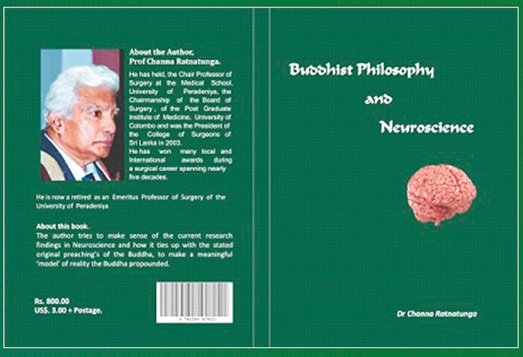
Review of the book ‘Buddhist Philosophy and Neuroscience’
Authored by Dr. Channa Ratnatunga
I think the book Buddhist Philosophy and Neuroscience’ is a kind of ‘Atuwawa’ (Commentary) explaining the scientific basis of the deeper doctrine of Buddhism. A scientist especially with a biological or medical background who has an inclination to try to understand Buddhism, tends to view the deeper doctrine with his forte. This book possibly is a result of this tendency to contemplate on these lines.
Though this subject is commonly discussed in Western countries, I think this is the first time this kind of book has been written in Sri Lanka, and it is no easy task.
It is interesting to find out whether Western scientists who postulated Default Mode Network (DMN) and Central Executive Network (CEN) based it on the Buddhist doctrine and later did the research to prove it or vice versa. Ven: Ajahn Brahms describes these states as doer (DMN) and knower (CEN).
It is a very difficult task to research on subtle mental states, the explanation of these two states based on dependent arising and five aggregates of grasping is quite plausible.
Understanding of Annata doctrine based on neuroplasticity is interesting and self-protection and adaptation and neuroplasticity is almost experiential.
I am quite fascinated by the discussion on insight meditation, how it is helpful in subduing or neutralizing five aggregates of grasping (DMN) by bringing the CEN gradually to the fore. The CEN or equanimity as a state of mind building up to replace the DMN, which is enlightenment.Discerning reader or Meditator would also like a Sutra based explanation of this phenomenon. Sutra based explanation is more palpable for the insight meditator.
This book covers a vast area, almost all the main principles. One has to contemplate and discuss further. It may not be a bad idea, to have a ‘Symposium’ on this subject.
My knowledge got fortified after reading the book.
Dr. Ranjit Jayasekera
The book (151 pages) available at Sarasavi Book shops and BPS Kandy
24 12 2024 - The Island
B04.02
Buddhism in Practice – 4
Nanda P. Wanasundera
Published very recently and being distributed by its author – Ven. Siri Vajiraramaye ŇāŇāṇasiha Thera – is his latest collection of Buddhist essays in a book of 223 pages titled Buddhism in Practice. It is the Ven. Thera’s fourth collection of messages, newspaper articles, outlines and texts of Buddhist talks, academic contributions on the Dhamma and the history of Buddhism.
Its purpose, as noted in the Foreword by Emeritus Prof Asanga Tilakaratne (Buddhist Studies in the University of Colombo), is to “bring out insights and pieces of wisdom that help readers widen their knowledge and experience in the Dhamma while enriching their ways of thinking and ways of life.” He comments on the significance of the collection as being due to the author discussing issues through his own multifaceted knowledge and experience as an ordained monk now, and previously as a “national and international administrator and motivated practitioner of Buddhist social service.”
Ven. Vajiraramaye Ňāasiha Thera dedicates the book to the most Ven. Aggamahāpaita Tirikunamale Ananda Mahanayaka Thera: “Revered Spiritual Friend, Associate and Companion (kalyāamitto, kalyāasahāyako, kalyāasampavanka) since ordination on March 5, 2015.” In his Preface and Acknowledgements, Ven. Ňāṇasiha speaks of the importance of a kalyanamitta when one is on the Path or to get on the Path. And the present Head of the Amarapura Sri Dhammaraksita Nikaya has been a true kalyanamitta to the author.
“Life being ephemeral, I felt the only way that I could show my gratitude to those who have been helping me to be what I am today, in a somewhat lasting manner, is by dedicating my publications to them.” As a layperson, Deshabandu Olcott Gunasekera dedicated his first published Buddhism in Practice – first to his parents; (second) to his wife Anula – “companion in life who helped me in every way possible during the 50 years of family life.” The third book in the series, published after ordination in 2018, to his teachers in the Sri Vajirārāma Dhamma School when it celebrated its centenary. Gratitude is considered noble in Buddhism as mettā, karuṇā, muditā and upekkhā are.
Contents
The first article in the publication titled ‘A New Beginning’ deals with the coming of Arhat Mahinda from ancient Jambudîpa with five monks, a novice and a layman and its significance. He then traces the history of the Sangha that was set up in the island. He writes that “when there was mutual understanding and cooperation between the Mahâsangha and the rulers there has always been prosperity, echoed in such terms as Dharmadvîpa and Dhânyâgâraya. “Discipline of the Sangha is the heart-throb of the dispensation of the Buddha” and relates how recalcitrant monks were dealt with by the ruler and/or the Prelates at the time.The birth of schisms in Buddhism is touched on. “There is a new beginning after Covid 19, which has become a blessing both nationally and internationally. (For example) the institution of regular meetings between the State, represented by the President and the Mahasangha representing the Buddhasâsana, is a new beginning."
He suggests it should be named a Consultative Body and not an Advisory Body. He recalls witnessing an impressive meeting between the previous King of Thailand – Bhumibol Adulyadej – and the Sangharâja of Thailand with traditional protocols observed.
His second essay is titled Sammasambuddha, the Greatest Kalyanamitta. He deals with what the Buddha said and how important it is to have this kind of friend. The essay is formatted as notes. In his third essay with title The Buddha – an Epitome of Good Management, Ven. Ňāṇasiha makes full use of his administrative know-how and experience as a top civil servant in lay life.
The fifth essay is particularly significant being current, dealing with a situation brought on by the global financial and global recession of 2007 to 2009 and the 2019 Covid 19 pandemic. He titles his analysis as Facing the New Normal, which also is in point form. He deals with the New Normal under three sections: economic, social and behavioral; identifies the root causes and asks from a Buddhist perspective whether palliative measures are adequate. He explains the Buddha’s likely approach and lists the benefits of vegetarianism; and the measures at three levels to bring about changes.
Thirty essays comprise this very useful book which would benefit both Buddhists and non-Buddhists. Apart from those essays I have dealt with briefly, I picked on his dealing with 2021 – A Year of Significance; The Buddha’s Recipe for Mental Deliverance; Why are we hanging on in Sansara? and Resilient Sinhala Race – an anthropological viewpoint, as particularly interesting and thought provoking.
Written in excellent English but easy to read and flowing smoothly, the book will benefit all ages. The young can learn much on Buddhism given not as sermonizing but with anecdotes and as a practical way of life. To the older reader it is of great benefit since the essays are so varied subject-wise and interesting to read, even study and to absorb what the Ven. Thera has to say. The book makes a good addition to one’s library of Buddhist books and will surely assure a peaceful day or good night’s sleep when read.
We gratefully accept this gift of the Dhamma from Ven. Vajiraramaye Ňāasiha Thera who earned a First-Class honours degree in history from the University of Ceylon, Peradeniya; made a career in the top rungs of the Administrative Service and, closely associating with the Most Ven. Madihe Paňňāsīha Mahānāyaka Thera, rendered invaluable service to the people of this island being President of the Sasana Sevaka Society, Maharagama, and Dharmavijaya Foundation. Very many are the students, the sick and aged, and farmers who have been helped under his guidance. He was also Chairman of ADIC-Sri Lanka, he being a powerful opponent to alcohol and drug intake. Many more are his services to the nation.
His help to us is now spiritual – for the development of our minds and virtues – sîla, preaching and writing on true Buddhism. His book is gifted. I got my copy from the monk himself, resident in the Siri Vajirârâmaya Temple in Bambalapitiya.
May Ven. Asiha be blessed with good health and a long life, and then a shortened samsāric existence, which surely is assured him for all he has done for others and for his spiritual advancement.
15 11 2023 - The Island
|
3 ~ End of Aloka Books Page 4
Long is the night to him who is awake; long is a mile to him who is tired; long is life to the foolish who do not know the true law. Whatever precious jewel there is in the heavenly worlds, there is nothing comparable to one who is Awakened. Our life is shaped by our mind; we become what we think. Joy follows a pure thought like a shadow that never leaves. Buddha |
| JOURNAL | NEWS | LETTERS | BOOKS | PERSONS | HISTORY | SLIDES |
© Aloka MCMXCIX-MMXXIV