 JOURNAL - Page
22
JOURNAL - Page
22| JOURNAL | NEWS | LETTERS | BOOKS | PERSONS | HISTORY | SLIDES |
 JOURNAL INDEX :
Page 22 JOURNAL INDEX :
Page 22 |
| J22.01 The Path to Nibbana |
| J22.02 Vesak: A time for reflection |
| J22.03 Buddhist doctrine for all |
| J22.04 In search of true happiness |
| J22.05 Vesak: Its Significance today |
| J22.06 The Way It Is - Suffer a lot in our society from loneliness |
| J22.07 Seek spiritual beauty in isolation |
| J22.08 Uniqueness of the Buddha |
| J22.09 Vicious Misinterpretations of Dhamma |
| J22.10 The Buddha & Science |
| J22.11 An ancient path |
| J22.12 The gift of Buddhism: the perpetual torch bearer to the nation |
| J22.13 The doctrinal context of Jhana |
| J22.14 Ten ways to make merit |
| J22.15 Blessings of Cultivating Good |
| J22.16 Buddhist approach to combat COVID-19 |
| J22.17 Birth of a spiritual conqueror |
| J22.18 Buddhist viewpoint of celibacy |
| J22.19 The development of wisdom |
| J22.20 Meeting evil with loving-kindness |
J22.01
The Path to Nibbana
Bhikkhu Bodhi
The Buddha says that he teaches only Dukkha and the cessation of Dukkha, that is, suffering and the end of suffering. The First Noble Truth deals with the problem of suffering. However, the truth of suffering is not the final word of the Buddha’s teaching. It is only the starting point. The Buddha starts with suffering, because his teaching is designed for a particular end: it is designed to lead to liberation. In order to do this he must give us a reason for seeking liberation. If a man does not know that his house is on fire, he lives there enjoying himself, playing and laughing. To get him to come out we first have to make him understand that his house is on fire. In the same way the Buddha announces that our lives are burning with old age, sickness and death. Our minds are flaming with greed, hatred and delusion. It is only when we become aware of the peril that we are ready to seek a way to release.
In the Second Noble Truth, he points out that the principal cause of suffering is craving, the desire for a world of sights, sounds, smells, tastes, touch sensations and ideas. Since the cause of dukkha is craving, the key to reaching the end of dukkha is to eliminate craving. Therefore the Buddha explains the Third Noble Truth as the extinction of craving.
Psychological Dimension of Nibbana
The Noble Truth of the cessation of suffering has two dimensions: a psychological dimension and a philosophical dimension. We shall deal briefly with each of them.
First, the psychological dimension. We find that unhappiness, discontent or suffering results from the tension between desire and the lack of the thing desired. Now there are two possible approaches to overcoming this unhappiness. One is to obtain the object desired, to secure possession of it; the other is to eliminate the desire.The Buddha’s teaching reverses the common assumption that happiness can be found by satisfying our desires. If we carefully examine the happiness that comes from satisfying desire, we would find that such happiness is unreliable and insecure. This happiness depends on external things. These objects of desire are inevitably impermanent, and when we are separated from them we become unhappy. Thus even in the midst of happiness we become vulnerable to suffering. Therefore the Buddha points out that true happiness is to be achieved by taking the opposite approach, the approach of eliminating our desires.
If we eliminate the desire our mind remains satisfied, content and happy no matter what our external situation may be. The Buddha says that this principle can be carried through all the way to the total uprooting of craving. This is the cessation of craving, the end of dukkha visible here and now.
But the end of dukkha has a more wide-ranging meaning than this. Craving drives us on over and over in samsara, the round of birth and death. When craving is eliminated, our actions no longer build up kamma, then the wheel of becoming is brought to a halt. This is the state of final deliverance which is the aim of the Buddha’s teaching.
The state of final deliverance is called “Nibbana” in Pali and “Nirvana” in Sanskrit. Nibbana literally means the extinguishing of a flame. The word ”Nibbana” used by the Buddha means the extinguishing of the flame of craving, the extinguishing of the fires of greed, hatred and delusion.
Nibbana is the ultimate goal of the Buddha’s path. The Buddha says “Just as the water of a river plunges into the ocean and merges with the ocean, so the spiritual path, the Noble Eightfold Path, plunges into Nibbana and merges with Nibbana”.
Nibbana an existing reality
Regarding the nature of Nibbana, the question is often asked: Does Nibbana signify only extinction of the defilements and liberation from samsara or does it signify some reality existing in itself? Nibbana is not only the destruction of defilements and the end of samsara but a reality transcendent to the entire world of mundane experience, a reality transcendent to all the realms of phenomenal existence.
The Buddha refers to Nibbana as a ‘dhamma’. For example, he says “of all dhammas, conditioned or unconditioned, the most excellent dhamma, the supreme dhamma is, Nibbana”. ‘Dhamma’ signifies actual realities, the existing realities as opposed to conceptual things. Dhammas are of two types, conditioned and unconditioned. A conditioned dhamma is an actuality which has come into being through causes or conditions, something which arises through the workings of various conditions. The conditioned dhammas are the five aggregates: material form, feeling, perception, mental formations and consciousness. The conditioned dhammas do not remain static. They go through a ceaseless process of becoming. They arise, undergo transformation and fall away due to its conditionality.
However, the unconditioned dhamma is not produced by causes and conditions. It has the opposite characteristics from the conditioned: it has no arising, no falling away and it undergoes no transformation. Nevertheless, it is an actuality, and the Buddha refers to Nibbana as an unconditioned Dhamma.
The Buddha also refers to Nibbana as an ‘ayatana’. This means realm, plane or sphere. It is a sphere where there is nothing at all that corresponds to our mundane experience, and therefore it has to be described by way of negations as the negation of all the limited and determinate qualities of conditioned things.
The Buddha also refers to Nibbana as a ‘dhatu,’ an element, the ‘deathless element’ (amata-dhatu). He compares the element of Nibbana to an ocean. He says that just as the great ocean remains at the same level no matter how much water pours into it from the rivers, without increase or decrease, so the Nibbana element remains the same, no matter whether many or few people attain Nibbana.
He also speaks of Nibbana as something that can be experienced by the body, an experience that is so vivid, so powerful, that it can be described as “touching the deathless element with one’s own body.”
The Buddha also refers to Nibbana as a ‘state’ (pada), as ‘amatapada’ - the deathless state - or ‘accutapada’, the imperishable state.
Another word used by the Buddha to refer to Nibbana is ‘sacca’, which means ‘truth’, an existing reality. This refers to Nibbana as the truth, a reality that the Noble Ones have known through direct experience.
So all these terms, considered as a whole, clearly establish that Nibbana is an actual reality and not the mere destruction of defilements or the cessation of existence. Nibbana is unconditioned, without any origination and is timeless.
Is Nibbana conditioned by its path? Now the question is often asked: If Nibbana is attained by the practice of the path, doesn’t this make it something conditioned something produced by the path? Doesn’t Nibbana become an effect of the cause, which is the path? Here we have to distinguish between Nibbana itself and the attainment of Nibbana. By practising the path one doesn’t bring Nibbana into existence but rather discovers something already existing, something always present.
Is Nibbana mere annihilation? As a precaution we have to repeat that Nibbana cannot be understood through words or expressions or study of the text. One has to understand Nibbana by actual realization. However, in order to convey some idea of the goal to which his teaching points, the Buddha resorts to words and expressions. He uses both negative and positive expressions, and to get a balanced idea of Nibbana both types of expressions have to be considered. Otherwise you will come away with a one-sided, distorted picture of Nibbana.
The Buddha speaks of Nibbana primarily by way of terms negating suffering: as cessation of suffering, cessation of old age and death, the unafflicted, the unoppressed, the sorrowless state, and so forth.
It is also described as the negation of the defilements, the mental factors that keep us in bondage. So Nibbana is described as the same as the destruction of greed, hatred and delusion. It is also called dispassion (viraga), the removal of thirst, the crushing of pride, the uprooting of conceit, the extinction of vanity.
The purpose behind the Buddha’s negative terminology is to show that Nibbana is utterly transcendental and beyond all conditioned things; to show that Nibbana is desirable, that it is the end of all suffering, and to show that Nibbana is to be attained by eliminating defilements. The use of negative terminology should not be misunderstood to mean that Nibbana is mere annihilation, a pure negative attainment.
To correct this one sided view, the Buddha also describes Nibbana in positive terms. He refers to Nibbana as the supreme happiness, perfect bliss, peace, serenity, liberation, freedom. He calls Nibbana ‘the island’, an island upon which beings can land, which is free from suffering. For those beings swept away helplessly towards the ocean of old age and death, it is a place of safety and security.
It is also described as a “cave” which gives safety from the dangers of birth and death. Nibbana is called the “cool state” - coolness which results from the extinguishing of the fires of greed, hatred and delusion.
To illustrate this error of regarding Nibbana as sheer nothingness, the Buddhists relate the story of the turtle and the fish. There was once a turtle who lived in a lake with a group of fish. One day the turtle went for a walk on dry land. He was away from the lake for a few weeks. When he returned he met some of the fish. The fish asked him, “Mister turtle, hello! How are you? We have not seen you for a few weeks. Where have you been?" The turtle said, “I was up on the land, I have been spending some time on dry land.” The fish were a little puzzled and they said, “Up on dry land? What are you talking about? What is this dry land? Is it wet?” The turtle said “No, it is not,” “Is it cool and refreshing?” “No, it is not”, “Does it have waves and ripples?” “No, it does not have waves and ripples.” “Can you swim in it?” “No you can’t” So the fish said, “it is not wet, it is not cool, there are no waves, you can’t swim in it. So this dry land of yours must be completely non-existent, just an imaginary thing, nothing real at all.” The turtle said that “Well, may be so” and he left the fish and went for another walk on dry land.
Two elements of Nibbana
Now the attainment of Nibbana comes in two stages, the two referred to as the two elements of Nibbana. One is the Nibbana element with the residue remaining. The other the Nibbana element without the residue remaining. The element of Nibbana with residue remaining is the state of Nibbana attained by the arahat (the liberated one) in this present life. Namely, the extinction of greed, hatred and ignorance and of all other defilements. The residue that remains in the arahant is the five aggregates that constitute his present life individuality, the psycho-physical organism produced from the past life. Upon attainment of Nibbana, his body and mind continue until the end of the life span.
The second stage of the attainment of Nibbana is called the Nibbana element without a residue remaining. This is the element of Nibbana attained by an arahant with his passing away, with the breakup of his body, what we conventionally call death.
The passing away of an arahant is the final and complete passing out from conditioned existence. It does not lead to a new birth. In his own experience, the arahant sees only the cessation of a process, not the death of a self. The experience for him is without subjective significance, without reference to ‘me’ or ‘mine’. At this stage the residue of the five aggregates comes to an end.
07 05 2020 – Daily News
J22.02
Vesak: A time for reflection
Phra Paisal Visalo
Vesak is a time for Buddhists everywhere to reflect on the Buddha and his heritage. Indeed, this can be considered as the day of the Buddha as it commemorates three separate events: his birth, enlightenment and passing. The question, however, is how best to remember him.
One way is to think of him as a great man who once walked this Earth and dedicated his life to dispensing teachings which have since developed into Buddhism, as we know it. Remembering him this way will make us feel grateful to him and make us want to express that gratitude through merit-making or the practice of dharma.
Another way is to remember the Buddha by his virtues and by the dharma which is his legacy. For, as he once said, “Those who see dharma will see me.” Remembering him in this way will remind us to adopt his qualities as a guide for our lives. It will inspire us to follow what he preached and to keep on developing ourselves so that we can reach the level that he achieved.
The Buddha was a great man with many noble qualities. Which ones should we celebrate today? For me, the answer lies in the practice of panya (wisdom) and karuna (compassion). Wisdom connotes a clear understanding of the realities of life and the ways of the world. We attain wisdom when we clear our minds of ignorance and self-attachment. Wisdom means complete freedom from suffering. It brings us to the ultimate peace, which is nirvana.
Karuna is an unbounded love for all life, a selfless wish to help other people get out of suffering.
Wisdom and compassion are attributes that we should always carry as a compass. They help us face sadness - departure and loss - without losing ourselves. With these two qualities, we will be able to maintain our equanimity amid change, while reserving enough energy to keep on creating what is good and beautiful for the world, without despairing.
Panya and karuna are also necessary for our modern world, which is currently under threat from the twin cultures of greed and hatred. These major forces are spreading rapidly around the globe and causing immense suffering to all forms of life. In fact, they are jeopardising the very survival of our planet.
The culture of greed is easily seen in the consumerism which evokes violent desires in human beings. It not only burns people’s hearts but also leads to intense competition. Individuals take advantage of and abuse one another for their own benefit. Not only have crime rates been rising, but the income gap is also widening. Poverty is everywhere. Each year, millions of people die of starvation while hundreds of millions are condemned to subsist on meagre rations.
The culture of hatred is dividing people on every strata, from the international down to the community level. Differences in race, religion, language, skin colour and beliefs are turning neighbours into enemies. It is not only science and technology that is used for killing, but also religion.
The two cultures - greed and hatred - are expanding in our country and they are more dangerous than any epidemic. Under these circumstances, it is imperative that we develop both panya and karuna as a shield to protect us from falling victim to the trend.
Wisdom is necessary because, when we have it, we realise that true happiness does not lie in the consumption or possession of material objects; rather, it can be found in peace of mind and in the maintenance of harmonious relationship with our environment and the people around us. When we attain wisdom, we will be able to see through the myths and prejudices spun by advertising and propaganda. We will see that all people, regardless of which religion they believe in, are friends in suffering. Human beings have more similarities than they have differences. We may disagree on certain things, but we have no other means to settle these disagreements than non-violent ones. Violence may rid us of bad people, but it won’t make bad things go away.
Compassion, meanwhile, helps our hearts to touch the pure joy that we can receive from giving, from receiving the good will of others. It opens our mind so that we are ready to forgive. Karuna is the foundation for non-violence. In practice, compassion is the easiest way to get rid of your enemies: you use it to win over their hearts and turn them into friends.
Since this country is facing many challenges, the power of wisdom and compassion should be adopted as guiding principles, principle that will lead our society to permanent peace and happiness.
If we believe that panya and karuna can make human beings realise the Buddha within themselves, we should also believe that these two qualities can turn a land beset by conflict into a place of peace.
07 05 2020 – Daily News
J22.03
Buddhist doctrine for all
Ven. Dr. Beligalle Dhammajoti Thera
Some scholars with a little knowledge of Buddhism are of the opinion that there is no socio-economic and political philosophy of Buddhism.
A well-known scholar, Max Weber, who is considered as ’father of sociology of religion’ explaining the socio-political aspect of Buddhism says: “Buddhism had no sort of tie with any sort of social movement, nor did it run in parallel with such and it has established no social and political goal.” He further says that Buddhism is a social and anti-political and it can be considered to be an ‘other-worldly religion.’
This is a misleading and distorted concept of Buddhist doctrine. It is very clear that Max Weber never analyzed and understood Buddhist teachings deeply. Early Buddhism is in no way another-worldly religion. It includes a well-defined socio-economic and political philosophy and also a philosophy of history. Prof. D.D. Kosambi and Rhys Davids explicitly recognize that there is a socio-economic and political philosophy of Buddhism and their idea give one lie to the above-mentioned notion of Max Weber.
Another misconceived idea of Buddhism states that Buddhism is such a sublime system that ordinary people cannot practice it. One has to retire to a monastery if one desires to be a true Buddhist.
This is a partial and distorted view. The doctrine of the Buddha is meant not only for mendicant monks but also for ordinary men and women living in their homes with their family members. The Noble Eightfold Path, meditation on loving-kindness and ten perfection are meant for all. They can be practised in their daily life.
It is extremely incorrect to say that Buddhism is social. Addressing the first 60 Arhaths, the Buddha says: “O monks walk on tour, for the good of the many, for the happiness of the many, for the welfare of the many, good and happiness of human beings and celestial beings.” This shows that the Buddha has laid much emphasis on the members of society and their welfare. Therefore the old Buddhist monasteries had become the spiritual centres and the centres of learning and culture. The five precepts are meant for the whole human society. Any person can observe them and lead a spiritual life and that would be of great benefit for him and to this competitive society.
The Sigalovada Sutta explicitly explains the family and social relationships. It gives a set of instructions and teachings that pertain to man’s socio-economic and spiritual progress. Modern man can lead a very happy and prosperous life if he understands the significance of these social relations explained in the Sigalovada Sutta.
Some scholars are of the opinion that Buddhist philosophy is interested only in higher morality and it ignores the social and economic welfare. This is also another misconception of Buddhist socio-economic and political philosophy. The Kutadanta Sutta explains the way and approach of development of a country with proper planning and also it shows the nature of socio-economic progress. We should not forget that the Buddha expounded these words in the 6th Century BC and even today that they are of great value.
The Cakkavattisihanada Sutta explains poverty, revolution, poverty-related crimes and the reasons for the chaotic situation of a country and also the reasonable grounds for arising those social ills. Today our competitive global society experiences these socio-economic and political ills and tribulations that are explained in the Cakkavattisihanada Sutta.
In the Agganna Sutta we find a theory of the origin of social classes. There the Buddha explains the arising and evolution, the origin of State, the evolution of human race and social grades, the changing nature of moral values and the relationship between moral degeneration and the deterioration of environmental elements. The Sutta explains how beings were becoming less hard-working, less honest, less ethical and how they lost their physical and mental qualities with the passage of time.
Fundamental unreasonable concepts related to social organisations were radically transformed by the Buddha. The Buddha explained the nature of those concepts and their connection with the ditthis or dogmatic views of certain religious traditions.
The socio-economic and cultural transformations by the Buddha can be seen explicitly even in the present time in our Buddhist societies. Making a comment on the social upheaval of Buddhism, Narendranath Bhatthacharya says:
“The rise of Buddhism was certainly to serve some social purpose. It had some distinct social and functional role. But very few attempts have been made to understand all these.”
It is a well-known fact that Buddhism is capable of making a drastic transformation of the present day competitive and war-like Society. For such a transformation, it needs a proper knowledge and correct understanding of the Buddha’s teachings.
The first significant work in the Buddhist social field was Die Religion des Buddha (1957) written by C.F. Koppen. In his book Koppen explains. “...the Buddha was viewed as the emancipator of the oppressed and a great political innovator.”
Here it is very interesting to note that Koppen was a close friend of Karl Marx and Friedrich Engels.
Karl Marx ruthlessly criticized religion and the widely accepted concept of omnipotent God. Buddhism is completely free from that criticism, for it has no concepts of God. Trevor Ling in his great work on Buddha, Marx and God explains that Buddhism is free from his critique. French scholar La Loubere says that Buddhism is totally different from other religions as it does not possesses a doctrine of God and it teaches rebirth (re-becoming or Punabbhava) without accepting the concept of a soul.
Addressing the Berlin Science Academy in 1856, Albrecht Weber explained that Buddhist teachings were so helpful for social reformation and it had accepted the equality of all human beings.
07 05 2020 – Daily News
J22.04
In search of true happiness
Extracts from an interview with Ajaan Suchart (Abhijato Bhikkhu)
Q: For those who have sinned, can they be redeemed?
A: No. Sin or unwholesome action, once committed, will bring on the result that will hit us sooner or later. Maybe not in this lifetime. Maybe in the next life. The immediate result that we can feel right away is in the mind. We feel bad, worried and afraid. When we see a cop we can get very scared. This is already the result of our sin. We cannot absolve or wash it away.
Q: Is there really hell or heaven after life?
A: Hell and heaven are already here in this life and also in the after life. When we feel good after having done something good, this is heaven already. It’s all in the mind. When we do something bad, we feel bad, this is hell already, right in this life. In Buddhism, heaven and hell also exist after we die, depending on our karma, what we have done.
For instance, when we die and it’s time for our bad deeds to bear fruit, then we’ll have to go to hell. If it’s time for our good deeds to bear fruit, then we’ll go to heaven. But heaven or hell is not a place or a location. It’s a state of mind.
The nature of the mind is very difficult to grasp. We all have the mind. Without the mind, we will not be conscious, be able to feel or to know. The mind is the consciousness, “the one who knows,” the seed of our emotion, suffering and happiness, resulting from what we do, say and especially what we think.
When we think good, we feel good. We are already in heaven at that moment. Whatever we do, good or bad, will accumulate and become a habit that will compel us to do it again and again.
Heaven and hell are inside the mind that cannot be perceived with the naked eyes. The only way to perceive the mind, to get to know the mind is through meditation whereby we focus our attention on one particular mental object, such as the in-and-out breathing until the mind converges and rests in peace and calmness. That’s when we will get to see the mind because during that time the mind is temporarily detached from the body and all the sensual objects like sight, sound, smell, taste, and tactile objects that come through the corresponding sense doors of eyes, ears, nose, tongue and body. There, we’ll see the mind in its pure form and will know that heaven and hell are in the mind itself.
Because when the body breaks up, the mind doesn’t break up with the body. The mind will continue on with the state of mind we have developed. If we have consistently done good, good mental states like heaven and nirvana will appear. In nirvana the mind is totally free from all forms of suffering because the three defilements of greed, hate and delusion have been completely eliminated. If we have consistently done bad, woeful state of mind like stress, worry and anxiety will consume the mind. This is hell.
So, to answer your question whether hell and heaven really exist. The answer is yes. It’s not a place or a location though, but a state of mind at the time of the dissolution of the body and can last for a long time, but will eventually disappear and a new state of mind will take over. If it is a happy state of mind, it is heaven If it is a state of mind consumed by the fire of suffering, anxiety, worry, hate and fear, it is hell that will remain for a while and will eventually be supplanted by another state of mind that goes on and on, driven by the karmas that we have committed previously until reaping the state of mind of a human being. We will then take a human birth again. If it is a state of mind of an animal, then we will be born as an animal.
The thing that separates humans from animals is the observance of the five precepts. If we can keep the five precepts, then we are creating the state of mind of a human being. But if we keep breaking the five precepts, then we are creating the state of mind of animals. It’s good and bad karmas that make us humans or animals, that send us to heaven or hell.
Q: You told us about the duty of a monk in a temple, what do you think the duty of a Buddhist is?
A: For lay people, the three categories of actions that I mentioned earlier on also apply but in a lower level of intensity. Doing good for lay people means to help other people, like helping the sick, the elderly, the needy, and also the monks because monks have no occupation. They rely on the support of the lay people to exist. That’s why lay people give food to the monks every morning if there are monks who happen to pass by their houses. If not, they will wait until the weekly religious observance day to come to the temple to give food to the monks. This is what I meant by doing good, just a brief example. But it can cover every form of charity and everything you do that is beneficial and not harmful to other people and animals. If you see stray dogs and give them food and shelter, this is also doing good. But Thai Buddhists believe that giving to monks will earn them the most merits because monks study and practice the teaching of the Buddha, and then teach the lay people who have no time to study. So they have to rely on the monks to teach them the Dhamma.
To avoid doing evil is to maintain the five precepts, that is suitable for lay people: to abstain from killing, stealing, committing adultery, lying and consuming alcoholic drinks. The reason why we have to abstain from alcoholic drinks is because we will lose our ability to control our thoughts and mind. We will think crazy things and then do crazy things that will hurt other people. But if you really wanted to drink, you should first tie yourself to a bed or something. So when you get drunk, you’ll just go to sleep, you will then not hurt yourself or other people.
To eliminate greed, hate and delusion effectively we have to meditate. The simplest form of meditation for Thai lay Buddhists is to chant Buddhist verses. By concentrating on chanting and not thinking about other things the mind will gradually become calmer and more content, because it has no time to think and worry. This is the simplest form of meditation that will develop into a more advanced level whereby we will just concentrate on one particular mental object, such as the in-and-out breathing for example.
The goal of meditation is twofold: mental calm and wisdom or insight into the true nature of all physical and mental processes. Once the mind is calm, it becomes reasonable, logical and unemotional, readied to be taught the truth of life that we will all have to face in our lifetime. Having been born, we are all subjected to aging, sickness and death that no one can escape. The best way to face them is to be ready for them.
The body doesn’t know that it will age, get sick and die. The mind does. Due to delusion the mind thinks the body to be itself and clings to it. When the body becomes sick, old and dies the mind thinks it is the one that gets sick, gets old and dies, when in fact it doesn’t. The mind, as I said, goes on after the dissolution of the body.
So we have to teach the mind to be brave, to face up to the truth of the body. Once the mind becomes calm and composed it will accept it, free from anxiety and agitation. This is the development of wisdom in Buddhism: to know the truth of life and face it squarely and calmly. Because the mind doesn’t get old, get sick or die. It’s the body that does. Due to delusion the mind thinks that it is getting old, getting sick and dying.
Once the mind has learned the truth and embraces it, it will no longer resist or be afraid. It will accept it just like anything else. Like the rain, the storm, good and bad weather. They come and go, but the mind doesn’t change with these things. The mind just knows.
These are the three duties that the Buddha prescribes for Buddhists. To practice charity, to abstain from morally objectionable behaviour by keeping the five precepts, and to practice meditation to calm the mind and instill it with the truth of impermanence.
Q: How do we get rid of material possessions and why do we have to do that?
A: Material possessions have benefits and harm. We need some materials in order to live a comfortable life. The body needs the four requisites of food, shelter, clothing and medicine to maintain life. But we shouldn’t have more than what we need. The surplus will only be a burden because we have to take care of them. If we live a simple lifestyle, we can get rid of a lot of material possessions. Ask yourself this question every time you wanted something: “Do I need it? Can I live without it?” If you can live without it and don’t really need it, then you shouldn’t have it.
Q: What do you think of people’s perception of Buddhism in today’s age?
A: Today people’s understanding of Buddhism is quite far from the core of Buddhist teaching. The Buddha always teaches the principle of karma. You have to rely on yourself. Even the Buddha cannot help you. But sometimes people go to the temple and pray and ask from the Buddha images. This is not the teaching of the Buddha because the Buddha has always said that you are your own refuge.
You have to do good in order to reap good outcome. You have to avoid doing bad if you don’t want to reap bad consequences. You have to overcome your greed, hate and delusion. But instead you go to the Buddha with your greed. You want your wife or husband to be faithful to you. You want to always have good health. These things the Buddha can’t give you because good health depends on how you live your life. If you abstain from alcohol and do a lot of exercise, you’ll have better health than someone who drinks and doesn’t exercise. You have to rely on yourself, not the Buddha. The Buddha is just a teacher.
But most Thai Buddhists don’t realize this. We think the Buddha is a god who will always answer our prayers and wishes. If we wanted to be admitted into a university we pray to the Buddha, spending three days in a temple. Then we will be accepted by the university. Sometimes it happens, not because of our prayer but because we studied hard and have the qualifications. That’s all. Those who cannot separate cause from effect will believe that Buddha images and famous monks can work magic for them. If they need anything, they will donate some money and pray for it.
When they get it, they will tell other people how good and effective this monk or this Buddha image is. People will then rush to this particular monk or Buddha image without thinking that it’s just a coincidence. Many Thai Buddhists have this erroneous belief because they don’t study the Buddha’s teaching.

Q: Why do foreigners become monks and stay in the temple and what makes them so interested in Buddhism?
A: Because they study Buddhism. They understand and appreciate the teaching and know that if they practice they will benefit from it. Just like me when I first studied Buddhism and then applied it in my daily life by practicing meditation, I found something that I never had before right inside myself, inside all of us. But we keep looking outside. We look for money, for material possessions. But we are never truly happy with what we have, because material possessions are not the answer to our happiness. The real happiness is waiting for us inside ourselves. By meditating we can corral the mind into a state of single-mindedness where we will experience the kind of happiness that we have never experienced before.
This is one of the reasons why foreigners become monks in Thailand. First they study the Buddha’s teaching, then practice it in their daily life by giving to charity, abstain from bad behavior, and meditate. Having experienced the result it makes them want to have more. The best way to do it is to become monks. And there’s no better place in the world to become monks than in Thailand. Because Thailand has a long established tradition of monkhood. I think this is the reason why most foreigners come to Thailand to become monks. Plus the fact that they have found that material possession is not the answer. They come from countries more advanced and developed in material products than Thailand and know that they are not the answer to the happiness they are looking for.
Q: Lastly, what words of wisdom would you give to our foreign audience?
A: My word of advice to you is to be thankful to have come across the teaching of the Buddha, because what the Buddha knew and what he told us is a hard-to-come-by transcendental truth, that will make us happy all the time, free us from all forms of stress and grief. If you study his teaching and apply it in your daily life I’m sure you’ll always be happy.
First of all, the Buddha said you have to do good by giving to charity, help those who are less fortunate than you are. Secondly, don’t hurt other people. No matter what you do. Thirdly, find some peace of mind by doing meditation. You can start by mentally chanting some verses you know. Just keep chanting and not thinking about anything, in order to rid your mind of restlessness. When you think you’ll agitate your mind. When you stop thinking the agitation will disappear. You will then have peace of mind and happiness. The Buddha said that the happiness that arises from peace of mind surpasses all other happiness.
But it’s not easy to do, because the mind by its nature keeps thinking all the time, like a monkey that keeps moving from one tree branch to the next. The mind thinks about one story, then moves on to the next story, on and on. At the same time, it creates all kinds of emotions along with it. If you think good, you’ll feel good. If you think bad, you’ll feel bad. If you helped someone today, made him happier, made his life better, when you think about it, you’ll feel good. If you did something bad to someone, hurt someone, when you think about it, you’ll feel bad.
Learn how to control your mind. Steer your mind to think good thoughts, prevent it from thinking bad thoughts. In order to do this, you have to live simply. If you don’t, your greed will push you to do things that you’ll be sorry later on. If you live simply, you won’t do things that will cause problems or hurt other people.
So this is my advice to you. Be happy with what you have. Live as simply as you can. Just have the four requisites of life: food, shelter, clothing and medicine. Once you have this, there’s no need to have anything else, because what you have will give you problems and stress. When you possess something, you want to keep it as long as possible. But things don’t last forever or remain the same. They always change. They come and go. If you cling to them, when they leave you, you will feel terrible. Take it as it comes. Don’t cling. Then you will always be happy. I hope what I have said to you today will help you somewhat to understand Buddhism and the monkhood.
(The above is an interview Ajaan Suchart gave to a Pattaya cable tv channel on January 11, 2007.)
J22.05
Vesak: Its Significance today
Vinod Moonesinghe
Ruwanweli Maha Seya, Anuradhapura
Hundreds of millions of people, throughout the world, celebrate the festival we know in Sinhala as Vesak (or Visakat Tirunal, in Tamil). Uniquely, it commemorates not just the birth, but also the enlightenment and the demise of Siddhartha Gautama, the Sakyamuni Buddha; the equivalent of combining Christmas and Easter for Christians, or the holy Prophet’s birthday, Hajj and Ramazan for Muslims.
The exact dates of Siddhartha Gautama are debated. The Mahavamsa tradition places it at about 624-544 years before the current era (BCE), but Mahayana traditions have a wide range of dates. An early Buddhist document from Guangzhou, The dotted record of many sages placed the Buddha’s Parinibbana at 486 BCE. The scholar Wilhelm Geiger, by examining the Mahawamsa chronology in the light of Hellenist dating of Emperor Ashoka’s consecration, deduced it to be 483 BCE.
However, a conclave of Orientalists at Göttingen in 1988 came to a consensus, that Siddhartha lived his entire life within the 4th century BCE because -according to one of the participants- of ‘the ancient Indians’ lack of concern about chronology.’ It should be noted that the conference had no participants from India or Sri Lanka (or indeed any Asian countries except Japan, Nepal and Israel).
Nevertheless, Theravada countries continue to use the Mahawamsa chronology. Hence, we celebrated the Buddha Jayanthi, or 2500 years after the Buddha’s Parinibbana, in 1956-57.
Siddhartha entered this world in the ancient Sakya republic, the scion of the rich Gautama (or Gotama) family. According to the Buddhacarita of Ashvagosha, the Bodhisattva (Buddha-to-be) entered the womb of the lady Maya in a dream, as a white, six-tusked elephant.
It goes on that Maya, having a great longing in her mind, went into the Lumbini garden and as she supported herself by a flower-laden bough, “the Bodhisattva suddenly came forth, cleaving open her womb.”
Siddhartha grew up wanting for nothing, proving himself skilled and learned. However, he grew discontent, and set forth to discover the true meaning of existence. He travelled to Magadha, the then centre of sub-continental philosophical discourse.
Buddhism did not spring out of a vacuum. At the time the lower Gangetic valley hosted up to 60 sages of different creeds. The Dahara Sutta speaks of just six: Purana Kassapa, Makkhali Gosala, Ajita Kesakambalin, Pakudha Kaccayana, Sañjaya Belatthaputta, and the Nigantha Nathaputta. Only the philosophy of the last named, Jainism, still survives.
The Gangetic valley lay in the midst of a revolution: immense prosperity brought about a transformation in society, as non-Brahmanical and non-aristocratic classes began to increase in importance. They challenged the supremacy of the Brahmanical religious and social orthodoxy.
Siddhartha now entered this intellectual milieu, learning philosophy from Alara Kalama and Uddaka Ramaputta. However, their teachings failed to satisfy him, and he set out to deduce the truth by logic and meditation. He drove himself to near starvation, before realising that there must be a middle path between self-indulgence and self-denial.
Through further meditation, amid mental conflict, later allegorised as the “Mara War”, he achieved enlightenment: the realisation that suffering exists; that desire causes suffering; that desire must be eliminated to prevent suffering; and the path to the elimination of desire.
In these four noble truths lie the essence of the Buddha’s teaching. All else springs from this foundation. The immense corpus of Buddhist texts merely represents the means to the end: to eliminate desire and, thereby suffering.
After decades of peregrinations in the Gangetic valley teaching, the Buddha passed away, leaving a body of learned monks who could carry on with spreading the Dharma.
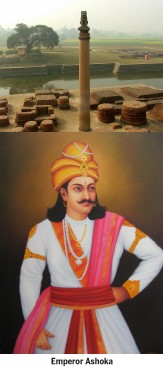
Two hundred years after the Buddha’s demise, Emperor Ashoka accepted these teachings and carried through a revolution: he began to rule according to the principle of justice for all living beings, in essence, he laid down the basis for humanitarian law and for animal rights. Importantly, he gave freedom to all belief systems, a principle of tolerance established by the Buddha.
As Buddhism spread, it developed at two different levels: the philosophical level, at which people look to means of enlightenment; and the popular level, in which people take part in rituals. Of course, there is no clear-cut distinction, the two blending into one another.
The mass of Buddhists wanted something to worship, and the Bo tree and the dagoba became symbols of the Buddha. No images of the Buddha existed for hundreds of years, until they emerged in Hellenistic kingdoms about the 2nd century CE.
The irony of Vesak is that Buddhists pay homage on this day to a great teacher who did not ask for such adulation. When Ananda asked the Buddha, shortly before the latter’s demise, about the funeral rites, the sage replied that he should not worry about these rituals, but should strive hard to attain the good goal. Following in the Buddha’s footsteps, striving for enlightenment, is the greatest homage that can be paid to the Tathagatha.
The story of how Vesak came to be a national holiday in Sri Lanka is significant, in these troubled times. During the Christian Easter celebrations in 1883, clashes broke out when some Roman Catholics attacked Buddhists walking in a procession in Kotahena.
The following January, members of the Buddhist Theosophical Society formed the Buddhist Defence Committee, also known as the “Colombo Committee”, to counter the authorities’ inaction in bringing the culprits to book. The Committee demanded that Vesak be declared a holiday for Buddhist public servants and also that the British government should follow a policy of religious neutrality – at that time one needed to be Christian even to join the native headman service.
The British government agreed, and on March 27, 1885, Governor Sir Arthur Hamilton Gordon proclaimed the Vesak Poya a public holiday. The British also removed disabilities from non-Christians: the secular and neutral character of the Sri Lankan state thus owes its existence to the Buddhists’ demand for the recognition of Vesak – and to the violent religious conflict in Kotahena.
07 05 2020 – Daily News
J22.06
The Way It Is
Ajahn Sumedho
We suffer a lot in our society from loneliness. So much of our life is an attempt to not be lonely: 'Let's talk to each other; let's do things together so we won't be lonely.' And yet inevitably, we are really alone in these human forms. We can pretend; we can entertain each other; but that's about the best we can do. When it comes to the actual experience of life, we're very much alone; and to expect anyone else to take away our loneliness is asking too much.
When there's physical birth, notice how it makes us seem separate. We're not physically joined to each other, are we? With attachment to this body we feel separate and vulnerable; we dread being left alone and we create a world of our own that we can live in. We have all kinds of interesting companions: imaginary friends, physical friends, enemies, but the whole lot of it comes and goes, begins and ends. Everything is born and dies in our own minds. So we reflect that birth conditions death. Birth and death; beginning and ending.
During this retreat, this kind of reflection is highly encouraged: contemplate what birth is. Right now we can say: 'This is the result of being born; this body. It's like this: it's conscious and it feels, there's intelligence, there's memory, there's emotion.' All these can be contemplated because they are mind objects; they are dhammas. If we attach to the body as a subject, or to opinions and views and feelings as 'me' and 'mine', then we feel loneliness and despair; there's always going to be the threat of separation and ending. Attachment to mortality brings fear and desire into our lives. We can feel anxious and worried even when life is quite all right. So long as there's ignorance -avijja- regarding the true nature of things, fear is always going to dominate consciousness.
But anxiety is not ultimately true. It's something we create. Worry is just that much. Love and joy and all the best in life, if we are attached to them, are going to bring the opposite along also. That's why in meditation we practise accepting the feeling of these things. When we accept things for what they are, we're no longer attached to them. They just are what they are; they arise and cease, they're not a self.
Now from the perspective of our cultural background, how does it appear? Our society tends to reinforce the view that everything is 'me' and 'mine'. 'This body is me; I look like this; I am a man; I am an American; I am 54 years old; I am an abbot.' But these are just conventions, aren't they? We're not saying I'm not these things; rather we're observing how we tend to complicate them by believing in the 'I am'. If we attach to them, life becomes so much more than it actually is; it becomes like a sticky web. It gets so complicated; whatever we touch sticks to us. And the longer we live the more complicated we make it. So much fear and desire comes from that commitment to 'I am' - to being somebody. Eventually they take us to anxiety and despair; life seems much more difficult and painful than it really is.
But when we just observe life for what it is, then it's all right: the delights, the beauty, the pleasures, are just that. The pain, the discomfort, the sickness, is what they are. We can always cope with the way life moves and changes. The mind of an enlightened human being is flexible and adaptable. The mind of the ignorant person is conditioned and fixed. Whatever we fix on is going to be miserable. Being a man, or being a woman, as a permanent belief, is always going to make life difficult. Any class we identify with - middle class, working class, American, British, Buddhist, Theravadin Buddhist - grasping to any of these will produce some kind of complication, frustration and despair.
Yet conventionally, one can be all these things - a man, an American, a Buddhist, a Theravadin; these are merely perceptions of mind. They are adequate for communication; but they're nothing more than that. They're what is called sammuttidhamma - 'conventional reality'. When I say, 'I'm Ajahn Sumedho,' that's not a self, not a person; it's a convention. Being a Buddhist monk is not a person - it's a convention; being a man is not a person, it's a convention. Conventions are as they are. When we attach to them out of ignorance, we become bound and limited. That's the sticky web! We're blinded; being deluded by the convention.
When we let go of the conventions, we don't throw them away. I don't have to kill myself or disrobe; the conventions are all right. There's no suffering involved in any of these if there is the awakened mind seeing them for what they are; they just are as they are. They're merely a convenience; expedient to time and place.
With the realization of 'ultimate reality' (paramattha-dhamma), there is the freedom of Nibbana. We are free from the delusions of desire and fear; this freedom from conventions is the Deathless. But to realize this we have to really look at what attachment is. What is it all about? What is suffering, and attachment to the 'I am' process? What is it? We're not asking anybody to deny themselves; attachment to the view of being nobody is still somebody. It's not a matter of affirmation or negation but of realization; of seeing. To do this we use mindfulness.
With mindfulness we can open to the totality. In the beginning of this retreat, we open to the whole two months. On the first day, we've already accepted in full awareness all possibilities: sickness and health, success and failure, happiness and suffering, enlightenment or total despair. We're not thinking, 'I'm only going to get..., I only want to have..., I want to have only the nice things happen to me. And I've got to protect myself so that I'll have an idyllic retreat; be perfectly safe and tranquillized for two months.' That in itself is a miserable state, isn't it? Instead, we take all the possibilities, from the best to the worst. And we're doing this consciously. That means: everything that happens during these two months is part of the retreat - it's a part of our practice. The Way Things Are is Dhamma for us: happiness and suffering, enlightenment or total despair - everything! If we practise this way, then despair and anguish take us to calm and peace. When I was in Thailand I had a lot of negative states - loneliness, boredom, anxiety, doubt, worry and despair. But accepted as they are, they cease. And what's left when there's no more despair?
The Dhamma that we're looking at now, is subtle. Not subtle in the sense that it's high up - it's so ordinary, so very much here and now that we don't notice it. Just like the water for the fish. Water is so much a part of its life the fish doesn't notice it; even though it's swimming in it. Sensory consciousness is here, now. It's this way. It's not distant. It's not really difficult. It's just a matter of paying attention to it. The way out of suffering is the way of mindfulness: mindful - awareness or wisdom.
So we keep bringing our attention to the way things are. If you have nasty thoughts, or feel resentful, bitter or irritated, then notice what it feels like in your heart. If we're frustrated and angry during this time, it's all right because we've already allowed for that to happen. It's a part of the practice; it's the way things are. Remember, we're not trying to become angels and saints -we're not trying to get rid of all our impurities and coarseness and just be happy. The human realm is like this! It can be very coarse and it can be pure. Pure and impure are a pair. To know purity and impurity is mindfulness-wisdom. To know that impurity is impermanent and not-self is wisdom. But the minute we make it personal - 'Oh, I shouldn't have impure thoughts!' - we're stuck again in the realm of despair. The more we try to have only pure thoughts, the more the impure thoughts keep coming. That way we make sure we're going to be miserable for the whole two months; guarantee it. Out of ignorance we create a realm for ourselves that can only be miserable.
So in mindfulness, or full-mindedness, all misery and all happiness are of equal value: no preferences. Happiness is this way. Misery is this way. They arise and they cease. Happiness is still happiness; it's not misery. And misery is still misery; it's not happiness. But it is what it is. And it's nobody's and it's only that much. And we don't suffer from it. We accept it, we know it and we understand it. All that arises ceases. All dhamma is not self.
So I offer this for your reflection.
Extracts from the first two talks given by Ven. Ajahn Sumedho to the monastic community of Amaravati during the winter retreat of 1988.
07 05 2020 – Daily News
J22.07
Seek spiritual beauty in isolation
Sachitra Mahendra
Enlightenment is a tough task in the crowds. The Buddha emphasized this factor in several suttas found in his teachings. The following is a brief extraction from the Satipatthana Sutta (translated by Venerable Soma Thera).
“And how, O bhikkhus, does a bhikkhu live contemplating the body in the body?"
“Here, O bhikkhus, a bhikkhu, gone to the forest, to the foot of a tree, or to an empty place, sits down, bends in his legs crosswise on his lap, keeps his body erect, and arouses mindfulness in the object of meditation, namely, the breath which is in front of him.”
Mind the keywords: forest (arannagato), the foot of a tree (rukkhamulagato) or an empty place (sunnagaragato). The Buddha had to leave his household life to seek the spiritual essence. Irrespective whether you are a monk or laity, this formula applies. Perhaps in a different way for the laity. The laity, of course, cannot approach the forest, the foot of a tree or an empty place in the literal sense. But they are in a position to manifest such environments in their own abodes.
Such an environment was offered by a strange visitor who knocked at our doors, coronavirus COVID-19. It ensured that we stay indoors for a seemingly indefinite period. And the wise among us must take it as a blessing and turn to the Buddha’s teachings in this Vesak eve. COVID-19 has given us a chance to manifest a forest, the foot of a tree or an empty place in the guise of isolation.
We are left to our own devices. The rest is up to us, for the Buddhas only point the way. We ourselves must strive. Easier said than done, but that opportunity shines right before us confined to home safety. With that in mind, let’s devote our attention to the significance of much-celebrated Vesak Poya.
Young ascetic Sumedha was steadfast in his attempt to achieve the highest spiritual realm - something only a few could reach. Remember the day he heard Dipankara Buddha was visiting the town. What he wanted was a definite prophecy that he would be a Buddha in aeons to come.
The locale, however, was congested with people and the young man could hardly think of seeing Dipankara Buddha. When he spotted the muddy road, his thoughts worked on so fast in a different plane.
He requested the great teacher and his retinue to walk over him. Dipankara Buddha saw the young man’s thought in his divine eye and knew the youth’s wish will materialise in uncountable aeons to come.
Dipankara Buddha prophesied ascetic Sumedha would be a Buddha named Gotama in the future. The day Buddha declared the solemn prophecy to his twenty-fourth successor was a Vesak Full Moon Poya day. Since then Sumedha had been reborn in many existences. He had to complete the thirty perfections, paramitas. And before his final birth, the Bodhisatva, or Buddha-to-be, was born in Thusitha heaven.
The divine creature inquired five affairs before expiring for the final birth: right time, right area, right continent, right cast and right mother. Then, as any Buddhist knows, the fully mindful divine being entered the womb of Queen Mahamaya to be sired by King Suddhodana.
A prince was born on a Vesak Poya and was named Siddharth, one who has found the meaning of existence. The queen passed away seven days after the prince’s birth.
The whiz kid declared the glorious verse, customary for all Buddhas, just after the birth: “I am the chief of the world. There is no equal to me. I am supreme. This is my last birth. No rebirth for me.” The teacher worshipped the teacher of the world, and then father worshipped the son.
Aspiring for enlightenment
Siddharth Gotama’s life was spent in royal luxuries until he realised life’s true nature. Moments later Siddharth renounced the princely life on a Vesak Poya. Yet ascetic life was not a simple thing for the prince.
The robed Gotama was trained in various mental skills under many teachers, only to get disillusioned that they do not have the truth he looks for. The right way to achieve the truth dawned on him one day. He directed the mind in the right meditation path. Moments later he reached enlightenment and conquered the world of sorrows on a Vesak Poya.
The Conqueror was heading to the city of Kusinara when he met Pukkusa. Pukkusa listened to the Dhamma and offered the Buddha two golden robes: one worn by the Buddha and the other by his assistant Ananda.
When the Conqueror was robed, his skin became clear dazzling the robe. Monk Ananda was amazed and the Buddha declared that the skin of a Buddha will be remarkably bright on two occasions: the night he attains Enlightenment and the night he passes into Parinibbana.
Third visit to Sri Lanka
The Buddha visited Sri Lanka on three occasions: first to Mahiyangana in January, second to Nagadipa in April, and third to Kelaniya in May, Vesak. On the second visit made to Nagadipa, King Maniakkikha invited the Blessed One for the third visit to Kelaniya. And he visited Kelaniya three years after his second visit, with 550 arahants.
However, Nishantha Gunawardena, a Sri Lankan historian resident in the United States, mentions an interesting find in his The Lost Dynasty: The Buddha was not invited by King Maniakkhika but by a king named Panitha and his daughter princess Abhi Upaliya. Nishantha cites rock inscriptions at Balaharukanda and Bambaragastalawa that corroborate this find.
“...the rock inscriptions are more accurate due to the difficulty in changing or forging them. It was the national King Panitha who invited Gautama Buddha the second time. The regional King Maniakkhika is mentioned in a few other records.
But it was not until the December 2004 tsunami hit, the king reintroduced himself. Tsunami tore through the island exposing several rock inscriptions. Two of them bore the names of King Maniagiya and his mother. This is, in fact, King Maniakkhika.” (82pp)
King Maniakikha is commonly mistaken as a Naga king; naga means serpent in oriental languages. But scholars believe the king belonged to a clan named Naga. Following the Buddha’s sermon in Kelaniya, the king erected a shrine with the Buddha’s hair, utensils and the seat buried inside. However, the foreign invasions have resulted in damaging the original shrine.
The Kelaniya Raja Maha Vihara became more sacred following the Ven. Mahinda’s arrival in Lanka to establish the Dhamma wheel officially. Mahawamsa - account of the great clan, if rendered into English - the official chronicle on Sri Lankan history written in the 5th Century CE, states King Devanampiyatissa’s brother Uttiya renovated the Dagoba along with the first quarters of the monks.
Parinibbana
Eighty-year old Gotama Buddha disclosed that his passing away, Parinibbana, would take place on the third watch of the night at Sal grove of Malla royal family. Maha Parinibbana Sutta gives an illustrious description of the Buddha’s last moment. We reproduce an excerpt from the translation of the sutta by Sister Vajira and Francis Story.
The Blessed One’s Final Exhortation
1. Now the Blessed One spoke to the Venerable Ananda, saying: “It may be, Ananda, that to some among you the thought will come: ‘Ended is the word of the Master; we have a Master no longer.’ But it should not, Ananda, be so considered. For that which I have proclaimed and made known as the Dhamma and the Discipline, that shall be your Master when I am gone.
2. “And, Ananda, whereas now the bhikkhus address one another as ‘friend,’ let it not be so when I am gone. The senior bhikkhus, Ananda, may address the junior ones by their name, their family name, or as ‘friend’; but the junior bhikkhus should address the senior ones as ‘venerable sir’ or ‘your reverence.’
3. “If it is desired, Ananda, the Sangha may, when I am gone, abolish the lesser and minor rules.
4. “Ananda, when I am gone, let the higher penalty be imposed upon the bhikkhu Channa.”
“But what, Lord, is the higher penalty?”
“The bhikkhu Channa, Ananda, may say what he will, but the bhikkhus should neither converse with him, nor exhort him, nor admonish him.”5. Then the Blessed One addressed the bhikkhus, saying: “It may be, bhikkhus, that one of you is in doubt or perplexity as to the Buddha, the Dhamma, or the Sangha, the path or the practice. Then question, bhikkhus! Do not be given to remorse later on with the thought: ‘The Master was with us face to face, yet face to face we failed to ask him.’”
6. But when this was said, the bhikkhus were silent. And yet a second and a third time the Blessed One said to them: “It may be, bhikkhus, that one of you is in doubt or perplexity as to the Buddha, the Dhamma, or the Sangha, the path or the practice. Then question, bhikkhus! Do not be given to remorse later on with the thought: ‘The Master was with us face to face, yet face to face we failed to ask him.’”
And for a second and a third time the bhikkhus were silent. Then the Blessed One said to them: “It may be, bhikkhus, out of respect for the Master that you ask no questions. Then, bhikkhus, let friend communicate it to a friend.” Yet still, the bhikkhus were silent.
7. And the Venerable Ananda spoke to the Blessed One, saying: “Marvellous it is, O Lord, most wonderful it is! This faith I have in the community of bhikkhus, that not even one bhikkhu is in doubt or perplexity as to the Buddha, the Dhamma, or the Sangha, the path or the practice.”
“Out of faith, Ananda, you speak thus. But here, Ananda, the Tathagata knows for certain that among this community of bhikkhus there is not even one bhikkhu who is in doubt or perplexity as to the Buddha, the Dhamma, or the Sangha, the path or the practice. For, Ananda, among these five hundred bhikkhus even the lowest is a stream-enterer, secure from downfall, assured, and bound for enlightenment.”
8. And the Blessed One addressed the bhikkhus, saying: “Behold now, bhikkhus, I exhort you: All compounded things are subject to vanish. Strive with earnestness!”
This was the last word of the Tathagata.
9. And the Blessed One entered the first jhana. Rising from the first jhana, he entered the second jhana. Rising from the second jhana, he entered the third jhana. Rising from the third jhana, he entered the fourth jhana. And rising out of the fourth jhana, he entered the sphere of infinite space. Rising from the attainment of the sphere of infinite space, he entered the sphere of infinite consciousness. Rising from the attainment of the sphere of infinite consciousness, he entered the sphere of nothingness. Rising from the attainment of the sphere of nothingness, he entered the sphere of neither-perception-nor-non-perception. And rising out of the attainment of the sphere of neither-perception-nor-non-perception, he attained the cessation of perception and feeling.
10. And the Venerable Ananda spoke to the Venerable Anuruddha, saying: “Venerable Anuruddha, the Blessed One has passed away.”
“No, friend Ananda, the Blessed One has not passed away. He has entered the state of the cessation of perception and feeling.”11. Then the Blessed One, rising from the cessation of perception and feeling, entered the sphere of neither-perception-nor-non-perception. Rising from the attainment of the sphere of neither-perception-nor-non-perception, he entered the sphere of nothingness. Rising from the attainment of the sphere of nothingness, he entered the sphere of infinite consciousness.
Rising from the attainment of the sphere of infinite consciousness, he entered the sphere of infinite space. Rising from the attainment of the sphere of infinite space, he entered the fourth jhana. Rising from the fourth jhana, he entered the third jhana. Rising from the third jhana, he entered the second jhana. Rising from the second jhana, he entered the first jhana.
Rising from the first jhana, he entered the second jhana. Rising from the second jhana, he entered the third jhana. Rising from the third jhana, he entered the fourth jhana. And, rising from the fourth jhana, the Blessed One immediately passed away.
Vesak brings in an engrossing historical tale mixed with spirit and elegance.
07 05 2020 – Daily News
J22.08
Uniqueness of the Buddha
Reflecting on the Nine Unique Qualities of the Buddha or 'Nava Arahadi Budu Guna'
The Buddha’s teachings are aimed at helping followers to deliver themselves from Dukkha or suffering (AFP)
He broke down mind and matter into its ultimate elements
Rabindranath Tagore called him “the greatest man ever born”
He showed most convincingly the impermanency of mind and matter
Gautama Buddha was a human being. As a man he was born, as a Buddha he lived and he passed away as an enlightened being. Though being a human he became an extraordinary man owing to his unique qualities and distinctive characteristics. It has been said of him that there was no religious teacher who was “so godless as Lord Buddha, yet none was so god like.” In his own life time he was highly venerated by his followers, but he never arrogated to himself any divinity. He taught that man can gain his deliverance from the ills of life and realise the eternal bliss of Nibbana without depending on an eternal God or a mediating priest.
The Buddha’s teachings have only one aim; to help followers to deliver themselves from Dukkha or suffering. To prove that existence means Dukkha; the Buddha started by analysing a living being into its five component factors namely; matter, consciousness, perceptions, feelings and mental formations which together constitute mind and matter or Nama-Rupa. He then further explained that these five components; which he called the five aggregates were impermanent (Anicca); subject to suffering (Dukkha) and without soul (Anatta). He broke down mind and matter into its ultimate elements; even beyond the stage of atoms into energies itself and showed that there is no permanent immutable entity or soul present. He went further and showed most convincingly the impermanency or terminability of mind and matter and also of everything else in the universe. This rationalisation exemplifies the fact that the Buddha undoubtedly was the greatest human being that set foot on planet earth. Quite fittingly, Philosopher Sri Radhakrishnan called him “a master mind from the East”. The great Poet Rabindranath Tagore called him “the greatest man ever born”. The Buddha’s first advice was; “do no evil”. His last words were; “strive with diligence”.
Worthy of homage“Nava Arahadi Budu Guna” or the nine unique qualities of the Buddha have been epitomised in the following Pali stanza which all of us professing the Buddha Dhamma have been reciting almost every day from our early childhood. “Itipiso baghava, Arahan, Samma – Sambudho, Vijja – charana – Sampanno, Sugatho, Loka – Vidu, Anuttaro, Purrisadhamma – Sarathi, Satta – deva – manussanan, Buddho – bhagavati." This stanza reads as follows in English. Itipiso - baghava means; for these reasons the Buddha is worthy of homage and worship. Arahan means that he has got rid of impurities or Kllesa. Samma - sambuddho means that he is fully self – enlightened. Vijja Charana - Sampanno means that he is endowed with clear vision. Sugatho means that he has good manners and habits. Loka - vidu means that he has gained full knowledge of all worlds. Anuttaro means that there is none greater than the Buddha. Purisadamma - Sarathi means that he is possessed of the highest super human powers. Satta - Devamanussanan means that he is a Teacher of both gods and men. Buddho - bhagavati means that he has realized the Four Noble Truths and rid himself of Sensuality (Raga), Hatred (Dosa) and Delusion (Moha).
Arahan: The Buddha is called Arahan because he has got rid of all impurities or Kilesa. Accordingly, he is worthy of the four requisites of a monk namely robes (chivara), food (pindapatha), medicine (gilana – paccaya) and shelter (senasana). His supreme quality is that he will not do any evil even in secret. It is said that out of all those who attained Arahatship he is the only Arahat who has got rid of Vasana – kilesa or the bad habits of the past.
Samma – Sambuddho: The Buddha is called Samma – Sambuddho, because he was the fully enlightened one; who knew all things rightly and by himself. What had to be known in detail; he knew in detail. What had to be known in parts and sections; he knew that too in parts and sections. What was not profitable; He either avoided or discarded. He knew what was profitable; especially how to develop the mind and attain concentration through meditation or Bhavana. Above all; he discovered the Four Noble Truths or Chaturarya – Sathya; the Noble Eightfold Path or the Arya – astangika – Marga and the five aggregates; Karma, Rebirth, Conditioned genesis (Paticca – Samuppada), No soul (Anatta) and mindfulness (Sathipattana).
Vijja – Charana – Sampanno: Means endowed with clear vision and virtuous conduct. Here vision is knowledge and refers to the three – fold – knowledge namely ability to recollect past lives or Pubbe – nivasanusathi; the divine eye or Dibba – Chakkhu which includes ability to see beings appear and vanish and reappear in different sentient states, according to their Kamma. All this is capped by the understanding of the law of dependent origination or Paticca Samuppada in all its aspects.
Sugato: Means sublime. Among the many unique qualities of the Buddha, there are a few which are extraordinary: His manners were pleasant, His manner of getting about was exemplary and above all he had reached the highest possible state called deathlessness or Nibbana.
Loka – Vidu: Means knower of world. The Buddha knew all about the three worlds, namely; Kamaloka or Sensual planes; Rupa – Brahma – Loka or form planes and Arupi – Brahma – Loka or formless planes. He also referred to Sankhara – Loka or the world of formations; Satta – Loka or the world of beings; and Okasa - Loka or the world of location. He spoke of three kinds of feelings; pleasant, unpleasant and neutral. Also the Buddha knew of four nutriments; Ahara or physical food; Phassa or contact with the outside world; Sankhara or the mental volitions that arise upon contact and Vinnana or consciousness which keep beings tied to the wheel of existence. The Buddha knew all about the five aggregates or Panchaskhanda. The Buddha knew all about the different planetary systems or Chakkavalas. Moreover, He knew about the different spheres of existence.
Anuttaro: Means that, there is none greater than the Buddha, or none to be compared with him. He is incomparable for he surpasses all in virtue, understanding and knowledge. For in virtue he is without peer, without his equal; and with never a double. Only another Buddha could be his equal.
Purisadhamma – Sarathi: Means to be tamed. Sarathi means to be guided. Accordingly, Purisadamma Sarathi means; “He tames, He guides, while He disciplines.” He tames non-humans too. For him all beings; however wild; however uncontrollable; however stubborn; they must all bend; if that be his will.
Satta Devamanussanam: Means the teacher of both Gods and men. Satta has a deeper meaning; the teacher of all that is to be known; of the here and now of the life to come; and the ultimate goal of human striving. It is the Buddha who brought home the caravan of men across the wilderness of birth and death; He did so like a caravan leader who brings home his caravan in safety across a robber infested wilderness; a wild beast infested wilderness; or a foodless wilderness or where there is no water for miles on end. Accordingly, the Buddha was called Satta – Devamanussanam; for he was the teacher of all gods and men; for he was the teacher of all that is to be known.
Buddho – Bhagavati: Is the ninth unique quality which means the Enlightened One as well as the Blessed One. The Enlightened one as well as the Blessed one. The Enlightened One had comprehended fully; of Himself and by Himself the Four Noble Truths. Everything, that had to be known, everything that can be known; he had comprehended; he had discovered. Therefore, he is Buddho; the fully Enlightened One. That is why he was called Bhagava or the Blessed One.
(The writer at one time held the position of Secretary to the President)
07 05 2020 – Daily Mirror
J22.09
Vicious Misinterpretations of Dhamma
Kingsley Heendeniya
This is not my usual brief essay because the subject requires a certain detail. By ‘vicious’ I use the OED meaning: 2. (Of language, document, reasoning etc.) incorrect, faulty, unsound, corrupt.
It is a follow-up of my essay on the Satipatthana Sutta and a response to another by an emeritus Prof. of Buddhism, University of Hawaii. [Daily News, 15th Dec.]. He has made gross distortions for a vicious adaptation of the Teaching of the Buddha to ‘explain’ the environment in Dhamma terms. He brow-beats readers with etymology and ontology when the Buddha says: Here, monks, some misguided men learn the Dhamma – discourses, stanzas, expositions, verses, exclamations, sayings, birth stories, and answers to question – but having learnt the Dhamma, they do not examine the meaning of those teachings with understanding [panna], and do not gain a reflective acceptance of them [ditthinijjanakanthi]. Those teachings, being wrongly grasped by them, conduce to their harm and dukkha for a long time. [Alagaddaupama Sutta]. Elsewhere, he says: ‘phrasing is a mere trifle.’
Paticcasamuppada
The seminal discovery of the Buddha is this: But, Udayi, let be the past, let be the future, I shall set you forth the Teaching – When there is this this is, with the arising of this this arises; when there is not this this is not, with cessation of this this ceases. When there is this this is, with arising of this this arises; that is to say with nescience [avijja] as condition [paccaya] determinations [sankhara]; with determinations as condition, consciousness [vinnana]; with consciousness as condition, name-&-matter [namarupa]; with name-&-matter as condition, feeling [vedana]; with feeling as condition, craving [tanha]; with craving as condition, holding [upadana]; with holding as condition, being [bhava]; with being as condition, birth [jati]; with birth as condition, ageing-&-death, sorrow, lamentation, pain, grief, and despair [jara, marana, soka, pariveda, dukkha, domanassa, upayasa] come to into being. Thus is the arising of this whole mass of dukkha [suffering, dissatisfaction, subjective impermanence, attachment, conflict, belief in a self and so on]. When there is not this this is not, with cessation of this this ceases; that is to say, with cessation of nescience, ceasing of determinations thus is the ceasing of this whole mass of dukkha. Note the common wrong translation: When this is, that is, etc. The word ‘this’ refers to a specific thing (dhamma, e.g. feeling) while ‘that’ can mean anything.
Nowhere, in the entirety of the Dhamma - as found only in the Suttas in particular – does the Buddha apply this exemplification of a fundamental structural principle to any phenomena other than, as he often says, ‘Monks, formerly and now, what I teach is the arising and the ceasing of dukkha.’ It is a travesty to claim that Buddha enunciated an ‘explanation’ of genesis of the universe, of earthquakes, tornados, volcanoes, pollution, terrorism, drug addiction and so on – like Albert Einstein who spent the last years of his life trying to find a ‘formulae for everything’.
The purpose of his teaching for 45 years was to show the way to end this ‘whole mass of dukkha’ – the corporate, degenerating foul fathom long carcass re-becoming through the millennia - like that ubiquitous recurring decimal - after he brought his own life to extinction, at 35 years. This is concept is beyond the ken of untaught persons, and more unintelligible when he further says: That consciousness by which the Tathagata might be manifested has been eliminated by the Tathagata, cut off at the root, dug up, made non-existent. It is incapable of future arising. The Tathagata, great king, is free from reckoning as consciousness [Avyakata Samyutta]. So too, Vaccha, the Tathagata has abandoned that matter by which one describing the Tathagata might describe him; he has cut it off at the root, made like a palm stump, done away with it so that it is no longer subject to future arising. The Tathagata is liberated from reckoning in terms of matter. Vaccha, the Tathagata he is profound, immeasurable, hard to fathom like the ocean. [Aggivaccagotta Sutta]. Apropos, the word ‘immeasurable’ is widely misunderstood by zealous monks as meaning ‘superhuman, beyond compare’. All measurement is from a here to a there, with in-betweens. In the Buddha, there is neither a here nor a there nor any in-between. He is thus immeasurable. See the discourse to Bahiya. With attainment of arahtship - and nibbana - there is no one here. Empty phenomena just roll on – empty of self. It is extinction of self, and ipso facto, of consciousness, the end of coming to being, and dukkha.
Sankhara
This is a key word in the Dhamma. The Buddha chose to use it in his last words, to summarise 45 years of teaching: Vyadhamma sankhara, appamadena sampadetha: it is the nature of sankhara to disappear, strive unremittingly. Sankhara do not just disappear [sankhara nirodha]. If it were the case, the Teaching would be pointless. We can sit and wait.
The common popular translation of sankhara is ‘formations’ along with other idiosyncratic bizarre renderings such as ‘preparations, fabrications, and dispositions’. And the popular Establishment interpretation is that sankhara is kamma [action] - by reversing the statement: It is intention that I call kamma. In some contexts sankhara does mean ‘intention’ [cetana]. While all cetana are sankhara, all sankhara are not cetana, as for example ayu-sankhara. See the Culavedalla Sutta for the three classes of sankhara.
Venerable Nanavira Thera of Bundala, [Englishman, BA Honors, at 21 years, Modern Classics, mathematician, Cambridge, sotapanna at 44 years] gives the accurate, elegant and apposite translation ‘determinations.’ [Clearing the Path, Writings of Nanavira Thera, Vol. I, BCC, 125, Anderson Road, Dehiwela, Sri Lanka, 2001, re-produced by me.] I shall not here go into its detailed exegesis. In the Culavedalla Sutta, ‘sankhara means a thing from which some other thing is inseparable – in other words, a necessary condition. If a sankhara is something upon which something else depends, we can say that the ‘something else’ is determined by the first thing, i.e. by the sankhara, which is therefore a ‘determination’ or a ‘determinant’. It will be convenient to use the word determination when we need to translate sankhara.’ [Ibid, p. 25]
Consciousness
Nowhere has the Buddha spoken about a ‘stream of consciousness’ [bhavangasota] as claimed by the professor. The concept is from the Visuddhimagga of Achariya Buddhagosa, or from the Abhidhamma, both of which are not the words of the Buddha. I have read neither. But I assert that Buddhagosha is responsible for gross distortion the Dhamma, as in the chapter Cittavitti, ‘mental process, cognitive.’ It is, perhaps, not superfluous to remark that this doctrine, of which so much use is made in the Visuddhimagga (and see also in Abhidhammatthasangha), is a pure scholastic invention and has nothing to do with the Buddha’s Teaching (or, indeed, with anything else). It is, moreover, a vicious doctrine, totally at variance with paticcasamuppada, setting forth the arising of experiences as a succession of items each coming to an end before the next appears (imassa nirodha idam uppajjati). [Ibid, p. 62]. Arising and ceasing are like two sides of a coin.
‘Consciousness’ is a hard subject. I shall here only say that consciousness is mere presence; and since there cannot be presence without something being present, it is what distinguishes living from non-living, such as tables and chairs. Any series of paticcasamuppada [dependent arising] – and there are several - ‘boils down’ to vinnana paccaya [conditioned by consciousness]. Our ‘problem’ is consciousness. No one can be conscious of consciousness. It cannot be syringed out to look at it, without by consciousness. There are no states of un-consciousness. Even in sleep we are conscious. Reflex actions [like the knee jerk] are mere movements like trees swaying in the wind. And consciousness is discontinuous – like a monkey swaying through trees, holding a branch here, letting it go, and grabbing another Consciousness, the Sun’s Kinsmen shows seems nothing but a conjuring trick! [Samyutta 22.95].
So the Buddha has nowhere explained or described what is consciousness. He describes six kinds: Eye, ear, nose, tongue, body and mind consciousness [internal bases, ayatana] with their six corresponding external percepts of visible form, sound, smell, taste, touch, images/ideas. In the untaught, this is indicative consciousness by which one infers from things. When inference leads to insight, consciousness becomes non-indicative as in the arahat [vinnanam anidassanm]. Experience is now divorced from subject-object duality. [Mulapariyaya Sutta]. That is, things do not point to a self [phassa nirodha]. It has been extirpated. There is now direct knowledge. This is private experience of ‘absolute’.
In the Mahatanhasankhaya Sutta [No. 38, Majjhima], a monk named Sati, son of a fisherman, says that as he understands the Dhamma taught by the Blessed One, it is this same consciousness that runs and wanders through the round of re-becoming, not another. "Misguided man, to whom have you known me to teach the Dhamma in that way? Misguided man, in many discourses have I not stated that consciousness is dependently arisen, since without a condition there is no origination of consciousness?" reprimands the Buddha. The definitive sutta of its dependent arising and ceasing is given in the Sutta on namarupa in Digha ii, 2. It is a long discourse to his cousin and personal attendant Venerable Ananda. Please read and study it. It is critical for getting an insight of the Teaching.
Scholarship
In the preface to Notes on Dhamma, Nanavira Thera writes: There is nothing in these pages to interest the professional scholar, for whom the question of personal existence does not arise; for the scholar’s whole concern is to eliminate or ignore the individual point of view in an effort to establish the objective truth – a would be impersonal synthesis of public facts. The scholar’s essentially horizontal view of things, seeking connexions in space and time, and his historical approach to texts, disqualify him from any possibility of understanding a Dhamma that the Buddha himself has called akalika [not taking time]. Only a vertical view, straight down into the abyss of his own existence, is a man capable of apprehending the perilous insecurity of his situation; and only a man who does apprehend this is prepared to listen to the Buddha’s Teaching.’
Elsewhere, in a comment to a writer who sent the draft of his book, Nanavira Thera wrote thus: `A person who simply makes a collection – however vast – of ideas, and does not perceive that they are at variance with one another, has actually no ideas of his own; and if one attempts to instruct him' (which is to say, to alter him) one merely finds that one is adding to the junk heap of assorted notions without having any other effect whatsoever Ignorance of the traditional Commentaries, he says, is a positive advantage as leaving less to be unlearned!
Understanding
Understanding is not ‘wisdom’. Here is the OED meaning: being wise; (possession of) experience and knowledge together with the power of applying them critically or practically; sagacity, prudence, common sense; wise sayings. In translating from Pali to English one must be equally proficient in both, and should have attained the path. ‘No one who has not attained the path’, says Nanavira Thera, ‘can assume to be right about the Dhamma’ The Dighanakha Sutta [No. 74 Majjhima] by the Buddha confirms it.
Understanding is panna - it is the third stage, after seeing [dassana, yatha bhutha nana, seeing things as they actually are], and path entry. The characteristic of the Dhamma is that it is leading onwards [opanayiko]. Thus, full understanding [parinna] is by the arahat. Unfortunately, that is beyond a householder, in this life. Let us be satisfied with panna - just as the dawn heralds the rising of the sun.
17 12 2005 - The Island
J22.10
The Buddha & Science
Kingsley Heendeniya
Physics is the King of Science. It is a very esoteric way of thinking. Thus, it was said that when Einstein announced his theory of relativity, only four persons understood him. Bertrand Russell was one of them. When Siddharata Gotama taught former five colleagues after Enlightenment, only Kondanna understood him, partly. Therefore, I am not writing to say that the Teaching of the Buddha is ‘superior.’ Let me discuss this pointedly without getting involved in a dissertation on Science.
Even astrologers these days align with science to gain respectability and legitimacy; and educated persons write that ‘Buddha is the greatest scientist of all time’; the ‘Dhamma is scientific’; re-birth is scientifically proven – and so on. To get alongside physicist Capra, may be, a professor in chemistry sent me his book demonstrating the understanding of the four noble truths in terms of ions and chemical bonding! Soon, someone is bound to write that the Buddha knew the binomial theorem and the differential calculus.
The fashion is not new. When the Buddha set rolling the Wheel of the Dhamma, the hub was the doctrine of anatta or ‘not self’: Not, this is mine; not, this am I; not, this is my self. But no amount of science, logic and scholarship can give insight and private experience of anatta. ‘It is only when the peculiar limitations of one’s thinking characteristic of this scientific ‘age of reason’ in which we live are removed that it becomes possible to read and listen to the Dhamma with any degree of sympathetic understanding’ wrote Nanavira Thera nearly fifty years ago.
Consider another aspect. ‘Without the scientist there is no science; but science cannot, without inconsistency, admit the existence of the scientist; for the scientist is a man, and a man is not to be explained if feeling is ignored; and feeling is outside the domain of science. For the scholar, the question of personal existence does not arise. His whole concern is to establish the objective truth – a would-be impersonal synthesis of public facts. This essentially horizontal view of things, seeking connexions in space and time disqualify him from any possibility of understanding a Dhamma that the Buddha has himself called akalika, ‘timeless’. Only in a vertical view, straight down into the abyss of his own personal existence is a man capable of apprehending the perilous insecurity of his situation; and only a man who does apprehend this is prepared to listen to the Buddha’s Teaching. Existential philosophies insist that any plain and positive answer is false, because the truth is in the insurmountable ambiguity, which is at the heart of man and of the world. The scholar or scientist, with his objective method, on principle knows and wishes to know nothing of the self, and nothing, therefore, of its inseparable correlative, the world. The collection of independent public facts produced by the scientific method is inherently incapable constituting a world, since it altogether lacks any unifying personal determinant – which indeed, it is the business of science to eliminate’. [Nanavira Thera].
An eminent scholar turned the four noble truths into propositions, or statements of facts. That they are things not facts can be seen from the Dhammacakka-pavatana Sutta [Discourse setting the Wheel of Dhamma rolling]. A fact is just a fact, and one cannot do anything to it, since as such it has no significance beyond itself. It does not imply any other fact not contained in itself. It just is. But things are significant. They are imperatives. They call for action. The first noble truth is ‘to be known absolutely’ [parinneyya]; the second ‘to be abandoned’ [pahatabba]; the third ‘to be realized’; the fourth or way ‘to be developed.’ By transforming things into facts, into propositions and logic, one abdicates performing these tasks just as Wittgenstein, in his Tractatus Logico-Philosophicus starts by declaring: 1. The world is everything that is the case. 1.1 The world is the totality of facts, not of things.
Finally, there are those who call witnesses to certify or testify to the Teaching. ‘This detestable practice’ says Nanavira Thera, ‘of bringing testimonials by distinguished personages to the Buddha’s good character is something of an inferiority complex as if it is necessary to prove to the world that one is not ashamed to be a follower of the Buddha. And he hits the nail on the head with this percipient comment: The European, from excess of panna [understanding] over saddha [faith] rejects things when true. The Asian, with excess of saddha over panna, accepts things even when false!'
29 10 2005 – The Island
J22.11
An ancient path
Siri Ipalawatte - Australia
I lost contact with a very dear friend of mine after he moved away to Sri Lanka from Australia. We first met thirty years ago when our wives became friends while living in Canberra. Then he vanished. We kept contact once or twice a year but then he stopped communicating. While walking in a remote part of southern Sri Lanka on my last holiday I bumped into someone who gave me some amazing news: Since last year, an Australian monk, Nirodha Thera, has been walking along the Southern coast of Sri Lanka barefoot, wearing a yellow sivura (robe) and carrying an alms bowl.
Over twelve months he has covered hundreds of kilometres from Kirinda to Pelana and along the way he has encountered and interacted with three-wheelers, cyclists, school kids, bullock carts, village and town folk. Some have offered him food, shelter and spent time talking with him about his life, the Buddha’s and theirs.
Someone had seen Nirodha Thera cross the Polwathu Oya Bridge near Polwathumodera and return with food in his alms bowl to Pelana beach. This, his only meal of the day, has to be eaten by midday. It was then 11.30 am!
I rush out and stride towards the Pelana beach. I am later than I want to be and haven’t had time to get even a banana to offer him. I feel bad about it, but think maybe I’ll have a chance to get a thambili (king coconut) on the way. As I walk along the Matara road with every brown or saffron object catching my eye, I realise I have to slow down my excited attention.
I sit on a bench in the warm morning sun for a couple of minutes watching students, fishermen, beggars and picnickers come and go. The crows scratch around the leftovers from the Chinese takeaways thrown away by late night beachgoers; the sun sparkles on the sea, and the waves sway the fishing boats.
A bearded old man wearing a pair of faded shorts and leading a large dog is keen to have a chat with me. He has a lovely smile and warm voice. We discuss the unusual memory span of his dog. He reckons the dog is very lucky because, unlike us, it doesn’t worry about the past or the future. The old man says he was able to exist in the present for a week once in a meditation centre at Puhulwella, and it was one of the best weeks he ever had.
I don’t meet Nirodha Thera today, but tomorrow I’ll get to the Pelana beach earlier, bring some food for him and hopefully he will pop out from behind a coconut tree or wetakeiya (Screwpine) bush. Or maybe I’ll meet the bearded dog lover again for a chat.
I was told that someone else he encountered had bought Australian chocolates to give Nirodha Thera because they had heard he liked them. The Thera denied he liked them; for that matter, he actually disliked chocolates, and had said it was common for people to project their own preferences upon him.
The idea of him being a mirror for those who meet him is interesting. I once spoke to the Chief Incumbent at the Mirissa temple, who said the same thing in relation to some devoted ladies falling in love with him. He said they project their desire onto him, and think they know him. He denied being known in this instance too, and said he was more like a mirror.
Three grey-haired foreign women staying in the beachfront hotel are running up and down on the beach under the instruction of a young Sri Lankan girl with a high ponytail. Who are we without a desire to be fit, clever and beautiful? Who am I, if not in my ageing body, uncertain mind and dated image?
After phoning around a number of friends to ask if they have seen or had contact with Nirodha Thera, I start to feel him slowly but surely walk out of my life again. Fifteen minutes before I’m due to come back to my homestay, I have a hunch. I so often ignore or don’t even notice the unconscious mind at work, but when I do take notice it makes life so much more interesting!
The hunch directs me to contact the Polwatte Monastery, which sometimes organises and hosts meditation groups. It is only a few kilometres from the beach I have been sitting on these last few days. As soon as I ring and speak to the head priest, the rocky path of uncertainty and disappointment changes into a well-swept path of equanimity.
The monastery has housed Nirodha Thera for the last few days. I prepare vegetable salad. I think it’s safest to take vegetarian food, but after arriving at the monastery, where Nirodha Thera is staying, I ask if he accepts chicken or fish if people offer it to him on the road. He says he eats whatever he is given but if people ask what he prefers, he tells them that he has no preferences regarding food, but thinks it is more compassionate not to eat meat.
Nirodha Thera sits back against the wooden headrest in his Wetakeiya leaves hut and stares out pensively. He gently brushes away a fly that has settled on his bare right shoulder. Monkeys are chattering in the trees and birds are screeching outside.
He tells me that there are three important things for a wise life: Wisdom, kindness and generosity. And he avoids intentional distractions. He says cognitive strategies such as controlling impulses, passions and craving entered psychologists’ do-books only in the 1970s. But, similar mental manoeuvres were deployed long ago by fifth century Buddhist monks.
A tale from those days, Nirodha Thera says, has it that one of these Buddhist monks is walking along when a gorgeous woman goes running by. That morning she has had a heated quarrel with her husband and she is now fleeing to her parents’ house. A few minutes later, her husband shows up in pursuit and asks the monk, ‘Venerable Sir, did you see a woman go by?’ And the monk answers ‘Man or woman I cannot say. But a bag of bones passed this way’.
He says that in all the monasteries he has lived in, and they range from large temples in Anuradhapura and Polonnaruwa to a remote forest monastery in Meethirigala, he has never encountered any monks who are free, liberated and enlightened.
He says this is due to a very common problem. Where there is ownership of land and buildings, even in a spiritual community, there is power and wealth, and with power and wealth comes attachment. So after spending a dedicated year at the Kirinda forest monastery, he simply walked out with an alms bowl. This is the way the Buddha lived until he passed away in his eighties, and Nirodha Thera is trying to live in a similar homeless way.
I decide to ask the question I had been longing to ask. I take a deep breath. I do not want to tell him that when he left a few years ago, I lost my best mate in Canberra and I have been in agony over it ever since. He was my best friend. We did everything together.
"When you look back at the life you led in Australia,’ I said, ‘when you think of the wealth and comfort you enjoyed, when you remember your friends, don’t you have any regrets?"
Nirodha Thera gazes at me in silence. "No," he says after a while. "I now find the thought of sensual cravings abhorrent. The whole point of the Buddha’s advice is to bring an end to that farcical existence. Nothing is permanent."
From my uncomfortable position on the mat on the hard floor with my legs tucked beneath me I glance up at him. He looks radiant and content. The light is fading and I think it is time for me to go. His gentle eyes rest on me. "It’s no sacrifice to give up everything for the sake of doing exactly what you want to do," he says. He leans back on his bed and is silent. Our meeting is at an end.
I stand up, join my hands and raise them above my head, bow to him and move away down the little path that leads to the village, and then back to Pelana. Behind me I left Nirodha Thera, my best friend, alone to face the long and dark night.
I am standing on the beach alone. There in the horizon is the setting sun and the clear blue arch above, the sound of crashing waves and vast emptiness. I feel utterly insignificant in the immensity of the large silence space around me and have an overpowering feeling that nothing in the life matter.09 05 2020 - The Island
J22.12
The gift of Buddhism: the perpetual torch bearer to the nation
‘Radiate boundless love towards the entire world; above, below and across unhindered without ill will, without enmity’
- Buddha
Randima Attygalle
Natural catastrophes, foreign invasions, insurgencies and blood shed, a three-decade long civil war, carnages of unimaginable terror have added to the chapters of our island’s chronicle. As the Poson Poya dawns this year, commemorating the official introduction of Buddhism to the country in 247 BCE by Arhant Mahinda, son of the Great Indian Emperor Asoka, we are once more put on trial by the COVID pandemic which has consumed an entire world. Yet, this tiny island dubbed as the ‘cradle of pure Theravada Buddhist Tradition’, continues to be a resilient nation, braving yet another storm with a way of living shaped by Buddhism gifted to us more than 2500 years ago.
Buddhism had remained the nucleus of the Sri Lankan civilization, mirrored across its entire cultural fabric. As Ven. Prof. Walpola Rahula notes in his work, History of Buddhism in Ceylon, ‘Buddhism offered to the people of Ceylon, a new order of life which was far superior to that which they had known and followed so far.’ The establishment of several organizations including the Bhikku and Bhikkuni Orders, the advent of a literary tradition and monastic culture, enabling of cultural and religious tolerance were all fruits of Buddhism.
Buddhism reached Sri Lanka in the third century BCE during the reign of King Devanampiyatissa, the Indian counterpart of King Asoka- both according to history, have been ‘great friends’ although the pair had never met in person. The fact that King Asoka chose to send his own son Arhant Mahinda as the emissary of Dhamma to Sri Lanka after the third sangayana or council to which he rendered royal patronage is an index to this great friendship. This was further solidified when King Asoka’s daughter, Theri Sanghamitta arrived in the island with a sapling of the Sacred Bodhi Tree and established the Bhikkuni order. Historian H.G. Wells in ‘The Outline of History’, extols the virtues of King Asoka: ‘amidst the tens of thousands of names of monarchs that crowd the columns of history, their majesties and graciousness and serenities and royal highnesses and the like, the name of Asoka shines, and shines almost alone a star. From the Volga to Japan his name is still honoured. China, Tibet and even India, though it has left his doctrine, preserve the tradition of his greatness. More living men cherish his memory today than have ever heard the names of Constantine or Charlemagne.’
Mahavamsa or the Great Chronicle documents that after the third sangayana or the council, messengers of dhamma (dhammaduta) were dispatched to nine different regions within and outside India. Arahant Mahinda according to Mahavamsa arrived in the island with a group of fellow missionaries. Reliable inscriptional evidence including those found from ancient Anuradhapura, had been acknowledged by archaeologists to confirm the historicity of this event. King Devanampiyatissa whose intelligence was unmistakable as he responded to the series of questions posed before him by Arahant Mahinda, embraced the ‘new religion’ and his fellow countrymen followed suit. Inspired by the lead given by the royalty itself after the ordination of Prince Aritta, the king’s nephew, many more were ordained. The subsequent history of the island including the royal patronage rendered to the new religion reflects how Buddhism permeated into all aspects of life while championing a new culture replete with art, sculpture, architecture and literary tradition.
The tradition of Buddhism introduced to Sri Lanka as eminent scholar in Pali and Buddhist Studies, Prof. Asanga Tilakaratne notes, traces its origins to the Buddha and his immediate disciples such as Maha Kassapa, Sariputta, Moggallana, Upali, Maha Kaccana, Ananda and Anuruddha. ‘For this reason it came to be known as thera-vada or view of the elders and had its establishment in Sri Lanka with the Maha Vihara of Anuradhapura as its centre.’ Prof. Tilakaratne further notes that ‘while Buddhism gradually disappeared from its place of origin, India, due to internal and external causes, in Sri Lanka it not only took root but also flourished.’
The strength of the Sri Lankan Buddhist tradition as the scholar notes is that it has continued to exist without serious rupture, successfully withstanding vicissitudes caused by mighty foreign invasions, initially from South India and later from the European quarters. In his paper, Buddhism Beyond 2600 years, Prof. Tilakaratne writes: ‘to exist for twenty six centuries is a remarkable achievement for any organization including religion, even though religions are among the longest lasting of all mass organizations.’
The journey of Buddhism as he further illustrates, has been characterized by its tolerance towards other religions. ‘While Buddha was not a relativist with regard to the concept of truth in religion, he was not as absolutist in the sense of holding that his own is only true an all else is false. At the same time the Buddha was not hesitant to claim that his teaching alone was capable to lead its followers to nibbana. But this claim did not mean all should follow Buddhism. The Buddha allowed people to choose their own religion. In other words, the Buddha asserted his position without at the same time asserting that everyone should accept it without any questions. This can be considered the distinguishing feature in the journey of Buddhism throughout the last twenty-six centuries.’
The journey of Buddhism for the last 26 centuries has been in conformity with what the Buddha said to his first sixty disciples, that they should go out and spread the message of Dhamma for the ‘welfare of the many and for the happiness of the many’ (bahujanahithaya, bahujansukhaya). It is in spirit of this teaching that Buddhism has remained peaceful in its journey todate. ‘It has not engaged in war to propagate itself or to subjugate other religions in its journey through various cultures and civilizations,’ Prof. Tilakaratne notes. He further remarks that rulers who embraced Buddhism have not subjugated other countries for the greater glory of the Buddha or Buddhism. The example of Emperor Asoka in India, clearly manifests how he put a stop to his expansionist wars ever since he accepted Buddhism.
The eminent scholar in the concluding remarks of the publication, 'Buddhism- living religion, Sri Lanka’ which marked the United Nations Day of Vesak, 2017 writes: ‘While Buddhism would not hesitate to call what is right and wrong according its understanding of what is right or wrong, it would never try to convert the entire world to Buddhism by eliminating all other religions. Buddhism respects the freedom of religious expression and believes that the exercise of such freedom should not violate the similar freedoms of others. What Buddhism expects from the rest of the religious world is to respect the liberty of all religions to practice and to teach.’
Here at home, Buddhism, as the scholar further points out "is not a private affair to be practiced behind closed doors but a way of life and a way of public behaviour. It is a rich culture of how people sit, stand, lie down and sleep and how they eat, dress, speak and keep silent. It manifests itself not exclusively in city monasteries or forest hermitages but more so in forms of art, poetry, painting, literature, performance, Vesak lanterns, colourful processions with solemn elephants and drum beaters with much noise and in complex rites and rituals built around the Buddha..." His observations that ‘Buddhism in Sri Lanka was not a mere historical relic; it proved to be the continual torch bearer to the people who created in this beautiful island, a righteous and humane culture rich in both inner virtue and outer prosperity and even in the most trying situations the Buddhists in the country never lost the ennobling touch of their religion’ seem to strike a most timely chord.31 05 2020 – Sunday Island
J22.13
The doctrinal context of Jhana
Ven. Henepola Gunaratana Thera
The Buddha says that just as in the great ocean there is but one taste, the taste of salt, so in his doctrine and discipline there is but one taste, the taste of freedom. The taste of freedom that pervades the Buddha’s teaching is the taste of spiritual freedom, which from the Buddhist perspective means freedom from suffering.
In the process leading to deliverance from suffering, meditation is the means of generating the inner awakening required for liberation. The methods of meditation taught in the Theravada Buddhist tradition are based on the Buddha’s own experience, forged by him in the course of his own quest for enlightenment. They are designed to re-create in the disciple who practices them the same essential enlightenment that the Buddha himself attained when he sat beneath the Bodhi tree, the awakening to the Four Noble Truths.
The various subjects and methods of meditation expounded in the Theravada Buddhist scriptures — the Pali canon and its commentaries — divide into two inter-related systems. One is called the development of serenity (samathabhavana), the other the development of insight (vipassanabhavana). The former also goes under the name of development of concentration (samadhibhavana), the latter the development of wisdom (paññabhavana). The practice of serenity meditation aims at developing a calm, concentrated, unified mind as a means of experiencing inner peace and as a basis for wisdom. The practice of insight meditation aims at gaining a direct understanding of the real nature of phenomena. Of the two, the development of insight is regarded by Buddhism as the essential key to liberation, the direct antidote to the ignorance underlying bondage and suffering.
Meditative process
Whereas serenity meditation is recognized as common to both Buddhist and non-Buddhist contemplative disciplines, insight meditation is held to be the unique discovery of the Buddha and an unparalleled feature of his path. However, because the growth of insight presupposes a certain degree of concentration, and serenity meditation helps to achieve this, the development of serenity also claims an incontestable place in the Buddhist meditative process. Together the two types of meditation work to make the mind a fit instrument for enlightenment. With his mind unified by means of the development of serenity, made sharp and bright by the development of insight, the meditator can proceed unobstructed to reach the end of suffering, Nibbana.
Pivotal to both systems of meditation, though belonging inherently to the side of serenity, is a set of meditative attainments called the jhanas. Though translators have offered various renderings of this word, ranging from the feeble “musing” to the misleading “trance” and the ambiguous “meditation,” we prefer to leave the word untranslated and to let its meaning emerge from its contextual usages.
From these it is clear that the jhanas are states of deep mental unification which result from the centering of the mind upon a single object with such power of attention that a total immersion in the object takes place. The early suttas speak of four jhanas, named simply after their numerical position in the series: the first jhana, the second jhana, the third jhana and the forth jhana. In the suttas the four repeatedly appear each described by a standard formula which we will examine later in detail.
The importance of the jhanas in the Buddhist path can readily be gauged from the frequency with which they are mentioned throughout the suttas. The jhanas figure prominently both in the Buddha’s own experience and in his exhortation to disciples. In his childhood, while attending an annual plowing festival, the future Buddha spontaneously entered the first jhana. It was the memory of this childhood incident, many years later after his futile pursuit of austerities, that revealed to him the way to enlightenment during his period of deepest despondency (M.i, 246-47).
Higher consciousness
After taking his seat beneath the Bodhi tree, the Buddha entered the four jhanas immediately before direction his mind to the threefold knowledge that issued in his enlightenment (M.i.247-49). Throughout his active career the four jhanas remained “his heavenly dwelling” (D.iii,220) to which he resorted in order to live happily here and now. His understanding of the corruption, purification and emergence in the jhanas and other meditative attainments is one of the Tathagata’s ten powers which enable him to turn the matchless wheel of the Dhamma (M.i,70). Just before his passing away the Buddha entered the jhanas in direct and reverse order, and the passing away itself took place directly from the fourth jhana (D.ii,156).
The Buddha is constantly seen in the suttas encouraging his disciples to develop jhana. The four jhanas are invariably included in the complete course of training laid down for disciples. They figure in the training as the discipline of higher consciousness (adhicittasikkha), right concentration (sammasamadhi) of the Noble Eightfold Path, and the faculty and power of concentration (samadhindriya, samadhibala). Though a vehicle of dry insight can be found, indications are that this path is not an easy one, lacking the aid of the powerful serenity available to the practitioner of jhana. The way of the jhana attainer seems by comparison smoother and more pleasurable (A.ii,150-52). The Buddha even refers to the four jhanas figuratively as a kind of Nibbana: he calls them immediately visible Nibbana, factorial Nibbana, Nibbana here and now (A.iv,453-54).
To attain the jhanas, the meditator must begin by eliminating the unwholesome mental states obstructing inner collectedness, generally grouped together as the five hindrances (pañcanivarana): sensual desire, ill will, sloth and torpor, restlessness and worry and doubt. The mind’s absorption on its object is brought about by five opposing mental states — applied thought, sustained thought, rapture, happiness and one pointedness — called the jhana factors (jhanangani) because they lift the mind to the level of the first jhana and remain there as its defining components.
Boundless space
After reaching the first jhana the ardent meditator can go on to reach the higher jhanas, which is done by eliminating the coarser factors in each jhana. Beyond the four jhanas lies another fourfold set of higher meditative states which deepen still further the element of serenity. These attainments (aruppa), are the base of boundless space, the base of boundless consciousness, the base of nothingness, and the base of neither-perception-nor-non-perception. In the Pali commentaries these come to be called the four immaterial jhanas (arupajhana), the four preceding states being renamed for the sake of clarity, the four fine-material jhanas (rupajhana). Often the two sets are joined together under the collective title of the eight jhanas or the eight attainments (atthasamapattiyo).
The four jhanas and the four immaterial attainments appear initially as mundane states of deep serenity pertaining to the preliminary stage of the Buddhist path, and on this level they help provide the base of concentration needed for wisdom to arise. But the four jhanas again reappear in a later stage in the development of the path, in direct association with liberating wisdom, and they are then designated the supramundane (lokuttara) jhanas. These supramundane jhanas are the levels of concentration pertaining to the four degrees of enlightenment experience called the supramundane paths (magga) and the stages of liberation resulting from them, the four fruits (phala).
Finally, even after full liberation is achieved, the mundane jhanas can still remain as attainments available to the fully liberated person, part of his untrammeled contemplative experience.
05 06 2020 – Daily News
J22.14
Ten ways to make merit
Ajahn Suchart (Abhijato Bhikkhu)
Attahi attano nadho, we are our own refuge is the central theme of Buddhist teaching. The Buddha teaches us to rely only on ourselves because we are the creator of good and evil, and the one who will reap their corresponding results of happiness and pain. The creating mechanism of good and evil, joy and sorrow, heaven and hell are inside our mind. Mind is the principal architect. The Buddha therefore concludes that the mind is the chief, the forerunner of all things. It is both a doer and a receiver of its own actions. The mind is the master who gives order to his servant, the body, to do and say things.
There are three kinds of actions or kamma namely physical, verbal and mental. When we do good kamma, happiness, progress and heaven will be the results that follow. On the other hand when we do evil kamma, then pain, worry, anxiety and degradation will follow. After death, the mind will go to one of the four states of deprivation (apaya-bhumi) such as hell for example. Therefore, the Buddha insists that we must rely only on ourselves. We shouldn’t wait for someone else to create happiness and prosperity, heaven and nibbana for us. We must do it ourselves. To pray to Buddha images or to ask monks for blessings of success and prosperity is not the Dhamma teaching of the Buddha because he can only point the way to peace, happiness, and prosperity, and the way to suffering and deterioration. His teaching can be summarized as follows: avoid doing evil, do good and cleanse the mind of all impurities.
Good Kamma
Doing good kamma or making merits such as giving to charity is like depositing money in a bank. The more we deposit the more money we will have accumulated. The interest will also increase and soon we will be rich. On the other hand, doing evil kamma is like borrowing money from the bank in which we would have to pay back the loan plus the interest as well. It can become a heavy burden to bear. People in debt are always anxious and worried, unlike those who have money in the bank, who are always smiling because their money keeps growing all the time. It is the same with making merits. It gives us peace of mind; make us feel happy and content. But when we do bad kamma, our mind would be set on fire. We become worried and restless. This we can see because it’s happening in our mind instantaneously, here and now, not in the next life. Therefore, if we want to be happy and prosperous, to sleep well and suffer no pain, then we must do only good kamma and avoid doing bad kamma.
There are ten ways to make merits or do good kamma as recommended by the Buddha namely,
1. Dana, giving, liberality; offering, alms. Specifically, giving of any of the four requisites to the monastic order. More generally, the inclination to give, without expecting any form of repayment from the recipient.
2. Sila, the quality of ethical and moral purity that prevents one from falling away from the eightfold path. Also, the training precepts that restrain one from performing unskillful actions.
3. Bhavana, mental cultivation or development; meditation.
4. Dedicating merits to the deceased.
5. Anumodana, congratulating on the merits or good kamma done by others.
6. Serving others.
7. Humility, modesty.
8. Right or correct view.
9. Listening to a Dhamma talk.
10. Teaching Dhamma.What we are doing today is called dana or giving. After we have given something good and valuable like money for example, we would feel content because we have overcome our selfishness, greed, and miserliness. If we only think of ourselves, are greedy and selfish, we would always be hungry and lusting. By giving we can overcome them and make ourselves happy and satisfied.
To have sila is to abstain from hurting others by what we say and do such as killing, stealing, committing adultery, telling lies, and drinking alcohol, which could only hurt us and other people. Sila helps us eliminate stress, anxiety and worry that come from our misconducts. When we lie, cheat or steal we would worry about being caught and punished.
To bhavana is to cleanse our mind of defilement or kilesa like craving, greed, anger and delusion that make us depressed and miserable. It is like washing our clothes. In order to do it successfully following the example of the Buddha and his noble disciples, we need to have mental collectedness (samadhi) and discernment (panna) just as we need water and detergent to do our laundry.
Developing Samadhi
By developing samadhi and panna the Buddha eventually achieved enlightenment, thus becoming a Buddha, one who rediscovers for himself the liberating path of Dhamma, after a long period of its having been forgotten by the world. He also became an arahant, a worthy one or pure one; whose mind is free of defilement (kilesa), who has abandoned all ten of the fetters (samyojana) that bind the mind to the cycle of rebirth, whose heart is free of mental effluents (asava), and who is thus not destined for further rebirth. Along with enlightenment the Buddha also realized the supreme bliss that is unsurpassed by anything in this world be it wealth, status, praise or sensual pleasure. The only way we can acquire it is through the practice of mind development (bhavana), developing samadhi and panna until the mind realizes vimutti or freedom from all forms of suffering (dukkha).
To dedicate merits to the deceased means to share the inner sense of well being that comes from having acted rightly or well. The recipients of our dedication are those people who have passed away and acquire the existence of a peta, a hungry ghost, one of a class of beings in the lower realms, sometimes capable of appearing to human beings. The peta are often depicted in Buddhist art as starving beings with pinhole-sized mouths through which they can never pass enough food to ease their hunger. We can’t dedicate our merits to the living since they can make merits for themselves and in greater quantity. The peta on the other hand are not able to do so and must rely on the living to do it for them. Those who are reborn in the human world or in the heavens have accumulated enough merits to keep them satiated and happy or are able to acquire more merits if they wish to do so. Those who are reborn in hell can’t also receive our dedication because they are completely consumed by the fire of suffering.
The peta who lust for our dedication are like beggars. Only a tiny fraction of the merits we have accumulated can be shared with them, like money for a bus fare or a cheap meal. That is all. Therefore, every time we have done something right or well like giving to charity and would like to do something for those who have passed away such as members of our family or friends, we could dedicate this merit to them. They might be waiting. But for us who are still alive, we shouldn’t be complacent. Don’t expect that after we die, others would share merit with us. Even if they do, it’s very little. We can accumulate a lot more merits ourselves while we are still alive like what we do today, coming to the temple to give alms, keeping the moral precepts and listening to a Dhamma talk, which are a lot more merits than what the peta would receive. Every time we give alms we should share this merit with those who have passed away. If they are waiting they would receive it and we would also gain more merit by sharing it.
Good deeds
Anumodana is to congratulate someone who has acted rightly or well. When we show our appreciation we would feel good. Acting rightly or well doesn’t hurt anyone; it only brings benefits. Even if we don’t directly benefit from it, we should not feel jealous, because it is a form of kilesa that would only make us feel miserable. On the other hand, if we congratulate and show our admiration, we would be happy. Acting rightly or well is like waves in the ocean that will eventually hit the shore, sooner or later the benefits will eventually come to us. When someone in the community acts rightly or well, the community as a whole would gain by making it safe and peaceful and will benefit. It becomes a good, peaceful community. When the community is peaceful, we who live there will benefit from that. Therefore, when we see someone acting rightly or well we should show our support and admiration.
To serve others is quite obvious, so there’s no need to go into further detail.
Humility or modesty is a virtue that can only endear us to others; as opposed to arrogance, which can only generate aversion. If we still need the support and goodwill of other people and don’t want to be isolated, we should be humble and modest.
To have right or correct view is to understand the law of nature or the truth that governs our existence, such as attahi attano nadho, we are our own refuge because we are the one who makes us happy or sad, good or bad. When we realize this, we would know how to live happily and prosperously, because we know that by acting rightly or well we would be happy, and by acting wrongly or badly we would be miserable.
If we believe this law of nature and act wholesomely and meritoriously we would gain happiness and a favorable outcome. If we don’t, but still act wholesomely, we would also reap the same benefit. But if we don’t believe and act unwholesomely we would surely gain an unfavorable outcome. If we believe we would definitely not dare to misbehave or do wrong. Believers would benefit from this law of nature while non-believers would not because they would rather misbehave. Driven by the domineering kilesa such as greed, anger and delusion, they would rather act wrongly or badly since they don’t believe in heaven or hell, in rebirth and in reaping the fruits of their kamma in a future life.
Wrong view
This is due to having the wrong view of the law of nature that would propel them to endless rounds of rebirth and ceaseless pain and suffering resulting from their unwholesome actions, because of their inability to get rid of greed, anger and delusion. On the other hand, those who have the right view of the truth would know that it is their unwholesome kamma that generates the unfavorable consequences that they themselves would have to bear. They would then act rightly and well because they wouldn’t like to reap the undesirable outcome. By continuing to act wholesomely and meritoriously, their minds would gradually advance until reaching the same level that the Buddha and his noble disciples have achieved.
To listen to a Dhamma talk is a very profitable experience because the Dhamma is like a light in the dark that will dispel the delusion in our mind that blind us from the truth. There are no benefits to be gained from associating with those who are similarly deluded. We should instead stick with those who are not deluded, like the Buddha and his noble disciples who have acquired the light of Dhamma that makes them know right from wrong, good from bad. If we regularly listen to their Dhamma teaching, we would gain knowledge, wisdom and insight that would make us do only what’s good and right and would generate good and favorable outcome. For these reasons listening to a Dhamma talk is another way to make merits.
Teaching Dhamma to others is another way of making merits. If we know some Dhamma, however little, we should teach it to others. When someone we know has fallen on hard times and doesn’t know how to get out of his or her predicament, a little word of Dhamma advice could be extremely useful, and could give him or her the strength to carry on. These days we are lacking in Dhamma. When in trouble, we don’t know where to turn to for support and encouragement because we haven’t been going to the temples to listen to the Dhamma teaching, to train and develop our mind. So when we run into troubles we wouldn’t know how to cope with them when in fact they could all be easily dealt with if we could accept the fact that whatever will be, will be. We must face up to reality. Whatever we do we would have to pay for it sooner or later.
Facing the consequences
If we did something wrong, accept it and be ready to face the consequences. If we should lose everything, so be it. If we think like this, there would be nobody committing suicide. But these days when we are confronted with unfavorable outcome, we wouldn’t know what to do except thinking of killing ourselves to escape from it, not realizing that we could only kill only the body. The mind would continue to suffer in hell. When we are reborn as a human being again, we would commit suicide again when we run into troubles that we couldn’t cope with. The Buddha says that for each suicide committed another 500 suicides would follow in future human existences because it’s habit forming.
The only way to break this vicious circle is to turn to Dhamma and use it to cope with our adversity. Use patience, perseverance and tolerance to face up to our problem, however severe it may be. We must not run away, even if it means going to jail or condemnation, just think of it as the consequence of our past unwholesome kamma. Once it’s paid off it would be gone forever.
Most of us probably think that to make merits is to give to charity only when in fact there are other ways to make merits. Like eating, we don’t eat rice alone; we also consume vegetables and fruits. Our body needs the five food groups in order for it to be strong and healthy. Similarly, our mind would only develop if we cultivate the ten ways to make merits. It is therefore incumbent on us to put what we hear today into practice. Then and only then would we reap the favorable outcome of bliss.
(Translated by Chantaporn Gomutputra)
05 06 2020 – Daily News
J22.15
Blessings of Cultivating Good
Ven. Kumbuke Visuddhi Citta Thera
“Sabba papassa akaranam – kusalassa upasampada
Sacitta pariyo dapanam – etam buddhanasasanam.”
“Not to do any evil – to cultivate good
To purify one’s mind – this is the teaching of all the Buddhas.”
- Dhammapada verse 183‘Good’ can be defined as simply actions performed by mind, body or speech, which are conducive to the happiness and welfare of oneself and others, in a moral sense. The good news is Virtues that make us good lie hidden and deep-rooted within ourselves. So, wouldn’t it be the responsibility of each and every individual to discover these gemstones of virtues and put forth them into practice whenever possible at the appropriate occasion?
First of all, one needs to be willing to welcome that which is good; again ‘good’ here implies the moral sense of leading a good and worthwhile life. Thus it is only after establishing oneself in ‘good’ that one would be in a position to perform and might as well cultivate such benevolent, good deeds!
‘Buddhanussati’ is reflecting over the virtues of the Exalted One. The virtues of the Buddha are so vast and countless that it would be impossible to name all of them within a short time. However, one could experience true happiness by contemplating even on a single virtue of the Omniscient One. For instance, the Buddha is known as ‘Araham’ attributed to the following five qualities in Him:
*The Blessed One did not commit any evil even in secret.
*The Buddha abandoned all kinds of evil.
*He destroyed all the vices; that is the mental defilements.
*The Buddha put an end to the recurring cycle of births and deaths; that is samsara.
*The Exalted One is worthy of honour and offerings made by humans as well as devas or deities.‘Seela’, which means ‘restraint in body and speech’, serves as the basis for a good and happy life. It also means ‘discipline’. Needless to say, before we begin to cultivate ‘good’, we need to get rid of ‘evil’. For instance, in the Five Precepts (Pancasila), to observe each precept, one ought to do away with the relevant evil action first. Only then could you reflect on the next step. In other words, each precept has two aspects. The first aspect is to abstain or refrain from the relevant evil action. This is known as ‘viramanaya’ in Sinhala. The second aspect is to observe and cultivate the good deed relevant to each precept. This is called ‘samadanaya’ in Sinhala. For instance, in the first precept, not to destroy any life including one’s own is the first aspect: ‘viramanaya’. Then, to rescue lives that are in danger is the other aspect: ‘samadanaya’.
Most importantly, only by abandoning evil could one build up a strong foundation and be confident in one’s endeavours of performing good and meritorious actions. Moreover, to bring this into the light, we need to generate ‘right effort’ in our day-to-day practice. The Blessed One teaches us four ways of putting forth ‘right effort’ into practice: not to commit again any evil already committed in the past, to continue not to commit the evil that has not yet been committed, to perform the good not yet performed and to perform again and again the good deeds already performed by oneself and bring such good actions into fruition. Interestingly enough, mastery of ‘good’ could be achieved mainly by learning the art of performing good deeds and being skilful in its application especially through direct personal experience!
Now let us consider the importance of performing good deeds. Would there be any place for ‘repentance’ by doing good acts? Of course, one may repent, regret or feel sorry in a negative sense only for one’s evil deeds committed in the past but never for one’s genuine and noble acts. Nevertheless one may argue that an individual would be likely to repent on certain occasions even after performing a good action! To cite a classic example, imagine you make an offering of food and drink to the community of monks. After this act of generosity, you may begin to repent owing to the thought: ‘What a waste of wealth?’ This is an unwholesome thought.
This unskilful thought arose because of ‘lobha’ or ‘greed’ creeping into your mind. So, once you become aware of this, you let go of the unwholesome thought, which arose due to ‘greed’, after having realized its vanity and absurdity. This is how you deal with, in such a situation when unwholesome thoughts begin to dominate your mind!
Once, the chief attendant of the Buddha, Venerable Ananda queries from the Blessed One:
“Venerable Sir, what are the benefits of ‘Seela’?”
Then the Buddha replies Venerable Ananda’s question as follows: “Ananda, the benefit of ‘Seela’ is ‘non-repentance’.”Thereupon Venerable Ananda wished to know the benefit of non-repentance to which the Blessed One responses:
“Ananda, the benefit of ‘non-repentance’ is ‘happiness’.”Accordingly, to each question posed by Venerable Ananda pertaining to the benefits of Seela the Buddha enunciates:
The benefit of ‘happiness’ is ‘joy’.
The benefit of ‘joy’ is ‘tranquillity’.
The benefit of ‘tranquillity’ is ‘unification of mind’ (Samadhi).
The benefit of ‘Samadhi’ is ‘seeing things as they are in their true perspective’.
The benefit of ‘seeing things as they are in their true perspective’ is ‘disillusionment’.Here ‘disillusionment’ is more or less like being disgusted over mundane phenomena and has a positive shade of meaning unlike the word ‘disappointment’, which generally carries a negative shade of meaning. The benefit of ‘disillusionment’ is ‘non-attachment’.
This exemplifies the fact that this mental state, ‘disillusionment’ is indeed positive as it enables an individual to be detached from worldly possessions by means of realizing and perceiving their true inherent nature namely ‘impermanence’; that is the nature of arising and ceasing and not lasting.
The benefit of ‘non-attachment’ is ‘wisdom’. Here, let us reflect over how the arising of wisdom in the mind takes place: ‘Attachment’ is an unskillful state of mind arising in the worldling (putthujjana) whereas ‘non-attachment’ is a skilful state of mind. The mental states related to ‘attachment’ are namely ‘craving’, ‘lust’, ‘greed’, ‘grasping’ and ‘clinging’. We need to get rid of these impure mental states as they are unskilful and do not lead us to our goal: final emancipation. Hence, we ought to arouse the skilful state of mind ‘non-attachment’. What happens then is, we replace lobha, dosa and moha with alobha, adosa and amoha. ‘Lobha, dosa and moha’ are the three main roots of defilements. They are ‘greed, hate and delusion’ respectively. So, in other words, ‘greed, hate and delusion’ are replaced with ‘non-greed, non-hate and non-delusion’. That is, the mind is free of greed, free of ill-will and free of delusion. Delusion is ignorance, which simply means ‘not knowing’. To be precise, it is, not knowing the Four Noble Truths taught by the Buddha: Noble Truth of the unsatisfactory nature in life (Dukkha Ariya Sacca), Noble Truth of the cause of this unsatisfactory nature (Dukkha Samudaya Ariya Sacca), Noble Truth of the end of Dukkha (Dukkha Nirodha Ariya Sacca) and Noble Truth of the path that leads to the end of Dukkha (Dukkha Nirodha Gamini Patipada Ariya Sacca). ‘Ignorance’ also means not being aware of the ‘impermanent’ or ‘not lasting’ nature of all conditioned phenomena. ‘Conditioned phenomena’ are things that come into being or existence due to a particular cause or a multiplicity of causes.
Now when the mind is devoid of unwholesome states, gradually it could be directed and focused on wholesome states of mind namely generosity, loving-kindness and wisdom. In this manner, ‘wisdom’ enables the noble disciple to liberate the mind and thereby experience the ultimate bliss of ‘nirvana’.
Once again, when you have decided to get rid of any particular evil deed, then your mind would be free from any defilements such as greed, hate and delusion. So, the mind is calm and pure now. At this stage, you would be in a position to create a mind calmer, purer and also more refine and sharp by guarding the mind through the gradual but steady practice of ‘meditation’ or ‘mental culture’. It is interesting to learn the origin of the word ‘meditation’. The word ‘meditation’ is derived from the Latin word ‘meditare’, which means ‘to think silently’. However, meditation has nothing to do with ‘thinking’. We simply let go of the ‘thinking’ mind. This is done by making a mental note ‘thinking, thinking, thinking’ whenever ‘thinking’ takes place in the mind.
Then, you gradually bring your attention to the object of the meditation. In this manner, instead of letting the mind to go astray by indulging in thoughts, one simply observes whatever that arises and passes in the mind and body process. So, let us be consistent in the practice of meditation to find delight in its invaluable benefits!
“Punnam ce puriso kayira – kayiratetam punappunam
Tam hi candam kayiratha – sukho punnassa uccayo.”“Suppose a person performs a meritorious action – such a meritorious action needs to be performed again and again. One needs to arouse a sense of joy in doing so – as the culmination of such merit results in happiness.”
The above verse proclaimed by the Blessed One explains us clearly the value of performing and cultivating good as such kind of practice would bequeath an abundance of happiness and well-being to an individual.
05 06 2020 – Daily News
J22.16
Buddhist approach to Combat COVID-19
K.A.I. Kalyanaratne
Consultant – Publications
The Postgraduate Institute of Management (PIM)
Saving ourselves from Covid-19 has made it compulsory for us to be conscious of what we do and what we aught to do every moment. In this attempt, there are numerous practices we had been doing but we ought not do, and numerous practices we had not been doing but we ought to do now. These practices become all the more important in order to avoid – arrest – combat the Covid-19 pandemic that has engulfed almost the entire world. These doings and un-doings are to be continued with in the same vigour and enthusiasm for an indefinite period, especially when we consider the announcement made by the World Health Organization (WHO) that we have got to live with this virus for an indefinite period, similar to how we live with influenza, what we commonly refer to, in our normal parlance, as "flu". The WHO pronounces that to date there are no specific vaccines or medicines for COVID-19. Many attempts that are being made, currently, will need to go through a series of clinical trials, and their success is anyone’s guess!
Flu is similarly an infectious disease caused by an influenza virus. It is also contagious. Although the writer is not a medical doctor to precisely describe its symptoms, our experience tells us that flu can be mild to severe. As we all have had flu, at least once in our life time, the most common symptoms of flu include high fever, runny nose, sore throat, muscle and joint pain, headache, coughing, and feeling tired. Of course, even in the case of the common flu, negligence, or incorrect medication, is bound to result in unexpected complications.
WHO’s Code of Conduct
So amidst these guesses and realities we are hardly left with an alternative other than to live with this deadly coronavirus for an indefinite period. We are expected, therefore, to do our utmost to avoid – arrest – combat the virus by being disciplined in our actions and reactions. The WHO, and our local health authorities, have provided us with a ‘code of conduct’ both to protect yourself as well as the society at large from the spread of Covid-19. The following code of conduct, among others, are considered as more important:a. Staying at home as much as you can.
b. Keeping a safe distance (physical distancing).
c. Cleaning/washing your hands often.
d. Covering your cough with the elbow.
e. Wearing of a face-mask so as to cover your mouth and nose.
f. Avoiding touching your eyes, nose and mouth.
g. Calling in advance and seeking medical attention if you experience cough, fever, difficulty in breathing.
h. Disinfecting living / working areas.
i. Avoiding going to crowded places.
j. Making sure that people around you, follow good respiratory hygiene.
A Decisive Do or Die Situation
How on earth one is going to be conscious of all these ‘dos’ and ‘undoes’ in the midst of our other engagements, commitments. You are correct. This has become a basic issue among most of us. But if we are to survive and if we wish to ensure the survival of the rest of us, it’s a must that we take responsibility for our safety and for that of others. In short, it is so decisive that it’s a matter of do or die situation. Once you become a victim, of course, there’s no way out other than to undergo the existing course(s) of medication. Our aim, attempt, therefore, needs to be arresting - avoiding - combating the virus.
Relevance of Buddha’s Teachings in Combating COVID-19
It is in these circumstances the Indian Prime Minister Narendra Modi, said on the eve of global Vesak celebrations that "Extraordinary times demand extraordinary measures. The teachings of Lord Buddha have become more relevant than ever before as the world is facing the Covid-19 a crisis." He further said that "one must follow Lord Buddha’s teachings that are especially relevant during the times of the crisis. The Buddha became his own visionary and showed others the way. Every word and preaching of the Buddha reinforces India’s commitment to serve humanity. He urged people not to give up and continue to face the challenge, and said to stop after getting tired cannot be a solution to any problem as people have to fight together to defeat the pandemic." (The Hindustan Times, May 08, 2020)
Three Months of Continuous and Conscious Mindfulness
Although most of us are unaware, we have been practising mindfulness for nearly three months now, since the code of conduct, as well as curfew, were imposed on us by the authorities with the outbreak of the Covid-19 pandemic. In fact, we have been mindful in conforming to the aforementioned basics of hygiene and sanitized living almost unknowingly. With a few more months of conscious living, not only us, Sri Lankans, even the entire world will bear the fruits of mindfulness. Those lesser mortals who survive after becoming victims of Covid-19 would, for certain, repent over their unmindful conduct and behaviour.
Mindfulness - Its Religious Background
It has become pretty obvious that unknowingly / unconsciously we have been practising momentary awareness since the outbreak of the Covid-19 pandemic. In other words, we have been in constant and continuous alertness, or mindfulness, to avoid all possible means of contacting the deadly coronavirus. As we have at least three months of experience of spending our lives mindfully, it is time we peep into its religious underpinnings, to know for certain what mindfulness is and what more benefits we could accrue from it.
Mindfulness – Present Moment Awareness
Mindfulness can be defined as the practice of present moment awareness, or the practice of maintaining a state of heightened or complete awareness of one's thoughts, emotions, or experiences on a moment-to-moment basis. It is ultimately the creation of space in time to enjoy the power of now. One’s total success depends on how successfully he/she spends every moment. The simple logic is that overall success is the product of the totality of successes of the present moments. In other words a person’s productiveness is determined by how meaningfully he/she spends ‘every now/ every moment’. Some refer to it as Nowness. What you have done or what you intend doing belongs to the past and the future. They, in fact, only exist as memory (history), and as projection (mystery).
Fruits of Mindfully Spending Present Moments
The brighter side of this most horrendous and heinous episode is that people are becoming more and more conscious of the benefits that could be accrued by being mindful or being totally conscious of the present moment. It is the totality of the mindfully spent present moments that make the past a fruitful one we could rejoice or that make the future a brighter one.
The normal complaint of persons who had been practising mindfulness is that they forget it in a busy day. This means that with a succession of busy days mindfulness would leave our soles altogether. Now that we have been compelled to practise mindfulness during the last three months we are now provided with a golden opportunity to apply this most beneficial practice to all our activities, irrespective of whether it is Covid-19 related or not. This is the brightest side of the Covid-19 menace. We are now compelled to live with this virus for an indefinite period of time. It means that we cannot let lose a single moment being unmindful of its ugly consequences. It, therefore, tantamount to our continuous and conscious alertness to the Covid-19 virus, and thereby, the need to be continuous and conscious in being mindful of the relevance of ‘MINDFULNESS’.
Coupling Mindfulness with Wise Direction
When one delves deeper into the Buddhist teachings, it is said that all steps of the Noble Eightfold Path should be guided properly or they should be directed wisely. Samma sathi or Right Mindfulness being one step of the Noble Eightfold path it should be coupled with wise direction or Yoniso manasikara. Some interpret this aspect as ‘prudent consideration or wise reflection. It needs, therefore, to be said that right mindfulness and wise direction should go together. In short it says that mindfulness should be properly directed to make the effort meaningful and productive.
Mindfulness for All and All Occasions
Now that we have ‘tasted’ mindfulness, and have realized how useful and effective it has been to avoid – arrest – combat the deadly Covid-19 corona virus, it is to our advantage to apply ‘mindfulness’ to the rest of our activities as well. That is to have a mindful approach to mindfulness at work. Attuning our minds to be both conscious and conscientious is a vital necessity.
In our search to find a multipurpose remedy for most of the occasions, mindfulness comes to the forefront, especially in our eternal struggle to understand ourselves, understand the surrounding we come into contact with, and the way we need to acclimatize ourselves, as well as to overcome difficult situations. That is, responding physiologically and behaviourally to a change/ to changes in conditions in the human and natural environments. Some of the major benefits that could be accrued through mindfulness are given in the text-box.
The journey into NOW is, therefore, the journey of a lifetime.27 06 2020 - The Island
J22.17
Birth of a spiritual conqueror
Sachitra Mahendra
If Vesak is historically momentous because Prince Siddhattha was born, then Esala also plays a key role in Buddhist chronology as the prince-turned-sage was conceived in Queen Mahamaya. If Vesak is important because of the Buddha’s awakening, then Esala is equally important as Siddhartha alighted from the lap of luxury for an ascetic life.
Queen Maya was born to King Anjana and Queen Yasodhara of the Koliya caste. That night she dreamt of gods, descended from four heavenly abodes, take her to Anotatta lake. She was bathed and donned in heavenly garb and jewellery. A white baby elephant, after circling her three times, entered her body. As it is famously known, King Sudhodhana’s prophets predicted this as a sign of a great being’s arrival. The baby was conceived while the queen was on the way to her mother.
The queen’s death, which occurred seven days after the prince’s birth, has caused contention. Some misunderstand that this took place as a result of the prince’s birth. The prince verified five factors, which included the mother’s age-span, before expiring for his last birth. Queen Mahamaya’s life had anyway neared the end at 40 years of age. Plus, when a princely sage is born, the womb that accommodated him would not be naturally fit for another.
Rahula, the son of Siddhartha and Yasodhara, was born following a considerably lengthy period since the couple was married. When the news was brought, the prince uttered: “A fetter (rahula) has been born, bondage has been born,” and this is how the wee prince was christened. Some scripts believe he was named after a lunar eclipse (rahu) that might have occurred around the time of his birth. Whatever it is, the little prince made his father take that giant leap and the life that was to become tougher afterwards. Towards sundown Siddhartha finally decided to leave, taking one last look at Rahula and his mother in a peaceful slumber. The mother’s arm was covering the child’s face protectively -as if to inspire the father to let go of bonds and go ahead with the decision.
Leaving the mansions
King Suddhodana did not ever want his son to leave the throne. It is common knowledge that the prince was given three palaces to spend the different seasons and the common man’s life is kept out of his sight. Siddhattha was already surrounded by the sights of pleasure: pretty damsels, dancers, singers and musicians.
But all this only made the prince curious about life.
One day while the sentries were asleep, the prince is said to have taken a tour in the city with his ally Channa. The scriptures relate how the deities have sent him the four ominous signs. And then he was determined to leave for sanctity. A day – or two, perhaps – later his son was born, and Siddartha renounced. Legend has it that he cut off his hair and threw it up to the sky. Deities from the thirty-three heavens got hold of that and offered saffron robes. He exchanged his royal garments with a deity, as scriptures relate. Prince Siddhatta thus entered the ascetic life.
The little prince, in the meanwhile, knew his father was in robes. His grandfather took every step to give him a proper education. Can anyone say Siddhartha neglected his fatherly duties? Once Rahula was enrolled in the monastic order, the Buddha paid attention to the moral education of his son. He entrusted Rahula with Sariputta and Moggallana. Genes do wonders for Rahula had the knack for grasping anything within a matter of few seconds. He was always mindful about his teachers’ instructions. The Buddha was satisfied with him, and named him as the ‘monk most concerned about training’. He offered his entire heritage, no matter how little his son is.
Prince Siddhattha is much scoffed at, mostly among non-Buddhists, for leaving his son and wife when they needed his warm company. The question is what would happen if he did change mind seeing his own baby’s face – Siddhartha, by all odds, was a 29-year robust young man. Some say the prince left the palace in the broad daylight while everybody was well aware. In that case, everyone must have attempted to make him stay. Suddhodana’s palace would have looked like a funeral. Becoming a monk, ironically or sadly, is still considered a bad option in many families. For most families, it is the welcome escape from financial worries. Siddhartha had no hard feelings about his small family. A poet sees the Buddha’s giant step in that way:
’Twas not through hatred of children sweet,
’Twas not through hatred of His lovely wife,
Whether he left in the broad daylight or at the night in secrecy, is still mystery.
First discourse
Dhammacakkapavattana Sutta appears in the 56th chapter of Samyutta Nikaya of Sutta Pitaka. In English, Dhamma can mean ‘nature’ or the Buddha’s teachings. In this case, it is the Buddha’s teachings, and Dhamma Cakka is the ‘wheel of the Buddha’s teachings’. Pavattana is ‘setting in motion’. The sutta is thus named because it was the Buddha’s first discourse, hence the starting point of a long mission. Dhammacakkapavattana Sutta has been translated into English by several authoritative scholars:
1. Setting in Motion the Wheel of the Dhamma (Bodhi, 2000, pp. 1843–7)
2. Setting in Motion the Wheel of Truth (Piyadassi, 1999)
3. Setting Rolling the Wheel of Truth (Ñanamoli, 1993)
4. Setting the Wheel of Dhamma in Motion (Thanissaro, 1993)Following Enlightenment and the invitation to preach his teachings, the Buddha browsed the world-scape for someone to pass down his discovery and exploration. This is his show of gratitude. He realised his first teachers - though their teachings did not help in Enlightenment - Alara Kalama and Uddakaramaputta are dead. Then he examined the five ascetics who had helped him.
The ascetics opted only for the extreme of self-mortification. This is why they left Siddartha when he took up the middle path. They saw their erstwhile companion approaching towards them, and they had a resolution not to attend to him.
But things took a different shape when the Buddha got closer. They noted something different, positive. They lost sight of their resolution and attended to him with reverence. In the discourse, the Buddha warns the ascetics against the two extremes: pleasure and mortification, and praised the middle path.
The Buddha introduces four noble truths and the noble eightfold path to explain the middle path. The path leads to the right pathway of the journey of which the destination is enlightenment and nibbana. The revelation was simple - the four noble truths - yet it was too deep to grasp. The truths, the Buddha explained, must be achieved in three aspects: recognising, pursuing and fully achieving. Only Kondanna, of the five ascetics, attained the first sainthood.
Bhikkhu Thanissaro’s translation of the sutta is reproduced below.
I have heard that on one occasion the Blessed One was staying at Varanasi in the Game Refuge at Isipatana. There he addressed the group of five monks:
“There are these two extremes that are not to be indulged in by one who has gone forth. Which two? That which is devoted to sensual pleasure with reference to sensual objects: base, vulgar, common, ignoble, unprofitable; and that which is devoted to self-affliction: painful, ignoble, unprofitable. Avoiding both of these extremes, the middle way realized by the Tathagata — producing vision, producing knowledge — leads to calm, to direct knowledge, to self-awakening, to Unbinding."
“And what is the middle way realized by the Tathagata that — producing vision, producing knowledge — leads to calm, to direct knowledge, to self-awakening, to Unbinding? Precisely this Noble Eightfold Path: right view, right resolve, right speech, right action, right livelihood, right effort, right mindfulness, right concentration. This is the middle way realized by the Tathagata that — producing vision, producing knowledge — leads to calm, to direct knowledge, to self-awakening, to Unbinding."
“Now this, monks, is the noble truth of stress: Birth is stressful, ageing is stressful, death is stressful; sorrow, lamentation, pain, distress, and despair are stressful; association with the unbeloved is stressful, separation from the loved is stressful, not getting what is wanted is stressful. In short, the five clinging-aggregates are stressful."
“And this, monks, is the noble truth of the origination of stress: the craving that makes for further becoming — accompanied by passion and delight, relishing now here and now there — i.e., craving for sensual pleasure, craving for becoming, craving for non-becoming."
“And this, monks, is the noble truth of the cessation of stress: the remainderless fading and cessation, renunciation, relinquishment, release, and letting go of that very craving.
“And this, monks, is the noble truth of the way of practice leading to the cessation of stress: precisely this Noble Eightfold Path — right view, right resolve, right speech, right action, right livelihood, right effort, right mindfulness, right concentration.
“Vision arose, insight arose, discernment arose, knowledge arose, illumination arose within me with regard to things never heard before: ‘This is the noble truth of stress.’ Vision arose, insight arose, discernment arose, knowledge arose, illumination arose within me with regard to things never heard before: ‘This noble truth of stress is to be comprehended.’ Vision arose, insight arose, discernment arose, knowledge arose, illumination arose within me with regard to things never heard before: This noble truth of stress has been comprehended."
“Vision arose, insight arose, discernment arose, knowledge arose, illumination arose within me with regard to things never heard before: ‘This is the noble truth of the origination of stress’... ‘This noble truth of the origination of stress is to be abandoned’... ‘This noble truth of the origination of stress has been abandoned."
“Vision arose, insight arose, discernment arose, knowledge arose, illumination arose within me with regard to things never heard before: ‘This is the noble truth of the cessation of stress’... ‘This noble truth of the cessation of stress is to be directly experienced’... ‘This noble truth of the cessation of stress has been directly experienced."
“Vision arose, insight arose, discernment arose, knowledge arose, illumination arose within me with regard to things never heard before: ‘This is the noble truth of the way of practice leading to the cessation of stress’... ‘This noble truth of the way of practice leading to the cessation of stress is to be developed’... ‘This noble truth of the way of practice leading to the cessation of stress has been developed."
“And, monks, as long as this — my three-round, twelve-permutation knowledge and vision concerning these four noble truths as they have come to be — was not pure, I did not claim to have directly awakened to the right self-awakening unexcelled in the cosmos with its deities, Maras, and Brahmas, with its contemplatives and priests, its royalty and common folk. But as soon as this — my three-round, twelve-permutation knowledge and vision concerning these four noble truths as they have come to be — was truly pure, then I did claim to have directly awakened to the right self-awakening unexcelled in the cosmos with its deities, Maras and Brahmas, with its contemplatives and priests, its royalty and common folk. Knowledge and vision arose in me: ‘Unprovoked is my release. This is the last birth. There is now no further becoming.’”
That is what the Blessed One said. Gratified, the group of five monks delighted at his words. And while this explanation was being given, there arose to Ven. Kondañña the dustless, stainless Dhamma eye: Whatever is subject to origination is all subject to cessation.
And when the Blessed One had set the Wheel of Dhamma in motion, the earth devas cried out: “At Varanasi, in the Game Refuge at Isipatana, the Blessed One has set in motion the unexcelled Wheel of Dhamma that cannot be stopped by priest or contemplative, deva, Mara or God or anyone in the cosmos.” On hearing the earth devas’ cry, the devas of the Four Kings’ Heaven took up the cry... the devas of the Thirty-three... the Yama devas... the Tusita devas... the Nimmanarati devas... the Paranimmita-vasavatti devas... the devas of Brahma’s retinue took up the cry: “At Varanasi, in the Game Refuge at Isipatana, the Blessed One has set in motion the unexcelled Wheel of Dhamma that cannot be stopped by priest or contemplative, deva, Mara, or God or anyone at all in the cosmos.”
So at that moment, that instant, the cry shot right up to the Brahma worlds. And this ten-thousand fold cosmos shivered and quivered and quaked, while a great, measureless radiance appeared in the cosmos, surpassing the effulgence of the devas.
Then the Blessed One exclaimed: “So you really know, Kondañña? So you really know?” And that is how Ven. Kondañña acquired the name Añña-Kondañña — Kondañña who knows.
Following the first discourse at the Deer Park near Varanasi, now Benares in northern India, the Buddha took steps to form the monk order.
All five ascetics became arahants within the first two months. This is when Yasa and fifty-four of his friends too became monks. And now the monk order was of 60 monks. Later it was to become an institution of more than 1000 monks.
Preaching in place of miracles
When the Buddha was staying at Nalanda, Kevaddha came to pay homage.
“Master. This city is booming with success. These people never starve. You have earned their confidence. Why don’t you, Master, get a monk to perform some supernatural powers to attract a bigger crowd?”
This sounds very unbuddhistic, yet this was the then social setting. The Buddha responded calmly.
“Kevaddha, that is not my teaching. If you go for physical supernatural powers such as appearing as many persons, going through the walls, flying in the air and walking on waters, then people of different faiths would take you in as a magician. If you can read others’ minds, then too, others will take you in as a magician. With all that apart, I teach one marvel.”
“What is that, Master?”
“Listen Kevaddha, as I speak. It is the power to steer people according to their mental progress. Just a magician cannot perform this trick. Just because you developed the mind a little, you cannot say you have reached the goal.”
Any monk who performs miracles of the first two categories, the Buddha stressed, is a shame to the whole monk order. It will not help the man get rid of suffering. Only good instructions and convincing power could do it, and that is a marvel.
With this said to Kevaddha, Vinaya rules out any miracle to impress and convert people. People should be enlightened more than impressed. This is the major difference between Buddhism and many other religions which believe in divine cures.
When Arahant Pindola Bharadwaja easily performed a miracle to challenge a man who did not believe in saints, the Buddha did not approve of that. Similarly, the Buddha showed the skill of convincing the people.
Higher teachings
Abhidhamma is known as ‘higher philosophy/doctrine’ in English owing to its weight over other categories, Sutta and Vinaya, of the philosophy. According to the Buddhist text, the Buddha preached Abhidhamma to his mother, who was then reborn as a deity in Thusitha Heaven. This account suggests Abhidhamma remained one distinctive separate Dhamma.
This distinctive Dhamma was further categorised in the first council of assembling the whole Dhamma following the Buddha’s death. As commonly known, the Dhamma was categorised into three: Sutta, Vinaya and Abhidhamma.
The legend says that the matu deva putta – that is how Mahamaya was known in the Thusitha heavens – had lifted his spirits when he was spending six years of hard meditation. Queen Maya wished to become a Buddha’s mother during Padumuttara Buddha’s period. She spent a vast number of virtuous lives in the existences before her birth as Queen Maha Maya.
Some scholars, however, do not buy the story of Abhidhamma. They claim that Abhidhamma is a later addition.
Abhidhamma legacy
Any Buddha, scripts state, would preach to his mother-god. Gothama Buddha followed the tradition by preaching the Abhidhamma to his mother-god Mahamaya.
Abhidhamma is quite long requiring about three months for preaching at a stretch. It is a hard job for humans to focus on listening for three months, quite unlike celestial beings such as devas and Brahmas – they could go on listening because of the difference in life spans. Following the rain retreat, the Buddha went to the Tavatimsa heavens to preach the Abhidhamma. His mother was in Thusitha heaven, which is more superior than Tavatimsa.
He did not journey to Thusitha straight away because if he did then those in Tavatimsa would have missed the sublime teachings. All the celestial beings descended to the Tavatimsa to give audience to the Buddha.
Since the preaching took place for three months, the Buddha created a physically similar figure in the preaching position to continue delivering the Abhidhamma. In the meantime, he would descend to the human world to take alms leisurely at Anotatta lake. It is Arahant Sariputta who attended to him during this period. The teachings were summarised to the arahant on a daily basis. Anotatta lake, on top of the Himalayan mountain, is legendary, hence many people would take this phenomenon as fictional. Certainly, it seems so, since this is beyond the human ken. Just because it is beyond our mind frame, the question arises, will it be right to come to the conclusion that the event is fictional.
Arahant Sariputta made it a habit to come back to the monk retinue and deliver what he was briefed. Remember Sariputta is well known for his preaching skills. Abhidhamma thus took shape:
1. Dhammasangani Classification of Dhamma
2. Vibhanga Division
3. Dhatukatha Discussion with reference to Elements
4. Puggalapannatti Designation of Individuals
5. Kathavatthu Points of Controversy
6. Yamaka The Books of Pairs
7. Patthana The Books of Causal RelationsOf these seven books, Kathavatthu was included only at the third Buddhist Council by Arahant Moggaliputtatissa. Abhidhamma Pitaka had not been accepted by major schools of Dhamma. Some opine Abhidhamma is strictly Theravada and has little to do with many schools of Dhamma. This is an issue because the Abhidhamma was not listed in the first convocation.
Reference.com refers to Abhidhamma books as follows:
Dhammasangani - This book begins with a matika (mātikā, literally, matrix), listing classifications of dhammas, variously translated as phenomena, ideas, states, etc. It starts with 22 threefold classifications, beginning with good/bad/unclassified, and follows this with 100 twofold ones according to the Abhidhamma method. Many of these classifications are not exhaustive, and some are not even exclusive. The matika ends with 42 twofold classifications according to the sutta method, which are used only in this book, whereas the other 122 are used also in some of the other books.
The main body of the book is in four parts. The first of these goes through numerous states of mind, listing and defining, by lists of synonyms, factors present in them. The second deals with material form, beginning with its own matika, classifying by ones, twos and so on, explained after. The third explains the book’s matika in terms of the first two parts, as does the fourth, by a different method, and omitting the sutta method.
Vibhanga - This book is in 18 chapters, each dealing with a different topic; for example the first deals with the five aggregates. A typical chapter (there are several divergences from this pattern) is in three parts. The first explains the topic according to the sutta method, often word-for-word the same as in actual suttas. The second is Abhidhamma explanation, mainly by lists of synonyms as in the Dhammasangani. The third uses questions and answers, based on the matika: “How many aggregates are good etc.”
Dhatukatha - This book covers both the matika and various topics, mostly from the Vibhanga, relating them to the 5 aggregates, 12 bases and 18 elements. The first chapter is fairly simple: “In how many aggregates etc. are good dhammas etc. included?” The book progressively works up to more complicated questions: “From how many aggregates etc. are the dhammas dissociated from attention etc. dissociated?”
Puggalapannatti - This book starts with its own matika, which begins with some standard lists but then continues with lists of persons grouped numerically from ones to tens. This latter portion of the matika is then explained in the main body of the work. Most of the lists of persons and many of the explanations are also found in the Anguttara Nikaya.
Kathavatthu - This book consists of more than two hundred debates on questions of doctrine. It does not identify the participants. The commentary says the debates are between the Theravada and other schools, which it identifies in each case. These identifications are mostly consistent with what is known from other sources about the doctrines of different schools.
Yamaka - This book consists of ten chapters, each dealing with a different topic; for example, the first deals with roots. A typical chapter (there are several divergences from this pattern) is in three parts. The first part deals with questions of identity: “Is good root root?” “But is root good root?” The entire Yamaka consists of such pairs of converse questions, with their answers. Hence its name, which means pairs. The second part deals with arising: “For someone for whom the form aggregate arises, does the feeling aggregate arise?” The third part deals with understanding: “Does someone who understands the eye base understand the ear base?”
Patthana - This book deals with 24 conditions in relation to the matika: “Good dhamma is related to good dhamma by root condition”, with details and numbers of answers.
Abhidhamma is considered sometimes with more reverence than Sutta and Vinaya. It has various commentaries written. Venerables Prof. Rerukane Chandavimala and Narada Maha Thera are pioneers in introducing Abhidhamma to the masses.
Modern Abhidhamma
On the other hand, some learned monks maintain Abhidhamma is a must-read to acquire an idea of the whole philosophy. Ven. Professor Rerukane Chandawimala compares suttas to medical prescriptions, whereas identifying Abdhidhamma as the whole medical science.
Books have been authored on studying Abhidhamma. Two most popular Abhidhamma authors are Venerables Professor Rerukane Chandawimala and Narada. Ven. Chandawimala’s books attempt to convey the meaning of Abhidhamma simply as much as possible.
Although Abhidhamma is being taught at Dhamma schools, students merely mug them up byhearting the calculations. Abhidhamma alone may not help achieve Nibbana, as some scholars imply. However, the philosophy is worth studying, since it gives insights into the depth of Buddhism.
04 07 2020 – Daily News
J22.18
Buddhist viewpoint of celibacy
Ven. K. Sri Dhammananda Thera
Celibacy is refraining from the pleasure of sexual activity. Some critics of Buddhism say that The Teaching goes against Nature and they claim that sex life is natural and therefore necessary.
Buddhism is not against sex, it is a natural sensual pleasure and very much a part of the worldly life. One may ask, why then did the Buddha advocate celibacy as a precept? Is it not unfair and against Nature? Well, the observance of celibacy for spiritual development was not a new religious precept at the time of the Buddha. All the other existing religions in India at that time also had introduced this practice. Even today, some other religionists, like the Hindus and Catholics do observe this as a vow.
Buddhists who have renounced the worldly life voluntarily observe this precept because they are fully aware of the commitments and disturbances which come along if one commits oneself to the life of a family person. The married life can affect or curtail spiritual development when craving for sex and attachment occupies the mind and temptation eclipses the peace and purity of the mind.
Important precepts
People tend to ask, “If the Buddha did not preach against married life, why then did He advocate celibacy as one of the important precepts to be observed and why did He advise people to avoid sex and renounce the worldly life?”
One must remember that renunciation is not compulsory in Buddhism. It is not obligatory to renounce the worldly life totally in order to practice Buddhism. You can adjust your way of life according to your understanding by practicing certain religious principles and qualities. You can develop your religious principles according to the needs of a lay life. However, when you have progressed and attained greater wisdom and realize that the layman’s way of life is not conducive for the ultimate development of spiritual values and purification of the mind, you may choose to renounce the worldly life and concentrate more on spiritual development.
The Buddha recommended celibacy because sex and marriage are not conducive to ultimate peace and purity of the mind, and renunciation is necessary if one wishes to gain spiritual development and perfection at the highest level. But this renunciation should come naturally, and must never be forced. Renunciation should come through a complete understanding of the illusory nature of the self, of the unsatisfactory nature of all sense pleasures.
The Buddha experienced his worldly life as a prince, husband and a father before his Renunciation and he knew what married life entailed. People may question the Buddha’s renunciation by saying that he was selfish and cruel and that it was not fair for him to desert his wife and child. In actual fact, the Buddha did not desert his family without a sense of responsibility.
Selfish love
He never had any misunderstanding with his wife. He too had the same love and attachment towards his wife and child as any normal man would have, perhaps even greater. The difference was that his love was not mere physical and selfish love; he had the courage and understanding to detach that emotional and selfish love for a good cause. His sacrifice is considered all the more noble because he set aside his personal needs and desires in order to serve all of mankind for all time.
The main aim of his renunciation was not only for his own happiness, peace or salvation but for the sake of mankind. Had he remained in the royal palace, his service would have been confined to only his own family or his kingdom. That was why he decided to renounce everything m order to maintain peace and purity to gain Enlightenment and then to enlighten others who were suffering in ignorance.
One of the Buddha’s earliest tasks after gaining his Enlightenment was to return to his palace to enlighten the members of his family. In fact, when his young son, Rahula asked the Buddha for his inheritance, the Buddha said that Rahula was heir to the richest wealth, the treasure of the Dhamma. In this way, the Buddha served his family, and he paved the way for their salvation, peace and happiness. Therefore, no one can say that the Buddha was a cruel or selfish father. He was in fact more compassionate and self-sacrificing than anybody else. With his high degree of spiritual development, the Buddha knew that marriage was a temporary phase while Enlightenment was eternal and for the good of all mankind.
Another important fact was that the Buddha knew that his wife and son would not starve in his absence. During the time of the Buddha it was considered quite normal and honorable for a young man to retire from the life of a householder. Other members of the family would willingly look after his dependents. When he gained his enlightenment, he was able to give them something no other father could give — the freedom from slavery to attachment.
04 07 2020 - Daily News
J22.19
The development of wisdom
Bhikkhu Bodhi
Though right concentration claims the last place among the factors of the Noble Eightfold Path, concentration itself does not mark the path’s culmination. The attainment of concentration makes the mind still and steady, unifies its concomitants, opens vast vistas of bliss, serenity, and power. But by itself it does not suffice to reach the highest accomplishment, release from the bonds of suffering.
To reach the end of suffering demands that the Eightfold Path be turned into an instrument of discovery, that it be used to generate the insights unveiling the ultimate truth of things. This requires the combined contributions of all eight factors, and thus a new mobilization of right view and right intention. Up to the present point these first two path factors have performed only a preliminary function. Now they have to be taken up again and raised to a higher level. Right view is to become a direct seeing into the real nature of phenomena, previously grasped only conceptually; right intention, to become a true renunciation of defilements born out of deep understanding.
Attainment of liberation
Before we turn to the development of wisdom, it will be helpful to inquire why concentration is not adequate to the attainment of liberation. Concentration does not suffice to bring liberation because it fails to touch the defilements at their fundamental level. The Buddha teaches that the defilements are stratified into three layers: the stage of latent tendency, the stage of manifestation, and the stage of transgression. The most deeply grounded is the level of latent tendency (anusaya), where a defilement merely lies dormant without displaying any activity. The second level is the stage of manifestation (pariyutthana), where a defilement, through the impact of some stimulus, surges up in the form of unwholesome thoughts, emotions, and volitions. Then, at the third level, the defilement passes beyond a purely mental manifestation to motivate some unwholesome action of body or speech. Hence this level is called the stage of transgression (vitikkama).
The three divisions of the Noble Eightfold Path provide the check against this threefold layering of the defilements. The first, the training in moral discipline, restrains unwholesome bodily and verbal activity and thus prevents defilements from reaching the stage of transgression. The training in concentration provides the safeguard against the stage of manifestation. It removes already manifest defilements and protects the mind from their continued influx. But even though concentration may be pursued to the depths of full absorption, it cannot touch the basic source of affliction — the latent tendencies lying dormant in the mental continuum. Against these concentration is powerless, since to root them out calls for more than mental calm. What it calls for, beyond the composure and serenity of the unified mind, is wisdom (pañña), a penetrating vision of phenomena in their fundamental mode of being.
Wisdom alone can cut off the latent tendencies at their root because the most fundamental member of the set, the one which nurtures the others and holds them in place, is ignorance (avijja), and wisdom is the remedy for ignorance. Though verbally a negative, “unknowing,” ignorance is not a factual negative, a mere privation of right knowledge. It is, rather, an insidious and volatile mental factor incessantly at work inserting itself into every compartment of our inner life. It distorts cognition, dominates volition, and determines the entire tone of our existence. As the Buddha says: “The element of ignorance is indeed a powerful element” (SN 14:13).
Strata of delusions
At the cognitive level, which is its most basic sphere of operation, ignorance infiltrates our perceptions, thoughts, and views, so that we come to misconstrue our experience, overlaying it with multiple strata of delusions. The most important of these delusions are three: the delusions of seeing permanence in the impermanent, of seeing satisfaction in the unsatisfactory, and of seeing a self in the selfless.[66] Thus we take ourselves and our world to be solid, stable, enduring entities, despite the ubiquitous reminders that everything is subject to change and destruction. We assume we have an innate right to pleasure, and direct our efforts to increasing and intensifying our enjoyment with an anticipatory fervor undaunted by repeated encounters with pain, disappointment, and frustration. And we perceive ourselves as self-contained egos, clinging to the various ideas and images we form of ourselves as the irrefragable truth of our identity.
Whereas ignorance obscures the true nature of things, wisdom removes the veils of distortion, enabling us to see phenomena in their fundamental mode of being with the vivacity of direct perception. The training in wisdom centers on the development of insight (vipassana-bhavana), a deep and comprehensive seeing into the nature of existence which fathoms the truth of our being in the only sphere where it is directly accessible to us, namely, in our own experience. Normally we are immersed in our experience, identified with it so completely that we do not comprehend it. We live it but fail to understand its nature. Due to this blindness experience comes to be misconstrued, worked upon by the delusions of permanence, pleasure, and self. Of these cognitive distortions, the most deeply grounded and resistant is the delusion of self, the idea that at the core of our being there exists a truly established “I” with which we are essentially identified. This notion of self, the Buddha teaches, is an error, a mere presupposition lacking a real referent. Yet, though a mere presupposition, the idea of self is not inconsequential. To the contrary, it entails consequences that can be calamitous. Because we make the view of self the lookout point from which we survey the world, our minds divide everything up into the dualities of “I” and “not I,” what is “mine” and what is “not mine.” Then, trapped in these dichotomies, we fall victim to the defilements they breed, the urges to grasp and destroy, and finally to the suffering that inevitably follows.
To free ourselves from all defilements and suffering, the illusion of selfhood that sustains them has to be dispelled, exploded by the realization of selflessness. Precisely this is the task set for the development of wisdom. The first step along the path of development is an analytical one. In order to uproot the view of self, the field of experience has to be laid out in certain sets of factors, which are then methodically investigated to ascertain that none of them singly or in combination can be taken as a self. This analytical treatment of experience, so characteristic of the higher reaches of Buddhist philosophical psychology, is not intended to suggest that experience, like a watch or car, can be reduced to an accidental conglomeration of separable parts. Experience does have an irreducible unity, but this unity is functional rather than substantial; it does not require the postulate of a unifying self separate from the factors, retaining its identity as a constant amidst the ceaseless flux.
04 07 2020 – Daily News
J22.20
Meeting evil with loving-kindness
Ven. Acharya Buddharakkhita Thera

A sylvan grove nestled at the foothills surrounding the capital city of Rajagaha: this royal pleasance, known as the Bamboo Grove, was offered to the Buddha by King Bimbisara. The king built a monastery there with a large number of meditation huts where at least 1250 monks stayed, spending their time in meditation and intense spiritual endeavor. The Bamboo Grove was neither too far nor too near the city, but at just the right distance from it for the large number of devotees who flocked there every morning and evening to pay homage to the Lord.
A certain brahman belonging to the Bharadvaja clan had a great prejudice against the Buddha since he thought a kshatriya[1] had claimed to be a saint. And as it transpired, his own wife was a great devotee of the Master. On a certain festival day when everybody, including his wife, had gone to the monastery to hear the discourse, the brahman, coming to know of it, became furious. Fuming with rage, he rushed to the monastery, and forcing his way through the crowd and shouting loudly foul abuse, he headed straight to the place where the Buddha was seated. People were aghast. Even the presence of the king, the nobles and ministers did not deter the enraged brahman from reviling the Buddha to his face. When the Buddha remained completely unruffled, projecting powerful thoughts of loving-kindness, the brahman stopped abusing him. But he was still peevish.
Now the Buddha asked him: “My friend, if somebody visits you, and you offer food which he refuses, who gets it?”
“If the visitor doesn’t accept it, I will get it back because I offered it to him.”
“Since I don’t accept your abuse, to whom will it return?”
The brahman was so moved by the tremendous implication of this analogy that he fell at the feet of the Buddha and sought to be ordained as a monk. Soon after his ordination he attained Arahatship. The Buddha had transformed him by his positive approach.
A friend of this brahman, belonging to the same Bharadvaja clan and noted for his cantankerous nature, heard about the incident and became very angry. In fact, he was known as Akkosa Bharadvaja, “Bharadvaja the Abusive.” He made his way to the monastery on a certain day when a large number of people flocked to hear the Buddha’s discourse. The outcome was identical and he too became a monk, and later on an Arahat.
Such was the tremendous impact which the Buddha’s positive response wrought even on the most hostile persons. The Tipitaka is replete with such instances. The following discourse known as the Akkosa Sutta describes the incident vividly.
The Sutta
Once the Blessed One was staying at Rajagaha in the Bamboo Grove near the Squirrels’ Feeding Place. Now the brahman Akkosa Bharadvaja heard this: “The brahman Bharadvaja, it seems, has become a monk under the Great Monk Gotama.” Angry and unhappy, he went to where the Blessed One was. Having approached the Blessed One, he abused and criticized the Blessed One in foul and harsh words. Thus reviled, the Blessed One spoke to the brahman Akkosa Bharadvaja: "Well, brahman, do friends, confidants, relatives, kinsmen and guests visit you?”
“Yes, Gotama, sometimes friends, confidants, relatives, kinsmen and guests do visit me.”
“Well, brahman, do you not offer them snacks or food or tidbits?”
“Yes, Gotama, sometimes I do offer them snacks or food or tidbits.”
“But if, brahman, they do not accept it, who gets it?”
“If Gotama, they do not accept it, I get it back.”
“Even so, brahman, you are abusing us who do not abuse, you are angry with us who do not get angry, you are quarreling with us who do not quarrel. All this of yours we don’t accept. You alone, brahman, get it back; all this, brahman, belongs to you."
“When, brahman, one abuses back when abused, repays anger in kind, and quarrels back when quarreled with, this is called, brahman, associating with each other and exchanging mutually. This association and mutual exchange we do not engage in. Therefore you alone, brahman, get it back; all this, brahman, belongs to you.”
“People, including the king, know the Venerable Gotama thus: ‘The Monk Gotama is the Worthy One.’ When does the Venerable Gotama become angry?”Said the Buddha:
“Where is anger for one freed from anger,
Who is subdued and lives perfectly equanimous,
Who truly knowing is wholly freed,
Supremely tranquil and equipoised?
He who repays an angry man in kind
Is worse than the angry man;
Who does not repay anger in kind,
He alone wins the battle hard to win.
He promotes the weal of both,
His own, as well as of the other.
Knowing that the other man is angry,
He mindfully maintains his peace
And endures the anger of both,
His own, as well as of the other,
Even if the people ignorant of true wisdom
Consider him a fool thereby.”When the Lord proclaimed this, the brahman Akkosa Bharadvaja said this to the Blessed One: “Wonderful, indeed, O Venerable Gotama! Herewith I go to the Venerable Gotama for refuge, to his Teaching and to his Holy Order of Monks. Most venerable sir, may I have the privilege to receive at the hands of the revered Lord Gotama the initial monastic ordination and also the higher ordination of a bhikkhu.”
And the brahman Akkosa Bharadvaja received at the hands of the Blessed One the initial monastic ordination and he also received the higher ordination of a bhikkhu. And within a short time of his ordination, the Venerable Akkosa Bharadvaja, living alone, secluded, diligent, zealous and unrelenting, reached that incomparable consummation of holiness for which sons of noble families, having totally abandoned the household life, take to the life of homelessness. With direct knowledge he realized the ultimate, then and there, and lived having access to it. He saw with his supernormal vision: “Ceased is rebirth, lived is the holy life, completed is the spiritual task and henceforth there is nothing higher to be achieved.”
The Venerable Akkosa Bharadvaja, indeed, became one of the Arahats.
04 07 2020 – Daily News
|
~ Dalai Lama Those who see worldly life as an obstacle to Dharma see no Dharma in everyday actions. They have not yet discovered that there are no everyday actions outside of Dharma. ~ Dogen Zenji All suffering is caused by one belief....the belief in separation. ~ Vivian Amis |
| JOURNAL | NEWS | LETTERS | BOOKS | PERSONS | HISTORY | SLIDES |
© Aloka MCMXCIX-MMXXI