 LETTERS - Page
6
INDEX
LETTERS - Page
6
INDEX| JOURNAL | NEWS | LETTERS | BOOKS | PERSONS | HISTORY | SLIDES |
L6.01
No place in Buddhism for superstition, blind faith and extremism
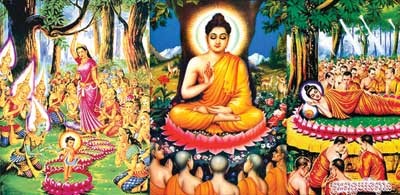
An interesting article in your SAT Mag, titled above by Dr. Upul Wijewardhana is a must read for by all Buddhists, especially Buddhist monks who teach, preach and maintain the fictitious events or episodes on Gauthama Buddha, such as walking on seven lotus flowers and declaring to the world that He is the greatest and will not be born again as pious truth. Referring to stories told to evoke ‘shardha in the uneducated’ he asks who amongst us will take the lead and call ourselves ‘GAUTHAMISTS’.
For centuries people have been indulging in superstitions, lucky charms, omens and fortune telling. They have used these things to help them make decisions, and keep them from responsibility for their own actions.
Buddha called all these practices LOW ART, and on many occasions stated that such things are of no use and we must take responsibility for our own lives.
Buddhism does not require belief in any god. It inherently does not require its followers to have blind faith, but to have knowledge based belief.
Extremism is having extreme political or religious views. Extremism is not allowed in Buddhism. Buddha has taught us the middle path. Religious extremism is very dangerous. Buddhism teaches us to be kind and compassionate to all living beings, including animals.
The Principle of Non-Violence is central to Buddhist teachings.
Buddha has said - Believe nothing, no matter where you read or who said it, unless it agrees with your own reasons and your own common sense.
D. Weeratunga03 06 2017 - The Island
L6.02
An interesting article in your SAT Mag, titled above by Dr. Upul Wijewardhana is a must read for by all Buddhists, especially Buddhist monks who teach, preach and maintain the fictitious events or episodes on Gauthama Buddha, such as walking on seven lotus flowers and declaring to the world that He is the greatest and will not be born again as pious truth. Referring to stories told to evoke ‘shardha in the uneducated’ he asks who amongst us will take the lead and call ourselves ‘GAUTHAMISTS’.
I can quote several such blasphemous tales woven around Prince Siddhartha Gauthama, who later attained enlightenment to be a Buddha. One such I can never forgive is the tale of Devas inviting Gauthama in Thauthisa Bhawana to come down to earth to preach the Dhamma. and He placed five conditions or requirements out which one was the death of His mother within seven days. Does this not amount to premeditated murder. It is considered very important to highlight one particular statement of Dr. Wijewardhana when he says: ‘To me, sticking to unproven and unproveable beliefs at the expense of what has been established is an attempt, though unintended, to belittle the unparalleled achievements of Gauthama Buddha. My view is that stories created by the well meaning to illustrate difficulty of attaining enlightenment and inadvertently diminish the achievements of Gauthama Buddha.’ I fully agree with this statement and so may others; in my view, these tales or fiction, have been created for the consumption of the not-so-intelligent masses.
It is not only these tales which bring down the image of that Great Teacher, Buddha Gauthama, but also the conduct, behaviour of our Buddhist monks who have been entrusted to preach and propagate the Dhamma, which Dr. Wijewardhana has omitted. Some question as to whether Gauthama Buddha ever encouraged such behavior. What is more, our Buddhist monks have framed a Pali Stanza to encourage devotees to offer betel to attain Nirvana.
Apart from the above, some Buddhist monks refuse to perform simple religious rites, such as tying a Pirith Noola, saying it has become a nuisance and hinders other work. This is my personal experience at a very famous temple in my area, which the well known Head Monk said, when I complained that one of his monks refused to issue me a Pirith Noola to be taken to an ailing child. If this trend catches up, the Pirith Noola, which is considered a sacred bond and spiritual relief will only be an ornament, like a bangle.
I conveyed this incident in detail to Dr. Wijewardhana and to K.K.S. Perera who writes to your paper regularly on Buddhism. They advised me not to be disheartened by this foolish act, but to have faith. I am grateful to them for relieving me of a great pain of mind.
All Buddhists should thank Dr. Wijewardhana and The Island for spotlighting these blasphemous, fictitious stories which tarnish the immaculate Gauthama Buddha, to make those concerned to realize the truth and take remedial measures.
G.A.D. Sirimal07 06 2016 - The Island
L6.03
Having labelled myself a ‘Gautamist’ and garnering the support of a powerful ally in Nan, I am emboldened to highlight a few more of the many unbelievable stories told which, inadvertently, belittle the achievements of Gautama Buddha. Unfortunately, probably due to some technical problems, the powerful piece "From ‘Folk Buddhism’ to ‘Scientific Buddhism’" written by Nan which appeared in the Midweek-Review of ‘The Island’ on 8th June, did not appear in the on-line edition denying the international readership the chance to see how forcefully she moved further forwards, the arguments stated in my piece ‘Belittling Gautama Buddha’s Achievements (The Island, 4th June).
Nan rightly points out the harm these ‘stories’ can do though some good Buddhists advise us to disregard and carry on. She is spot on when she states "If people believe that birth story, then all else is false is what the non-believers who challenged Buddhism used as a contentious axe to grind". I am in total agreement with her that we cannot and should not stand dilution and adulteration, if we want Buddhism to be the ‘religion’ of the 21st century. We ‘oldies’ may have taken more than six decades to mount a challenge to the conventional wisdom, after recognizing these inconsistencies, but our young generations, who are exposed to facts of all types at a very tender age, may not give due regard to Buddhism if they are exposed to it in the present form. That would be a great shame as the substance, the science of Buddhism is bound to stimulate them intellectually. As the embers of our lives are extinguishing slowly, one last thing we can do is to stimulate a debate so that those who have authority can take steps to change the way we teach the Dhamma; at least, that is the hope!
After a prolonged gap caused by the fascination of medical literature, reading again "The Buddha and His Teachings", the authoritative work of Venerable Narada Maha Thera, I was surprised by some of the facts stated. In no way am I attributing any blame to this great scholar who spent his life propagating Buddhism who has merely documented what is accepted as ‘facts’ by the Buddhist academia. It is just that I have changed; I am reading it now with a critical eye, as taught by Gautama Buddha in Kalama Sutta.
The Invitation to Expound the Dhamma
Venerable Narada describes in detail (p34-36) the conflict in the mind of the newly Enlightened Buddha as to whether others would be able to comprehend the complex Dhamma he realized and states "As the Buddha reflected thus, he was not disposed to expound the Dhamma"
That is surprising, isn’t it? Gautama Buddha, who was born to be king but abandoned it all, in search of the truth which he found not by divine revelation but by reflection and a detailed study of the nature of things for a long time, during which he met a number of other intelligent seekers of the truth, hesitating to share his discovery. What about that other story, that he could have achieved Arahanthood during the time of Deepankara Buddha but opted not do so as he wished to be a Buddha in the future to help many? After struggling for many an aeon to achieve his ambition, how can he forget what he intended to do?
I do appreciate that these tales were woven with the best of intentions but they do, inadvertently, belittle His achievements. This may be benign but, in my humble opinion, the rest of the story is really worrying. It is stated: "Thereupon Brahma Sahampati read the thoughts of the Buddha and, fearing that the world might perish through not hearing the Dhamma, approached him and invited him to teach the Dhamma thus:
‘O Lord, may the Exalted One expound the Dhamma! May the Accomplished One expound the Dhamma! There are beings with little dust in their eyes, who, not hearing the Dhamma, will fall away. There will be those who understand the Dhamma’"
Apparently, the Buddha refused twice but Brahma persisted making Gautama Buddha relent on the third attempt, after surveying the world with his Buddha-eye and realizing that there may be people with ‘little dust in their eyes’. May be this was intended to demonstrate that the Buddha was still human and would listen to reason. But to introduce a Brahma who not only could read the Buddha’s mind but also had a better understanding of the situation, I interpret as an attempt to subjugate the Buddha. Does it not go parallel with the subjugation of Gautama Buddha as the ninth Avatar of Vishnu?
The establishment of the Order of Bhikkunis
I had a mother; I have a number of sisters but, unfortunately, one of them ‘overtook’ me and decided to leave this world recently; I have a wife and a daughter. I know very well that they are all different in many ways to us, men, but still are equal. As a strong believer in the equality of sexes, I have always been troubled by the stories told by Monks about the ordination of women. It becomes even more important to me, as I have been expounding Buddhism as a ‘liberating influence’ on women, referring in previous articles to Empress Wu of China and Murasaki Shikibu, Japanese Nun and writer, who holds the record for having written the world’s first full length novel.
I expected Nan to dwell on this subject but all she mentioned was the fact that Venerable Ananda being blamed for persuading the Buddha to establish the order of nuns! On top of that, he is also blamed for being inattentive and thus not requesting the Buddha to postpone Parinibbana. I am in full agreement with Nan that these tales cast a blemish not only on Venerable Ananda, who admirably looked after the Buddha and committed to his memory the Buddha’s teachings, but also on the Buddha himself as these suggest that the Buddha was not willing to die.
To get the accepted traditional view, I consulted Venerable Narada’s book but had to search hard as this was not even a sub-topic. Finally, I found it in the chapter on ‘The Buddha and his relatives’, under the sub-heading of ‘The Buddha and Maha Prajapati Gotami’ (p84-87) and was surprised by what I found.
Maha Prajapati Gotami, Prince Siddhartha’s aunt and step-mother who suckled him, handing over her own son to a nurse, begged the Buddha to grant permission for women to enter the Sangha and, apparently, the Buddha refused straightaway without giving anyreasons. She requested thrice and was refused each time. This happened in Kapilavatthu and the Buddha moved on to Vesali. Not deterred, Maha Prajapati Gotami together with a large number of Sakya ladies got their hair cut, donned yellow robes and walked the 150 miles to Vesali experiencing many a hardship on the way.
Venerable Ananda having found her, covered in dust with swollen feet, weeping outside the porch of the Pinnacled Hall and out of pity to her, appealed to the Buddha but was refused thrice. He had to ‘trick’ the Buddha by asking the Buddha whether women could not attain the various stages of enlightenment and having received a favourable reply made a final plea reminding the Buddha how Maha Prajapati Gotami looked after him in childhood. I am summarizing a beautifully written piece but, unfortunately, conveys a wrong impression about the Buddha; Venerable Ananda had to plead to change the mind of the Buddha about a reasonable request from his own step-mother.
It seems the Buddha finally agreed but set eight rules; reading these I got the impression that these could have been set by any chauvinistic male. I simply cannot imagine Gautama Buddha who said "Na jattaVasalohothi, Na jattahohti Brahmano; Kammana Vasalohothi, kammanahothi Brahmano", espousing equality of birth, would discriminate against women. Agreed, some conditions may have been set for the protection of nuns but the following three are totally discriminatory.
1. A Bhikkuni even of a hundred years of Higher Ordination has to rise and respect a Bhikku who had received Higher Ordination even that day.
7. A Bhikkuni should on no account rebuke or abuse a Bhikku. (Implies that the reverse is allowed!)
8. Bhikkunis should not give admonitions to Bhikkus but Bhikkus should admonish Bhikkunis.
This, in effect, is a man’s charter for the suppression of women and could easily have been added later by Bhikkus for self-preservation; not what I would expect from Gautama Buddha.
Though Venerable Narada mentions that for several valid reasons the Buddha reluctantly permitted women to enter the Sangha, he does not expand on this statement.
In foreseeing the future repercussions, the Buddha is supposed to have remarked;
"If, Ananda, women had not received permission to renounce the world and enter the homeless state under the doctrine and discipline proclaimed by the Tathagatha, the holy life would have lasted long and the sublime Dhamma would have survived for thousand years. But since women have entered this homeless state, the holy life would not last long and the sublime Dhamma would now remain only for five hundred years"
Are we to believe that the Buddha got it so wrong! Certainly not.
Mr G A D Sirimal, in his valuable contribution, in response to my article (The Island, 8 June) highlights some issues with Buddhist monks but we have to remind ourselves the as much as there are bad doctors and bad lawyers there are bad monks. Further, we cannot forget the fact that, in spite of all their faults, it is the Sangha that preserved the Dhamma for us, passing it down in the oral tradition. Distortions may have occurred but the core remains intact.
A venerable monk, whom I respect immensely, had sent the following comment after reading my article:
"Personally, I believe if we want to understand the early and pure teachings of the Buddha, this sort of critical and analytical thinking is essential. I don't see any other way to realise the Dharma without applying a pragmatic approach."
It is in this spirit and with utmost respect to Gautama Buddha that I have written this second installment and do apologies, in advance, to ‘traditional Buddhists’ in case I hurt their feelings.Dr. Upul Wijayawardhana
07 07 2016 - The Island
L6.04
I have rarely read an article that was so interestingly written than that by Dr. Upul Wijayawardhana. There is no doubt that ALL the great Teachers have had additions made by others to what they actually did say, and we tend to forget that all who added these interpolations were somewhat self serving men.
The Council of Nicaea for example laid down rules which helped the Catholic Church to literally set up a few centuries of total domination over the Catholics (there was no Protestantism until Luther protested mightily) and the wealth, corruption and sheer misunderstanding of the Bible by the Papacy started from then on. The wealth of the Church of the Middle Ages was legendary. Christ would have spun in his grave at the manner in which his simplicity and life teachings were being so appallingly corrupted. Also let us not forget that a famous Pope once said, "Let us enjoy the Papacy since God has given it to us." And enjoy it they did, at the expense of the true message of Christ leading to the eventual Reformation.
Far be it from me to insist on the veracity of what I write, but it is written by others that even Christ's Divinity was VOTED upon by the Father of the Church at the time, because they felt that since Roman Caesars were called "Divine Caesar", Christ could not be called anything less than that.
As for what Dr. Wijayawardhana has said about the rules of the Bhikkhuni order, to believe them would be to relegate the Buddha to being a bigger chauvinist than our silly monks of today, who have very little respect among thinking men. I happened to sit behind some priests chanting Pirith the other day, and to my horror I witnessed two of the younger priests using mobiles to send messages or play games from behind their concealing fans.
There is very little doubt that all the great religions of the world have been tampered with and have done their Great Founders a disservice which has lasted through the ages. Let us apply common sense, History and other methods of understanding what great teachers actually said, even if it means discarding cherished beliefs. After all Truth is Truth, whatever religion we follow.
In order to truly try to get at Truth, here are a few methods employed by thinking men. They are the following 1. The written words of the time must be available and studied in context. 2. Verification by archaeology. 3. Epigraphs - meaning inscriptions. Let us not forget that India had forgotten all about the Great Emperor Asoka, until his pillar was discovered adding to the knowledge of the Gupta Empire. 4. Philology, which is the study of the meaning of words at the time. Meanings change from century to century. 5. Iconography, which means that History should be present in the statues of the time 6. Seals of the time should be studied. These methods may help us all to find deeper truths in the persuasions we follow.
I hope I have hurt no one's feelings. I am only trying to understand what is pertinent and believable in these days, where there is so much distortion and controversy.
Goolbai Gunasekara12 07 2016 - The Island
L6.05
Apropos the article written by Dr. Upul Wijayawardhana on the above subject in your esteemed newspaper of July 09 let me share with the readers a few comments that may be of interest. The sequence of events leading to the Enlightenment of the Blessed One and those that followed, are explained in several suttas of Sutta Pitaka and in the Maha Vagga of Vinaya Pitaka. The Aryaparyeshana Sutta of Majjima Nikaya, which explains Bodhisatta's long quest for enlightenment, also deals with the role of Brahma Sahampathy in entreating the Buddha to teach the Dhamma.
Ven. Bhikkhu Bodhi in the note No 307 to the English translation of Majjima Nikaya has given the following comments which are very relevant.
"[the question is raised] why when the Bodhisatta had long ago made an aspiration to reach Buddhahood in order to liberate others, his mind now inclined towards inaction. The reason, the commentator says, is that only now, after reaching enlightenment, did he become fully cognizant of the strength of the defilements in peoples' minds and of the profundity of the Dhamma. Also, he wanted Brahma to entreat him to teach, so that beings who venerated Brahma would recognize the precious value of the Dhamma and desire to listen to it". Refereence here is to Majjima Nikaya Attakatha compiled by Venerable Buddhagosa.
Mantriratna Panditha13 07 2016 - The Island
L6.06
When the war, not a civil war as some try mischievously to twist, but a war against terrorism which many an expert predicted was unwinnable, was finally won in May 2009, many of us wanted to criss-cross the length and the breadth of our Motherland breathing the heavenly scent of freedom. I, for one, yearned to visit Jaffna as I never got the opportunity though I very much wanted to; may be because I am from Matara, the southern end and was keen to see the ‘opposite’, the northern end. In late 1972, just six months after my appointment as Visiting Physician in Badulla Hospital, the Department of Health had tried to transfer me as VP, Jaffna but Dr. N.J. Walloppillai, who was the representative of the Association of Medical Specialists on the transfer board, has objected to my premature transfer. In late 1986, when I was Cardiologist, I had a number of Senior House Officers from the North who offered to ‘smuggle’ me to Jaffna and Naga-Deepa but I got cold-feet.
As it was still not possible to visit Jaffna and Naga-Deepa, in late 2009 we decided to visit Somawathie Chaitya instead. Though, even at that very early stage, work had already started to build a proper road to Somawathie Chaitya, we had to be driven on a cart track for about 15 Km. After around an hour’s drive, nay torture, as it felt more like being in a tortuous ride in a theme-park than a drive, suddenly a clearing appeared in the thick jungle and there it was in all its’ majesty; Somawathie Chaitya which predates all the grand creations of the Anuradhapura era when our ancestors built two of the ten largest structures in the world.
There were a few pilgrims and hardly a vehicle in sight. The gentleman in the office, who happened to be a fellow Southerner, while writing a receipt for the small donation we made, told us how glad they were to see even a trickle of pilgrims at last, after a period of nearly thirty years when the whole area was surrounded by two-legged tigers. He told us how, once a month, the Nayaka Thero went in an army convoy to buy provisions and how the LTTE once attacked the convoy killing many but missing the Nayaka Thero, though he was the intended target. We had to make the arduous return journey the same evening as there were no places to stay.
Re-visiting Somawathie Chaitya, a few weeks ago, was a wonderful experience as we could witness a miraculous transformation. Though the initial road that was built had been washed away by a severe flood, a brand new concrete road, the longest in the country, had been built and we reached a completely transformed Somawathiya in no time. The place was teeming with pilgrims and packed with vehicles. Unbelievably, there were so many new buildings; a new Viharage with beautiful statues and a new library, both of which were elevated to accommodate the recurring December floods, in addition to a number of Pilgrim’s rests, some of which had air-conditioned rooms as well. A lonely elephant, confined to a corridor with electric fencing leading to the jungle round the tributary of the Mahaveli, was entertaining pilgrims with his antics of putting the trunk in the mouth gesturing for the need for food. What a transformation!
What had been achieved in such a short time is not short of a miracle but the miracle of Somawathie started way back in 1947. I am using the term miracle, not miracles, purposely as I am not referring to the miracles Somawathie Chaitya has gained a reputation for, recently; at least not for the moment.
According to Chronicles, Somawathie Chaitya had been constructed in second century BCE supposedly enshrining the sacred right canine tooth of the Buddha. It was constructed by King Giriabha on the initiative of his consort, Queen Somawathie, the sister of King Kavantissa (the father of King Gemunu), in Somapura. Apparently, Arahant Mahinda resided in this area and had given his approval for the construction of the Chaitya. As the Sinhala Kingdoms faded and shifted, forest covered the weather-beaten Chaitya which lay hidden for two millennia only to be discovered around 1947. Though all the residents of the surrounding villages are Muslims, they too seem to hold Somawathie Chaitya with reverence and affection and it is said that mysterious lights they noticed led to the discovery of the ruins by a group of Buddhist priests led by Ven. Sirimalwatte Piyaratana Thero.
Waiting for the miracles
We decided to stay overnight hoping for the miraculous lights to appear. I had warned my fellow pilgrims that the presence of me, the sceptic, may prevent the miracles from happening though in my heart of hearts I was wishing that they would occur to convert the sceptic. After the evening Pooja we listened to a masterly discourse, for nearly two hours, by the chief incumbent of the Viharaya, Venerable Pahamune Sri Suman-gala Nayaka Thero, who went through the history of Buddhism and Kingdoms of Sri Lanka. Of course, he described in detail the miracles but, unfortunately, we did not witness any. The night passed without any incidents, except the murmurings and the stings of a few mosquitoes, and till we left after the morning Pooja there were no miracles.
Need for scientific investigation
Having failed to observe the miracles in real-time, the only option left was to buy a DVD, which we did. I enjoyed watching it for nearly two hours but not for the miracles but for the vast amount of historical facts pointed out by the Nayaka Thero. Though it could have been edited better, there being discordance between the sound and visuals on many occasions, the historical facts exposed by the etchings on the stone slabs widely distributed in the surrounding area as well as the photographs tracing the history of reconstructing Somawathie Chaitya including those of DS and Dudley are not to be missed. Video footage of the floods clearly illustrates the challenges faced every year, some years more than the others. The massive progress against all odds is simply remarkable. Though not a great enthusiast of rituals I cannot help but be proud of this piece of our heritage.
The miracles recorded were not entirely convincing and were full of technical issues like chromatic aberration which may mimic miracles. I wish one of our universities would undertake the task of investigating these phenomena. They may not find an explanation but if they can establish that these phenomena really do occur, then we can wait for an explanation in a future date. After all, till electricity with charges and discharges were discovered, lightning and thunder were considered acts of gods. Simply because science cannot explains certain phenomena it does not mean they are not there; sometimes they may be explained by magic as simple illusions. We follow Gautama Buddha who encouraged questioning and do hope our academics will take this challenge.
What an ungrateful nation we are
What saddened me immensely was the lack of gratitude shown by the Nayaka Thero in his sermon during the evening Pooja. Though it is obvious to anyone that we are reaping the peace-dividend of defeating terrorism by Mahinda Rajapaksa, it was surprising that the Nayaka Thero could not pluck up courage to mention this and refer to him by name, just mentioning him in passing, as the ex-president.
Mahinda Rajapaksa was accused of treason, planning a coup after the last presidential election, by a big-mouthed Minister who behaves as an invertebrate in front of western leaders; another minister, who virtually licked his boots, accused him of swindling billions of dollars but all continue to be allegations yet. Yahapalanaya is out to jail him and the international community is hell-bent on condemning him for war-crimes. They may jail him; secret services of foreign governments may attempt to assassinate him; the rump of LTTE will do their best to discredit him but the fact remains that it was Mahinda Rajapaksa who achieved something unique; comprehensively defeating terrorism. For the peace-dividend we enjoy today, we should be grateful to him.
It is said that the first act of Gautama Buddha, on attaining Enlightenment, was showing his gratitude to the tree that gave him shelter; by gazing at it for a week. Sadly, that is a quality we, as a nation, seem to lack.Dr. Upul Wijayawardhana
11 06 2016 - The Island
L6.07
The new Buddhism of Buddhaghosa has two principal constituents, Vandana and Puja both of which are ritualized forms of entreating or supplicating.
Vandana
Vandana as a constituent of the new religion is the most popular means of acquisition of merit through worship. It must be emphasized here that it is not a merit generating action according to the Buddha’s teaching. As we have seen above, I is through a dishonest manoeuvre that it has been appropriated to the Buddha. Vandana is the act of paying homage to the (animationised) Buddha and the (similarly animationised) objects of worship to the accompaniment of the correct pronunciation of the relevant formula which is in Pali the correct meaning of which is not understood by the worshipper. The second object of Vandana is the Cetiya (pagpda) where the relics of the Buddha or of the arahants are enshrined. The third object of vandana is the Bodhi seated under which the Buddha is said to have attained Buddhahood. It may be noted here that the Buddha has never stated anywhere that he attained enlightenment seated under a Bodhi. The story of the Buddha sanctioning the planting of a Bodhi near the entrance to the Jetavana monastery is a fiction sneaked into the commentary of the Kalingabodhi Jataka. The entire episode has not been corroborated by any literary or other source.
The veneration of the Sri Mahabodhi at Anuradhapura and the conversion of the Sri Lankans to Bodhi puja and Bodhi vandana are two separate sets of developments belonging to two different religious cultures. The first is veneration of the Bodhi as the tree under which the Buddha is believed to have sat at the time of his enlightenment. The second are those which developed out of the animationism and the consequent belief in the ability of the Bodhi to respond to Puja and Vandana requests. While the pre-Buddhist Sri Lankans are recorded to have worshipped a Palmyra as the abode of Vyadha deva and a Banyan tree as the abode of Vaisravana, both near the Western gate of Anuradhapura, they worshipped only those two trees, but not all the Palmyra and Banyan trees in the whole Island.
While Vandana can be either an individual activity or a community activity in its execution the two of its forms, the Vandana carika and Upatthana Carika are both community activities. The Carika Vandana is the pilgrimages undertaken to visit a convenient selection from the hundreds of places of worship whether in Sri Lanka or outside. The local pilgrimages are arranged by individuals either in towns or villages and are firmly believed in as merit generating actions according to the teachings of the Buddha, though they are definitely not, as we have seen.
Another Vandana carika which has become of very popular demand is that of Dambadiva Carika which are conducted by tour operators taking people to worship all the places of interest to the Buddhists. These Dambadiva Carika have become so sought after that it has become highly prestigious to to be able to visit the Buddhist holy land at least once in your life time. But, it must not be forgotten that in spite of all the heinous distortions by Buddhaghosa, generation of merit in Buddhism is far beyond silly teachings on Punya like these.
Upatthana Carika is another form of pilgrimage. These pilgrimages are organized by village or town tour organizers to visit forest hermitages to provide the daily needs of the meditating monks. While almost all such hermitages are located in forest caves very difficult of access, it seems that the more difficult of access a hermitage is, the more difficult it is to get a booking for a dana pilgrimage in Sri Lanka. Most forest hermitages in Sri Lanka are fortunate enough to have a continuous flow of Upatthana attendance that it seems to be welcomed interference with their solitude. These upatthana pilgrimages are believed to be highly productive of merit accumulation it outweighs any inconvenience caused to the meditating inmates.
Vandana is worship of the relevant sacred object before which the worshipper supplicates while reciting the appropriate puja vakya. Each time the relevant formula is recited to the accompaniment of recommended physical gestures, merit is generated and credited to one’s Nibbanic account, it is believed. The most popular Vandana is that of flower offering which is:
Pujemi Buddham kusumena nena punnenametenca hotu mokkham
Puppham milayati yatha idam me kayo tatha yati vinasa bhavam
(I do offer these flowers to the Buddha. May I attain nibbana by this merit. My body too will wither away like these flowers.)
The Pali stanza entreats the Buddha to accept the offering of flowers and deliver the emancipation of Nibbana to the worshipper. The addition of the last line of the stanza which says that the worshipper’s body too would wither away as the flowers would pretend a momentary meditative thought. But, meditation in Buddhism as one of the three merit generating actions is nowhere close to the recital of a short phrase on meditation. It seems to fall in line with the pleasing praise showered on the deity in the god religions to win a supplication.
Puja
Puja is a ritual offering. The alms giving or the donation of the four requisites of a bhikkhu, robes, food, residential accommodation, and medicaments are never described as puja in canonical Buddhism. The origin of ritual puja is the replacement of animal sacrifice (pashukarma) with flower ritual (pushpa karma), several centuries after the parinibbana of the Buddha, according to Dr. Suniti Kumar Chatterji. It is also described as the replacement of the offering of raw flesh (amisa puja) to the gods with flower offering (pushpa puja) (s.v. Puja, Encyclopedia of Buddhism).
In the god religions what is offered is what is most cherished by the deity. The offering is humbly supplicated to the deity in the language acceptable to the deity. While in the ancient times this offering was of live animals, with the decline of the popularity of animal sacrifice, gods seem to have consented to accept offerings of flowers instead. The offering to the deity must be prepared complying with all requirements of the deity communicated to the client by the mediator priest or by his authorized deputy. The humble submission of the offering must be made in the appropriate puja vakya.
In the adoption of the ritual for the use of the Buddhist, the object of offering can consist of any number from the hundreds or more of objects of offering. The inclusion of any object of offering can be done merely by adding the Pali term for the object into the puja vakya. The most popular offering is that of food to the Buddha which is usually supplicated in the following puja vakya:
"Adhivasetu no bhante bhojanam parikappitam - Anukampam upadaya patiganhatu muttama"
(May the Blessed one be pleased to accept this food which has been prepared in accordance with all stipulated conditions.)
Ritual Buddha puja can be an offering of food (ahara puja), drinks (pana puja), light (aloka puja), flowers (pushpa puja). The items offered can be limitless, depending on what one aspires to continue to have in this life and have hereafter. For example, even betel leaves are offered to the Buddha irrespective of the fact that the Buddha is never recorded to have been a betel chewer. According to the Mahavamsa, it was King Sena III who started the offering of food and garments to statues of the Buddha going against the stipulations laid down in the Mahaparinibbana Sutta of the Digha Nikaya.
Relic Worship (Dhatu puja) is another ritual offering which covers all the Pagodas which enshrine the relics of the Buddha and of the arahants. The worship of the Sacred Tooth Relic is given special attention by all Buddhists. It is firmly believed that the (animationised) Sacred Tooth Relic will grant any supplication of a worshipper if it is duly submitted.
Bodhi Puja (worship of the Bodhi) is a very recent form of ritual solution to most afflictions and problems and therefore sought after by Buddhists. According to tradition the Buddha is said to have his enlightenment seated under a Bodhi tree. It is held that it was the Srimaha Bodhi at Buddhagaya in India. The Buddha has himself never referred either to a Bodhi or to his having sat under a Boshi when he attained Buddhahood. The story of his spending four weeks immediately after his enlightenment is found in the introduction to the Vinaya pitaka, the Mahavagga. Later on, the number of weeks has increased into seven in the hands of Buddhaghosa, the famous Buddhist commentator and fiction writer.
The popular story of the Bodhi tree is that of the Anandabodhi which does not show any valid excuse for the intrusion into the commentary of the Kalingabodhi Jataka. According to this story the Buddha himself approved the planting of a seedling from the Sri Mahabodhi, got down through Venerable Mahamoggallana, near the entrance to the Jetavana monastery. It may be noted here that the Buddhism of the Buddha’s day was certainly not the religion of Vandana and puja as the religion of Buddhaghosa. A visit to the Sri Mahabodhi on any day would show how the puja begging operates for the worshippers of the Bodhi. Their worship is loaded with the supplication for redress of various grievances which they firmly believe the animationised Bodhi would undoubtedly grant. Thus, it may be noted here that the Sri Maha Bodhi as well as the Bodhi trees in most of the ten thousand nine hundred temples in the country have turned into important centres of religious Begging in the religion of Buddhaghosa.
One more item which has been adopted from the post Mauryan religions is the commemoration of important events from the national and religious calendar. Many towns and villages in the country possess a rich heritage of commemorative processions which parade the roads every year. These are intended to be expressions of faith and belief in the Buddha’s teaching. Most people are awed when they see the Maligawa tusker Raja gracefully carrying the Casket containing the sacred Tooth Relic in the annual procession in Kandy. The rhythmic steps with which the elephant walks to the music of the drummers and dancers would mesmerize anybody. Of course, it would only be a disruptonist who would barge into such faith enveloped environment to see the heavy chains in which the elephants are chained making it impossible for them even to walk fast.
The offering of the eight requisites of a bhikkhu, the Astapariskara Puja has grown to be a major attraction to merit hungry Sri Lankan clients as well as to their merit brokers. The number of astapariskaras and ritually offered on any day in the Island must easily be over a ten thousand and several billion a year. An Astapariskara comes in a standard ritual pack which is never opened except for its periodic renewal of the ritual packing. An Astapariskara Puja guarantees to the worshipper the attainment of arahanthood in the dispensation (sasana) of Buddha Maitreya according to Buddhaghosa. But, Buddha Gotama does not seem to have been aware of this according to the authentic Pali canonical texts.
Thus, the so called Punya (merit) Buddhism of Buddhaghosa is a crazy chase after merit accumulation through physical activities which have not been accepted as productive of merit leading to the next step in the scheme of gradual training leading to Nibbana. Buddhaghosa’s claim of direct access to Nibbana through merit accumulation is a Micchaditthi which cannot be accepted according the teaching of the Buddha Gotama.Prof. M.M.J. Marasinghe
03 08 2016 - The Island
L6.08
Venerable Thera Mahinda brought the message of Theravada Buddhism after the conclusion of the Third Buddhist Council which was held under the patronage of the great Mauryan Emperor Asoka. As the Mahindian mission was sent with the personal goodwill of the Great Emperor to the reigning monarch at the time, king Devanampiya Tissa, it was received with due honour and respect by the king and the people of this country.
The Mahindian mission brought with them the Pali texts of the Theravada canon as approved by the Theras of the Third Buddhist Council. It was these texts which were to serve as the source of authority on all questions of Theravada Buddhism in Sri Lanka. Venerable Mahinda was able to provide with state assistance, all facilities for those who desired to practice the Buddha’s teaching. It is recorded that there were many who attained arahanthood by making full use of the facilities provided and the guidance offered by the Theras. Not only the construction of rock caves for meditators, the Venerable Thera was able to provide assistance for all those who desired to study the Dhamma and the Vinaya texts by providing them with suitable incentives. He recognized such bhikkhus as experts in the relevant branches of the Dhamma and the Vinaya. Endowed with his far-sighted vision the Great Thera was able to ensure that the new teaching took firm root in the Island. As a result, it was able to survive many political as well as other disastrous periods which were faced by the country. One very important event which took place in the first century B.C. was the writing down of the Buddhist texts.
According to historical records, the Mahindian Mission brought with them only the texts of the Pali canon. In order to help resolve problems faced by those who studied these texts, commentaries were written in the language of the people, under the direction of the Venerable Mahinda Thera. The religion of the Anuradhapura period did not have Puja and Vandana as the religion of the Buddhaghosa period came to have. The construction of the Thuparama cetiya enshrining the relics of the Buddha sent by Emperor Asoka, and the planting of the Bodhi in the Mahameghavana Royal park in Anuradhapura, did not generate Cetiya and Bodhi-puja and Vandana because these sacred objects had not yet undergone animationism as we shall see later.
The political stability brought about by the Mauryan Empire in neighbouring India made the central government strong enough to withstand any political threat from the thousands of forest tribes in the vast unconquered lands adjacent to the state held areas. The almost total neglect of the neighbouring forest tribes by the central government of India, on the other hand ensured a life of peaceful co-existence to the two sets of people, the people of the government held areas and the people of the forest tribes. It was the Brahmin priest who saw a golden opportunity in this situation and took speedy action. Not only did he become the first ever goodwill messenger from the state held areas to the tribe, but he was also the first one who could, understand the language and symbolism of their forms of worship and was therefore able to communicate with them meaningfully. The Brahmin was able eventually to invite the tribal chief and his people to his own religious worship to which; he had by this time, been able to incorporate important elements from the tribal forms of worship. The Brahmin also saw to it that the tribal deity was a companion of the Brahmin’s own god, who of course, had ascended to the status of a national god by this time. The tribal religion seems to have developed a system of ritually remembering certain important events associated with the gods of the tribe, which by this time had been accepted as events in the national calendar as well.
The first century BC saw the beginning of the depiction of gods in religious worship in statues and pictures under the influence of Greco Roman art. This brought about another important revolution in religious worship. This was the enlivening or animationism of the statues and the pictures. This meant that both the client worshipper and the priest mediator at the time of worship came to regard the statue or the picture before which they are supplicating is in fact the god himself or the goddess herself in person, despite the hard fact that such belief is a short lived self deception. Such was the religious environment from which Buddhaghosa decided to become a bhikkhu to follow the Buddha’s teaching. It is not at all clear whether he and his friend Buddhamitta came to Sri Lanka or were sent here on a definite mission.
It is thus clear that the multi-religion and multi- culture of this period which has been described by pre-modern Western scholars as Hinduism was a wide variety of god beliefs and ritual which at the time we are concerned with is described by D.D. Kosambi as, "This conglomeration goes on forever, while all the tales put together form a senseless, inconsistent, chaotic mass" (D.D. Kosambi, The Culture and Civilization of Ancient India, page. 170). We have no information on the type of Buddhism which was practiced by the people of the South Indian Kerala State when Buddhaghosa became a monk and served the service demands of their temple till he left for Sri Lanka. But, it seems possible to infer Buddhaghosa’s affiliation from the seven merit generating actions he cheated into the Anguttara sutta in the Danavagga of the Atthaka Nipata (A.1V.241).
The Third Buddhist Council, held under the patronage of Asoka and the leadership of Moggaliputta Tissa Thera, does not show any evidence that the Pali Buddhism was under serious threat from the Mahayana schools which had ceded from the Theravadins or from the influence of the new ritualisation of South Indian Hinduism. The Third Buddhist Council is recorded to have rejected a proposal by the Rajagiriyas and the Siddhatthikas that the donation and acceptance of merit (punya) is permissible under the Buddha’s teaching.
They have quoted an Anguttara Nikaya passage (A.111.43) in support of their claim. The passage, quite contrary to their claim points to a social acceptance that parents wish for a male child in their family hoping that he will observe the obsequiesial rites after the death of his parents (petanam kalakatanam dakkhinam anupadassatiti, A.111.43). Both donation and acceptance of merit are not found in any canonical text. It may be pointed out here that the two sects are classified as two Mahayana Schools by Professor Bapath (‘2500 Years of Buddhism’). It may not be by accident that Buddhaghosa has been able to take the Mahavihara bhikkhus for a ride by getting them to accept a doctrine rejected by the Third Buddhist Council and is in any case not acceptable to Pali canonical Buddhism. This is definite evidence that Buddhaghosa had Mahayana leanings and has been clever enough to get the Sri Lankans to accept a Mahayana doctrine
It is curious to find that the donation and acceptance of merit is now included in the ten meritorious actions (dasapunnakiriya vatthuni) added on to the Anguttara Nikaya sutta in the commentary to the Dhammasangani. The learned theras of the Mahavihara fraternity accepted this claim of Buddhaghosa when he claimed that these two items, donation and acceptance of merit were included in the Buddha’s discourse in the Anguttara sutta referred to above (A.1V.241).
It is not clear why the bhikkhus of Mahavihara agreed to replace the time honoured Sinhala commentaries of the Pali canon. But it seems possible to suggest that it was for a very enticing carrot which was dangled before their eyes. This attraction seems to have been the very vast potentialities in falling in line with the Hindu theistic animationism which easily could sponsor Vandana and Puja to the animationised Buddha and the sacred places of worship. The modus operandi was by the apparently harmless claim that the new items of merit generation were included in the Buddha’s original discourse (though visible only to the wise as in the case of the story quoted below). It was accepted by the faith blinded herds and continues to be accepted to the present day.
It is puzzling to see that Buddhaghsa seems to have had two different views on the Anguttara sutta on merit generating actions contradicting himself. In his Manorathapurani commentary on the Anguttara Nikaya he accepts the Buddha’s explanation of the merit generating actions as three, (dana, sila, bhavana). But, in his own commentary on the same sutta in the Dhammasangani which is Atthasalini, he says that although the Buddha said that there are three merit generating actions, in fact seven more merit generating actions are included in the three as follows:
1. Morality (Sila) has within it, respectful behaviour to elders and serving a higher person.
2. Liberality (dana) has within it, donation of merit acquired and accepting merit from others.
3. Meditation (bhavana) has within it, preaching (the dhamma?), listening and rectification of views.
According to Buddhaghosa when the seven merit generating actions are included in the three, there are only three merit generating actions, but when they are separated they are ten, although they should be seven only because the three are there when the seven are put together but when they are separated there could only be seven. Buddhaghosa’s mathematical explanation is not acceptable, because the three merit generating actions cannot exist both within the seven and also in addition to the seven. The seven merit generating actions of Buddhaghosa are as follows:
1. Apaciti sahagatam - Respectable behaviour towards elders,
2. Veyyavacca sahagatam - Serving an elder,
3. Desanamayam - Preaching the dhamma,
4. Savanamayam - Listening to the dhamma,
5. Pattanuppadanam - Donation of merit acquired,
6. Abbhanumodana - Accepting merit,
7. Ditthijjukamma - Rectification of views.
The allocation of Buddhaghosa’s seven merit generating actions among the three merit generating actions of the Anguttara Sutta is highly questionable. The two merit generating actions placed under morality are not acceptable as merit generating actions in the sense that morality is a merit generating action. Morality, according to the Anguttara sutta is only the initial step in the scheme of spiritual development which important function is not present in the respectful behaviour to elders (apaciti) and serving a higher person (veyyavacca). Similarly, the donation and acceptance of merit placed under liberality (dana) shows that Buddhaghosa had not understood the purpose and direction of dana. Thus, when Buddhaghosa claimed that the three merit generating actions of the Anguttara sutra included the seven merit generating actions only when he read the same sutta in the Dhammasangani of the Abhidhammapiaka, it is not clear why he changed his earlier stand. His claim however, was accepted by the Mahavihara fraternity, in spite of the many discrepancies with which the whole episode was laboured with. The members of the bhikkhu sangha too seem to have concurred with Buddhaghosa that the seven are included in the three.
This is exactly similar to what happened in the ancient story of the king who wore the suit tailored by two men who were clever enough to prevail upon the king and his men that they possessed a magic thread to make suits for royalty which was visible only to the wise. When the tailoring was completed, the king attired in the new magic suit paraded the streets of his city accompanied by his ministers and retinue in all grandeur when a small child shouted shame on the king for walking naked in public, like the Digambara ascetics of the Jains. This is exactly what happened when Buddhaghosa claimed that he saw the seven merit generating actions merged in the dana, sila and bhavana, merit generating actions. All the wise from the fifth century A.D. to the present day have fallen in line with Buddhaghosa and continue to see and accept this claim without blinking an eye.
The widening of the scope of the merit generating actions was the launching pad for Buddhaghosa’s new Buddhism which he planned to replace the Buddhism of the Pali canon with. However, in spite of adding seven new merit generating actions to the three merit generating actions of the Anguttara sutta, what seems to have relieved Buddhaghosa is the Jain conception of Punya, more than any other. It is the Jain Namaskara Punya which as Vandana has been nurtured to develop to become the principal merit generating activity, supporting Puja worship. Borrowing a ritual item from the Indian (South Indian in particular) god religions, the animationism adopted to the Buddhist sacred objects provided a powerful religious force to propagate the new Buddhism which can best be described as a Beggism because it is a system of earnest praying or begging which Buddhism certainly is not.Prof. M.M.J. Marasinghe
10 08 2016 - The Island
L6.09
Buddhist Councils have been held to preserve the teachings of Gautama Buddha, by various means, and the time is ripe for another but this should be different. It should have not only scholarly monks but also lay experts as well, for a critical analysis so that myths built around the great teachings can be discarded. The analytical genius of Gautama Buddha, especially relating to mind and consciousness, had not been surpassed by science and it is our duty to ensure the true teachings of Gautama Buddha be available for the entire humanity to benefit.
Let Gautamism be re-established as true Buddhism; not a religion, but as a philosophy and a way of life.
The choice for us, Theravada Buddhists, seem either to continue with the present adulterated form of Buddhism or seek actively what Gautama Buddha did actually teach; the latter being the obvious choice for me, an avowed Gautamist. In an erudite academic analysis of how Buddhism transformed to a ‘Beggism’, printed in the Midweek Reviews of 3rd and 10th August, Professor M.M.J. Marasinghe describes in detail the part played by Venerable Buddhaghosa in bringing about this transformation and goes to the extent of stating "It is not at all clear whether he and his friend Buddhamitta came to Sri Lanka or were sent here on a definite mission." This statement suggests that there was a sinister movement to reverse the radical deviations Gautama Buddha made from the existing religions in India. I have no hesitation in concurring with him, as I have expressed my concerns too in two ‘Island’ articles; ‘Belittling Gautama Buddha’s achievements’ (June 4th) and ‘Gautama Buddha; Unbelievable stories’ (July 9th).
Professor Marasinghe states: "The new Buddhism of Buddhaghosa has two principal constituents, Vandana and Puja both of which are ritualized forms of entreating or supplicating." How true! Across the land most Buddhist temples excel in these activities to the detriment of the true message of Gautama Buddha. He describes in very accurate detail how these two introduced concepts has distorted the practice of Buddhism but I get the impression that the order of printing of the two-part article has been reversed, due to some technical error; surely, his concluding remarks would be "Thus, the so called Punya (merit) Buddhism of Buddhaghosa is a crazy chase after merit accumulation through physical activities which have not been accepted as productive of merit leading to the next step in the scheme of gradual training leading to Nibbana. Buddhaghosa’s claim of direct access to Nibbana through merit accumulation is a Micchaditthi which cannot be accepted according the teaching of the Buddha Gotama".
Many still consider Buddhaghosa to be the authority on Theravada Buddhism and this is what ‘Wikipedia’, the website we often refer to for information, states: "Buddhaghoṣa was a 5th- century Indian Theravada Buddhist commentator and scholar. His best-known work is the Visuddhimagga "Path of Purification", a comprehensive summary and analysis of the Theravada understanding of the Buddha's path to liberation. The interpretations provided by Buddhaghosa have generally constituted the orthodox understanding of Theravada scriptures since at least the 12th century CE. He is generally recognized by both Western scholars and Theravadins as the most important commentator of the Theravada."
Though his best known work is Visuddhimagga, Buddhaghosa was responsible for synthesising and translating a large number of commentaries written in Sinhala on the Pali Canon. Though Mahavamsa ascribes many books to him, doubts have been raised about this. In view of the great reputation he developed, it looks as if books written by others have been ascribed to him. Two historical facts lead to suspicions about his work:
1. On completing the translations he returned to India and nothing is known about him since; he simply disappears into history.
2. The original Sinhala manuscripts he worked on are lost for ever and it is claimed that he collected and burnt them; an act acknowledged in the introduction to the English translation of Visuddhimagga by Venerable Nanamoli (an Oxford educated British intelligence officer, born Osbert John Moore in June 1905, who became a Buddhist monk and lived in The Island Hermitage till his premature death in 1960).
The burning of the originals, surely, is not an act of a great scholar or for that matter a Buddhist priest, and leads to the justified conclusion that his translations were biased. He may have resorted to this act of vandalism to prevent subsequent verification. It looks as if the monks of Mahavihara were taken for a ride and Professor Marasinghe has done a great service by challenging the concepts of Buddhaghosa which has distorted the teachings of Gautama Buddha.
Another noteworthy fact about Buddhaghosa is, though in Visuddhimagga he describes the path to attaining Nibbana, in a postscript he states that he wishes to be born in heaven, as a result of merit acquired by this work, to await the appearance of Maitreya Buddha to attain enlightenment after listening to His preachings. Not an expression of confidence on Gautama Buddha!
What can be done?
From the time of the Parinibbana of the Buddha, the method used to ensure His teachings continue unadulterated, unaltered has been the Councils of the Sangha, Dhamma Sanghayana. In fact, it is this practice that led to the term Theravada and to the notion that Theravada is the ‘purest’ form of Buddhism.
The First Council was held shortly after the death of the Buddha in 400BCE, under the patronage of King Ajasattu and presided over by Arahant Mahakassapa. It is said to have been triggered by an inappropriate comment made by a priest named Subhadda: "Friends, since Buddha is dead there is no one to tell us what to do and what not to do. Hence we can do whatever we want." During this council, Arhant Mahakassapa questioned Arahant Upali about Vinaya, as he heard from the Buddha, and Ananda, who had just attained Arahanthood by sheer perseverance, about rest of the Dhamma. All the assembled Arahants had recited the Suttas after Ananda and it had taken seven months to complete.
The Second Council was held a hundred years after the Parinibbana, during the time of King Kalashoka and presided over by Revatha Mahathera to consider the ten point request about Vinaya rules by Bhikkus of Vajji, which was refused after due consideration.
The Third Council, held in 251 BCE, was under the patronage of Emperor Ashoka and was presided over by Moggaliputta Tissa Mahahera with the purpose of purifying the Buddhist movement from opportunistic groups that have been attracted by royal patronage. Following this Council, emissaries were sent all over including Sri Lanka, Thambapanni.
The Fourth Council was held in the first century BCE in Alu Vihara during the time of King Vattagamani-Abhaya but the king was not the patron as he was a supporter of Mahayana. In fact, one of the reasons for the Council was persecution of Theravada and the other was the unstable political situation due to constant invasions. It was conducted by the monks of Mahavihara but a leader had not been named. The most important achievement of this Sangayana was putting the entire Pali Canon to writing.
The Fifth Council was held in 1871 in Mandalay, Burma during the time of King Mindon. It was attended by 2400 monks and lasted five months during which all the teachings of the Buddha were recited. The Council also approved the Tripitaka to be inscribed in Burmese, for posterity, in 729 marble slabs which were then housed in miniature ‘Pitaka’ Pagodas which still stand in Kuthodaw Pagoda, at the bottom of Mandalay Hill and referred to as ‘the world’s largest book’.
The Sixth Council was also held in Burma in 1954, but this time in Rangoon sponsored by the Burmese Government headed by Prime Minister U Nu. A special cave, Maha Passana Guha, was constructed to simulate Sattapanni Cave where the First Council was held. 2500 learned monks from eight countries; Burma, Thailand, Cambodia, Laos, Vietnam, Sri Lanka, India and Nepal took part, two monks of German origin, Ven. Nyanatiloka Mahathera and Ven. Nyanaponika Thera being included in the Sri Lanka delegation. The work of this council ended on the evening of Vesak Full Moon day in 1956, exactly 2500 years after the Parinibbana of the Buddha.
Time for another Council?
Buddhist Councils have been held to preserve the teachings of Gautama Buddha, by various means, and the time is ripe for another but this should be different. It should have not only scholarly monks but also lay experts as well, for a critical analysis so that myths built around the great teachings can be discarded. The analytical genius of Gautama Buddha, especially relating to mind and consciousness, had not been surpassed by science and it is our duty to ensure the true teachings of Gautama Buddha be available for the entire humanity to benefit.
Let Gautamism be re-established as true Buddhism; not a religion, but as a philosophy and a way of life.Dr. Upul Wijayawardhana
13 08 2016 - The Island
L6.10
In recent times there has been much criticism of the conduct of some of the members of the Maha Sangha. Earlier these unfortunate incidents were mainly reported in the newspapers. Today they are shown on Television with people recording such conduct on their cell phones. The pictures shown on the screen has a more telling effect than newspaper items in the newspaper.
Bhikkhus are expected under their Vinaya (discipline) rules to be always calm and collected in their conduct, both physical and vocal. They are expected to walk slowly and mindfully all the time and a Monk walking in such a manner is an inspiration to laymen to lead a noble life and develop a sense of equanimity (Upekkha) or balance of mind in facing the vicissitudes of life, the pleasant and unpleasant experiences.
Often we see Bhikkhus walking throwing their body and arms around and even gesturing to emphasize their arguments. In one recent incident a Monk leading a demonstration was seen on television grappling with Police Officers. It should be appreciated by both Monks and laymen that Police Officers are expected to enforce Law and Order and most often demonstrations on public highways are permitted up to a considerable extent as it should be in democratic country. More so the Monks who are expected to be role models for laymen.
Actually, Monks should not be involved in public demonstrations at all. They could express their views, their opposition or support for certain actions through the media. When a part of a demonstration it is difficult to be calm and collected and it is best for the Monks to keep away from such activity altogether. Sometimes in such situations their anger and hatred are reflected on their faces whereas it is the noble qualities of Brahma Viharana, the art of noble living, Metta, Karuna, Mudita and Upekkha that should be visible in Monks in their bodily actions.
Of course there a large number of Monks who live accordingly to the Vinaya and a never provoked to anger and always maintain a sense of balance in difficult situations. In this connection, past Monks of the calibre of Ven. Gnanatiloka, Ven. Narada and Ven. Madihe Pannaseeha Theras comes to mind.
In these circumstances the courageous action of a Magistrate in a Court of Law who was bold enough to reprimand a Monk for his unacceptable conduct in Court should be commended.
These comments are made not to ridicule certain Monks but with the sincere wish to encourage their reformation under the guidance and example of senior Monks who live the noble life.
May all beings be well and happy.
Rajah Kuruppu, Vice President - Colombo YMBA14 08 2016 - Sunday Island
L6.11
Several months ago I went for a two-week retreat to a hermitage in the low country highly respected for the austere, meditative life of its monks. Each day a different group of dayakas (donors) comes to the monastery bringing alms food, often from remote towns and villages. They arrive the previous evening, prepare an early breakfast which is sent up to the refectory, and then, in the forenoon, offer alms directly to the monks when they come down on alms round. After the other monks have collected their food and gone back up, one elder stays behind to give the Refuges and Precepts, preach a short sermon, and conduct the dedication of merit.
One day during my retreat I noticed some of the male dayakas behaving rather oddly near the abbot's quarters. I asked my friend, a German monk, about their strange behavior, and the explanation he gave me jolted my mind. "They were drunk," he told me. But that wasn't all. He continued: "The only thing unusual about yesterday's incident was that the men had gotten drunk early in the day. Usually they put on their best behavior until the formalities are done, then they break out the bottles."
This stark revelation aroused in me both indignation and sorrow. Indignation, at the idea that people who consider themselves Buddhists should flaunt the most basic precepts even in the sacred precincts of a monastery -- indeed one of the few in Sri Lanka where the flame of arduous striving still burns. Sorrow, because this was only the latest evidence I had seen of how deeply the disease of alcoholism has eaten into the entrails of this nation, whose Buddhist heritage goes back over two thousand years. But Sri Lanka is far from being the only Buddhist country to be engulfed by the spreading wave of alcohol consumption. The wave has already swept over far too much of the shrinking Buddhist world, with Thailand and Japan ranking especially high on the fatality list.
The reasons for this ominous trend vary widely. One is rising affluence, which for the rich makes of liquor (hi-grade imported) a visible symbol of newly acquired wealth and power. Another is a burgeoning middle class, which blindly imitates the social conventions of the West. Still another is poverty, which turns the bottle into an easy escape route from the grim face of everyday reality. But whatever the reason, it is more than our woes and worries that alcohol is dissolving. It is gnawing away at the delicate fabric of Buddhist values on every level -- personal, family, and social.
For his lay followers the Buddha has prescribed five precepts as the minimal moral observance: abstinence from killing, stealing, sexual misconduct, false speech, and the use of intoxicants. He did not lay down these precepts arbitrarily or out of compliance with ancient customs, but because he understood, with his omniscient knowledge, which lines of conduct lead to our welfare and happiness and which lead to harm and suffering. The fifth precept, it should be stressed, is not a pledge merely to abstain from intoxication or from excessive consumption of liquor. It calls for nothing short of total abstinence. By this rule the Buddha shows that he has understood well the subtle, pernicious nature of addiction. Alcoholism rarely claims its victims in a sudden swoop. Usually it sets in gradually, beginning perhaps with the social icebreaker, the drink among friends, or the cocktail after a hard day's work. But it does not stop there: slowly it sinks its talons into its victims' hearts until they are reduced to its helpless prey.
To dispel any doubt about his reasons for prescribing this precept, the Buddha has written the explanation into the rule itself: one is to refrain from the use of intoxicating drinks and drugs because they are the cause of heedlessness (pamada). Heedlessness means moral recklessness, disregard for the bounds between right and wrong. It is the loss of heedfulness (appamada), moral scrupulousness based on a keen perception of the dangers in unwholesome states. Heedfulness is the keynote of the Buddhist path, "the way to the Deathless," running through all three stages of the path: morality, concentration, and wisdom. To indulge in intoxicating drinks is to risk falling away from each stage. The use of alcohol blunts the sense of shame and moral dread and thus leads almost inevitably to a breach of the other precepts. One addicted to liquor will have little hesitation to lie or steal, will lose all sense of sexual decency, and may easily be provoked even to murder. Hard statistics clearly confirm the close connection between the use of alcohol and violent crime, not to speak of traffic accidents, occupational hazards, and disharmony within the home. Alcoholism is indeed a most costly burden on the whole society.
When the use of intoxicants eats away at even the most basic moral scruples, little need be said about its corrosive influence on the two higher stages of the path. A mind besotted by drink will lack the alertness required for meditative training and certainly won't be able to make the fine distinctions between good and bad mental qualities needed to develop wisdom. The Buddhist path in its entirety is a discipline of sobriety, a discipline which demands the courage and honesty to take a long, hard, utterly sober look at the sobering truths about existence. Such courage and honesty will hardly be possible for one who must escape from truth into the glittering but fragile fantasyland opened up by drink and drugs.
It may well be that a mature, reasonably well-adjusted person can enjoy a few drinks with friends without turning into a drunkard or a murderous fiend. But there is another factor to consider: namely, that this life is not the only life we lead. Our stream of consciousness does not terminate with death but continues on in other forms, and the form it takes is determined by our habits, propensities, and actions in this present life. The possibilities of rebirth are boundless, yet the road to the lower realms is wide and smooth, the road upwards steep and narrow. If we were ordered to walk along a narrow ledge overlooking a sharp precipice, we certainly would not want to put ourselves at risk by first enjoying a few drinks. We would be too keenly aware that nothing less than our life is at stake. If we only had eyes to see, we would realize that this is a perfect metaphor for the human condition, as the Buddha himself, the One with Vision, confirms (see SN 56:42). As human beings we walk along a narrow ledge, and if our moral sense is dulled we can easily topple over the edge, down to the plane of misery, from which it is extremely difficult to re-emerge.
But it is not for our own sakes alone, nor even for the wider benefit of our family and friends, that we should heed the Buddha's injunction to abstain from intoxicants. To do so is also part of our personal responsibility for preserving the Buddha's Sasana. The Teaching can survive only as long as its followers uphold it, and in the present day one of the most insidious corruptions eating away at the entrails of Buddhism is the extensive spread of the drinking habit among those same followers. If we truly want the Dhamma to endure long, to keep the path to deliverance open for all the world, then we must remain heedful. If the current trend continues and more and more Buddhists succumb to the lure of intoxicating drinks, we can be sure that the Teaching will perish in all but name. At this very moment of history when its message has become most urgent, the sacred Dhamma of the Buddha will be irreparably lost, drowned out by the clinking of glasses and our rounds of merry toasts. (Courtesy: Buddhist Publication Society)Bhikkhu Bodhi
16 08 2016 - The Island
L6.12
Vesak is approaching, and one of Buddha’s principal precepts is to refrain from killing. Our response to it is the hypocritical and ridiculous rule of banning selling of meat but not fish on Poya Days! Perhaps, our legislators believe that fish are edible, inanimate, floating objects!
Eating meat necessitates killing until artificial meat production in the test tube becomes a reality. There is research in that direction. Refraining from eating meat as at present means saving millions of animal lives a day! Globally, there are 1.3 billion cattle, 45 billion chickens, half a billion turkeys and 800 million goats, lining up for the abattoir annually. Let alone the ‘sin’ factor, animal farming and meat eating are serious risks to global food security, environment and human health.
Meat eating and global grain demand
Apart from pollution and health concerns, beef eating especially, could have serious repercussions on the future global food supply as bulk of the grain go to produce feed stocks. Globally over a third of grain –corn, soybean, sunflower, rapeseed, barley and sorghum are cultivated for the sole purpose of livestock feeding. In the U.S an unbelievable 80% of all grain produced is for animal feed, states Tibbets in his book" Satisfying the Global Appetite"
Even some of the poorest African countries are said to divert a share of the grain for animal feed to produce exportable meat. Whereas grain produces between 1.5 to 2.5 food calories for every calorie of fossil fuel burnt, range-fed beef requires 3 calories. By contrast, beef produced from feedlots requires eleven times more calories! This is not all. Meat must be cooked at high temperatures for a long time to be safe for consumption, expending much energy. According to one estimate, the energy used annually to produce meat for one American is equivalent to that consumed by a third world individual in one year!
People have been wolfing down more meat than their ancestors. The world meat consumption between 1961 and 2007 rose from 71 to 247 million tons, a fourfold leap!. A New Zealander consumes 312 pounds of meat per year; almost a pound a day! Correspondingly, U.S, Cyperus and Ireland consume 273, 288 and 233 pounds per capita per year! Sadly, despite large populations of poor people in the developing world, meat consumption has risen sharply competing for grain. In China it has risen from 8 pounds per capita in 1961 to 119 pounds in 2002, and in Brazil from 61 to 174 pounds. Chinese grain consumption dropped 45% in the cities while meat eating rose by 278%. Paradoxically, Ethiopia is the ninths out of ten highest meat eating countries; and Botswana and Ivory Coast two of the ten highest grain-feeding countries for animals despite widespread hunger and starvation. Traditionally these are countries with tribesman tending free-roaming livestock in wastelands, but feeding grain to animals despite widespread hunger and starvation is obviously unethical. This is a global trend. With increasing affluence there is a drift from an essentially starchy diet to an oil -rich diet and then to a meat and fish diet.
It takes 16 pounds of grain to produce one of beef. Imagine then, for a moment, what impact meat eating will have on food security in the future on a global scale in the light of predicted doubling of the world’s population by 2060. The dire concern is the limitations of land, water and energy resources needed to meet this demand.
Meat eating and environmental pollution
Farmyard manure poses a massive environmental problem; its excessive production in factory farms , in particular, necessitates production of manure ponds or lagoons. In most situations there is more manure than the soil can accommodate. Rain and snow storms lead to washing off from manure heaps and these ponds of nitrates, phosphates , heavy metals, other agrochemical residues, bacteria and viruses into local water supplies. Consequently, in 2001, the Environmental Protection Agency of the U.S forced several hog farms to provide bottled drinking water to those living around farms because seeping manure contaminated the drinking water sources! Livestock account for more than 50% of the nitrogen and phosphorus fertilizer in the U.S and many European countries. Millions of U.S people drink from wells with nitrate levels exceeding safe limits, according to an FAO study. A further FAO study in 2007 has claimed that livestock is the leading contributor to water pollution, globally. There is now a tendency to export farmyard manure, especially processed pig dung, and our "toxin-free nation" policy pundits are now promoting import of such fertilizers. Are these materials quality certified? Farmyard manure, especially from animals fed with grain and concentrates is known to have toxins, agrochemical residues, in particular heavy metals.
It is often argued that pasture-fed cattle cause minimal environmental pollution, the culprits being stall-fed animals. That may be true to some degree so long as grazing is of lush pastures where the carbon dioxide emitted by livestock can be effectively sequestered via photosynthesis, as carbon dioxide is a key pollutant as seen later. On the other hand, by far the greater share of the global pasture cover is overgrazed, and there is little grass for carbon fixation in such pastures during most times of the year. Overgrazing and incessant trampling of pasturelands cause high soil compaction leading to serious erosion problems as a result of reduced infiltration and heavy runoff of rainwater. Over 85% of the land degradation of the U.S is due to cattle. Perhaps both systems of animal farming contribute equally to environmental degradation. The primary cause of deforestation in Latin America is livestock, and Central American rainforests are reported to be degraded at 11 acres per minute in order to grow soybean for cattle.
Meat eating and global warming
Livestock generates more greenhouse gases than transport. The FAO points out that whereas transportation accounts only for 13.5% of the global warming via greenhouse gases, livestock contributes 18%.
The cattle account for 50% of the world’s output of carbon dioxide according to the FAO’s Report "Livestock’s Long Shadow". However, a part of this gas is sequestered via photosynthesis in lush pastures, and hence does not escape to the atmosphere. However, in overgrazed pastures this possibly happens only to a minute degree. On the other hand, livestock generates 86 million tons of methane per year, a gas 24 times more potent than carbon dioxide in trapping heat. It is reported that an Argentinean cow belches out up to 1000 litres of gas per day threatening coral reef degradation in the Caribbean!. Pigs are bigger culprits as regards manure- produced methane. The most potent of all greenhouse gases is nitrous oxide, very little of which exists naturally in the atmosphere. It is produced from volatilizing ammonia from nitrogen fertilizer applications, essentially for pasture and feed production, reacting with nitrogen in the atmosphere. Nitrous oxide is 300 times more potent in trapping heat than carbon dioxide. Unlike carbon dioxide and methane it contributes to ozone depletion. Some 200, 000 tons of this gas is produced annually which persists in the atmosphere for over 100 years!
Meat eating and health
The food-borne bacterial diseases such as E.coli and Salmonella and the frightening prospect of the mad cow disease are serious health concerns. As for cardio-vesicular diseases (CVD), namely coronary heart disease and strokes, it is reported that saturated fat in meat elevates blood serum cholesterol increasing the risk of CVD. The saturated fat –cholesterol- CVD hypothesis is, however, now being refuted by many including some who supported it strongly in the 1960s. Some have even gone to the extent of labeling it as the biggest medical hoax of the 20th century!. It is, however, safe to confine to lean meat and skinless chicken to reduce your fat and cholesterol intake. Of course the overall risk of CVD is determined by a multiplicity of factors apart from the fat and cholesterol composition of the diet. The WHO recommendation is to confine the total fat content in the diet to less than 30% of the energy intake ; and the American Heart Association recommends confining the saturated fat intake to 7% or less.
There is, however, yet substantial controversy as to the role of dietary fat consumption and the risk of both heart disease and cancer. Many researchers claim that red meat in particular increase the risk of colorectal cancer. A recent U.S National Institute of Health study with half a million old Americans concluded that people who ate red meat and processed meat over a ten year period were likely to die sooner than those who ate smaller amounts. A similar study with 72,000 women for 18 years confirmed that those who ate red or processed meat had increased risk of heart disease and cancer.
Is fish the answer?
If not meat is fish the answer for dietary protein demand? Fish naturally transforms its feed into edible flesh full of protein and fish oils with health benefits. Fish synthesize more protein with lesser resources than animals do; and one would naturally think that fish is the answer to global protein demand visibly freely available in the oceans and other water bodies with far less environmental pollution.This is furthest from the truth! Unlike the farmer the fisherman reaps without sowing and aftercare, and there is the serious threat of overexploitation of fish resources with rapidly increasing demand. The FAO in 2004 reported that 75% of the commercial fish stocks are overexploited, and some resources are approaching extension. Taras Grescore in "Bottom Feeder: how to eat ethically in a world of vanishing seafood" (2008) argues that by 2048 the major global fish stocks face total collapse unless urgent remedial action is taken. Bottom trawling with satellite navigation in vessels with 3000 ton capacity is the technology of the day! "By catch" the fish caught in such trawlers which is fish not consumable and thrown back to the sea amounts to 85-90% of the total catch! It is reported that in 1986 and 1987, Norwegian fisherman discarded as ‘by catch’, 80 million cod fish because they were too small to sell. Little or none survives when they are thrown back into the sea. We end eating only 10% of all fish that is killed to feed us.
So the ecological impact of conventional fish farming is atrocious! One would think that for long term sustainability of fish supplies is via artificial aquaculture. Despite a history of over 3 thousand years, it has begun growing only recently and over the last 30 years it has expanded over 30 fold. However, frantic demand for high- end species such as salmon, cod and shrimp have led to overcrowded tanks, excessive use of antibiotics and gross mismanagement of waste, causing serious environmental problems no different from animal feedlots! Sadly, human greed supersedes long term sustainability and environmental considerations. As Buddha preached: ‘Thanhaya jayathi soko’!
Dr. Parakrama Waidyanatha
29 04 2017 - The Island
L6.13
In an article I wrote for The Island and which was published on 21st April 2017, I highlighted several well-known details about the life of the Buddha, which most Buddhists assume come from the Tipitaka, but which in fact cannot be found there. I went on to suggest that some of these stories may well have been created centuries after the Buddha. Several people have responded to this article, including Dr. Chandre Dharmawardene of Canada. In his response he mentions that the Tipitaka was first committed to writing in the 1st century BCE at Aluvihara in Sri Lanka. In saying this Dr. Dharamawardene is of course in accordance with generally accepted and oft repeated ‘fact.’ However, it is a ‘fact’ that I would like to reassess.
Firstly, where does this piece of information come from? It comes from the Dipavamsa and is, I think, repeated in the Mahavamsa also. Both these great Chronicles were composed in circa 3rd - 4th century and CE and 5th century CE respectively, that is, they are reporting an event that took place at least 500 years earlier. This is in itself no reason to doubt this information, but it is good to keep it in mind. A lot can happen in 500 years. But far more important than this, is that the chronicles are doing nothing more than reporting an event that took place in Sri Lanka; the committing of the Tipitaka to writing. For reasons that are not clear it is widely assumed that therefore this was the first time this had ever been done anywhere. But was it? Might it not have been written down in India, some time before this? Quite possible, indeed quite likely!
I will be arguing from silence here, but nonetheless, I think there is good reason to assume that the Buddhist scriptures were first committed to writing in India during the Mauryan period, in particular, during the reign of King Asoka (268-232). Consider this – Asoka was a devoted Buddhist and very clearly he wanted the Dhamma to be as widely known as possible. To this end he sent religious delegations throughout India, to the West, to Suvanadvipa (probably southern Myanmar), and of course to Sri Lanka. Tradition says he built numerous stupas, a tradition backed up by archaeology, in that many Indian stupas are known to have been first built during the Mauryan period. Tradition also says that he convened a council to try to reform the Sangha, something hinted at in his Allahabad and Sarnath edicts. But even more significant, Asoka made wide use of writing in his public polity; in fact, his edicts are the oldest decipherable writing from India. As far as writing is concerned Asoka was an innovator. Further, in his edict of 256 BCE he urged monks "to listen to and remember" certain suttas from the Tipitaka, which he also named. In asking them "to listen to" certain suttas he may have been referring to listening to them being chanted, but he also may have meant listening to them being read out from a palm leaf book. In short, it is not a major jump from all this to saying that the Tipitaka was written during the reign of King Asoka.
But there is more. The so-called British Museum scrolls, extracts from the Tipitaka recently discovered in Afghanistan, have been shown to date from about 100 BCE. This is conclusive proof that Indian Buddhists had already written down at least parts of the suttas by that time. And of course the task of doing this may well have begun earlier.
But there is yet more. In a Buddhist text called the Manjusrimulakalpa, it makes the startling claim that the Tipitaka was first written during reign of Udayibhadda, the son of King Ajatasattu. If this is correct, it would mean that the writing down of the Tipitaka took place only some 30 years after the Buddha. The Manjusrimulakalpa dates from about the 8th century CE, although there is little doubt that parts of it draw on much older material.
One big difference between ancient Sri Lankans and ancient Indians is that the former were fairly good record-keepers and the Indians were not. Further, vast amounts of information about ancient India that may have once existed have simply not survived; records written on palm leaf easily fall prey to termites, mould and damp. Our knowledge of the progress of Buddhism, particularly during its first 500 years, is extremely sketchy. Perhaps some Indian monks did write the Tipitaka and recorded the fact, but the record of it has not survived. The Dipavamsa, etc. did survive and it tells us of an event of enormous importance that took place in Sri Lanka in the 1st century BCE. But it tells us almost nothing about things that did or might have taken place in India. It was the recording Sri Lankan history, not the history of India, of which it probably knew little.
Bhante S. Dhammika, Australia03 05 2017 - The Island
L6.14
This is indeed a challenging poser that may have led to intellectual discourse, even going back to the time the Buddha passed away (attained Nirvana). The Buddha unequivocally underscored the primacy of the Mind when he preached that the "The Mind is All"! The heavy psychological undertones of the Abhi Dhamma may have lent themselves to debates, interpretations and searching analysis. These are likely to have further led to different views being expressed on contentious issues, based on individual perceptions of such issues.
The human mind is a universe of its own. The experiential knowledge acquired by humans over several millennia is infinitesimal, compared to what the human mind is capable of accomplishing. The Buddha was able to develop his mind by disciplining it through long meditative silences. It is acknowledged by scientists that the human mind could be developed to break through the third dimension, and transcend the barriers of the spatial and the temporal. Time and space are, as Kant put it, are ‘empirically real and transcendentally ideal’.
Once he attained Buddhahood, the Buddha proclaimed that He was the ‘ALL Enlightened One’, conveying that he had conquered all defilements and attachments that bind one down to the mundane. He had attained Enlightenment. The essence of what the Buddha taught is, in my view, encapsulated in the word ‘Transience’. All corporeal things come into being and pass away. This is the inexorable law of impermanence, which is ‘in rerum natura’. It reflects strikingly the Heraclitean adage –"Panta Rhei" – all things are in a state of flux.
According to the Dhamma, Sorrow is immanent in Life, and if one is to escape the karmic cycle of birth and death one has to follow the path laid down by the Buddha. To be rid of sorrow and suffering, one has to initially understand the Four Noble Truths viz. - 1) Suffering 2) the cause of suffering 3) the cessation of suffering, and 4) the path leading to the cessation of suffering. The path was described by Him as the Noble Eightfold Path. The Buddha made it clear that anyone can achieve Enlightenment and attain Nirvana, by following the path laid down by him. The fact that the Buddha spelt out clearly the path to Enlightenment and to Nirvana, to enable those who believed in His doctrine and followed it to escape the recurring cycle of birth and death, would only signify that Buddhism is quite definitively a Religion.
The gods and deities and the accompanying rituals that later virtually became a part of Buddhist worship, perhaps helped to reinforce the faith and belief the ordinary votaries had in Buddhism; by providing much needed solace and emotional stability to these people in times of personal losses and tragedies like family bereavements etc. It is often alleged that the clergy contrived to keep the people in a state of perpetual obeisance to them, by holding out the promise of heavenly abodes to the righteous and the threat of hell and brimstone to the sinners. This is as we know, a well known strategy adopted by the priestly classes in all religions, which found expression in the extreme cruelty perpetrated under the Spanish Inquisition, and the over-riding control the Catholic Church exercised over its flock, through ingenious devices like the Confessional! However, it has to be said that the Buddhist clergy had in addition to their religious services ,imparted literary skills to the people at a time when there were no educational institutions to teach people even basic literacy. All great religious teachers laid down moral and ethical codes for their adherents to follow and lead a good family and community life. The endeavour was to make people better human beings.
I would even venture to say that even if an individual is open minded, eclectic, with a marked philosophical bent, if he still opts to look upon Buddhism as a philosophy and a way of life, and follows the basic moral code laid down, he would certainly become a good human being.
Hermes04 10 2016 – The Island
L6.15
It had been rumoured that Ven. Rahula was against Buddha Puja which he denies but clarifies that what he is against is futile rituals in the name of puja. In spite of Ven. Rahula’s protestations things are no better, definitely worse today.
He accepts that no one deserves more respect and pujas than the Buddha, who can be honoured by action (Pratipatti puja) or ritual (Amisa puja) and points out that what we do is having the label of ‘Buddha puja’ outside but perform a carnival inside. Is this real Puja? Why are we not using our intelligence, he quite rightly questions. We offer food and drinks to the Buddha statue and what purpose does it serve? Food should be given to someone who can appease his hunger with it, gain nourishment from it; not waste it in front of an inanimate statue that has no need for it. We should give food for consumption and honour the Buddha by appeasing the hunger of the starving. By that action, kindness and compassion is generated whereas offering food to a statue breeds greed, to acquire merit for a better life in the next birth.
I have been committed to hell by my friends and relations for eating Buddha puja after an alms giving. English birds and animals have not yet developed a taste for rice and curry and what is left after the alms giving, including the Buddha puja should be thrown away, they say. When millions, may be billions, are starving the world over, is it not a crime to throw away perfectly edible food? Even if you wish to blindly follow ritual and offer food to the Buddha, throwing it away is blinder still. Was it not the very Buddha to whom we offer food and drinks, which he cannot consume though our intentions are pious, who said that what matters is the intention. I eat the food offered to Him, not out of disrespect but with great respect. I may be accused of being stingy, being a miser. Is waste a sign of detachment? Clinging to the false belief that food and drinks should be offered to the Buddha is bad enough but it should be thrown after the ceremony and should not be eaten is a misjudgement of the highest order. Anyway, I am doing the second best but, perhaps, it is time to listen to Ven. Rahula’s voice from the past and stop offering food and drinks to the Buddha even though this may irk some friends and family, may even the Bhikkhus who attend.
Buddha puja ritual has gone mad of late. There are widely publicized pujas where over one thousand curries are offered. Imagine this happening in Buddha’s time. If, just to please those who took great pains to prepare these delicacies, the Buddha had to eat one small spoonful of each, what would have happened to him? Even if He did not choke to death, His life span would have been drastically reduced, preventing Him from going round preaching the Dhamma. What misguided Buddhists are we?
Pahan puja
While accepting that Viharas should be adequately lit, Ven. Rahula questions the logic of burning thousands of oil lamps in the name of the Buddha. He poses the very apt question "Is it not better to give a lamp to a poor student to read his books instead of going to bed early, neglecting his studies, simply because his parents are too poor to afford a light or even burn an oil lamp?"
I could not help laughing when he created the scenario of lighting 84,000 oil lamps, as some do: Imagine the discomfort the Buddha would have felt, standing in the middle, surrounded by 84,000 burning oil lamps, which in addition to light produce heat and smoke.
If we had our way and if Buddha were alive today, we would have fed him rice & roti with over 1000 curries during the day and lighted 84.000 lamps around him at night!
Mal pooja
Ven. Rahula has no objections to the practice of offering flowers and his reason is that it had been the traditional way of showing respect, even to a person not visible. It is an external expression of a pure thought but, again, if done with greed defeats the purpose.
If we offer a few flowers, not decimating all the flowering trees around, and contemplate on the impermanence, that these flowers will wither even faster now that we have plucked them, something spiritual is generated out of a ritual.
Ven. Rahula explains how the Sngha has exploited these pujas to their advantage and points out that the best Amisa puja for the Buddha is tending the sick; feeding, clothing and sheltering the poor, of which there are many even in this 21st century. Not, exaggerated Buddha pujas.
It is more than 80 years since Ven. Rahula dropped these pearls before us, which we have disregarded so far. The best way of honouring this great Buddhist Scholar is gradually reducing these illogical, unproductive, more than anything else un-Buddhist, rituals.
08 10 2016 – The Island
L6.16
A cousin whose wife phoned me with New Year wishes wanted me to write an appeal to the International Buddhist Congresses that will meet here in Sri Lanka this Vesak to dedicate a date in the calendar to loving kindness. Each country represented at the Sri Lankan conference can devote a day on their calendar so that eventually, the UN may step in to declare a day as Universal Day of Loving Kindness. My cousin mentioned that there are international days of water, famine, drought, squirrels (his invention) so why not a Day of Loving Kindness. If observed universally it would improve people and countries remarkably, so much so that eventually terrorism and wars may be eliminated.
Pondering on this idea I emailed a person in New York who regularly attends Bhikkhu Bodhi’s meditation sessions and follows his exposition of the Suttas every Saturday. He first replied: "If anything curdles my loving kindness, it’s this sort of request....... Just joking!" and then sent me an excellent piece which I give below in toto. I asked whether he was quoting Bhikkhu Bodhi. He said no, but of course has been greatly influenced by that excellent monk. This man who I wrote to has a family, a demanding job and is very much of this world. But he seems to have grasped truths that take years to penetrate certain egotistic, material minded heads.
He wrote:
"’Loving kindness’ like ‘downhill skiing’ is much easier to say than do. Many consider themselves loving and kind people, but if you examine their actions, much of what they do is the exact opposite."
"Why is it that people have such a hard time doing and being what they so sincerely want? It is my opinion that ego and the survival instinct are the two factors most to blame."
In the Buddhist view, both these are hindrances and fetters that must be cast off to progress toward enlightenment on one’s samsaric journey.
"As we all know, ego is the sense of ‘self’. Anatta or the concept of ‘non-self’ is the central Buddhist doctrine where the Buddha said, ‘there is in humans no permanent, underlying substance that can be called the soul.’"
"Since every human being with the possible exception of an Arahat has the survival instinct, if we feel our survival is threatened, we take every step possible to protect ourselves. We won’t hesitate to kill a rabid dog that attacks us, loving kindness notwithstanding. Ditto for a soldier in the battlefield faced with an enemy soldier."
"If we expand this thinking beyond the individual to a nation of individuals, the concept becomes even more stark. Nationalism under the guise of ‘patriotism’ is something that is drummed into each and every one of us, whether with a benign intent of creating cohesive societies, or the cynical, malign intent of division and control."
"So, as a nation, when our nationalism (ego) is under threat, especially when this threat is positioned as existential, the national instinct is to eliminate the threat, hence the Eelam War, genocides in countries too numerous to mention, and even the Islamist wars across the Middle East."
"The interesting paradox is that when you zero in on the ‘ego’ and ‘survival’ factors, one can see that whichever side you are on, the thesis holds. In our own Eelam war, the Tamil side felt their ethnic identity (ego) was being subjugated by the Sinhala majority (existential threat) while on the Sinhala side, the majority felt their ‘national identity’ (ego) was being threatened with a separate state (existential threat). Result: Carnage 100: Loving Kindness: 0. What is even more tragic is that the warring factions were Hindu and Buddhist and believers in Bhakti Yoga and Metta respectively, both words for loving kindness."
Steps to be taken
"So, what can be done? What can we do?"
"Nations are made up of individuals. If we individually and collectively focus on the elimination of nationalism and exposure of false threats, we should be able to make significant progress."
"Below are five steps we should adopt to help us on this journey:"
1. Create a Kindness Challenge: Take religion and ethnic identity out of this. An inclusive phrase like ‘The Kindness Challenge’ will rally people to a cause that includes everyone. Get some popular celebrities and media to promote this so it becomes fashionable to participate.
A great example is the Ice Bucket Challenge that was started in the US in 2015 when several ALS associations (Amyotrophic Lateral Sclerosis, a motor neuron disease also known as Lou Gehrig’s Disease) worked together. The challenge encouraged participants to be filmed having a bucket of iced water poured on their heads and then nominating others to do the same. A stipulation is that nominated participants have 24 hours to comply or forfeit by way of a charitable financial donation. In one version of the challenge, the participant was expected to donate $10 if they poured the iced water over their head or to donate $100 if they did not. By 2016, this challenge had raised over US $ 100 million!
2. Create a Kindness Fund: Fund this with the proceeds of the Kindness Challenge and have a Board of Trustees representing all ethnic groups who can vote on how to disburse the funds according to a pre-agreed protocol that list qualifying criteria that is blind to ethnic and religious differences, while still being equitable to ensure fair distribution.
3. Hold politicians accountable for kindness through the media. After all, they are there to serve the country and what better service than kindness? So, let the media praise the politicos who do something that benefits everyone without divisions and ego. Expose politically motivated and cynically contrived divisions.
4. Create a National Kindness Index like Bhutan’s Gross National Happiness Index. GNH is a continuously evolving concept built upon four GNH pillars: economic self-reliance, environmental conservation, cultural preservation and promotion, and good governance. GNH states adopt collective happiness as the goal of governance, by emphasizing harmony with nature and traditional values. Similarly, our National Kindness Index (NKI) could have metrics such as ethnic cooperation, sustainability, cooperation for economic growth, etc., as the benchmarks.
5. Sublimate the Self – Since ego is the root cause of all this, we should change the public conversation whether in mass media or social media away from the ‘me-me’ focus and more toward venerating ‘what I did’ focus. If done successfully, the national and social conversations would slowly turn toward admiring service.
In brutally real terms, we are no different from a bunch of rats trapped in a burning box, for aren’t we all living atop a globe that is getting ever warmer? None of us is going to get out of this alive, so instead of behaving like the rats jumping over each other to find a way out, let’s show the doors that we should take to live and leave gracefully – the door of loving kindness to others first and then ultimately, ourselves.
This all encompassing article is what the New Yorker sent me. He thinks much and has also imbibed much from Bhikku Bodhi who now lives in upper New York State.
I told my cousin I had no clout to tout such ideas to be picked up by the Buddha Sasana Ministry and those organizing the international conference during Vesak. My voice is weaker and more lost than the proverbial Voice in the Wilderness. But I shall send this article to a couple of VVIP monks. Of course even without a designated Day of Loving Kindness we can each nurture metta within ourselves irrespective of religion. That will certainly have a salutary effect on our lives and the state of the country.
07 05 2017 – The Island
L6.17
“One should not kill a living being, nor cause it to be killed, nor should one incite another to kill. Do not injure any being, either strong or weak.” — Buddha
As a consequence of good actions merit is accrued and carries over through life and the succeeding births. There are a number of ways in which merit can be achieved. According to The Bodhisattva Sutta of Mahayana fame one can transfer one-seventh of the merit of an act to a loved one who is no more, to minimize the deceased’s misery if there is any, in their new lives. Theravadin does not believe in such proportions.
Some Western scholars of Buddhism, think that the transfer of merit was a Mahayana concept developed lately and that it has nothing to do with Buddhist perceptions of karma theory. However, Anthony Barber, the Buddhist scholar, notes that merit transfer was an integral part of Buddhism practised from Buddha’s times in India. Buddhism teaches that the accumulated merit can be transferred, can be shared with others; it is reversible and the persons who receive it can be either living or dead.
The mode of transfer is simple; the doer has merely to wish that the merit gained is transferred to somebody in particular, or to ‘all beings’, the wish can be mental or expressed by words. According to the Buddha, of all actions, what really matters is thought. Transference is mainly an act of the mind. Tirokuddha Sutta – Khuddakapatha says, there is no use in crying, lamenting, feeling sad and grieving; such approaches are of no effect to the departed ones. Doing some meritorious acts like building orphanages, schools, temples, libraries, hospitals, or distributing religious books and other numerous related charitable deeds are equally profitable as offering alms.
The most popularly practised ritual is inviting the Maha Sangha to the residence of the deceased on the death anniversary, along with relatives, friends and neighbours. A large majority uses carcasses of innocent animals brutally slaughtered for food, in preparation of dishes for the Bhikkhus and participants. Those who offer meat commit a crime by aiding and abetting animal killing. It means no merit can be acquired in the process, instead, the exact opposite happens; and if transferred to the dead, obviously there could be disastrous effects. Therefore the practice of offering animal flesh at alms givings for the purpose of merit transfer should be discontinued forthwith. Buddhists should altogether refrain from offering flesh at alms.
In Dhammapada, Danda Wagga verse 129 says,
“Sabbe bayanti maccu no - Na hanneiya - na ghayate”, ‘Na Ghayate’ means NO CAUSE TO KILL.
There is a long passage in the “Lakavatara sutta”, prohibiting the consumption of flesh, killed or dead. In fact the Buddha predicted in the Sutta that later monks will “hold spurious writing to be authentic Dhamma, and will concoct their own suttas and claim that the Buddha allowed eating carcasses of dead animals.” A passage shows Buddha speaks out very forcefully against eating meat, that it is undesirable and karmically unwholesome, and is unambiguously in favour of vegetarianism. Jivaka Sutta says, meat should not be shared under three situations: when it is seen or heard or suspected that the animal has been butchered for the eater; when it is not seen or heard or alleged, in which meat can be eaten. The meat prepared for eaters do not belong to “Thricotika parisuddha” category: it is a myth created through flawed interpretations by those who are greedy for flesh: if you eat you contribute to the sin; it’s killed for you!
K.K.S. Perera
17 05 2007 - Sunday Times
L6.18
Sifting through the data available to the public via the different forms of media, my attention focused on the misinformation, misrepresentations and fallacies that constitute our daily lives. This compelled me to lure the reader along a different uncharted path - a stream of consciousness running parallel to our own which only a few people are aware of.
I am an octogenarian housewife whose personal experiences I will be presenting here along with those of some others. My own experiences are so strange and varied that I decided some years back to place them on record for the use of those interested in pursuing such phenomena. The original script has undergone some significant alterations as my original perceptions regarding certain incidents were reviewed in a fresh light.
The stream of karmic energy along which I am flowing diverges at intervals to enter and merge with another strain running alongside resulting in reincarnation.
Thus it is that I was born into my father’s family, several members of which comprising both genders, varying age groups, and different generations possess an Extra Sensory Receptivity (ESR) to paranormal activity that transcends Time and Space.
As they are too numerous to be stated here I will be relating only a few while personally vouching for their veracity.
These mainly comprise of premonitions in various forms that are, strangely, not confined to living beings; with one of us being affected by natural disasters. She would feel extremely ill with no apparent cause for a short period, which instantly vanished when some environmental upheaval took place - like major floods; earthquakes; landslides; cyclones etc, the Tsunami being particularly traumatic. It was their persistent repetitiveness over time that convinced her of the uncanny "gift" she possessed.
My own experiences encompass a wide range of occurrences that are not confined to premonitions. I am forewarned of illness, accident or death, not only among my family, close friends and beloved pets but also of well known public figures whom I have not met or associated with at any time of my life.
These signs appear in different forms, depression; physical or mental fatigue; voices, either inside my head or right beside me (both instances when I am in a somnambulist state between sleeping and wakefulness); the repetitive strains of a particular tune invading my mind at unexpected times (my brother jokingly refers to then as the "Loony Toons"!) These tunes have been changing several times over the past many years but by then I had already been attuned to what it meant.
I will now deal with some minor "aberrations" I am subjected to.
Firstly, when I am looking for a misplaced article my eyes gets instantly drawn to it wherever it be. It is like iron fillings being attracted to a magnet in a laboratory demonstration.
Adversely there have been a few times when while searching desperately for a lost item my mind tells me that I will never find it, which subsequently proved true because I never did find it. In one instance, not even after we packed up lock, stock and barrel and moved into a new home leaving the old house totally empty. It did not turn up during unpacking and re-arranging either.
Secondly, if I casually wish for something lightly or strongly, like some delicacy, a letter, some news, a phone call, a visit, a windfall, it will be granted within a few hours or days in a most unexpected manner.
Both these cannot be dismissed as being coincidental as they happen too often.
Now to the weirdest of all my experience, which occurred more than two decades ago but is still deeply engraved in my mind by its very strangeness.
An entire episode was enacted before me an instant before it actually happened!
They were identical in every minute detail, attire; speech; action; thought; reaction and when the "replay" took place I could not grasp what was happening. Had I been dreaming? One solid piece of materiel evidence, an employee’s pay packet left on the dressing table was proof that the second was the real one and the other (where no money had been left) had been the prelude to it.
The next one goes beyond all boundaries of a layman’s understanding and is the most frightening I have experienced in my life. It still unnerves me with its "spiritual" connotation.
I was about nine years old at the time and crossing the dining hall from my room one morning on my way to the garden. Suddenly I found myself "outside" my body! It seemed that I had slid partly out of it, sort of stuck halfway in and halfway out, but definitely not hovering way up above like an angel.
There were two "me"s - the physical and the astral, bound by some intangible force.
(I remember distinctly the frock I was wearing at the time - it had on all over print of tiny pink flowers, with collar, cuffs and false pocket of white, with box pleats.) A question suddenly materialised.
"Who are you?" and an instant answer - "I am Ransiri", then - "Who is Ransiri?" and that, I did not know. I had no identity. I was not myself. I was a lost entity swirling around in the unknown. It was terribly frightening
Who was asking the questions and who was answering them?
That state must have lasted for just an instant and then the two ‘entities’ were re-united. I was wholly myself again; I had an identity; I was well aware at what had just taken place.
Weak - kneed and trembling I rushed out to our spacious garden in Tirivanaketiya where we were living at the time, and stayed there hidden in a far corner for a long time. I entered the house only when I felt confident to face the others.
I did not talk about it to anyone. I could not.
This "out-of-the-body" experience recurred some time later - days? weeks? months? same location? - I cannot recall now, but that time it was less scary for I knew that I would slip back to my own self eventually.
As I write this I cannot help wondering as to what would have happened if these two "entities" failed to merge, become completely "unstuck" and went their separate ways. It is a spine-chilling speculation.
This was such an eerie and scary experience that I could not make myself talk about it to anyone until more then half-a-century later.
I was discussing paranormal phenomenon with my husband’s elderly uncle whose interest in the subject was akin to my own; when I decided to tell him about my weird childhood experience.
His response was surprising. He confided that he too had undergone the identical experience when at the same age and been so frightened that he had not confided in anyone up to that point, like me. However he had experienced it only once but recalling it still made his skin crawl he admitted.
Even now at times I find myself with two inner identities; one detachedly reviewing the other’s actions. Here there is no separating of the ‘entities’ and therefore not scary, only a bemused interest while being aware of what is happening.
This is compatible with the other uncanny ability I possess of being able to observe a place, particularly a room from a different dimension, not view or angle - but an unusual perspective of a familiar set - up presented to the eye in a refracted way leaving me temporarily confused. This brief "optical illusion" (for lack of a more appropriate term) instantly re-orientates itself and although not scary like my "out-of-the-body" experience bears an interesting similarity to it.
Different forms of energy flow through the limitless cosmos running concurrently yet separately. Any receptive environment attracts one of these to be absorbed on a temporary or permanent basis - the former resulting in predictions, apparitions and other paranormal activity, and the latter evident in Pranic healing.
This, I believe, explains predictions made by some people about happenings due to take place many centuries ahead or episodes from the past, recent or otherwise, re-enacted before others which have been subsequently proved as having actually taken place.

One such strange authentic story from Scandinavia impressed me so deeply that I re-wrote it in fictional form with a local setting titled "A HEADLINE STORY" which appeared in my second collection of short stories, "WEAVER AT HER LOOM".
This is the way things are and will always be. There is no beginning and no end, as the Buddha pointed out to us.
Each one’s advancement can be achieved only by disciplining the mind. Meditation (the latest religious fad) is not closing one’s eyes and posturing in a hypocritical public display, but in practising it in private when positive results are achieved. Mind control can be attained through mindfulness and awareness of one’s daily thoughts and actions - a very difficult but achievable goal.
I am also convinced that if one’s single-minded thoughts are forcefully generated towards a particular target, like offering merit to the dead, it can transcend All barriers to reach that end - even if that entity has already been born as another human being.
This, I admit, is contrary to popular belief yet in accordance with reality where it has been indisputably proved that the MIND can rule over MATTER. The many factual cases (in Sri Lanka itself) of incurably ill cancer / leukaemia patients of differing faiths making a full recovery through mind control, baffling their doctors, is ample proof.
Scientists and "Rationalists" (some, not all) nurtured on western guidelines believe that all things should be in material form. While acknowledging "telepathy", it appears to be, beyond their grasp to consider the existence of other forces of super intelligences operating around us. The Buddhist doctrine accepts the existence of other planes of existence - the upper layer comprising of "Devas" and in the lower depths - the "Pretha’s."
Another fallacy they cosset is that the earth is the only and mosts advanced of all the planets in the universe. They are blind to the fact that the earth is an almost invisible galactic speck in comparison with other planets and stars. They nurture this laughable dream of colonising then moon while being unable to control or stabilise the enormous pull the moon has upon the earth!
Super Intelligences can observe the universe with their "mind’s eye" without moving out of their abodes. It is puny man who resorts to creating fake UFO’s and "Flying Saucers" as public eye-wash.
Ridiculing astrology is another of their misconceptions. It is difficult to understand how scientists, while openly acknowledging the inter galactic gravitational pull the moon exerts upon the earth, contradictorily refuse to accept the fact other planets can also have the same effect upon us.
The earth’s natural calendar is a lunar based one. A month, from one full moon to the next being 28 (twenty eight) days with four weeks of seven days each. A woman’s menstrual cycle follows the same pattern.
The tides and the waves of the earth’s seas are created and controlled by the moon. When it is full is has a devastating effect on mentally disturbed people (Luna-tics), and maybe animals as well although I am not competent to comment on that. Child-birth is also accelerated. Full Moon days are a nightmare for midwives and the nursing staff in maternity hospitals. I know. I was there myself!
There is nothing new in "scientific discoveries". These gadgets are already present in the universe and chanced upon through prolonged experimentation like tuning on to the correct radio or TV channel by extensive fiddling with the control knob.
It can also be compared to an archaeological excavation site where long buried ancient relics emerge with careful digging - like my grandpa’s missing pipe turning up months later in a clod of upturned soil where our pet Kalu had buried it!
This article is based on personal experiences and observations along with a minute bit of basic science absorbed during my school days. Needless to say, I never entered the university.
I would greatly appreciate readers’ responses, for they will educate me further.Ransiri Menike Silva
16 09 2017 - The Island
L6.19
As a religion having defined views on the plight of man in the Cosmos and his ‘deliverance’ from the thralldom of samsaric existence, the connection of Buddhism with science is at most superficial. Soteriological concerns are not part of science nor has science a prescriptive ethic for the betterment of mankind. It (science) views the human condition as an epiphenomenon connected with the evolution of highly organized natural processes - leading to complex adaptive systems of which our species is the prime example. More importantly, the ‘cosmological habitat’ revealed by science is totally at odds with the heavens and hells, gods and devils of orthodox faiths.
There are no punishment centres in the Universe nor are there heavenly abodes for the righteous as a ‘reward’ for their good work’. It could be argued that our description merely fits a ‘vulgar’ exegesis of subtle Buddhist doctrines - that Quantum Physics and other recent developments in science point in directions that match the insights of the Abhidharma School of Buddhist Thought. While the esotericisms of some Buddhist thinkers across the ages is intriguing, such comparisons have no bearing on the religious practices (and thoughts) of ordinary Buddhists who hew to an interpretation that is strictly non-esoteric - they see Buddhist practice as a way to escape (after death) from a body that is ‘foul and despicable’ and a bodily condition that traps us into states of ‘karmic decadence’ The ruling motif in Buddhism is ‘release’ or ‘escape’ from the devilry of earthly life.
In deep contrast, a plausible scientific approach to the travails of the human is "Transhumanism’ where our knowledge of science is used to improve the human condition – to lift it up from its current deplorable state - through wise praxis in this life. There is no Afterlife.
R. Chandrasoma
07 06 2017 - The Island
L6.20
The Island has carried letters describing Buddhism as a philosophy, a religion, and today as a science! None of the readers who expressed their opinion are wrong. Today, opinion that it is a science is not wrong. Today's opinion that it is a science was expressed by no less a person than Professor Heys who came to Sri Lanka to attend an anniversary of Ceylon Association for the Advancement of Science, in a radio speech. He stressed the fact that Buddhism is the science of living! Therefore, what we should do is tread the path shown us by the Enlightened One.
Buddhism is a religion because, every evening in Buddhist homes mothers, fathers and their children worship the Buddha and make offerings, chanting appropriate stanzas. I know of very many Families where children grew up to be doctors, engineers or lawyers. Therefore, Buddhism is the treasure of those families.
For the educated, Buddhist, Buddhism is a deep philosophy. Listening to Dhamma or reading about various Sutras enunciated by the Buddha, such as Mahamangala Sutra deals with the happiness and advancement of - man. Parabhava Sutra tells us activities we must avoid.
Prof. Heys confessed to have become a Buddhist after reading Dhamma Pada; the year was 1982. Parabhava Sutra, dealing with the downfall of a man has very many examples for us to learn our lesson about life. Read newspapers - Even then, you will learn. All sutras are very important. There is no harm in calling Buddhism a Deep Philosophy.
There is also no harm in calling Buddhism a science. The Hoyle - Wickramasinghe theory is very close to what Buddhism says on the origin of life on our planet. Causes and effects are clearly shown in Buddhism. We must be happy to call Buddhism a science. Buddhists know the value of the Buddha. We need not worry at whatever that appears in newspaper because people are not going to be swayed by a critical letter in a newspaper.
C.J. Senasinghe
06 06 2017 - The Island
L6.21
Some years ago, on a beautiful Vesak Poya night, we were listening to bana by Ven. Narada on TV when suddenly without warning the power failed and we were enveloped in a mantle of velvety darkness. We groped for candles, box of matches and lit our standby generator, the old brass Aladdin kerosene oil lamp, to dispel the darkness. We gathered on the verandah talking in whispers wondering how to spend the long vigil till power returned.
My little daughter Chootee, suggested that we sit in the garden where there was beautiful bright moonlight which reflected silvery streaks on the swaying coconut branches and the walkway decorated with rows of colourful Vesak lanterns, flags and streamers. We placed some chairs in the garden and made ourselves comfortable with soft drinks and short eats. The only sound in the silence was the distant beating of tom-toms at a temple.
Chootee felt sorry for Achchi alone in her candle-lit room and so she fetched her frail Achchi and made her relax comfortably in an armchair.
The beautiful moon seemed huge over the trees in the eastern sky and Chootee was thrilled to see it. She asked, “Achchi, the full moon is rising, isn’t it bright and beautiful?” Achchi whose eyesight was rather poor said, “Yes Podee, it should be beautiful especially on this Vesak Full Moon night.” “Achchi, it is so big and bright, shines like a silver plate in the sky, I wonder whether there are any Devas living there?” Achchi smiled and said, “I don’t know about Devas but do you see a Hava (a rabbit) painted on the moon?”
Chootee gazed at the moon for some time trying to fathom what those shades of grey resembled, and suddenly she did see a figure like a Hava. She shouted, “Achcho, yes there is a beautiful Hava painted on the moon."
Chootee’s mother teased Achchi, “Amma, I hope you are not going to relate that Jathaka story you told me when I was a child! Nowadays children are not foolish to believe in such fairy stories!” Achchi kept silent for a while. With a trembling voice she said, “Duwa, it was related to my mother by her mother, and her mother by her mother and so on for two thousand years, and I wish these children would relate it to their children and their children to their children till the end of time. Such a beautiful Jathaka story should not be allowed to be forgotten.” Chootee pleaded, “Please, Achcho do tell me the story, I would like to listen.”
“Once, Buddha when he was a Bodhisathva, was born as a Hava (a rabbit). This was due to some sin he committed in a previous birth. He lived in a rabbit-hole under a large rock in the jungle. He was an Upasaka Hava (hermit) and led a religious life. He prayed that he would in his next birth be born in a better life; would give even his life to fulfil his wish. The Great Sakaraya, God in charge of Earth and Heavens heard the prayers of this Bodhisathva Hava, and wanted to know whether the prayers were genuine.
He appeared near the rabbit-hole on a full moon night as an emaciated starving beggar in rags groaning and moaning. The Hava saw the man and asked, “Why are you groaning Sir?” The beggar replied, “I am lost in this jungle for days and days without anything to eat, and about to die of hunger, can you give me something to eat, little Hava?” The Hava felt sorry for the man. “I am only a Hava and have nothing to ease your hunger, but wait. Light a fire at the foot of the rock. When ready I will jump into the fire and when roasted you could eat my flesh and live.” Still doubting, Sakaraya lit the fire with twigs and logs and when the fire was blazing, the Hava jumped from the rock to the fire saying “Eat me and ease your hunger gentle Sir.” Sakaraya stretched out his hand and caught it in midair. He believed in the Bodhisathva, and with a magic brush painted the Hava on the face of the moon.”
There was silence as each of us thought of some way we could help by sacrificing our life for another some day. Chootee asked, “Achcho, didn’t Jesus Christ give His life on the Cross for us as told in the Sunday School Bible classes” “Yes Chootee, He was a Buddha too who gave his life to save us from sin."
Chootee gazing at the moon asked, “Achcho, did you at any time think of sacrificing your life for someone?” Achcho smiling thought for some time and said, “Yes my Podee, when I was giving birth to your mother in hospital on an operating table, I was hopelessly ill. I heard doctors with anxiety whispering to your Seeya that the operation was critical and either the mother or the baby could be saved. Seeya in anguish burst into tears pleading to the doctors to save both mother and child. There was no hope for me and I pleaded, “Please save my baby, I want my baby to live and not me.” Puzzled, Chootee asked, “Then how come both of you are alive?” Achcho sheepishly replied, “Sakaraya must have heard my prayers and let me and your mother live.”
Chootee was most thrilled with the Jathaka story. We all hugged and kissed her Achcho saying “Nivan Dakithwa Achcho. Nivan Dakithwa Amma, you are a real Bodhisathva.”D.L. Sirimanne
19 05 2019 – Sunday Times
L6.22
The idea of Karma is one of the central ideas of Buddhist philosophy, while it is also present in other Asian faiths. Francis Story wrote (1973); "In Buddhist philosophy it is axiomatic that more than one cause is necessary to produce a given result, so that while character may be partially drawn from heredity, and partly modified by environment, these two factors do not in any way rule out the third factor, that of the individual Sankhara or karma forming tendency developed in previous lives, which may prove itself stronger than either of them". Ian Stevenson had a similar view about :a third factor of influence in addition to our genetic make-up and environmental experience (North 1997). Story continued "That the mind or rather the mental impressions and volitional activities, produce changes in living structure, is a fact that science is beginning to recognize" (Arseculeratne, 2010, p 305).
Karma is a spiritual philosophy of cause and effect that postulates that one reaps what one has sown, the law that rules our lives; bad deeds in the past beget bad consequences. "Karma is closely associated with the principle of Causality and rebirth; It is generally agreed that one is born with karma and accumulates karma during his life time by thoughts and actions. We are conditioned beings because of our karma" (Rao 2010, p283).
The postulate that karmic effects follow previous deeds, is not to invoke Isaac Newton’s 3rd law of motion, "Every action has an equal but opposite reaction"; a jet engine’s exhaust backwards, propels the plane forwards; so this Law is not quite the same as the Karmic effect of deeds through which one incurs good effects for good deeds and bad effects for bad deeds, contrasting with the backward thrust of the exhaust causing the forward thrust of the plane.
In terms of the philosophy of modern science, I hesitate to call the idea of Karma, a Theory of Karma. The essence of a scientific theory or hypothesis, according to the philosopher of modern science Karl Popper is it’s capability of being falsified, or to its being verified. This is akin to the Paris-Dhakkar run of a new brand of vehicle to test its road-worthiness. If it survives the run it is deemed road-worthy. Similarly, if an idea or a hypothesis survives attempts to falsify it then it remains a valid theory. On that account, the idea of Karma is not capable of being either verified or falsified; but it’s support is from circumstantial evidence which is a basic guide in legal considerations. There are real examples from the lives of people of which I am aware that supports the idea of Karmic effect when a person’s bad deeds have incurred bad effects in this life itself or in previous lives. The ancient (over 1400 years) Indian palm ("Ola") leaf horoscopes deal with the owner’s past lives and state that events or effects in his present life reflect the occurrence of Karmic effects in former or even present lives. These amazing ancient (1400 year old, as carbon dated by Thomas Ritter in Germany) Indian palm (Ola) leaf horoscopes of contemporary people, describe the past, present and future lives of people. One such reading stated "Before reaching 28 years, you will loose your father and mother within one year. This is the effect of your previous birth Karma". In another case which I was told of, a female in this life was born with a deformed leg; her leaf had said that in her previous life, she had kicked the pregnant mistress of her husband, thereby causing her to abort, earning her curse that she will in a future birth suffer the consequence.
A misdeed in the present life can have consequences in the present life, too, as in the case of a doctor who levied a charge on patients in a state hospital where they were entitled to free treatment; he later suffered a nerve disease that left him bed-ridden for several years. These instances suggest that Karmic effects of bad deeds do indeed occur but they do not provide scientific proof of Karmic Theory.
Rao considers that Karma is merely a connecting link between desire and rebirth. When the self ceases to desire, it suffers no rebirth and becomes immortal. 285. According to Buddhist ideas, once the Karmic account is closed , no further birth occurs (Arseculeratne 2010. p 307).
Some quotations from Rom Harrè (1985) are relevant to these views on Karma as an idea rather than as a theory.
i. "It is hardly a scientific explanation of phenomena merely to describe some other phenomena with which they are associated unless one has some conception of how this association comes about". (p 24)
ii. "Thus a scientific explanation is not just an account of the conditions under which phenomena occur, but must include an account of the means by which those conditions are brought about". (p 33).
However cogent, the Karmic conseqences of previous actions are, The insoluble questions are (1) where is the Karmic information on deeds stored? (2) who or what mechanism operates on this karmic account to impose consequences?
References:
Arseculeratne, S. N. 2010. Approaches to the study of Reincarnation.
In Rao, K. R. 2010. Yoga and Parapsychology. Motilal Banarsidas, Delhi, Indiua. p 306, 307
Harrè, Rom. 1985. The Philosophies of Science: An introductory survey. Oxford University Press
North, A. 1977. The Paranormal. A guide to the unexplanined. London, Cassell Ltd.
Rao, K. R. 2010. Yoga and Parapsychology. Motilal Banarsidas, Delhi, Indiua.
Story, F. 1973. The case for Rebirth. The Buddhist Publication Society. Kandy, Sri Lanka.
11 01 2020 - The Island
L6.23
Sometimes we replace the Buddhist thought of karma with the colloquial term 'karume', which uses to explain retributive justice of karma in a metaphysical or deterministic sense. It then couples with 'samsaric' existences generating a lot of conceptual proliferations ('papanca'). In the Buddhist thought, karma is not entirely explained in deterministic sense as advocated by the other Indian thoughts, where past karma will ripen no matter what one does. The Buddha simply said that karma is the intent (Nibbedhika Sutta). What an extraordinary phase! Intention is focused on the here and now, the present moment, and the right effort has a direct power to change the intent or karma (Lonaphala Sutta).
The Buddhist thought emphasised that the known past determines the present existence, and the present and the known past would in turn determine the future existences, because I think, unknowns cannot form the intent. Rather than try to lay this argument to rest, I wonder if we can replace karma with sankhara—the psychological imprint of direct experience.
The Sutta sources stated that sankhara is produced by ignorance as intent for future consciousness. So, there is a definite relationship between karma and sankhara. While it is true that both words have been used interchangeably, as Prof. David Kalupahana states, the word karma existed in the pre-Buddhist Indian thought, but sankhara was not. It is, therefore, no doubt that sankhara has been a philosophical innovation introduced by the Buddha, probably with an intention to differentiate it from karma in the contemporary Indian thought.
Moreover, sankhara has been used in almost all key Buddhist doctrines. Sankhara is one of five aggregates. It is placed between ignorance and consciousness in the dependent origination, so in the presence of ignorance, sankhara come into being to form consciousness. Sankhara as a condition starts the body, speech and mind activities, and the effect of a sankhara is nothing but a conditioned phenomenon that is characterised by the three characteristics of existence. Unlike 'karume', sankhara never works in isolation, but rather works together as explained by the dependent origination. Even the parting words of the Buddha included sankhara. Therefore, I think that investigating sankhara is highly endowed for realising the Buddhist Dhamma.
Dr. Kemachandra
10 01 2020 - The Island
L6.24

A large majority of human beings deny the right to life of animals and other sentient beings, including insects. Why? (Sentient being is a living being endowed with mind and consciousness). The late Venerable Narada Thera in his book titled, Manual of Buddhism, states as follows- “The tolerance of the Buddha was not only to men and women but to dumb animals as well. For it was the Buddha who banned the sacrifice of poor beasts and admonished the followers to extend their loving kindness (maithree) to all living beings. No man has the right to destroy the life of another living being, even for the sake of one’s stomach, as life is precious to all” He quotes from the Metta Sutta: “Whatever living beings there be, feeble or strong, long, stout or medium, small, large, seen or unseen, those dwelling far and near, those who are born and those who are to be born, may all beings be happy-minded, without exception. Just as a mother would save her own child, at the risk of her own life, even so let him cultivate boundless love towards all beings.”
Venerable Bhikkhu Bodhi in his book, titled “The Noble Eightfold Path-Way to End Suffering” says: “The positive counterpart to abstaining from taking life, as the Buddha indicates, is the development of kindness and compassion for other beings. The disciple not only avoids destroying life, he dwells with a heart full of sympathy desiring the welfare of all beings. The commitment of non injury and concern for the welfare of others represents the practical application of the second path factor “Right Intention” in the form of goodwill and harmlessness. Abstaining from taking life (Panathipatha Veramani) – Herein someone avoids the taking of life and abstains from it. The intention of harmlessness, is a thought guide by compassion (karuna) aroused in opposition to cruel, aggressive and violent thoughts. Compassion has the characteristic of wishing that others be free from suffering; a wish to be extended to all living beings. It springs up by considering that all living beings, like ourselves, wish to be free from suffering.”
The Lankavatara Sutra of Mahayana Buddhism states: Quote: “For the sake of love of purity the Bodhisatva should refrain from eating flesh, which is born of semen, blood,etc., for fear of causing fear to living beings; let the Bodhisatva who is disciplining himself to attain compassion, refrain from eating flesh. It is not true that meat is proper food and permissible when the animal was not killed by himself. Meat eating in any form, in any manner and any place, is unconditionally and once for all prohibited”
The Surangana Sutra states: “In seeking to escape from suffering ourselves, why should we inflict suffering upon others? How can a Bhikkhu who goes to become a deliverer of others, himself be living on the flesh of other sentient beings? The Buddha forbade Buddhists from engaging in occupations that involve killing of animals, such as Butcher, Fisher, or Animal farmer.”
When it comes to small animals, like rats, and insects, the attitude of the large majority of humans is as if they do not have right to life.
According to Buddhism, they, too, have the right to life as human beings. While some human beings try to prevent cruelty to animals such as elephants, tigers, dogs, etc., I have never heard of any one talking of cruelty to insects. My opinion is that the first precept in Buddhism ( Panathipatha Veramani) applies to all animals, and insects, as well. They too feel pain.
I would like to obtain the observations of other readers of your newspaper on my opinions expressed above.
Neil Perera
16 04 2021 - The Island
L6.25

The coronavirus pandemic is challenging our health, work, family, food and fun. It's also disturbing our peace of mind and forcing us to question our own existence.
We are each asking our own existential questions: Why is this happening to me? Why can't I go on with my usual life? Who created the problem and why?
While scientists are working hard to find medical solutions, concepts from Buddhism can provide us with some solace for our overburdened minds. The Buddha's answer would be to focus solely on the existential facts, aiming first for understanding and then to adopt a pragmatic meditation practice.
Consider the case of Malunkyaputta, a disciple who kept troubling the Buddha some 2500 years ago in ancient India. Malunkyaputta prompted him to answer a series of complex questions.
One particular day, he walked up to the Buddha and insisted he needed to be given the answers.
The Buddha responded with an anecdote of a man wounded with a poisonous arrow coming to see a physician for medication. The man insisted that he would not let the arrow be taken out until he knew who shot him and how. The Buddha said by the time all the answers had been given the man would be dead.
The Buddha defined this teaching as eschewing answers to philosophical questions and dealing only with the existential facts: "there is birth, ageing, dying, grief, sorrow, suffering, lamentation, and despair" and their "suppression here and now".
What this means for us is that although it is natural to have such questions, worrying about the answers may only bring more suffering. We would be wiser to work to reduce our own suffering and that of others.
What remains in this core Buddhism is the pure existentialism of dispassionate detachment from the space-time world that results in nirvana. This state is defined simply as the absence of greed, hatred, and delusion.
Buddhism teaches us the coronavirus is causing us to experience some heightened forms of the three marks of our existence (tilakkhana). They are the impermanence (anicca), the un-satisfactoriness or suffering (dukkha) and the non-self (anatta).
The pandemic's sudden encroachment on our society, causing death and misery, reminds us of that impermanence. It shows us the inevitable nature of our own death and the associated suffering, leading us to do some soul-searching.
Buddhism teaches meditation practices with deep introspection. These are designed to make us mindful of nature and help relieve us from sufferings, as described in several Buddhist suttas - the records that hold the Buddha's original utterings.
The process involves loosening our grasp - those things we cling to that are governed by our desires - on both tangible and intangible things in life by realising their true nature - relating them back to three tilakkhaa. Meditation invites us to be happy with the simplest and most basic things in life.
The meditation steps taught in the suttas can guide our mind, calm our body and help our senses find peace and delight. It is hoped that meditation brings about our inherent yet dormant happiness without relying on our body or our dispositions, which are impermanent.
While these deliberations, because of their psychological effect, can bring in peace, happiness and even health benefits to the individual, there are other benefits.
Firstly, such mindful practice can help us get on with our day-to-day life in a more disciplined and safer manner, which as we can see is extremely valuable in a crisis situation such as today.
Meditation might help us not to panic, to be conscious of our own behaviour so that we will be careful even with what we touch, or not touch. It would help us to be conscious of cleaning our hands regularly and mindful of others around us so that we are careful about any chances of passing on germs.
Many believe meditation can help the rest of the world as well, because of the thoughtfulness it creates. Our meditation practices can help us evaluate the impermanence, decay and inevitable death of our existence, against any privileges we may have. Meditation can direct us to consider the possibility of living a happy life by meeting basic needs alone. For some, this can make us reevaluate what we see as our misfortunes.
The Buddha can also be seen as simply an insightful thinker and teacher. He proposed a natural outlook, providing solutions that do not appeal to any supernatural force.
Coupled with the psychological solutions and health benefits meditation can bring, we may find it is possible to adopt Buddhist concepts into a framework for contemplation - one geared for salvation from our current crisis.
The writer is a Phd Candidate, Philosophy, University of New England. From The Conversation.
Nishantha Dahanayake
07 05 2020 - Daily News
L6.26
I am sure Sri Lankans - not only Buddhists but also others - are sad to have missed Vesak celebrations for two years in a row. Last year, we missed them due to religious extremism, which by the way is a paradox in itself, coupled with the incompetence of the rulers. This year we are missing them due to a natural phenomenon, which reminds us all the impermanency of life, a fact so fundamental to Buddha's teachings. Keeping ourselves reminded of impermanence is not being pessimistic but simply realistic. It reminds us of the true nature of life and a means to spurring ourselves to achieve the maximum without delay. For a world that was overindulging in consumerism, if a reminder was needed about impermanence, the miniscule COVID-19 virus has done so in striking fashion.
Some argue that by celebrating Vesak, the way we do, we are letting down Gautama Buddha and stress the need for spiritual actions alone. Perhaps, we are. But, then, the Buddha never spoke against celebrations. In fact, one of the greatest concepts the Buddha introduced to the world is the 'Middle Path'. Where is the middle path in this? Buddhism is unique in that it is a religion that is adaptable according to the indigenous culture of different countries and, in the process, has become the driving force of many Asian cultures. The balancing of cultural celebrations with spiritual practices would be entirely consistent with the concept of the middle path.
Whilst each house is adorned by 'Wesak Koodu' (lanterns), made with the expertise passed from one generation to the next, together with Buddhist flags fluttering in a gentle breeze laden with the sweet fragrances of spring flowers, Buddhist temples are thronged by devotees making offerings as well as the pious observing the Eight Precepts. Danselas crop up all over, to feed the masses thronging to see huge pandals, depicting events from the life of the Buddha, which are embellished with thousands of electric bulbs giving fantastic displays of colour and design, reminding us of the vast talent of our craftsmen. Devotional songs fill the air, pumped out by the loudspeakers around pandals, perhaps the most heard being 'Obe ragi mana kelabeido….', in which Mohideen Baig sings majestically 'Buddham Saranam Gachchami', highlighting the cultural cohesion and religious tolerance which was once the hallmark and the pride of our nation. For yet another year, these scenes of exaltation would be only in our memory.
Talking of memory, it was the Buddha who pointed out, long before scientists discovered, that our memory was our own interpretation of things rather than what actually transpired. The Buddha's analysis of the mind and thoughts have not been surpassed by any branch of science so far. By turning the searchlight inwards, the Buddha explored the universe and the facts he established have stood the test of science. To me, the Buddha was an ordinary human being who became extraordinary by his actions. He was not a conduit for delivering divine messages. He was a normal human being, who used his supreme intellect to analyse the sense of dissatisfaction, not sorrow 'dukkha' is often mistranslated as, that pervade every aspect of life. He discovered the way to overcome and showed us that path. He proclaimed that to be his successor.
Maybe, in an attempt to enhance the Buddha’s greatness implausible tales have been woven around His life and though done with the best of intentions, by not discarding them we are letting Him down. We should have doubts about what does not stand to scientific scrutiny. After all, the Buddha was the first to introduce to the world, the concept of scientific thinking, 'Kalama Sutta', laying the foundation for this. I would not go into details as I have written many articles about this in the past, including the article 'Belittling Gautama Buddha’s achievements' (The Island, June 4, 2016).
Future and past Buddhas
As far as past Buddhas are concerned, even if they did exist, it has to be on another planet, in a different solar system, or in a parallel universe. Science has outlined, in detail, how life evolved on Earth and there is no possibility of even one more Buddha having lived during human history. Therefore, what is the point in persisting with the story of previous Buddhas finding the same truth, which only dilutes the great achievements of Gautama Buddha.
We do not know what the future holds for the human race. The coronavirus that is still spreading across the globe, causing the COVID-19 pandemic, is a grim reminder that nothing is certain, not even the survival of homo sapiens. In this scenario, keeping faith in a future Buddha, to me, seem an exercise in futility. But stories abound how Maithri Buddha is waiting in Thawthisa Divya Loka (Tusita heavenly realm), awaiting the invitation of Sakra Devendra (God Sakra), to be born. Some wish to be born in that time to attain Nibbana. For me, that is an action far worse than letting down Gautama Buddha; it is an act of insult to the greatest human being that ever lived. Gautama Buddha’s Dhamma is not lost; it is still available for us. In fact, with improving means of communication, it is even more readily available than ever before, for us to study and practice. Simply put, we are steeped in ignorance.
Discrimination on the basis of caste
It pains me to be critical of Sangha but I am left with no choice. I am taking the risk of being committed to hell, if there is such a place, for accusing our Sangha of letting down Gautama Buddha and do so because of my utmost respect to Gautama Buddha, who was a rebel. Considering how strong the caste system in India is, even today, I hasten to consider what it could have been in Buddha's time. He rebelled against this and boldly stated that you become a Brahmin or untouchable not by birth but by action (Najatta vasalo hothi, Najatta jathi brahmano, Kammana Vasalo hothi, Kammana hoti Brahmano).
Perhaps, I may be spared torment in hell because I am simply repeating what Ven. Walpola Rahula said, way back in 1934:
"It is well known that caste divisions have no place in Buddhism and the Buddha did not care for the age-old tradition of caste even as much as dirt on his feet. All castes were represented in his following. They sat together, ate together, meditated together and slept together as equals. The cornerstone of His 'Sasana' is equality. In this situation, it pains me immensely to state that Bhikkus in Sri Lanka uphold the caste system even worse than laymen, at times."
He made this plea to Siyam Nikaya:
"With great respect to you and with your permission, may I address the hierarchy of Siyam Nikaya about your attitudes to caste? How can it to be a religious tradition, granting ordination only to those belonging to Govigama caste, refusing ordination to others on the premise that their castes are inferior? Admittedly, we can never get rid of class and caste differences completely but to enshrine caste as a religious tradition in Buddha Sasana is unimaginable and preposterous. This is a practice that insults the Buddha and turns the back on His teachings. Though you claim to be the protectors of Buddhism, pillars of Buddhism in Sri Lanka, let me very respectfully point out to you that, by your actions, you are undermining the very foundations of Buddhism. You are protecting your caste, not Buddhism. You are slowly destroying Buddhism."
Though, unfortunately, this plea has fallen on deaf ears, I was hopeful that an opportunity would arise when Amarapura Nikaya and Ramanna Nikaya were unified in August 2019. To its credit Ramanna is the most cast-neutral of all Nikayas and Amarapura Nikaya has sub-divisions based on cast, though it accommodates all casts. It was a great missed opportunity, in my opinion, that at the unification, no statement was made that the new unified Nikaya was totally cast-neutral. Had it been done, Siyam Nikaya would have been isolated.
It is 2564 years since the Parinibbana of Gautama Buddha and what a great shame it is that some of His disciples have still not understood His message of equality and compassion to all.
Dr. Upul Wijayawardhana08 05 2020 - The Island
L6.27
Dr. Upul Wijayawardhana has asked the question of the century: have we let down Gautama Buddha? (The Island 08/05). I could not agree more on his insights. But my primary concern lies on how to corroborate the key Buddhist doctrines with some religious practices that can be unfavourable to the realisation of Dhamma. So, I understand the Four Noble Truths in terms of existence: the truth of existence, the truth of causes for existence, the truth of the end of existence and the path that leads to the end of existence. Now it is easier to analyse the individual self.
The Buddha categorically expounded that he only teaches dukkha and dukkha only. Dukkha is nothing but an individual experience of the world, and existence is everything that I experience. So, dukkha and existence are directly related. For me replacing religiously loaded term dukkha with existence provides completely different perspectives of Dhamma. So, I understand the Four Noble Truths in terms of existence: the truth of causes for existence, the truth of the end of existence and the path that leads to the end of existence. Now it is easier to analyse the individual self.
Preservation of the self or 'I' can be considered a premise for experiences linking with the past, where 'I' is the constant behind experience and existence. This premise is not very different from the Brahmin concept of permanent self; ātma is what is immoral in us, so the life goes on in samsara. Therefore, we too follow practices comparable with believers of other Indian thoughts.
All conditioned phenomena generate our existence. The Buddha clearly expounded that all conditioned phenomena are anicca (impermanent), that they are dukkha, and that they are Anatta (not self). As Paticcasamuppada expounded, self or 'I' is produced by causes and conditions in consequence of their connectedness, as opposed to that of permanent self. As causes and condition change, 'I' changes, and no permanent 'I' can exist whatsoever. For example, right now I am writing this opinion piece to "The Island" Editor, which includes some ideas, memories of my reading and understanding. I am also experiencing the inside of my room, my chair and table etc. I could of course go on and on to represent my present moment. If someone shouted, my attention would go straight to it. Everything I experience is what is immediately available in the present moment. What is 'I' in here? The 'I' depends on objects and stimuli, either physical or mental, present at this moment. It is not me (or ātma) who controls 'I', but instead causes and conditions underpin the moment or the phenomenon. How can one hang on to this causally produced thing? It changes all the time.
Furthermore, the middle path of the temporal scale is the present moment experience in contrast to the past and the future. Dhammapada (verse 348) tells us: "do not dwell in the past, do not dream of the future, concentrate on the present moment without clinging on to it". An experience in the present moment is captured by five aggregates that analyse the immediate experience of reality. The five aggregates change all the time, so does 'I' and my existence. Realisation of the non-existence of 'I' is the foundation of Anatta.
The Anatta doctrine was expounded against the Brahmin concept of ātma. Ironically, most Buddhist practices entirely wrap around past and next ātmas. How can one enter the Dhamma path while manufacturing past and future lives with a permanent self? I think we need to do away with all sort of practices that couple with ātma.
We need to separate the Dhamma from all sort of wrappings, so then one who sees Dhamma sees Buddha.
Dr. Kemachandra10 05 2020 - The Island
L6.28
Professor Carlo Fonseka has done it again. In his unique and sarcastic way, Instead of taking the ‘Bull by the Horns’, he throws a challenge to the readers; with a 'Brain Teaser', in his own words a ten-minute amusement test on a 12- point 'agree-disagree', using "material culled from the article" by two eminent scholars on "Removal of organs for transplant: issues beyond ethics" on Nov. 30.
Let me include four more culled from Professor Carlo's final comment too, to add further amusement .
1. Philosophy consists of speculations about matters concerning which scientific knowledge is not yet available.
2. When such knowledge about philosophical matter becomes available it ceases to be a matter of philosophical speculation and becomes part of scientific knowledge.
3. It is a truism that science is what we know and philosophy is what we don't know.
4. It is part of worldly wisdom to base our daily life on scientific knowledge rather than on philosophical speculation.
Birth, life, death, re-birth, are beyond the comprehension of mundane. Philosophy and science falls within human knowledge systems, but again are not standards that can be measured using fixed scales. (the learned professor can add a few more points to his list if he so wishes).
The two scholars, Dr. Gunathunga and Prof. Hemamali Perera attempt to draw parallels in science and Buddhist sentiments and explain 'life and death' in Buddhist / scientific terms, in questioning the ethicality of removing organs from a terminally ill 'brain dead' patients for transplant. One feels they are using Dhamma as an object of scholarship, that academics are famous for. Prof. Carlo, a former Rationalist and a firm believer of scientific knowledge, seems to enjoy a little fun or humour in it. Science observed only the material, and came to believe gradually only in the reality of the "stuff" that could be observed by the senses and minor extensions using instrumentation. The scientists blinded themselves to rational analysis of the theories. Theories are considered 'models' that make predictions of reality, but do not always describe reality. Science is only concerned with predicting the results of an experiment, instead of identifying reality.
Ironically those who are faithful to scientific knowledge fail to realize that scientific 'creations' change as well, or are being modified in stages, the theories being established and disproved with times. Best example being replacement of Newton's laws on 'gravitational force' by Einstein's gravitational field. Development of quantum physics undermined the classical view of sub-atomic reality, revealing "parts cannot be understood separately from the whole but only in terms of interrelationships between them", a close parallel to what the Buddha discovered and revealed in 'Paticca-sammuppada' or dependant origination.
Buddhism is not scientific neither is science buddhistic it will never be so. Most of the 19th and 20th century philosopher's conceptions of self, ideas on space and time, or 'nature of things' show some parallels with Buddhist thoughts. There are mere simple parallels between Science and Buddhists teachings, not perfect equalities. The Buddha's quest was ethical and was for a solution to the persistence problem of existence, with a developed mind. Substantial evidence can be drawn from Einstein's biography to show that he was highly influenced by the thinking of David Hume and Ernst Mach, two great Buddhists philosophers, who did not believe in the existence of material substance.
Any ordinary folk without going into pros and cons of the issue, to determine "where the mind lies, where memory is stored, what mind is made of ..etc, etc,", will understand that if an organ taken from a dying person, or more appropriately a patient declared as 'irreversible brain damaged', unconscious, dependent on life-support machines, or in simple terms in a "vegetative state", is used for transplant to save another life, it is nothing but a great meritorious act.
"The religion of the future will be a cosmic religion. It should transcend personal god and avoid dogma and theology. Covering both the natural and the spiritual, it should be based on a religious sense arising from the experience of all things natural and spiritual as a meaningful unity. Buddha dhamma answers this description. If there is any religion that should cope with modern scientific needs it would be Buddha dhamma". - Albert Einstein
K.K.S. Perera, Panadura10 12 2010 - The Island
L6.29
"Every block of stone has a statue inside and it is the task of the sculptor to discover it." –
Michelangelo (AD 1475-1564). And he discovered THE DAVID inside a rock of marble around AD 1501-1504.Barana, the Sri Lankan sculptor, performed a similar act in the 5th Century AD. He was supposed to have accomplished this around 455-477 AD during the reign of King Dhatusena. Avukana is a standing statue of the Buddha near Kekirawa in the North Central province of Sri Lanka. The statue, which has a height of more than 40 feet (12 m), was carved out of a large granite rock face.
BARANA, THE SCULPTOR
There are enough historical records about Michelangelo and his paintings and sculpture. Barana was virtually unknown. My speculation is that he was employed by the king, not for his artistry but merely for his skills to get a Buddha statue sculptured. In ancient Sri Lanka, kings were well known for creating Buddha statues and Stupas (dome shaped buildings to preserve relics).Whatever the reason both Barana and Michelangelo deserve great honour from us. Why? It is amazing the genius of both of them, how they produced such wonderful work of art without the aid of modern cameras and computers, electromechanical drills etc. Also, how did the Romans carve their tall fluted columns which are perfectly proportioned. The magnificence of ancient Egyptian pyramids goes without saying.
SPIRITUAL ASPECTS
Michelangelo later in life developed a belief in Spiritualism, for which he was condemned by Pope Paul IV. The fundamental tenet of Spiritualism is that the path to God can be found not exclusively through the Church, but through direct communication with God. I speculate than Barana was a devout Buddhist. Buddhism being the only organised religion at the time. As mentioned earlier the kings spent lot of wealth and employed skilled artists to honour the Buddha.
THE PERFECT BUDDHA STATUE
Carved out of the living rock with supreme assurance, Avukana Buddha is a magnificent image. His expression is serene and from his curled hair sprouts the flame called siraspata signifying the power of supreme enlightenment. Although the statue is large and stands straight up with feet firmly planted on the lotus stone pedestal, the body retains a graceful quality enhanced by beautifully flowing drapery clinging to the body.
THE TALLEST BUDDHA STATUE IN THE WORLD
The magnificent free-standing (still attached to the original massive rock) statue carved out of a single rock is the tallest Buddha statue in existence today. Following the destruction of similar but much larger statues at Bamiyan in Afghanistan, the Avukana Buddha has gained even greater significance in the Buddhist World.
MY PERSONAL EXPERIENCE
My parents were devout Buddhists and school holidays were combined with a family pilgrimage. So, I was taken to Avukana statue with my two brothers and the two sisters to worship the Buddha. I was only about 10 years old. As I reached my adulthood I began to look up to Buddha for his philosophy.As an octogenarian, I visited the site on 7 December 2019 and venerated Barana for giving us such a marvellous image of art. A combination of philosophy and art!
"I am still learning" said Michelangelo at the age of 87. I can say the same thing now, seven years ahead.
(The writer taught Applied Physics at The University of Arts London (UAL) and retired as a professor.)Sampath Fernando
13 05 2021 - The Island
L6.30
In his article 'Have we let Dhamma Down?' (The Island, 11/5/2020), Dr. Kemachandra wrote, "The Buddha categorically expounded that he only teaches dukkha and dukkha only." This is not just the writer's own opinion, he is paraphrasing something the Buddha actually said, and the writer is quite right to make this point. Nonetheless, a reading of the Tipitaka will show that the Buddha taught a wide variety of things, for example Right Speech,
Right Livelihood, Right Action, etc. In Bhikkhu Bodhi's recent and excellent book, 'The Buddha's Teaching on Social and Communal Harmony,' he presents all the suttas the Buddha taught, pertaining to these important subjects, and there are many of them. Several years ago, I published my book, 'Like Milk and Water Mixed, Buddhist Reflections on Love', using all the teachings the Buddha gave on conjugal relationship, friendship, romantic sentiment, kindness to animals, parental love, etc. Scanning the Tipitaka to see what the Buddha had to say about medical ethics, healing, patient care, medicine and maintaining general good health, will yield a surprising amount of important and practical material. This is not to say that Dr. Kemachandra is wrong, but only that he may have been a bit too emphatic or focused on one aspect of the Dhamma only, albeit a fundamental and important one. My understanding is that the Buddha taught two goals - (1) a primary goal and (2) secondary goals.The primary goal of Buddhism is the attainment of Nirvana and, of course, this is intimately connected with understanding the concept of dukkha. He taught a range of secondary goals too - to be aloving parent, a responsible citizen, an honest businessman, a dedicated teacher or doctor, etc. To get to the top floor, you have to start at the ground floor, and work your way up - as long as you don't lose sight of the penthouse and the wonderful view it offers from up there. Thus we can say that the Buddha's vision of the spiritual life is a holistic one, taking into account diverse needs, abilities and aspirations. I think that was his genius.
Bhante Dhammika, Australia13 05 2020 - The Island
|
5 ~ End of Aloka Letters Page 6
1. Spend 5 minutes at the beginning of each day
remembering |

| JOURNAL | NEWS | LETTERS | BOOKS | PERSONS | HISTORY | SLIDES |
© Aloka MCMXCIX-MMXXI