 HISTORY - Page
5
INDEX
HISTORY - Page
5
INDEX| JOURNAL | NEWS | LETTERS | BOOKS | PERSONS | HISTORY | SLIDES |
 HISTORY INDEX :
Page 5 HISTORY INDEX :
Page 5 |
| H5.01 The hidden history of Buddhism in the West - The establishment of a previously alien religion... |
| H5.02 A long lost friend? - Following the biased and ‘desperate to fall in line attitude’... |
| H5.03 Spreading the Buddha’s word - Inscription from Sanchi mentioning a woman ‘who knows a Pitaka’ |
| H5.04 A legacy both religious and cultural - For an enriching experience... |
| H5.05 When the Tripitika was first written - Reading the article "The Buddha you never knew"... |
| H5.06 When the Tripitika was first written - Opinions expressed by Western and Indian scholars... |
| H5.07 The city John Marshall wrote about - Located just a few miles on the outskirts of Islamabad... |
| H5.08 On the History of Vesak - It is believed that the Buddha was born, awakened and... |
| H5.09 Buddhist cartography, a lost tradition - The Buddha’s contribution to human knowledge... |
| H5.10 Deur Kothar, the earliest evidence of Buddhism - It as granted that the Buddha... |
| H5.11 Visiting the cradle of Buddhism - Mihintale is the focal point during Poson Poya |
| H5.12 When the message of Poson lights up Thanthirimale - I remember sitting on a rock observing... |
| H5.13 King Asoka’s Amazing Engineers - King Asoka is widely accepted... |
| H5.14 The Lotus - Buddhism’s Favorite Flower... |
| H5.15 The Sakyans and Kapilavatthu - Paralleling the Himalayan foothills that define... |
| H5.16 Sacred Relics: from Britain to then Ceylon - Rummaging through his late... |
| H5.17 The arrival of Anubudu Mihindu Himi or the Light of Lanka |
| H5.18 So close yet so far: The broken link between Odisha and Sri Lanka |
| H5.19 The dawn of Poson and the significance of Thanthirimale |
| H5.20 Sinhala Buddhagama - Dr. P. G. Punchihewa’s essay on... |
H5.01
The hidden history of Buddhism in the West
Bhante Dhammika of Australia
Charles Pfoundes in Japanese eccleastical garb
The establishment of a previously alien religion in a new environment is bound to be one of fits and starts, successes and dead ends, and so it has been with Buddhism in the West. Until fairly recently the beginnings of Western Buddhism was thought to be fairly clear and well-known, but recent research has shed new and unexpected light on this phenomena.
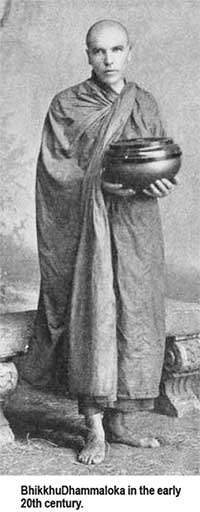
It seems certain now that the first Westerner to ordain as a monk, remain so for an extended period, and have at least some influence, was Bhikkhu Dhammaloka. His early life and given name are uncertain. He reportedly gave at least three names for himself at different times; Laurence Carroll, Laurence O'Rourke and William Colvin. Born in Dublin in the 1850s, he emigrated to the United States, worked his way across the US as a migrant labourer before finding work on a trans-Pacific liner. Leaving the ship in Japan, he made his way to Rangoon arriving in the late 1870s or early 1880s, around the time of the British annexation of Upper Burma. He became a monk sometime before 1899 and started giving public talks a year later. As with some other early Western monks in Asia Dhammaloka urged Buddhists to remain true to the faith of their fathers and not be seduced by the enticements of Christian missionaries. He told the Burmese that their religion was as coherent and as valid as Christianity, if not more so. Being Irish, Dhammaloka was also decidedly anti-British and he attacked the colonial government at every opportunity, making him something of a hero to the Burmese and an irritation to the British. Touring the country huge crowds flocked to listen to the European who lauded rather than disparages the Burmese and their religion. In 1907 Dhammaloka founded The Buddhist Tract Society which during its existence published numerous books and booklets on the Dhamma. His anti-British comments eventually led to Dhammaloka and some of his supporters being charged with sedition, found guilty and fined Rupees 1000 each. Dhammaloka’s numerous Burmese admirers had no problem raising the money to pay his and the other’s fines. Dhammaloka left Burma sometime after this and disappeared from history. He is thought to have died in 1914.More well-known successors to Dhammaloka were H. Gordon Douglas (Bhikkhu Asoka) formerly head of Mahinda College in Ceylon who ordained in February 1899 and died of cholera in Burma in April 1900; the Scotsman Allan Bennett (Bhikkhu Ananda Metteyya) ordained in Burma in May 1902 and founder of the International Buddhist Association and Buddhist Society of Great Britain and Ireland. He died in 1923; Anton Gueth (Ven. Nyanatiloka) of German who was ordained in Burma in 1904 by Ananda Metteyya and lived much of the rest of his life in Ceylon; and J. F. McKechnie (Bhikkhu Silacara) who ordained as a novice in July 1907 in Rangoon. After disrobing in 1925 he continued as editor of The British Buddhist for many years.
However, recent research has uncovered a surprising number of other Westerners who were drawn to the Buddhist monkhood before these pioneers. In the 1870s a destitute Russian became a monk in Bangkok and in 1878 an Austrian man is reported to have ordained in Bangkok. Nothing more is known about these two individuals. In June 1892 a Mr. MacMillan arrived in Ceylon from Scotland and ordained under the name Sumangala. Records from Japan show that a Dr. Norman, "a well-known Englishman"became a monkthere in 1900.A Jewish man named Arnold Abraham or Abrams who had lived in the Straits Settlements in Malaya ordained in Rangoon in June 1904and took the name Dhammawanga. M. T. de la Courneuve was ordained as a novice by Dhammaloka under the name Dhammaratanain Singapore October 2nd 1904. He was an ex-Inspector of Police, Pahang, Straits Settlements in Malaya and his father had been a Deputy Commissioner in the Burmese Civil Service. An individual named C. Roberts, a Welshman who is said to have spoken with an American accent, ordained as a novice probably in Rangoon in 1904. He disrobed in October 1904 after receiving a remittance from parents. He may have put on the robe simply because he was without money. An American sailor whose name has not been recorded ordained in Burma and in 1905 was residing in the Tavoy Monastery in Rangoon.
Others who have come to light include Frans Bergendahl (Sunno), a 20-year-old son of a wealthy Amsterdam merchant and a German Stange (Sumano) were both ordained by Nyanatiloka in 1906. Sumano died in 1910 and Sunnodied in 1915. An Irishman whose lay name is unknown took the name Bhikkhu Visuddha and was involved in mass conversions of untouchable mine-workers in Marikuppam in India in 1907-8. Nothing else is known of him. A Mr. Solomonbecame a novice in Burma in 1907 but was disrobed shortly after for breaking rule about drinking alcohol. The German Walter Markgraf became a novice under Nyanatiloka in 1907 and disrobed half a year later. E. H. Stevenson born in the UK in 1863 ordained under the name Sasanadhajain Burma in September 1908 and is mentioned as giving lectures in Australia on a tour as a missionary for Buddhism in 1910.As with most of these others we have only the barest information about these pioneers, mainly from incidental sources. Because of lack of information it is difficult to know why these men took, what then was such an unusual step and why they eventually disrobed. No doubt some were at a loose end or were eccentrics, others may have developed a fascination for Asian culture and wanted to experience it from the inside. Certainly all of them would have found the climate and food in the tropics challenging, and Asian Buddhist norms so different from their own, and this probably explains why so few of them lasted in the robes for long. One who did survive and indeed flourish was Captain Charles Pfoundes.
Up until recently it has been widely accepted that the British monk Ananda Metteyya’s (Allan Bennett) founded and organized the first Buddhist mission to the West in London in 1908. Recent collaborative research by historians in Japan and Ireland however has shown that this assumption needs to be revised. In fact it was not Theravadian but rather Japanese Mahayana Buddhists who were the first to try to teach Buddhism in the West. In 1889 the Japanese-sponsored Buddhist Propagation Society (BPS) of Japan launched a mission to London led for three years by the Irish-born Buddhist Captain Charles Pfoundes. The Buddhist Propagation Society had chosen a particularly opportune time to send its mission. Gilbert and Sullivan’s Japanese-themed opera The Mikado was running to record crowds in London and several exhibitions of Japanese art in London and Paris had created a fascination in things Japanese.
Charles Pfoundes was born 1840 in Waterford in Ireland in 1840 to Protestant parents who had been bankrupted during the great Famine of 1845-50. Immigrating alone to Australia in 1854he joined the colonial navy and later captained a Siamese ship and ever after usually prefixed his name with Captain. He came into contact first in Thailand and seems to have been fascinated by it. His travels led him to Japan in 1863 where, having quickly learned Japanese he worked in shipping, as a cultural mediator, interpreter, guide and later as a newspaper columnist. He returned to Europe in 1878 via the US, married, worked at various jobs and began giving lectures on oriental subjects, mainly Japanese culture and Buddhism. On his return to Japan 10 years later without his wife he ordained as a priest in Kobe. Throughout the 1870 the Japanese government pressured monks to marry in the belief that it would weaken Buddhism and aid the modernise the country, and many monks gave into this pressure. Thus most Japanese clergy became and remain today technically priests rather than monks. Pfoundes died in Kobe in 1907 at the age of 67.
During his three year mission in London and elsewhere in the UK starting in 1888 Pfoundes’ lectures were well attended given that he was apparently an engaging and interesting speaker. A photograph of him at this time shows him in the full regalia of a Japanese prelate, accoutrements that must have increased his authority and made him appear even more interesting. Newspaper reports of the time show that Pfoundes’ two main subjects were Buddhist doctrine and criticisms of Theosophy which he dismissed as nonsense masquerading as Buddhism.
In 1883 the Theosophist A. P. Sinnet had published his book Esoteric Buddhism which became and remains even today a seminal text of Theosophy. Sinnett claimed that his book was the gist of "psychic communication" he had had with Mahatma KootHoomi, one of the supposed "Great White Masters in the Himalayas". It should be kept in mind that the general public at the time knew little of genuine Buddhism and Madam Blavatsky and Sinnett’s "esoteric Buddhism", actually a mish-mash of late Victorian spiritualism and occultism with a smattering of Buddhism and Hindu, was attracting a great deal of attention. In his lectures, Pfoundes made it clear that Buddhism and Theosophy had nothing in common. Notices in newspapers of the time show that Pfoundes was determined to clarify Buddhism and distinguish it from Theosophy.
Stratford, Enterprise Hall, Great Eastern Road. Sun. December 6th, at 7, Captain Pfoundes, ‘Theosophy: Its frauds and follies.’
Progressive Association, Penton Hall, 81 Pentonville Rd, Sun December 13that 7, Captain Pfoundes, ‘Theosophy: Is it true? – An exposé of a dangerous fallacy.’
Progressive Association, Penton Hall, 81 Pentonville Rd,–January 31st, at 7, Captain Pfoundes, ‘Buddhism not Theosophy: the two critically contrasted’, preceded by vocal and instrumental music.
However, on several occasions Pfoundes went beyond criticizing Theosophy to pointing out the dubious behaviour of some Theosophists, calling Madam Blavatsky a charlatan, Sinnett either delusional or a liar, and Charles Webster Leadbeater a pederast. All these claims have since been shown to have some substanceto them but not at that time and Pfoundes was sued for libel. He settled out of court for 550 Pounds.
Having said all this, it is right to point out that while the early Theosophists had a scant understanding of the Buddha’s Dhamma and the "Great White Masters in the Himalayas" were non-existent, they had an important role to play in the revival of Buddhism in Ceylon and elsewhere, and energised the independence movements in various Asian countries. Their esoteric Buddhism owed almost everything to Blavatsky and Sinnett’s fanciful claims and almost nothing to the Buddha. As Colonel Olcott learned more about genuine Dhamma during his stay in Ceylon is quietly distanced himself from Madam Blavatsky and her followers.Western monks such as Ananda Metteyya and Silacara helped give Asian Buddhists a renewed confidence in their religion while at the same time explaining it to European readers. Captain Charles Pfoundes went to the West to promote it and to help distinguish it from other forms of spirituality. Buddhists both East and West owe a debt of gratitude to them all.
18 06 2016 - The Island
H5.02
A long lost friend?
Ashley de Vos
Following the biased and ‘desperate to fall in line attitude’ towards the voting at the UNHRC sessions held three years ago, and again two years ago in Geneva, the genuinely friendly countries and the quality of this friendship has been exposed and is now in the open. There have been questions raised as to why India, a country that Sri Lanka regards as a friend for a thousand odd years, decided to drag Sri Lanka over the coals twice and abstained once, even though they themselves, had a large hand in most of the problems this island nation has suffered from. Since independence, the creation and nurturing of the separatist insurgents and the insurgency that this island nation was embroiled in for close to thirty years and even the help in latter stages of the war. What is the ‘India’, being referred to, when the concept of an ‘India’ as we know it, is of a more recent origin!
When Alexander, the Greek, captured the different principalities across today’s Afghanistan and in 327 BCE entered the sub-continent through the Hindu Kush, crossing the upper reaches of the river Indus to reach Taxila in 326 BCE, there was no ‘India’ in existence. In 322 BCE when Chandragupta Maurya established his empire that stretched across the north of the sub-continent and south up to the Deccan plateau, and Chanakya his chief advisor promulgated the Arthashastra and Megasthenes the Greek sat in his court, there was no ‘India’ nor a reference to an ‘India’.
In 308 BCE when Arahath Mahinda was sent by his father Emperor Asoka to Lanka to officially establish through Royal patronage the teachings of the enlightened one, there was no ‘India’ as we know today in existence, all dealings were with the north of the sub-continent. Six months later when the branch of the Bodhi tree under which the Buddha attained enlightenment was brought to Anuradhapura by Theri Sangamitha the daughter of Emperor Asoka and the sister of Arahath Mahinda, there was no ‘India’ either.
In the 4th C. ADE when the Sacred Tooth relic was brought to Lanka from the Kalinga Desa, a specific area to the north east of the sub-continent, hidden in a hair knot, there was no ‘India’ in existence. When the Cholas. Pandyans from the south and Kalinga Maga with forces gathered from the south of the sub-continent, devastated the island state continuously for about two hundred and fifty years during the 9th, 10th and 11th C. ADE, plundered, sacked and razed the City of Anuradhapura to the ground, the invaders did not represent an ‘India’, they are officially recorded as marauders from southern parts of the sub-continent only interested in pillage.
Much later in 1519 ADE, when the Moguls under Zahir-ud-Din Mohammed, better known as Babur entered the sub-continent and took Delhi and Agra, there was no ‘India’ in existence. The Moguls fought different Princedoms for a piece of the cake and the Mogul Empire was confined to the North and in the south only up to the Deccan plateau. In 1492 ADE, Christopher Columbus looking for the ‘Land of the Sindu’ as recorded by Alexander the Greek and the Persians as ‘Indu’ after the River Indus, found the West Indies and Brazil first. It was only in 1498 ADE that the Portuguese gained landfall in Calicut, in what they had correctly assumed was the ‘Land of the Indus’, this in their desperate attempt to gain access to the lucrative spice trade of the East Indies. Both the Portuguese and the Dutch were confined to very small pockets on the coastal belt of the sub-continent.
Under the British, the sub-continent was still not a single country. There existed several pockets of human habitation that had not even felt nor even seen British rule. This ‘British India’ with a population of over a couple of hundred million governed by forty two thousand servants of Queen Victoria, even today erroneously referred to as the ‘Empress of India’, had to wait for independence, when over five hundred and fifty Princedoms were coerced to amalgamate at a cost and the ruling families to suffer forfeiture, to form the ‘Modern India’ we know of today. There were four previous attempts recorded to unify the sub-continent, by Emperor Asoka, the Gupta Kings, the Moguls and the British under Queen Victoria, but all ended in failure.
In the historic period, Lanka’s friendly contacts were strongest with the Royal families in north of the sub-continent; even the great Emperor Asoka, the grandson of Chandragupta Maurya saw equality between the peoples in his kingdom and those living in Lanka and was confident that his son Mahinda would not be harmed. The island nation sought alliances with different southern kingdoms, only during the wars with the Chola and Pandya. All confirming, that there was no one single ‘friendly India’ in existence, at least, not till after independence in 1948.
Therefore, it is no doubt strange that, a country that never existed as a single entity is often referred to as a country with which Sri Lanka has had a friendly relationship for a thousand or thousands of years? Today, while Sri Lanka respects the concept of a sovereign ‘Modern India’, she deserves and expects reciprocity from this ‘Modern India’.
This recent creation ‘Modern India’, which encompasses a large part of the original sub-continent, should learn to respect the great philosophies that grew out of its land and show more humility in its dealings especially towards its neighbours. It is a well-researched and a documented fact that, most of the problems Sri Lanka faced in the recent past were created by the need for ‘Modern India’ to settle its own ruffled feathers.
It was only recently, in fact in 1950’s with the help of the ‘Mahavamsa’, the Tika maintained by the monks of the Maha Vihara in Anuradhapura, in Lanka, that ‘Modern India’ was able to accurately decipher the name recorded in the Asokan inscriptions and date the reign of Emperor Asoka, simply because, up to independence, there was no one ‘India’ nor was there a single comprehensive authentic historical record of the sub-continent in existence.
In his book ‘The Discovery of India’ compiled and written while in Prison between 1942 and 1946, Jawaharlal Nehru, later to become the first Prime Minister of ‘Modern India’, presenting his book, referred to it as "an ancestral gift to a new nation." For the first time within its pages he compiled a broad historical view of the sub-continent beginning from the Indus Valley, to include the great philosophies, to the Government under the British, viewed through the eyes of a liberal Indian fighting for the Independence of his Nation. Nehru argues in his compilation that his ‘India’ was a historic nation with a right to sovereignty.
Unfortunately, with regard to the sovereignty of Sri Lanka, this important fact is often forgotten by the emotional, at times immature and self-seeking decision makers sitting on their high horses in Delhi, kicking the vision of the sovereign nations in the region, well and truly in the teeth.
While India has every right to protect its sovereignty and its people Sri Lanka has an equal right to protect its own rights and its people. Unfortunately at times, India and its politicians tend to forget that Sri Lanka is a sovereign country. One cannot understand why?
The fact that, little Sri Lanka a sovereign country, can stand tall and proud knowing that it had a continuous monarchy, an Internationally recognised, a recorded and well documented history for over 2500 years from as early as 500 BCE, adds to the problem that ‘Modern India’ will continue to suffer from, even in the years to come. Unfortunately, this inferiority complex is also seen in the area referred to as Tamil Nadu in the south. Here the different caste groups that sort shelter from the Brahmanical Shivite invasions from the north, are easily hyped and politically stirred up to a frenzy in a celluloid world of make believe. None will be eligible for an Oscar as the film is consumed by over acting or were an Oscar for acting and another for separation promised, during the visit of Madam Hilary Clinton about four years ago? Their aged and not so aged leaders still think that they are Hero and the Heroine embroiled in the drama being played for their political survival, a phenomena that usually peaks at election time.
K.M. De Silva, editing the British documents on the end of the Empire, in Series B Volume 2, Part ll Towards Independence 1945-1948 reveals in 396, on page 302 under External Defence 18 the following. ‘A threat to the territorial integrity of Ceylon is likely to come only from India, although a full scale attack from that country is only likely to occur if she were overrun by, or had thrown in her lot with a hostile power.’ And on Internal Security 20. ‘The danger of India (particularly Congress India) interfering with Ceylonese internal politics and provoking dissension among the powerful Indian minority is a real one.’
‘The training by former Indian military, the financial assistance given by the Indian Government under the logistics support given by Tamil Nadu to these militant groups makes ‘Modern India’ an accompli to murder for every act of terror committed against this island Nation, over a period of almost 3 decades’.
Sri Lanka wants desperately to imitate Singapore, a City State, always run by her late Prime Minister Lee Kuan Yew as a dictatorship and a police state. But to her credit at every instance her Leaders dished out Singapore always first, and everyone else, second. Cannot our leaders stay proud as Sri Lankans, and regard everyone else including India second. Is it not possible to think of this country and its people first and not as a "Puwak" held in the hands of a neighbour who towers above with a "Giraya" ready. Or is it the blood drenched Nobel Prize that is desperately sought, to hell with the consequence and the unborn generations.
05 09 2016 – The Island
H5.03
Spreading the Buddha’s word
Inscription from Sanchi mentioning a woman ‘who knows a Pitaka.’
Bhante Dhammika of Australia
As a Buddhist I believe that the Dhamma had one enormous advantage over most other philosophies or ideologies – it is true. But I am also aware that it has several serious drawbacks, obstacles and stumbling-blocks that hinder an understanding of it and of its dissemination. To my mind the most serious of these drawbacks is the Tipitaka, the sacred scriptures. The New Testament is small enough to fit comfortably into the average pocket. Likewise, an English translation of the Koran without the Arabic text can be easily published as an average sized paperback. By contrast, the Pali Texts Society’s English translation of the Tipitaka takes nearly 50 volumes. Here is an example of where big is not necessarily better. In my years as a monk in Sri Lanka I have never known or even heard of any Buddhist lay person who has even 5 or 10 volumes of the Sinhala Tipitaka in his or her home, let alone the whole thing. And of course if you do not have a book readily at hand you are unlikely to read it.
Then there is another problem - that of translation. As astonishing as it seems, the first living language the Tipitaka was translated into was not Burmese or Sinhala, Thai or Cambodian, but English. Buddhist countries had the Tipitaka for centuries; worshipping it, putting its pages between gem-encrusted covers, rapping its volumes in silk brocade and storing them in beautifully crafted and decorated cabinets - but they never translated it into a commonly spoken tongue. The Culavamsa mentions that one Sri Lankan king had the Jataka translated into Sinhala but it is unlikely that this translation was widely available; it was probably kept in the palace library.It is interesting to note that the unavailability of the Buddhist scriptures in ancient times seems to have nothing to do with the likelihood that the majority of people were illiterate. The evidence suggests that in Buddhism’s first few centuries many lay people had access to, read and were familiar with the sutras. Here is some evidence of this. Monks are supposed to stay in one place during the vassa, the rainy season. But the Vinaya says that a monk may leave his residence if he hears that a lay person who knows a sutra by heart which he does not know; is dying; he can go and learn the sutra from that lay person.
So some lay people must have been known enough that monks could sometimes learn from them. The impressive stone railing around the Sanchi stupa had inscriptions on it mentioning the people who donated the money to construct this railing. Some of the men and women mentioned in these inscriptions are described as ‘learned in a Pitaka’, ‘who knows many sutras’, and ‘well-versed in a Nikaya’. The Divyavadana, a Sanskrit work from about the 1st or 2nd century CE, describes a group of travelling merchants rising early in the morning to read some of the sutras.
The so-called Sigiriya Graffiti indicates that Sinhala people of many different classes and professions could not only read but write well and even compose verse of a high standard. But, in the case of Sri Lanka there is no evidence that these people had access to the Tipitaka, which of course was kept in Pali.With the approach of the Buddha Jayanti in the early 1950s calls were being made to make the Tipitaka available in ordinary languages. The ministries of religious affairs or of cultural affairs of the countries that celebrated the Jayanti undertook to do this, but as seems that the initial enthusiasm soon slowed to a crawl. As for the Sinhala Tipitaka, 60 years after the project started it is still not finished. But beyond this unexplainable delay are other problems. Each volume of the Sinhala Tipitaka is very large and even two or three copies would be quite expensive for the average person. Then there is the problem of accessibility. I cannot read Sinhala, but monks who can tell me that the language in the translation is high Sinhala; archaic and difficult to read. Several monks have even told me that they actually find it easier to read the Pali than the old-style Sinhala. But it gets worse! Even if you were prepared to persevere and struggle to understand the language, just trying to get a volume requires time and trouble.
The volumes of the Tipitaka available so far can only be had from two or three outlets in the whole country. The Bible is available in nearly every hotel room in Sri Lanka, but trying to find the Tipitaka remains a desiderata. The same situation prevails in Myanmar, Thailand, Laos and Cambodia. The sad truth is that other than the Dhammapada and small booklets containing the Mangala Sutta, the Metta Sutta, the Sigalovada and a few others, the thousands of other discourses of the Buddha remain unknown to the average person. All that wisdom is available mainly to a small elite who can read Pali, i.e the Sangha. Things are very different for western Buddhists. Over the last several decades the American monk Bhikkhu Bodhi has translated all the Majjhima Nikaya, the Anguttara Nikaya and the Samyutta Nikaya into accurate, lucid English and enhanced each with excellent explanatory notes. This has been a major undertaking – all done by one monk! And what’s more, these volumes are available in many ordinary bookshops in the West and on Amazon. And these translations sell well; Western Buddhists have a hunger to read what the Buddha said rather than just hearing the Dhamma preached in sermons or explained in secondary literature. Other books from the Tipitaka have been translated by Maurice Walsh, I. B. Horner, K. R. Norman and others and are all easily available.
There are several things that make any religion vibrant and healthy, and one of these is a laity well-read in the sacred literature. The Buddha was clear that he wanted all this disciples and followers to know the Dhamma well. In the Mahaparibbana Sutta he said: "I shall not die until the monks, the nuns, the laymen and the laywomen have become deeply learned, wise and well trained, remembering the teachings, proficient in the greater and lesser doctrines, virtuous and learned; not until they are able to tell it to others, teach it, make it known, establish it, open it up, explain it and make it clear; not until they are able to refute false doctrines taught by the others and to spread the convincing and liberating truth abroad."
Sri Lanka is beautified with hundreds of stupas and new ones are constructed every decade or so; it is studded with numerous viharas; elaborate eye-pleasing pujas and religious ceremonies are celebrated every year; pious people donate money to print books on Dhamma for free distribution, sometimes including a few already well-known sutras. But almost no thought is given to making the great treasure-trove of the Buddha’s words more available for the ordinary man and woman. Given this sad situation I would like to suggest several things that could be done to rectify it.
The Cula Tipitaka
A selection of several hundred sutras should be translated into modern every-day Sinhala and published in a single volume. The sutras selected should give preference to those dealing with subjects likely to be of interest to the average person; i.e. lay people. There should be explanatory notes, a glossary and a detailed index. Called The Cula Tipitaka, The Small Tipitaka, it should be made available at cost price or if possible for free; generous donors could pay for reprinting it in memory of their departed loved ones. Just as importantly, it should be as easily available as possible. Every school library and public library should have a copy. Wouldn’t this be wonderful, wouldn’t it be a true Dhamma-dana? Further, if an effort were made to have this Cula Tipitaka translated into English and have a copy placed in every hotel room in the country tourists who came here could go back home with just more than photos and good memories. Some might be drawn to the Dhamma.
The Buddha’s Words. One would have to admit that the many of the sutras are not easy to read; some are long, often due to continual repetitions. So together with The Cula Tipitaka another book should be published made up of extracts from the sutras, taking the best of the sutras. In this form the book could include far more material than possible in The Cula Tipitaka. Other than this, such a book should have the same character.
Several decades ago a Japanese industrialist and devote Buddhist set up an organization called Bukkyo Dendo Kyokai to publish a book called ‘The Teachings of Buddha’ similar to the ones I am proposing. This project has been highly successful. The book is beautifully produced, with fine paper and binding, so far over 8 million copies have been printed, it has been translated into 45 languages and it is available in thousands of hotels all around the world. Further, the book is free. Unfortunately, despite these achievements it has several drawbacks. In the English edition at least, the languages is awkward and clumsy, the reference system is confusing, and including of both Theravada and Mahayana sutras leaves the reader unsure and slightly confused as to exactly what Dhamma is. This project shows what could be done. But it also offers a warning that such a project as I am proposing should be done with careful and realistic forethought, considering all the options and keeping the goal always in mind – making the Dhamma available, appealing and understandable to the average person.26 11 2016 - The Island
H5.04
A legacy both religious and cultural
Kumudini Hettiarachchi
For an enriching experience spend time at the Vidyodaya Pirivena, a haven amidst the bustling city
Samaneras at their books in the Dharma Shalawa with paintings by M. Sarlis on the wooden roof.
Pix by M.A. Pushpa Kumara
Fame it has achieved as a seat of learning nearly 150 years ago, spreading the gentle and all encompassing message of metta (loving kindness), karuna (compassion), mudita (sympathetic joy) and upekkha (equanimity) of Lord Buddha.
Even now, about 250 samaneras, small and big, in their saffron-robes gather after regular school for lessons on the dhamma at the Vidyodaya Pirivena in Maligakanda amidst the hustle and bustle of Maradana.
While millions of Buddhists clad in white will throng temples bearing trays of lotuses or light little clay lamps and joss-sticks on the thrice-blessed day of Vesak to pay homage to the Buddha or string up colourful kudus from the eaves of their homes, within the serenity of the Vidyodaya Pirivena lies enfolded a most revered relic.The largest fragment believed to be from Lord Buddha’s ‘dane welandu paatraya’ or his very begging bowl is enshrined in the pirivena’s ‘Dathu Mandiraya’ (Relic Chamber).
It is not only this relic, an exposition of which is held every six years, that should beckon the devout Buddhists to gather in their numbers but also the full legacy, both religious and cultural, of the Vidyodaya Pirivena now under the guidance of Chief Priest Balangoda Sobitha Na Himi.
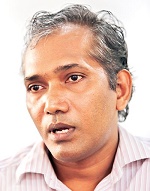
Gayan Vidanapathirana
For, this was the hub from which the Buddhist revivalist movement blossomed in the 19th century under the inspirational guidance of the erudite Hikkaduwe Sri Sumangala Thera (1827-1911) who was also a fiery orator. His name is inextricably linked to the famous Panadurawadaya, the religious debate between Buddhist monks and Christian missionaries in Panadura in 1873 while then Ceylon was under the yoke of the colonizers. Not only was he founder of the Vidyodaya Pirivena, when missionaries were establishing schools across the country, he was also appointed Chief Priest of the holy mountain of Sri Pada in 1864.
“The Bowl Relic was the largest of 13 fragments excavated in the late 1800s from Sopara near Mumbai, India,” says the pirivena’s spokesperson Gayan Chanuka Vidanapathirana, adding that as eminent Hikkaduwe Sri Sumangala Thera was not only well-known for his scholarship but also much respected, this relic was presented to him as also numerous others. And it is not just Buddhist relics that have been gifted to him, for preserved in the museum of the Dathu Mandiraya just beyond the Bowl Relic is a tome-like Bible along with its case.
Hikkaduwe Sri Sumangala Thera: Painting by Richard Henriques
The beautiful Bible had been a gift by none other than Edward VII, ‘King of the United Kingdom and Emperor of India’ from January 22, 1901 to 1910.
On Tuesday, shoe-wear cast off, unperturbed by the noon-day heat in the green and still haven that is the Vidyodaya Pirivena with only muted sounds of the city indicating that this is Colombo, we go back in time, more than 2,500 years, to be enriched once again by the life of one of the greatest philosophers of this world who pointed people in the direction of the Middle Path.
The most prized possession - the Bowl Relic - lies within three caskets (karandu) – the inner-most of crystal, then silver and outer-most of wood in the Dathu Mandiraya accessed by two wooden staircases, the ground floor of which had been the Spartan avasaya (abode) of Hikkaduwe Sri Sumangala Thera.
The most number of Buddhist relics, coming in second only to the hallowed Ruwanveliseya in Anuradhapura, is enshrined in the Maha Stupa or Chaithya of the Vidyodaya Pirivena, says Gayan, adding, “Ganan karanna beri pramanayak nidan karala thiyena”.
The pinnacle placed in 1906 is unique, according to him, for there was no protective lightning conductor nor were chuda manikya enshrined but a swarnalepa Buddha prathimavak in a cone-shape.
All these had been donated to the Vidyodaya Pirivena due to the fame of Hikkaduwe Sri Sumangala Thera both locally and internationally and is attributed by Gayan to his “silvath kama, gunawath kama and ugath kama”.
The fragment of the Bowl Relic of Lord Buddha
While Hikkaduwe Sri Sumangala Thera had read the Tripitaka (the sacred scriptures of Buddhism) 36 times, he had also mastered nine languages including English and was thus able to exchange views and engage in debates with the colonizers. Many including members of the royal families of Thailand, Cambodia and Burma had arrived in delegation to pay homage to him, while numerous Buddhist relics had been gifted to him from India and Pakistan.
Among the treasured sepia-toned photographs preserved in the museum are those documenting a visit by Mahatma Gandhi to the Vidyodaya Pirivena and the letter authorizing Sir Henry Steele Olcott to promote the Sasana and establish Buddhist schools such as Ananda College, a stone’s throw from the Vidyodaya Pirivena, with the first signatory being Hikkaduwe Sri Sumangala Thera.
It was also this scholar-monk from among a handful who paved the way for greats such as Anagarika Dharmapala and Bramacharya Walisinghe Harischandra to take up the quest of spreading the teachings of Lord Buddha far and wide and reviving Buddhism.As we linger awhile under the rustling leaves of the bodhiya, all pointers are that the bodhiya too is old, easily spanning a hundred years, with the bo-maluwa taking the unique shape of a crown.
Ensconced between the bodhiya and the Dathu Mandiraya earlier known as the ‘Poth Ge’ is the Sri Sumangala Dharma Shalawa with direct access through a sky-walk to the Dathu Mandiraya. While the samaneras in little groups take up their books in the Dharma Shalawa, an upward glance at the wooden roof brings into focus beautiful paintings in the Kandyan style.
The masterpiece here is the Dharmasanaya (the seat from which the monk preaches bana), intricately carved of ebony and donated to the Vidyodaya Pirivena back in 1930.
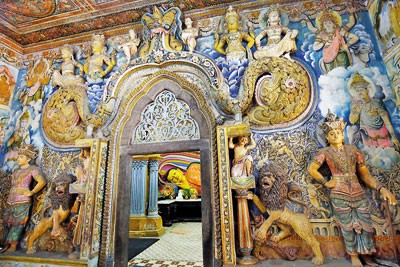
The ornate art of the Budu Ge
Meanwhile, the museum portraying a large painting of Hikkaduwe Sri Sumangala Thera by Richard Henriques in 1899, is home to the basic knick-knacks used by this monk in his frugal life such as brass pots, a bronze water kettle, a wooden plate, a pair of spectacles and walking staff, a plump ink-pen and much more including panhinda (writing stylo) used for ola leaves and also ola booklets and moth-eaten, yellowed and frayed letters, testimony to the monk’s sphere of influence.
In the premises of the Vidyodaya Pirivena, within a small commemorative tomb taking the shape of a stupa, lie the ashes of Hikkaduwe Sri Sumangala Thera.
As we depart, the thought uppermost on our minds is “why, oh why” do we need to venture on pilgrimages far out of Colombo, when right in the city’s heart at Maligakanda, on our door-step, lies the ‘eye’ of the cyclone of life that is the Vidyodaya Pirivena. Here we can meditate, listen to bana, observe sil and re-integrate enriched and re-invigorated, into the rat-race of modern-day living.
The Budu Ge, a work of art
The Budu Ge with the reclining, standing and Samadhi Buddha statues is the sparkling gem in the crown of the Vidyodaya Pirivena.
Old murals on the walls and the roof depicting the Jathaka stories, encapsulate through brush and paint, the life of Lord Buddha, from birth to enlightenment to attainment of nirvana, while sculptures of lions, makara thorang and leaders enhance the scenes. The artwork is by well-known Buddhist revivalist painter M. Sarlis.
Even the panels of the wooden door leading to the inner sanctum exhibit colourful paintings as well as a wonder of yore – the art of fixing iron-hinges which link the doors to the stone (kalu-gal) arch.sundaytimes.lk/170507
H5.05
When the Tripitika was first written
P.S. Mahawatte
The articles by Dr. Dharmawardana from Canada and Bandu De Silva from Colombo, referring to the Banthe’s article summed up politely as "what comes out is a presentation of the life of Buddha with the least elaboration".
In Bante Dhammika’s letter in The Island of 2nd May 17, he wants to know "when and where the Tripitaka was first written" rejecting Dr. Chandre Dharmawardene’s (CD) explanation "that the Tripitaka was first committed to writing in the first century BCE at Aluvihara in Sri Lanka" as "oft repeated ‘fact"!
As a retired professional devoting most of his time to learn as much of the Dhamma taught by the Buddha (not Jathaka stories), I would like to confirm Dr. CD’s explanation and provide more details from my notes of respected authorities.
First Council was held three months after the Great Demise of Buddha by Maha Kasappa with other Maha Theras called the 1st Council to recite the Dhamma, to review and to rectify any irregularities so that nothing was lost or inadvertently included.
"The First Great Council was held at Rajagaha under the patronage of King of Magadha".
"At this First Great Council Maha Kassapa Maha Thera assigned specific sections of the Dhamma to particular monks and groups of monks to be their custodians and to have them memorized and handed over from Teacher to Pupil"
The Vinaya Pitaka was entrusted to Upali Thera and his pupils. The Samyutta and Anguttara Nikaya to Ananda Maha Thera."
"These Theras to whom these tracts were assigned together with their pupils were expected to be able to recite them from memory without a flaw. Such reciters were called "BHANAKAS".
Note. The entire cannon was handed down in the oral tradition for the next 500 years until it was finally committed to writing at the fourth great council in 25BC in Sri Lanka. It was during King Vattagamini Abhaya at Matale (Aluvihare).
"Writing down of the Buddhist Cannon in 1st century BCE was the greatest contribution that the Sinhalese people had made to the intellectual heritage of Mankind"(Dr. Paranavitane in 1959) We highly respect Dr. Paranavitane’s writings.
The Second Great Council was held at Vesaki, 100 years after the Great Demise of the Buddha.
The Third Great Council was held at Pataliputra during the reign of Emperor Asoka.
The Fifth Great Council was held at Mandalay, Burma under the patronage of King Mindon.
The Sixth Great Council, the last council, was held in Rangoon to mark the 2500 years after the demise" of the Buddha.
06 05 2017 – The Island
H5.06
When the Tripitika was first written
Opinions expressed by Western and Indian scholars
Bandu de Silva bandudes@gmail.com
P.S. Mahawatte has in recent letter in The Island of May 06 related the usual traditional opinion on the date of committing [Pali] Tripitaka into writing. There is a wealth of opinions expressed by Western and Indian scholars on the codifying of the Pali Tripitaka, first in oral version before it was committed to writing which would be useful reading for anyone to gain an idea of the process in which what has come down came to be. Though Prof Romila Thapar has tried her best (Asoka and the Decline of Mauryas, Delhi, Oxford University Press, 1993), there is no unanimity on the subject of growth of Tripitaka. It is generally believed that the present text was decided at the Third Buddhist Council held in Pataliputra in Asoka’s time but the historicity of this Council having been held under Asoka’s patronage remains doubtful. It is however, conceded that a Council may have been held under Ven. Moggalipuuta Tissa who is a historical figure. (His relics were discovered). Asoka does not mention in his Edicts of having given patronage to the Council but refers to Schism in the Order and advocating practice of tolerance.
The Pali chronicles, however, give exaggerated importance to this Council, perhaps, to emphasise the significance of the writing down of Tripitaka in the 1st century BC.
Here again writing down the whole of Tripitaka would have been a tremendous time-consuming task to be completed in one go. Could Alulena provided the physical space alone for an enclave to be held for such a task? It would be safe to believe that the task began in the time of Valagamba but continued to later times. Valagamba’s reign was marked by the devastating long famine in the island known as Baminity(s)aSaya.. Though the king who ruled for 14 years reconstructed irrigation works to overcome the ill effects of the famine, it would have taken sometime to remove the effects of that famine. Under such circumstances, it is unthinkable that MahaSangha could have been in enclave to fulfil the mentioned task in a short time.
The most likelihood is that the writing down of the Tripitaka was a continuous process commencing from the 1st century B.C. onwards. Thapar’s view is that the story of Ven. Mahinda found in Sri Lankan chronicles could be an attempt to prove that that he was a follower of Vibhajjavada, which came into existence shortly after Buddha’s demise which the southern Buddhists consider the doctrine that Buddha preached.
There are several versions of the Tripitaka besides the Pali one. These are the Sanskrit version, Tibetan Version, Khotanese version, Chinese version and Korean version. One should examine their relationship to the Pali version
And the dates on which they came into existence. The Dhammapada seems to be common to all of them. It looks a late work written in easy-to –memorise "sutra" form. Could that be a clue to dating the Tripitaka in all versions?
One should also examine the relationship of Tripitaka to Mahayana doctrine which came to dominance between 1st C A C and in Sri Lanka four to five centuries later.
09 05 2017 – The Island
H5.07
The city John Marshall wrote about
Sumaira Jajja
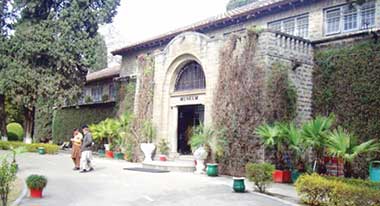
The foundation stone of the Taxila Museum was laid in 1918 by Lord Chelmsford
Located just a few miles on the outskirts of Islamabad is one of Pakistan’s most astonishing heritage sites, the fabled city of Taxila. Taken from the Sanskrit term "City of Cut Stone", Taxila is a must-see location. Dating back several thousand years, it has witnessed some of the milestone events in the history of the subcontinent.According to tradition, the Mahabharata was first recited at Taxila - or Takshashila. The city witnessed some of the greatest figures of history going through it, including Darius I, Alexander the Great, Chandragupta Maurya and Ashoka. Chanakya (Kautilya), Ancient India’s very own Machiavelli and an adviser to Chandragupta Maurya, is also said to have taught at the university in Taxila.
A valuable site for tourists and students of history, Taxila was once a seat of Buddhist learning. Many come to pay respect to this place because of the great significance it holds for Buddhists everywhere, similar to what Al Azhar University means to the world’s Sunnis or what Qom and Najaf is to the Shias.
According to tradition, the Dharmarajika Stupa housed the bone fragments of Buddha himself. The surrounding ruins, archaeological dig sites and the lush green grass take your breath away. It is easy to imagine being there in ancient times when Buddhist priests would sit underneath the surrounding trees and debate theological questions.
Though there has been much discussion about whether Taxila University could actually be called just that, there is little doubt that it is one of the oldest locations of higher learning anywhere in the world.
Nurtured by Greek rulers who succeeded Alexander, as well as by Chandragupta Maurya and Ashoka, during the Gandhara period that dominated the region, Taxila was the place to go for higher learning and teaching.
There are several monuments around the area, including decaying statues of the Buddha, as well as burial sites of Buddhist priests. During British rule, in the early half of the 20th century, archaeologist Sir John Marshall first carried out excavation at the location over a period of 20 years. The surprising thing about the archaeological find is that even though excavations first began over a hundred years ago, nearly 90 per cent of the site is still unexplored.
Driving a few miles from the site and towards the modern city of Taxila, one must take a stop at the local museum that houses relics and artefacts discovered during the excavations. The museum was built during the British Raj and was cultivated by Sir John Marshall, whose portrait greets you at the entrance of the main building. The building is built very much in the architectural style of the British colonial era, with limestone buildings preserving a rich cultural heritage within its four walls.
The foundation stone of the Taxila Museum was laid in 1918 by Lord Chelmsford. The interior of the museum is very well-maintained, which has two main wings to your right and left as soon as you enter. The wooden flooring, columns and ceiling, as well as the wood and glass cases are simply magnificent.
The polished wood glimmers whenever rays of the sun enter this confined place. The museum displays are dominated by Gandharan Buddhist art as well as utensils that were used by the villagers in Taxila many centuries ago. Huge statues of Buddha, including his head are placed behind enormous glass cases. Replicas of Buddhist statues, the Dharmarajika Stupa, as well as a large model of the archaeological site are all on display there.
One of the best displays at the museum is of a mannequin dressed up in velvet clothing and ancient gold jewellery. Those familiar with German archaeologist Heinrich Schliemann’s famous photo of his wife covered with the so-called jewels of Helen of Troy, will notice a resemblance.
It was interesting to note that a number of visitors are youngsters, who seemed to be in awe of the accomplishments of the people who lived on this land thousands of years ago. Drawn towards the face of the Buddha peacefully meditating behind the glass case, they urged their parents to keep up with their sense of wonderment while they ran from one end of the museum to other to marvel at each relic.
The Taxila Museum may well be the best-preserved museum in Pakistan; it certainly has the best collection of Buddhist art one is likely to find in the country. The guards at the museum and the curators are very friendly and more than willing to help you get a clear perspective about each heritage piece. However, don’t be too surprised if they expect some monetary contribution for their often unsolicited help.
It is sad that this heritage site is not marketed for the entire world to see. Lack of public interest and poor marketing has made this and many other sites unknown to the outside world. Taxila and other heritage sites are without proper care and are in great danger of irreparable damage.04 05 2018 - The Island
H5.08
On the History of Vesak
Bhante Dhammika of Australia
Today is Vesak, the most universally observed of all Buddhist celebrations or holidays. Traditionally it is believed that the Buddha was born, awakened and passed into final Nirvana on the same day, the full moon of the second month of the ancient Indian called Vesakha, which corresponds to the modern April-May. For at least the last 60 years Vesakha has been widely pronounced as Vesak, the Sinhalese way of saying it. Why not the Thai (Waistkha), the Tibetan (Sa Ga Dawa), the Korean (Seokga Tansinil) or the Vietnamese (Phat Dan) forms? Or for that matter, why not the Pali/Sanskrit Vesakha? Because in 1950 the inaugural meeting of the World Fellowship of Buddhists was held in, paid for and very much dominated by Ceylon, and so that country’s way of saying it became current.
1. The Japanese custom of bathing a statue of the baby Prince Siddhattha
2. A parade of lotus lanterns in Korea on VesakVesakha has not always been a major celebration in all Buddhist countries. In Thailand it was only a low-key ecclesiastical holiday until 50 years ago, as was Magha Puja and Wan Asanha Bucha. The big holidays and celebrations were Hindu ones: Songkran, Loi Krathong, etc. and in the north of the country Inthakin, the water throwing festival, and several others. In Sri Lanka campaigning in the early 1880s to have Vesakha made a public holiday continually failed until Colonel Olcott went to London to petition the British authorities and finally succeeded in 1885. Malaysian Buddhists hardly celebrated it at all until the dynamic American monk Venerable Sumangalo popularised it and began petitioning the British government to make it a public holiday in the 1950s. Although the majority of Singaporeans have always identified themselves as Buddhists no move by any of them to make Vesak a public holiday was made until 1947. In 1950 after receiving several petitions subsequently the government formed a committee to look into the possibility of making Vesak a public holiday but found little public support for it. It only became a public holiday in 1955.
Interestingly, there is very little information about how or exactly when the Buddha’s birth, Awakening and passing was celebrated in most Buddhist countries in ancient times. The records are blank except for India and Sri Lanka. The Chinese pilgrim Xuanzang who was in India in the 7th century wrote this concerning how and when Buddhists celebrated these events. "The Bodhisattva was born on the 8th day of the second half of the month of Vesakha… But the Sthavira school hold that it was the 15th day of the second half of Vesakha. It is said in the ancient records that the Buddha entered Parinirvana… on the 15th day of the second half of the month of Vesakha… But according to the Sarvastivada school he entered Parinivana on the 8th day of the second half of the of the month of Karttika. The Tathagata attained full awakening on the 8th day of the second half of the month of Vesakha on the Indian calendar. But according to the Sthavira school the event occurred on the 15th day of the second half of Vesakha. The Bodhisattva was born on the 8th day of the second half of the month of Vesakha… But the Sthavira school hold that it was the 15th day of the second half of Vesakha."
So it would seem that the Mahayanists and the Sthaviras (the Indian version of Theravada) disagreed on the days these events occurred, although not the month. Exactly how the celebrations were conducted Xuanzang gave no information. However, he did say something about the Vesakha celebrations at Bodh Gaya. "Each year on that day the monarchs of various countries and the monks and laymen of different places gather here in hundreds of thousands and bathe the Bodhi Tree with scented water and milk to the accompaniment of music, flowers and lamps burning continually and vie with each other in making offerings to the Tree."
Vesakha was first celebrated on a wide scale in Korea during the Silla period in about the 7th century when what was called the Lotus Lantern Festival (Yeon Deung Hoe) was inaugurated. People would make lanterns in the shape of lotus flowers and hang them in temples, a tradition that has continued until today.
At the beginning of the 5th century an earlier Chinese pilgrim, Faxian witnessed how Vesakha was celebrated in Patna. "On the 8th day of the second month (i.e. Vesakha) there is a procession of images. They construct a four-wheeled car and erect upon it a tower of five stages made of bamboo lashed together, the whole being supported by a central post… so that it looks like a stupa. Then they cover it with fine white linen which they later paint with bright colours. Having made figures of devas and decorated them with gold and silver they place them under canopies of embroidered silk. Then on each of the car’s four corners they make shrines in which they place images of the Buddha in the sitting posture flanked on each side by bodhisattvas. About twenty such cars are each somewhat differently decorated. During the day of the procession monks and lay people gather in great numbers with chanting, music and the offering of flowers. After being invited to do so by brahmacariyas (lay people keeping the ten Precepts for the day) the cars enter the city and then stop. All night there is chanting and music by the people who have gathered from many different regions." This is most interesting because it is the earliest reference to the chariot festivals, still done in Nepal and parts of India.
The earliest reference to Vesakha celebrations in Sri Lanka is from the 1st century BCE. It must have been a major, probably the major, religious festival. In the Mahavamsa the reign of some kings is measured by how many Vesakhas they had celebrated. But exactly what form the celebrations took the chronicle gives no information. The Mahavamsa reports that Sena II "celebrated the Vesakha festival with the poor, giving them food and drink and clothing as they desired." The Chinese pilgrim Faxian spent two years in Sri Lanka at the beginning of the 5th century. He witnessed one festival to the Tooth Relic during which large brightly coloured depictions of all the Jataka stories "looking completely life-like" were set up on each side of the roads in the capital. Again, this is interesting because it could well be an account of how Vesakha is celebrated in Sri Lanka today. At main intersections in many cities and towns large plywood boards with illustrations of Jataka stories or events in the life of the Buddha painted on them are erected. Nowadays most of these pandols as they are called, are illuminated with thousands of light bulbs, some of the figures move, and loudspeakers explain each story. In Faxian’s day they would have been illuminated by oil lamps.
A practice that has become widespread and popular in recent decades is having a statue of the baby Prince Siddhattha and tipping water over it. This is in imitation of the legend that when the holy prince was born that water fell from the sky to wash him. This is a lovely way of honouring the Buddha and something children can participate in, but it has no precedence in Sri Lankan history. It originated in Japan from where it was introduced several decades ago.
29 04 2018 - Sunday Island
H5.09
Buddhist cartography, a lost tradition
Bhante Dhammika of Australia
A Burmese world map dated 1850
The Buddha’s contribution to human knowledge was primarily focused on ethics and to the analysis of consciousness; its contents, its workings and to how it could be harnessed and transformed. He also had an indirect influence on the development of Indian medicine. His de-emphasis on ritual impurity meant that physicians, many of whom were Buddhists in the early centuries BC, could touch their patients and even dissect corpses, essential for the development of anatomy. One area of human knowledge that later generations of Buddhism made a contribution was cartography. Yes cartography, the study and practice of making maps. The foundations of this skill were laid by the Buddha with his vision of the universe and the place of the Earth in it. In fact, his ideas about the universe were probably the most accurate until the 14th century. Rejecting the concept of divine creation over a period of six days, freed him to speculate somewhat rationally about it. Very briefly, he posited the universe coming into being through natural forces, of being countless millions of years old, of going through cycles of expansion and contractions, of countless ‘world system’, or what we would call galaxies, being disk-shaped (cakkavala), and so on. His idea that the Earth was supported by the four elements and space (suspended in space?) was miles ahead of the prevailing theory that it was perched on the back of a huge elephant which in turn stood on the back of a cosmic turtle. An early Buddhist text even says that the Earth spins "like the stone of an oil press" although it’s not certain whether it is referring to the Earth as a disk or a globe.
We know from literary sources that Buddhists, mainly monks, started making maps from about the 6th century onwards although sadly none from that period and even few from later times have survived. The motive behind these maps was mainly to help pilgrims to find their way to various sacred places, within their own countries but also to other countries beyond their own. As monks were great travellers some of them took careful note of what they saw as they traversed to the countryside.
Ancient Buddhist maps often showed either Mount Meru or Bodh Gaya in their centre. The most famous of these is the Gotenjiku Zu, Map of the Five Indias, drawn by the Japanese monk Juaki in 1364. This map is based on Xuanzang's account of his pilgrimage to India (he gave accurate distances and directions from one place to another) and indeed even marks his route with a red line. Mount Meru and Lake Anotatta with the traditional four rivers flowing out of it is shown in the centre, while Bodh Gaya is located towards the south-east. The purpose of the Gotenjiku Zu was didactic and scholarly more than practical. This is clear from Juaki's own words. He wrote: "With prayers in my heart that Buddhism might prosper, I engaged myself in the task of making this map, wiping my eyes which are dim with age, and feeling that I myself were actually traveling through India."
In 1202 the Japanese monk Myoe Shonin (1173–1232) decided to undertake a pilgrimage to India. As part of his preparations for this seemingly impossibly difficult undertaking he actually tried to calculate the distance involved and the time it would take if he set out from Ch’ang-an, the Chinese capital. His calculations are to be found in Dai Nihon Shiryō where he wrote: "If I walked 7 long ri a day, I could reach India in 1,130 days, arriving on the 20th day of the second month of the 4th year of my travels. And if I walked 5 ri a day, I could at long last arrive on the 10th day of the 6th month of the 5th year, a total of 1,600 days." Myoe Shonin was not making a complete stab in the dark, he had carefully studies earlier maps and had sort advice from other monks and merchants who had been to Central Asia and India. Later he drew up a map to accompany his calculations but it has not survived.
A Japanese map called Map of Jambudvipa from 1710 shows India in the centre, China to its right, and a little further along, Japan. However, route maps meant to be used existed too. These were probably not available for ordinary pilgrims but were made by and for merchants and royal embassies. One of the few such maps that survives, from northern Thailand, was drawn in the early 19th century although based on a much earlier prototype, probably by someone who had actually been to India. The map shows important pilgrimage sites such as Rajagaha, Kusinara, Campa and Dona's stupa, and gives their direction and the number of days needed to reach them from the Mahabodhi Temple, which is depicted in the centre of the map.
A type of maps that became popular in Tibet were street maps of towns and cities, the earliest of these to survive was drawn in 1632. These street maps were pictorial in concept but were meant to be used so that strangers to a town could find their way around. They were usually posted in the veranda of the local temple, the focus point of any town and the first place a visitor would go..
While all these maps are extremely interesting in themselves, they also say something about traditional Buddhist cultures. By the 15th century, European maps were starting to become increasingly accurate and realistic while Buddhists maps by contrast, remained almost unchanged right up to the late 19th century, when they were abruptly and entirely superseded by modern maps. Geographical knowledge grew decade by decade but Buddhists ignored the new findings and clung to the past. A Burmese map from about 1850 is evidence of this, it is a beautiful piece of cartography but it bears no relationship to reality. Despite this, Buddhist cartography in ancient times made small but significant contributions to a knowledge of the world.30 06 2018 - The Island
H5.10
Deur Kothar, the earliest evidence of Buddhism
Bhante S. Dhammika of Australia
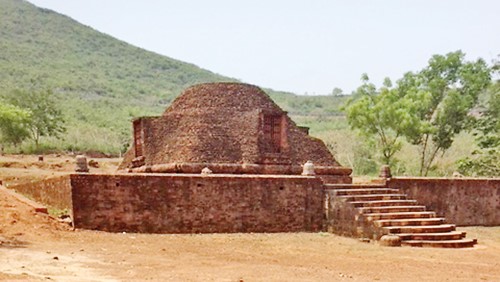
Stupas at Deur Kothar reconstructed by archaeologists
We take it as granted that the Buddha was a real person, that he did the things that are said of him, and that he taught the Dhamma that we are familiar with. Further, almost all historians accept that the Buddha was a real person. However, there is no actual contemporary or near contemporary material evidence of the Buddha’s existence. The same is true for most other ancient founders of religions.
But recently, archaeological discoveries made in India have pushed back evidence for Buddhism, and, therefore, for the Buddha himself, to perhaps only four or five generations after his time, perhaps even earlier than the evidence provided by King Asoka’s inscriptions. This evidence has come from a so far little-known and remote site in the northern part of the Indian state of Madhya Pradesh in a location called Deur Kothar. This place sits on the top of a high, steep-sided plateau which must have been on or near the famous Dakkhinapatha, the main route from the Middle Land, i.e. the Ganges valley where the Buddha’s life and mission unfolded, to the Dakkhina, i.e. the South, what is now called the Deccan. In the north this road passed the famous stupa of Bharhut and the even more famous stupa of Sanchi in central India. It was one of the main routes monks took as they spread Buddhism throughout India. Deur Kothar was discovered in 1982 and the first excavations were done there in 1999-2000.
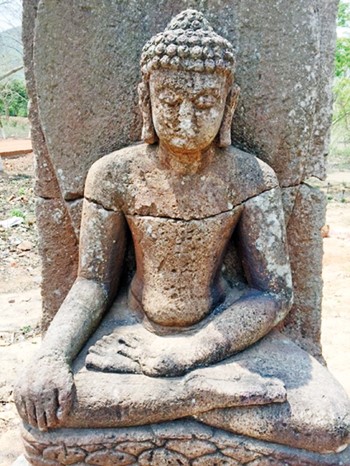
These discoveries have unearthed four brick stupas dating from the time of King Asoka and some thirty others made mainly of stone. Also found are foundations of numerous early monasteries, ancient pathways, water cisterns and some fifty caves and rock overhangs, some of which show evidence of being lived in, almost certainly by monks. On the walls of one of these caves is a much-faded painting of a stupa and a tree surrounded by a railing, almost certainly meant to be the Bodhi Tree that the Buddha was sitting under when he was Enlightened. Excavation of the monasteries has revealed coins, beautifully made bangles, small clay sculptures, and various copper objects. Also found has been iron and copper slag suggesting that metallurgy may have taken place in some of these monasteries, perhaps at a later date for making small images.
Digging around some of the stupas revealed stone railings with simple decorations such as stupas, wheels and other recognisable Buddhist symbols. However, these decorations are simple and even crude, suggesting that the artists were not just working with a new medium, i.e. stone instead of wood, but also that they were not copying earlier conventional prototypes. This points to these decorations being early, perhaps even before the time of King Asoka. If this is right it may mean that material evidence of Buddhism and, therefore, of the Buddha, is as little as 150 or 120 years after him.
Near one of the stupas two other objects of great interest were also found. One of these, a beautifully made stone umbrella, must have once been raised above one of the stupas. The second of these was a large stone pillar, highly polished like those erected by Asoka but not made from the Chunar sandstone that all his pillars were made from. This pillar has been broken into nearly sixty pieces. Even more important, it has an inscription on it although because of its fragmentary state, it is difficult to read. The Buddha is mentioned in the first line. The gist of the rest is that an unnamed upasaka erected the pillar in honour of the Buddha, and that a teacher (acariya) named Dhammadeva and his three disciples, Uttamitra, Bhadra and Upasaka all of who resided in the monastery, helped with this project. The evidence still needs to be examined more thoroughly and by other epigraphists, but initial evidence suggests that the script of this inscription may be older than those of King Asoka.
The shattered pillar has caused archaeologists to speculate why and by whom it was broken up so thoroughly. One theory is that it was done by Pushpamaita Sunga, the strongly anti-Buddhist king who overthrew the pro-Buddhist Mauryan dynasty in 187 BCE and who ancient sources say launched a persecution of Buddhism.
All these discoveries are of enormous importance to the history of India and of Buddhism in particular, and have aroused great excitement amongst Indian archaeologists and historians. When ordinary people hear of important and exciting archaeological discoveries they think of dazzling treasure, of Indiana Jones kind of objects. Nothing could be further from the truth of the discoveries at Deur Kothar. The location is dry and rugged, the structures are impressive to the eye, and the objects uncovered are drab, without any glitter or shine. In fact, everything about Deur Kothar would be underwhelming to the average untrained person. But to the trained eye they might well fill big and frustrating gapes in the early history of Buddhism.
20 05 2017 - The Island
H5.11
Visiting the cradle of Buddhism
D.C. Ranatunga
Poson Poya is only second in importance to Vesak for Buddhists in Sri Lanka
Mihintale is the focal point during Poson Poya. Pilgrims in their thousands gather at Mihintale, the cradle of Buddhism in Sri Lanka, to commemorate the sacred day that Arahant Mahinda appeared at the ‘aradhana gala’, addressed the king who was on a hunting expedition, explained his mission, and convinced the king and his followers to accept Buddhism. The event took place in the 3rd century BC when King Devanampiya Tissa (250-210 BC) was ruling the country from Anuradhapura, the first royal capital.
The visit of Arahant Mahinda followed the meeting of the Third Council of the Sangha after the passing-away of the Buddha. It was held at Pataliputra during the time of Emperor Asoka, who embraced Buddhism following the carnage he witnessed during the war to conquer the kingdom of Kalinga around 260 BC. The conversion was brought about by a young monk, Nigrodha, the son of Asoka’s elder brother who lost his life during the struggle for power where Asoka was the victor.
Asoka renounced war altogether and decided to conquer the world without the use of weapons through ‘dhammavijaya’. Noticing several factions among the Sangha, he arranged for the pious Thera Moggaliputta Tissa to hold a meeting of the monks to purify the Sangha by expelling those who were not behaving properly. Among the decisions taken by the elders of the Sangha was to send missionaries to neighbouring countries and propagate the Theravada tradition, which was finalised by the Third Council. It is recorded that Thera Moggaliputta Tissa had decided that the principal missionary to each country must be accompanied by four other monks so that in addition to preaching the Dhamma, it would be possible to establish the Sangha thereby ensuring the continuance of Buddhism in those countries.
Mihintale, known as Mishrakakanda prior to the arrival of Arahant Mahinda, was surrounded by thick forest. Situated eight miles to the east of Anuradhapura, the king had chosen to come there on a hunting expedition on the day he encountered Arahant Mahinda. “The accounts of the conversion of the king and people to Buddhism, written by monks after that religion had secured for itself dominance over the minds of the people, are overlaid with edifying legends in which the miraculous element is conspicuous,” says Professor Senerat Paranavitana in ‘History of Ceylon’(1961). He adds: “Mahinda and his companions transport themselves by air from Vessagiri to Mihintale, gods are at hand to make smooth the path of the religious teachers, and impress the multitude with the efficacy of their doctrines. Earthquakes which do no harm to anyone vouch for the veracity of the prophesies ascribed to the Saint. At sermons preached on important occasions, the Devas in the congregation far outnumber the humans. Elephants, without anyone’s bidding, indicate to the king the exact spots on which sacred shrines are to be sited. In spite of the legendary overlay, the main event, i.e. that Buddhism was accepted by the people and the ruler, is attested by the presence at Mihintale and Anuradhapura of epigraphical and other monuments of a Buddhist character attributable to that period.”
Often we tend to forget that Sela Cetiya (stupa) at Mihintale is one of the sixteen places– ‘Solosmathana’ – hallowed by the visits of the Buddha.
Reaching Mihintale, the devotees climb the impressive broad stairway made up of 1,640 granite slabs arranged in four flights. Well-grown ‘araliya’ trees adorn either side of the steps, providing shelter to the pilgrims. The slabs being laid at convenient distances to climb, it is a smooth ascent which the pilgrims hardy feel. Once the climb is over, they reach the Ambastala dagaba (Sela Cetiya) which marks the spot where the historic dialogue between Arahant Mahinda and the king took place. From here, they are directed to different places. The Maha Seya, the largest of the stupas at Mihintale can be spotted at the summit. Enshrined in it is a Hair Relic of the Buddha. On the other side is the ‘aradhana gala’.
A path takes the pilgrim down to a valley and to a steep rock wall. Well sheltered within, under a natural arch, is the ‘Mihindu guhava’ – the cave where Arahant Mahinda relaxed on a smooth flat slab of stone.
The Kantaka Cetiya, 40 feet in height with a circumference of 425 feet at the base, is famous for the ‘vahalkada’ (frontispiece) adorning the four sides of the stupa. Describing the architectural features of a ‘vahalkada’ Paranavitana says it consists of “a series of horizontal bands separated by string courses which are variously ornamented. The upper part of the frontispieces took the form of ‘vimanas’ containing figures of divine beings in the niches.” They are built alongside the altars where devotees offer flowers.
Having done a comprehensive study of the Mihintale complex, Sinhala scholar Professor J.B. Disanayaka states that compared with the stupas in Anuradhapura, those at Mihintale are simple in structure, and modest in size. In his publication, ‘Mihintale’ (1987), he describes the features of a stupa: “It can be divided structurally into three parts: base, dome and superstructure. The base consists of three concentric terraces of berms,’pesa vavalu’, some of which were moulded with blocks of white limestone, as those at Kantaka Cetiya. It is conjectured that these terraces were originally, either procession paths for ‘pradakshina’ (circumambulation), or altars for flower offerings.
The dome, hemispherical in form is a brick structure that contains a relic chamber, ‘dhatu garbha’ in which are deposited the relics of the personage in whose memory the stupa was erected. The shape of the dome is varied. The shapes recognised by old craftsmen include a heap of paddy (‘dhanyakara’), the temple bell (‘ghantakara’), the filled pot (‘ghatakara’), a bubble of water (‘bublukara’) and the lotus flower (‘padmakara’).
The superstructure, in its most developed form, consists of a solid cube, ‘hatares kotuva’, the four sides of which are ornamented with designs of railing and discs; a cylindrical shaft,‘devata kyuva’; a brick spire, ‘kot kerella’, resembling the umbrellas of Indian stupas and finally, a pinnacle, ‘kota’.
Pointing out that the story of Sinhala sculpture also begins at Mihintale, Prof. Disanayaka states that the objective of the early Sinhala sculptor was mainly decorative – to embellish the various architectural features of the stupas and other monastic buildings. The best collection of sculptures at Mihintale is found in the eastern ‘vahalkada’ of the Kantaka cetiya. The ‘muragal’ (guardstones), ‘koravakgal’ (balustrades), ‘sandakada pahan’ (moonstones) and ‘purma ghata’ (full-pots) are among pieces of sculpture that are characteristically Sinhala.
Being rather anxious to get to Anuradhapura and do the ‘vata vandanawa’ to worship the ‘Atamasthana’- the eight places of worship, pilgrims tend to miss out most of the interesting places at Mihintale. The grandeur of Mihintale was lost along with the decay and destruction of the Anuradhapura and Polonnaruwa kingdoms.
Pioneering archaeologists, H.C.P. Bell and Senarat Paranavitana were responsible for the rediscovery of Mihintale.
08 06 2017 - Daily Mirror
H5.12
When the message of Poson lights up Thanthirimale
Chris Edirisinghe
I remember sitting on a rock observing the religious ceremonies associated with the Duruthu Poya programme held at Thanthirimale in January 2004 taken up with the sacred and serene surroundings of this hallowed place. This was before the Aloka Pooja programme was begun by Wijeya Newspapers. Though I had visited this place earlier, I had not experienced the sacredness of this hallowed place to a great extent. Something within me told me that I should get involved in the activities at Thanthirimale irrespective of my being a Catholic.
When I returned to Colombo I put down my thoughts and experiences and wrote my first article on Thanthirimale, titled ‘Meeting Divinity at Thanthirimale’ which was published in the Sunday Times. To be involved in all the activities of this sacred place came as a new challenge to all of us who took part in the work involved with the Aloka Pooja that started at Poson that year.
This is the 14th year that Wijeya Newspapers will light up the Thanthirimale Shrine and offer the Aloka Pooja. The initial Aloka Pooja was during Poson in 2004, when Thanthirimale was called a ‘border village’ and LTTE terror was at its worst. Just a few feet away over the other side of Malwathu Oya was the territory of the LTTE Tigers and on this side of the river bank stood our forces ever alert ready for any eventuality. I remember that the staff involved in the Aloka Pooja were advised not to go bathing in the river as the Tigers were an unpredictable lot. Gunshots could be heard even during the day and the Army personnel always said, “ Un apey aya maranawa” (They are killing our own). Thankfully this situation is no more. Today one can swim, bathe and spend the whole day in Malwathu Oya even observing the majestic elephants pass by.
Thanthirimale has associations to Unduwap Poya in December. The place became famous only after the arrival of Sangamitta Theri on an Unduwap Poya day many centuries ago. It was she who brought us the Sacred Bodhi on the instructions of her father, the great king Ashoka of India. This was done at the request of the local king Devanampiyatissa and her own brother, the great Mihindu Maha Rahathanwahanse or Mahinda Thera. It was Mahinda Thera who brought the teachings of Lord Buddha, to this country, with the initial preaching of the Dhamma to king Devanampiyatissa.
The name of this humble village changing from Upatissagama and Thivakkabamunugama to Thanthirimale are known facts. History records the transformation of the name through the stories of Saliya and Ashokamala with the link to an endemic butterfly variety that was known as ‘Thanthiri’ that flew around the area encircling the village and the forest area now known as Wilpattu.
After Sangamitta Theri and the Royal guests passed through via Malwathu Oya, the village settled down to its normal routine with of course the happy memories of the events connected to the arrival of Sri Maha Bodhi sapling. Thivakka Brahmin who officiated at the arrival of the Theri and the royal guests was gifted with the 8th shoot of the Bodhi (Ashtapalamaha Bodhi) by the king in recognition of his commitment at the initial event. From that day on the village gained prominence. People began to arrive at the site and venerate the sacred Bodhi planted at the present spot high up on that rocky outcrop. When some visitors see this sacred Bodhi growing up there, they are surprised at how it had survived so long in the most difficult surroundings.
A new plant needs a lot of care and attention at the initial stages of its growth. If the start is taken care of it will survive for many years. This is what happened to this plant. People took very good care of this sapling, nurturing it day in and day out till it established itself. Constant offerings may have been made and the village was united as a single group protecting their ‘living treasure’. Their religious activities were not limited to a special day or a Poya. The village became a flourishing unit.
But misfortune struck this village when invaders such as Cholas ran through it. These invaders destroyed whatever stood in their way, massacred the villagers and created mayhem in the whole area. With this great destruction the village was lost to the jungle for many centuries and only wild life survived here with ancient structures with historical value going into decay. Miraculously the sacred Bodhi plant survived with only the intermittent rain giving it sustenance.
According to modern history Thanthirimale began its journey back to glory after the former Chief Incumbent Ven. Kudakongaskada Wimalagnana Thera ventured into this hostile territory in 1960. From the day he arrived he got the villagers interested and additionally worked with the officers of the Archaeological Department to resurrect this place from oblivion. When the first Aloka Pooja was held in 2004, difficulties in travel and living were present. Though the village had many lakes and so called water holes agriculture centred around Chena cultivation, in most parts. As the war was on, many young men had joined the forces and the police force. But poverty was apparent.
With the Aloka Pooja this village came to be known around the country and even abroad, with visitors and devotees coming to pay homage, in larger numbers especially on poya days. Despite the threat of war the annual Aloka Pooja continued without a break, and after 2009, with peace finally here to stay, the Aloka Pooja continues with greater enthusiasm.
Thanthirimale will continue to be lit up with villagers having better living conditions all round and pilgrims and visitors in their thousands making the journey to pay their homage at the Ashtapala Mahabodhi.
08 06 2017 - Daily Mirror
H5.13
King Asoka’s Amazing Engineers
Bhante S. Dhammika of Australia
King Asoka is widely accepted to be one of the most unusual, not to say one of the greatest, monarchs of all time. And it was Buddhism that made him so. He is also the first Indian king for which we have a great deal of knowledge; his dates, his personality, his religious impulses and his policies. This is because we have a great deal of information about him in his own words, which is what his edicts are, not the usual royal proclamations full of hyperbole and artificial language, empty boasts and fake genealogies. This is almost unique in the ancient world, certainly in ancient India until the Muslim period. As a result, Asoka’s edicts have been studies in great detail. As is well-known, these edicts were written on boulders, a few on separate slabs of stone and, of course, most noticeably on great stone pillars. Crowning each pillar was the image of an animal, some of which survive; a noble bull, an elephant, a lion and, in two cases, four lions back to back, as with the famous capital crowning the pillar erected at Sarnath where the Buddha preached his first sermon. These pillars and their capitals have also been studies in great detail, mainly for their aesthetic qualities, as works of art. But there is one aspect of Asoka’s pillars that has received very little attention; the engineering skills that went into designing, producing, transporting and erecting them.
Today, only 30 pillars survive; some are fragmentary, some are lying prostrate, some are still standing but without their capitals, and only two, the one at Lauriya Nandangar and the other at Vesali, are still complete, both with lion capitals. Over the last 2250 years, some pillars, such as the one at Lumbini, were struck by lightning, others like the one at Sanchi were broken up so that their stone could be used for other purposes. The pillar at Patna was probably washed away by the Ganges River’s constantly changing course and the one at Sarnath was smashed when the tower of the nearby temple collapsed on it. How many others there were is unknown, but what remains give us some idea of the engineering implications of these remarkable monoliths.
All Asoka’s pillars are made of a hard, fine-grained, honey-coloured sandstone from the quarries at Chunar, about 30 km further up the Ganges from Varanasi. Even today the evidence of Asoka’s masons can be seen in long fissures in the stone out of which the pillars were cut, and sections of pillars that were abandoned either because they broke or because of faults on the stone. After a long section of stone has been cut it had to be shaped. This must have been done by teams of men with iron tools but with the utmost care. When the required shape was near to finish, a process of pecking got the surface closer to what was needed. The evidence of this pecking can be seen on the sections of the pillars that were meant to be underground; thousands of tiny peck marks done with a pointed tool. The pillars are exactly cylindrical and taper perfectly from bottom to top with a graduation of only millimetres. Exactly how such precision was achieved on huge, heavy and unwieldy pieces of stone in unclear, but it points to considerable technical skill. When the final shaping was finished the pillars had to be polished. This was done by rubbing abrasive grit lubricated with water over the surface of the pillar, a low tech task but laborious and time-consuming. Probably dozens of men worked on each pillar for several months.
When ready, the pillar would be carefully rolled down to the Ganges, the way having been smoothed for the purpose, and then loaded onto low barges. A look at a map showing where all Asoka’s pillars are or were situated will show that they are all near (within a maximum of 25 km) a large river, one exception being the pillar at Sanchi.
How was Sanchi pillar transported, over sometimes rugged and hilly country, the nearly 600 km from Chunar to where it was erected? How were the other pillars moved from where they were unloaded on the river banks to where they were to be erected, sometimes up to 25 km away? Fortunately, we have information from some Muslim sources that can answer such questions. Asoka’s pillars have long attracted admiration and wonder. Indian monarchs occasionally ordered them moved from where Asoka had them placed to royal capitals. The two pillars now in Delhi were moved from their original place, the Allahabad pillar originally stood in Kosambi, the one now in the mosque in Fatehabad and the other nearby at Hisar were both moved from their original locations.
Firuz Shah Tughlaq who reigned from 1351 to 1388 saw the pillar Asoka had erected in Topara and was amazed by it. Initially, he thought it was made of bronze and dubbed it "the golden pillar". He ordered it to be taken all the way to Delhi to enhance the glory of the new capital he was building there. This major operation was done like this. Kapok cotton was wrapped around the pillar and it was then lowered on a soft bed, encased in reed and raw skins and placed on a carriage with 42 wheels. Two hundred men then pulled the carriage with strong ropes to the bank of the Yamuna River, the pillar was eased to a large barge by means of pulleys and leavers and then transported down the river. Just in the last few years an ancient manuscript was discovered with an illustration of this operation. Further, an engraving on the ancient fort at Raichur gives some more information about transporting such pillars. It shows a carriage with four huge solid wheels and nine bullocks pulling it with a team of men at the rear with leavers helping it along. There is good reason to suppose that Asoka’s engineers did something like this.
Having been delivered to the place where it had was to be erected the pillar then had to be raised. But that could not have been as easy as it sounds. Each pillar was to have a capital on it and some of the ones that survive weigh four or five tons. We know that these capitals were attached to the top of the pillars with a bronze bolt. But if the capital was affixed to the pillar before it was raised or after it was, cannot be determined. Either way this again would have been a major and difficult operation. To take the pillar, a hole was dug 2.50 m deep on average and a square stone slab was placed in its bottom. The pillar was slid into the hole by means of ropes until it stood upright and earth and gravel filled the hole and then rammed in.
Other than the ones struck by lightening or deliberately toppled, nearly all the pillars erected stood for 2300 years without ever leaning; such was the skill and care of Asoka’s engineers. The only exception are the two pillars at Rampurva. Due to an oversight the place selected to erect them has water near the surface, making the ground slightly sodden. Consequently, the pillars started to lean and then eventually toppled. When they were discovered they and their capitals had gradually sunk into the ground so that only a part of one pillar could be seen. We know nothing about Asoka’s engineers beyond their work; their names, their origins, how they acquired their skills has all been forgotten. It was these engineers’ skills that made the pillars as perfect as they are, but it was Asoka’s deep faith in the Buddha’s Dhamma that led them to being created in the first place.11 04 2018 - The Island
H5.14
The Lotus; Buddhism’s Favorite Flower
Bhante Dhammika of Australia
1. The Bodhisattva of Compassion holding a lotus blossom
2. The Tian Tan Buddha in Hong Kong sitting on a lotus
3. Blue waterlily, often mistaken for the lotusIt is said that the world’s most beloved flower is the rose, and the second-most loved is the lotus. Found from northern China and Korea all the way through south, south-east and east Asia and down to northern Australia, the lotus plant has influenced all the fine arts, culinary science, medicine, horticulture, poetry and even architecture (e.g. the lotus bath in Polonnaruwa). It is an aquatic plant, growing best in bodies of water with thick muddy bottoms and, being a hardy plant, it tends to dominate the lakes, ponds and reservoirs where it grows. The flower comes in three colors; creamy white, pink and yellow. One often hears of or reads about the ‘blue lotus’ but actually there is no such flower, for here the term lotus is mistakenly used for the blue waterlily, uppala in Pali, plants of the Nymphaeaceae family according to botanists. Even a cursory look at this flower will reveal its difference from the lotus. Lotus leaves are a lustreless pastel green and rise above the water; waterlily leaves are a shiny green and float of the surface of the water. The lotus flower is large with a pronounced carpel and its petals are like rounded slightly elongated cups; the waterlily flower is much smaller, its carpel small and its petals are spear-shaped. Also, the lotus’ perfume is subtle and hardly noticeable while the waterlily’s is quite pronounced.
The lotus endeared itself to the Indians long before the Buddha which is clear from the many names it was given in both Pali and Sanskrit; bhisa, kamala, kokananda, kumunda, mulalipuppha, pokkhara, pundarika, rasaroruha, varija, and of course its most common name paduma. While it is obvious that the lotus’ ethereal beauty would attract attention this does not fully explain why it would become so favoured by Buddhists and so identified with Buddhism. After all, northern India is home to many beautiful flowers, the kimsuka (Butea fondosa), the sala (Shorea robusta) and the simbali (Bombax malabaricum) being some of them. So why did the early Buddhists give the lotus a special place in the symbolism and iconography of their religion?
Examining all the Buddha’s references to the lotus, and two things in particular, helps to answer this question. The first was that this beautiful pure flower emerges from dirty muddy water. To the Buddha, this was analogous to the enlightened person’s transcendence of samsara. He said: "Just as the lotus is born in the water and grows up beneath the water, yet remains undefiled by the water, fragrant and beautiful, even so, the Buddha is born in the world, grows up and dwells in the world but like the lotus unstained by the water, he is not defiled by the world." Taking note of these words and using their creative imagination, ancient Buddhists sculptors often depicted the Buddha sitting on a lotus. In later centuries Avalokitesvara, the bodhisattva of compassion, known in Sri Lanka as Natha, was sometimes also known as Padmapani (Lotus in Hand) and was always depicted holding a lotus. The second thing was the fact that water will not adhere to the lotus leaf. Because of microscopic waxy papillae on the surface of the leaves water splashed on them instantly turns into quicksilver-like drops and immediately slips off, leaving no trace of moisture. Concerning this, the Buddha said in the Dhammapada: "Whoever in the world overcomes this low unruly craving, sorrow falls away like drops of water on a lotus leaf." So for the Buddha of two of the lotus’ characteristics one reminded him of the beauty and freedom of the Nirvanic state, while the second suggested to him the mind of the mature Buddhist – living in the world but unaffected by it. So next time you see a lotus blossom, after admiring its beauty, take the opportunity to consider the spiritual messages it embodies.23 06 2018 - The Island
H5.15 The Sakyans and Kapilavatthu
Bhante S. Dhammika
Paralleling the Himalayan foothills that define the modern India-Nepal border is a strip of terrain called the Terai. The whole region is flat and the soil is rich fertile alluvium. The numerous rivers and streams that flow down from the hills in the north sink into the gravel and then percolate to the surface in the Terai creating pools, bogs and swamps. For centuries most of the Terai was made up of thick malarial forest but beginning in the late 19th century it has been deforested and given over to rice cultivation. To get some idea of what the Terai was like before the clearing of the forest one has to visit the Katarniaghat and the Suhelva sanctuaries, Dudhwa National Park, or Valmiki National Park. Elephants, one-horned rhinoceros, the beautiful chital deer, tigers, wild buffalo and hyena roam through stands of sal and trees and areas of tall grasses. During the monsoon when the rain has washed the dust from the atmosphere the snowy peaks of the Himalayas can be clearly seen on the horizon to the north.
• The Sakyans are vassals of the king of Kosala, they offer him humble service and salutation, do his bidding and pay him homage
• If Kapilavatthu had a population of 1,300 it would have been big enough to be described as bustling and crowded
• All structures had mud walls and the only ones made of backed brick dated from well after the Buddha’s time. Kapilavatthu was nothing like the grand royal capital as described in later Buddhist legend
In the 5th century BCE, one of the ethnic groups who inhabited parts of the Terai were the Sakyans and it was into this group that the person who was to become the historical Buddha was born. Nothing in the early texts suggests that the Sakyan homeland was anything other than a small and unimportant chiefdom. Several ancient books make brief references to the Sakyans. The Mahavamsa and the Mahavastu give genealogical data include mentions of the Sakyans but these texts were composed centuries after the Buddha and thus may not be reliable. The Vishnu Purana includes a genealogical list for the Sakyans and mentions Suddhodhana, the Buddha’s father but not the Buddha himself. In several places in the Tipitaka 16 of the main states in the Middle Land are listed but Sakya is not amongst them. The Tipitaka also records the names of only ten population centres in the Sakyan country, again suggesting that it covered a modest area and probably that it was sparsely populated.
The Sakyans claimed to be descendants of the sons of the semi-mythical King Okkaka who had been driven into exile by the machinations of his second queen. Wandering through the forest they came to the hermitage of the sage Kapila who invited them to settle down nearby. Out of gratitude for Kapila, they named the settlement they established Kapilavatthu which later grew into the Sakyan’s principal town. Because this settlement happened to be in a grove of saka trees, the Indian teak, the exiles became known as Sakyans, at least that’s what Sakyan clan history said. In fact, the name Sakya is actually derived from ‘sak’ meaning to be able or capable. The Sakyans also claimed to be of the Adicca lineage, which supposedly went back to the Vedic sun god and to be of the warrior caste. Although nominally independent, the Sakyans were under the influence of the kingdom of Kosala, their larger and more powerful neighbour surrounding them on the south and west.
The Tipitaka says:
“The Sakyans are vassals of the king of Kosala, they offer him humble service and salutation, do his bidding and pay him homage.”This explains why once the Buddha described his homeland as belonging to the king of Kosala and why the king of Kosala once said to the Buddha that the two of them were Kosalians. One text in the Tipitaka mentions the king being driven into Sakyan territory in his state carriage to the town of Medaḷumpa. It seems certain that he could only have done this because Sakya was subordinate to and a tributary of Kosala. Tradition says that towards the end of the Buddha’s life, the Sakyans’ de jure independence came to an end when their lands were formally absorbed into Kosala.
The Sakyan’s neighbours to their east were the Koliyans, the border between their territories being the Rohini River which has its source in the Himalayan foothills and flows into the Rapti River a little west of the modern town of Gorakhpur. A later although plausible legend from the Dhammapada commentary claims that the Sakyans and Koliyans nearly came to blows over the use of the water in the river during a summer drought. The Tipitaka preserves only a few scraps of information about the Kolians; that the Buddha visited the chiefdom on several occasions, that they had a form of government similar to that of the Sakyans, and that they had a kind of police force which had a reputation for extortion and highhandedness. Later texts also claim that the Sakyans were related to and sometimes intermarried with the Kolians, which again seems quite plausible.
The Sakyans had a reputation for pride and impulsiveness and were considered rustics by their neighbours. A group of Sakyan youths are reported as saying of themselves: “We Sakyans are proud”, and Upali, himself a Sakyan described them as “a fierce people”.
Taking a more positive stance, the Buddha said his kinsmen were “endowed with wealth and energy”.
When the arrogant young Brahman Ambattha complained to the Buddha that during a visit to Kapilavatthu, the Sakyan youths did not give him due respect, the Buddha defended his kinsmen saying:
“But Ambattha, even the quail, such a little bird, can talk as she likes in her own nest.”
There are only a few scattered references to give us some idea of what Kapilavatthu, the Sakyan capital, was like. There was some kind of school there and a council hall (Santhagara) where the elders of the clan would meet to discuss matters pertaining to the running of the chiefdom. After the construction of a new council hall, the Buddha was invited to inaugurate it by spending the night in it. Within walking distance from Kapilavatthu was the Nigrodharama, a park where the Buddha would stay during his occasional visits. From there he could walk to the Mahavana, the Great Forest, indicating that the town was surrounded, at least on some sides by extensive forests.Two other references in the Tipitaka give an idea of the extent of the Sakyan capital. In one place Kapilavatthu is called a village (gama) and in another, a Sakyan elder described it as being “rich, prosperous, full of people, crowded and thickly populated” which seems to be describing something bigger than a mere village. Archaeology can help resolve the apparent disparity between these two descriptions. In the 1980s archaeologists did an extensive survey of ancient settlement sites in the Kanpur district of Utter Pradesh dating from between the 7th to the 3rd century BCE.
They found that of 99 sites 41 covered an area of less than one hectare and 40 between one and two hectares. Thus as many as 81 settlements were less than two hectares and it was calculated that these could have had a population of not more than 500 people. There were 14 settlements covering an area of between two and four hectares and these could have had a population of between 500 and 1000.
We have no idea what religion prevailed amongst the Sakyans and thus might have influenced the young Gotama. There is no mention of any Brahman priests residing in the Sakyan country. Four settlements were more than four hectares and could have accommodated between 1,200 and 1,300. All these population centres were much smaller than the main cities of the time and they would qualify as villages today.If Kapilavatthu had a population of 1,300 it would have been big enough to be described as bustling and crowded, especially if it was also a centre of commerce and the seat of government. Excavations conducted at Kapilavatthu itself in the early 1970s confirm the impression that it was a modest place even by the standards of the time. They revealed that the area it took up was small, although the whole area could not be explored because much of it was under agriculture. All structures had mud walls and the only ones made of backed brick dated from well after the Buddha’s time. Kapilavatthu was nothing like the grand royal capital as described in later Buddhist legend.
Today the site of Kapilavatthu is contested between India and Nepal.
The Nepalese say it is in their territory at Tilaurakot while the Indians claim it is in their territory at Piprahwa. All the archaeological evidence points to the Indian claim being correct. Seals mentioning the name Kapilavatthu have been excavated at Piprahawa as well as a relic casket mentioning the Sakyans. This second inscription is amongst the oldest decipherable writings ever found in India.
It has often been said that the Buddha came from a Hindu family, a claim that seems to be based on the assumption that because most Indians today are Hindus they must have been in ancient times too. In reality, we have no idea what religion prevailed amongst the Sakyans and thus might have influenced the young Gotama. There is no mention of any Brahman priests residing in the Sakyan country and the only one mentioned as having visited Kapilavatthu was given none of the respect such people took to be their due. Vedic Brahmanism, the precursor of Hinduism, had been moving from its traditional sacred land in Punjab into the Ganges Valley for at least 200 years was in the process of establishing itself in the main Magadha were kings such as Bimbasara of Magadha had taken Brahmans as court advisors and functionaries. On the other hand, one of the king’s cousins had become an Ajivaka, one of the heterodox sects of the time suggesting that the new religions had a following amongst the elite. But peoples such as the Sakyans, on the fringes of the major states, were still probably uninfluenced by Brahmanism.
And in at least some quarters Brahmanism was being resisted. This is probably why throughout the Tipitaka the warrior caste is always considered superior to the Brahman caste.
It seems that the clan-based chiefdoms were still resisting the Brahman concept of caste hierarchy. The only hint we have of the religious life of the Sakyans is the brief comment that Vappa, the Buddha’s uncle, was a follower of Jainism, again another heterodox sect. The majority of Sakyans, indeed most people throughout the Middle Land during the Buddha’s time, were probably what we would now be called animists, worshipping their own local spirits and gods.We have some information on the political life of the Sakyans. Legend claims that the Buddha’s father Suddhodana was a king although there is scant evidence in the Tipitaka to back up this claim. Nowhere is the Buddha called a prince (raja kumara), nowhere is he or his family said to live in a palace, and only once is his father called raja, a word usually translated as king. Although by the 5th century the word had come to mean a king it still retained its earlier meaning of an elected chief without any regal connotations. Even in the very places where one would expect the Buddha to call his father a king or himself a prince he did not do so. For example, when asked by King Bimbisara about his family and birth, the Buddha simply replied that he was from a Sakyan family.
The Tipitaka mentions that the Sakyans had a body of men called rajakattaro, ‘chief-makers’. Such groups are mentioned in other early Indian texts and it is clear that they elected chiefs to rule over them, either for a set period or for as long as he had their confidence. The council hall the Buddha had inaugurated in Kapilavatthu, was the very kind of place where the chief-makers and clan elders would have gathered to conduct business and the chief preside over their meetings as the first among equals.
Thus we can say that while the Buddha was almost certainly from a patrician or ruling class family, he was not royalty in the sense that is understood today. It is also worth noting that Suddhodana gets only three brief references in the Tipitaka. The only person who is mentioned as being a Sakyan chief other than Suddhodana is Bhaddiya, at VinayaII,180-182. After he became a monk he mentioned that when he was chief he lived in constant anxiety and had to have guards in his residence and in the town for his security. This suggests that Sakyan politics could sometimes get nasty.
Of course, later tradition and popular legends have much more to say about the Sakyans and Kapilavatthu but what has been given here is everything the Pali Tipitaka, the oldest and most authentic record of Buddhism says about these people and their capital.
20 05 2019 - Daily Mirror
H5.16
Sacred Relics: from Britain to then Ceylon
Yomal Senerath-Yapa
How The Times of Ceylon reported the arrival of the Relics
Rummaging through his late great aunt’s attic in Waxway Cottage deep in Devon, Nick Gilbey was arrested by a paper cutting and a letter from 1940- two documents that pulled him away from the English countryside setting, reminding him of the strong connection his family had had with the East, in particular with India, at the time Victoria was Empress of that subcontinent, and also, much later, Ceylon- the ‘crown jewel’ of the British Empire.
The paper cutting was from The Times, the most respected of British dailies. It spoke about how, in that year almost eight decades ago, Nick’s grandmother Ethel Leslie-Smith and his great aunt Winifred Burrows had gifted to Ceylon the Sacred Bone Relics found in 1851 in Sanchi by Nick’s great-great grandfather- Frederick Charles Maisey.
The letter, dated around the same time, was from the Governor of Ceylon Sir Andrew Caldecott, a cordial epistle of thanks to the two sisters where that great British administrator had enclosed more paper cuttings for them, these from The Times of Ceylon and other local broadsheets describing the welcoming of the Relics.
Wrote Sir Caldecott to Winifred Burrows, “(your gift of relics) is valued so highly that all the big temples in the island have clamoured for it.” For this was no ordinary Relic. As the man who unearthed them with their translucent crystal casket, General Frederick Maisey, believed firmly, these were remains of none other than the Buddha.
Yet who was General Maisey, and how did he come across that beautiful casket and the sacred treasure concealed therein?
Son of renowned artist Thomas Maisey, Frederick was himself an artist with a distinctive flair. But while the father painted rustic English scenes, the son was destined to capture, more memorably, Indian antiquities half clothed by wilderness. Having gone to India in 1842 to become an ensign in the Bengal Native Infantry, Maisey was an ardent antiquarian in love with the vestiges of ancient India that Englishmen were then discovering.
Maisey was best known for his archaeological work with Sir Alexander Cunningham in Sanchi- the most ancient of Buddhist sites in India. It was in Bhojpur, a site near the famous great Sanchi stupa, that Maisey discovered these relics.
Bhojpur has some 60 stupas, in a fortified rocky hilltop where the wind howls over yellow grass and dry bush. It was the large mound christened the ‘Bhojpur Stupa 2’ that yielded the Relic casket. Described as ‘the most curious and costly of all the discoveries’ made there, it contained three small pieces of bone each about 10mm long, and ‘seven precious things’ as the British Times grandly put it. These were “thin round pieces of gold, a bead of garnet, a crystal bead, two beads of pale greenish crystal and some minute fragments of pearl’.
Nick Gilbey in the shrine room with monks of the Vidyalankara Pirivena
Finders not being keepers, Maisey had to hand over the discoveries on the site to the Victoria and Albert Museum in London in 1856. But he managed to retain the objects enshrined within the reliquary. The museum was content with the miniature masterpiece of crystal rock casket, while Maisey, with his deep interest in Buddhism, was delighted to retain what he doubtless knew was the real treasure- objects pulsating with sacred and historical significance.
The General’s firm conviction was that the tiny Bone Relics were of the Buddha. Not only were they discovered in the womb of the most perfectly shaped stupa in the area, but the casket was the most exquisite and ornate to be discovered. But the most sound of his arguments is that it had no inscription- and only the name of the Buddha was then considered too sacred to be put down; designations of any other personage, lay or clerical, could be inscribed on the reliquary.
The General passed away in 1892, and his lifelong labour of love, ‘Sanchi and its Remains’, was published posthumously the year after. The Relics were handed down to his son- Colonel Maisey- and through him later to the sisters Mrs. Leslie- Smith and Mrs. Burrows.
So much for the Victorian part of that saga. The newspaper cutting that Nick held in his hands in the Devon attic spoke of the next episode happening in the 1930s. It reported that his grandmother had been in Ceylon- which was news to Nick.
General Frederick Maisey
He was, however, then able to piece the story together with the help of a postcard sent by the grandmother to the Burrows great-aunt while on the way to Australia by ship. On that journey Mrs. Leslie-Smith and her friend, Maddie Henderson, had called at Colombo.
It was here that she had met a Buddhist monk (Nick believes from the Gangaramaya temple), who, learning about the great treasure in the care of the two sisters, had enlightened her on how highly such objects would be venerated within the island.
So, in 1940, the two generous women did the best they could and provided the island with a Relic, supposedly of the Teacher held most supreme there. The Times article speaks of a silver ‘tope’ (stupa) being specially made for the occasion.
It was welcomed with grand processions and was taken amidst peraheras to the Vidyalankara Pirivena temple in Peliyagoda- chosen as home for the Relic by Sir Baron Jayatilaka, ‘leader of Ceylon Buddhists’.
Nick, now having put together this family puzzle more or less as an armchair adventurer, wanted to add his own piece. Would he be able to find, in the island now renamed Sri Lanka, memories of the two English ladies, and what they donated?
Travelling to Sri Lanka this April, he found his kith and kin not only remembered, but also thanked, each evening, in the chants recited in the special shrine in the temple. The monks have incorporated the name of Winifred Burrows into the evening worship- and sung her praises for the past 80 years. The warm welcome Nick was accorded would have made up for the fact that he was not able to view the Relic, or the golden and silver caskets it is housed in, these being displayed only during the ceremony in December when devotees queue up to worship.
Part of Nick’s quest was accomplished- having seen the relics associated for so long with his family, safely enshrined in a place where it is the sanctum sanctorum. Yet another object, much valued for its academic lustre, is however, lost in limbo- the diary of General Maisey which for some reason accompanied the Relics to Colombo, from where it disappears from record.
All the late antiquarian’s diaries are held at the British Library in London, save this particular precious volume, written at the time of the discoveries at Sanchi. The British Museum as well as the Victoria & Albert would have coveted photographs of this invaluable record, yet Nick could not provide these institutions with positive tidings following his trip to Sri Lanka. Perchance- it is another quest awaiting him.* * *
Mrs. Burrows
Still remembered with gratitude
Winifred Burrows
The Vidyalankara Pirivena, Peliyagoda, where the Relics are enshrined and venerated, is one of the largest seats of monastic learning in the island, with a history of nearly 150 years. Sir Baron Jayatilaka selected this temple, from amidst the many shrines that competed for the honour, because the temple accepts no sammadan (money in any form including collection boxes). Flowers and food are the only alms received there.
Director of the Pirivena, Ven. Welamitiyawe Kusaladhamma Nayaka Thera, Chief Sanghanayake for Colombo and Chilaw provinces and Chancellor, University of Kelaniya, said that the Relics are worshipped daily with thevava services in the morning and the evening, just as happens at the Kandy Dalada Maligawa.
Each December, the Sacred Relics are displayed in their three-storeyed shrine for a selected number of days, in the evening from 5 to 8. The Prelate spoke with warmth of Nick Gilbey’s visit, as grand-nephew of Mrs. Burrows, still remembered with gratitude in the central shrine.
19 05 2019 - Sunday Times
H5.17
The arrival of Anubudu Mihindu Himi or the Light of Lanka
Dr. P.G. Punchihewa
The arrival of Mahinda Thera, the son of the Emperor of India, Ashoka, with five other Bhikkhus and a layman, on the Missaka mountain on the full moon day of the month of Poson, 2,265 years ago, marked the greatest event in the long history of this island. In his Pali Literature of Ceylon (pg 25) Professor G.P. Malalasekera refers to it as the most successful and most productive of the missionary efforts of Ashoka and as amongst the greatest civilizing effects of the world.
This event was the dawn of a new civilization in the island. A community of people made up of the first Aryan emigrants from India,following different cults and beliefs , trying to settle down to a new way of life and the indigenous people of the island imbued in animistic beliefs together were directed accordingly to a new spiritual way of life.
The arrival of Mahinda Thera in the island was neither a myth nor an accident. It was a well-planned one. An inscription in Rajagala in the Ampara district marks the site of a stupa built to enshrine the relics of Mahinda Thera and Iddhika Thera who accompanied him and they are mentioned in the Mahavamsa by name. “The record is thus of first rate historical importance, in that it proves the trustworthiness, in its essentials of the account given in the chronicles of the introduction of Buddhism to Ceylon in the reign of Devanampiyatissa” says Prof. Paranavitane (Inscriptions of Ceylon Vol.1 (pg) ci)
After his arrival, Mahinda Thera set about the task of establishing the Buddha Sasana systematically. Having convinced and converted the King Devanampiyatissa whom he found to be a very intelligent person after his incisive questioning, he delivered the Culla Hatthi Padopama Sutta to the King. The King no doubt would have had a good knowledge of elephant behaviour. The Thera next turned to the courtiers and their families. He was very selective in the choice of the subject to them.The two discourses, Pethavatthu and Vimana vatthu dealt with the results of bad and good actions which the listeners would have had no difficulty to grasp.
These discourses had a ripple effect in society, in taking the message of the new faith to near and far.The important fact was that the Thera Mahinda delivered his sermons in the language of the island (deepabhasaya).It is possible that he studied the language of the island during the six months he spent in Vidisa where he was the guest of his mother. All the discourses Mahinda Thera delivered were from the Tripitaka. As such there would have been the necessity to explain them in detail to the local followers. So the Thera had come up with the commentaries to the Tripitaka, which came to be known as Sihalaatthakatha in the language of the island. The Thera no doubt used the Brahmi script with which he was familiar and which was the same as that found in edicts of Ashoka and the early inscriptions of the island thus giving rise to the Sinhala script which over the years developed to the present form.Thera Mahinda meanwhile was also concerned with the other requisites which bind the Sasana together. He ordained the layman Bhanduka who accompanied him thus establishing the local bhikkhu lineage.He along with his associates observed the Vassana (retreat during the rainy season) as laid down in the Vinaya. With the possible expansion of the numbers, Thera Mahinda realized the need to have a sima-malaka for the Sangha to perform their ecclesiastical functions (uposatha ceremony and other acts of religion). Accordingly he advised the King to demarcate and assign the boundaries for the sima-malaka.When it was done,the Thera himself had fixed the inner boundary which later came to be the sacred city.
Dr. Walpola Rahula is of the opinion that other than the Thera there was no one knowledgeable in the island to perform this task. He had lived in such big cities like Pataliputra and seen his father constructing the Asokaramaya.What was built within the premises later became the Mahaviharaya. First lessons on architecture in the island may have come from the Thera.
Since the arrival in the island, Mahinda Thera took steps to give the new faith an indigenous outlook.The culmination of it was when he told the King that the Sasana would be established in the island only after a child of the island,having entered the Order, learns the Vinaya and expounds it to others. “In other words he wished the leaders of the Buddhist Church in Ceylon to be natives of the island,” says Paranavitane. Accordingly arrangements had been made for the Maha Arittha Thera to perform this function.
The Thera was also instrumental in getting down his sister Theri Sangamitta from India who established the Bhikkhuni sasana in the island bringing with her the branch of the pipal tree from Buddha Gaya.
As mentioned by Prof. Malalasekera, the mission to Sri Lanka was the most productive one. It was due, no doubt, to the untiring effort of Thera Mahinda, ably supported by the King Devanampiyatissa.
After serving the Sasana and the Sihala- deepa which he made his home, the Thera, passed away at the age of 80. Within this period he transformed the spiritual, cultural and social life of the islanders as never happened or never to happen in future. Acknowledging the contribution the Thera Mahinda made here, the people called him the Light of Lanka (Lanka pradeepo).Vessagiriya 2 inscription of the 10th century refers to him as Anubudu Mihindu Himi.To this day in the island he is better known by that honorific.* * *
Missaka Pabbata worthy of World Heritage title
Missaka Pabbata had been the cradle of Sri Lankan civilization for more than a millennium. The ruins of the largest hospital and the monastery dating back to the 10th century can be seen even today.
According to the criteria laid down to qualify to be a world heritage site Missaka Pabbata stands tall.“To be selected, a World Heritage site must be an already classified landmark, unique in some respect as a geographically and historically identifiable place having special cultural or physical significance (such as an ancient ruin or historical structure, building, city, complex, desert, forest, island, lake, monument, mountain, or wilderness area. It may signify a remarkable accomplishment of humanity, and serve as evidence of our intellectual history on the planet.”
There are 44 heritage sites in France and the same number in Germany. Sri Lanka has only 8. It is high time the authorities move to get Missaka Pabbata declared a world heritage site.
16 06 2019 - Sunday Times
H5.18
So close yet so far: The broken link between Odisha and Sri Lanka
Tissa Migara
Odisha sites: Buddha statue
Can you mark the state of Odisha (formerly Orissa) on a map of India? I can wager that 24 out of 25 Sri Lankans won’t be able to. And yet, there is arguably no other Indian state that has such historical links with Lanka as the State of Odisha.
Sri Lankan history is replete with references to Orissa, that part of East India which is now broken up into three States – Bihar, West Bengal and Odisha (see map).
The links are ancient. According to legend, Prince Vijaya set sail with his band of men to Thambapanni (land of the golden sand) as the island of Lanka was then known from Tamluk, ancient Tamralipti, a port city in present day West Bengal bordering Odisha. And Odisha itself is where the Great Emperor Ashoka fought the last of his battles — at Kalinga. That battle which Ashoka’s army won resulted in the massacre of over 100,000. Viewing the battleground from a nearby hillside, he realised the futility of war and embraced Buddhism that was flourishing in Kalinga at the time, spreading instead the message of universal love. That clash of arms took place in Dhauli only a few kilometres from Odisha’s current state capital of Bhubaneswar. Emperor Ashoka was considered an even more acclaimed warrior than Napoleon or Alexander the Great. His Mauryan Empire spread from present-day India to Afghanistan and almost Iran.
What was remarkable is that he was never defeated in battle, but overcome by his own remorse at blood-letting in the pursuit of glory. Who knows, if not for his change of heart, his next stop may well have been the conquest of Lanka.
Instead, he sent not his Army, but his children, Mahinda with the message of the Buddha Dhamma to Lanka’s King Devanampiyatissa on a Poson Poya day and his daughter Sanghamitta with a Bo sapling from Buddha Gaya. He conquered Lanka in a different way.
Odisha sites: Buddha statue
Odisha’s Buddhist history has only really been officially rediscovered due to the work of Universities, and also the Archaeological Survey of India. In Udayagiri, Ratnagiri and Lalithgiri, known as the Diamond Triangle are numerous archaeological sites and monasteries so much so it was hailed as a centre of learning second only to the iconic Nalanda University in fairly close proximity to Buddha Gaya in which there is renewed international interest as one of the greatest seats of learning of all time.
Odisha’s sites, which also include the ancient Buddhist sites in Puri have yet to receive due recognition from the State Government leave alone the Government of India or of international governments and UN agencies like UNESCO.
While the Odisha State government advertises its tourism attractions over CNN, it has to upgrade its vast potential in ‘Buddhism tourism’. It has failed to exploit the historical story of Emperor Ashoka who pioneered the change in the course of Indian history from that of conquest to one of love. The famed rock edict in Dhauli which Ashoka inscribed in Brahmi script is kept locked in a seemingly makeshift shed, opened by a watcher for a small tip. There are around 30 edicts of Ashoka in different parts of India, several of them found in Dhauli and Jaugada both in Odisha.
The Japanese built a peace pagoda near the banks of the river Daya in 1972 to commemorate Asoka’s change of heart after the Kalinga war - the Dhauli International Peace Pagoda or Dhauli Giri Shanti Stupa and that is the only proper place for visitors to come and spend a morning.
Today, Odisha’s sea routes have gone into disuse. The Bhubaneswar airport largely caters to domestic travellers. Only Thai Airways flies in from overseas, given its Buddhist history. SriLankan Airlines flies to dozens of destinations in India a week but there’s no direct flight to Bhubaneswar, which should take just over an hour’s flying time from Colombo.If Palaly airport is opened one day for regional flights it should take less than an hour to Bhubaneswar from there.
Ashoka’s edict inscribed on rock
The other day the PM’s official website quoted Premier Ranil Wickremesinghe referring to the impact of Emperor Ashoka in a speech made at the foundation stone laying ceremony of the Postgraduate Institute of Pali and Buddhist Studies at the Kelaniya University. “Emperor Ashoka of India disseminated Buddhist missionaries extending to Greece, Egypt and Iran for the propagation of Buddhism. They used the Greek and the Egyptian languages in the propogation of the Dhamma. We have to take these examples and move forward.”
Both the Government of Sri Lanka and the State Government of Odisha must join hands in restoring the ties between the peoples, the cultures and historical links. The Congress spokesman in Odisha said that out of 100 Sinhala words, 34 have their origin in Odia, the language of Odisha.
This forgotten history has to be reconnected as both Sri Lanka and Odisha have been engrossed in their own politics over the years. The two are so close, yet so far.
16 06 2019 - Sunday Times
H5.19
The dawn of Poson and the significance of Thanthirimale
Chris Edirisinghe
Prerparing for the Aloka Pooja. Pix by Athula Bandara
On Poson Poya we commemorate the introduction of Buddhism to Sri Lanka centuries ago.
Some historians record that King Ashoka of India after his battle at Kalinga met a young Buddhist prelate and was so impressed by his tranquil demeanour, that he embraced this new doctrine. Keen to spread this to countries in the region, he sent his son to preach the new religion to his friend, King Devanampiyatissa in the adjoining kingdom of Thambapanni, as Sri Lanka was then known. It was on a Poson Poya day that Arahat Mahinda had a momentous encounter with the King at Mihintale. This is the story of Poson we celebrate today.
Religious observances at Poson were traditionally centered in Mihintale and in Anuradhapura. This year these will be held on a larger scale according to reports, since Vesak could not be observed as planned due to the problems that the country experienced recently.
In recent years Thanthirimale too has gained prominence during Poson celebrations. Thanthirimale has been known for centuries as the village honoured by Sangamitta Theri when she brought the sacred Bo sapling to the kingdom of Anuradhapura on Unduwap Poya. Theri Sangamitta was the youngest child of King Ashoka and the sister of Arahat Mahinda. She and her entourage, as well as King Devanampiyatissa had to stop for the night at Thanthirimale on their journey to Anuradhapura.
In grateful remembrance of this event the 8th shoot of this sacred Bo sapling was presented to Thanthirimale at the time as a gift.
Many pilgrims visit Thanthirimale after their religious observances in Mihintale and Anuradhapura.
16 06 2019 – Sunday Times
H5.20
Sinhala Buddhagama
Gamini Seneviratne
Dr. P.G. Punchihewa’s essay on Sinhala Buddhagama comes at the end of his account of Arahant Mahinda’s legacy to the people of this country, - an island named Sinhale or Lanka. It was from here that the Buddha dhamma, as explained by the Arahant and his associate bhikkus, Ishtiya, Uttiya, Shamkhala and Bhadrashaala, spread eastward to Myanmar, Lao, Thailand, Cambodia and Vietnam.
The Arahanth’s sister, the Theri Sanghamitta was entrusted with the responsibility for conveying a sapling of the Bo tree under which Gautama attained Buddhahood to the King in Anuradhapura. It was planted within the Mahameuna Uyana that he had donated to the Sangha. Known the world over as the Sri Maha Bodhiya in Anuradhapura, devotees gather there all the year round for meditation and prayer. It was such a group of devotees, mostly women, whom the terrorists of the LTTE attacked in May, 1985, killing 120 and injuring 85.
Punchihewa records, too, the role played by Therini Sanghamitta in ‘empowering’ women - to use a term in frequent use today especially in the western media that determine who should rule the world as they see it and how that should be done.
What instruction we children received on the pathways of life included the weekly Daham Paasela at or close by the village temple. Besides guidance at home, generally from their mother, the daham paasela provided pointers towards a life marked by compassion towards all living beings. One of the ‘texts’ used there was the lovaeda sangarava the 15th Century AC instructional poem by the Vidagama Mahathera. (Incidentally, afresh annotation of the poem together with a translation into English by Jinasoma Weerasuriya, the whole edited by Dr. Punchihewa, has been published recently and would serve as a companion to the book under review here, "Anubudu Mihindu Mahimi").
In our childhood we had other ‘teachers’ as well, depending. I do not know how it was with Punchi but I was taught Pali at our village temple in Mattumagala before I was four years old. Things did not proceed as hoped, the oldest of us cousins thought to befit for the sangha taking to medicine, the next to the civil law and I – well, to public administration, coming round through those excursions to the humanities and the social sciences that, together and with much else, seem to straddle ‘religion’.
How close or far those disciplines were/are to Sinhala Buddhism I leave it to you to judge. Reference to matters somewhat close to me are made here also as demonstration that in its history Buddhism has not been treated by the Sinhalese as some exotic kind of worship.
At the daham paasela, usually on the temple premises, occasionally at the village school nearby, we learnt compassion and quietude. At Royal College, a "secular" school (to adopt the much misused current parlance that is value-loaded to obfuscate superstitions put about by the ‘western world’}, we had a reading from a text (the dhammapada, bhagavat gita, bible, koran) twice a week at senior assembly and, at General Assembly each Friday, a talk on one of them by an old boy who could relate those beliefs / injunctions in clear language and hold the attention of 10 to 18 year olds for little short of an hour. Such was the "religious instruction" we received at Royal and it served us well. (The school prize for Comparative Religion - which btw I won - was named in memory of S.H. Mackeen: there was a question on each of the religions mentioned above with three out of four requiring an essay – I wrote on Christianity, Islam and on the Upanishads).
In later years, in the Third Form at Royal, I returned to Pali to escape from "Pol-Thel" Baptist and his lessons in the Geography of Ceylon. And I continued with Pali, taught by a later, senior colleague in the CCS, D.M.P.B. Dassanayake, in a failed attempt to dodge K C (Penguin) Fernando, who taught Sinhala Literature - though he was the compiler of an English-Pali Dictionary then in use in schools and pirivenas. (Mr. Fernando had been a classmate of my father at Ananda and felt obliged to be extra-stern in assessing such work as I managed to do: ‘corporal punishment’ was not unusual at that time and, at a rough guess, I received five times the share that, maybe, was due to me). Such were some of the circumstances under which Sinhala buddhagama came to be lodged in our consciousness. Dr. Punchihewa’s is an erudite essay in recounting the history of the Chandragupta - Asoka heritage in the spread of the doctrine developed by Prince Siddhartha Gautama over twenty-five centuries ago. It is informed by a quality of study that has become rare. I myself lack the tools of scholarship needed to evaluate the particularities in his exposition. Dr. Punchihewa has drawn on documentation that range from Lanka / Sinhale to the Asokan rock inscriptions. As for Asokahimself, Punchi quotes H.G. Wells (whose "Outline of History" paved the way for A.J. Toynbee’s 12 volume "Study of History"): Wells held that "among the thousands of kings, emperors and savants in human history the name of Asoka glitters like a lone star".
Punchi also recounts the close association that Asoka had with the king of Lanka, Devanampiyatissa. That led to the emperor sending his son, the Arahanth Mahinda, to introduce the Buddha vacana and their import to Lanka’s king. That event and its sequel in being placed within the literary record, over 2000 years ago at Aluvihare, laid the foundation for the unique place of Sinhala Buddhist culture in the history of human society.
The notion (which Punchi quotes) that the stability of buddhagama is somehow related to the country producing a native arahanth is not one that Gautama would have seen any logic in. Be that as it may we did have the Maliyadeva rahathan vahanse, resident initially at Dimbulagala and later at Arankele, not many centuries ago. In the late 1970’s a scholar from northern Europe who was engaged in doctoral studies on mahayana Buddhism was sent to me for assistance in obtaining an extension of his resident visa here. I remarked that Mahayana is practiced mostly in and above the upper reaches of what is referred to as ‘India’ and he should perhaps conduct his researches there. He said he had spent three years in Bhutan, Sikkim, Nepal and Tibet and had been told that in Lanka there was a Theravada bhikku who had reached arahathood: he had come here in the hope of meeting him. The bhikku was named Katukele Seevali and was known to reside in the forest hermitage of Arankele. He was indeed a savant and possessed of a presence that gave support but did not overawe: he died young.
The name of this country has been distorted through the centuries, as often happens to other, much larger, spaces as well, innocently by travelers and not innocently by covetous intruders. Hence, it would seem appropriate in these times of ‘fakery’ on a global scale to provide a word or two on the genesis of the name of this sacred island and, by extension, what "Sinhala buddhagama" behooves. Following the name associated with Prince Vijaya (6th Century BC), this island was known as Tambapanni in the time of Asoka (3rd Century BC) or, in the corrupt version adopted by the Greeks, as Taprobane.
By the 2nd century BC it was known as Heladiva (in old or Elu Sinhala), Sinhaladvipa in Sanskrit and Sihalamin Pali. It was known as Siar-xa-diep in China (2nd Century AC) and by the 4th century AC as Serendiviin the Roman Empire. Wang-te-Yuan who visited Adam’s Peak in 1330 AC refers to the island as Seng-ka-la. Marco Polo, late 13th century, refers to it as Zeilan. The editor of Polo’s ‘Travels’, Thomas Wright, observes, "The name of this important island is pronounced Selan by the Persians and the people of Hindoostan (who also call it Serendib)". Mahdi Hussain (in his edition of The Rehlat of Ibn Battuta) has it that "Siylan appears to have been connected with Sihalam the Pali name of Sarandip" Nearer in distance and time South Indian records have consistently maintained the identity of the island as Sinhala (e.g., the Ariyur Plates of Virupaksha, 1390 AC), and the Telegu composition Simhala dvipa Kathava (16th century).
The processes by which Buddhism in this island came to acquire its Sinhala-specific character could be traced by observation or in conversation with bhikkus at most viharas and at pirivenas. Pirivenas are centres of learning and also serve as repositories of large collections of palm leaf manuscripts as well as of printed documents of more recent vintage. Am slightly acquainted with the Vidyalankara pirivena, (our maternal great grandfather L. Weerasinghe and his senior nephew, D.B. Jayatilaka, were among its dayakayas), and I had the privilege, when I served as a visiting lecturer there, of guiding its senior academic, the Venerable Kotahena Pannakitti, through Nehru’s "The Discovery of India".
Half a century ago, besides the famous pot gula at Hanguranketha, the Mahamantinda pirivena in Matara and the Ridigama pirivena were home to invaluable libraries mostly of religious texts. I have since learnt that following the LTTE’s terrorist attack on the Dalada Maligawa, officers of the National Archives in Kandy had catalogued the holdings of the Maligawa library – a most praiseworthy action. The Government Archivist, as that office was originally designated, continues to have responsibility for preserving such palm leaf and other manuscripts for the use of scholars –bhikkus as well as ly persons.
Reports of the population of Buddhists in the world suggest that there are over 500 million worldwide. Percentage-wise Myanmar and other East Asian countries have high numbers (in Sri Lanka Buddhists have been put at 2/3rds of the total population). One supposes that Australia showing the highest ‘growth rate’ of Buddhists would excite interest in some quarters.
Persons who have been in one way or another exposed to the practice of Buddhism would have acquired some form of sympathetic understanding of it. At a kind of memorial gathering in honour of Professor S.J. Tambiah a couple of years ago, his colleague Professor Gananath Obeyesekere said that after his work in Thailand that resulted in his major work, World Conqueror and World Renouncer: A Study of Buddhism and Polity in Thailand against a Historical Background’, Tambi had become a crypto-Buddhist. Such a development is not unusual in social anthropology as also among those whose personal experience of a culture has provided insights that go beyond their specialist interests.
The research engineer (he designed the first air balloon that could carry passengers across continents) and novelist, Nevil Shute, went that way. Among anthropologists, I believe the Anglican Gehan Wijewardena too may have been a crypto Buddhist. Gehan carried out his field work in Thailand. He also translated a novel that explicated Thai life into English.
Closer here was Martin Southwold whose studies were in a village off Kurunegala. As he wrote to me some years later, his book ‘Buddhismin Life: The Anthropological Study of Religion and the Sinhalese Practice of Buddhism’ had drawn the ire of some colleagues at his University in Manchester. They had castigated him for becoming ‘a Sinhalese Buddhist’ – a reading he was happy to accept.
So, it would appear that Sinhala Buddhagama has had a way of spreading from here beyond the lands of eastern Asia.
15 06 2019 - The Island
|
4 ~ End of Aloka History Page 5 ~ 6
The Four Reliances |
| JOURNAL | NEWS | LETTERS | BOOKS | PERSONS | HISTORY | SLIDES |
© Aloka MCMXCIX-MMXXI