 HISTORY - Page
6
INDEX
HISTORY - Page
6
INDEX| JOURNAL | NEWS | LETTERS | BOOKS | PERSONS | HISTORY | SLIDES |
H6.01
Poson Brings 'Hope, the Only Thing Stronger than Fear'
Rohana R. Wasala

"Buddhism aims at creating a society where the ruinous struggle for power is renounced; where calm and peace prevail away from conquest and defeat; where the persecution of the innocent is vehemently denounced; where one who conquers oneself is more respected than those who conquer millions by military and economic warfare; where hatred is conquered by kindness, and evil by goodness; where enmity, jealousy, ill-will and greed do not infect men’s minds; where compassion is the driving force of action; where all, including the least of living things, are treated with fairness, consideration and love; where life in peace and harmony, in a world of material contentment, is directed towards the highest and noblest aim, the realization of the Ultimate Truth, Nirvana."
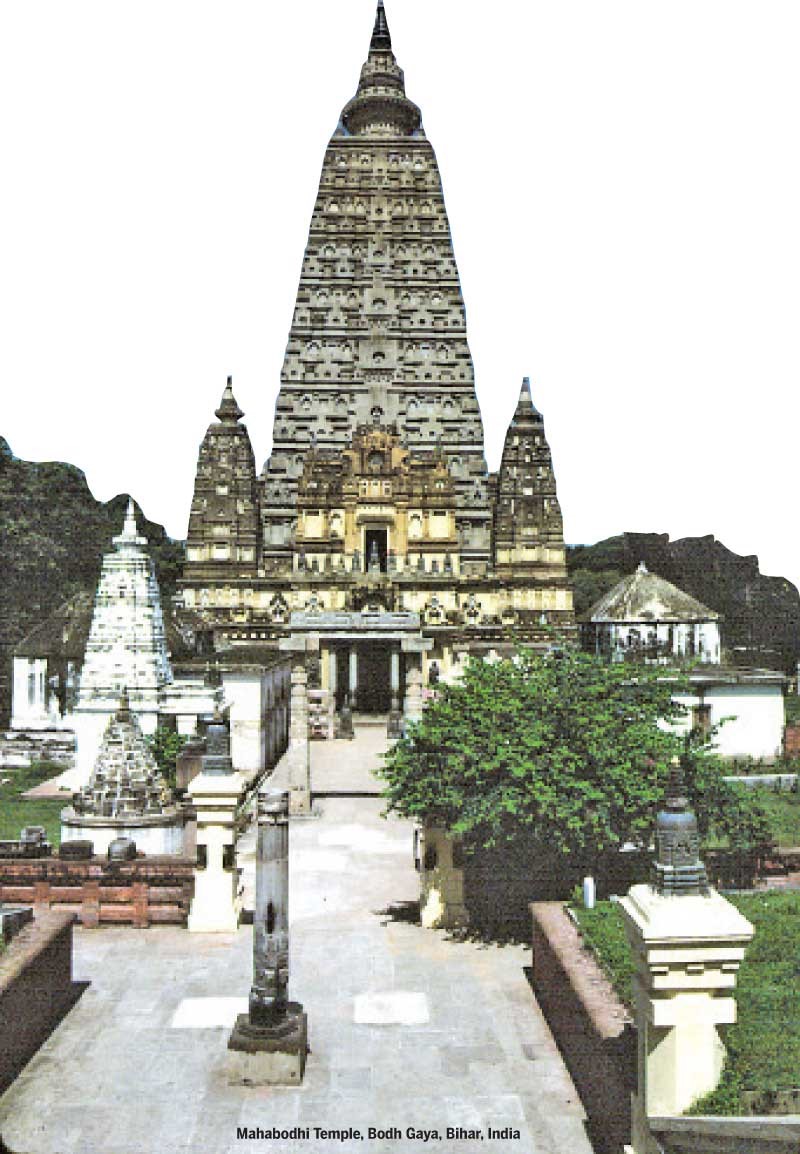
- Walpola Rahula TheraIt is two thousand two hundred and fifty-five years since the official introduction of Buddhism to Sri Lanka. The small mango-shaped island that is Sri Lanka lying at the southern tip of the large land mass of the Indian subcontinent is the homeland of the majority Sinhalese, which they share with the minorities in peace and harmony. It has been so from time immemorial. They have no other homeland. There is no other Sinhala speaking nation in the world. The Sinhalese have a recorded history of over two thousand five hundred years, but their indigenous tribal ancestors had been living in the island for countless millennia before the time that recorded history began, that is, prior to the date of the alleged arrival of the legendary prince Vijaya from North India. It was during the reign of King Devanampiya Tissa (250-210 BCE) that Arhant Mahinda Thera (285-205 BCE) came to the island of Sihaladwipa (the island of the Sinhalese, now known as Sri Lanka) to establish the Buddhasasana there in the year 236 BCE. Subsequent to that, when Theri Sangamitta (281-202 BCE) arrived in the island in order to establish the bhikkuni (female Sangha) order, she brought a sapling from the Bodhi Tree at Bodh Gaya (located in the northern Indian state of Bihar as that area is known today) under which the ascetic seeker prince Siddhartha Gothama attained Enlightenment. According to the ancient chronicles such as the Dipavamsa and the Mahavamsa, the two missionaries were, respectively, the son and daughter of the Maurya Emperor Ashoka of India (304-232 BCE). The official introduction of Buddhism under royal patronage marks the dawn of the great civilization that the Sinhalese built as a Buddhist nation. Sri Lankans celebrated the coming of Buddhism to the country on the Poson Full Moon Poya Day which this year fell on June 16.
The dispatch of his own children by Emperor Ashoka as Buddhist missionaries to the country of the Sinhalese points to the fact that they received special attention from him. The arrival of the two royal Maurya siblings for the formal inauguration of the Buddhist dispensation with its symbiotic relationship with the secular state is historically well authenticated. Their legacy remains to this day. The late Ven. Dr Walpola Rahula Thera described Arhant Mahinda Thera as ‘the father of Sinhalese literature’ by virtue of the fact that he translated the Tripitaka (the ‘Three Baskets’ containing the Buddhist Scriptures) into Sinhala (‘the language of the islanders’ as he called it) and wrote a commentary on it in that ancient form of Sinhala (source: Wikipedia). This, of course, suggests that the Sinhala language already had adequate resources to receive and give expression to the new religious ideology. Besides, it is known that Mahinda Thera preached to them in their own language, that is, Sinhala. So, he had to have studied the language before he undertook the mission. Scholars tell us that the Buddha Dhamma had not been entirely unknown to at least some of the people of the island by the time the missionaries came. Canadian Buddhist scholar Professor Suwanda Sugunasiri has established the fact that Mahinda Thera was the redactor of the oldest Buddhapuja (Offering to the Buddha) in the world in 247 BCE (Source: Wikipedia). The funerary stupa built at Mihintale for Mahinda Thera who died at the age of eighty is a hallowed site that Buddhist pilgrims visit in their thousands every year.
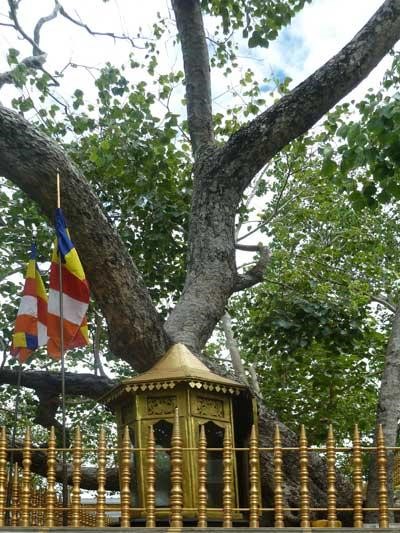
The humane approach that Mahinda Thera adopted in weaning the islanders off their native superstitious practices such as animistic observances and veneration of dead ancestors by modifying them to suit the Buddhist teaching was, no doubt, inspired by the same compassion he had towards ordinary people in the predominantly Hindu society into which he was born. He was mindful of the emotional distress that the people would have experienced if they were called upon to throw those time honoured practices overboard suddenly. This compassionate attitude was implicit in his accommodation of puja (offerings) in the Buddhist ritual practice that was mentioned above, although the Theravada doctrine that he represented excluded that element found in Hinduism. The native practice of supplicating to dead relatives for protection was replaced with ‘punyanumodana’ or sharing of merits with them. This is akin to the Buddha’s giving a new meaning to the ancient Vedic ritual of worshiping the six quarters of the earth and sky that the young householder Singala of the city of Rajagaha was performing early one morning, when the Buddha was passing by. Arhant Mahinda Thera’s elder sister Sangamitta Theri’s bringing of the Bodhi sapling to Sri Lanka seems to be a concession to the animism that the locals were familiar with. The sacred sapling was received by the king with great reverence, conveyed in a procession and planted in the royal park of Mahameghavana at Anuradhapura the capital city. It stands to this day, known as the Sri Maha Bodhi. The ‘conversion’ of the island dwellers to Buddhism did not involve any use of force, violence or bloodshed.
The history of Buddhist Sri Lanka is literally ‘written in stone’ throughout the island. Rock inscriptions recording significant events relating to the Buddhist dispensation are found in every part of the country. The land is strewn with ruins of mighty structures such as ancient viharas, cheitiyas, palaces, and forts. Not all of these ancient constructions have disappeared. For example, many of the great irrigation tanks and canals that the Sinhalese built beginning with the Abhaya Wewa at Anuradhapura done under the patronage of King Pandukabhaya (437-367 BCE) still serve the nation. The Poson festival that commemorates the beginning of this long stretch of glorious history assumed added significance this year because of the besieged conditions in which the Sinhalese had to celebrate it.
The passage quoted above as the epigraph to this essay is the final paragraph of Chapter VIII ‘What the Buddha Taught and the World Today’ of the classic work containing the essentials of Buddhism titled WHAT THE BUDDHA TAUGHT by the late Ven. Dr Walpola Rahula Thera (originally published by the Gordon Fraser Gallery Ltd., London and Bedford, England, in 1959). We may appreciate how deeply desirable the Buddhist goal delineated there is to the world in general, and to Sri Lanka in particular, especially at the present juncture. The recently held Poson ceremony must have brought this broad aim of Buddhism to the forefront of the celebrants’ minds in a context where they are having a foretaste of the very antithesis of the ideal society that Buddhism wants to create.
As can be judged from media reports, Poson this year, celebrated across Sri Lanka on June 16, brought a new breath of life for our beloved motherland made terminally ill by unpatriotic politicians who represent the interests of external and internal forces inimical to her. One popular preacher monk advised that every Buddhist house be illuminated with a Vesak lantern, though Vesak is supposed to have been observed a month ago. Presumably, the monk’s request was because, on the past two occasions (i.e., this year and the last), Buddhists’ premiere religious celebration, the annual Vesak festival, could not be held the way it is traditionally done due to uncertainties created by unsettling political developments in the country. Bright illuminations are the norm for the duration of the Vesak week, light being an offering made to the Buddha. In the prevailing circumstances, a Vesak lamp in every Buddhist home on the Poson Poya might be taken as a demonstration of righteous defiance of unjust pressure exerted on Buddhists for their alleged extremism, as much as an expression of undimmed religious piety. The mainstream and social media reported a few Toranas (also usually associated with Vesak) being on display for public view. And there were some dansalas (alms halls) too. The country’s security services were able to reassure the Buddhist public to come out of the siege mentality they were driven into by the mindless and faceless Islamic terror attacks on April 21 and reassert their right to freedom of religious belief and practice.
For at least one hundred years to date, the Sinhala majority of the country have been the target of unilateral criticism on grounds of their alleged racist mentality and religious extremism. This criticism is entirely baseless. Sinhalese are not and have never been racists (if racism means unfair treatment of people of a different race or unprovoked violence against them). Sinhalese Buddhists are not religious extremists, either. It is a fact that no one can claim that Buddhists are less tolerant towards people of other faiths than Christians or Muslims are. It is an established fact that no exclusively Sinhalese race-based or Buddhism- based political party has had any prospect of being popular among Sinhalese Buddhists. At least that has been the case so far. Sinhalese politicians invariably talk about the interests of the country – the land - first; they don’t exclude the minorities when they talk about the national interest. Racist minority politicians do not speak a word about the national interest or the country; they only talk about ‘the Tamil people’, ‘the Muslim people’, etc. (Of course, not all minority politicians behave this way.) The worst Sinhalese politicians do not behave in that manner. Yet it is the Sinhalese who get branded as racists. Even some discredited Sinhalese politicians are quick to condemn co-ethnic opponents who are courageous enough to speak up for the Sinhalese Buddhists when their rights are violated as racists in an attempt to curry favour with the minorities.
Over the past five centuries of European colonial hegemony in Sri Lanka, the Sinhalese have suffered many injustices at the hands of the ruling minorities (imperialists and their native lackeys). The situation hardly changed after independence. Although the colonialists are not there in person, their wish is being carried out by their local agents. Every legitimate attempt that the majority community makes to secure justice for all citizens and achieve progress as a single nation while conforming to the principles of humanity, equality, peace, and non-violence taught in Buddhism and found in other religions as well is somehow frustrated by the few racist minority politicians who manage to get elected to parliament by hoodwinking the masses they claim to represent. They oppose anything that goes against their narrow racist schemes, although it may be good for the whole country. But the ordinary minority Tamils and Muslims that these handful of racists draw upon as bloc-vote banks are, like the majority Sinhalese, non-communalist, non-violent, peaceful people who want to live and let live minding their own business. The Poson that came after the April 21 watershed rekindles prospects for creating in Sri Lanka the sort of peaceful and harmonious society that Buddhism aims at. All the communities Sinhalese Buddhists, Tamil, Hindus, Muslims, Christians (a large proportion of Muslims and Christians are racially Sinhalese) have become targets for Islamic terror attacks. The quranic ‘People of the Book’ ‘Ahl al-Kitab’ - Jews, Christians, etc - are perhaps in less danger from mortal Islamic terror; but Buddhists and Hindus will have no reprieve; it is time Sinhalese and Tamils took serious note of this. Therefore, practically all Sri Lankans have a strong incentive now to unite against the common enemy, Islamic fundamentalism, in whatever guise it comes. Buddhist monks and clerics of other religions are getting together to provide the necessary spiritual leadership for intellectual engagement over the matter. The influence of the deep rooted Buddhist cultural heritage of the country is an important factor in this context.
(The quote in the title is from the late American thriller writer Robert Ludlum)
20 06 2019 - The Island
H6.02
Road Less Travelled
Sanka Wijeyakulasuriya
The Colombo International Airport situated on the West Coast of Sri Lanka is one of the main reasons why the East coast of the island is neglected in terms of inbound tourism. All the travelers enter the country from the West coast and only a handful of them take the effort to travel all the way across the country to the East, to explore. As a tourist destination we need to keep changing our product portfolio which we offer to our travelers since if not, we would never create a repeat client base since we would be selling the same itineraries over and over again and the travelers would not have any reason to come back to Sri Lanka.
This being the situation for the last several decades, provides a great opportunity for those who wish to travel or promote the Eastern part of the island since this region has not changed their way of life to adapt to the requirements of the tourists which is a great thing. It's very raw and authentic, everything that today's traveler values.
Following are the top 15 sites that one can visit while in the East coast;
Tiriyaya Watadage
Also known as Girihandu Seya, this is considered to be the oldest temple in the entire country which was built while Lord Buddha was still alive. It was built by ancient merchants called Tapassu and Balluka. The temple is around 50KM north of Trincomalee town. The temple has been built enshrining the hair relics of Lord Buddha and is believed to be a site visited by Him. To get to the temple you would need to climb to the top of a small hill which is an easy climb.
Sober Island
There's a resort run by the Sri Lanka Navy inside this island which gives them exclusive access to the place and is called Sober Island Resort. The only way to get to the island is by boat and you need to get permission from the resort or from the Sri Lanka Navy to enter. It's just a 10 - 15 minute boat ride from the Trincomalee harbor. French occupied this island in 1672 and called it the "Island of Sun". Then the British took it over in 1784. During the World War 2, the British fortified the island with gun batteries which were used against the Japanese Navy in defending Trincomalee. Today there are remnants of ruins from different centuries in the island. There's a steel tower that you can climb which would give you a view of the entire harbor. Then there're graves, underground ammunition storage areas, tunnels and many more ruins of the barracks. The hike inside the island ends on a secluded beach which is a great place for a dip in the water. This is a hidden away beach corner with some half sunk ships in the yonder. The resort has basic accommodation and a seperate restaurant as well.
Seruwavila Temple
When you are travelling from Trincomalle towards Pasikudah, you will find this temple which houses the forehead bone of Lord Buddha, where the temple was built in the 2nd century BC. Another hidden away gem of a temple in the island which is an amazing place to meditate. There're several huge trees next to the temple which have roots coming out of the Earth in several directions making it a magical setting. The area around the temple is filled with ancient ruins and the last time I was here, they were renovating the image house which was about 5 minutes walking distance from the temple. Around the temple from a distance, there's an electric fence making sure that the wild elephants don't come in at night.
Somawathiya Temple
This is by far the most mythical temple in Sri Lanka, situated inside a thick jungle - the Somawathiya National Park. The temple is older than Ruwanweliseya, Mirisawetiya and Jetavanaramaya. The temple enshrines the right tooth relic of Lord Buddha. There're pictures hanging in an area close to the temple, taken by pilgrims which shows that a white baby elephant running through the temple walls and some have witnessed an entire Perahera procession coming out of the completely enclosed temple. If you visit this temple, watch out for the pilgrims chanting Buddhist prayers looking at the top of the temple since many say that they have seen Lord Buddha's rays coming out from the top of the temple. During the times of the civil war in the country, the monks who were staying at the temple said that every night elephants would come and guard the temple making sure that Lord Buddha's relics were protected.
Dimbulagala Temple
A little far away from Somawathiya is where you will find this forest hermitage - Dimbulagala temple. It's a hard climb to the top of the temple since at certain areas you would have to hold on to rocks and trees when hiking. I saw a lot of pilgrims hanging a branch on a sacred tree for their protection while climbing up and coming down. I followed their example and did the same. This is a beautiful temple which is situated on top of a mountain and the view from the top is very beautiful. In the vicinity there're several caves with ancient inscriptions and paintings as well. This monastery was abandoned after the fall of the Polonnaruwa kingdom and was restored to the present state after around 850 - 900 years of it being lost to the world.
Boat Safari in Senanayake Samudraya
In Ampara there's a breathtaking phenomenon that one could witness where wild elephants swim in the Senanayake Samudraya. The Wildlife Department in the area operates a couple of boats in the tank. It's a once in a lifetime opportunity to go on these boats and see wild elephants swimming right next to your boat which is called "The Crossing". Since there're only two boats, it's always advisable to call the wildlife department and pre-book your boat time slots (morning and evening) to avoid disappointment. There're several islands inside the tank and the elephants swim from mainland to these islands in search of food. Also on these islands and on rocks you would be able to see lots of bird species as well. During the boat tour, the boatman will let you get on to one of these islands to have a small break as well. This is the only wildlife safari in Sri Lanka that you can do in a boat instead of a safari jeep.
Nilgala Jeep Safari
A lesser known forest in the country which was also the Medicinal Garden of an ancient King who was also an Ayurvedic doctor - King Buddadasa. Today you will find relics of an ancient castle - for which you would have to go deep inside the jungle, which is not included as a part of the jeep safari. Finding a jeep in Nilgala could be a bit of a challenge. Therefore please remember to call the Nilgala Forest department and reserve a jeep. Today Nilgala Forest safari is also known as the Gal Oya National Park safari. One of the greatest kings of Sri Lanka was King Dutugemunu and before he became the king of the country, an Indian invader named Elara was ruling the island from Anuradhapura.
King Dutugemunu's army was in the South Eastern side of the island (present day Yala and Kumana national parks) and the army needed to travel all the way across the island to Anuradhapura to wage their war. Since it was a long march, King Dutugemunu had to make sure that his army doesn’t get lost during this long journey. So the king ordered a small road to be built from present day Yala to Anuradhapura, which was called the "King's Road". This road was built way back in time, even before the Romans started building their roads. The only place in the country where you can still see parts of this road is inside Nilgala forest. Talk to the wildlife officials and the safari driver before you go on the safari and make sure that they know where this is, since unfortunately, this is a part of history that's being lost in time and we are forgetting our own heritage.
Nuwara Gala Hike
This hike is only recommended for those who like adventures and there's a certain amount of risk involved as well. An ancient king of old started building an ancient city and a castle for his kingdom in Anuradhapura - I was told it was King Saddattissa by the locals, but I didnt find evidence to support this. However half-way down the construction, a civil war had broken off in another part of the country and the King had to focus his entire attention and time for this war. This half built kingdom and its fortress is slumbering in the wild to this date. When I got closed to the Nuwara Gala rock (at the base), I zoomed in at one part of the rock with my camera lens (at the request of a village porter who was helping us) and I saw what appeared to be doors carved on the rock which was half way in between. There was no possible road that could take us up to this doorway. I was acting as the photographer for a Sri Lanka Tourist Board project and another video cameraman and a reporter from a reputable TV channel was present at that time as well and they were documenting this entire journey. The road to the top of the rock was in seven layers. It was a hard climb where we had to hold on to trees and rocks to get to the top. Once at the top we found the Royal pond which had been carved into the rock. It was a breathtaking sight to see such an amazing man made rock pool which was almost the size of an Olympic swimming pool. The local porters from the village who accompanied us told that elephants climb all the way to the top of the rock during drought season since this pool never dries out it seems. Also they said at one point, a helicopter had landed on top of the rock and had tried to dry out the pool using generators in the hopes of finding buried ancient treasure at the bottom. However they have given up since the pool had kept going deeper and deeper into the rock and they couldn't find the bottom. On the side of the rock was a huge cave at the top with ancient inscriptions. An amazing place for a camping night since the cave can easily hold about 100 people. But we were warned that bears climb to the top of the rock in search of water as well. The view from the top is something out of this world. Mountains, lakes and greenery as far as the eye can see. No buildings and most of the time, the clouds were beneath us. The area is related to the Veddhas as well where it's believed that "Thissa Hami" the greatest Veddha chief of all time had been visiting his mother who was living in caves close to Nuwara Gala.
Rajagala Ancient City
The locals said that Nuwara Gala was supposed to be the rock fortress where as Rajagala was supposed to be the King's city where all the temples and monasteries were being built. It's another nature climb to the top through the forest, holding on to rocks and trees. But the last time I was in Rajagala I was happy to see that the Archeological department was doing work in the area which meant it was going to be preserved. I was told that a 4x4 jeep could take you to the top. Once at the top, you will experience something that you can't find anywhere else in the country. An actual ancient civilization being half built and then abandoned for centuries. You will see tall Lord Buddha statues lying on the floor with one side of the rock has perfect carvings of the Lord Buddha's body features and the other side is still a rock. There're so many ruins that you could explore and if you are visiting this place, make sure to go there as early as possible since there's lots to see and around 3pm you should come back down since there're no electric fences to keep away the wild elephants.
Deegavapi Temple
It's written in the chronicles that Lord Buddha visited a village in Ampara and Deegavapi temple was built on the place where He sat and meditated. The temple has a recorded history dating back to the 3rd Century BC. Unfortunately the temple is in a very bad state at the moment. There're small trees growing on top of the temple structure. The last time I visited the place, I had a chat with the Chief monk of the temple and he told that he had plans of creating a very large temple structure around the existing temple so that pilgrims and visitors can go inside this structure and witness the actual temple. This was going to be done to help the old structure since the rain and the burning Sun was not helping to preserve the ancient temple. In a very sad tone, the monk said that he had found people to fund this great cause, but he was not been given the "political go ahead" that he needs to make this project a success. Hope this great historical temple will not fade into the night.
Mailla Archaeological Cave
The easiest way to get to Mailla would be to drive to Siyambalanduwa either from Ampara or Pottuvil or Monaragala sides. Then from Siyambalanduwa drive straight to Kodayana town and then take a left. Afterwards proceed straight to Kottiyagala from where you would have to talk to the villagers and organize a tractor to take you to Mailla. Be clear to the villagers about your interest in seeing the archeological site and this site alone. This is an amazing cave where a sleeping Lord Buddha statue had been created out of clay. The cave is painted beautifully with different colours. This reminded me of Dambulla cave temple. The road to the temple is very bumpy and the last bit of the journey needs to be hiked. Its an easy hike. Following your guides instructions to the letter is recommended.
Maligawila Buddha Statue and Dambegoda Bodhisatva Statue
Maligawila Lord Buddha statue is the tallest free standing stone statue in the entire country with a height of 14.5 meters. This was carved in the 7th century by a prince called Aggabodhi. This is located close to Buttala. From the Buttala town you need to take the Okkampitiya road and you will pass the Dematamal temple along the way. Very close to the Maligawila statue (around 5 minutes walking distance) is the Dambegoda Bodhisatva statue which is believed to be of the Maithree Natha Bodhisatva. This statue was damaged due to a fall and by treasure hunters, but was renovated to its current state. The statue is set on a platform where there're several steps for you to climb in order to get to the statue. At the base, there's an ancient stone pillar with inscriptions.
Magul Maha Viharaya
Located close to Lahugala, some believe that this was the original temple where King Kavantissa (ruler of Ruhunu kingdom) and Queen Viharamahadevi (daughter of Tissa, king of Kelani kingdom) got married. However there's another temple close to Yala with the same name and others believe that this is where the King and Queen got married. King Kavantissa and Queen Viharamahadevi are the parents of our great King Dutugemunu who defeated Elara, the Indian invader king and united Sri Lanka. The temple is filled with beautiful ruins and you would hardly find any tourists here. One of the main unique attractions of the temple is one Moonstone. In the moonstone during that era, seeing an elephant is a normal inclusion. However this is the only moonstone in the country where it shows different stages of a Mahout, climbing on top of the elephant. It's said that during the wedding ceremony of the King and Queen, one elephant had got violent. This mahout had courageously jumped on the elephant and had stopped it from destroying everything in its path. The King had carved this moonstone to honor the bravery of this mahout.
Kudumbigala Monastery
The temples in Sri Lanka have been built in different shapes. This is the only Cylindrical shaped temple in the entire country. It was built in 246 BC and there're more than 200 rock caves in the vicinity that belonged to the monastery. It's said that King Dutugemunu had 10 giant warriors and many believed that this was just a myth. However just before you start the climb to Kudumbigala monastery, there's a cave where the ancient inscriptions confirm the existance of the giant warriors by talking about the Giant Warrior Nandimithra. The last part of the climb is a little steep, but however there's a railing to hold on to, which makes your climb easy. Ancient monks used this monastery to get away from the city life and to meditate in peace.
Kumana National Park
The Kumana national park is filled with leopards, bears and elephants. The park is a Ramsar Wetland, which is a heavan for many species of birds. The park also provides good feeding grounds for 3 threatened turtle species - Green Turtle, Loggerhead Turtle and Olive Ridley Turtle. This is by far the most beautiful national park in the entire country since it's not spoiled at all. When entering the park you will see the ancient Okanda temple which is a Hindu kovil. Also once inside the park, there's the Kuda Kebiliththa dewalaya. The Maha Kebiliththa Dewalaya is deep inside Kumana and many believe that Lord Katharagama lives here. One should refrain from eating meat and eggs for 21 days and be "clean" before you visit Maha Kebiliththa dewalaya. Around 200 BC an ancient civilization existed inside the Kumana National Park. Inside the park are the ruins of an ancient monastery called Bambaragasthalawa Naga Pabbata Monastery. A majestic reclining Lord Buddha statue is present in the middle of the thick jungle. Unfortunately the entire head of Lord Buddha had been blown off by the treasure hunters. The locals believe that even though the statue is surrounded by trees in the forest, not even one leaf from the trees fall around the vicinity of the statue. I checked and quite surprisingly, there was none. Before the Veddhas in Sri Lanka existed, there were "Nittaewo" who were supposed to be around 3 feet tall and had very sharp nails. They were close to the apes in evolution. It's said that during the final days of the Nittaewo, Veddhas started to emerge and the Nittaewo would steal the Veddhas food, destroy their homes and steal their women. After so much of harassments from the Nittaewo, Veddhas have got together and had drove all the Nittaewo into a cave and had burnt the cave, continuously for three days. This was the end of the Nittaewo in Sri Lanka. This cave is located inside Kumana national park. It's said that there're three standing Mahayana Buddha statues located deep inside the jungle and it had been photographed only thrice in history. There's no map or very few people know how to get there. I have seen these images myself. In the first picture which was ever taken, had all the three Lord Buddha statues perfectly. The word must have got out and the third picture I saw had two of these statues damaged by the treasure hunters. Somethings are best left lost in the sands of time! Next, there's an old tower deep inside the Kumana park where during the ancient civilization times, the king have had his queen locked up in here since her face had got disfigured. The King loved the queen and therefore didnt kill her, but locked her up in this tower. The story is a little bit different, but it reminds me of our version of Rapunzel in the Tower. Finally, a part of the world famous Hollywood film - "Indiana Jones and the Temple of Doom" was filmed inside Kumana national park where Harrison Ford, George Lucas and Steven Spielberg visited the park. During an interview, Harrison Ford told the below;
Question - You’ve played a vast array of characters, traveled to numerous destinations, and met many influential people- but what remains on your bucket list that you’re most excited to cross off?
Harrison Ford - You know when you travel for work, you don’t reallly get a chance to experience the place you visit. I would like to go back to Sri Lanka, where we shot one of the Indiana Jones movies.
28 07 2019 - Sunday Island
H6.03
Bharhut Stupa; Majesty and Mystery
Bhante Dhammika of Australia
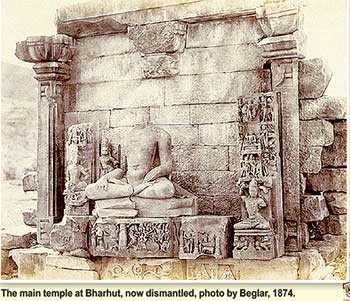
The British Major had ridden for days from Allahabad while on his way to Nagpur and had arrived in the small village of Bharhut just before sunset. That evening while resting in a villager’s house he noticed some carved stones paving the floor and suspected that they had been taken from some ancient structure. Inquiring about this he learned from his host that there was a half-buried ruin a little beyond the eastern edge of the village. So in the morning the major went to have a look at this overgrown mound of bricks and stone. The time was November 1873, the major was Alexander Cunningham and he was about to stumble upon one of the most important archaeological discoveries ever made in India and one that is testimony to the artistic genius of the early Buddhists.
Cunningham was an engineer by training but after arriving in India in 1833 he developed an interest in India’s past which in turn led to an interest, actually a passion, for Buddhism and its history. During his five decades in India he discovered, verified the location of or excavated Savatthi, Kosambi, Kusinara, Sankassa, Visali, Nalanda, Taxila, Sanchi and various sites around Rajagaha including the Satapanna Cave where the first Buddhist council had been held. His discoveries did much to demonstrate to scholars, whose explorations of Buddhism was still in its infancy, that the Buddha was not a legendary or mythic figure but an actual human being rooted in history. Of all the discoveries Cunningham ever made he always considered that at Bharhut to be the most significant.
On examination the ruins at Bharhut the next morning Cunningham realised that he had found something of great importance, but he had work to do in Nagpur and so after a quick examination of the ruins he continued his way. On his return journey three months later he spent several weeks in Bharhut excavating what turned out to be an extremely ancient and extensively decorated stupa, a veritable gallery of Buddhist art. Under his instructions, J.D. Beglar did further digging at the site a month later and the two men returned together in November to do yet more digging and to search the countryside around Bharhut, discovering carved stones, inscriptions, pillars and statues. For centuries local people had plundered the stupa to use its material for a variety of purposes. Cunningham later wrote that almost every one of the 299 houses in the Bharhut village had been built of bricks from the stupa. Because of this more than two thirds of the magnificent monument had been destroyed.
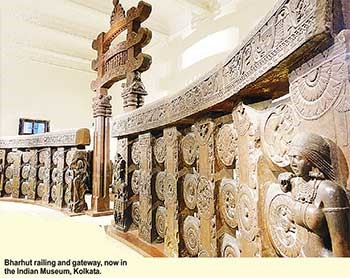
The stupa had been built between about 100 and 150 BCE during the reign of one of the Sunga kings. It had a circumference of 20.5 meters and was made of brick covered with a layer of plaster. Near the base of the stupa’s dome were small triangular-shaped recesses in which lamps could be placed, much as devotees still do at stupas. A paved path went around the stupa and this in turn was surrounded by a stone railing with gates at each of the four cardinal points. The railing pillars and their cross bars are all richly carved, as is the gateway. The carvings are of various geometrical and floral designs, scenes from daily life, sea monsters, lions, lotuses, nagas, and female devas, but most importantly, of Jataka stories and events in the life of the Buddha. Altogether 24 Jatakas are depicted, the name of each story being inscribed above it, and 15 episodes from the Buddha’s life. These are important because it shows that the Jatakas were already well known 150 years BCE as was the Buddha’s biography.
One of the most interesting of the other carvings shows a man riding an elephant and carrying a casket containing Buddha relics. It would seem that there had been a festival at Bharhut, perhaps once a year, when the stupa’s relics were carried in procession, reminding one of the annual Kandy Perahera. One interesting thing about the female figures carved on the railing pillars is that some of them are depicted with tattoos which must have been a fashion at this time. Some of the women have star, moon or flower-shaped tattoos on their cheeks, breasts, and upper arms.
There are also more than a hundred inscriptions on the railings, mostly the names of and brief details about the devotees who donated the parts of the railing or paid artists to do the carvings on them. Interestingly, some of these names are still in use; one monk was named Buddhadasa, one woman was named Chandra and another Srima, and one man was called Nanda. Unfortunately, none of the inscriptions give the original name of Bharhut or tell us why the stupa was built there. Perhaps such information was provided but on a part of the monument that no longer exists.
The Bharhut is of interest to today’s Buddhists because many of its features are familiar to us even though we live more than 2000 years elater. It speaks of the remarkable continuity of Buddhist beliefs and practices. It’s depictions of events in the Buddha’s biography and of Jatakas shows the creativity of the early Buddhists in using a range of new mediums (writing and plastic art) to transmit the Buddha’s message. We should take a cue from this and not be reluctant to use today’s new mediums to transmit the Buddha’s Dhamma.
The great stupa was not the only monument at Bharhut. Near it Cunningham discovered a monastery that had been inhabited until the 10th century, several smaller stupas and a large beautifully decorated temple with a Buddha statue still in it dating from 8th or 9th centuries. Today, nothing remains at the original site other than a low grassy mound. To see the majesty of Bharhut one has to visit the Indian Museum in Kolkata where a whole gallery is dedicated to it and where the surviving railing (vedaka) and its gateway (torana) have been re-assembled. Cunningham wrote a detailed and extensively illustrated book about Bharhut. In it he acknowledged the help he received from the famous Waskaduwe Sudhuti Thera in helping him identify the Jatakas on the stupa. He apparently had a correspondence with some of Ceylon’s scholar monks to help him better understand Buddhism. Since then a dozen or so important monographs have been published about Bharhut and its art.

Nevertheless, despite all the attention given it and the research done on it a mystery about this wonderful monument remains to be uncovered. Why was it built at Bharhut? We know why the other great stupas of India were built – many where significant events in the Buddha’s career took place. Those at Sanchi and Amaravati were built for other reasons – the first because Asoka had spent time there and Mahinda left for his mission to Sri Lanka from there; the second because it was believed to be where Sumedha made his adithana to become a Buddha. But of Bharhut’s origins we do not even have legends. The name Bharhut cannot be linked to the name of any location associated with the Buddha. And anyway, as the place is some way beyond the Middle Land, the region we know was the scene of all the Buddha’s activities, it is unlikely he visited it. Nor is Bharhut mentioned in any later Buddhist literature. Bharhut is situated at the southern end of the Mahiyar Valley formed by fairly high forest-covered hills. The ancient road from Kosambi to Ujjani ran through the valley and was undouble used by merchants and travellers even during the Buddha’s time, being as it were one of the main arteries running to the south, the Deccan, from the Middle Land. Perhaps Bharhut was an important stopping place for travellers and some monks established first a monastery and later a stupa there for the devotional needs of these travellers. Beyond this we cannot say.
14 08 2019 - The Island
H6.04
How new finds are changing Buddhist history - I
Rachel Lopez
One of the colossal Buddha statues in BamiyanBuddhist history is turning a corner. New finds suggest that it spread wider, lasted longer and was more influential than we realised. it is time to update the map.
Across Asia, geography is changing history. A slew of excavations and chance discoveries show that the history of Buddhism, the belief system that flourished from 600 BCE until a decline in the 13th century CE, still contains many surprises.
Newly unearthed sites in Uzbekistan are evidence that it spread farther than previously thought. Stupas and sculptures dating back 2,000 years show that it flowed into new territories earlier. And magnificent monastery complexes are proof that the Buddhist institutions exerted greater influence over commerce, urban development, economic systems and everyday life than previously thought.
Emerging from the digs are stone structures, coin caches, copper plates, mantras punched on gold foil, inscriptions on palm leaf and ivory, colourful murals, and scriptures in at least 20 languages. How did Buddhism, which preached a renouncement of the material world, leave behind such a staggering wealth of physical evidence? K.T.S. Sarao, former head of Buddhist Studies at the Delhi University, says that a mingling of the sacred and non-sacred was inevitable. “Monks spreading the Buddha’s teachings would travel along the Silk Road with merchant groups for safety; merchants, in turn, relied on them for spiritual support on these risky journeys,” Sarao says.
Over time, shrines sprouted at rest stops, becoming a constant in an uncertain landscape. “They grew to include storehouses, factories, banks, and guesthouses, allowing monks to benefit not only from royal patronage but from local commerce too.”
In Bihar, where the Buddha is said to have attained enlightenment, efforts are on to unearth an administrative centre that until now only existed in texts. A monastery headed by a woman has been found there, and in Odisha, there is evidence of an unusual meditation complex open to both monks and nuns. In Afghanistan, monasteries located alongside copper mines reveal how rich monks wielded clout over the region.
Archaeology, then, is recreating parts of the story that are not found in the scriptures. Because of the Buddha’s renunciation of material possessions and the self — he told followers he should not be the focus of their faith — there are key questions that are still unanswered. Researchers are hoping to confirm whether Kapilavastu, the Buddha’s childhood home, corresponds to the town in Nepal or one of the same name, not far away, in Uttar Pradesh. They are tracking how his teachings travelled clockwise out of central India, spreading through north-west Asia and then to China and further east over 1,000 years.
“Sri Lanka, Thailand and Myanmar have done admirable jobs of preserving Buddhist monuments,” says Sarao. In India, however, unmarked Buddhist sites are often mistaken for Hindu temples by locals. Idols of Buddha are worshipped as Shiva, Ashokan pillars are taken for lingams. “We should work together to preserve the Buddha’s legacy,” says Sarao. “His teachings are more relevant than ever.”
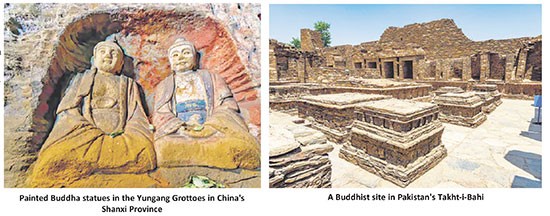
Across the arid Khyber Pakhtunkhwa Province, which encompasses much of the north and northwest of Pakistan, lie some 150 Buddhist heritage sites. The area was a major centre for early Buddhist development under Ashoka’s reign 2,300 years ago.
Italian archaeologists were investigating the province’s northern Swat region as far back as 1930. But digs were abandoned before discoveries could be made. Local teams, back at the site last year, were luckier. They discovered a monastery and education complex, the largest found in the region, and believed to be between 1,900 and 2,000 years old. Discovered thus far are stupas, viharas, a school and meditation halls, along with smaller cells higher in the mountains where monks could retreat into isolation. Also unearthed was a coin, helping date the site to the Kushan Empire (30 CE – 375 CE), which spread across modern-day Afghanistan, Pakistan and northern India and was instrumental in spreading Buddhist teachings. The bonanza: rare frescoes depicting figures in various poses, including the namaskar.
Afghanistan’s chance to make amends
It has been 20 years since the Taliban destroyed the Buddha colossi in Bamiyan. They still could not erase signs of Buddhism, which had a large following here until the 11th century. Cave networks, paintings and statuary have been found at six major sites.
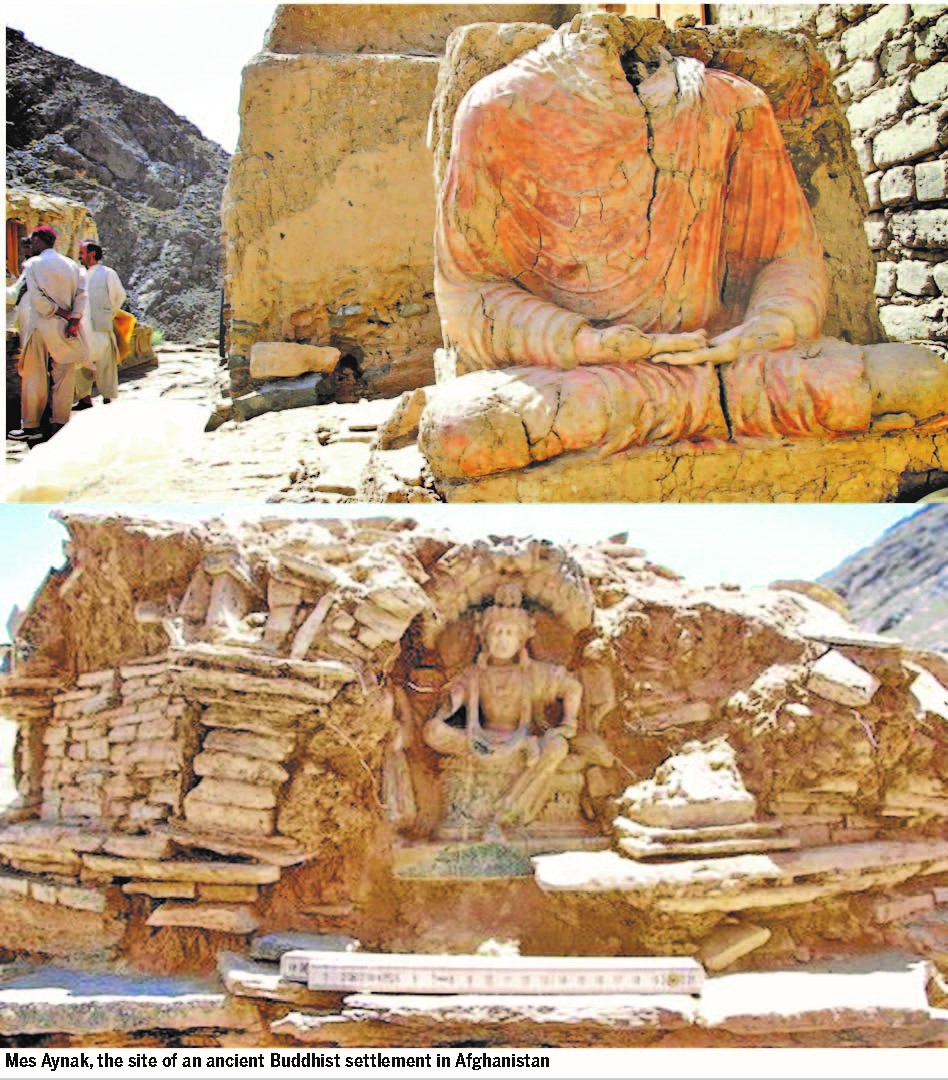
In 2008, when the Chinese bought over the world’s second-biggest unexploited copper mine in Mes Aynak, the site of an ancient Buddhist settlement, archaeologists raced to document and salvage the 2,600-year-old monastery that stands there, before it was lost forever. Mes Aynak was a spiritual hub along the Silk Road from the 3rd to 8th centuries CE, a peaceful cosmopolitan pitstop run by monks who’d become rich from the copper ore. Researchers unearthed monastery complexes, watchtowers, walled zones, jewellery hoards, manuscripts and close to 100 stupas. One statue of the Buddha, twice as tall as a human, still bore traces of red, blue and orange on the robes. Several copper coins featured an image of the Kushan emperor Kanishka on one side, and the Buddha on the other.
As a result of Afghanistan’s poor infrastructure, mining work has stalled. Archaeologists could not be happier. Their initial three-year deadline for digs has stretched to nearly 13 years already, becoming the most ambitious excavation project in Afghanistan’s history. In 2016, when a mural was discovered in Termez in southern Uzbekistan, near today’s border with Afghanistan, few were surprised. Uzbekistan was, after all, once part of the Kushan Empire. Its residents were intermediaries as goods flowed west to Rome and east to China.
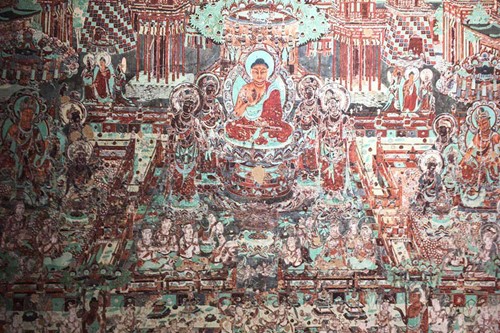
But the mural was unusual. It was discovered in a stone basement adjoining a pagoda and looked to have been made in the 2nd or 3rd century CE. Despite its age, its figures in blue and red were remarkably vivid, blending influences from East and West, its angled face shaded to mimic depth. It seemed to be part of a lost larger painting about the life of the Buddha. Researchers drew parallels with murals in Dunhuang, China, an eastern junction on the Silk Road. It was proof that the route did not just transfer things, it let art, religion and ideas flow in both directions too.
Nepal’s tryst with history
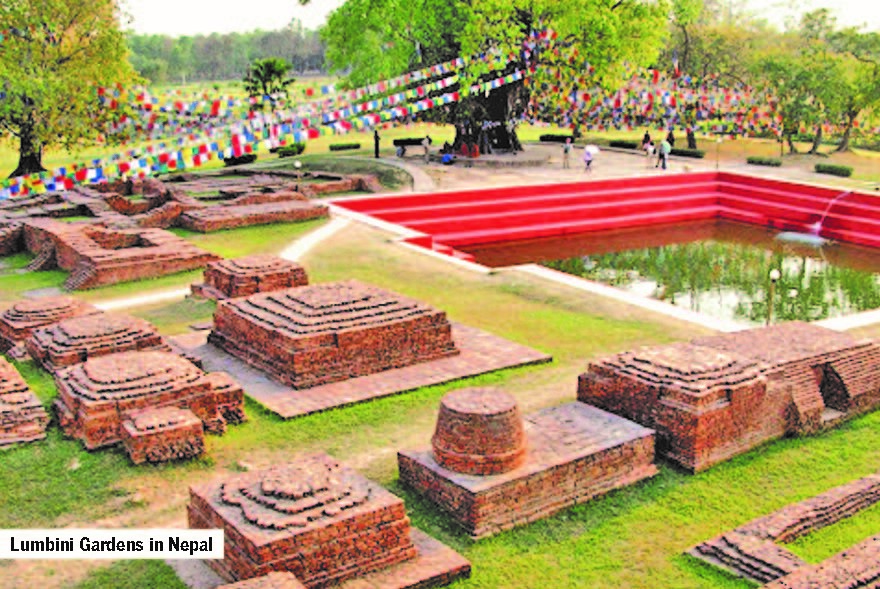
The Buddha disapproved of the idea of devotees focusing on him, and so little about him and his life is known. Followers believe that his mother, en route to her parents, went into labour and gave birth to him (grasping the branch of a sal tree) in the Lumbini garden in present-day Nepal. We know that Emperor Ashoka built the first Buddhist structure there — a pillar inscribed with his own name, the story of the Buddha’s birth, and a date corresponding to the 3rd century BCE.
That spot is now a UNESCO world heritage site. But in 2013, when British archaeologist Robin Coningham excavated inside the 3rd century BCE Maya Devi temple that also stands there, he found that the site (and Ashoka’s story) went deeper. Beneath the temple his team found a roofless wooden space, with signs of ancient tree roots over which a brick temple had once been built. Charcoal and sand fragments were carbon dated and found to be from 550 BCE, around the time the Buddha is said to have lived. If this was a Buddhist shrine, the timing would make it the first one ever built. Indian archaeologists are sceptical, though. “Tree shrines have been part of Hindu worship much earlier than the time of the Buddha,” says K.T.S. Sarao, who is also a former classmate of Coningham at Cambridge. “It is not unusual for temples to be renovated and there is no proof connecting it to the Buddha.”
He adds a further blow: The Government of India does not permit foreign archaeologists to dig here. So some scholars may exaggerate foreign findings to make them sound as important as the sites they cannot access, he says.
Meanwhile, work continues in Nepal. Coningham’s excavations in the Tilaurakot region, where the Buddha was believed to have lived as Prince Siddhartha, have unearthed the remains of an 1,800-year-old palace complex and walled city. There are courtyards, a central pond and stupas. But still no concrete connection to the Buddha.
(Hindustan Times)
27 05 2021 – Daily News
How new finds are changing Buddhist history - II
Rachel Lopez
Images of the Buddha found in Jammu and Kashmir
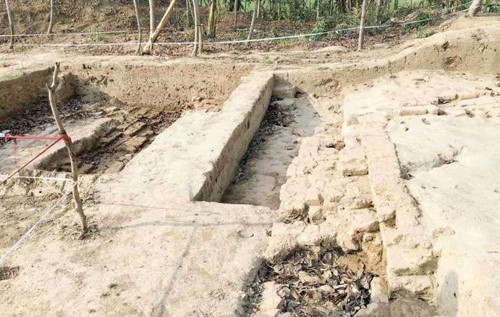
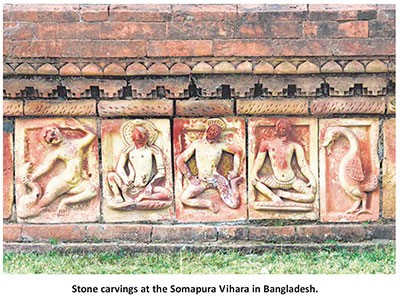
When a storm tore through the village of Dalijhara Dhibi in south-western Bangladesh in 1988, it uprooted rows of trees in a mango orchard. The owners decided to plant banana instead, but found they could not. Under the soil was a thick layer of brick. Thirty years later, they tried to plant mango again, and that is when they decided to examine the bricks more closely. They unearthed a brick structure. The regional archaeological department was brought in.
Three months of excavation later, the orchard yielded an unusual harvest: a 1,200-year-old Buddhist monastic complex. Last year, continuing digs unearthed two temples and courtyards, and 18 residential cells. Fragments of ornamented bricks, terracotta plaques and clay pots show engravings of lotus flowers and geometric shapes.
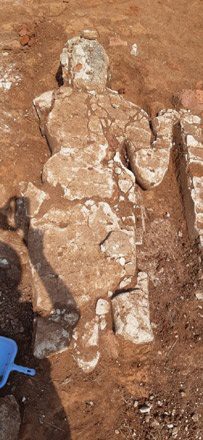
The life-size Bodhisattva, the biggest stucco statue in IndiaThere are other sites of note in the country. In Nateshwar in central Bangladesh, a 1,000-year-old temple was excavated in 2015. Researchers say the revered teacher and saint Atish Dipankar probably spent time there before his travels to Tibet and China. His life, like the Buddha’s, left no known material evidence. Perhaps that is changing.
Across China, a past that won’t stay buried
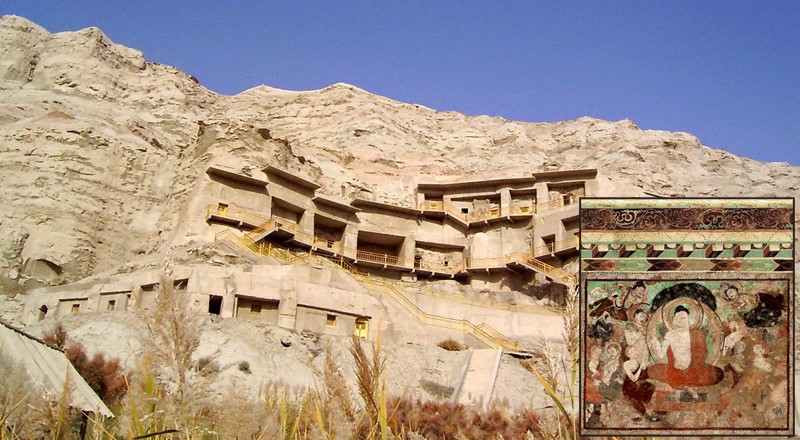
China is hardly short on historic treasures. Local traditions say that the first Buddhist temple there was established in 68 CE. The 339 Kizil cave temples in the Xinjiang Uyghur Autonomous Region were built between the 3rd and 8th centuries CE and are the country’s oldest. They hold two kilometres of narrative murals, calligraphy and painted clay statues that borrow styles from across Asia.
And despite political efforts to minimise it, Buddhist history keeps popping up. Reservoir renovation work reveals a 600-year-old idol of the Buddha; ancient statues are discovered built into what are now the bedrock foundations of residential buildings; buried boxes in villages are found to contain cremated remains of scholars and monks — and these are just the biggest finds across the mainland from the last five years.
This year, researchers found that the artwork in Dunhuang’s famous caves is not 500 years old as believed but at least 700 years old, and it has an Indian connection. Text on an image from Cave 465 was found to be mistakenly pasted backwards. Researchers flipped it digitally. It turned out to be Sanskrit.
For Japan, a pillar of hope
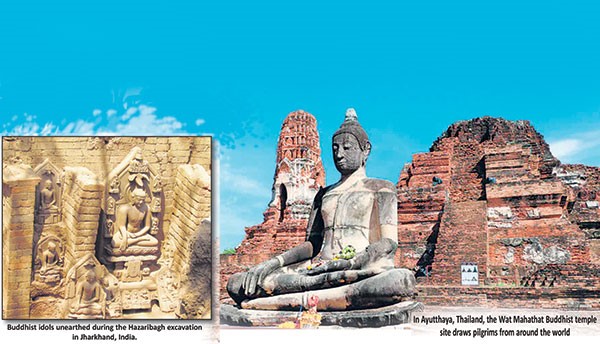
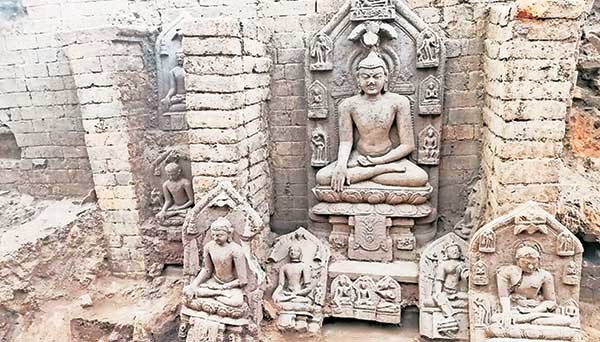
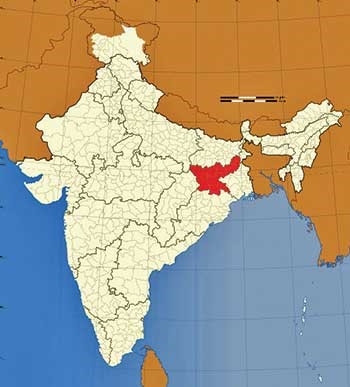
A mural painting in ChinaPriests overseeing the renovation of a temple in the Shiga prefecture, north-east of Kyoto, found history hiding in plain sight last year. Two old pillars bore blurred, sooty images. Infra-red photography revealed images of eight Buddhist saints. Each pillar bears the images of four Bodhisattvas — monks who delay enlightenment to help others find salvation. The photographs indicate they were once painted in bright blue, green and vermilion. Researchers believe these could date to the Asuka period, which lasted from 538 CE to 794 CE, putting them possibly among the oldest known Buddhist paintings in Japan. In Hazaribagh, 110 km from Ranchi, the Archaeological Survey of India (ASI) identified three mounds last year as having possible links to Buddhism. One yielded a 900-year-old shrine and two subsidiary structures, two metres below ground level. In January this year, digging into the second mound revealed another shrine and monks’ cells. The site’s six sandstone sculptures depicted a seated Buddha and five likenesses of Tara, depicted as the female Buddha in the tantric-influenced Vajrayana Buddhism.
Historians believe the area may have been a religious hub, a stop between Sarnath in Uttar Pradesh (UP) and Bodh Gaya in Bihar. But site security is a problem – two of the Buddha sculptures were stolen, and recovered by the police only a week later.
Gujarat’s season of plenty
In the past decade, archaeologists have unearthed a nunnery (India’s first record of a shelter for women monks) and metal workshops in the village of Vadnagar; a massive 23-chamber monastery and a cache of artefacts on the banks of Sharmishtha Lake; and a stupa, capped with burnt bricks and a chipped-stone entryway, at Taranga Hill.
Last year, Vadnagar discovered that its roots ran deeper. Excavations near a grain godown revealed a well-preserved semi-circular structure resembling a chaitya or prayer hall, and two stupas. All were built or repaired between the 2nd and 7th centuries CE – meaning that Hiuen Tsang, who mentioned 10 monasteries in Anandpura (the town’s old name), may have been right after all.
Archaeologists digging at Phangiri in Suryapet in 2019 knew the area was once a bustling Buddhist site. What they didn’t know was that they’d unearth the biggest stucco statue in India there. The life-size Bodhisattva, made from a brick base and covered with sand, lime and other materials, stands alongside stupas, meditation cells, prayer halls, and sculptural panels with Brahmi inscriptions, that date from the 1st century BCE to the 3rd century CE. Later explorations have yielded coin caches, beads, iron objects and storage jars. The finds indicate that the complexes supported commerce and religion.
A 1,200-year-old Buddhist monastic complex in Bangladesh (dhakatribune.com)Buddhism’s heartland made news this January, when digs at the administrative centre of Lakhisarai yielded the region’s first hilltop monastery and more evidence that the lost city of Krimila lay underneath. Clay seals from the 8th or 9th century CE bore inscriptions pointing to a Mahayana monks’ council, but shows, startlingly, that the vihara might have had a significant population of women too. The script on a previously unearthed sculpture indicates the monastery may have been headed by a nun, Vijayshree Bhadra.
There are plans to dig at 60 more sites in Lakhisarai. In Telhara, 100 km to the west, the remains of a university older than the 4th century CE Nalanda have been unearthed. One terracotta seal shows a chakra flanked by two deer and the university’s name. The government plans to open a museum there soon.
Across Uttar Pradesh, change is underfoot
Workers building the Purvanchal Expressway in the Mau district last year found a pocket of history along the way – a stone Buddha head, a hoard of coins, terracotta pieces and bricks that hadn’t seen the light of day since at least the 12th century CE.
The cache adds to the abundant evidence of the state’s Buddhist heritage. Scriptures mention the Buddha spending time in cities such as Sravasti and Saaketa. British archaeologist Alexander Cunningham’s surveys in the 1860s and 1890s, and A.K. Narayanan’s in the 1960s, corroborate the claims. The writings of Chinese traveller Hiuen Tsang, who visited between 629 and 645 AD, record 3,000 monks and 100 monasteries in Ayodhya alone. Land-levelling work for the Ram temple in Ayodhya has revealed artefacts on-site too. Indian Buddhist groups have been petitioning the government to allocate a site for a vihara in Ayodhya too.
Andhra Pradesh is taking in the sites
The Thotlakonda, Bavikonda and Pavuralakonda complexes, discovered in the 1970s, have offered proof that the region was a hub of commerce and learning. More than 8,000 artefacts and antiquities have been found here in the last three years. In Guntur, 350 km to the south, locals found a polished cup, terracotta roof tiles and a broken parasol from the 1st century BCE. In the coastal town of Ghantasala, Buddhist-era remains have emerged from fields and school backyards. Locals say there is enough to fill a small museum.
A mural at Kizil Cave Temples in China
From Odisha, a twist in the tale
Buddhism was the state religion when the Bhaumakara kings ruled Odisha between the 8th and 10th centuries CE. Many believe that this was the home of the Buddha’s first disciples. But a surprise emerged in 2018 in the Angul District, 120 km from Bhubaneswar. Archaeologists found a monastery dating from the Shunga-Kushan reign between 150 BCE and the 1st century CE. Bits of brick, sculptures, stupas and a sandstone pillar were found. The site is likely the monastery that is referenced in a copper plate found in the 19th century. The inscriptions mention a space for 200 devotees and habitation for monks and nuns.
In Jammu and Kashmir, they’re just getting started
Modern monasteries dot the state. The ruins of a Kushan-era temple and meeting hall at Harwan, on the outskirts of Srinagar, were discovered in the 1920s and lay forgotten. But in 2000, in Ambaran on the banks of the Chenab, archaeologists unearthed an even older Buddhist stupa. The site’s haul, dating from the 1st century BCE to the 4th-5th century CE, included monastery walls, decorative idols and ornaments. One casket at the base of the stupa contained ashes, charred bone, coins and part of a tooth believed to be from a saint.
Researchers concluded that the site may have been a transit camp for monks and pilgrims, and a spot from which the Buddha’s teachings were disseminated to local communities. It is believed to have been abandoned in the 7th century CE, after flash floods and the decline of Buddhism in the region.
In 2009, researchers cleaning the site discovered the stupa’s foundation featured fire-baked bricks, designed as eight spokes, much like the ones in Punjab and Andhra Pradesh — another indicator that it might have been built in the Kushan period. But there has been no further excavation since.
(Hindustan Times)
29 05 2021 – Daily News
H6.05
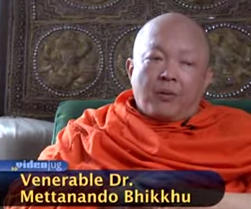
Did Buddha die of mesenteric infarction?
Ven. Dr. Mettanando Bhikkhu - Bangkok Post, 17-May-2000
(Dr. Mettanando Bhikkhu was a physician before entering the monk hood)
Ancient texts weave two stories about the Lord Buddha's death. Was it planned and willed by the Buddha, or was it food poisoning, or something else altogether?
The Mahaparinibbana Sutta, from the Long Discourse of Pali Tipitaka, is without doubt the most reliable source for details on the death of Siddhattha Gotama (BCE 563-483), the Lord Buddha. It is composed in a narrative style that allows readers to follow the story of the last days of the Buddha, beginning a few months before he died. To understand what really happened to the Buddha is not a simple matter, though.
The sutta, or discourse, paints two conflicting personalities of the Buddha, one overriding the other. The first personality was that of a miracle worker who beamed himself and his entourage of monks across the Ganges River (D II, 89), who had a divine vision of the settlement of gods on earth (D II, 87), who could live until the end of the world on condition that someone invite him to do so (D II, 103), who determined the time of his own death (D II, 105), and whose death was glorified by the shower of heavenly flowers and sandal powder and divine music (D II, 138 ).
The other personality was that of an old man, who grumbled about his failing health and growing senility (D II, 120), who almost lost his life because of a severe pain during his last retreat at Vesali (D II, 100), and who was forced to come to terms with his unexpected illness and death after consuming a special cuisine offered by his generous host. These two personalities take turns emerging in different parts of the narrative. Moreover, there also appear to be two explanations of the Buddha's cause of death: One is that the Buddha died because his attendant, Ananda, failed to invite him to live on to the age of the world or even longer (D II, 117). The other is that he died by a sudden illness which began after he ate what is known as "Sukaramaddava" (D II, 127-157).
The former story was probably a legend, or the result of a political struggle within the Buddhist community during a stage of transition, whereas the latter sounds more realistic and accurate in describing a real life situation that happened in the Buddha's last days. A number of studies have focused on the nature of the special cuisine that the Buddha ate during his last meal as being the agent of his death. However, there is also another approach based on the description of the symptoms and signs given in the sutta, which modern medical knowledge can shed light on. In another mural painting at Wat Ratchasittharam, the Lord Buddha is approaching death, but he still takes time to answer questions put forth by the ascetic Subhadda, his last convert who, after being admitted to the Buddhist Order, became an arahant (enlightened monk).
1. What we know
In the Mahaparinibbana Sutta, we are told that the Buddha became ill suddenly after he ate a special delicacy, Sukaramaddava, literally translated as "soft pork", which had been prepared by his generous host, Cunda Kammaraputta.The name of the cuisine has attracted the attention of many scholars, and it has been the focus of academic research on the nature of the meal or ingredients used in the cooking of this special dish. The sutta itself provides details concerning the signs and symptoms of his illness in addition to some reliable information about his circumstances over the previous four months, and these details are also medically significant. The sutta begins with King Ajatasattus' plot to conquer a rival state, Vajji. The Buddha had journeyed to Vajji to enter his last rainy- season retreat. It was during this retreat that he fell ill. The symptoms of the illness were sudden, severe pain. However, the sutta provides no description of the location and character of his pain. It mentions his illness briefly, and says that the pain was intense, and almost killed him.
Subsequently, the Buddha was visited by Mara, the God of Death, who invited him to pass away. The Buddha did not accept the invitation right away. It was only after Ananda, his attendant, failed to recognise his hint for an invitation to remain that he died. This piece of the message, though tied up with myth and supernaturalism, gives us some medically significant information. When the sutta was composed, its author was under the impression that the Buddha died, not because of the food he ate, but because he already had an underlying illness that was serious and acute-and had the same symptoms of the disease that finally killed him.
2. The Timing
Theravada Buddhist tradition has adhered to the assumption that the historical Buddha passed away during the night of the full moon in the lunar month of Visakha (which falls sometime in May to June). But the timing contradicts information given in the sutta, which states clearly that the Buddha died soon after the rainy-season retreat, most likely during the autumn or mid-winter, that is, November to January.A description of the miracle of the unseasonal blooming of leaves and flowers on the sala trees, when the Buddha was laid down between them, indicates the time frame given in the sutta. Autumn and winter, however, are seasons that are not favourable for the growth of mushrooms, which some scholars believe to be the source of the poison that the Buddha ate during his last meal.
3. Diagnosis
The sutta tells us that the Buddha felt ill immediately after eating the Sukaramaddava. Since we do not know anything about the nature of this food, it is difficult to name it as the direct cause of the Buddha's illness. But from the descriptions given, the onset of the illness was quick. While eating, he felt there was something wrong with the food and he suggested his host have the food buried. Soon afterward, he suffered severe stomach pain and passed blood from his rectum. We can reasonably assume that the illness started while he was having his meal, making him think there was something wrong with the unfamiliar delicacy. Out of his compassion for others, he had it buried. Was food poisoning the cause of the illness? It seems unlikely. The symptoms described do not indicate food poisoning, which can be very acute, but would hardly cause diarrhoea with blood.Usually, food poisoning caused by bacteria does not manifest itself immediately, but takes an incubation period of two to 12 hours to manifest itself, normally with acute diarrhoea and vomiting, but not the passage of blood. Another possibility is chemical poisoning, which also has an immediate effect, but it is unusual for chemical poisoning to cause severe intestinal bleeding. Food poisoning with immediate intestinal bleeding could only have been caused by corrosive chemicals such as strong acids, which can easily lead to immediate illness. But corrosive chemicals should have caused bleeding in the upper intestinal tract, leading to vomiting blood. None of these severe signs are mentioned in the text.
Peptic ulcer diseases can be excluded from the list of possible illnesses as well. In spite of the fact that their onset is immediate, they are seldom accompanied by bloody stool. A gastric ulcer with intestinal bleeding produces black stool when the ulcer penetrates a blood vessel. An ulcer higher up in the digestive tract would be more likely to manifest itself as bloody vomiting, not a passage of blood through the rectum.
Other evidence against this possibility is that a patient with a large gastric ulcer usually does not have an appetite. By accepting the invitation for lunch with the host, we can assume that the Buddha felt as healthy as any man in his early 80s would feel. Given his age we cannot rule out that the Buddha did not have a chronic disease, such as cancer or tuberculosis or a tropical infection such as dysentery or typhoid, which could have been quite common in the Buddha's time. These diseases could produce bleeding of the lower intestine, depending on their location. They also agree with the history of his earlier illness during the retreat. But they can be ruled out, since they are usually accompanied by other symptoms, such as lethargy, loss of appetite, weight loss, growth or mass in the abdomen. None of these symptoms were mentioned in the sutta. A large haemorrhoid can cause severe rectal bleeding, but it is unlikely that a haemorrhoid could cause severe abdominal pain unless it is strangulated. But then it would have greatly disturbed the walking of the Buddha to the house of his host, and rarely is haemorrhoid bleeding triggered by a meal.
4. Mesenteric infarction
A disease that matches the described symptoms-accompanied by acute abdominal pain and the passage of blood, commonly found among elderly people, and triggered by a meal-is mesenteric infarction, caused by an obstruction of the blood vessels of the mesentery. It is lethal. Acute mesenteric ischaemia (a reduction in the blood supply to the mesentery) is a grave condition with a high rate of mortality. The mesentery is a part of the intestinal wall that binds the whole intestinal tract to the abdominal cavity.An infarction of the vessels of the mesentery normally causes the death of the tissue in a large section of the intestinal tract, which results in a laceration of the intestinal wall. This normally produces severe pain in the abdomen and the passage of blood. The patient usually dies of acute blood loss. This condition matches the information given in the sutta. It is also confirmed later when the Buddha asked Ananda to fetch some water for him to drink, indicating intense thirst. As the story goes, Ananda refused, as he saw no source for clean water. He argued with the Buddha that the nearby stream had been muddied by a large caravan of carts. But the Buddha insisted he fetch water anyway.
A question arises at this point: Why did the Buddha not go to the water himself, instead of pressing his unwilling attendant to do so? The answer is simple. The Buddha was suffering from shock caused by severe blood loss. He could no longer walk, and from then to his death bed he was most likely carried on a stretcher. If this was indeed the situation, the sutta remains silent about the Buddha's travelling to his deathbed, possibly because the author felt that it would be an embarrassment for the Buddha.
Geographically, we know that the distance between the place believed to be the house of Cunda and the place where the Buddha died was about 15 to 20 kilometres. It is not possible for a patient with such a grave illness to walk such a distance. More likely, what happened was that the Buddha was carried on a stretcher by a group of monks to Kusinara (Kushinagara). It remains a point of debate whether the Buddha really determined to pass away at this city, presumably not much larger than a town. From the direction of the Buddha's journey, given in the sutta, he was moving north from Rajagaha. It is possible that he did not intend to die there, but in the town where he was born, which would have taken a period of three months to reach. From the sutta, it is clear that the Buddha was not anticipating his sudden illness, or else he would not have accepted the invitation of his host. Kusinara was probably the nearest town where he could find a doctor to take care of him. It is not difficult to see a group of monks hurriedly carrying the Buddha on a stretcher to the nearest town to save his life. Before passing away, the Buddha told Ananda that Cunda was not to be blamed and that his death was not caused by eating Sukaramaddava.
The statement is significant. The meal was not the direct cause of his death. The Buddha knew that the symptom was a repeat of an experience he'd had a few months earlier, the one which had almost killed him. Sukaramaddava, no matter the ingredients or how it was cooked, was not the direct cause of his sudden illness.
5. Progression of the disease
Mesenteric infarction is a disease commonly found among elderly people, caused by the obstruction of the main artery that supplies the middle section of the bowel-the small intestine-with blood. The most common cause of the obstruction is the degeneration of the wall of the blood vessel, the superior mesenteric artery, causing severe abdominal pain, also known as abdominal angina. Normally, the pain is triggered by a large meal, which requires a higher flow of blood to the digestive tract.As the obstruction persists, the bowel is deprived of its blood supply, which subsequently leads to an infarction, or gangrene, of a section of the intestinal tract. This in turn results in a laceration of the intestinal wall, profuse bleeding into the intestinal tract, and then bloody diarrhoea. The disease gets worse as the liquid and content of the intestine oozes out into the peritoneal cavity, causing peritonitis or inflammation of the abdominal walls. This is already a lethal condition for the patient, who often dies due to the loss of blood and other fluid. If it is not corrected by surgery, the disease often progresses to septic shock due to bacterial toxins infiltrating the blood stream.
6. Retrospective analysis
From the diagnosis given above, we can be rather certain that the Buddha suffered from mesenteric infarction caused by an occlusion of the superior mesenteric artery. This was the cause of the pain that almost killed him a few months earlier during his last rainy-season retreat. With the progress of the illness, some of the mucosal lining of his intestine sloughed off, and this site became the origin of the bleeding. Arteriosclerosis, the hardening of the vessel wall caused by ageing, was the cause of the arterial occlusion, a small blockage that did not result in bloody diarrhoea, but is a symptom, also known to us as abdominal angina. He had his second attack while he was eating the Sukaramaddava.The pain was probably not intense in the beginning, but made him feel that there was something wrong. Suspicious about the nature of the food, he asked his host to have it all buried, so that others might not suffer from it. Soon, the Buddha realised that the illness was serious, with the passage of blood and more severe pain in his abdomen. Due to the loss of blood, he went into shock. The degree of dehydration was so severe that he could not maintain himself any longer and he had to take shelter at a tree along the way.
Feeling very thirsty and exhausted, he got Ananda to collect water for him to drink, even though he knew that the water was muddied. It was there that he collapsed until his entourage carried him to the nearest town, Kusinara, where there would have been a chance of finding a doctor or lodging for him to recover in. It was probably true that the Buddha got better after drinking to replace his fluid loss, and resting on the stretcher.
The experience with the symptoms told him that his sudden illness was the second attack of an existing disease. He told Ananda that the meal was not the cause of his illness, and that Cunda was not to blame. A patient with shock, dehydration and profuse blood loss usually feels very cold. This was the reason why he told his attendant to prepare a bed using four sheets of ifsanghati nf. According to Buddhist monastic discipline, a ifsanghatinfis a cloak, or extra piece of robe, very large, the size of a bed sheet, which the Buddha allowed monks and nuns to wear in winter. This information reflects how cold the Buddha felt because of his loss of blood. Clinically, it is not possible for a patient who is in a state of shock with severe abdominal pain, most likely peritonitis, pale and shivering, to be ambulatory. The Buddha was most likely put into a lodging, where he was nursed and warmed, located in the city of Kusinara.
This view is also confirmed with the description of Ananda who, weeping, swoons and holds onto the door of his lodge after learning that the Buddha was about to pass away. Normally, a patient with mesenteric infarction could live 10 to 20 hours. From the sutta we learn that the Buddha died about 15 to 18 hours after the attack. During that time, his attendants would have tried their best to comfort him, for example, by warming the room where he was resting, or by dripping some water into his mouth to quench his lingering thirst, or by giving him some herbal drinks. But it would be highly unlikely that a shivering patient would need someone to fan him as is described in the sutta. Off and on, he may have recovered from a state of exhaustion, allowing him to continue his dialogues with a few people. Most of his last words could have been true, and they were memorised by generations of monks until they were transcribed. But finally, late into the night, the Buddha died during a second wave of septic shock. His illness stemmed from natural causes coupled with his age, just as it would for anyone else.
7. Conclusion
The hypothesis outlined above explains several scenes in the narrative of the sutta, namely, the pressuring of Ananda to fetch water, the Buddha's request for a fourfold cloak for his bed, the ordering of the meal to be buried, and so on. It also reveals another possibility of the actual means of transportation of the Buddha to Kusinara and the site of his death bed. Sukaramaddava, whatever its nature, was unlikely to have been the direct cause of his illness. The Buddha did not die by food poisoning. Rather, it was the size of the meal, relatively too large for his already troubled digestive tract, that triggered the second attack of mesenteric infarction that brought an end to his life. (@Buddhism Today)
H6.06
A century-old tradition
Madapatha Chintaka
By the 6th century BC, the centre of Indian civilisation had shifted to the Ganges Valley. Social and economic conditions made possible the rise of several religions that posed as alternatives to the rigid orthodoxy of Brahmanism. By the end of the 5th century BC, the number of these sects had come down, and among those that survived were Jainism and Buddhism.
The Gangetic Basin became the centre of the second urbanisation of ancient India, following the Indus Valley phase from 3300 to 1800 BC. This second urbanisation accordingly took place in two stages, the first going back to the 6th to 5th century BC and the second to the last centuries of the first millennium BC. By the 7th century BC, before the rise of cities in the region, 16 small states had sprung up, bordering the Ganges Valley.
Alexander Cunningham, founder of the Archaeological Survey of India, retraced the route taken by the Chinese pilgrims Fa-Hsien and Xuanzang to the sites of some of their cities, including Mathura, Ahicchatra, Sankisa, Kanauj, Kausambi, Ayodhya, Sravasti, Kusinagara, Varanasi, Vaisali, Pataliputra, Bodhgaya, Rajagaha, Nalanda, Champa, and Tamralipti.
Illustrious rulers
Within 150 years, these small “republics” or “janapadas” would be reduced to four, while within the next two centuries they would be consolidated into one empire, Magadha. Bimbisara and Ajasattu, its most illustrious rulers, were among the most influential patrons of the Buddha, who spent much of his life there; the language he used was, after all, Maghadi Prakrit.The story of Buddhism and its rise is thus, at one level, the story of the economic and social changes rapidly unravelling throughout India. In the Mauryan Empire Indian civilisation had its first universal monarchy, while Buddhism would be adopted as a state religion many decades later under Asoka, the grandson of its founder.
Jean Darian points out correctly that the ascent of Buddhism was tied to two historical trends: the withering away of tribal republics and the formation of kingdoms, and the rise of a merchant class which was more conducive to the growth of empires than a priestly class/caste.
Buddhism hence did not emerge in a vacuum: there were conditions that stimulated its rise over not just those priestly sects but sects which, while sharing some of its key tenets, nevertheless emphasised a more ascetic and extreme lifestyle. Indeed, Siddhartha Gautama’s first two teachers, Alara Kalama and Uddaka Ramaputta, were followers of these extreme creeds: under Alara Kalama he attained the “Realm of Nothingness” (Akincannayatana), and under Uddaka Ramaputta he attained the “Realm of Neither Perception nor Non-Perception” (Neva Sanna Nasannayatana).
How did urbanisation come about, and what influence did it exert on Buddhism, a religion which in Sri Lanka finds its truest expression, as eminent writers like Martin Wickramasinghe and Gunadasa Amarasekara have observed, in the village?
Orientalists and philologists
The transition from the Indus Valley to the Ganges was accompanied, if not driven, by the emergence of a Vedic culture in the latter. This culture was the product of a semi-nomadic people who called themselves “Arya”, which European orientalists and philologists of the 18th and 19th centuries, including William Jones and Max Muller, linked to the civilisations of Europe. We know a lot from literary sources and at the same time so little from actual inscriptions about the nature and the character of these people.The little we do know is that in their hands, the Ganges Valley, which Brahmanical and Buddhist texts referred to as the “Majjhimadesaya” or the Middle Kingdom, transformed from a fertile agricultural enclave to a highly developing civilisation. As a rural outpost, the valley was the site of a stratified society, divided into castes and occupational groups; its transformation into a highly urban civilisation was thus marked by breakdowns in the traditional rural order.
Buddhists texts attest to the commercialisation of life in the 5th century BC. The Jataka stories tell us of a “flourishing urban society” in North India. This spurt of commercialisation centred on, and revolved around, Rajagaha, the capital of Magadha. A steady rise in the number of people in urban settlements there meant the rise of an urban consciousness and the formation of towns, markets, and trade guilds, including those of woodworkers, ironworkers, leatherworkers, and painters.
The Magadha period saw developments in mercantile practices and skills, in the trade and transport of items such as silk, jewellery, and armour, of a special ceramic called the Northern Black Polish Ware, the latter making its first appearance in 500 BC and spreading rapidly beyond the Ganges valley. Kosambi puts all this against the ascent of Buddhism: “The 1,500 years of the full cycle of the rise, spread, and decline of Buddhism saw India change over from semi-pastoral tribal life to the first absolute monarchies and then to feudalism.”
Under these absolute monarchies, the faintest outline of a market economy emerged for the first time in India. The rule of these monarchs was linked inextricably to the rise of a merchant class, among which were the famed sresthi, the financiers. The immediate result of this was the undercutting of the caste system. No longer tied to the land like their ancestors, the merchants forwent on their allegiance to the rigid texts of the Vedas.
Traditional religious texts
Indeed, injunctions against and condemnations of city life run through many of the traditional religious texts from this period: cities are described as places “where the Vedas are not recited”, and householders who are completing their studies are warned against “spending too much time in the city”, since urban-dwellers “cannot attain salvation, despite their austerities.”The rulers, on the other hand, found in merchants a ready means of accumulating capital for large public works, which Marx and Engels noted as the distinguishing mark of Indian (and Asiatic) civilisation. Capital needed to be freed from control by traditional status groups or the upper castes. At the same time, they required a polity, and a religious doctrine, which would discourage too much accumulation of wealth, especially “in the hands of potentially rival groups.”
Buddhism was one among many creeds that witnessed this spate of urbanisation, but it was the most adaptable. The religious revolutions of the Gangetic Basin can be traced to the teachings of Ajita Kesakambali, a materialist philosopher who, in stark contrast to the Brahmins and the Vedas, believed that the body turned to dust and nothing else upon death.
This evolved into still other sects, of which the Samkhyians were among the first to propound that the soul was distinguishable from the body, whose decomposition the former survived. Alara Kalama was a follower of this creed. The Jains under Mahaviraswami adhered to a rigid ideology which forbade drinking “without straining or filtering” and in-breathing, since they could kill life-forms in water and in the air. Uddaka Ramaputta is considered to have been a Jain.
The achievement of Buddhism was its avoidance of both materialism and asceticism. The Middle Way, the “Majjhimapatipadawa”, thus suited a civilisation rooted in trade practices liberated from caste constraints on the one hand, and a clergy and a lay following which believed in staying away from accumulating too much wealth on the other. That was, arguably, its single greatest innovation.
The founder of the doctrine, whose birth, enlightenment, and passing away we commemorate today, was in many respects representative of the transitions of the period he was born to. While much of his life remains shrouded in mystery, there is certainly no lack of biographies, including the Pali Canonical texts, the Tripitakaya, Buddhagosa’s Aththakatha or Commentaries, and Asvaghosa’s Buddhacharitha. Orientalists and Pali scholars of the 18th and 19th centuries, including Carl Koeppen (Die Religion des Buddha und ihre Entstehung, 1857), W. Wassiljew (Der Buddhismus: Seine Dogmen, Geschichte, und Literatur, 1860), Hermann Oldenberg (Buddha: Sein Leben, seine Lehre, seine Gemeinde, 1881), and Edward Thomas (The Life of the Buddha as Legend and History, 1908), all of them dwarfed by Edwin Arnold (The Light of Asia, 1879) and Hermann Hesse (Siddhartha, 1927), published one biography after another.
First Buddhist Council
These texts, including the Canonical ones, differ on certain points though the biographies essentially agree with each other. Michael Carrithers, for instance, argued that the Sakyans were not strictly speaking kings, but were instead oligarchs “or councils of elders, or some mixture of the two”, or leaders of tribal republics that were yielding place to the Maghada Empire, while at the First Buddhist Council months after the Mahaparinibbana the interpreters were divided over whether Siddhartha Gautama saw the “four sights” in one go and day or over several days: the “Digabhanakas”, entrusted with the study of the Digha Nikaya, are said to have made the case for the former interpretation, while all other groups favoured the latter.Despite these differences and disagreements, the outline of Buddhism has survived to this date, and continues to exert a tremendous influence over Asia, especially Sri Lanka. To admit that, however, is to understate the reality, for Buddhism inspired in the latter not just its marvels of architecture and art, but also its culture and civilisation.
Newton Gunasinghe saw in the transformation of Buddhism from an urban theology in India to a folk religion in Sri Lanka an ideological paradigm shift that suited the dominant social patterns of each country. Thus, from the emperor and urban-dweller Buddhism came to be patronised, in Sri Lanka, by the king, landlord, and peasant.
By the turn of the 19th century, when urbanisation made inroads to the country via changes in the economy forced on locals by colonial officials, Buddhism in Sri Lanka faced its second revival: the Theosophist Protestant Buddhist revival. Yet despite its urban trappings, even this movement remained bonded to the rural wellsprings of the religion. As in the Ganges Valley and the Middle Kingdom of India, the teachings of the Buddha adapted to their new environment, and with that to entirely new patterns of life, without letting go of their cultural and civilisational roots.
27 05 2021 – Daily News
H6.07
Origins of spiritual diplomacy
Sachitra Mahendra
The significance of Bak poya is historical since it marks Buddha’s second visit to Sri Lanka. This is noteworthy, as Bak is a month of national importance as well.
According to Mahavamsa, Buddha could foresee an imminent war between two Naga Kings Culodara and Mahodara, uncle and nephew, over a jewel-studded throne that made Him think of visiting Lanka for the second time. Professor Wilhelm Geiger explains the conflict in the translation of Mahavamsa:
That same Naga Mahodara was then a King, gifted with miraculous power in a Naga Kingdom in the ocean, that covered half a thousand Yojanas. His younger sister had been given (in marriage) to the Naga-King on the Kannavaddhamana mountain; her son was Culodara. His mother’s father had given to his mother a splendid throne of jewels, then the Naga had died and therefore this war of nephew with uncle was threatening and also the Nagas of the mountains were armed with miraculous power.
Mahavamsa also records that the Buddha was accompanied by a deity to Sri Lanka.
The deva named Samiddhisumana took a rajayatana-tree standing in Jetavana, his own fair habitation and holding it like a parasol over the conqueror, he with the Teacher’s leave, attended him to that spot where he had formerly dwelt. That very deva had been, in his latest birth, a man in Nagadipa.
On the spot where thereafter the rajayatana-tree stood, he saw paccekabuddhas taking their meal. And at the sight his heart was glad and he offered branches to cleanse the alms-bowl.
Therefore he was reborn in that tree in the pleasant Jetavans garden, and it (the tree) stood afterwards outside at the side of the gate-rampart. The God of all gods saw (in this) an advantage for that deva and for the sake of the good which should spring (therefrom) for our land, he brought him hither (to Lanka) together with his tree.
Mahavamsa then relates how Buddha settled the dispute and the next development of events.
Hovering there in mid-air above battlefield the Master, who drives away (spiritual) darkness, called forth dread darkness over the Nagas. Then comforting those who were distressed by terror he once again spread light abroad.
When they saw the Blessed One they joyfully did reverence to the Master’s feet. Then preached the Vanquisher to them the doctrine that begets concord and both (Nagas) gladly gave up the throne to the Sage.
When the Master, having alighted on the earth, had taken his place on a seat there and had been refreshed with celestial food and drink by the Naga-Kings, he the Lord, established in the (three) refuges and in the moral precepts eighty kotis of snake-spirits, dwellers in the ocean and on the mainland.
The Naga-King Maniakkhika of Kalyani mother’s brother to the Naga Mahodara, who had come thither to take part in the battle and who, aforetime, at the Buddha’s first coming, having heard the true doctrine preached, had become established in the refuges and the moral duties, prayed now to the Tathagata: ˜Great is the compassion that thou hast shown us here, O Master!"
Hadst thou not appeared we had all been consumed to ashes. May thy compassion yet light also especially on me, O thou who art rich in loving-kindness, in that thou shalt come again hitherto my dwelling country, O thou peerless one’.
When the Buddha had consented by his silence to come thither, he planted the rajayatana-tree on that very spot as a sacred memorial and the Lord of the Worlds gave over the rajayatana-tree and the precious throne-seat to the Naga-Kings to do homage thereto. In remembrance that I have used these do homage to them, ye Naga-Kings!
Buddha’s calling forth dread darkness over the Nagas should not be misunderstood. The Buddha holds fame for being the Greatest Compassionate on earth. The concept bears a symbolic meaning; Buddha preached the dark side of the world, and the Naga tribes were scared just to hear and visualise them. That paved the way for them to comfort later on.
Buddha’s visits to Sri Lanka are believed to be false and legendary in certain sects. One reason is that it is not contained in Tripitaka, the official document of Buddha’s life. Tripitaka contains more philosophically important factors, rather than history. Buddha had been to Sri Lanka thrice: the first visit to Mahiyangana, second to Jaffna, then called as Nagadipa, and third to Kelaniya.
The common question is that if Buddha had already been to Sri Lanka, not only once, but thrice, why did Arahant Mahinda visit Sri Lanka once again. Arahant Mahinda, of course, had a mission to fulfil: to establish the Upasampada Bhikku order. The suitable time was not ripe for Buddha to consider establishing the serious Bhikku order. However, Buddhism was not alien when Arahant Mahinda set foot.
26 04 2021 – Daily News
H6.08
Buddhism spread wider, longer and more influential than previously thought
S. Venkat Narayan
NEW DELHI, May 17: New excavations across Asia suggest that Buddhism had spread wider, lasted longer and was more influential than anyone thought till now.
Across Asia, geography is changing history. A slew of excavations and chance discoveries shows that the history of Buddhism, the belief system that flourished from 600 BCE until a decline in the 13th century CE, still contains many surprises.
Newly unearthed sites in Uzbekistan in Central Asia are evidence that it spread farther than previously thought. Stupas and sculptures dating back 2,000 years show that it flowed into new territories earlier. And magnificent monastery complexes are proof that the Buddhist institutions exerted greater influence over commerce, urban development, economic systems and everyday life than previously thought.
Emerging from the digs are stone structures, coin caches, copper plates, mantras punched on gold foil, inscriptions on palm leaf and ivory, colourful murals, and scriptures in at least 20 languages. How did Buddhism, which preached a renouncement of the material world, leave behind such a staggering wealth of physical evidence? KTS Sarao, former head of Buddhist Studies at the University of Delhi, says that a mingling of the sacred and non-sacred was inevitable.
“Monks spreading the Buddha’s teachings would travel along the Silk Road with merchant groups for safety; merchants, in turn, relied on them for spiritual support on these risky journeys,” Sarao told the Hindustan Times. Over time, shrines sprouted at rest stops, becoming a constant in an uncertain landscape. “They grew to include storehouses, factories, banks, and guesthouses, allowing monks to benefit not only from royal patronage but from local commerce, too.”
In Bihar, where the Buddha is said to have attained enlightenment, efforts are on to unearth an administrative centre that until now only existed in texts. A monastery headed by a woman has been found there. And in Odisha, evidence of an unusual meditation complex open to both monks and nuns has emerged. In Afghanistan, monasteries located alongside copper mines reveal how rich monks wielded clout over the region.
Clearly, archaeology is recreating parts of the story that aren’t found in the scriptures. Because of the Buddha’s renunciation of material possessions and the self — he told followers he shouldn’t be the focus of their faith — there are key questions that are still unanswered.
Researchers are hoping to confirm whether Kapilavastu, the Buddha’s childhood home, corresponds to the town in Nepal or one of the same name, not far away, in Uttar Pradesh in north India. They’re tracking how his teachings travelled clockwise out of central India, spreading through north-west Asia and then to China and further east over a thousand years.
Says Sarao: “Sri Lanka, Thailand and Myanmar have done admirable jobs of preserving Buddhist monuments.” In India, however, unmarked Buddhist sites are often mistaken for Hindu temples by locals. Idols of Buddha are worshipped as Shiva, Ashokan pillars are taken for lingams. “We should work together to preserve the Buddha’s legacy,” says Sarao. “His teachings are more relevant today than ever.”
Across the arid Khyber Pakhtunkhwa province, which encompasses much of the north and northwest of Pakistan, lie some 150 Buddhist heritage sites. The area was a major centre for early Buddhist development under Emperor Ashoka’s reign 2,300 years ago.
Italian archaeologists were investigating the province’s northern Swat region as far back as 1930. But digs were abandoned before discoveries could be made. Local teams, back at the site last year, were luckier. They discovered a monastery and education complex, the largest found in the region, and believed to be between 1,900 and 2,000 years old.
Discovered thus far are stupas, viharas, a school and meditation halls, along with smaller cells higher in the mountains where monks could retreat into isolation. Also unearthed were a coin, helping date the site to the Kushan empire (30 CE – 375 CE), which spread across modern-day Afghanistan, Pakistan and northern India and was instrumental in spreading Buddhist teachings. The bonanza: rare frescoes depicting figures in various poses, including the namaskar.
It’s been 20 years since the Taliban destroyed the Buddha colossi in Bamiyan, Afghanistan. They still couldn’t erase signs of Buddhism, which had a large following here until the 11th century. Cave networks, paintings and statuary have been found at six major sites.
In 2008, when the Chinese bought over the world’s second-biggest unexploited copper mine in Mes Aynak, the site of an ancient Buddhist settlement, archaeologists raced to document and salvage the 2,600-year-old monastery that stands there, before it was lost forever. Mes Aynak was a spiritual hub along the Silk Road from the third to eighth centuries CE, a peaceful cosmopolitan pitstop run by monks who’d become rich from the copper ore.
Researchers unearthed monastery complexes, watchtowers, walled zones, jewellery hoards, manuscripts and close to a hundred stupas. One statue of the Buddha, twice as tall as a human, still bore traces of red, blue and orange on the robes. Several copper coins featured an image of the Kushan emperor Kanishka on one side, and the Buddha on the other.
As a result of Afghanistan’s poor infrastructure, mining work has stalled. Archaeologists couldn’t be happier. Their initial three-year deadline for digs has stretched to nearly 13 years already, becoming the most ambitious excavation project in Afghanistan’s history.
In 2016, when a mural was discovered in Termez in southern Uzbekistan, near today’s border with Afghanistan, few were surprised. Uzbekistan was, after all, once part of the Kushan Empire. Its residents were intermediaries as goods flowed west to Rome and east to China.
But the mural was unusual. It was discovered in a stone basement adjoining a pagoda and looked to have been made in the second or third century CE.
Despite its age, its figures in blue and red were remarkably vivid, blending influences from East and West, its angled face shaded to mimic depth. It seemed to be part of a lost larger painting about the life of the Buddha. Researchers drew parallels with murals in Dunhuang, China, an eastern junction on the Silk Road. It was proof that the route didn’t just transfer things, it let art, religion and ideas flow in both directions, too.
The Buddha disapproved of the idea of devotees focusing on him, and so little about him and his life is known. Followers believe that his mother Maya Devi, en route to her parents’, went into labour and gave birth to him (grasping the branch of a sal tree) in the Lumbini garden in present-day Nepal. We know that Emperor Ashoka built the first Buddhist structure there: a pillar inscribed with his own name, the story of the Buddha’s birth, and a date corresponding to the third century BCE.
That spot is now a UNESCO world heritage site. But in 2013, when British archaeologist Robin Coningham excavated inside the third century BCE Maya Devi temple that also stands there, he found that the site (and Ashoka’s story) went deeper. Beneath the temple his team found a roofless wooden space, with signs of ancient tree roots over which a brick temple had once been built. Charcoal and sand fragments were carbon-dated and found to be from 550 BCE, around the time the Buddha is said to have lived. If this was a Buddhist shrine, the timing would make it the first one ever built.
Indian archaeologists are sceptical, though. “Tree shrines have been part of Hindu worship much earlier than the time of the Buddha,” says KTS Sarao, former head of Buddhist Studies at the University of Delhi and a former classmate of Coningham at Cambridge. “It’s not unusual for temples to be renovated and there’s no proof connecting it to the Buddha.”
He adds a further blow: The Government of India does not permit foreign archaeologists to dig here. So, some scholars may exaggerate foreign findings to make them sound as important as the sites they can’t access, he says.
Meanwhile, work continues in Nepal. Coningham’s excavations in the Tilaurakot region, where the Buddha was believed to have lived as Prince Siddhartha, have unearthed the remains of an 1,800-year-old palace complex and walled city. There are courtyards, a central pond and stupas. But still no concrete connection to the Buddha.
When a storm tore through the village of Dalijhara Dhibi in south-western Bangladesh in 1988, it uprooted rows of trees in a mango orchard. The owners decided to plant banana instead, but found they couldn’t. Under the soil was a thick layer of brick. Thirty years later, they tried to plant mango again, and that’s when they decided to examine the bricks more closely. They unearthed a brick structure. The regional archaeological department was brought in.
Three months of excavation later, the orchard yielded an unusual harvest: a 1,200-year-old Buddhist monastic complex. Last year, continuing digs unearthed two temples and courtyards, and 18 residential cells. Fragments of ornamented bricks, terracotta plaques and clay pots show engravings of lotus flowers and geometric shapes.
There are other sites of note in the country. In Nateshwar in central Bangladesh, a 1,000-year-old temple was excavated in 2015. Researchers say the revered teacher and saint Atish Dipankar probably spent time there before his travels to Tibet and China. His life, like the Buddha’s, left no known material evidence. Perhaps that’s changing.
China is hardly short on historic treasures. Local traditions say that the first Buddhist temple there was established in 68 CE. The 339 Kizil cave temples in the Xinjiang Uyghur Autonomous Region were built between the third and eighth centuries CE and are the oldest in China. They hold two kilometres of narrative murals, calligraphy and painted clay statues that borrow styles from across Asia.
And despite political efforts to minimise it, Buddhist history keeps popping up. Reservoir renovation work reveals a 600-year-old idol of the Buddha; ancient statues are discovered, built into what are now the bedrock foundations of residential buildings; buried boxes in villages are found to contain cremated remains of scholars and monks. And these are just the biggest finds across mainland China from the last five years.
This year, researchers found that the artwork in Dunhuang’s famous caves isn’t 500 years old as believed but at least 700 years old, and it has an Indian connection. Text on an image from Cave 465 was found to be mistakenly pasted backwards.
Researchers flipped it digitally. It turned out to be Sanskrit.
Priests overseeing the renovation of a temple in the Shiga prefecture, north-east of Kyoto in Japan, found history hiding in plain sight last year. Two old pillars bore blurred, sooty images. Infra-red photography revealed images of eight Buddhist saints. Each pillar bears the images of four Bodhisattvas — monks who delay enlightenment to help others find salvation. The photographs indicate they were once painted in bright blue, green and vermilion. Researchers believe these could date to the Asuka period, which lasted from 538 CE to 794 CE, putting them possibly among the oldest known Buddhist paintings in Japan.
In Hazaribagh, 110 km from Jharkhand capital Ranchi, the Archaeological Survey of India (ASI) identified three mounds last year as having possible links to Buddhism. One yielded a 900-year-old shrine and two subsidiary structures, two metres below ground level. In January this year, digging into the second mound revealed another shrine and monks’ cells. The site’s six sandstone sculptures depicted a seated Buddha and five likenesses of Tara, depicted as the female Buddha in the tantric-influenced Vajrayana Buddhism.
Historians believe the area may have been a religious hub, a stop between Sarnath in Uttar Pradesh (UP) and Bodh Gaya in Bihar. But site security is a problem. Two of the Buddha sculptures were stolen, and recovered by the police only a week later.
In the past decade, archaeologists have unearthed a nunnery (India’s first record of a shelter for women monks) and metal workshops in the village of Vadnagar in Gujarat; a massive 23-chamber monastery and a cache of artefacts on the banks of Sharmishtha Lake; and a stupa, capped with burnt bricks and a chipped-stone entryway, at Taranga Hill.
Last year, Vadnagar discovered that its roots ran deeper. Excavations near a grain godown revealed a well-preserved semi-circular structure resembling a chaitya or prayer hall, and two stupas. All were built or repaired between the second and seventh centuries CE – meaning that Hiuen Tsang, who mentioned 10 monasteries in Anandpura (the town’s old name), may have been right after all.
Archaeologists digging at Phangiri in Suryapet in Telangana in 2019 knew the area was once a bustling Buddhist site. What they didn’t know was that they’d unearth the biggest stucco statue in India there. The life-size Bodhisattva, made from a brick base and covered with sand, lime and other materials, stands alongside stupas, meditation cells, prayer halls, and sculptural panels with Brahmi inscriptions, that date from the first century BCE to the third century CE. Later explorations have yielded coin caches, beads, iron objects and storage jars. The finds indicate that the complexes supported commerce and religion.
Buddhism’s heartland made news this January, when digs at the administrative centre of Lakhisarai yielded the region’s first hilltop monastery and more evidence that the lost city of Krimila lay underneath. Clay seals from the eighth or ninth century CE bore inscriptions pointing to a Mahayana monks’ council, but shows, startlingly, that the vihara might have had a significant population of women, too. The script on a previously unearthed sculpture indicates the monastery may have been headed by a nun, Vijayshree Bhadra.
There are plans to dig at 60 more sites in Lakhisarai. In Telhara, 100 km to the west, the remains of a university older than the fourth century CE Nalanda in Bihar have been unearthed. One terracotta seal shows a chakra flanked by two deer and the university’s name. The government plans to open a museum there soon.
Workers building the Purvanchal Expressway in Mau district last year found a pocket of history along the way: a stone Buddha head, a hoard of coins, terracotta pieces and bricks that hadn’t seen the light of day since at least the 12th century CE.
The cache adds to the abundant evidence of the state’s Buddhist heritage. Scriptures mention the Buddha spending time in cities such as Sravasti and Saaketa. British archaeologist Alexander Cunningham’s surveys in the 1860s and 1890s, and AK Narayanan’s in the 1960s, corroborate the claims.
The writings of Chinese traveller Hiuen Tsang, who visited between 629 and 645 AD, record 3,000 monks and 100 monasteries in Ayodhya alone. Land-levelling work for the Ram temple in Ayodhya has revealed artefacts on-site too. Indian Buddhist groups have been petitioning the government to allocate a site for a vihara in Ayodhya, too.
In Andhra Pradesh, the Thotlakonda, Bavikonda and Pavuralakonda complexes, discovered in the 1970s, have offered proof that the region was a hub of commerce and learning. More than 8,000 artefacts and antiquities have been found here in the last three years. In Guntur, 350 km to the south, locals found a polished cup, terracotta roof tiles and a broken parasol from the first century BCE. In the coastal town of Ghantasala, Buddhist-era remains have emerged from fields and school backyards. Locals say there’s enough to fill a small museum.
Buddhism was the state religion when the Bhaumakara kings ruled Odisha between the eighth and 10th centuries CE. Many believe that this was the home of the Buddha’s first disciples. But a surprise emerged in 2018 in Angul district, 120 km from state capital Bhubaneswar. Archaeologists found a monastery dating from the Shunga-Kushan reign between 150 BCE and the first century CE. Bits of brick, sculptures, stupas and a sandstone pillar were found. The site is likely the monastery that is referenced in a copper plate found in the 19th century. The inscriptions mention a space for 200 devotees and habitation for monks and nuns.
Modern monasteries dot the state. The ruins of a Kushan-era temple and meeting hall at Harwan, on the outskirts of Jammu and Kashmir’s capital Srinagar, were discovered in the 1920s and lay forgotten. But in 2000, in Ambaran on the banks of the Chenab, archaeologists unearthed an even older Buddhist stupa. The site’s haul, dating from the first century BCE to the fourth-fifth century CE, included monastery walls, decorative idols and ornaments. One casket at the base of the stupa contained ashes, charred bone, coins and part of a tooth believed to be from a saint.
Researchers concluded that the site may have been a transit camp for monks and pilgrims, and a spot from which the Buddha’s teachings were disseminated to local communities. It is believed to have been abandoned in the seventh century CE, after flash floods and the decline of Buddhism in the region.
In 2009, researchers cleaning the site discovered the stupa’s foundation featured fire-baked bricks, designed as eight spokes, much like the ones in Punjab and Andhra Pradesh — another indicator that it might have been built in the Kushan period.
But there has been no further excavation since.
18 05 2021 - The Island
H6.09
900-year-old Buddhist monastery discovered in India’s Jharkhand state
S. Venkat Narayan
The Archaeological Survey of India (ASI) made a major discovery early this year. It found remains of a sprawling Buddhist monastery at least 900 years old, full of small and large statues of Buddhist deities in Bahoranpur village of Gurhet panchayat in Hazaribagh’s Sadar block in India’s Jharkhand state. There were also some Shaivite remains at the site.
The site, at the eastern side of Jharkhand’s Sitagraha hills, has been cordoned off by security personnel. Over the last several weeks, groups of people have been making their way to the site, about 12 kilometres outside Hazaribagh town, on foot or on bicycles.
Hazaribagh is 124km from Bodh Gaya in Bihar, where Gautama Buddha (567-487BC) had attained enlightenment at the age of 35 after 49 days of continuous meditation under the Bodhi Tree.
“Bhagwan ke darshan karne aaye hain,” (“I have come to see God”), said Prajapati, a skilled labourer trying to make his way to the site. He is hoping the excavation will continue for some time so he can perhaps find a job at the site.
Already, shops selling tea and sugarcane juice have come up at some distance from the site. Villagers claimed there are days when up to 5,000 people come to look at the statues.
Among the ASI’s discoveries are four statues of Taras, the “saviouresses” of the Thunderbolt Vehicle, displaying the Varada mudra, a hand gesture signifying the dispensing of boons. There are six statues of the Buddha in the Bhumisparsha mudra, with all five fingers of his right hand extended towards the earth, symbolising his enlightenment. Then there are remnants of a statue of the (Hindu) Shaivite goddess Maheswari, with a coiled crown and chakra, suggesting a degree of cultural assimilation at the site.
Assistant Archeologist Niraj Kumar Mishra of Excavator Branch III, Patna, said: “We had excavated this area in November 2019… Since January 31 this year, we focused on a mound near Juljul Pahar in the Sitagarhi hills, where we found remains of a Buddhist monastery-cum-shrine, with an open courtyard and rooms along the sides.”
Soon after the findings became widely known, two of the statues disappeared from the site. The thieves were arrested in Jharkhand capital Ranchi a week later, and the statues were recovered. But the incident underlined the neglect that the priceless archaeological site faced.
Mahesh Tigga, head of Gurhet panchayat, said: “Buddhist relics have been found at several places in this area. We have asked the government to build a museum here. We will not allow the statues to be taken away from our land.”
The first archaeological discoveries in this area were made three decades ago. In 1992, veteran environmentalist and tribal arts conservationist Bulu Imam, convener of the Hazaribagh chapter of the Indian National Trust for Art and Cultural Heritage (INTACH), stumbled upon pottery and remains of Buddhist relics and statues here.
Imam reported the discovery of painted grey ware (PGW) pottery, a votive stupa, a black basalt apsara torso, and an “eight-petalled astadala lotus” inscribed on stone.
“Remains of a vihara, stupa, and village with iron smelting siter alongside in a Sarna or sacred grove which yielded PGW fragments are confirmed. It seems that several tanks and wells and villages in the region were once part of comprehensive Vihara on the pilgrim route to Midnapore (Tamralipti),” Imam wrote (Damodar Valley Civilisation, 2001).
Imam estimated the antiquity of the Buddhist sites of Hazaribagh from 300 BC to the period of the Palas (8th to 12th centuries AD), and the Sena (11th-12th centuries). The monastery that has now been excavated lies on the old trade route from Varanasi to Tamralipti, via Sherghati in Gaya district in neighbouring Bihar state, and the Sitagraha hills in Jharkhand.
A lot of Hazaribagh district is forested, and is home to the Birhor tribals to whom Juljul Pahar is sacred. Every year, on Buddha Purnima day and other occasions of religious significance, local people go to the top of the hill with offerings of rice and milk. Besides the remains of the ancient vihara, the hill has a 65-foot stone face that the Birhors revere as Mahadeva (Lord Shiva, a Hindu deity).
Imam, who is now 79 and runs a museum that contains neolithic artefacts and collections of the local Khovar and Sohrai paintings, said he had been trying to get the Central Government to relocate a BSF (Border Security Force) firing range in the area from the early 1990s.
“However, till date, the firing range remains as it is… I informed ASI in 1992, but it took them close to 30 years to begin excavating this major Buddhist site… The ASI’s recent findings are the most significant archaeological discovery in Jharkhand in modern India. No other intact Buddha statue of this beauty and quality, around four feet tall and with heavy back support typical of the time of the Palas, has been found … Even in Bihar only a few statues of this quality have been found,” he said.
Imam’s discoveries were confirmed in the ASI’s report on ‘Exploration in districts Hazaribagh and Chatra, 1995’. The report, published in 2000, said: “Historical sites at Sitagarh yielded evidence of three circular brick structures besides one habitational mound, while Itkori yielded temple remains alongside a huge habitational area.
“At both these sites were noticed the sculptures of both Brahmanical and Buddhist pantheon. At Itkori a large number of sculptures, majority of which comprised votive stupas, were noticed. These sculptures belong to the Pala period, and only a few of these are inscribed.”
Imam believes the Chinese scholar Hiuen Tsang (Xuan Zang) may have visited Sitagraha during his travels in India in the seventh century. “His visitations were very complex, but at that time, he could have gone back to China through one of only two routes, from Mayurbhanj in Odisha and Tamralipti in Bengal,” he said.
19 04 2021 – The Island
H6.10
How the Buddha became a Christian saint
Author Philip C. Almond
Emeritus Professor in the History of Religious Thought, The University of QueenslandFrom the 11th century onwards, the Legend of Barlaam and Josaphat enjoyed a popularity in the medieval West attained perhaps by no other legend. It was available in over 60 versions in the main languages of Europe, the Christian East and Africa. It was most familiar to English leaders from its inclusion in William Caxton’s 1483 translation of the Golden Legend.
Little did European readers know that the story they loved of the life of Saint Josaphat was in fact that of Siddhartha Gautama, the Buddha, the founder of Buddhism.
The ascetic life
According to the legend, there reigned in India a king called Abenner, immersed in the pleasures of the world. When the king had a son, Josaphat, an astrologer predicted he would forsake the world. To forestall this outcome, the king ordered a city to be built for his son from which were excluded poverty, disease, old age and death.
But Josaphat made journeys outside of the city where he encountered, on one occasion, a blind man and a horribly deformed one and, on another occasion, an old man weighed down by illness. He realised the impermanence of all things:
No longer is there any sweetness in this transitory life now that I have seen these things […] Gradual and sudden death are in league together.
While experiencing this spiritual crisis, the sage Barlaam from Sri Lanka reached Josaphat and told him of the rejection of worldly pursuits and the acceptance of the Christian ideal of the ascetic life. Prince Josaphat was converted to Christianity and began to practise the ideal of the spiritual life of poverty, simplicity and devotion to God.
Scenes from the Story of Jehosophat from the Bible. Augsburg, G. Zainer, c.1475. Harvard Art Museums/Fogg Museum, Gift of Paul J. Sachs
To forestall his quest, his father surrounded him with seductive maidens who “tantalised him with every kind of temptation with which they sought to arouse his appetites”.
Josaphat resisted them all.
After the death of his father, Josaphat remained determined to continue his ascetic life and abdicated the throne. He journeyed to Sri Lanka in search of Barlaam. After a quest lasting two years, Josaphat found Barlaam living in the mountains and joined him there in a life of asceticism until his death.
A great saint
Barlaam and Josaphat were included in the calendars of saints in both the Western and Eastern churches. By the 10th century, they were included in the calendars of the Eastern churches, and by the end of the 13th century in those of the Catholic church.
Saints Barlaam and Josaphat, Jacques Callot’s Calendar of Saints, c.17th century. Harvard Art Museums/Fogg Museum, Gift of William Gray from the collection of Francis Calley Gray, by exchangeIn the book we know as The Travels of Marco Polo, published around the year 1300, Marco gave the West its first account of the life of the Buddha. He declared that — were the Buddha a Christian — “he would have been a great saint […] for the good life and pure which he led”.
In 1446, an astute editor of the Travels noticed the similarity. “This is like the life of Saint Iosaphat”, he declared.
It was, however, only in the 19th century the West became aware of Buddhism as a religion in its own right. As a result of editing and translating of the Buddhist scriptures (dating from the first century BCE) from the 1830s onwards, reliable information about the life of the founder of Buddhism began to grow in the West.
The Sacred Bodhi Tree. Smithsonian American Art Museum, Gift of Chicago Society of Etchers
Then the West came to know the story of the young Indian prince, Gautama, whose father – fearful his son would forsake the world – kept him secluded in his palace. Like Josaphat, Gautama eventually encountered old age, disease and death. And, like Josaphat, he left the palace to live an ascetic life in quest of the meaning of suffering.
After many trials, Gautama sat beneath the Bodhi tree and finally attained enlightenment, thereby becoming a Buddha.
Only in 1869 did this new-found knowledge in the West about the life of the Buddha lead inescapably to the realisation that, in his guise as Saint Josaphat, the Buddha had been a saint in Christendom for some 900 years.
Intimate connections
How did the story of the Buddha become that of Josaphat? The process was long and complicated. Essentially, the story of the Buddha that began in India in the Sanskrit language travelled east to China, then west along the Silk Road where it was influenced by the asceticism of the religion of the Manichees.
It was then transposed into Arabic, Greek and Latin. From these Latin versions it would be translated into various European languages.
Years before the West knew anything about the Buddha, his life and the ascetic ideal which it symbolised were a positive force in the spiritual life of Christians.
Gautama Buddha seated on a lotus throne, c.1573-1612. © The Trustees of the British Museum, CC BY-NC-SAThe Legend of Barlaam and Josaphat demonstrates powerfully the intimate connections between Buddhism and Christianity in their commitment to the ascetic, meditative and mystical religious life.
Few Christian saints have a better claim to that title than the Buddha.
In an era where the Buddhist spirituality of “mindfulness” is very much on the Western agenda, we need to be mindful of the long and positive history of the influence of Buddhism on the West. Through the story of Barlaam and Josaphat, Buddhist spirituality has played a significant role in our Western heritage for the last one thousand years.
H6.11
Remnants of Tenth-Century Buddhist Monastery Found in India
The excavation uncovered statues of the Buddha and Tara, a prominent bodhisattva
Livia Gershon - smithsonianmag.com
Six of the statues appear to depict Siddhartha Gautama, while five likely portray the Hindu deity and Buddhist bodhisattva Tara. (Archaeological Survey of India)
Researchers with the Archaeological Survey of India (ASI) have discovered what appear to be the remains of a Buddhist monastery dated to the tenth century A.D.
As Abhijit Sen reports for the Times of India, the archaeologists recently found 11 stone statues at the site, which is located in the Hazaribag district of the eastern Indian state of Jharkhand.
The sculptures each stand two to three feet tall. Six represent the Buddha, Siddhartha Gautama, while the other five likely depict Tara, who is known as a deity in Hinduism and a female bodhisattva—central figures who delay personal enlightenment in order to offer earthbound worshippers salvation—or Buddha in different Buddhist traditions.
Also recorded at the site were inscriptions in Devanagari script, which is used in languages including Sanskrit and Hindi. The team hopes that the writing, once translated, will provide more information about the monastery.
Per the Hindustan Times’ Sanjoy Dey, the ASI first discovered three mounds at the site—located in the foothills of Juljul Hill—last year. A team excavated one of the mounds and, after digging about six feet down, found a central shrine and two subsidiary shrines.
Since January, archaeologists have been working on a second mound about 130 feet away from the first. So far, they’ve found three cells in a nearly 27,000-square-foot space. The researchers say the site appears to be a small Buddha Vihar, or combination shrine and monastery.
“As per the evidence found here, it appeared that the structures had been built during the Pala period,” ASI archaeologist Neeraj Mishra tells the Hindustan Times.
Mishra notes that the site was located on the route of Grand Trunk Road, which connected Sarnath in Uttar Pradesh to Bodh Gaya, where Gautama reportedly attained enlightenment.
Two other depictions of Tara (Public domain / Brooklyn Museum via Wikimedia Commons)D.N. Ojha, a historian at Ranchi University, tells the Hindustan Times that the discovery may help clarify the history of the arrival of Buddhist monks in the area and the overall spread of Buddhism. As Abhishek Angad reports for the Indian Express, the presence of Tara’s likeness suggests that the monastery served as an important center for the Vajrayana sect, a form of Tantric Buddhism.
The Pala Dynasty ruled the regions of Bengal and Bihar between the 8th and 11th centuries. It supported the establishment of Buddhist institutions, including monasteries, while also permitting the flourishing of Hinduism, the majority religion of the area. During the early Pala period, eastern Indian sculptors developed a regional style that paid detailed attention to textiles, jewelry and the human torso, per the Brooklyn Museum.
Earlier this year, archaeologists announced the discovery of the ruins of a Bihar monastery headed by a woman. Dated to the 11th or 12th century, the hilltop structure housed either all women or both women and men, as Jai Narain Pandey noted for the Times of India.
“Monasteries have been discovered at many locations in this area, but this is the first setup located at the top of a hill,” lead researcher Anil Kumar, an archaeologist at Visva Bharati University, told the Hindustan Times’ Reena Sopam in January. “Seems the Mahayani Buddhists set up the monastery far from the hustle and bustle of the human population to practice Mahayana rituals in isolation.”According to the Times of India, the researchers at the Jharkhand site have removed the statues from the brick walls to which they were attached. They plan to ship the artifacts to ASI’s museum in Patna, Bihar.
Locals who have heard about the discovery, however, have proven eager to see the statues, and some are asking that the ASI set up a museum near the site to draw tourists to the area.
H6.12
The Aftermath of Empire - Reappraisal and Reconciliation (Part 1)
Prof. Chandra Wickramasinghe
The author is an Honorary Professor at the University of Buckingham, UK, at the University of Ruhuna, Sri Lanka, and also at the National Institute of Fundamental Studies in Sri Lanka. He was a former Fellow of Jesus College, Cambridge, Staff Member of the Institute of Astronomy, Cambridge, and former Professor at Cardiff University. He is a pioneer of the discipline of Astrobiology and the author of over 450 scientific papers and some 35 books.
In our post-colonial modern world, the restoration of unity and harmony in our ethnically diverse multicultural polities stands out as an important priority. However, we have another task we cannot neglect – to explore and sift the enormous treasures of ancient wisdom and knowledge that have come to light following a long colonial history. An impartial assessment of competing paradigms would be of crucial importance for progress.
The British Empire finally ended in India in 1947, and a year later in Ceylon (now Sri Lanka). Its legacy – including the use of the English language pervades the modern world. But we also see many unresolved conflicts – conflicts between races in our newly generated polities, as well as clashes between competing paradigms. This article will explore a personal perspective of the decolonisation process focussing in particular on the Indian subcontinent. In this context it is relevant to declare my own personal background. I am very much a part of the British Empire, having grown up in the crown colony of Ceylon during the twilight years of the Raj. I went to a school (Royal College Colombo) that was modelled on Eton, learning Greek and Latin, but regretfully less of my own native mother tongue and culture. My early upbringing epitomises what the Roman historian Cornelius Tacitus (AD56-120) famously said of conquered people – that they readily adopt novelties of the conqueror’s ‘civilization’ whilst in fact they were adopting features of their own enslavement.
Two generations of my ancestors have epitomised this connection. My paternal grandfather Dionicious Lionel had worked in the office of the Governor General Sir Reginald Edward Stubbs for which he was later honoured with the title Mohandirum. My father Percival Herbert**, who was a Cambridge-trained mathematician obtaining the highest distinctions in the Mathematical Tripos in the 1930’s (being taught by Sir Arthur Eddington), went on to become an Indian Civil Servant with his first posting as “Deputy Collector of Customs” in the Bihar state in India. With such a background and education a more colonially-oriented upbringing could not be imagined. To cap it all my arrival in Cambridge in 1960 and the start of my long career as an astronomer and astrobiologist in the UK began with the award of a Commonwealth Scholarship, a scholarship scheme that was presumably launched as part of a process of post-colonial atonement. However, the process of decolonisation at a much deeper level, which involves accommodation and acceptance of a diversity of races as well as ideas has still a long way to go.
Injustices of Empire
British rule in India has been variously described as benevolent and generous on one the one hand, and replete with cruelty, plunder and pillage on the other. The truth lies somewhere in between. However, the evidence of cruelty, of punitive taxation and concerted attempts at de-industrialising of India throughout the 17th and 18th centuries abound.In the pursuance of purely commercial objectives the British administration in India has carried out many acts of violence and cruelty that in modern times would be deemed violations of human rights and crimes against humanity. These include the extraction of punitive taxation from the population of Bengal during two major famines that led to the deaths of millions of people. There was also the deliberated flooding of rice paddy fields in the coastal plains of Ceylon rendering the land unsuitable for paddy cultivation, done it would seem for the sole purpose of enhancing demand for the Empire’s new rice plantations in Burma; and the illegal sale of opium to China leading to addiction and great distress. The impoverished state of the subcontinent when the British finally left India in 1947 was at least in part due the imperial encounter of the preceding 3 centuries.
In my view, one of the most regrettable aspects of colonial rule both in India and Sri Lanka was its implementation of a policy of divide and rule – divide et impera (one that has been originally attributed to the father of Alexander the Great – Emperor Phillip II of Macedon (359-366BC)). The effect of imposing such a policy was to make it easier for the British to rule a religiously and ethnically diverse group of subjects; but on their eventual departure it undoubtedly contributed to many tragic events. The partition of India and its regrettable fallout had roots in the divide et impera policy, as did the ethnic conflicts that erupted between the Sinhalese and Tamils in Sri Lanka in the 1980’s.
Deep History of EmpireEmpires in one form or other have existed throughout the history of human civilization. It is a process of colonisation that probably started in the fertile valleys of Mesopotamia and the Indus region over four thousand years ago. The formation of empires has always brought far-flung peoples and races together under a common banner, and this contributed to the spread of technological and intellectual discoveries over ever larger parts of the globe. But these advantages were often gained at the expense of much hardship and suffering, a feature that tends to go unnoticed in the euphoria of triumphant victories and achievement. We all know that in the recent history of empire, which included genocide, slavery and racism, amongst other evils, there is a great deal that is to be regretted. There is also much to be celebrated. I would not be writing this article in English if it was not for the British Raj that had once coloured a third of the world in its red vermilion hue and dominated world history for at least four centuries (Fig.1).
The British Empire and its European counterparts can all trace their cultural ancestry back to the Roman Empire that had dominated for a full millennium, and before that to the city states of classical Greece – “The glory that was Greece, and the grandeur that was Rome”. Beyond this point in history our westernised collective cultural memory conveniently begins to falter. What about the Persian Empire that preceded the Greeks, and the Mesopotamian and Indus Valley civilisations in the preceding two millennia? It was these most ancient civilizations that had indep0endently laid down the framework for mathematics, science as well as literature.
This is the point at which a Eurocentric culture with its built-in prejudices begin to assert itself most stridently.
Unravelling of Ancient wisdom
There is now little doubt that the Babylonians knew Pythagoras’s theorem and had even invented calculus by at least the 2nd millennium BCE. These were probably used as tools both for their development of city planning, surveying and engineering, as well as in nurturing their interest in astronomy. The Indians and the Indus valley civilizations of Mohenjo-Daro and Harappa at about the same time bear a similar testimony to a highly sophisticated scientific culture that included the invention of the so-called Hindu number system with concepts of zero and infinity, both of which were crucial for the later flourishing of mathematics. Throughout the middle ages, long after the collapse of the Roman Empire, the cumbersome system of Roman numerals continued to be used throughout Europe for arithmetic as well as for accounts for purely chauvinistic reasons. When the far better ancient system of Hindu numerals came to be discovered in Europe the reluctance to switch to this system is well documented.The Arab mathematician Al-Khwarizmi in the 9th century was among the first to use Hindu numerals but it took over two centuries before translations of his work appeared in Europe. The great advantages of the new number system very slowly dawned on European mathematicians, although it was not until the 16th century when the Hindu numerals (renamed Hindu-Arabic numerals) completely replaced the old Roman numeral system. The delay in the transition was undoubtedly connected with a deep-rooted suspicion of the alien non-Christian pagan culture from which the system had emanated.
Trade and cultureAfter the start of the British East India Company in 1600CE a deeper knowledge of the ancient civilization of the subcontinent began to slowly dawn. The intellectual responses to this West-East encounter varied with time. The British colonisers and traders were initially surprised to find the Moghul empire of India far richer and more sophisticated than they might ever have imagined. Throughout the 17th and 18th centuries the technological difference between India and Britain was minimal. Moreover, the economy of India based on its long-established supremacy in cloth weaving, combined with a thriving steel and ship-building industries, made India among the richest countries of the world.
There can be no doubt that Britain’s trade with India over the next two centuries served to greatly increase its own prosperity at home. The planned demolition of the centuries-old cloth weaving industry in Bengal (allegedly including the chopping off of the weaver’s thumbs) was directly connected with the growth of similar industries in the north of England in the 18th century.
The development of an intellectual culture that was centred around Coffee houses (and later Tea houses) in London was also directly the result of the tea and coffee trade with India and later Ceylon. But despite all the beneficial developments that followed from Empire, responses to the encounter between Britain and India remained fraught with a deep sense of ambivalence. It was clear that Britain was dealing with an exceedingly sophisticated and very ancient civilization – albeit in straightened circumstances – one that was considerably older than any in the West. And this fact remained very difficult to admit and come to terms with.
Unravelling the treasures of SanskritThe realisation of the great literary and cultural heritage of the Indian subcontinent began to fully dawn through the work of the British Orientalist and Philologist Sir William Jones who arrived in Calcutta in March 1783 to take up a post as Judge in the Supreme Court of India. Besides quickly mastering Sanskrit and assiduously translating a vast body of ancient Indian literature, Jones as a philologist unravelled the ancestral relationship between Sanskrit several European languages of later date including Greek and Latin. His work is seen today as the starting point of comparative linguistics and the birth of the idea of an Indo-European family of languages. The genres of Sanskrit literature that were unravelled by Jones included epic poetry, drama, history that in its total volume far exceeds the combined content of the surviving Greek and Latin literature of Europe.
The European colonial rulers at this time found it exceedingly difficult to accept that their own languages and literature had any ancestral debt to any language that belonged to the dark-skinned people of the subcontinent, people who in their view were only fit to be servants and slaves. Although this sounds a harsh indictment today it remains a fact and one that we have to grasp.William Jones founded the Asiatic Society on 15 January 1784 (later to become “The Royal Asiatic Society”) based in structure on the Royal Society of London. Its declared aim was ‘…the investigation of subjects connected with, and for the encouragement of science, literature and the Arts in relation to Asia’. It perhaps came as no surprise that native Sanskrit scholars were initially excluded from membership of the society, a society that was ostensibly dedicated to unravelling their own indigenous intellectual culture and traditions! This constraint was lifted in later years but the racist overtones of the entire venture became clear at the outset and echoes of it rumbled long after.
A more recent shock to Eurocentric pride came in 1905 with the discovery in India of a Sanskrit text dating back to the 3rd century BCE dealing with statecraft which was amazingly similar in spirit and content to Niccolo Machiavelli’s classic work “The Prince” published in the 16th century of the common era. This was Kautiliya’s Arthashastra which was a comprehensive treatise on how a king should rule so as to enlarge his empire and his treasury as well as to bring happiness to his subjects. In one memorable statement Kautiliya recommends scrutiny of accounts supplied by his staff because: “Just as it is impossible to know when a swimming fish is drinking water, so it is impossible to find out when a government servant is stealing money”. This book that predated Machiavelli by nearly two millennia was a bitter pill for Western scholars to swallow. But the lesson to be learnt from the experience of Empire became clear – that no single polity or civilization can claim a monopoly of intellectual attainments of any kind.
Continued.
07 03 2021 - The Island
The Aftermath of Empire - Reappraisal and Reconciliation (Part 2)
Prof. Chandra Wickramasinghe
Several generations of British historians, archaeologists and naturalists devoted their entire lives to tirelessly exploring the multiplicity of wonders of India. Studies of the subcontinent’s natural history, archaeology and anthropology are just a few scientific disciplines that enormously benefited from the imperial encounter. The introduction of greenhouses, zoological and botanic gardens to the Western world and much else came directly as a result of the colonial venture.
One discovery of great importance is worthy of mention. A large number of stone pillars and columns bearing mysterious inscriptions in a hitherto undeciphered Brahmi script had been scattered across the length and breadth of India and, rather strangely, gone unnoticed for centuries. In the 1830’s it was an English Philologist and scholar James Prinsep (1799-1840) who successfully deciphered these inscriptions. The edicts written in the Bhrami language mentioned a King Devanampriya Piyadasi which Prinsep had initially assumed was a Sri Lankan king. He was later to discover a Pali text from Sri Lanka from which he was able to connect the title Piyadasi with Ashoka, and thus was revealed for a first time a long-hidden secret of Indian history – the life and times of Emperor Ashoka who had reigned between 268 and 232 BCE. Ashoka is famous as the Indian monarch who became a Buddhist and unified a vast part of the Indian subcontinent into a single empire ruling it according to Buddhist principles. H.G. Wells in his “Outline of World History” said of Ashoka that amid tens of thousands of names of monarchs, “Ashoka shines, shines almost alone, a star”.
In the 1920’s it was again thanks to British archaeologists that we owe the next major discovery – the unravelling of the great Indus valley civilizations of Harappa and Mohenjo-Daro which represents another long-hidden chapter in the prehistory of the Indian subcontinent stretching back to the third millennium BCE. We already had knowledge from Mesopotamian records of a vigorous trade in lapis lazuli that existed between empires in the Mesopotamia and India, but now we could link this precisely with the Indus valley civilizations.
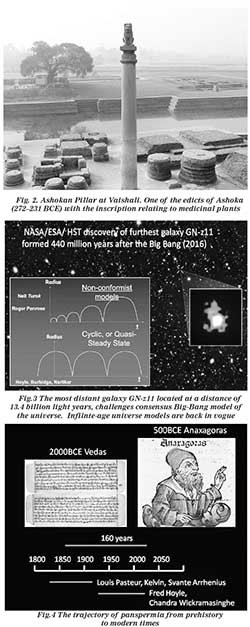
Unravelling a Buddhist heritage
A few British Civil Servants who were posted in Ceylon in the 19th century became assiduous students of Buddhist texts and wrote extensively and enthusiastically about Buddhism. Thomas William Rhys David (1843-1922) was one such scholar who found himself posted as Government Agent near the historic ancient city of Anuradhapura. There he became actively involved in archaeological excavations that led to the discovery of a vast number of inscriptions and manuscripts relating to Buddhism and this triggered his interest. He soon became a formidable Pali scholar, translated many Buddhist Pali texts into English and also wrote extensive commentaries on Buddhism that are still being read today.
The colonial response to Buddhism on the whole had been positive throughout the time of the Empire. H.G. Wells (1866-1946) in his “Outline of World History” writes of Buddhism thus:
“Many of our best modern ideas are in closest harmony with it. All the miseries and discontents of life are due, he (the Buddha) taught, to selfishness. Selfishness takes three forms – one, the desire to satisfy the senses; second, the craving for immortality; and the third the desire for prosperity and worldliness. Before a man can become serene he must cease to live for his senses or himself. Then he merges into a great being. Buddha in a different language called men to self-forgetfulness five hundred years before Christ. In some ways he was nearer to us and our needs. Buddha was more lucid on our individual importance in service than Christ, and less ambiguous upon the question of personal immortality.”
The amazing degree of concordance between Buddha’s view of consciousness and modern post-Jungian ideas in psychology were discussed by me and Daisaku Ikeda in our dialogue many years ago. The practice of Buddhist meditation is becoming increasingly popular in the West today because of its potential to yield mental and physical health benefits. Such practices, however, are looked upon with suspicion by many – now and in the past – as heathen primitive rituals that challenge the cannon of Christian faith. Such a narrow view cannot be interpreted as being any other than a component of racial thinking that prevailed throughout the period of British imperialism and filters down even into our post-colonial modern era.
Buddhist cosmology
In matters relating to cosmology and life in the Universe ideas from Buddhist as well as earlier Vedic traditions have run contrary to the canonical Western world-view. For instance, in the cosmology described in the Anguttara Nikaya (a Buddhist text dated at around the 1st century BCE) it is stated thus:
“As far as these suns and moons revolve, shedding their light in space, so far extends the thousand-fold world system. In it there are a thousand suns, a thousand moons, a thousand inhabited Earths and a thousand heavenly bodies. This is called the thousand-fold minor world system….”
It then goes on to define a hierarchy of world systems, referring to the entire universe as “this sphere of million, million world systems”. Similar views do not dominate scientific thinking in Europe until after the Copernican revolution in the 17th century of the common era. Today, with the recent discoveries of exoplanets in the past decade, the total number of exoplanetary systems in our Milky Way galaxy alone is estimated to exceed 100 billion.
As far back as the first millennium BCE a school of atomism similar to that of Democritus was founded in India, the most important proponent of this school being a philosopher named Kanada (600 BCE). The idea was that atoms are point-sized, indivisible and eternal, each possessing a distinct property and individuality. These concepts were developed further by a burgeoning Buddhist school of atomism that flourished in the 7th century CE.
Aryabhata (476-550CE) was perhaps the first Indian astronomer in the modern mould who discovered an approximation of pi to six significant figures and also correctly maintained that the planets and the Moon shine by reflected sunlight. He also correctly inferred from observations that the daily motion of the stars in the celestial sphere is due to Earth’s rotation about its axis.
From both archaeological and later historical evidence there is no doubt that high levels of advancement in science and technology had been achieved in India long before Aryabhata going back to at least the second millennium before the common era. Vedic Sanskrit texts dated at the 8th century BCE refer to Pythagorean triples (eg. (3,4,5), (5,12,13), (8,15,17)) and display a knowledge of Pythagoras theorem. One of the earliest Indian astronomical texts (Vedānga Jyotiṣa) dates from 1400–1200 BCE, with the currently extant form dating possibly from 700–600 BCE. This latter timespan also corresponds to the dating of the most ancient known “university” in the world, Takshashila in India, which was a centre first of Hindu and later Buddhist scholarship.
Ayurveda and plant-based pharmaceuticalsDevelopments in the field of ayurvedic plant-based medicine, and including reports of surgical interventions, have been recorded in a variety of sources from the earliest times. In one of the Ashokan pillars (272-231BCE), to which I have already referred, an edict reads: “Everywhere King Piyadasi (Ashoka) erected two kinds of hospitals, hospitals for people and hospitals for animals. Where there were no healing herbs for people and animals, he ordered that they be bought and planted.” There also exist many thousands of ayurvedic texts both in India and Sri Lanka with extensive lists of medicinal herbs and their alleged benefits for curing various ailments. The result of four centuries of colonial rule has unfortunately been to relegate this vast legacy to the “archive of curiosity”.
The few ayurvedic physicians who now practice in India and Sri Lanka still rely on time-hallowed anecdotal accounts of the efficacy of their plant-based medicines. The correct procedure will be for western science to fully explore these claims with chemical analysis and trials, but this has not yet been done. It should be recalled in this context that many drugs currently used in western medicine are indeed derived from plants – aspirin, quinine, digitalis, morphine, codeine – are just a few. It is hard to imagine the medical legacy that would follow from a complete investigation of the thousands of claimed herbal remedies that still remain unexamined.
Transition from ancient to modern scienceI have already mentioned the knowledge of land surveying technologies and irrigation schemes that was evident in the Indus valley civilizations of Mohenjo-Daro and Harappa; and these and other technological developments have also been found elsewhere in India and in neighbouring Sri Lanka throughout the period from the beginning of the common era until the time of the arrival of the British in 1600CE.
When the British arrived in India the difference in technological development between Britain and the subcontinent was arguably marginal. Handlooms and weaving technology that were developed and used in Bengal made India (run by the Moghuls) one of the richest countries of the world at this time. In a real sense it could be maintained that the technological advancement of the West took place at the cost of the continued impoverishment of India.
From the beginning of the 20th century many Indian scientists who were trained in British Universities and laboratories made highly significant contributions to the progress of science furthering the dominant scientific paradigms of Western science. A common feature of all these scientists is that their corpus of work supported and did not in any way challenge the major accepted paradigms of the day. Their achievements were thus thought to be a continuing tribute to the prevailing and predominant traditions of western science, and so were readily acknowledged and rewarded. However serious difficulties can arise whenever an ethnically non-European scientist hailing from an ex-colony dares to challenge a reigning paradigm of Western science.
Clash of Orthodoxy and Heresy
It should occasion no surprise to find that most important advances in science with regard to fundamental of issues concerning the Universe and Life have always been subject to cultural and religious constraints. Thus, in the 19th century the unfolding facts of geology that yielded an age of the Earth of some 4 billon years came into sharp conflict with Biblical chronologies of mere thousands of years, and this had initially caused great angst in some circles. Likewise, the facts of biological evolution that were unravelled after Charles Darwin’s Origin of Species was published in 1859 continued to disturb conventional beliefs for several decades.
As already mentioned Buddhist and earlier Vedic cosmologies can be interpreted as being consistent with many aspects of modern and post-modern scientific thought. There are also fundamental differences that can cause consternation in a Western scientific context. In Vedic cosmology the universe is thought to be infinite in spatial extent and cyclic in time– strikingly reminiscent of the modern versions of oscillating universe models. In this context it is worth noting that the currently favoured Big-Bang theory of the Universe with an age of 13.8 billion years is by no means absolutely proved. The very recent discovery of a galaxy designated GN-z11 located at a distance of 13.4 billion light years (implying its formation just 420 million years after the posited Big Bang origin of the Universe) poses serious problems for the current consensus view of cosmology.
Recently Nobel Laureate Roger Penrose has come in among the select band of dissenters from the standard view of a unique Big Bang origin of the Universe 13.8 billion years ago. In a theory called the “conformal cyclic cosmology” Penrose postulates that the universe undergoes an infinite number of cycles in which the Big Bang event 13.8 billion years ago is the most recent cycle of which we are a part – a result strikingly in accord with ancient Vedic and Indian cosmology.
The inescapable fact of PanspermiaFinally, I turn to the age-old problem of our own origins – how we, humans and indeed all of life, came to be. This question has been approached in a multitude of different ways, embracing superstition, religion, philosophy and eventually science. The ideas that prevailed throughout ancient India involved the concept of life being an integral part of the structure of the universe – a view closely aligned to the ideas of panspermia discussed in the West by pre-Socratic Greek philosopher Anaxoragas of Clazomenae who lived around 500BCE. Panspermia implies that “seeds of life” are eternally present in the cosmos and take root whenever and wherever the condition permit.
This concept was vigorously rejected in the Western tradition in favour of the ideas of the more influential Greek philosopher Aristotle in the 3rd century BCE. Aristotle proposed instead that life must arise from non-living inorganic matter whenever the right conditions prevailed, and he cited many instances that were incorrectly regarded as supportive evidence, the most graphic being the statement of “fireflies emerging from a mixture of warm earth and morning dew”. Over a millennium and a half later Saint Thomas Aquinas (1225-1272) essentially co-opted Aristotelian philosophy into church doctrine, so that dissent from any component of it thereafter was effectively construed as heresy. The Aristotlean doctrine of “Spontaneous Generation” was transformed into “Abiogenesis” in modern terms and continues to dominate Western science almost to the present day.
Attempts to re-examine panspermia in the West began in earnest with the French biologist Louis Pasteur in the early 1860’s. Pasteur showed in the laboratory what was already known for larger visible life forms – that life is always derived from pre-existing life of a similar kind. This casual chain of events – life-from-life – is true not only for lifeforms existing today but it is also true throughout the entire record of fossilised life on the Earth. The question that next arises is: when and where this connection cease to operate. The answer could be never – so this then naturally leads to panspermia.
Following the experiments of Pasteur, panspermia came at last to be championed by many contemporary physicists in the late 19th century.
Lord Kelvin declared: “Dead matter cannot become living without coming under the influence of matter previously alive. This seems to me to be as sure a teaching of science as the law of gravitation….”
And the German physicist Herman von Helmholtz wrote in 1874:
“It appears to me a fully correct scientific procedure, if all our attempts fail to cause the production of organisms from non-living matter, to raise the question whether life has ever arisen, whether seeds have not been carried from one planet to another…”.
A similar position was also championed a few years later by the Nobel prize-winning Chemist Svante Arrhenius in his 1908 book Worlds in the Making. But all this enthusiasm was transient. On the basis of poorly designed experiments concerning limits to the viability of microbes in space, the situation soon reverted, and spontaneous generation and abiogenesis came back into vogue.
In the past five decades abiogenesis was confronted with a formidable array of new facts from astronomy, geology, space science and molecular biology, all of which challenged its validity. On the other hand, an ever-increasing number of predictions of panspermia has come to be verified to an astounding degree of precision. Wrong theories do not perform in this way, so it soon became amply clear that panspermia’s star was on the ascendant! The sociology of science now took over: the triumphs of panspermia over rival models began to irritate an ever-increasing body of scientists. This was aggravated by the fact that all attempts to demonstrate the validity of abiogenesis in the most advanced laboratories in the world consistently led to dismal failure.
The trajectory of panspermia from its early roots in the Vedas through to Anaxoragas in the 5th century BCE and into modern times is sketched in Fig.4. The last phase following on from Pasteur led up to the work of the present writer, Fred Hoyle and many collaborators. This unfolding scientific drama is well-documented in a very large number of scientific papers and recent books.
What I would like to reiterate by way of conclusion is that the body of objective scientific evidence in favour of cometary panspermia and against abiogenesis is now compelling and overwhelming. The main reason that this new world view has yet to enter mainstream thinking, and even become more widely known, may be simply because its principal proponent (the present writer) is seen as a heathen and a former colonial subject. In what could be seen as the most egregious travesty of justice serious attempts are being made to “steal” our well-documented priority on these ideas in recent publication of similar ideas but with a deliberate omission of any reference to pioneering work over the past 40 years. In my view overt racism including antagonism for what is seen to be an alien concept is the only conceivable explanation for this conduct. This explanation also provides the only reason for why a long-overdue paradigm shift from planet-centred life to cosmic-centred life – a paradigm shift which is potentially of the most profound importance across the whole of science – is being delayed.
The long colonial encounter between “West” and “East” that began in the 15th and 16th centuries ending barely seven decades ago has in every sense shaped the modern world. Many scars have been left, however, and a priority of the ongoing decolonisation process must not only be to expand on the legacy of this long experience but also to heal its wounds.
14 03 2021 - The Island
H6.13
The Glorious Flourish of Buddhism in India
and its Ignominious Disappearance
Deshamanya K.H.J. Wijayadasa
The Early History of Buddhism in India
Buddhism is the oldest of the great world religions. Its founder Siddhartha Gautama, a prince born in Lumbini in present day Nepal; achieved enlightenment a little over 2500 years ago; so he was known as the Buddha, meaning the Enlightened one. Buddhism, which flourished in India in all its glory for several centuries; was forced out of its country of birth and enrichment unsung, unwept and by and large unaccounted for. Before the advent of Buddhism; the two religions which were widely practiced in the Ganges valley were Brahmanism and Jainism. Brahmanism was based on the divinity of the “Vedas” or ancient Hindu scriptures. Jainism was more akin to Buddhism in scope and content; hence there was greater room for peaceful co-existence.
According to traditional accounts the Buddha in his lifetime pioneered the movement for the propagation of Buddhism far and wide; by dispatching the first 60 monks ordained by him with the following words of advice. “Go monks and travel for the welfare and happiness of the people, out of compassion for the world, for the benefit, welfare and happiness of gods and men. No two of you go the same way. Teach the Doctrine monks, which is fine in its beginning, middle and end, with its meaning and letter, sheer and whole, and proclaim the pure holy life. There are beings, naturally of little passion, who are languishing for lack of hearing the Doctrine. They will understand it.“
With these words, the Buddha had dispatched the first 60 monks he had ordained, in different directions to propagate the Dhamma. In fact the Buddha had lauded the gift of Dhamma as the greatest of all the gifts; “Sabba danam dhammadanam jinathi”. At the time of the passing of the Buddha; the Sangha or the order of the monks had firmly taken root. Shortly after the Parinibbana or the passing of the Buddha 500 senior monks well versed in the Dhamma held a council to codify his teachings. At the conclusion of this Buddhist Council, these monks who were living in monasteries in Bihar spread out throughout northern India and engaged in missionary activities.
The Expansion of Buddhism in IndiaBuddhism was at the height of its influence in India from around 250 BC to the middle of the first millennium AD. The great expansion of Buddhism came under its benevolent patron Emperor Asoka (268-239 BC). Historians are of the unanimous opinion that Emperor Asoka was the greatest figure in the history of Indian Buddhism after the Buddha. From his capital in Pataliputra (Modern Patna) Asoka ruled over the whole of northern and central India; more than two thirds of the sub continent and probably the largest empire that India was to see for two millennia. Being enthroned as the king of Pataliputra was evidently not good enough to become the Emperor of the vast Maurya empire. He fought a series of battles to annex all neighboring principalities and kingdoms; most of the adversaries happened to be his half brothers. Asoka’s father king Bindusara belonged to the Brahmanical faith. He had provided alms daily to about 60,000 Brahmins. King Asoka continued this practice for about four years until he embraced Buddhism. There is general agreement between Asoka’s minor Rock Edic and Sri Lanka Pali sources that his devotion to Buddhism grew gradually through his association with the Sangha. In all likelihood he embraced Buddhism in the fourth regnal year.
The Kalinga war which was fought in his ninth regnal year marked a veritable watershed in Asoka’s imperial policy. The misery and havoc which this war brought forth made him disconsolate and repentant. In his tenth regnal year he eschewed war altogether and launched Dhammavijaya or conquest by Righteousness. Dhammavijaya which commenced ten years after his consecration continued unabated until his demise 27 years later. He collected the relics of the Buddha from the original relic mounds in which they were enshrined and dispatched them to different parts of his vast empire with instructions that they should be enshrined in stupas for veneration by the Buddhists. Asoka also played a major role in the reforming and purging of the Sangha by convening a Dhamma Sangayana or a Recital of the Scriptures, presided over by Moggali Puttatissa Maha Thero.
He undertook pilgrimages to the holy sites connected with the life of the Buddha such as Lumbini, Bodh Gaya, Saranath, Kusinagar etc. and erected massive granite pillars indicative of their true identity and significance. Emperor Asoka’s greatest achievement in life as well as his everlasting legacy to the world was the dissemination of the Buddha’s ethical message not only to the frontier and neighboring countries such as Sri Lanka, but also as far beyond as Greece, Egypt, Libiya and Syria; up to a distance of six hundred “yojanas”. The introduction and spread of Buddhism in different countries of Asia in particular brought in its wake Buddhist thought which embodies not mere faith of creed but an entire culture with a world view, a scale of human values and its perception of the meaning and significance of life.
The fact that Buddhism flourished in India from the pre Christian era up to the medieval period is corroborated by ample literary, archaeological and epigraphical evidence. There were hundreds of Buddhist temples and monasteries in the kingdom of Mathura between 300 BC and 600 AD. The Saka and Kusana monarchs patronized Buddhism, the monks and their monasteries with great devotion while promoting Buddhist art especially in Mathura, Sravasti, and Saranath. Hsuan-tsang who resided in India from 630 AD to 644 AD speaks of the existence of some 115,000 Hinayana and 120,000 Mahayana monks in India at that time. Also he has stated that there were around 2,000 Hinayana and 2,500 Mahayana Monasteries in India which provided shelter, alms and education to monks.Fa-hsian (399-411 AD) reported the existence of 20 monasteries which sheltered 2000 monks in Mathura. Buddhism flourished in the North-Western region of India in present day Pakistan from around 100 BC to 400 AD as amply evidenced by literary, archaeological and epigraphical evidence as well as unique Buddhist art, architecture and sculpture especially of the Gandhara period. The ruins of Buddhist Monasteries of North Western India provide ample proof that they were foremost among the architectural wonders of Asia. Hsuan-tsang has recorded that around 18,000 monks lived in 1,400 monasteries in Uddiyana in the Swat valley. Nalanda, the seat of the famous Buddhist University was the greatest centre of Buddhist learning in ancient India. One of the largest monastic settlements in India was Saranath in close proximity to Varanasi. Sanchi was a major centre of Buddhist monasticism, art, architecture, sculpture and culture from around 200 BC to 600 AD.
A large number of monasteries and shrines were in existence in several districts of Andhra Pradesh including those of Amarawathi and Nagarjuna Konda which had acquired great fame and acclaim throughout the then Buddhist world. A unique school of Buddhist art and culture flourished in Andra Pradesh from about 2nd century BC to medieval times. Large scale excavation of rock monasteries for the use of monks and nuns commenced around 200 BC in the mid-south west of India and continued up to the 9th century AD. There are over 1000 such rock monasteries in Maharashtra, Madya Pradesh, Gujarat and Rajasthan. According to oral tradition after the third Buddhist Council Emperor Asoka dispatched Buddhist missionaries to different parts of the then civilized world. Arahat Mahinda set out for the introduction of Buddhism to Sri Lanka, Mahadeva to Mahismandala, Rakkhita to Vanavasa, Dhamma Rakkhita to Amarankata and Mahadhammarakkhita to Maharattha. There is epigraphical evidence which confirms that Asoka established medical treatment centres for men and animals in the neighboring states such as Cholas, Pandyas Satyaputa, Keralaputa and Thambapanni. Emperor Asoka would have in all probability attempted to introduce Buddhism to the South Indian states but without much success.
However, there is sufficient literary, epigraphical and architectural evidence to establish the existence of Buddhism, even though sporadically, in several states in South India from about the 4th century AD. Hsuan-Tsang ^630-644) has observed that in the Pallava country there were around 100 monasteries with over 10,000 monks. His records indicate that he had visited the Pandya Kingdom called Malakuta and noted the existence of old monasteries which were continuously inhabited by monks. As for archaeological evidence there are numerous images of the Buddha found all over South India. Likewise, there are many Buddha images in Sivam Temples in Travancore, Pondichery and Tanjore districts. For several centuries Nagapatam continued to be a centre of Buddhism and a busy port in the Chola Kingdom.
Fa-hien the Chinese Buddhist monk who travelled extensively in India and Sri Lanka has left to posterity valuable and authentic records of his travels in the first decade of the 5th century AD. Buddhism flourished in South India in two phases; firstly, under Pallava rule from the 3rd century AD to the 7TH century AD and secondly, during the Chola period from the 9th to the 14th century AD. The Chola Kingdom with the capital in Kaveripattinam was one of the most powerful, one of the largest and flourishing kingdoms in South India. From the very inception the city had been a centre of Buddhist learning of great repute. Two great Tamil epics based on Buddhist themes, the Silappadikaram and the Manimekhalai, provide insights into Buddhist activities of an ancient Buddhist temple at Kaveripattanam called Indra Vihara.
Likewise there is ample literary and archaeological evidence to establish the existence of several Buddhist monasteries in Nagapattanam and Kanchipuram. An eminent poet of Java writing in the 14th century AD has stated that Buddhism was on the decline in South India; being battered by hostile opposition from Jainism and Hinduism. He has added that Buddhism and Vaishvanism had got so mixed up that it was difficult to distinguish one from the other. Further, he has placed on record that Buddhist Viharas were being converted to Hindu Kovils while Buddha statues were being paraded in the guise of Hindu gods. The closing years of the 14th century AD saw much damage and irreparable destruction of Buddhist shrines and monasteries in South India; the last haven of Buddhism in India.
Contd.
The Glorious Flourish of Buddhism in India
and its Ignominious Disappearance - Part 2
K.H.J. Wijedasa (Former Secretary to the President)
The complete disappearance of Buddhism from the land of its birth after its glorious flourish is one of the greatest puzzles of history. In present day India Buddhism survives only in the Himalayan fringes, along the Tibetan frontier and in small pockets in Northern and Western India among recent Ambedkar’s Dalit converts. Buddhism reached many countries of Asia at an early date. However, it did not survive for long in the countries to the north west and north of India due to foreign invasions and the advent of Islam; but remained firmly established in Tibet, China Mongolia, Korea, Japan as well as in the whole of South East Asia and Sri Lanka. The ignominious disappearance of Buddhism from India has triggered much debate among historians, social scientists and theologians. The following analysis attempts to figure out the possible reasons for this incongruous phenomenon.
During the time of the Buddha, Hinduism or Brahaminism, a polytheistic religion of Hindus or the Aryans of North India was the sole preserve of the Brahmins or the elevated Hindu priestly caste. The bedrock of Brahminism was the Vedas. The Buddha held that all men are equal and that the caste system or varanadharma to which the Vedas and other Brahmanical books had given religious sanction was completely false. The Buddha is said to have exhorted the Bhikkus saying “Just as the great rivers, when they have emptied themselves to the great ocean lose their different names; so do the four varnas or castes; Kshatriya, Brahmin, Vaishya and Sudra; when they begin to follow the doctrine propounded by the Buddha renounce the different names of caste and rank and become the members of one and the same society.” The simplicity of the Buddha’s message, its stress on equality and its crusade against the bloody and costly sacrifices, and ritualism of Brahmanism had attracted the hitherto oppressed and despised masses to Buddhism in large numbers.
Buddhism by nature is a non- aggressive, non-violent and non-invasive religion. Even though Buddhism was promulgated more than 2,500 years ago, its propagation and expansion throughout northern and Central India took place around 300 years later during the reign of Emperor Asoka (268-239 BC). Thus firmly rooted, Buddhism flourished in India under royal patronage for about 800 years from 2nd century BC, without serious competition or ruthless aggression from other faiths and invading armies. From the 6th century AD up to the 14th century AD, a period of 800 years, Buddhism was harassed and hounded by invading armies of Muslims and mauled by the Brahmanical revival followed by the rise of Hiduism which drove the final nail in the coffin.
Various theories have been put forward which seek to explain the tragic eclipse of Buddhism from India. Many historians have surmised that waves of Arab, Turkish and Muslim invasions which took place from about to 6th century AD to the 14th century AD had dealt several lethal blows to Buddhism in northern and central India in particular. It is on record that in the 6th century AD the Huna King Mihirakula caused the demolition of some 1,600 Buddhist monuments in north-western India where the great Gandhara civilization had flourished for several centuries. Sasanka, a Brahmanical king of Bengal is reported to have persecuted Buddhism in and around Boddh Gaya early in the 7th century AD. In the early part of 12th century AD invading Muslim armies had destroyed the magnificent temples and monasteries at Saranath, one of the centres of Buddhist learning and scholarship from the 2nd century BC.
Bodh Gaya the site of Buddha’s enlightenment, highly venerated and sacred to Buddhists, was subjected to vandalism by Muslim invaders at the beginning of the 13th century AD. Nalanda the seat of the famous ancient Buddhist University was the premier seat of Buddhist learning for many centuries. Invading Turkish armies devastated this vast and magnificent institution in the closing years of the 12th century AD. Chinese pilgrim scholars Hsuan-tsang and I-tsing have stated that Nalanda housed thousands of scholars, numerous libraries, observatories, prayer halls and monk’s hostels. Successive Muslim invasions over several centuries, ruthlessly wiped out the ruling indigenous dynasties which fostered, nurtured and provided royal patronage to Buddhism.
Another plausible argument advanced by scholars to substantiate the gradual decline and eventually the disappearance of Buddhism from India is the corruption as well as the disunity in the Sangha or priesthood. While it is true that with time Buddhist priests became increasingly lax in the observance of the Vinaya or religious rules, corruption alone cannot explain the death of Buddhism. After all it should be borne in mind that Buddhism was replaced in India by an even more corrupt Brahmanism. Buddhism was not a regimented or an institutionalized religion; hence the emergence of Tantra Buddhism weakened Buddhism by making it look like a form of Hinduism.
Another important factor that has been overlooked by historians is the gradual disappearance of Buddhist dynastic rule in some regions of India and the emergence of Brahmanical dynastic rule which adversely impacted on the Buddhists. Thus, in places such as Bengal and Sind which were ruled by Brahmanical dynasties but had Buddhist majorities, Buddhists are said to have welcomed the Muslims as saviours who had freed them from the tyranny of “upper caste” rule. This explains why most of the “lower caste” people in eastern Bengal and Sind embraced Islam. In actual fact, few among the “upper castes” too of these regions did the same.
Since Buddhism was replaced by triumphant Brahmanism, the eclipse of Buddhism in India was primarily a result of the Brahmanical revival. The Buddha’s fight against Brahmanism won him many enemies from among the Brahmins. When Buddhism was on the ascendancy under royal patronage and universal acceptance in India, the Brahmins kept a low profile and marked time until such time “the iron was hot enough to strike”. The Brahmins were not as greatly opposed to the Buddha’s philosophical teachings as they were to his message of universal brotherhood and equality; for it directly challenged their hegemony and the scriptures they had invented to legitimize them.
After Buddhism lost ground in northern and central India, following on successive Muslim invasions, the sacking of temples and monasteries and the prohibition of Buddhist worship, it sought refuge in the Chola, Chera and Pandya Kingdoms of South India up to medieval times. Buddhist missionaries who went to South India initially had to encounter stiff resistance from Jain and Hindu opponents. However, these missionary monks quite often had the good fortune of receiving the encouragement and support of kings, noblemen and wealthy merchants. As a result these monks were able to move freely in many parts of South India, build monasteries and establish centres of Buddhist learning.
These missionary monks undertook various social services in addition to the propagation of the Dhamma. Caste differences were immaterial to them and this provided great relief to the depressed communities. Undoubtedly, the depressed classes found their emancipation in Buddhism. However, between the 13th and 15th centuries AD Buddhism was wiped out of South India as well; with Hinduism making great strides under state patronage.
Today, Brahmanism or Hinduism is the most widely accepted religion in India; practiced by nearly one billion people. To combat Buddhism and revive the tottering Brahmanical hegemony, Brahmanical revivalists resorted to a three-pronged strategy. Firstly, they launched a campaign of hatred and persecution against the Buddhists Secondly, they appropriated many of the finer aspects of Buddhism into their own system so as to win over the “lower caste” Buddhist masses, but made sure that this selective appropriation did not in any way undermine Brahmanical hegemony. The final stage in this campaign to wipe out Buddhism was to propound and propagate the myth that the Buddha was merely another incarnation or Avatar of the Hindu god Vishnu. Thus the Buddha was turned into just another of the countless deities of the Brahmanical pantheon.
The Brahmanical campaign of hatred and persecution against Buddhists was multi–pronged, continuous and relentless. To lend legitimacy to their campaign against Buddhism, Brahmanical texts included fierce strictures against Buddhists. Manu, in his Manusmriti laid down that “If a person touches a Buddhist he shall purify himself by having a bath. Aparaka ordained the same in his Smriti. Vardha Harit declared that entry into a Buddhist temple is a sin, which could only be expiated by taking a ritual bath. Even dramas and other books for lay people written by Brahmins contained venomous propaganda against the Buddhists. Fines were imposed on those who associated or entertained Buddhists. Shankracharya the leader of the Brahmanical revival, struck terror into the hearts of the Buddhists with all sorts of diatribes against Buddhism.
In order to win over the Buddhist masses, the Brahmanical revivalists appropriated many of the finer aspects of Buddhism into their own system. The Vedic Brahmins taught that animal sacrifice was highly meritorious. The Buddha categorically denounced animal sacrifice. However on account of Buddhist influence, some Hindus renounced the slaughter of animals and adopted the first precept of Buddhism. The Bodhi tree is sacred to Buddhists because the Buddha attained enlightenment seated at the foot of the Bodhi tree. The Buddhist practice of worshipping the Bodhi tree has been emulated by the Hindus of South India. Consequent to the gradual fading out of Buddhism from South India many Buddhist temples were converted to Hindu Kovils, Buddha statues were paraded in the guise of Hindu Gods and the Buddhist history of many of their shrines was transferred to that of Hindu geneology.
In order to make Hinduism more attractive to the Buddhists, many Buddhist concepts were incorporated into Hinduism. Further, the Hindus made an attempt to absorb the Islamic faith. During the reign of King Akbar a new Upanishad named Allah Upanishad was proclaimed. Even after Buddhism was wiped out, Hindus continued to worship the Buddha as the 9th Avatar or incarnation of the Hindu god Vishnu. The Shaivites, one of the main branches of Hinduism made the Buddha one of their gods, calling him Sasta Aiyanar and Dharmarajan. They called him Buddha Vinayaka and equated him to Hindu God Ganesh. The Dharmaraja Vihara and the Vinayaka Vihara were converted to Dharmaraja Kovil and Vinayaka Kovil.
Finally, the Buddhists were absorbed into the caste system as Shudras and Untouchables and with that the Buddhist presence was completely obliterated from the land of its birth. The process of the assimilation of Buddhism by Brahmanism was minutely planned and expertly executed. The Brahmins who were once voracious beef eaters, turned vegetarian imitating Buddhists in this regard. Popular devotion to the Buddha was replaced by devotion to Hindu gods such as Rama and Krishna.
24 01 2021 – Sunday Island
H6.14
Restoring Afghanistan’s Largest Stupa
Bhante Dhammika of Australia
According to the Samyutta Nikaya, a group of monks once approached the Buddha and told him they had decided to travel to the western region and stay there for a while. He advised them to consult with Venerable Sariputta before leaving, which they did. Having told Sariputta of their intentions, he said to them: “There are inquiring nobles and brahmans, householders and ascetics who are likely to question a monk when he goes to foreign parts because such people are learned. They will ask, ‘Who is your teacher?’ and ‘What does he teach?’ So I hope you have learned the teachings well, studied, grasped, thought about and gone deep into them so that when you answer you will say what the Lord has taught and not misrepresent him.” Sariputta then suggested to them some salient aspects of the Dhamma that they could use to introduce it to people they would meet.
It is quite probable that the “western region” (pacchabhumam janapadam) that the monks planned to visit was what is now Pakistan’s Punjab region and parts of north- eastern Afghanistan, then known as Gandhara and that these monks were the first Buddhist missionaries to go there. Very early in Buddhism’s history Gandhara became a major center of the religion – works such as the Milindapanha (the Questions of King Milinda) were composed there, the monks who took Buddhism first to Central Asia and later to China were mainly from there, and of course the sculpture of Gandhara is still admired for its great beauty.
It has been estimated that there some 500 stupas in Afghanistan – all of them ruined, some no more than piles of rubble – but the biggest of them all is to be found near the village of Topdara some 50 km. north of Kabul, the capital. It overlooks Bagram where extensive Buddhist ruins and artifacts have been discovered. Almost nothing is known about Topdara’s stupa as most records were lost during and in the centuries after the Islamic invasion, and no inscription has been found in or around the stupa itself. It was probably built in the 2nd century BCE but why and by who is unknown. The dome of the stupa is 29 m. high and has a diameter of 22 m. and its drum is decorated with a row of arched niches each of which originally would have held an image. There is an impressive stairway leading up to the platform the stupa rests on and the circumambulation path around it. When complete with its umbrella atop its dome and its white painted exterior it must have been a most impressive sight. The whole side of the hill where it sits has other ruins as well – three monasteries each with a stupa, and a large mound suggesting a very large monastery with two stupas a short distance away at Qala-i-Khalifa. A small stream and a spring nearby would have provided the monks with adequate water and the site has a marvelous view over Bagram and the rugged mountains beyond.
In 1833 the intrepid British traveler Charles Masson visited the stupa and left a detailed description of it, including several drawings. He dug into it and found small bone fragments, probably what were believed to be relics of the Buddha. At that time no one knew what this and the many other stupas in the region were or were for, so thoroughly had Buddhism been forgotten by the Afghani people themselves.
In 2016 the Afghanistan Cultural Heritage Consulting Organization teamed up with the Afghan Institute of Archaeology and began a project to restore and conserve the Topdara stupa. The job was recently finished and now we have at least some idea how this grand monument once looked like.
08 11 2020 - The Island
H6.15
Was the Buddha Born in Sri Lanka?
Bhante Dhammika of Australia
Just a few weeks ago the recipients of this year’s Nobel Prizes were announced. I always follow the announcement because I’m interested in the great men and women who have contributed so much to improving and enriching human life. But I have sometimes thought that there should also be an annual prize for the most useless, the most harmful or the most ridiculous invention, idea or scribbling each year – just to remind us that humans can also be incredibly stupid. It could be called the Ignoble Prize. If there was such a prize and I were one of the judges tasked with selecting the winner, this year I would award this Ignoble Prize to those who are claiming that the Buddha was born in Sri Lanka.
As there is not an atom of evidence for this laughably claim I will lay out just some of the mountain of evidence that the Buddha, the greatest of men, was an Indian, born in India, and who spent his whole life in India.
(1). Throughout the Tipitaka, the subcontinent we now call India is known as Jambudipa. The Buddha described India like this, “In this Jambudipa there are few pleasant parks, pleasant groves, pleasant stretches of land and lakes while more common are the steep rugged places, uncrossable rivers, dense thickets of thorny trees and inaccessible mountains.” This is a rather good description of India and quite at odds with the topography of Sri Lanka which most people agree is green, lush and fertile. There is no literature from either India or Sri Lanka where the name Jambudipa is given to Sri Lanka.
I may also mention that the English name ‘India’ comes from ‘Sind’ the name the ancient Greeks and Arabs used for India, and which is derived from the Indus (i.e. Sind) River, which is now in Pakistan, not Sri Lanka.
(2). The region of India where the Buddha was born was known to him and his contemporaries as the Middle Land (Majjhima Desa) because it was roughly centrally situated in northern India. Again, no ancient sources refer to Sri Lanka by this name, in fact, it is always described as being an island. The Buddha mentioned that in his time there were 16 states and kingdoms in India – Magadha, Kosala, Vamsa, etc. – and no states or kingdoms with such names are mentioned in Sri Lankan history. Likewise, none of the ancient kingdoms of Sri Lanka – Anuradapura, Rajarata, Ruhana, Polonnaruwa, etc. – are mentioned in any Indian sources. Further, archaeologists have uncovered the ruins of Rajagaha the capital of Magadha, Savatthi the capital of Kosala, and Kosambi the capital of Vamsa and identified them conclusively by ancient inscriptions found at the sites. All these and other cities visited by the Buddha are in northern India, not Sri Lanka.
(3). In the Rathavinita Sutta of the Majjhima Nikaya the Buddha described the Sakyan country as “the land of my birth” (jatibhumaka). All ancient sources without exception mention that the Sakyan land and its capital Kapilavatthu were in northern India. When, in the fifth-sixth centuries, several Chinese pilgrims journeyed to India and visited Kapilavatthu, one of them, Xuanzang, gave quite precise details of how to get there; and it was in India. He spoke to the monks living the monastery at Kapilavatthu but none of them told him that if he wanted to visit ‘the real’ Kapilavatthu he’d have to go all the way to Sri Lanka.
(4). In the Cullavagga of the Vinaya, the rules for monks and nuns, is a long account of the lead up to and the enactments of the Second Buddhist Council which took place about 100 years after the Buddha’s passing. There it says, “Lord Buddhas are born in the eastern districts” (puratthimesu janapadesu buddha bhagavanto uppajjanti). The Pali word uppajjati means ‘to arise’, ‘appear’ or ‘to be born’.
But what about the words puratthima and janapada? Does this mean that the Buddha was born in the eastern provenance of Sri Lanka? In Batticaloa perhaps, or Ampara? How about Kalmunai, Uhana or Pulladiputti? As ridiculous as it sounds, there are actually a few people who might argue that this is possible.
But if the Middle Land is really in India as I have mentioned above, why does this passage from the Vinaya refer to it as “the eastern district?”
During Buddhism’s first few decades it gradually spread throughout India but particularly so to Gandhara which was in what is now northern Pakistan and parts of Afghanistan which are to the west of the Middle Land and thus it was known to the Buddhists of Gandhara and other regions beyond the Middle Land as “the eastern district.”
(5). In the year 249 BCE King Asoka made a pilgrimage to Lumbini, the site of the Buddha’s birth and erected a great stone pillar there to mark the place and commemorate his visit. The inscription on the pillar clearly mentions that the Buddha was born at this location. This pillar has stood solid and unmoved since it was erected all those centuries ago and it was in India, until the British surveyed and drew the India-Nepal border in 1867 so that it ended up just inside Nepal, unbeknown to everyone until it was discovered in 1896.
(6). In 1897 excavations were done at a large mound near a village named Pippahwa in northern India very close to the border with Nepal. As the excavations proceeded it became clear that the weed-covered mound was actually an ancient Buddhist stupa and so it was decided to dig into this stupa and see if it contained anything. A sandstone relic casket was discovered which had an inscription on it, very possibility the oldest decipherable writing from India. The inscription reads, “This casket of relics of the blessed Buddha of the Sakyas [is gifted by] the brothers Sukirti, jointly with their sisters, sons and wives.” This inscription confirmed that the Buddha was a real person, and from India.
In the early 1970s the eminent Indian archaeologist K.M. Srivastava did further excavations at Pippahwa to see if it was, as many experts believed, the sited of Kapilavatthu, the Buddha’s hometown. In the process he uncovered nearly 40 clay sealings which included the words “Kapilavatthu bhikkhu sangha” thus proving beyond any doubt that Pippahawa is the town where the Buddha spent the first 35 years of his life. This site is in India, the casket and the sealing inscriptions are in an Indian language, King Asoka’s inscription on the Lumbini pillar is likewise in an Indian language, proving conclusively that the Buddha was born in India. Do any inscriptions found in any ancient sties in Sri Lanka mention that the site is Kapilavatthu or Lumbini? No! Not one!
(7). The authors of the Dipavamsa, the Mahavamsa, the Thupavamsa, the commentaries (atthakattha) to the Tipitaka and their sub-commentaries (tika) all agree that the Buddha was born in India. According to the Dipavamsa and Mahavamsa, King Asoka sent his son Mahinda to Sri Lanka to introduce the island to Buddhism. If the Buddha was a Sinhalese from Sri Lanka, the opposite should have happened, King Devananpiyatissa should have sent his son to King Asoka’s court to introduce Buddhism to India. To say that the Buddha was born in Sri Lanka is to turn 2000 years of history and tradition on their heads. It is to render the Dipavamsa and Mahavamsa to nothing more than useless novels whereas almost all historians agree that they contain a great deal of historically accurate information.
It would be easy to marshal much more evidence to show that the Buddha was born in India but perhaps this is sufficient, and there is little point in spending any more time debunking a notion that has no credibility. But how could someone come to believe and then promote a notion so patiently false? Why would someone oppose an idea that not only goes against the unanimous consensus of all historians of Indian culture and history, all Buddhist scholars, and the belief of 99.009% of the world’s Buddhists for the last 2,500 years? It could be plain common ignorance but this seems unlikely. Anyone with any education, especially living in a country where knowledge of Buddhism is widespread, could not possibly be unaware that the Buddha was an Indian. There must be some other reason for people holding to this view. Another possibility is a personality trait which has been identified by sociologists and psychologists. Some people, for whatever reason, feel the need to stand out from the crowd and to be the centre of attention. They lack the originality, the skills or the virtues that usually warrant acclaim so they adopt a belief, or sometimes a style of dress so ridiculous that everyone starts talking about them.
There are others who derive a perverse pleasure from being annoying. One way they do this is to pretend to believe something so outlandish that others try to convince them they are wrong and get frustrated when they fail to do so. There are many examples of people behaving like this – those who insist that the world is flat, that the moon landing was faked, that Marlow really wrote Shakespeare, etc. Another thing that sometimes drives people to adopt fringe theories is super-nationalism. They will insist that their country or countrymen excel all others and are better than all the other. They feel the need to adopt some great personality as one of their own to glorify their country and themselves by proxy. Napoleon was doing this when he famously said, “All great men are French.” Hitler did the same when he shouted, “The German Aryans are the apex of humanity.”
But the notion of the Buddha being a Sri Lankan is more than just a harmless delusion, the result of an inadequate personality or the hot air of an inflated ego; it is also potentially harmful. While it is now only the opinion of a few, it could spread and cause confusion, doubt and divisions within the Buddhist community and that would not be good for the progress of the Dhamma. King Asoka long ago said, “Truth triumphs” (Satyameva jayate) and hopefully it will in this case.
30 10 2020 - The Island
H6.16
Cultural Relationship between Indonesia and Sri Lanka
Indonesian National Day falls on Aug. 17
Dr. P.G. Punchihewa
In spite of Sri Lanka and Indonesia (Java and Sumatra) having a common heritage based on Buddhism, the evidence of political, religious and cultural relationship that existed between the two countries in ancient times, is meagre.
It is presumed that Buddhism was established in Java by the 5th century AD The earliest evidence in Buddhism in Indonesia is found in an account of the voyage of a Chinese monk Faxien, who having spent two years in studying Buddhism in Sri Lanka on his return trip on a merchant ship in 414 AD visited Java. With both countries being placed on the sea route from Far East to India and to West there would have been close links between the two. In the 14th century Venetian traveler Marco Polo visited both countries.
Reports by the travelers particularly the Chinese and the archaeological monuments in situ and excavations done both in Java and Sumatra indicate the extent Buddhism influenced the culture of these islands and the links they had with the outside world, including Sri Lanka.
J.G. De Casperis in Artibus Asiae Vol 23 no 3/4 (1961) refers to an inscription found in Ratubaka Plateau in West Java which mentions “This Abhayagiri Vihara here of the Sinhalese ascetics was established”. He further says that “In the present state of research there is, however one important conclusion that may be safely drawn from the inscription: the existence of cultural relations between Java and Ceylon in the Sailendra period (around the 8th century).This means that the possibility of Sinhalese influence upon Old Javanese art and architecture should be kept in mind.”
Incidentally the famous Borobudur Temple was built during the time of this dynasty. The Buddha statues of Borobudur temple have a very close affinity to early Sri Lankan Buddha statues and to those about the same time. Two inscriptions from Palembang Sumatra dating 682 and 684 AD belonging to the Sri Vijaya period contain references to Buddhist influence. The first one refers to setting up of a park to be planted with coconuts, arecanuts, sugar palm, fruits of which can be had by the people. Though they are dated according the saka era, months are according to the lunar Buddhist calendar. It says on the eleventh day of crescent moon, Citta (April).The other refers to the eleventh day of the crescent moon of Vaisakh (May). (Incidentally, Culavamsa refers to establishing a coconut garden three yojanas in length, about the same time in Sri Lanka by King Aggabodhi 1 who reigned from 571 to 604 AD) .What is more important is that the two inscriptions have been written in Pallava script also used in Sri Lanka about the same time.
Buddhism prevailed in Indonesia up to the time of the introduction and expansion of Islam from late 13th century in Sumatra and 14th century in Java. From then onwards the religious and cultural relationship between the two countries diminished.
But a different kind of relationship developed between Indonesia and Sri Lanka due to their occupation in part or full by the Dutch. The household objects like lemari, arloji,meja, kemaja, kuvitansi, notaris, sendok, and food items like achcaru, dodol have their parallel in Sinhalese. But there are others as well. For example, the word “asik” meaning nice, attractive, infatuated in Indonesia, in Sinhala is now common among the average Sinhala folk. Meaning in Sinhala too is a close one.
The word ‘mara’ in Sinhala must be as old as the ancient times meaning death. But now how come it means anger? When one is very angry one says “mara tarahai”. Strangely the word “mara” in Indonesian means anger, wrath. Some of the Indonesian words that have found their way to Sinhala vocabulary have acquired a secondary meaning. In Indonesia the word “pendek” means a short or small. It applies to animate as well as to inanimate objects but does not connote a derogatory meaning. When in a shop a short-sleeved shirt is called kemeja pendek. But in Sinhala it means a timid, effeminate person who cannot do anything by himself. Sarong in Indonesia is worn by ladies. Sarong no doubt introduced to SrI Lanka from Indonesia, is an attire here for men. Over the past century the Indonesian art of batik-making has become firmly established in Sri Lanka.
Reflecting on the past we recall how our parents used to keep us on their laps and rock us to and fro, crooning ‘ aspaya goyang, goyang goyang, kolomba duwang, duwang, duwang.’We were thrilled by the movement of our body, this way and that way as our beloved ones rocked us to the rhythm of this ditty.
What does ‘goyang’ mean? What is its connection to ‘aspaya’.What we really did was not to ride a horse. But to rock on the lap of a parent. ‘Goyang ‘in Bhasa Indonesia according to Indonesian –English dictionary is to ‘shake, swing, to rock’ (a cradle).
This is one of the many foreign words that have crept into the Sinhala vocabulary about whose origin we have not paused to ponder.
In urban colloquial Sinhala one word which is often used is “nakkal”.We hear people saying “nakkalayak damma.”In Indonesia the word nakkal means disobedient, rowdy and mischief.
In course of time it is natural for words to acquire a different meaning and some of them even get a derogatory connotation. The word “bang” in Sinhala is still being used. There is a similar word “bang” or “abang” in Indonesia meaning older brother and is even used by the wife to address the husband. The word “ado” in Sinhala is certainly derogatory. In Indonesia “adoo” means “surprise.”
During the Sinhala New Year it is a common sight to see children as well as adults indulging in a game of “panchi.”The chart used here is called “peta.”In Indonesian peta means a “map” “chart”. The ‘peta’ used here is like a map where according to the points gained the contestant go higher.
Leekeli is now considered to be a national game in Sri Lanka. No Buddhist procession (perahara) can be had without lee keli players. In leekeli when the players reach a certain point the leader calls “habis.”In Indonesian habis means “finish.” In any case lee keli is a sport which has its origin in Malaysia/Indonesia.
In Indonesia one finds certain varieties of fruits which have their origin in Indonesia or Malayasia., along with the name. Rambutan means the fruit with hair and durian means with thorns/spikes.
There are many varieties of mangoes in Indonesia and the most sought after is the one called Harumanis’, Haru means smell and manis is sweet meaning the one which is sweet and fragrant. However it does not seem to have any connection to Haramanis, the personal name. There is no trace it being used in Indonesia although we get such names as Padmavathie common to both countries.
Sinhala language has been enriched with words from numerous sources. The words we have from Indonesia are not many. Some of the words mentioned may have a common origin like Dutch. It calls for a separate study.
With both countries achieving independence in mid-20th century, there was the initiative to commence closer diplomatic relations. Sri Lanka established diplomatic relations with Indonesia in 1950. Indonesia reciprocated with the establishment of a Consular Office in 1952. Indonesia was one of the five countries along with Sri Lanka, India, Pakistan and Burma to initiate the Bandung Conference which subsequently developed to be the Non Aligned Movement.
Buddhism in Indonesia received an impetus with the declaration of Vaisak Full moon Day as a holiday in1983. Therevada Buddhism too has revived due to the untiring efforts of Ven. Narada Maha Thera from Vajiraramaya , Colombo. After many centuries, he was the first Theravada bhikkhu to visit Indonesia. The movement of Buddhist pilgrims between the two countries is now a common feature.
A Bo sapling from the Sri Maha Bodhiya in Anuradhapura planted in Borobudur in early 1980s heralded the revival of Theravada Buddhism in Indonesia and renewing the cultural and religious links between the two countries.
One area where the impact of Indonesia had not been felt in Sri Lanka is in literature. Indonesian writers were highly involved in the Indonesian fight for freedom from the Dutch and Japanese and some of their literary works speak of their struggle. Sri Lankans are hardly aware of such Indonesian literary giants as Pramodeya Ananta Toer,Mochtar Lubis or Madelon H.Lulofs. Although they wrote in the Indonesian language, their work has been translated into English by Western writers mainly from Australia.
The New York Times wrote thus on Pramodeya’s first novel, the Fugitive. “Mr. Toer is a master and a brilliant one at setting out an intricate web of motivation, character and emotion (the prose) owes much to the sensitive translation of William Samuels.” Prof. Anthony H. Jones of Australian National University in his introduction to Mochtar Lubis’s, “A Road with No End” says “He writes in the tradition of Swift – hard, incisive, belligerently honest and merciless in the exposure of corruption and humbug.”
Author's note: The original article appeared in my book “A String of Archaeological Sites in the East.” I have added more material to this article particularly the last paragraph. (I have translated “the Fugitive” to Sinhala which was published sometime back. The writer lived and worked in Indonesia for many years, heading what was the Asian Coconut Community following his retirement from the position of Secretary to the Ministry of Coconut Development here).
18 08 2020 - The Island
H6.17
Arahath Mahinda and Ven. Buddhagosa
N.A. De S. Amaratunga
I write this note to bring to the notice of Buddhists and others who have an interest in Buddhism the gross injustice Ven. Buddhagosa may have done to Arahath Mahinda, who stood for Theravada Buddhism in its original form, as close to Buddha's preaching as possible, and also about the far reaching distortion he caused in the practice of the Dhamma in Sri Lanka. There are eminent scholars who are of the opinion that this was a well-planned gross betrayal (Prof. M.M.J. Marasinghe, 2015). I must also try and clarify certain matters raised by previous writers on the subject in these columns, recently.
Arahath Mahinda created history in the 3rd Century BC when he not only brought Buddhism to Sri Lanka, but also catalyzed the development of a rich civilization on the island. This great achievement is unparalleled in the annals of Buddhism since the demise of the Buddha. Ven. Buddhagosa is held in high esteem among Sri Lankan Buddhists for translating the Sinhala Commentaries on the Tripitaka into Pali in the 5th Century AD.
The huge enterprise undertaken by King Dharmasoka and his son Arahath Mahinda was to spread the Theravada Dhamma cleansed of all impurities that had crept into it over time. The effort of Ven Buddhaghosa, in contrast, was to reintroduce some of these impurities back into Theravada. These impurities had been removed at the Third Dhamma Sangayanava sponsored by King Dharmasoka, where Ven. Moggalliputtatissa preached the Katavattu, which refutes and eliminates all these impurities. Katavattu has been good enough to be included in the Tripitaka. By this means metaphysical and transcendental features were removed from the Dhamma before it was brought to Sri Lanka. Ven. Buddhagosa in his translation of the Sinhala Commentaries into Pali has reintroduced these features into the Dhamma. His action had resulted in the introduction of ritual worship, and a larger than life image of the historical human being that was Buddha.
Arahath Mahinda after introducing Buddhism to Sri Lanka, worked tirelessly on two vital aspects, the practice of the Dhamma and the study of the Pali canonical texts. Historical remains of the facilities made available for the pursuit of these two aspects bear witness to the fact that people were interested in both. Ruins of libraries, lecture theatres and meditation cubicles abound in the country. Practice of the Dhamma was based on the three main features of the Gnana Marga (Path of Wisdom), "Dhana, Seela, Bhavana". There were no rituals. Age old oral tradition was employed for the study of the suttas with designated disciples, in the ancient tradition of the Bhanakas who memorized the suttas and recited them at meetings for their revision. Arahath Mahinda facilitated the teaching process by arranging to make available the commentaries on the suttas in Sinhala.
It is this version of Buddhism that was written down at Aluvihare. Mahinda was careful to see that this Dhamma was established in Sri Lanka. In order to make sure that the correct tenets and dogma were studied he provided Sinhala commentaries. It was these Sinhala Commentaries that were translated into Pali by Ven Buddhaghosa. But what was the need for this translation? One cannot think of any valid reason. Sinhala commentaries were needed for the teaching of the Dhamma to Sinhala people, and the original Pali version was available in the Tripitaka for reference when necessary. If Buddhagosa wanted to write his own commentaries in Pali he could have done that instead of translating the Sinhala version. He had a command of the Pali language but there is no evidence of how or where he learnt Sinhala with sufficient proficiency to translate complex works to Sinhala. Moreover, what has happened to the Sinhala commentaries is a mystery. Chronicles say they were burnt. Was it done to destroy the evidence? Were they destroyed by invaders? If so why only the Sinhala commentaries, why not all the written works? Did Mahaviharins collude with Buddhagosa in these activities?
Buddhagosa in his translations had made changes, added stories and anecdotes, which is not the accepted function of a translator or even a commentator These additions are meant to raise the Buddha to a transcendental being, above the realm of this world, who is god like and could grant to humans what they pray for. Some stories describe people offering flowers and incense to Buddha (see Buddhagoosa's commentary on Kalinga Bodhi Jataka). What benefit did Buddhagosa and Mahaviharins, if they were involved, expect from these activities? In this connection Prof. Marasinghe says; "The hard work of Buddhagosa and the Mahavihara fraternity culminated in the formulation of a new ritual structure with attractive advantages to keep both the lay followers and the members of the Sanga happy and content. As a result, when we pass from the canonical Pali texts to the post-canonical Pali texts and the Pali commentaries we come into a totally new teaching different from the original".
Buddha was a normal human being who gave up lay life and went in search of an answer to the eternal suffering of humans and led a very simple life, often resting or sleeping under a tree. What he achieved did not make him a larger than life being or make him or his Dhamma a transcendental or metaphysical phenomena. The Pali canonical texts still depict this Theravada Buddha (Prof Marasinghe's words) who is totally different to the glorified Buddha of the Buddhagosa's Commentaries. Buddhagosa's Buddha had accumulated merit in innumerable eons of samsara to achieve what he achieved. Here Buddhagosa asserts that achieving Nirvana is not possible without such accumulation of merit. Buddha has never said merit is necessary for achieving Nirvana, merit could be accumulated or that merit could be transferred from one person to another. Sri Lankan Buddhists make the futile attempt to do all this and the blame must lie with Buddhagosa.
Before the advent of Buddhagosa there were no rituals, during a period of 700 years from the 3rd Century BC to the 5th Century AD. Though there were stupas like Thuparamaya and statues of Buddha and the Bodhi Tree, people treated these as objects of veneration for recollection of the Buddha and his attainment, and not for ritual worship of the theistic kind. Buddha advised people to offer alms or give away their possessions to help them get rid of attachment to these objects that are impermanent, for it was the cause of suffering. But Buddhists of today offer alms expecting an accumulation of merit as an insurance for a better life in the next birth. The concept of accumulation of merit and its transfer were discussed and rejected at the Third Dhamma Sangayanava referred to above, and therefore these concepts were not brought to Sri Lanka by Mahinda.
Practice of ritual worship is associated with theistic religions and was never advocated by Buddha, who said that one could attain freedom from suffering by one's own effort and not by the intervention of an external agent. Buddhagosa paved the way for the entry of ritual worship into the practice of Buddhism, and the belief that worship before stupas, statues, and Bodhi trees would result in the accumulation of merit and rewards. The uniqueness of Buddhism was ruined. Let me quote Prof. Marasinghe; "Thus all aspects of the new ritual Buddhism which changed the Theravada Buddhism into a system of worship, offering and prayer, like any other theistic religion, has been very carefully planned and smuggled into practice with several bonus packages for the operators".13 06 2020 - The Island
H6.18
Some reflections on Poson
Madapatha Uditha
Unlike Vesak, which is celebrated on different days at different times and with different festivities in different countries throughout Asia, Poson is specific to Sri Lanka and India. Briefly, it celebrates the coming of Buddhism to the island through an embassy or retinue of five monks, one samanera, and one layman, led by Mahinda Thera, the son of Asoka Maurya from his second wife, Vedisa-Devi. The Dipavamsa and the Mahavamsa are the main literary sources from this country that we have for the details of this embassy, while all other accounts are more or less variations of them. According to the Chronicles, Tissa, the second son of Mutasiva, was out on a hunt with 40,000 of his courtiers during a water festival, when he caught sight of an elk-stag (or a deer) which he proceeded to give chase to. After signalling his presence to it, he pursued it to the top of Missaka Mountain, or Mihintale as it is known today, where Mahinda Thera preached the Dhamma to him after testing his intelligence. The choice of the discourse by Mahinda Thera – the Cula Hatthipadopama Sutta or the "Lesser Discourse on the Simile of the Elephant’s Footprint" – indicates that the aim of the embassy was to convince the king and the people of the country of the intrinsic purity of the Dhamma. After the conversion of the 40,000, the Chronicles tell us that, through intervention by Tissa (or Devanampiyatissa as he was later to be called), it was established in the island.
Buddhism was not unheard of or ignored in Sri Lanka before Mahinda Thera’s arrival. Adikaram puts it that even prior to the establishment of links between the Mauryan Empire and the Anuradhapura Kingdom, Buddhist temples existed side-by-side with Jain and Hindu temples, as well as yaksa and tree cults. Pandukabhaya, the de facto founder of the Anuradhapura Kingdom, built a temple for the Yakkha Cittaraja, whom Paranavitana identified as a water spirit, while also fixing a banyan tree near the Western Gate of the kingdom for Vaisravana, along with a Palmyra tee for Vyadha Deva. Patron deities and Jains, the latter including the rigidly ascetic Nigantas who were to lose patronage during the reign of Vattagamini-Abhaya, as well as Paribbajakas and Ajivikas, had several cults of their own, which if we are to believe the Dipavamsa survived even Gautama Buddha’s three visits to the island. Significantly in the first of those visits, the Sakyamuni, quite in contrast to his usual calm demeanour, inspires terror among these yaksas and banishes them; this reading of the visit might have been due to the need of the writers to uphold the primacy of Theravada Buddhism "by seeking authority in the past", as Sirima Kiribamune put it.
Tissa came to the throne almost 20 years after Asoka Maurya had, yet the trajectory of the doctrine had a lot to do with the friendship between the two monarchs. The ascent of Buddhism in Sri Lanka, in fact, was coterminous with its decline after the death of arguably the single greatest patron of the religion in India. Popular historians attribute the decline to the lack of interest shown in it by Asoka’s successors, but as writers such as Romila Thapar have concluded, those successors didn’t hesitate to sponsor the renovation of temples and dagabas. The truth was that Asoka had, in his intense zeal for Buddhism, in which he found a philosophy which suited the needs of an empire that had reached its zenith, established the closest to a Buddhist State India came to; his decease in that sense signalled the end to such a polity, a polity that was to find its expression later in Sri Lanka.
The groundwork had been laid down by his predecessors. By the time of the Buddha’s passing away the Magadha region had turned into a monarchy, shedding away the janapadas and tribal republics from which the founder of the doctrine had emerged. Under the Haryankas (546-414), the Sisnugas (414-346), and the Nandas (344-322), the kingdom expanded to the territories of Kosala and Vrjis in the north, Kurupancala and Mathura in the west, Avanti, Haihaya, and Asmaka in the centre and the southwest, and Bengal and Kalinga in the east. Bimbisara, Ajasattru, Udayin, Munda, and Kalasoka lavishly patronised Buddhism, although other kings, while not privileging it, nevertheless did extend support to its propagation. Interestingly enough, neither Uttarapatha nor Sri Lanka, which Buddhist missionaries were to touch later, figured in as important regions (or polities) in the Magadha Period; Uttarapatha of course was the site of Taxila, the famous ancient university.
The teachings of the Buddha flourished particularly in the Middle Ganges. Lack of patronage stunted its potential to expand further, however, and it was soon overshadowed by the rival orders of the Nigantas, Ajivikas, Aviruddhakas, Tendandikas, and other sects. The two Councils, one convened in the year of the Buddha’s decease in 486 BC at Rajagaha and the other 100 years later at Vaisali, tried to stamp out heterodox tendencies from the Order. The fact that its founder had refused to name or designate a successor did not help reconcile these rival factions. In any case, right after the death of Kalasoka, under whom the capital was shifted from Rajagaha to Pataliputra, and who was arguably the last Magadhan king to publicly patronise Buddhism, a period of 22 years of rule by no fewer than 10 kings was followed by another 22 years of rule by nine kings of the House of Nanda, of which the last, Dhana-Nanda, was killed by Chandragupta Maurya with the help of Kautilya in 320 BC. The fight was harsh, if not bloody: the Nandas were reported to have a powerful army of 20,000 infantrymen, 20,000 horsemen, 2,000 chariots drawn by four horses EACH, and 3,000 elephants. While they were in Pataliputra, moreover, Alexander the Great had conquered the northwest.
The shift to a new monarchical order, and the statecraft of Kautilya, did much to erode State support for Buddhism. In Kautilya and his Arthashastra the Mauryans had their equivalent of Machiavelli and The Prince. Both laid emphasis on two key imperatives: stability through an authoritarian State, and sustained intervention in all spheres of activity. Chandragupta’s defeat of the Nandas was the defeat of a kshatriya or upper caste clan of a lower caste one, according to mythical lore (the founder of the Nanda dynasty was the son of a Shudra peasant woman), so the emphasis on caste, sidelined if not abhorred by Buddhists, came to the fore during his reign. The needs of empire were prioritised over the qualms of religious doctrines, and so with "an army of 600,000 men" (according to Plutarch) the founder of the new dynasty "overran and subdued the whole of India." Chandragupta’s war with Seleucus I – which may have ended in defeat for the latter, but which, more probably, ended in the signing of a treaty of friendship between the two – confirmed the immense, awesome power of the Mauryans over the country and the continent. This is puzzling when you consider that the founder of that immense, awesome empire was eclipsed by his less ambitious grandson.
Asoka’s achievement was his realisation of a Buddhist State against the backdrop of an empire which had reached its zenith. His conquest of Kalinga or Orissa, which had resisted Mauryan expansionism until then, led to the deaths of 100,000 and the deportation of 150,000 others. Popular accounts pin this as the starting point of Asoka’s conversion to Buddhism. The temporal conquest was followed by the spiritual: by 258 BC, two years after the end of the war, he had turned to the new doctrine. Both Chandragupta and his son Bindusara had resisted converting to Buddhism, the former spending his last years as a Jain hermit in the forest, succumbing to hunger brought on by a fast. So the effect of becoming a devout follower of the new doctrine, which emphasised a middle path that favoured neither self-indulgence nor self-denial, was symbolically to transform Chandasoka, or the Evil Asoka, who had reportedly prior to the Kalinga Campaign murdered his brothers and suppressed a revolt in Taxila, to Dharmasoka, who balanced the needs of that faith with a state policy that laid emphasis on peace at home and abroad. He privileged Buddhism, yet he didn’t do so by withdrawing support for other heterodox sects: as one of his Major Rock Edicts (No 12) put it, "one should honour the sect of another, for by doing so one increases the influence of one’s own."
With that policy Asoka balanced the needs of the State and the needs of the faith while keeping the two distinct and at the same time entangling them in each other. While implementing the norms of the Dhamma in his empire, he was pragmatic enough to understand that there were religious mores and, paraphrasing the Biblical phrase, a law of Caesar that had to be rendered to. He frequently had to intervene in the affairs of the Sasana, as when forest-dwellers were causing a schism, and raised the concept of ahimsa to the level of state policy by, inter alia, banning animal sacrifices and paring down the cooking of meat (though as we know from his own inscriptions, he allowed for the cooking of "a little venison and peacock meat", which evidently were his favourites). He deemed sideshows and ceremonies as useless and unworthy, yet he did not object to displays of divine power as long as they created an interest, among village dwellers, in the Dhamma. Asoka was the foremost patron of Buddhism. He also was a pragmatist who had to juggle competing State interests.
Propaganda and propagation has a lot to do with the spread of a faith. So it was with Buddhism after the Third Council, where it was held that missions should be despatched to other parts of the region. Under Moggaliputta, who presided over the Council, these missions gained an evangelical character, though with Asoka’s patronage they became a spiritual expression of a temporal need. One of them was even sent to the country of the Yonas, the Greeks, while others were sent to the Himalayas and to Suvarnabhumi, or Indonesia. Mahinda, with the theras Ittiya, Uttiya, Samba, and Bhaddasala, and the samanera Sumana, were selected for the mission to Sri Lanka. The Mahavamsa, as well as other narratives, tell us that after they visited the city of Mahinda’s mother, Vedisagiri or Vidisha, a layman called Bhanduka, a nephew of Mahinda, joined them. From there they miraculously floated through the air and alighted at Missaka or Mihintale, where they encounter Tissa.
We have epigraphical evidence for this encounter. In 1935 22 inscriptions were discovered at a cave in Rajagala or Rassahela in Batticaloa. One of these was a record in ancient Brahmi script dating back to around 200 BC, commemorating the arrival of Mahinda’s entourage. The inscription read "Ye ima dipa patamaya idiya agatana Idika-tera-Mahida-teraha tube", or "This is the stupa of the Elder Idika [Ittiya, one of the monks in the embassy – M.U.] and the Elder Mahinda, who came to this island by its foremost good fortune." Paranavitana contends that the stupa alluded to in the inscription could have been built after Mahinda’s decease. More importantly, he interprets the word Idiya to mean, as it usually does, "prosperity" and "good fortune", and suggests that by distorting this to "Iddhi", the Pali word for supernatural power, later chroniclers could have taken it to mean that Mahinda and his embassy came to this island by miraculous means: by flight through air, for instance.
As Buddhism began its descent in Mauryan India, the patronage of Asoka soon gave way to a more lukewarm reception from his successors – his son Kunali, born to his third consort Padmavati, was as sainted as Mahinda, yet either was blinded by his fourth consort, Tisyaraksita, or, as Romila Thapar argues, metaphorically blinded himself by turning away from Buddhism – and later, by the time of a new dynasty, the Shungas, an attitude of indifference and dis-favouration. Buddhism in India at this juncture survived thanks to two main factors: the sheer largeness of India which allowed for sects to develop and flourish even if they militated against the conventional doctrines, and the enmeshing of Buddhism in folk religion across more rural parts of the country. To these we can add another crucial factor: the spread of Buddhism to other parts of the continent, including Cambodia, Laos, Thailand, China, and, most significantly, Sri Lanka: which brings to light the importance and the relevance of Poson, not just to Sri Lanka, but also to the rest of the Buddhist world.
UDAKDEV1@GMAIL.COM05 06 2020 – The Island
H6.19
High level diplomacy before Buddhism came to Sri Lanka
Rajitha Weerakoon
Devanampiya Tissa’s initiative to plant a Bo Sapling in Anuradhapura was found to be a wise move by the King to spread the doctrine islandwideOn a Poson Full Moon Poya Day in 247 BCE, Arahant Mahinda arrived from the Asokan Empire and planted the seed of Buddhism in Sri Lanka – a seed that took firm root and is still flourishing 2266 years thereafter. The Royal patronage of the Lankan ruler Devanampiya Tissa and the formation of the monastic order by Arahant Mahinda made Sri Lanka a fertile soil for the dissemination of the sublime Teachings of the Buddha, while the momentous event transformed Sri Lankan culture bringing about a new dimension to Lankan civilisation.
The advent of Buddhism however, was not an isolated event. According to studies made by historians, it was the outcome of statesmanship and high level diplomacy between Anuradhapura and Pataliputra, the capital of the Asokan Empire. While it established and strengthened bonds between Devanampiya Tissa and the Mauryan Emperor Asoka, emissaries comprising members of the royalty and ministers of the two countries criss- crossed between the two Capitals holding discussions. The arrival of Arahant Mahinda was the end result of such diplomatic activity.
The introduction of Buddhism to Sri Lanka formed part of a broader mission of carrying the Teachings of the Buddha to different parts of the then known civilised world. Sri Lanka was the ninth and the last country in the list of Emperor Asoka – a plan delayed by him for nine years. With Mutaseeva, an aging king on the Lankan Throne, the Mauryans preferred to await for the reign of the young king Devanampiya Tissa to start their mission. Just six months after Devampiya Tissa’s consecration, Asoka dispatched his two siblings to Sri Lanka, Arahant Mahinda, 32 years of age and Asoka’s daughter Sanghamitta, a few years younger to Arahant Mahinda. She arrived six months later bringing with her the Sacred Bo Sapling from Bodhi Gaya. Their arrival with several of their close relatives, shows the extent of trust and confidence Asoka had in the new King.
The whole hearted patronage in the meantime on the part of Devanampiya Tissa, helped the swift spread of the new religion across the island. Historian K.M. De Silva in “A History of Sri Lanka“ wrote, “No doubt the conversion of Devanampiya Tissa was decisive in ensuring its success. At a time when the authority of Anuradhapura Kingdom over other kingdoms in the island was on the increase, the patronage given by the Anuradhapura Royalty, would have hastened the acceptance of the religion by the people at large.”Also convincing was the fact that many, with the royalty leading, took to robes. This followed many more to enter monkhood with the King granting everyone of them accommodation in the Mahamega Park. Devanampiya Tissa’s invitation to the regional rulers and provincial leaders to participate in the hallowed planting ceremony of the Bo Sapling in Anuradhapura which they accepted and attended was found to be a wise move by the King to spread the Doctrine islandwide. He further strengthened the spread by distributing 100 Bo Saplings that sprang from the Mother Tree to the provinces which caused the establishment of Buddhist Viharas and monasteries throughout the regions around the planted saplings.
In the Asokan Empire, Emperor Asoka, who had been repenting of the destruction he created in Kalinga War which he waged with repeated conquests, had transformed himself to “Dharmasoka” in the tenth regnal year following the Kalinga War. The serene demeanour of samanera Nigrodha is said to have caused the transformation in him. His Minor Rock Edit 1 and Pali sources of Sri Lanka however, have agreed that his devotion to Buddhism was a gradual process which had taken place through his association with the Sangha.
"The introduction of Buddhism to Sri Lanka formed part of a broader mission of carrying the Teachings of the Buddha to different parts of the then known civilised world"
In Asoka’s early years after conversion, he was totally immersed in promoting the essence of Buddha Dhamma within his Empire. He undertook pilgrimages to places connected with the Life of the Buddha and erected Asoka Pillars at such places and at meeting places with his thoughts inscribed. He was also constructing memorials and Stupas when he was informed by the Maha Sangha of the offensive behaviour of certain members of the Sangha and the harm they were causing to the Order by not conducting themselves in keeping with Buddhist Teachings. The unpleasant development was causing much concern and anxiety to them. It was in order to bring such monks to book and maintain discipline that they proposed to Asoka to organise a Buddhist Council.The King who accepted the proposal, held the Baudhya Sangayanaya or the Third Buddhist Council at Pataliputra when such monks were questioned, punished and some even purged from the Order. Also expelled were monks guilty of schisms.
The most far reaching decision taken at the Third Buddhist Council however was to disseminate the Buddha Dhamma beyond India. Emissaries as a result, who spoke the Greek language such as those who arrived in the East with Alexander’s troops and settled down in the NorthWest of India and had taken to robes were among those who trekked to the West with the message of Buddhism. Remains of Buddhist monuments erected along ancient trade routes in West Asia and East European countries give evidence of Buddhist pockets between India and Europe. These emissaries said to have travelled through Afghanistan, Persia, Turkey and going as far as Egypt, Macedonia and Greece spreading the Buddhist Teachings.
"In Asoka’s early years after conversion, he was totally immersed in promoting the essence of Buddha Dhamma within his Empire"
The spread of the doctrine evidently had met with greater success in the East as Buddhism still thrives in countries such as Myanmar, Thailand, China, Cambodia, Vietnam, Japan and South Korea although it diminished in India, the country of its Birth. Yet, Asoka’s dissemination programme helped Buddhism to survive and become a world religion – an exercise he explained as conquests by righteousness when he achieved what he could not have achieved militarily.The Buddhist Doctrine in the meantime, remains as the most precious gift Asoka gave his close friend, Sri Lanka, which had been preserved and nourishing the Lankans through 2000 years.
05 06 2020 - Daily Mirror
H6.20
Saga of Poson and Arhant Maha Mahendra
The Maha Seya, 41 metres high and 44 metres in diameter, as seen from below.
• Poson Poya Day is a victory day for Sri Lanka
• The Path of Sublime Truth, is the priceless sacred treasure bestowed on us by the Emperor Dharmasoka
• Asoka not only embraced Buddhism, but also declared it as the State Religion of Jambudeepa (country of red apple)When the full moon shines over the ‘pearl of Indian Ocean’, Srilankans celebrate the annual Poson Festival in the month of June. Srilankans observe Poson Poya Day, as the dawn of national renaissance.
Sakyamuni Tathagata Gautama, declared “Bhikkus, what middle path comprehend by Tathagata produces vision, knowledge and leads calm, penetration, Enlightenment Nibbhana”.
“In realising the four Noble Truths and eightfold noble path there arose in me vision, knowledge, insight, wisdom, light (Aloko Udapadi), things unknown hither to anyone”.
Poson Poya Day is a victory day for Sri Lanka. In as much as the Vesak Day signify the triple significance the Birth, Enlightenment and the Reclining of the Tathagata. The Poson Day, reminiscences the advent of Maha Samana Arahant Mahendra, to establish the sublime path, which transformed Sri Lanka to a Dharmadeepa.
The Path of Sublime Truth, is the priceless sacred treasure bestowed on us by the Emperor Dharmasoka.
Maurian king Asoka, who ascended the throne in 269 B.C. was married to Queen Vasudevi of Vadisapura. They were blessed with a son and a daughter namely, Prince Mahendra and Princes Sanghamitta.
Being a tyrant worrier Emperor Asoka, conquered the entire network of neighbouring states an almost 1/3 of the planet. Then, he was identified as “Chandasoka”. However, his battle against Kalinga, became a turning point in his life. Asoka was shocked and anguished at the brutal carnage of the war.Remorse stricken Emperor at his balcony noticed a Novice bhikkhu, peacefully and gracefully moving down the street. Through a messenger he invited the monk to the palace. During the brief dialog he had with the samanera, the emperor was consoled. He also realised the sinful consequences of war and vowed to shun violence.
Asoka not only embraced Buddhism, but also declared it as the State Religion of Jambudeepa (country of red apple).
Under the guidance of Arahant Moggaliputta Maha Thera, the 3rd Sanghayana (235 B.C.), was held under Royal patronage at Patali Nagar. Inoder to cleanse, protect and propagate the Buddha Sasana.Thence, it was resolved to deploy Arahant bhikkhus as missionaries to nine foreign countries including Greece, Miyanmar and Sri Lanka.
Asoka enjoyed moral victory than territorial victory and implementing to Buddha’s advice given to Bhikkhus to spread the truth, “Carika Bhikkhave Carikam – Bahu Janna Hitaya – Bahu Jana Sukaya”
“For the Happiness of many and for the welfare of many go from place to place and enlighten”.
Asoka launched his missionary service inland and overland intensively.
Subsequently, he became Dharmasoka. As his final gesture the Emperor consented to ordain his only son and daughter, Crown Prince Mahendra and princes Sanghamitta to Bhikkuhood.In the past (247 B.C.), though the economy remained stable with foreign diplomatic connections, the Srilankan social standards were at a low ebb, in spiritual aspects. They worshipped the sun, moon, trees, rocks and even dead souls seeking protection and benefits.
Following the demise of King Mutasiva, Devanampiya Tissa ascended the throne (250 – 210 B.C.). Though they never met each other, Emperor Asoka and King Devanampiya Tissa had a cordial friendship.
Asoka, was delighted and replied that he had embraced Buddhism and adopted a non violent policy. He urged his Sri Lankan counterpart too, to do the same and promised to send a religious missionary.
According to the prevailed traditions the King of Sri Lanka too, involved himself with his army on a hunting expeditions. It was a Poson full moon day, Arahant Maha Mahendra, had already set foot on the Ambastala rock, accompanied by four Arahant Bhikkhus.
Being a day of destiny as the King was targeting an arrow at a running deer, a Clarian command came from above “Tissa! Tissa! Stop”. Hearing him addressed by his name, the King was shocked and looked up to find the strange group at the summit of Mihintale.
Commencing with a self introduction the Arahant announced,
“Samana mayam maharajha - Dhammarajassa savaka
Themeva anukampaya - Jambudeepa idagatha”“Oh great King - Samanas are we,
The disciple of the king of truth - with compassion towards thee
Are we coming from Jambudeepa” (Country of red apple) ?On hearing the magnificent verse the King’s fear left and became consoled. At the same time he recollected the recent message from Emperor Dharmasoka. Soon he approached the Maha Samana Mahendra, to pay his reverence and exchange greetings.
Since Buddhism is not meant for the unwise, the Mahasamana, adopted a psychological approach towards the King to open the dialogue in the form of talent quest.
According to chronicle Mahavansa, the Arahant firstly quarried of their natural environment from the King.
Q Maharaja what kind of tree is this?
Venerable this is a mango tree.
Q Besides this mango tree do you find anymore mango trees?
Yes Venerable there are plenty of mango trees.
Q Besides this mango tree and other mango trees do you find any other trees?
Of course venerable there are variety of other trees.
Q Has thou, Kings folk O’King?
There are many.
Q Are there also others who are not Kinsfolk?
Yes Venerable others are in majority than my Kinsmen.
Q Is there anyone besides Kinsfolk and others?
There is myself / the King.Being pleased with the Kings intelligence the Maha Samana, preached “Chulla Hattipadopama Sutta” (Buddhadahamma in condensed form), to the King and his retinue. The Sutta is based on a tale of elephants very much familiar to Sri Lanka.
“Start, set forth, observe the path of Enlightenment! Destroy the armies of Mara (Evil one), as an elephant crushing a Bamboo Hut. This path leads to eradicate defilements bringing an end to the sorrowful cycle of births. At the end of the discourse the King and his men embraced Buddhism. The day after Poson, Arahant was received by the members of the Royal family, at the Kings Palace. On that occasion the Arahant delivered sermons on ‘Vimana Vattu’ & ‘Peta Vattu’. These two discourses explain the suffering of spirits and of heavenly beings and were appropriately relevant to the existing religious beliefs of the local society at the time. On the 27th day following the arrival of the missionary, a member of the Royal family namely Prince Aritta and a group of 50 others became the first fortunate batch to enter the order of Bhikkhus in Sri Lanka. Nearly 60 rock cells which they occupied and the Mihindu cell, can still be seen at Mihintale.
It is recorded that at the end of the first discourse, Sumana Samanera had attained Arahantship while 40,000 devotees had attained “Sovan” status.There was anxiety and religious thirst among the female sectors too. Headed by Queen Anoma, they made an appeal to the King expressing their desire to enter the Bhikkhuni order. When the King placed the issue before Arahant Mahendra, it was resolved to send a Royal delegation to Jambudeepa, seeking Emperor’s patronage.
Ushering another golden chapter in the Sasana history, Arahant Sanghamitta Maha Theri arrived at the City of Anuradhapura. Moreover, she brought with her the Right wing Bo – sapling of the Jayasiri Maha Bodhi of Buddhagaya. The sacred bodhi replanted at the Mahameuna gardens Anuradhapura, flourishes up to date and is also glorified and venerated as the worlds oldest tree. Ambastala rock also known as the Aradanagala, Chethiy pabbhata, or Missaka Pawwa (Rock of Invitation) is the “Cradle of Buddhism”.It is ironically one of the most sacred worshipping centers of our nation, being the golden spot where Arahant Maha Mahendra and the holy group descended on Poson Full moon Day, by means of divine psychic powers.
Today the great Stupa or the ‘Mahaseya stands’ there, enshrined with Buddha relics. Beside is the “Mihindu Seya” built enshrine the relics of Maha Samana Mahendra.Mihintale is a unique spiritual and archaeological assert with historical rock caves occupied by the Arahant Bhikkhus.
During the past 2328 years thousands of pilgrims climb up 1840 rock stairs to its summit. This is perhaps the Worlds grandest rock stairway.
Historically the Sinhala race originated with the landing of Prince Wijeya at Tambapani in 483 B.C. coincidentally when Alexander the Great, was invading Western Asia.
The advent of Arahant Maha Mahendra, gave rise to resplendency in moral civilization, including social, economic and cultural endowments to our nation. Thus, being a Theravada Buddhist Nation, Poson Day, is a sacred memorial event annually celebrated with Mass Sil Campaigns and Mihindu Peraharas, Island wide. “Dhamma is the phenomenal Galaxy that explains the “Eternal Truth, relating to cause and effect” (Ambedkar)Morality is Dhamma & Dhamma is morality
“Dhammo Haverakkati Dhamma Cari”!05 06 2020 – Daily Mirror
|
5 ~ End of Aloka History Page 6 ~ 7
What is evil?
Killing is evil, lying
is evil, slandering is evil, |

| JOURNAL | NEWS | LETTERS | BOOKS | PERSONS | HISTORY | SLIDES |
© Aloka MCMXCIX-MMXXI