 HISTORY - Page
8
INDEX
HISTORY - Page
8
INDEX| JOURNAL | NEWS | LETTERS | BOOKS | PERSONS | HISTORY | SLIDES |
H8.01
Vijayarama: the Ancient Monastery of Anuradhapura
Dishan Joseph
The quadrangle with four stairways.Sri Lanka is embellished with beautiful Buddhist temples. As we know Anuradhapura is synonymous with ancient places of Buddhist worship, which have also drawn thousands of tourists.
Anuradhapura is the capital city of the North Central Province. Resonating with Buddhist heritage, Anuradhapura is one of the ancient capitals of Sri Lanka, famous for its well-preserved ruins of an ancient civilisation. During the late Anuradhapura period, the royal family and nobility of Sri Lanka strongly supported Buddhism. It is recorded that King Pandukabhaya (377-307 BC) is credited with building Anuradhapura into a great city. Anuradha, the grand uncle of King Pandukabhaya, is recognised as the person who established the settlement, using his name to identify the area. King Pandukabhaya created a post called Nagara-Guttika (Guardian of the City) to monitor the affairs of Anuradhapura. Spanning two millennia, these amazing monuments stand like giant sentinels of our cultural achievements.
The city is duly recognised as a World Heritage Site, nestled adjacent to the banks of the historic Malvathu River (once known as Kadambanadi). It is one of the oldest continuously inhabited cities in the world. Some opine that during its glorious era, this sacred city and kingdom was home to almost 8,000 Buddhist monks. This ancient kingdom flourished for about 1,300 years. The famous places of Buddhist veneration are Jaya Sri Maha Bodhi, Ruwanwelisaya, Thuparamaya, Lovamahapaya, Abhayagiri Dagaba, Jethavanaramaya, Mirisaveti Stupa and Lankaramaya.
Another place famous for its carvings is Isurumuniya, with its beautiful rock carved elephant pond. One of my favourite venues in this sacred city is Ranmasu Uyana, an ancient park containing the ancient Magul Uyana (Royal Gardens). It is situated close to Isurumuni Viharaya and Tissa Wewa. It sits on approximately 40 acres, and is an endorsement of Sri Lankan garden architecture.
According to an inscription found in Vessagiriya, the water to the park was supplied by Tissa Wewa and then released to paddy fields. It is believed that centuries ago Anuradhapura was a great learning hub for Buddhist monks, with scholars coming from India and China to study canonical texts. The area has magnificent Stupas. The word Dagaba is a Pali term which can be traced back to the Sanskrit root words dhatu (relics) and garbha (womb). The word Stupa is a Sanskrit term meaning heap or mound. Throughout its history, Anuradhapura had many monasteries. The Mahavamsa chronicle records that King Devanampiya Tissa built abodes for ordained Buddhist monks and these monasteries were called Issarasamanaka.
Last week, we visited a lesser-known monastery in the Anuradhapura area. The Vijayarama Monastery is built in the style of Pabbatha Vihara (rock temple). Its origin can be traced to Mahayana Buddhism. We were greeted by a representative of the Central Cultural Fund Dhammika Ratnayake. She shared her insight into this ancient monastic complex where monks meditated in the stillness of the forest in solitude. The ruins of Vijayarama were first noted by H.C.P. Bell (former Archaeology Commissioner) but no attention was given to these ruins since 1896. The complex was covered in jungle for over 100 years without much attention until 2014 when the Archaeological Department initiated a project to study and protect the ruins.
We began to walk around this ancient Buddhist compound which extends across an area of 12 acres. The monastery was built by King Sena I. The large central terrace (sacred quadrangle) features an elevated platform (281 feet x 268 feet) and has four edifices. We observed the Stupa, Bodhighara (bo-tree shrine), the Image House which is the Patimaghara and the Upasathoghara (the Chapter House). The concept of the Pancavasa is complete with the presence of the Sabha in what would be the centre of the ancient terrace. The solid Stupa is said to be made to resemble the Mihinthale Kantaka Chethiya.
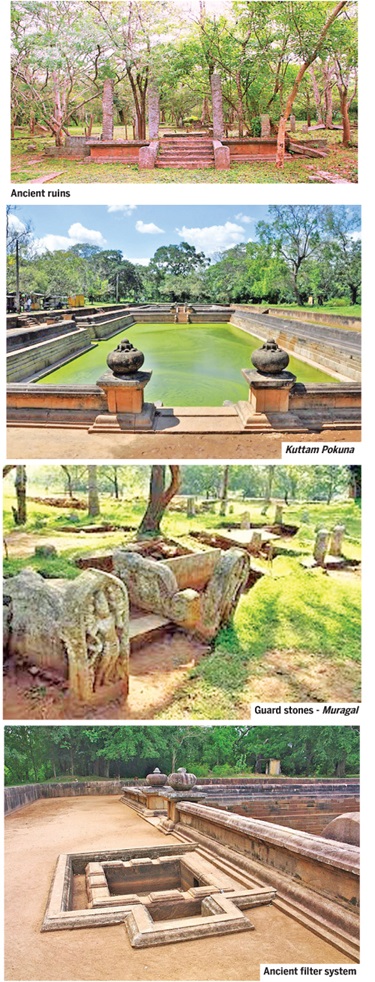
We noticed the brick platform can be approached from four sides, which denote the four cardinal directions. We also observed the four animals associated with the approach ways - Elephant (east porch), Horse (south porch), Lion (north porch) and Bull (west porch). We also observed the muragala - ancient guard stones carved with figurines. The evolution of the muragala is closely linked to the evolution of the Sandakada Pahana (a semi-circular stone slab also known as moonstone). Charles Godakumbura, the Archaeology Commissioner in Ceylon (1956–1967) described the evolution of the Muragala from its origins as a painted wooden plank or a stone terminal slab, serving as a stop wedge at the lower end of a slanting rail or korawakgala through to its final form as a carved stone. Centuries ago there has been a moat along the border of the magnificent terrace at Vijayarama.
Passing the main terrace, we saw signs of the resident monk’s bathhouse - Jantaghara. The humble abode where the monks resided and meditated has also been located. The refectory was able to feed 52 monks at one given time. We noticed the plinth had some amazing intricate stone carvings. There are men and women figures. Some opine the men figures represent Naga kings. There are dragon beasts - Makara firmly cut into the rock. I kneeled to inspect these ancient designs and noticed quaint dwarf cuts into the solid rock.
There were some mysterious-looking gargoyle designs. Some of these figurines seem to be playing an instrument. The attitude of the figures especially in the double-figured patterns are interesting and reminds one of the much-discussed panel of the man and woman in a love scene at Isurumuniya. According to oral tradition at Isurumuniya, it is believed that the man and woman depicted are Saliya and Asokamala. One wonders if this same couple is replicated at Vijayarama or does it denote two other humans? In addition to this small copper plaques with epigraphs have been found at this once hidden site. The verses on these plaques are maybe ancient forms of Buddhist blessings. There is a large pokuna, which once collected water for the daily use of the meditating monks.
The Vijayarama Monastery caught the attention of Bauddhaloka Foundation Chairman Jagath Sumathipala, who dedicatedly got involved in supporting the restoration of this important archaeological site in many ways, since 2014. In 2014, he was the President of the All Ceylon Buddhist Congress, and at the 93rd Annual General Meeting, a request was forwarded to them seeking assistance to restore the Vijayarama Monastery, to which he responded with great enthusiasm. In 2018, he also sponsored the publishing of a book on this archaeological site. The Bauddhaloka Foundation is a vibrant movement dedicated to preserving the Buddhist heritage of Sri Lanka.
A visit to this monastery not only reveals the Buddhist history of Anuradhapura, but provokes one to think of detachment and life’s values. This is a tranquil and revered venue for all those deeply interested in Sri Lankan history.
17 03 2022 - Daily News
H8.02
Pakistan holds conference on Buddhism
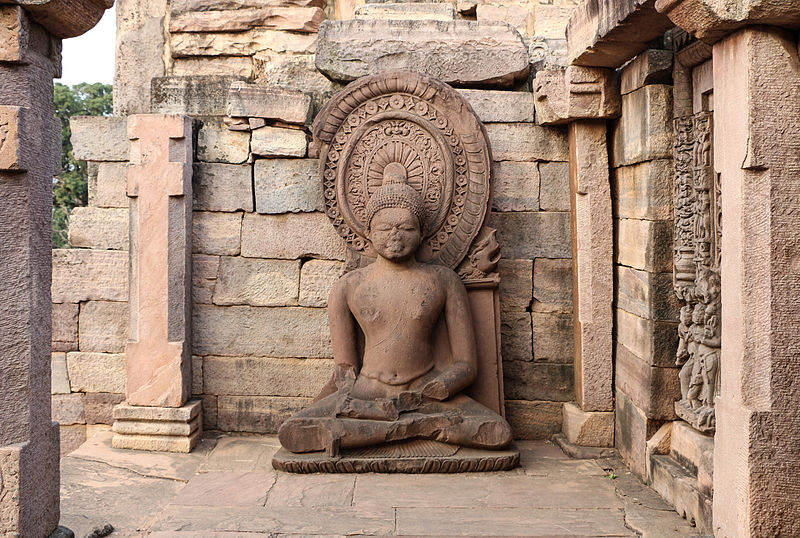
Buddha statues from Gandhara, PakistanThe two-day international conference on ‘Buddhism in Pakistan: History, Archaeology, Art and Architecture’ on Tuesday unveiled the potential of religious tourism in Pakistan in terms of promoting social cohesion and interfaith harmony.
Managing Director Pakistan Tourism Development Corporation, Aftab-ur-Rehman Rana chaired the session on ‘Potential of Religious Tourism in Pakistan’ at the two-day conference. MD PTDC said, “We need to engage all the stakeholders to provide an ideal environment for the promotion of religious tourism especially for Buddhist religious tourism in Pakistan.
Pakistan is a land of great Buddhist heritage and there are millions of Buddhist who can be attracted to visit Pakistan.
He said, we need to especially involve local communities living in the vicinities of heritage sites through the sustainable heritage tourism in the protection and providing custodianship of the heritage sites. There is also need to create a self-financing mechanism through tourism promotion to better protect and manage the heritage sites of Buddhism which have great potential for attracting religious tourism”.
During the session, topics like religious tourism, overcoming hindrances of religious tourism to enhance social cohesion in multi-religious settings, Potential of Religious Tourism in Pakistan with Special reference to Religious Heritage of Khyber Pakhtunkhwa, Sri Lanka Image of “Taxila” in the Sri Lankan Folklore and Writing Context, Interfaith Dialogue and Peace Making in the Age of Globalization: A Necessity of Youth Involvement, Potential for cultural diplomacy of Gandhara were covered.
The two-day 2022 International Conference and Art Festival for Promoting Social Cohesion and Interfaith Harmony was jointly organised by Silk Road Centre, International Institute of Central Asian Studies, Quaid-e-Azam University Islamabad and Taxila Institute of Asian Civilizations with the support of PTDC, STFP, Serena and other organisations at Pakistan National Council of the Arts (PNCA) Islamabad.
Both in-person and online panel sessions provided an opportunity to multiple presenters to speak on a common theme of the conference. Presentations by the panelists were followed by questions and answers. Together with research presentations, the conference hosted an art festival featuring exhibition of Gandharan art and craft. In this exhibition, local and international artists presented the outstanding beauty of Buddhist art through their artworks and visual stories. The artwork was on display at the conference.
Meanwhile, Pakistan’s Federal Ministry of Education has said that Buddhism and Zoroastrianism will be added to the nation’s religious studies curriculum, the Single National Curriculum (SNC). Five other minority religions will be added as well: Baha’i, Christianity, Hinduism, Kalash, and Sikhism.
The draft curriculum for Buddhism was accepted on March 4, while the others are still in process. The move marks the first time in Pakistan’s history that such a broad set of religious studies recommendations has been undertaken by the Ministry of Education.
For Buddhists in Pakistan, the move comes at a crucial time. There are few communities of Buddhist practitioners in the country, but a lack of places for worship and teachers has led some to worry that the religion could die out in the country. Meanwhile, archeologists have unearthed several ancient Buddhist sites in the country in recent years, increasing interest among Buddhist scholars and practitioners in visiting the country. In 2019, Pakistan Government gave authorization to the Jogye Order of Korean Buddhism to establish a Buddhist temple at an ancient site in the country.
In a conference this week, Pakistan’s President Dr. Arif Alvi said that Buddhism’s propagation to places such as Korea and Japan came by way of Northern Pakistan, highlighting the role the country once played as a key nexus in the spread of the religion. In his address, he reportedly also said, “Buddha taught that in the presence of worldly desires, there could not be peace and this message was reflected in the image of fasting Buddha. Buddhism stressed upon curbing of desires in life to becoming familiar with other basic human emotions.”
(News International, APP)17 03 2022 - Daily News
H8.03
The ancient historic monument at Kurundumale
Dishan Joseph
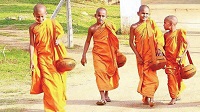
Novice monks at the PirivenaIn the early hours of Tuesday I set off with my colleagues from our sister newspapers Silumina, Dinamina and Thinakaran to discover an ancient Sri Lankan monument deep in the dense forest of Mullaithivu. We travelled for hours passing many rural areas. Villagers were harvesting their crops and new paddy was put to dry on the side of the main road. We passed Padaviya (ancient name Padirata) by evening and shortly reached Weli Oya. Our vehicle stopped at a Pirivena (a Buddhist school for junior monks) which was nestled across the serene Kiriibban Wewa (lake). The view of the still waters was refreshing.
This Pirivena is known as Shri Thilakamithra Mulika Pirivena. The resident chief monk Ven. Pimburaththewe Santhirindhiyalankara Thera greeted us. He explained that there were 23 young novices undergoing training to become ordained in this quaint village. The young monks surrounded us and we were blessed by their innocent smiling faces.
Junior monks
Amidst this remote village these junior monks faced some challenges. Jagath Sumathipala had assisted them through the Bauddhaloka Foundation for which the clergy were thankful. The Pirivena is in need of a classroom (hall) and those interested may come forward to assist this humble Buddhist school and enhance the welfare of the student monks. After sometime we left for our overnight stay.
Ancient ruinsThe next morning we set off to Mullaithivu. This is a vast area dotted with clusters of palmyrah trees. We travelled via Pulliyankulam and Nedunkerni. From the main road (at Kumilamunai) we took a turn to a sandy rough road, a distance of 14 kilometres to our venue. The drive is demanding, but this is the real essence of a journey of discovery. We passed herds of cattle and goats. A lone tusker is said to roam this wilderness. Soon we were within the Kurundumale Forest Reserve, an area covering a staggering 400 acres. A name board with the words Kurundumale Archaeological Reserve was visible. We halted here and met up with Kapila Senadheera, from the Department of Archeology- Vavuniya Office. To our right side there is a lake called Thannir Murrippu – meaning water breach in Tamil language. Within minutes we began our trek using a rough foot path. The ground was strewn with leaves and protruding tree roots, and I observed some rock stones which had once served as markers on this path. Birds flew within the lush foliage. We had climbed about 120 feet and the voices of people were heard. The side view of this ancient Kabook edifice was quite imposing. Workmen were engaged in the ongoing restoration. The summit of the hill and surrounding areas is said to cover 20 acres. Centuries ago the view from this summit would have shown lush fields and a beautiful lake.
Buddhist temple
After a short rest Kapila Senadheera explained to us about some of their findings within this site. The ancient Buddhist temple is said to be the only one of its kind in Sri Lanka built fully out of Kabook. For decades it had been concealed, fully covered with sand and trees that had obscured its view. Thankfully nature had protected this important historic site. The monument and adjacent area had once extended to cover about 75 acres. The Stupa rises to a height of 45 feet and is built to reflect the Padmakara style (lotus flower). How it withstood this long in a thick jungle is a miracle. The valuable historic site also survived the three decade war without any harm, although some treasure hunters had dug randomly in this area seeking valuables. This is the selfish ignorant attitude of some and must be severely condemned.
It is recorded that in 1895 the Government Agent of the Northern Province, Penry Lewis made mention of this site in a report on the Vanni region. The hill was called Kurundumalai in Tamil and Piyangala in Sinhalese. It is said that in 1905 H.C. Bell (Commissioner of Archaeology) had mentioned this important site in his report the Archaeological Survey of Ceylon (North Central- Central – Northern Provinces).
According to oral tradition the temple was called Kurundavashoka Vihara and Kurunduveli. It is opined that Kurundavashoka is the shortened form of Kurundavapi Ashoka. According to Buddhist scholar Ven. Ellawela Methananda Thera who has been closely associated with the restoration initiative at present, assumes that the Kurundi Atuwa (ancient Buddhist book) had been written from this temple centuries ago, thus reflecting in its name. He also opines that in its glory day at least 500 monks may have been at this location. Records indicate the Kurundavashoka Monastery area was declared a protected archaeological site by gazette 7981 of May 1933.
An ancient king named Khalatta Naga had built this monument (109-104 BC). He was the third son of Saddha Tissa. The temple had been duly enhanced by King Agbo 1 and King Vijayabahu 1, when they worshipped here. We noticed the pillars to be monolithic and built with gneiss rock. The remains of the Vattadage (circular relic house) with about 12 pillars is still visible. The Pilima-ge had once rested on a platform measuring 85 feet by 64 feet. We walked amidst the trees and Kapila led us to a large Pokuna- which had no water at present. This would have been about 60 feet by 80 feet, we couldn’t discern its correct depth. It must have held so much water when this site was occupied, which explains the assumption that 500 monks were here. In his report Government Agent Penry Lewis also states that an ancient village named Kuruntanur was also in this area. Another point in the 1905 Archaeological Survey of Ceylon by H.C. Bell stands out to capture the mind of those keen in archaeology. He mentions about two flights of steps. One is from the summit to the terrace- a flight of 18 steps. The second is a grand staircase of 100 steps, cut out of stone. As per the report the flight of steps “descends the hill unbroken to the forest below”. These steps connected the monastery to the city below. I inquired about this from Kapila Senadheera (Department of Archaeology) and he confirmed the existence of a staircase, and that it is buried, but some small parts of it have been found protruding from the ground. As the excavations are ongoing the team remains optimistic of finding this ancient stairway. Kurundumale has many mysteries to be revealed.
Excavation and restoration
Another person faithfully associated with the excavation and restoration of Kurundumale is Chairman of the Bauddhaloka Foundation, Jagath Sumathipala. He has donated much time and money to preserve this Sri Lankan monument. Archaeological restoration takes time. At this juncture I must point out that all places of religious worship must be respected, sans political influence. The Nagadeepa Vihara draws Buddhist and Hindu devotees. Likewise the magnificent Nallur Kandaswamy Kovil in Jaffna also draws Hindu and Buddhist devotees. The Kataragama Devale is venerated by Buddhists and Hindus. Therefore the Kurundumale Vihara is duly open for all Sri Lankans to visit. Let it be a radiant oasis of worship that unites the Sinhalese and Tamil people. This is a historic Sri Lankan monument and part of our nation’s rich heritage.
21 03 2022 - Daily News
H8.04
Diplomacy through Compassion
The significance of Bak Poya is historical since it marks Buddha’s second visit to Sri Lanka. This is noteworthy, as Bak is a month of national importance as well.
According to Mahavamsa, Buddha could foresee an imminent war between two Naga Kings Culodara and Mahodara, uncle and nephew, over a jewel-studded throne that made Him think of visiting Lanka for the second time. Professor Wilhelm Geiger explains the conflict in the translation of Mahavamsa:
That same Naga Mahodara was then a King, gifted with miraculous power in a Naga Kingdom in the ocean, that covered half a thousand Yojanas. His younger sister had been given (in marriage) to the Naga-King on the Kannavaddhamana mountain; her son was Culodara. His mother’s father had given his mother a splendid throne of jewels, then the Naga had died and therefore this war of nephew with uncle was threatening and also the Nagas of the mountains were armed with miraculous power.Mahavamsa also records that the Buddha was accompanied by a deity to Sri Lanka.
The deva named Samiddhisumana took a rajayatana-tree standing in Jetavana, his own fair habitation and holding it like a parasol over the conqueror, he with the Teacher’s leave, attended him to that spot where he had formerly dwelt. That very deva had been, in his latest birth, a man in Nagadeepa.
On the spot where thereafter the rajayatana-tree stood, he saw pacceka Buddhas taking their meal. And at the sight his heart was glad and he offered branches to cleanse the alms-bowl.
Therefore, he was reborn in that tree in the pleasant Jetavana garden, and it (the tree) stood afterwards outside at the side of the gate-rampart. The God of all gods saw (in this) an advantage for that deva and for the sake of the good which should spring (therefrom) for our land, he brought him hither (to Lanka) together with his tree.
Mahavamsa then relates how Buddha settled the dispute and the next development of events.
Hovering there in mid-air above the battlefield the Master, who drives away (spiritual) darkness, called forth dread darkness over the Nagas. Then comforting those who were distressed by the terror he once again spread light abroad.
When they saw the Blessed One they joyfully did reverence to the Master’s feet. Then preached the Vanquisher to them the doctrine that begets concord and both (Nagas) gladly gave up the throne to the Sage.
When the Master, having alighted on the earth, had taken his place on a seat there and had been refreshed with celestial food and drink by the Naga-Kings, he the Lord, established in the (three) refuges and in the moral precepts eighty crores of snake-spirits, dwellers in the ocean and on the mainland. The Naga-King Maniakkhika of Kalyani mother’s brother to the Naga Mahodara, who had come thither to take part in the battle and who, aforetime, at the Buddha’s first coming, having heard the true doctrine preached, had become established in the refuges and the moral duties, prayed now to the Tathagata: Great is the compassion that thou hast shown us here, O Master!
Hadst thou not appeared we had all been consumed to ashes. May thy compassion yet light also especially on me, O thou who art rich in loving-kindness, in that thou shalt come again hitherto my dwelling country, O thou peerless one’.
When the Buddha had consented by his silence to come thither, he planted the rajayatana-tree on that very spot as a Sacred memorial and the Lord of the Worlds gave over the rajayatana-tree and the precious throne-seat to the Naga-Kings to do homage thereto. In remembrance that I have used these do homage to them, ye Naga-Kings!
Buddha’s calling forth dread darkness over the Nagas should not be misunderstood. The Buddha holds fame for being the Greatest Compassionate on earth. The concept bears a symbolic meaning; Buddha preached about the dark side of the world, and the Naga tribes were scared just to hear and visualise them. That paved the way for them to comfort later on.
Buddha’s visits to Sri Lanka are believed to be false and legendary in certain sects. One reason is that it is not contained in Tripitaka, the official document of Buddha’s life. Tripitaka contains more philosophically important factors, rather than history. Buddha had been to Sri Lanka thrice: the first visit to Mahiyangana, second to Jaffna, then called as Nagadipa, and third to Kelaniya.
The common question is that if Buddha had already been to Sri Lanka, not only once, but thrice, why did Arahant Mahinda visit Sri Lanka once again. Arahant Mahinda, of course, had a mission to fulfil: to establish the Upasampada Bhikku order. The time was not ripe for the Buddha to consider establishing the Bhikku order. However, Buddhism was not alien when Arahant Mahinda set foot. (SM)
13 04 2022 - Daily News
H8.05
The Ancient Glory of Abhayagiri Viharaya
Dishan Joseph
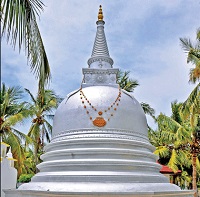
Abhayagiri DagobaThe pre-colonial history of Sri Lanka has been constructed from a variety of textual sources, in particular, the Dipavamsa, Mahavamsa and Culavamsa. The kingdom of Anuradhapura can be called the cradle of Buddhism in Sri Lanka. Once Buddhism was established, the monasteries of Anuradhapura gained international recognition and drew monks from across Asia. The splendour and religious zeal of Anuradhapura which has the atamasthana (eight Sacred places) cannot be compiled into this one page. Sri Lanka was once known as dhammadipa - the chosen land of Buddhism among Buddhist adherents.
Ancient chronicles show contact was maintained between King Devanampiyatissa’s kingdom and the Mauryan Empire. After his conversion to Buddhism, it is recorded that Mauryan Emperor Asoka (272–235 BCE) sent missionaries to neighbouring states to spread the Dharma. Asoka’s son Arahat Mahinda who was sent to Sri Lanka, after converting Devanampiyathissa, supported spreading Buddhism throughout this resplendent island. Subsequently, Asoka’s daughter Sanghamitta brought a branch of the Sacred Bodhi tree from Bodhgaya, under which the noble Buddha gained enlightenment, to Sri Lanka. This remains a significant centrepiece that is still venerated by millions at the Jaya Sri Maha Bodhi in Anuradhapura. Further, relics were brought to Sri Lanka, including the noble Buddha’s alms bowl, while his collarbone was enshrined within the Thuparamaya in Anuradhapura.
Our ancient kings were magnificent patrons and promoters of Buddhism. During their reign, they enhanced the Sangha, which transformed ancient Sri Lanka into a serene heaven for monks from beyond our shores. With regard to Sri Lanka, a number of deities such as Ganesh, Vishnu and Kubera continued to be venerated after the advent of Buddhism but their positions were reconstituted within a cosmography that placed the Buddha centrally.
When I first saw Abhayagiri Viharaya two decades ago, it did not resonate with the superlative beauty, which usually adorns an ancient Viharaya. This is because of its brown outer surface, which resonates with a ‘different’ kind of beauty. The colossal Abhayagiri Viharaya was built by King Vattagamini Abhaya (known as Valagamba). It is the second-largest brick-built monument in the world. Prior to this, there had been a small Jain monastery on this site. King Vattagamini Abhaya had to be in exile for 14 years due to an invasion. However, he collected his troops and gallantly drove out the invader. The triumphant king decided to build the Viharaya on this site. Ven. Mahatissa Thera of Kuppikala was appointed the Chief Monk by the king, as he had been faithful to the king. This Viharaya duly blossomed into a major hub of international learning consisting of four faculties - Uttara Mula, Vahadu Mulla, Kapara Mula and Mahanetpa Mula covering the whole Buddhist philosophy. It was on par with the Buddhist universities of Nalanda, Jagaddala and Vikramashila in India.
Different Sects have been found in Anuradhapura. The first was the centric monastery, dating from the first century CE. They are designated as centric due to a layout focused around a massive and imposing Stupa. The Mahaviharaya, Jetavana, Abhayagiri, and Vessagiriya in Anuradhapura fall into this building style. The travelling Chinese monk Fa Hsien reported that more than 10,000 monks and nuns resided in the Anuradhapura area. The Abhayagiri Viharaya once accommodated 5,000 resident scholar monks. Abhayagiriya embraced Theravada, Mahayana and Vajrayana Buddhism. Abhayagiri Dagoba was the original custodian of the Sacred Tooth Relic.
The figure of 5,000 monks indicates how strong Buddhism was in this era and the abundance of provisions to sustain such a large religious community. When I walked around its vast precincts, I could imagine how these monks had lived, accumulated knowledge and worshipped as a united and faithful fraternity. The area has many interesting remains of a vibrant religious order. For instance the Bath Oruwa - carved out of solid granite stone is a reminder of the community meal time. We can now assume that cooked rice was kept in this long rectangular stone, from which the monks served their meals. The grand complex has twin pools called the Kuttam Pokuna, although they are not identical in size. The prudent planners had built 30 bodies of water, of which the largest is the Eth Pokuna (Elephant Pond).
The area has remains of a building with guard stones (muragal). There are moonstones with intricate designs. Among the designs are swans, symbols of wisdom and purity. The treasury of Abhayagiri Viharaya was said to contain jewels and gems of much value, garnered from patronage. King Gajabahu I had also supported the growth of the Vihara complex. During the reign of King Parakramabahu, he supported the Mahaviharaya, and soon Abhayagiri Viharaya began to lose its glory.
For 800 years, this great Buddhist University and Stupa complex was shrouded in obscurity. It was literally covered by trees. In the 1880s, it was discovered and its value realised. The excavations at Abhayagiriya in Anuradhapura in the 1980s unearthed Buddha statues lying flat with their heads removed and this was cited as evidence of destruction as narrated in the Culavamsa (reference: Sri Lanka at the Crossroads of History). Archaeological interest in this area is found in the pioneering work of S.B. Burrows whose findings were duly published in 1886. Subsequently, H.C.P. Bell, S. Paranavitana and G.E. Godakumbura engaged in research at this historic site.
There was a period in history when this amazing Stupa was covered with trees and creepers due to neglect. A massive restoration project was set in motion under the guidance of Professor T.G. Kulatunga and the Central Cultural Fund. This project lasted many years. There was so much cleaning to do followed by accurate recreation of some areas. Brick by brick the restoration maintained progress. During October and November, there was intense rain, but these men and women remained committed. In the final weeks of this project, hundreds of volunteers came from adjacent villages to complete this long and difficult task. This nation owes its deep gratitude to all these people who invested so much time to bring back this magnificent Buddhist Stupa to its former glory.
Abhayagiri Viharaya displays plain bricks and ornamental bricks. The Stupa has three basal rings. Glazed and plain tiles have also been found. Pottery has also been found here - cups and bowls. Beads have also been found during excavations. Some opine that the monks used bead chains to count mantras. Numismatic evidence is proven from coins - copper, silver and even gold. It is interesting to note that brass ornaments were also found at this archaeological site. The area has also revealed fragments of coral, which would have been used in plastering work. Abhayagiriya stands as a historic and religious symbol. You must take at least two hours to walk around this vast complex. I conclude with this saying “Let the discerning man guard the mind, so difficult to detect and extremely subtle, seizing whatever it desires. A guarded mind brings happiness” - The Dhammapada. Centuries ago the monks of Abhayagiri Viharaya learnt about life and its values. May we follow their example and build a righteous nation.
13 04 2022 - Daily News
H8.06
Isinbassagala - The Rock of Sages
Dishan Joseph
Sri Lanka is a resplendent island bestowed with centuries of Buddhist history. Delving into this history one finds surprising new facts, which can be contested by historians. In order to understand today’s narrative we must pause and reflect on ancient history, perhaps from a new angle.
During the Anuradhapura period, in the times of well advanced kingdoms in Deva Hela, prior to pre-Vijayan period, it is noted that well advanced kingdoms prevailed in Ruhuna and the East. Scholars also attest to the fact that well preserved books, texts and documents written in Hela language and Maghadi language were used and referred to by the ancient scholars who once lived in this county.
The books and texts of this nature were stored in the libraries in Heladiva. Our history shows the facts which point to the destruction of almost all these books by fire due to political and cultural attacks faced by our ancient country from time to time. The great kings such as Wesamuni, Wiroodha, Viroopakkha and Datharaadtha found in the Aataanaataa Sutta and in the Tripitaka literature as Chaththaro Maharaja, are the four Guardian Deities who are respected and worshipped by our people even today.
Anuradhapura period
In the ancient times, prior to the shifting of the capital city to Lankapura – to Anuradhapura – well developed towns and villages were situated within this Helabima in the Eastern coastal belt. Such settlements were also found in Ruhuna and in the central regions of the country. The Kingdom of Magadha of which the city of Rajagaha was the capital city (present day Rajagala in Ampara), the Kingdom of Lichchavi in which the city of Visala was the capital city (presently is assumed this is the area covered by the Yala wildlife sanctuary), the kingdom of Rawana Dynasty which dominated the areas such as Kegalle, Rathnapura and also Mahanuwara region.
There is a thought process which points that the kingdom situated in the city of Varanasi in Kasirata (present day Mullaithivu and Vavniya), the Kingdom of Kosala of which the city of Savath was the capital city (present day Ritigala area) were the very powerful kingdoms in the ancient Heladiva.
Certain Buddhists believe that today what we read as Mahavamsa is the “Pali Mahavamsa” translated and written in Pali language after 300 years of the original Mahavamsa written in Hela language. We have three more chronicles, namely, Daathu Vamsa, Thoopa Vamsa and Bodhi Vamsa which were written after the Anuradhapura period, at the end of Polonnaruwa period or the period even after that. There had been one historic Hela book called Deepavamasa.
Isinbassagala is a rock plateau located off Medawachchiya. The word “isi” is derived from the Sanskrit word “rishi” (meaning sage). This is the rock from which the sage descended. It is believed that this is the true location from which the prudent Buddha had delivered his first sermon after attaining enlightenment. Some would contest this fact, and that is their democratic right.
I set off from Colombo with some learned Buddhist monks and two friends Janaka Fernando and Vinod Amerasinghe to this historical Buddhist site. We left Colombo at 4.30 am and reached Anuradhapura by around 8.30 am. Travelling these rural roads gives you many beautiful scenes. We were blessed to see the first rays of sunlight, effortlessly penetrating the mist laden forests and fields. Peacocks proudly spread their feathers. Buffaloes resting in the cool mud gazed at us as we drove by.
Hundreds of parrots flew across the clear blue sky. Storks were resting in the paddy fields. Men on bicycles carried fruits and vegetables to village markets. It was nice to see a bullock cart drawn by two sturdy bulls, something not seen in digitally dominated Colombo.
We reached the historic rock by 9.30 am. We had some refreshing king coconut before commencing our climb. The rock rises very slowly to a height of about 530 feet. It is an easy climb that will take just 30 minutes. Even senior citizens can visit this place without any worry. There is a staircase, and then we began the ascent. On our right side we came across a large pond, cut into the rock’s surface.
This water is actually fresh rainwater. This shows the wisdom of our ancient forefathers. The little stupa is part of a complex that was built by King Devanampiyatissa during his reign. It was built after Buddhism was introduced to Sri Lanka and although it is not the original structure, it was re-created in the early 20th Century after excavations had unearthed an ancient Naga Gala and a footprint of the Buddha known as Sri Pathul Gala.
The discovered Naga stone gives evidence of a Naga tribal community that had existed during the pre-Buddhist period of ancient Lanka. The Sri Pathul Gala is a relic of the past giving a clue that the noble Buddha did descend upon Lanka.
Beautiful surroundings
A carving of a white dragon sits at the entrance of the rock and a short ascend up the steps reveal a golden Buddha statue and of King Devanampiyatissa which stands facing the stupa. As you reach the top of the plateau, you will see the main temple of Isinbassagala Viharaya, where devotees visit to seek blessings.
This complex holds a cave room on the side. A unique feature of this sacred site is the panoramic 360 degree view of the beautiful surroundings. Lush green fields laced with dense thickets of trees. It is said by some to be a place of strong positive energy force fields. Those engaging in deep meditation claim of being able to connect to clear fields of energy.
The cave room has an ancient statue referred to as Arahath Guhawa, this manifests the legendary belief that Arahath along with several other Buddhist monks had arrived first to this historical region before reaching Mihintale; hence the translation of Isinbassagala as ‘the rock that the sages came from.’ After spending an hour on this rock we began our journey to Colombo.
The most important thing is to be awakened from within and live our lives to enhance the lives of others, and spread love, tolerance, forgiveness and kindness. When we choose this path the natural universe will support us in our endeavour.
25 04 2022 - Daily News
H8.07
The Rise and Decline of Tamil Buddhism
Abhayagiri Stupa in AnuradhapuraBarring scholars, very few in Sri Lanka would know, or readily acknowledge that in the past Buddhism had flourished among the Tamils both in Tamil Nadu and Sri Lanka. There was “Pali” Buddhism as well as “Tamil” Buddhism, depending on the language used.
Dr. Gintota P.V. Somaratna, former Head of the Department of History and Political Science, Colombo University, says in his paper entitled: Tamil Buddhism in Sri Lanka, that Buddhism existed in Tamil Nadu in three phases: (1) Between the 3rd and the 7th centuries; (2) during Pallava rule (400 to 650 AD), (3) in the Chola period (mid 9th to early 14th century AD).
According to the Uppsala University’s Tamil Professor Peter Schalk (Author of Buddhism among Tamils: An Introduction), Buddhism faced many challenges in Tamil Nadu and virtually disappeared by the 16th century, while it went from strength to strength in Sri Lanka.
Prof. Schalk attributes the decline in Tamil Nadu to the loss of political (Kingly) patronage and the rise of the Saiva, Vaishnava and Bhakti movements led by great saints.
Historian Burton Stein notes in his Peasant, State and Society in Medieval South India that the Bhakti movement was a social reaction to the town-based and mercantile society of Jains and Buddhists.
It may be seen as an expression of the largely rural population with an emphasis on agriculture. It is more rooted in Tamil culture.
Be that as it may, Buddhism had been in Tamil Nadu from very early times. Somaratna says that the Asokan Rock Edicts II, V and XIII mention Kerala, Chola, Pandya and Chera kingdoms in Tamil-speaking South India apart from Tambapanni in Sri Lanka.
"Buddhism faced many challenges in Tamil Nadu and virtually disappeared by the 16th century, while it went from strength to strength in Sri Lanka"
These were places to which Emperor Asoka had sent his Buddhist missionaries. A number of caves with Buddhist inscriptions in Brahmi have been found in Madurai, Tiruchi, Tirunelveli, Tanjaur and several other districts of Tamil Nadu, he points out. The Brahmi script had come to South India through Asoka’s missionaries.
There is evidence that Mahinda Thera, the son of Emperor Asoka, had taught the Dhamma in Tamil Nadu before his arrival in Sri Lanka. He had travelled by sea from North India and called at Kaveripattinam on the Tamil Nadu coast, before heading for Dambakolapatuna aka Jambukolapatuna (the modern Sambuthurai) in Jaffna.
Buddhism had spread in Tamil Nadu by winning the patronage of its rulers. It appears that State patronage is the sine qua non for the wide acceptance of any religion. During the heyday of Buddhism in Tamil Nadu, there were many great Pali scholars there like Buddhaghosa, Buddhadatta, and Dharmapala. At that time, Buddhism was recognized as a separate religion (Samayam).
The 7th century Chinese Buddhist monk-scholar-traveller, Hiuen Tsang (or Xuanzang) had described Kanchipuram, the Pallava Empire’s capital, as a flourishing city of Buddhists with over 100 Buddhist monasteries and over a thousand monks. But Prof. Schalk says that the Pallava rulers deliberately marginalized Buddhism and had given primacy to Hinduism.
Be that as it may, the Buddhist Tamil poet Sathanar’s epic Manimekalai written in the late 2nd century AD or early 3rd century, broke new ground by giving the teachings of the Buddha in Tamil.
The epic’s protagonist, Manimekalai, was the epitome of Buddhist ideals. She requested the Chola king to convert prisons to a place of piety with Buddhist monks in them. Sathanar disapproved of the caste system and ugly rituals.
Among other Tamil literary epics which show the influence of Buddhism are the Silappadhikaram, Valaiyapathi, Kundalakesi and Jivaka Cintamani.Tolkappiyam, the earliest Tamil grammar (3rd century BC), was written by a Buddhist, Somaratna says. He points out that Hiuen Tsang had recorded instances of Tamil Buddhist monks fleeing to Sri Lanka when they were worsted in religious debates or feared the repercussions of the rulers’ change of religion.
The Chulavamsa states that in the 13th century, King Parakramabahu VI of Dambadeniya (in the North-Western Province) brought down Buddhist monks and scriptures from the Chola country to resuscitate Buddhism in his kingdom.
The Mahavamsa is cited to show that several Buddhist Viharas existed in the Jaffna peninsula. Devanampiya Tissa himself built two Viharas close to Jambukolapatuna – the Tissamaha Vihara and Pachina Vihara. Monks from Piyangudipa (Pungudutivu) participated in the meritorious acts of Dutthagamani. King Dhatusena (455-473 AD) restored the Maha Naga Vihara.There are remains of Buddhist establishments datable to the early centuries of the Christian Era in Kandarodai, Vallipuram, Ponnalia, Makiyapini, Nilavarai, Uduvil, Nainativu, Punkuditivu, and Neduntivu in Jaffna. Both Manimekalai and the Mahavamsa describe the Buddha settling a dispute between two Naga princes over a gem-set throne in Nainativu. Kandarodai has very rich archaeological remains that point to early settlements. It was probably an emporium in the first centuries AD, Somaratna says.
"There are remains of Buddhist establishments datable to the early centuries of the Christian Era in Kandarodai, Vallipuram, Ponnalia, Makiyapini, Nilavarai, Uduvil, Nainativu, Punkuditivu, and Neduntivu in Jaffna"
According to Peter Schalk, there was a Tamil monk known as Cholika Sanghamitta in the reign of King Gothābaya (309–322 or 249– 262). The monk’s story is told in the Mahāvamsa also. Schalk also refers to inscriptions in Prakrit which were written in the Brahmi script by Tamil speakers. They date from the 2nd century BC to the 3rd century AD, a period known as the “early Anuradhapura period.” These Tamil speakers were Buddhists whose Buddhism cannot be distinguished in content from the Buddhism of contemporary inscriptions by Prakrit speakers, he says. These inscriptions are all about donations to a Vihara made by Tamil merchants apparently to gain merit and make money. These merit-earning Buddhists were active in the political, administrative, and religious centre, Anuradhapura. These inscriptions show the existence of early settlements by Tamil speakers confirming the record of the Mahavamsa.
According to Mahāvamsa, Tamil mercenaries, merchants and settlers became Buddhists and were accepted in the military and civil administration. These Tamil speakers were dedicated to the “Ila Chola Bauddham” (Eela Chola Buddhism or Tamil Buddhism). These were loyal to the political centre in Anuradhapura. Some were mercenaries in the service of the King who could only survive by keeping to the oath of allegiance to the King of the Sinhala speakers. To these was entrusted the guard of the holiest relic, the tooth of the Buddha. These mercenaries’ Tamil Buddhism could be studied in inscriptions from Mayilankulam, Morakakavelai, Vijayarājapuram and Polonnaruwa.
Others were merchants organized in guilds with strong connections to Tamil Nadu.Mercenaries and merchants could live in the same city as Sinhala speakers, albeit in different parts of the city. Schalk further notes that “the Buddhists were organizationally and linguistically integrated through Prakrit with the insular Maha Sangha. There was concord and co-operation between Tamil speakers and non-Tamil speakers with the common aim to establish monumental Buddhism on the island.”
Schalk points out that the Mahawamsa did not rile against all Tamils. It only considered non-Buddhists among the Tamils as ‘beasts’. Conversion to Buddhism made them acceptable to Sinhala-Buddhists. They promoted Buddhism and contributed to the building and maintenance of the classical showpieces of monumental architecture, like for example the buildings in the vicinity of the Abhayagiri Vihara in Anuradhapura.Switch to Tamil
Schalk notes that Prakrit Buddhism, which for ritual and teaching purposes was based on the Pali canon and its Pali commentaries, was discontinued among Tamil speakers both in Sri Lanka and in Tamil Nadu. The religious language of Buddhism shifted to Tamil in the 8th century. The linguistic change from Pali (Prakrit) to Tamil, loosened the links between Tamil and Sinhala Buddhists in Sri Lanka. When Saivism and Bhakti movement ascended to an unassailable position in Tamil Nadu under the Cholas (300 BC to 1279 AD), they pushed Buddhism and Jainism to the periphery there. And with the Cholas repeatedly invading Sri Lanka, Tamil Buddhism in the island also got marginalized - to the point of extinction.
17 01 2022 - Daily Mirror
H8.08
Some reflections on the temples of the South
Uditha Devapriya, With input from and photographs by Manusha Lakshan
The social and cultural history of Buddhist temples in Sri Lanka has been the object of study for well over a century. Far from receding into a world of their own, these temples occupied a prominent place in the world around them. Buddhist monks essentially lived under a code of piety and self-denial, and they operated under their own rules and customs. Yet despite being cut off from mundane concerns, they were very much linked to the society they hailed from. Granted entire villages for their upkeep, the clergy made use of the social institutions of their time, most prominently caste, to maintain their hold.
The first proper sociological overview of the relationship between the Buddhist clergy and Sinhala society was R.A.L.H. Gunawardana’s Robe and Plough: Monasticism and Economic Interest in Early Medieval Sri Lanka. Gunawardana’s point, in essence, was that conventional narratives of Sinhalese kings, especially Parakramabahu I, uniting warring religious factions underlay a very complex reality. For Gunawardana, Parakramabahu I didn’t so much enable the triumph of one faction (Theravada) over another (Mahayana) as achieve a compromise between the two, a compromise that was in line with the interests of a monarchy in search of unity against the threat of South Indian overreach.
Comprehensive as it was, Gunawardana’s book did not delve much into Sri Lanka’s post-Medieval history. Nor did it examine the sociological relevance of Buddhist temple art and architecture. Coming in almost 70 years after the publication of Ananda Coomaraswamy’s Medieval Sinhalese Art, Senake Bandaranayake’s Sinhalese Monastic Art sought to fill this gap. Published five years before Robe and Plough, Bandaranayake’s book limited itself to the same period covered by Gunawardana, the Anuradhapura and Polonnaruwa periods. It laid the groundwork for a more comprehensive study two decades later, The Rock and Wall Paintings of Sri Lanka. This latter work, a landmark for its time, has since proved itself useful to scholars of social and cultural history, particularly of Buddhism in Sri Lanka.
In The Rock and Wall Paintings of Sri Lanka, Bandaranayake divides the history of Buddhist art into four distinct periods: the primitive rock-shelter paintings, associated with prehistoric times and Veddah tribes; the paintings of the Early and Middle Historic Periods, dating from the 5th to the 13th century AD; the Kandyan Period; and the Southern or Maritime Period. The latter two belong to the period between the 14th and 19th century, while the Southern Period can be located in the Dutch and British eras, going beyond the 19th century and well into the early 20th century. Bandaranayake constantly emphasises that these periods can’t be viewed in isolation from each other, since there were, to quote the title of another of his works, important continuities and transformations between them.
I wish here to examine some of his insights on the Southern Tradition. Concentrated along the coastal belt between the Galle and Matara districts, the Southern Tradition has been the subject of much study over the decades. However, owing to its position in the nationalist consciousness perhaps, it is the art of Kandyan temples, the murals and the sculptures, that has won more attention. Even more intriguingly, though it has been claimed that Southern painters either stuck independently to their artistic visions or borrowed extensively from the Kandyan tradition, the reality was much more complex. There were important intersections between the Kandyan and the Southern traditions, to be sure, but there were also cleavages and distinctions.
Bandaranayake underscores this rather painstakingly.
“What is not yet clear is whether the Southern murals are a provincial offshoot of the Kandyan school, branching off in the late 18th or early 19th century; or a continued and late development of that same tradition, as most observers view it; or a partly independent school or sub-school, with its own history and character… What is not so certain, due to the lack of sufficient evidence, is the nature of the relationship between the two schools in the period from about 1750 to 1830 and before, and the forms of art that were extant in the southern and western regions in the preceding phase of the 17th and early 18th centuries.” (Senake Bandaranayake, “The Rock and Wall Paintings of Sri Lanka”, page 201)
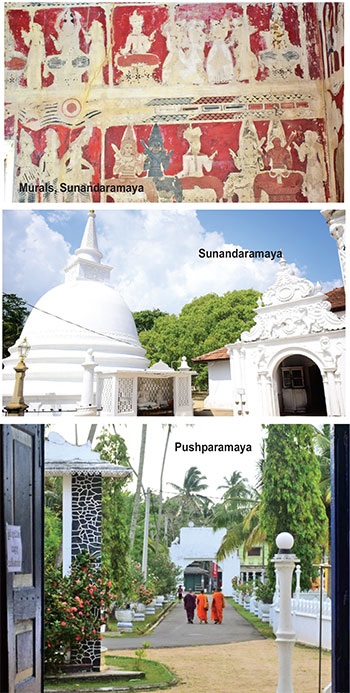
Part of the reason why we don’t have a clear answer to this, Bandaranayake observes, is that there is a substantial body of work belonging to the Southern mural tradition that has been lost to us, “the reconstruction of which… is about as impossible a task as the retrieval of the pre-1750 painting styles of the Kandyan kingdom.” Although scholar-painters, like the great Manjusri, attempted to date the temples and monasteries to which this phase belongs, Bandaranayake rightly cautions against his chronologies. For instance, while Manjusri dates the murals at the Sunandaramaya in Ambalangoda to 1802, Bandaranayake argues that they appear “too elaborate” to belong to that period.
Perhaps the most important point to note about Buddhist temple art in the South is its immense diversity. To say this is not to deny, or underestimate, the artistic diversity of the Kandyan murals. They too were influenced by other periods and cultures, predominantly Dravidian. Like the Kandyan Tradition, the Southern Tradition was influenced heavily by a folk culture. Whatever period they belonged to, these murals epitomised the spirit and age of a people who were yearning for freedom from colonial subjugation and at the same time accommodating the colonial presence in their homeland. It is this latter quality which sets the Southern Tradition apart from the Kandyan School, since direct confrontations between the Kandyan Kingdom and British colonialism transpired later.
These confrontations threw up their own bundle of contradictions, even in the post-1815 Kandyan political landscape. At the Maduwanwela Manor in Embilipitiya, for instance, we are told that Maduwanwela Dissawe spurned the colonial administration by laying on his floors mosaic tiles, including those with Victoria’s face. Popular lore has it that the Dissawe wished to spite the British, against whom he nursed a grudge, by walking on tiles that bore obvious colonial associations. One can accept this view, but one can also question it, on the grounds that the post of Dissawe under the British required acceptace of colonial structures and above everything else of the suzerainty of the British monarchy.
The Maduwanwela Walawwa is a secular establishment, with its own share of intrigues. We can note similar contradictions in the Southern temples, extending beyond the Southern coastline. Victoria’s portrait adorns the entrance of many of these temples, including the Kotte Raja Maha Viharaya. We can cite several reasons for this. For instance, the Head Priest of the Randombe Viharaya in Ambalangoda, who has been officiating there since 1965, told me that since it was under Victoria’s reign that Buddhists in Sri Lanka obtained certain rights and freedoms, such as the promulgation of Vesak as a public holiday, devotees wished to note their gratitude and thus placed her portrait at the entrance.
Another possible reason, told to me by a history writer, is that Buddhist monasteries wished to remain neutral vis-à-vis the confrontations between locals and colonial officials in the Maritime Provinces. By setting up Victoria’s portrait interspersed with Dutch insignia at the entrance, these temples more or less promoted their fealty to the British crown. This does not, however, fully explain the rationale given by certain monks for the mosaic tiles laid down in the budu-meduru or image houses: as with the Maduwanwela Walawwa, to openly spite the colonial powers by symbolically “trampling” them. The Randombe Head Priest’s explanation is particularly interesting, and needs to be cited in full.
“Under the Dutch and the British, there was a general feeling among the people of the South that an alien power was treading on our way of life, on our history. By laying down these tiles in the image-house, devotees ensured that when perambulating around the outer chamber, they would pay their respects to the Buddha and also spurn European rule. They essentially had treaded on our way of life and we were treading on theirs.”
These are, to be sure, anecdotal accounts and explanations, and they must be taken with a pinch of salt by the scholar. Yet they cohere with the artistic and architectural motifs of these establishments. Bandaranayake does not fully delve into this aspect of Southern temple art, but he does mention imply that there’s a great deal about the tradition that we are yet to ascertain. Why, for instance, would a temple feature Victoria’s portrait at the entrance while also featuring a depraved foreigner languishing in the fires of hell on the wall, as is the case at the Kataluva Purvaramaya in Ahangama? What explains the incredible church-like architecture of the Dharmasalawa at the Pushparamaya in Balapitiya? And what of the presence of art nouveau in the image house at Randombe?
Senake Bandaranayake’s explanation is perhaps the most accurate: these motifs and details, he tells us in the closing paragraph of The Rock and Wall Paintings of Sri Lanka, are “as much a comment on our perceptions of that tradition and the historical trajectory that produced it, as they are indicators and reflections of our contemporary moment.”
udakdev1@gmail.com09 04 2022 - The Island
H8.09
Some Thoughts on Kusinara
Bhante Dhammika of Australia
It is at Vesaka more than at other times that devoted Buddhists turn their attention to the Buddha and the three most important events in his life. The last of these, his attainment of final Nirvana, took place in a town called Kusinara, a name associated forever with this event as well as with sal flowers, and perhaps his final exhortation: “Now, I declare to you: all conditioned things are impermanent. Strive on with awareness.”
Something else that often comes to mind when thinking of Kusinara is why the Buddha would pass away in what we are always told was a rather obscure and miserable little town. At least that’s how the Tipitaka describes Kusinara, isn’t it? Perhaps! But maybe the Pali of this description of the town might be interpreted in another way.
A Wretched Place?
Ananda famously described Kusinara as kudda nagaraka, ujjangala nagaraka, sakha nagaraka, which Prof. Rhys Davids translated as “this little wattle-and-daub town, in this town in the midst of the jungle, this branch township”. Subsequent translators have followed the gist of this, giving the impression that Kusinara was a wretched and dismal place. Some of the variations include “this sorry little town” (Lord Chalmers); “this mean place, this uncivilized township in the midst of the jungle, a mere outpost of the province” (Sister Vajra and Francis Story); “this miserable little town…right in the jungle in the back of beyond” (Maurice Walsh); “this small town, this barren town, this branch town” (Bhikkhu Anandajoti); and “a little hamlet, a jungle hamlet, a branch hamlet” (Bhikkhu Sujato). These last two translations follow the wording of the Pali more closely than the others.
Nonetheless, there are problems with what branch (sakha), could mean in this context. In English it would mean off the main route, usually in reference to a path, road or railway line. But far from being off the main road, it is fairly certain that Kusinara was situated right on the main road running from Magadha and Vajji to Kosala’s capital at Savatthi and beyond – the northern equivalent of and roughly parallel to the Uttarapatha, what later came to be called the Grand Trunk Road.
Also, no town or village in the Tipitaka, or in any other Indian literature, to the best of my knowledge, is ever described as being sakha, a word which is always used in reference to bush or tree branches. Kudda is from the Sanskrit kuḍya, meaning ‘a wall’, and could be related to the Sanskrit ksunna, ‘to grind, and the Pali cunna, ‘powder’. Both meanings might be relevant to Kusinara and may refer to the defenses of the town—a wall or rampart—or to the lime plaster coating that was put over mud bricks to protect them from rain. Ujjangala can refer to hard or compact soil or mud.
Modern visitors to Kusinara will note that the soil around the town is not noticeably hard or barren (or no more so than anywhere else in northern Uttar Pradesh); in fact, it is fertile and productive. Thus, in relation to Kusinara, ujjangala may refer to the rammed earth or mud used in ramparts. Likewise, sakha could well refer to the branches of thorny bushes that were cut and used for defensive purposes or, alternatively, to a palisade running along the top of a rammed earth rampart.
If this interpretation is correct, Ananda’s comparison of Kusinara with the great cities of the time was that it was a small place with basic or antiquated defenses, the main cities having more impressive and substantial ones of stone and bricks. Ananda’s concern, as he clearly stated, was that there were not enough wealthy people in Kusinara who could arrange a fitting funeral for the Buddha, not that the town was a miserable backwater.
Why Kusinara?
After the Buddha passed into final Nirvana and preparations were being made for his funeral, a large group of monks led by Mahā Kassapa happened to be going along the main road to Kusinara when they met an Ajivaka ascetic who was coming from the town. Kassapa asked him if he knew his and his party’s teacher, the Buddha, to which the Ajivaka replied that he did know of him, and he had passed away in Kusinara only a week ago. This news caused dismay, confusion and grief amongst the monks.
But the fact that Kassapa and the monks with him were on this road and heading in the direction they were is intriguing. A look at a map will show that the ancient road would have passed through Kusinara and continued all the way to Savatthi and that at some point beyond Kusinara, it would have branched off to Kapilavatthu. Where was Kassapa going and why was he with/did he have a group of monks with him? The gruff and ascetic Kassapa was known for his penchant for solitude, not mixing with other monks and keeping to his forest hermitage. I would like to offer a possible explanation.
It would not be unreasonable to conjecture that the Buddha planned to spend his final days in his hometown amongst his kin. The evidence shows that he had a special affection for the Sakyans. When the brahman Ambatta disparaged the Sakyans for not respecting him in the proper way, the Buddha defended his kinsmen, saying: “But even the quail, such a little bird, can talk as she likes in her own nest.” We also know that the Buddha always addresses the people he was talking with by their clan names except when he was talking with Sakyans when he would use their given name.
So it is quite possible that when the Buddha set off from Rajagaha on his final journey, his destination was Kapilavatthu, where he hoped to spend his last days. If so, before departing he would have asked some monks to spread word to senior disciples that they should meet him in Kapilavatthu for final instructions and goodbyes, but as it happened, he died in Kusinara before reaching his planned destination.
This conjecture would also explain why Maha Kassapa, one of the Buddha foremost disciples and one who preferred to live alone in the forest, was where he was when he heard of the Buddha’s passing—he had been on his way to Kapilavatthu for a final meeting with the Buddha.
24 04 2022 - The Island
H8.10
Lumbini – Birth and Rebirth
Bhante Dhammika of Australia
As is well-known, Lumbini is the first of the four major holy places in Buddhism, it being the place where the person who was to become the Buddha was born. Almost every account of the Buddha’s life, traditional and contemporary, recounts the incidents that supposedly occurred at his conception and birth: his mother dreaming of a white elephant before or as she conceived; giving birth to him while grasping the branch of a tree; and he emerging from her right side. Some later accounts even add that Mahamaya was a virgin when she gave birth. None of these stories are mentioned in the Tipitaka.
The only discourse in the Tipitaka dealing with the Buddha’s birth is the Acchariyabbhuta Sutta which relates several wondrous events that supposedly occurred before, during and immediately after the event. However, not all the ‘wonders’ it mentions should be dismissed as fantastic exaggerations; some may have been based on fact, while others may have had a didactic purpose.
For example, the discourse claims that Mahamaya gave birth while standing, which is by no means improbable. Little is known of ancient Indian birthing practices, but it appears that women commonly delivered in either a sitting, lateral or upright position. Interestingly, Britain’s Royal College of Midwives recommends upright birthing and says that it is quite safe if the midwife and other attendants are properly trained and prepared for it.
The discourse also says that a brilliant light appeared when the Buddha was born – not a star indicating a particular location as with the Christian nativity story – but one which allowed beings to think differently about each other. The sutta says: “When the Buddha came forth from his mother’s womb, a great immeasurable light more radiant even than the light of the gods shone forth into the world… And even in the dark, gloomy spaces between the worlds where the light of our moon and sun, powerful and majestic though they are, cannot reach, even there did that light shine.
“And the beings that are reborn in that darkness became aware of each other because of that light and thought, ‘Indeed there are other beings here’.” It would seem that this story was not meant to suggest that an actual light appeared when the Buddha was born. Rather, it is a literary device, an allegory, a way of saying that the advent of the Buddha would enable beings to become aware of each other, thus making empathy and understanding between them more likely.
Almost the only thing that can be said with certainty about the Buddha’s birth is that it took place in Lumbini, a place between the Buddha’s hometown and the main Koliyan town – Kapilavatthu and Devadaha. The birth is always depicted as happening in the open, with Mahamaya standing and grasping the branch of a tree, and although tradition says Lumbini was a garden, the Tipitaka says it was a village (gama) and King Asoka’s Lumbini inscription calls it a village too. So it is much more likely that she gave birth in one of the village houses or at least under some type of shelter.
The Buddha asked his disciples to try visit the places where the four pivotal events in his life occurred, one of these being Lumbini, and pilgrims must have started going there perhaps even while the Buddha was still alive. The first person we know of to have gone there was King Asoka who made a pilgrimage in 249 BCE. After that we have no records of Lumbini until the Chinese pilgrim Faxian went there at the beginning of the 4th century CE.
About two centuries later another Chinese pilgrim, Xuanzang, visited but neither he or Faxian gave much information about Lumbini other than to mention a few landmarks and to say that it was a rather forlorn place. It seems that by the Muslim conquest of India in the 13th century Lumbini was already lost in the jungle, it’s very whereabouts forgotten. Nothing is known at all about it for the next 1,000 years until the second half of the 19th century. Buddhists still knew of Lumbini’s significance in their religion but it seems they made no effort to locate it, an endeavor task that was taken up by westerners.
As a knowledge of Buddhism by westerns and particularly by British scholars grew, so did an interest in the religion’s historical geography – an interest which grew into a passion and a passion that became a race, to discover the places associated with the Buddha, particularly where he was born and his hometown.
Initially, where the Buddha attained awakening (Bodh Gaya) and where he proclaimed the Dhamma for the first time (Sarnath) were identified with little trouble, then one by one, Kosambi, Savatthi, Rajagaha, Visali and Kusinara were located and excavated, but Lumbini and Kapilavatthu remained frustratingly evasive. The ancient texts all said these two places were near each other so scholars knew that if they found one they would be able to find the other.
The Chinese pilgrims had left fairly detailed information about in what direction and how far one was from the other and scholars argued with each other, sometimes with a great deal of bile, where Lumbini might be found. The more intrepid of those involved in the search even hacked their way through the jungle risking malaria and tigers in a determined effort to be the first to find either place.
Eventually, some of the more perceptive scholars thought the two places might lie somewhere across the British-Indian border in Nepal, in what was called the tarai. This sparsely populated and thickly forested strip of land ran along the India-Nepal border and was dangerously malarial and deliberately left like that by the Nepal’s government in order to deter unwanted foreigners entering the kingdom.
Nonetheless, a few British officers – Vincent Smith, Laurence Waddell and Alois Fuhrer had got managed to get permission to explore parts of the tarai through the good offices of the British authorities. Fuhrer claimed to have discovered several antiquities in the area but all of them were shown to be fraudulent.
Interestingly, on several occasions the British went remarkably close to locating Lumbini without knowing it. In 1816 their surveyors demarcated the India-Nepal border in such a way that Lumbini ended up being in Nepal a mere seven km north of Indian territory. As a result, today one often reads or hears the ridiculous claim that “the Buddha was Nepalese.” If the surveyors had explored the jungle a bit more they might have stumbled on King Asoka’s great pillar and perhaps put the border slightly to its north, and Lumbini would have been in India.
A little more than 60 years later they missed another chance. In 1880, Laurence Waddell, a doctor and passionate amateur antiquarian with a particular interest in locating the Buddha’s birthplace, had been posted to a district abutting the Nepalese border and some locals had informed him that there was a stone pillar in the jungle just across the border in Nepal.
Intrigued, he instructed one of his Indian workers to go there and make a copy of any inscription that might be on the pillar, which was done. However, the worker made a copy of a small piece of graffiti near the top of the pillar – Asoka’s now famous inscription being covered by centuries of rubbish and rubble at the time. When Waddell read the graffiti, which was of no significance, he gave the pillar no further thought, and thus missed having the honor of discovering Lumbini. In the end, that honor went to a Nepalese rather than a Briton.
A Nepalese nobleman named Khadga Shumsher (1861-1921) happened to be the governor of the province which included Lumbini at this time and he came to know about British interest in finding the Buddha’s birthplace. When he heard about the pillar he went to see it, dug away some of the earth around its base and revealed Asoka’s inscription. To cut a long and rather complicated story short, British scholars heard of Shumsher’s discovery, the Nepalese gave them permission to make a copy of the inscription, it was translated and the words “for here the Lord was born” (hida Bhagavam jate ti) finally confirmed the location of Lumbini.
Newspapers in India, Germany, Britain and even Russia all reported the news. Over the next 18 months at the request of the British Indian government the Nepalese gave permission for scholars to visit Lumbini, including some of the big names in Indian and Buddhist studies, including Prof. Rhys David, Vincent Smith, L. Waddell, and Willium Hoey.
Right next to Asoka’s pillar was a small temple to a goddess called by the locals Rupam Devi, the interior of which some of these visitors tried to examine, but not being Hindus the presiding swami would not let them enter. However, Hoey managed to slip into the temple unnoticed and found that its principle image was actually an ancient much worn and damaged image of the Buddha’s birth.
Realizing the importance of Lumbini’s identification, in 1899 the British authorities managed to get permission from the Nepalese government to allow an archaeologist to come to Lumbini to do some excavations. Thinking that a Hindu would be more acceptable to the Nepalese they chose P.C. Mukherji although he was given only two months in which to do his exploration. Of many important discoveries Mukherji found was the missing part of the nativity image in Lumbini’s temple.
One would have hoped that the discovery of Lumbini would allow pilgrims to once again go there in keeping with the Buddha’s instructions that it would be uplifting for a devotee’s faith it they did so. But it was not to be. Nepal’s oppressive and reactionary Rana government was determined to prevent any outside influence into the kingdom, fearing, probably correctly, that it would endanger their grip on power.
Thus for the next 50 years it was almost impossible to visit Lumbini despite being only a few km from Indian territory. Despite such hinderances a few people, sometimes in disguise, managed to do so. A trickle of Indian, Burmese and Sri Lankan Buddhists were able to get to Lumbini, mainly because the border guards thought they might be Nepalese. A few Europeans managed to do it also.
For example, in 1933 the German Indologist Ernst Wald Schmidt teamed up with a small group of locals and accompanied them all the way to what he called “the Bethlehem of Buddhism.” But as soon as he got there a guard noticed him and demanded he leave, although they did allow him to have a look around before being accompanied back to the border.
In 1951 Nepal’s Rana regime was finally overthrown, the king, who had been confined to his palace for decades was freed, and the first attempt to establish a modern democracy in the country was made. In 1955 Indian prime minister Jawaharlal Nehru wrote to the king of Nepal informing him that the coming year would mark the 2500 anniversary of the Buddha’s birth which was expected to be celebrated around the world and suggested that he develop Lumbini for the numerous pilgrims who were expected to visit the Buddhist holy places.
King Mahendra took the hint and with a development plan provided by the Indians, a reasonably good road was constructed from Lumbini to Nautanwa (which was to become the main India-Nepal border crossing), a tourist bungalow, post office and a small Theravadin vihara were built and a tube well was dug, all paid for by the king – 100,000 rupees all told. Further, he had a forest of sal trees planted a modest garden laid out and banned animal sacrificed being made in the temple, something he could do as many Nepalese believed, an incarnation of Vishnu.
On the big day of the 1956 Buddha Jayanti the king actually visited Lumbini and announced that from that day onwards that Vesak would be a public holiday.
It should also be noted that beginning in the 1930s but especially after 1951, the Newari Buddhists of Kathmandu, many of who had converted from Mahayana to Theravada, did much to help develop Lumbini: leading pilgrim parties, looking after pilgrims who came, petitioning the governments concerning problems at Lumbini, etc., chief among being Ven. Dhammaloka and Ven. Aniruddha, an alumni of Sri Lanka’s Vidyalankara Pirivana.
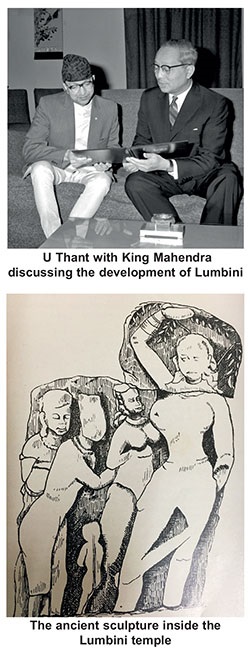
When, in 1967, the deeply religious Buddhist Secretary-General of the United Nations, U Thant, visited Nepal he flew from Kathmandu to Lumbini and after his visit commented: “This is the most important day of my life” and then broke into tears.
On his return to Kathmandu, he met King Mahendra and discussed with him the possibility of further enhancing Lumbini’s sanctity. On his return to New York, he set up a UN committee to turn the nativity site into an international center for peace, got UNESCO involved who in turn hired the famous Japanese architect to draw up a master plan. Tange visited Lumbini and spent some time studing Buddhism and its history (he was not at all religious), and in 1978 his firm submitted its design.
The project to preserve Lumbini and landscape the sacred garden and surrounding park was supposed to be finished by1985, but bureaucratic indolence and corruption in Nepal slowed progress and in 2005 without ever seeing the completion of his master plan. Despite these and other setbacks, Tange’s master plan is largely finished and with most Buddhists countries and several bigger Buddhist organizations building temples there, Lumina has been reborn.
01 05 2022 - The Island
H8.11
Where Mahakassapa – Waiting for Maitreya
Bhante S. Dhammika of Australia
Grave, austere and given to solitude, Mahakassapa was one of the Buddha’s foremost disciples. When Sariputta and Moggallana predeceased the Buddha it was Mahakassapa who came to be seen as his successor. Several important discourses in the Tipitaka are attributed to him, he was the leader of the ascetic movement within the Sangha, and presided over the First Buddhist Council. In later centuries in China, he was seen as the founder of the Ch’an (Jhana) school of Buddhism.
Pali sources have much to say about Mahakassapa’s life but strangely, they are silent about his last years and his death, the details of which are found it the Sarvastivadin Vinaya, the Divyavadana and several other early Sanskrit works. Although the details differ slightly in different sources, its outline is basically the same. Just before his final Nirvana, the Buddha exchanged his robe with Makassapa’s – an incident confirmed in the Tipitaka, although there this is said to have taken place just after Mahakassapa’s first meeting with the Buddha.
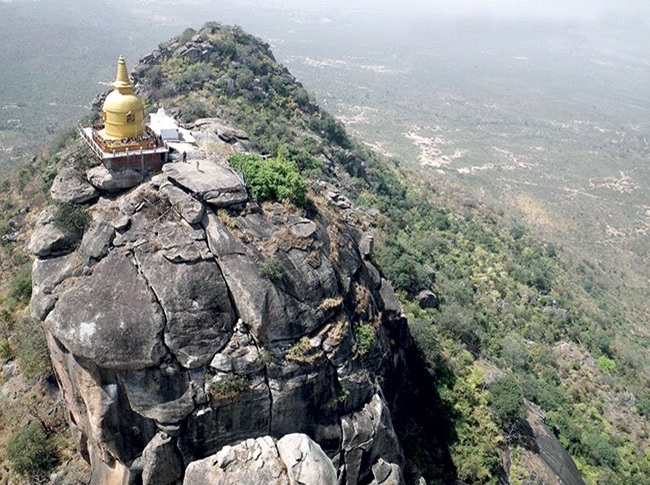
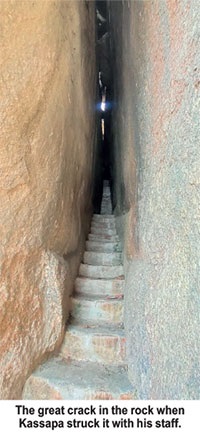
Some 20 years later, feeling that death was approaching, Mahakassapa made his way to a remote mountain with the intention of climbing to the top. When a rocky cliff blocked his way, he struck it with his staff and it opened to let him through. As he reached the summit, a cavity appeared in the rocks; he entered, the cavity closed, and he fell into a deep samadhi. The legend concludes by saying that in the distant future when Maitreya appears in the world, he will come to this mountain and awaken Mahakassapa, who will pass the Buddha’s robe to him. Then Maitreya will proceed to proclaim the new dispensation. The place where all these events did and will unfold was called Gurupadagiri (Teacher’s Foot Mountain) or more usually Kukkutapadagiri (Cock’s Foot Mountain), apparently because its three pointed peaks resembled a cock’s foot.
During the time Buddhism flourished in India Kukktapadagiri was one of the most popular destination for pilgrims because of its association with both Mahakassapa and Maitreya. The stupa on the summit, said in the Asokavadana to have been built by King Asoka was always depicted on statues of Maitreya as nestled in his crown. One of the few statues of Mahakassapa ever found in India has an inscription on it giving his biography and concludes by saying that “he entered Nirvana on the charming hill of Gurupadagiri.”
The mountain gained the reputation as the abode of saints and sages. In one account we read: “On this mountain as of old, there are arahats abiding. Devotees from various countries go year by year to the mountain and present offerings to Kassapa, and those whose hearts are strong in faith arahats will come to them at night and talk with them, discussing and resolving their doubts and disappearing suddenly afterwards.”
One of the saints who is said to have lived on the mountain was the great philosopher Asanga. Legend says he spent 12 years meditating in a cave there, hoping to have a vision of Maitreya. After six years without success, he decided to give up and leave, but just as he was about to do so he noticed a bird’s nest and besides it the rock was worn smooth by the wing of the occupant brushing against it. This object lesson in patience inspired Asanga to continue his practice which eventually bore fruit.
Many of the Chinese pilgrims who visited India between the fourth and the 11th centuries CE went to the sacred mountain. I-tsing says he dreamed fondly of climbing Kukkutapadagiri even before leaving China – a dream he was later able to realize. The monk Hsuan-hui is said to have climbed the mountain often during the several years he stayed in Bodh Gaya. Faxian and particularly Xuanzang, left detailed descriptions of the place. So strong among Chinese was the desire to visit Kukkutapadagiri that as pilgrimage to India became increasingly difficult after the 11th century, a mountain in China, Che Chu Shan, in Yunnan Provence, came to be seen as the real one. Even today, Chinese Buddhists will express surprise and confusion when told that Mahakassapa’s mountain is actually in India, not in their country.
The sacred mountain continued to attract pilgrims right up to Buddhism’s twilight period in India. Taranatha, the great Tibetan historian, wrote that the Tantric adept Sanavasika lived in a cave on the mountain for some years. The last reference in traditional Buddhist literature to anyone going there is in the biography of the great rambler Buddhagupta, who stayed there briefly during his travels in the 16th century. After that, we here no more of Kukkutapadagiri.
During the second half of the 19th century, British archaeologists and antiquarians interested in the historical topography of India used the writings of the Chinese pilgrims and modern survey maps to try to identify ancient Buddhist sites, including Kukkutapadagiri. The first person to try to identify it was Major Markham Kittoe and he was followed by the intrepid Alexander Cunningham, Sir Aural Stein and several others. But despite their best efforts and the historical information they brought to the task, all the hills they thought were the sacred mountain turned out not to be so.
In 1906, two Indians, Sreegopal Bosa and Rakhal Das Banerji, brought to the attention of scholars yet another site some 20 miles from Bodh Gaya, suggesting that it might be Kukkutapadagiri. The evidence in favour of this place was compelling. Its modern name, Grupa, was an exact Prakritic development of Gurupada, the mountain’s alternative name; there were Buddhist sculptures and inscriptions there; it was still held sacred by local people; it had all the geological features mentioned by the Chinese pilgrims, in particular the great crack in the rock that legend said was made when Mahakassapa struck it with his staff; and finally, its distance and direction from Bodh Gaya as given by Xuanxang roughly corresponds with Grupa’s location.
There is a line of three small Hindu shrines on the top of the mountain and on the floor in one of these is a stone with a pair of footprints on it with an inscription. The first part of this inscription is the famous dhammapariyaya which was always used to consecrate Buddha images, while the remaining part has not yet been translated. This inscription is in Kutila script which dates from the 10th century CE. There seems little doubt that the footprints on the stone were believed to be those of Mahakassapa and which that they gave the mountain the second of its two names, Gurupadagiri, Mountain of the Teacher’s Footprint.
Next time you go on pilgrimage to Bodh Gaya plan to stay a little longer, make inquiries on how to get to Gurpa and make a point of visiting Kukkutapadagiri, the place where legend says Mahakassapa waits for Maitreya.
29 05 2022 - The Island
H8.12
Kanheri caves: An ancient tale left untold
Kanheri, credited with the largest number of cave excavations on a single hill, is a ticketed monument protected by the Archaeological Survey of India (ASI).
Kanheri, credited with the largest number of cave excavations on a single hill, offers no guides or pamphlets for tourists to understand the site better.
For Mumbaikars, the Kanheri caves have long been a favourite spot to get far from the madding crowd, with the ancient Buddhist structures atop a hill at the Sanjay Gandhi National Park offering much-needed tranquility, even as you breathe in a bird’s-eye view of the bustling city below.
However, despite its historic significance and adequate maintenance, the site is not among Mumbai’s most popular tourist destinations, with most visitors flocking to places such as Gateway of India, Juhu Chowpatty, Elephanta caves and Mahalaxmi temple, according to a recently conducted state tourism survey.
While accessibility may be one of the reasons for this, with SGNP located in Borivli in the far north of Mumbai, the caves also lack various elements needed to help tourists understand them better.
Kanheri, credited with the largest number of cave excavations on a single hill, is a ticketed monument protected by the Archaeological Survey of India (ASI).
However, at the ticket counter, no brochures or information pamphlets are available to help tourists know more about the structures.
There is just one billboard at the entrance that gives details of the caves and their importance, but from there on, the tourists are on their own.
There are no boards, official or even private guides to explain the history of each cave, and without brochures and audio guides, no possibility for tourists to have a self-guided walk through the structures.
As a result, most visitors simply amble around the site, clicking pictures and enjoying the view.
“It’s a very well-maintained structure, and it feels calm to be up here, away from the humdrum of the city, but I would have definitely liked to know more about why the Kanheri caves are significant for Buddhism, and what each cave means,” said Rohan Pataskar, who is originally from Pune and works in Mumbai’s financial services sector.
According to the ASI website, Buddhism first arrived in Aparantha (western India) at Sopora, which is very close to Kanheri. Some of the caves in Kanheri date back to mid 3rd century BC, and were in occupation till nearly 11th century AD.
11 04 2016 - Express News Service, Mumbai
H8.13
Somawathiya the Buddhist Oasis of Polonnaruwa
Dishan Joseph
Somawathiya ChaityaThe Buddhist history of Sri Lanka is fascinating. Today I am writing about one of the most important spiritual sites in the domain of Buddhism. I first visited Somawathiya Chaitya as a child, and had limited understanding of its religious significance. On my second visit I was able to witness the beautiful aura around this magnificent Buddhist edifice and was impressed by the faith of hundreds of pilgrims gathered here. Before we talk about this awe inspiring stupa which is nestled in the dense wilderness, we must pause to appreciate the political and cultural importance of the once glorious kingdom of Polonnaruwa in ancient Sri Lanka. It is recorded that Polonnaruwa was a great city which came into prominence during its brief period of 2 centuries in Sri Lankan history, being second only to the regal city of Anuradhapura in our island's glorious history.
Polonnaruwa today is a showcase of the great ancient Sri Lankan architecture dating back to 12th Century AD, which was interwoven with many Buddhist monasteries and monuments which were built by the prudent King Parakramabahu I. Later, King Nissankamalla (1187-1196 AD) from Kalinga dynasty also had contributed to the development of many buildings and monuments in Polonnaruwa. During the Anuradhapura period around 1st to 6th Century AD, there have been agricultural developments with irrigation work and constructions such as Elahera canal, Minneriya tank, Kaudulla tank, Giritale tank within the fertile Polonnaruwa area.
King Parakramabahu I, is considered by historians as the greatest King who ruled Polonnaruwa during the Polonnaruwa era for 33 years from 1153-86 AD and it had been a prosperous time for the entire nation. It was a time with numerous architectural engagements which one can still see even in the present time. He developed the city with architects and technicians brought down from India and their influence can be seen from many well preserved sites existing today.
The most powerful ruler of the time - Parakramabahu the 2nd who vanquished Magha, started the restoration of Polonnaruwa, but he established his base at Dambadeniya. It is said that the area around the Thuparama in Anuradhapura was in wilderness when his son Vijayabahu the 4th started the restoration at Anuradhapura. The “Culavamsa” states that the latter assigned the protection of the city of Anuradhapura to Vanniyars or forest chiefs; proceeded to Polonnaruwa and restored it as well before leaving for his capital Dambadeniya. Location on the banks of the Mahaweli made it a suitable area for irrigation and agriculture.
Rajarata - efficient reservoir system
The main centres of power, Anuradhapura and Polonnaruwa were located in the administrative heartland referred to as ‘Rajarata’. The thriving economy of agriculture-based Rajarata was supported by an efficient reservoir system which is testament to the wisdom of our ancestors. The notable factor is that for nearly eighteen centuries, political, economic and social administration was centred around Rajarata. During the time when Anuradhapura was the capital of the country, Thopa, Minneri and Giritale tanks had been built in the Polonnaruwa region. It is assumed that the agricultural development brought about by these tanks resulted in the migration of people to Polonnaruwa. The Somawathiya sacred area (once known as Somapura) is presently known as the Somawathiya Vihara and situated at Minvila about 50 km north-east of Polonnaruwa consists of a stupa and a few other monumental remains. There are two access ways to the site, from Minneriya via Higurakgoda to Sungavila, and the other from Polonnaruwa to Sungawila. The Somawathiya natural reserve and wildlife sanctuary is under the purview of the Department of Wildlife Conservation. It is 37,645.5 hectares and was established first as a wildlife sanctuary in 1966 and as a national park in 1986. It is one of the four national parks belonging to the Mahaweli Development Project.
In the 1940s, a group that was newly settling into this isolated area had witnessed luminous rays, similar to those emanating from the enlightened Buddha, glow from the position of a large mound. They had duly alerted the authorities. After examining, archaeologists were amazed and recognized it as the Somawathiya Chaitya in 1947, which was considered lost for nearly 8 Centuries. The revelation of this sacred Buddhist site in this mysterious manner further augments the devotee’s faith. There is an oral tradition of a lone monk whose name is said to be Ven. Sirimalwatte Piyaratne Thera walking in the dense jungle, when a ray of light guided him, through the forest to the location of this ancient stupa. The Somawathiya historical site is located 10 km ahead of Sungavila. Further, a branch of the Mahaweli River runs through Sungawila. On the basis of the available archaeological evidence such as Chathtra stone (chatragala), moonstones (sadakadapahana), balustrades (korawakgala), and guard stones (muragala) have been dated to the Second-Century BC.
Today Somawathiya is popular among thousands of pilgrims for three main reasons. Somawathiya holds the right Tooth Relic of the Buddha existing in the human world. The other Tooth Relic is enshrined at the “Dalada Maligawa” in the dazzling city of Kandy. Details with regard to virtues, dignity and miracles of the Tooth Relic have been recorded in the Dhatuwansha, Thupawansha, Dhadawansha, and Mahawansha. Incredible unexplained phenomena which have been occurring around the stupa. These have been witnessed by thousands of pilgrims. This includes luminous rays of laser like beams and shining orbs around the stupa at night. Some devotees told me they have heard drum beats at night, somewhat similar to drum beats heard at a Buddhist Perahera. This site is located deep inside the jungle and infested with roaming elephants and other wild animals. According to village folk, wild elephants that roam the neighbouring land have often been seen worshipping the stupa. There is a story of one lone elephant who visits the area and venerates this great chaitya. On my second visit to Somawathiya in 2018 I caught a brief glimpse of this gentle giant, moving into the foliage adjacent to the boundary of the temple. But I cannot endorse that he is the same elephant mentioned by the pious devotees. Interestingly elephants have been associated with Buddhism and Buddhist rituals for centuries.
According to ancient chronicles, prince Giri-aba and princess Somawathi (sister of King Kavanthissa) lived on a small community called “Somapura” on the banks of Mahaveli River. Price Giriaba constructed Somawathi Chethiya on the request of his wife who wanted to engage in religious activities. Upon completion of the Stupa, the prince requested a monk named Mahinda for some “dathu” to be kept in the Relic Chamber of the stupa. Ven. Mahinda Maha Thera gave him the right Tooth Relic of the Buddha. Upon completion of the stupa and five viharas the prince and princess handed over the temple to Ven. Mahinda Maha Thera and sixty other monks.
Stupa site
Floods often occur during the rainy season inundating the area surrounding the stupa site. It is evident that the stupa of Somwathiya was under about 7 m (20 ft) of water due to the floods in 1947. Before starting the restoration of the stupa, excavations were conducted by the Archaeological Survey of Ceylon under the direction of C.E. Godakumbura who has revealed a previously constructed stupa (5 ft 5 in) that is established as the inner stupa with a strong foundation. It was noted that the outer stupa did not have a proper foundation. Apparently, two foundations were identified after the excavation. On the lower level, there are ancient moonstones which were placed parallel on the steps at the present stupa (Godakumbura 1965). There is archaeological and literary evidence for the Somawathiya and its surrounding area showing that it was probably occupied by Early Iron Age inhabitants. According to Deraniyagala, a few archaeological remains were found in some places like Kandakadu, Trikonamadu and Kadiraweli (Deraniyagala 1992).
Nine stone inscriptions have been found around this site and the most popular is the four inscriptions found on the Eric Swan rock. This rock can be seen few metres away from the gravel road, about 100 metres before the main entrance to the temple. This rock got its name because a photographer called Eric Swan who was killed by a wild elephant near this rock. On July 4th in 1981 then President J.R. Jayewardene came to Somawathi to ceremonially open the “Kotha” of the stupa. As soon as they arrived at the site, at about 2 pm the whole sky became yellow and the sun looked like the moon. Multiple colours started appearing around the stupa. All the white clothes worn by the devotees had appeared yellow by this unusual light. On April 28, 2002, a similar occurrence happened in front of thousands of pilgrims. This time it had continued for over 45 minutes, the longest time this phenomenon continued. Many incidents can be found in the Holy Canon about the Buddha Rays. Six coloured rays which were gathering and spreading from the Buddha’s body was named as “Shadwarna Rashmi” are signified within the Buddhist Flag and the same six colours have been used to design it. Somawathiya will remain a venerated Buddhist oasis for decades to come.
11 08 2022 - Daily News
H8.14
Spiritual Grandeur of Ruwanweli Maha Seya
Dishan Joseph
Stupas in Sri Lanka are monumental structures built to honour the noble Buddha. A Stupa is an indispensable feature of any Buddhist temple, and architecturally the Stupa is the most important Buddhist structure. Stupas house Sacred Relics of the Buddha, or mark the sacred spots at which some important event connected with the religion had taken place, and they are venerated by the Buddhists. The most venerated Stupa in Sri Lanka is Ruwanweli Seya at Anuradhapura, because it enshrines the most amounts of the Sacred Corporal Relics of the noble Buddha. The Ruwanweli Seya is also known as Maha Thupa standing at 340 feet. The colossal Ruwanweli Seya was built by King Dutugemunu and completed by his brother King Saddhatissa. These pinnacles of Buddhist pride dominated our ancient kingdoms.
Amazing Stupas
Due to foreign invasions and the shifting of the capitals from one place to another, the ancient Stupas were neglected and became increasingly dilapidated. Various Kings driven by religious zeal carried out reconstruction and restoration of Stupas built by their predecessors, increasing their size and grandeur. The dome is the biggest component of a Stupa and it contains the Relics in a Relic Chamber, either at the level of the basal rings at the bottom, or in the square chamber at the top. Several shapes have been used for the dome, described as the bell, bubble, paddy heap, pot, and lotus. The bell and bubble shapes are the most common. Sadly by the turn of the nineteenth century all the amazing Stupas from ancient Sri Lanka were left in ruins.
The oldest Stupa in Sri Lanka is Thuparama built by King Devanampiyatissa (250-210 BC) in the magnificent and historic capital of Anuradhapura. With the passage of time more Stupas were built by the wise kings, notable ones being Ruwanweli Seya by King Dutugemunu (161-137 BC), Abhayagiri by King Valagamba (89-77 BC), and Jetavana by King Mahasen (276-303 AD). The colossal Jetavana Stupa, which attained a full height of 121 metres, was at one time the third tallest structure in the world surpassed only by the two great pyramids in Giza. The Stupas’ imposing appearance supplemented by a religious aura give us a feeling of stability, strength, nobility, and grandeur. Ancient Stupas in Sri Lanka are solid structures, built mostly of burnt clay bricks. The Stupa dome has one, two or three cylindrical terraces or basal rings at the bottom, which sometimes form a plinth. At its top, the dome carries the square chamber, which is a solid structure having a square plan.
According to oral tradition there is a story of a forest deity named Swarnamali. She occupied a large tree, which was in the desired construction site of the Stupa. The tree was a raan thelambu gaha which is believed to correspond to the Java olive tree (sterculia foetida). King Dutugemunu had kindly asked her to relocate saying he desired to build a Stupa here. She obliged the king’s request and wanted the Stupa named after her as Swarnamali Seya.
The historical chronicle Mahavamsa (Geiger 1950), describes how the foundation of the Ruwanweli Stupa was laid. “First the land was dug out to a depth of seven cubits (5.3 metres) and then crushed stones were stamped down by elephants whose feet were bound in leather. Then butter clay was spread over the stones and bricks were laid over the clay. Over this mixture, a rough cement and a network of iron was laid. Finally a sheet of copper and a sheet of silver were laid”. This system gives a reinforced concrete foundation with damp proofing. The prudent system of using both human labour and assistance from trained elephants is an endorsement of the engineering genius of our wise kings and architects.
The main building block of a Stupa is the burnt clay brick, and different sizes of bricks have been used in different components of the Stupa. The Dome, the most bulky component of the Stupa, has an outer layer of high quality bricks of large size. According to Mahavamsa material used in Stupa construction was subjected to strict quality control. King Dutugemunu employed the master builder who said that “he will pound the sand in a mortar and then shift it so that no grass or any such thing will grow on the Stupa”. The king also appointed a committee to supervise the construction work. The mortar used in the brickwork of ancient Stupas is a clay type called “butter clay” – with an adhesive from a tree and a solvent of sweetened water (Mahavamsa Geiger 1950). This was spread between different courses of bricks in very thin layers, to fill the cavities between bricks.
The four frontispieces at Ruwanweli Seya are supposed to be built by King Lanji Tissa. The frontispiece is known as vahalkada. Here we see carvings of lions, cattle, tuskers, horses and lotus. The image house here is called paspillimagae- consisting of five statues. They are supposed to be that of Kakusanda, Konagama, Kashappa, Gautama (Sakyamuni Buddha) and for Maitreya Buddha who is prophesied to come. Near the main entrance we can see statues of King Dutugemunu, his mother Queen Viharamahadevi and King Bathikabaya in worship. Devotees offered lotus flowers, as we walked in awe of this giant Stupa. A stone slab inscription near the shrine room proclaims the royal patronage bestowed on the Stupa. There was an ancient tradition at this Stupa when people gathered to paint it with lime. This was said to be an annual event.
Golden Age of Anuradhapura
We see that the Mahavamsa copiously describes the building of the Maha Thupa (Ruwanweli Seya). At the top of the conical spire the koth kerella, rests the chudamanikkya. It mentions copper and silver being used in the foundation of the Stupa. The silver was obtained from Ridhigama- the Sinhalese term for silver is ridhi. The ancient builders of Sri Lankan Stupas knew about electricity charges even before electricity was invented in the present understanding of the word. Our vintage engineers studied and observed weather patterns in Anuradhapura, which had low humidity. This area was prone to lightening strikes. The ancient calendar months for intense rain were March, April and October. This is why copper and silver were infused into the final layer of the foundation. Another lesser known ingredient was added by the wise builders- Cinnabar, a mercury sulfide mineral to ward off burrowing insects.
Figures of 338 elephants adorn the Tusker Wall around the Stupa, augmenting its appeal. This grand Stupa during its glorious era was visited by thousands of foreign monks as it evoked reverence. History reveals to us that at the end of the Golden Age of Anuradhapura, the majestic Stupas faded into time. The Ruwanweli Seya was “rediscovered” by British Army Major Skinner. The once marvelous Buddhist edifice was covered with vegetation. Later measurements of the compound and drawings were done in detail by J.G. Smither. In 1872 Ven. Naranwita Sumanasara Thera was able to initiate the clean up and restoration of this amazing edifice. In 1940 the restoration was duly completed. The imposing Ruwanweli Seya is visited by thousands of pilgrims every month. This great Buddhist edifice with remarkable architecture will stand for centuries after us, as a magnificent monument for all Sri Lankans.
16 06 2022 - Daily News
H8.15
Remembering Pakistan’s Buddhist past
Arshad Awan
Sacred Buddhist sites in GandharaGautama Buddha may have been born in India, but the religion he inspired flourished in the lands that became Pakistan.
In contrast to India’s conquest of Buddhism’s multimillion-dollar tourism market and brand as the land of Lord Buddha, Pakistan’s participation in its Buddhist tradition has received significantly less attention despite having more Buddhist sacred sites than the land of Lord Buddha. Indeed, Buddha was born in India, but Buddhism flourished from the region of Pakistan.
Buddhist symbolism is prominent on India’s national flag and emblem and on well-known Buddhist sites in India. Thanks to its well-positioned tourist policies and programmes, the Ajanta Caves and Bodh Gaya are the focal points of India’s thriving religious tourism. Although the region that is in Pakistan is the birthplace of Buddhism, Pakistan has failed to promote a better knowledge of its relative religious tourism strategy and tap its market potential. Dedicated attention to Buddhist alone sites can place Pakistan on the international tourist map and energise the Buddhist heritage route throughout the Gandhara region.
Rich heritage and history
Pakistan possesses a vast untapped potential for worldwide religious tourism due to its rich heritage and history if adequate security is provided for foreign religious tourists. Six places in Pakistan have been declared the World Heritage Sites, while twenty-six sites are on the tentative list. The holiest Buddhist religious sites are Taxila and the Buddhist Ruins of Takht-i-Bahi, and the Remains at Sahr-i-Ahlool. These landmarks can market the country as the world’s most popular Buddhist destination, put Pakistan on the international tourism map and revitalise the Buddhist cultural path throughout the entire Gandhara region. To realise the full potential of religious tourism in Pakistan, a small step in the right direction can translate into a quantum leap tomorrow.
From the perspective of religious tourism, Pakistan can become the next major destination for Buddhist religious tourism. However, this potential has long been hampered by bureaucratic red tape, law and order issues, religious extremism, and denigration of religious minority ceremonies and sites. Successive governments disregarded the preservation of Pakistan’s archaeological heritage. This ignorance causes damage to Pakistan’s culture and traditions.
According to the Travel and Tourist Competitiveness Index compiled by the World Economic Forum, Pakistan performs poorly on all sub-indicators vital to any nation’s tourism industry. Out of 140 countries on the list, Pakistan is ranked 130th for having an enabling environment, 138th for safety and security, 102nd for health and hygiene, 138th for human resources and labour market, 123rd for travel and tourism policy and enabling conditions, 120th for government prioritisation of travel and tourism, and 107th for tourism infrastructure. Pakistan is ranked 141st out of 142 nations for environmental sustainability.
Religious tourism
Pakistan is one of those nations where people suffer from various deficiencies, lack of tolerance and understanding being a very significant one. For Pakistan, religious tourism is one of the driving forces that attract visitors from around the globe to witness the nation’s attempts to preserve its tangible and intangible cultural legacy. Pakistan’s Buddhist and Hinduism history are the stuff of myths and legends. From the authoring and recitation of the Mahabharata, the greatest Hindu epic, in the Gandhara region during the early historical period to the preeminence of the ancient heartland of Buddhist learning, the region has a long history of cultural significance.
Since time immemorial, the legend of Gandhara as the cradle of Buddhism history and heritage has always inspired the imagination of people from diverse lands. Once strategically placed at the intersection of caravan routes that connected Southern, Western, and Central Asian areas to the West, the Gandhara region was a melting pot of civilisations, including the Achaemenid, Hellenistic, Mauryan, Greco-Bactrian, Kushan, Gupta, Hun, and lastly, Muslim. Chinese monks, including Fa Hsien and Hsuan Tsang, arrived at Gandhara to study the earliest Pali Buddhist literature. Megasthenes, a Greek diplomat who spent fifteen years in the Mauryan Court, gave extensive descriptions of Gandhara’s main centre, Taxila. The neo-Pythagorean sage Apollonius of Tyana visited Gandhara in the first century AD. His biographer Philostratus described the Gandhara region, its walled cities with a symmetrical layout, and compared their scale to Nineveh, an ancient city of the Assyrian empire. Christian traditions show that the apostle Thomas, who was sent by Jesus Christ on a divine mission to promote Christianity in India, visited Buddhist Gandhara during the Parthian period.
Pakistan is the origin of Mahayana Buddhism, the greatest Buddhist sect today. More than half of its adherents are in Korea, Japan, China, Vietnam, Tibet, Malaysia, Mongolia, Bangladesh, and some other countries. As they recovered in the decades following the Second World War, several East Asian nations, such as Japan and South Korea, began to embrace their Buddhist past, as did some countries of the former Soviet Union in the 1990s. Currently, 97 percent of the world’s Buddhist population resides on the Asian continent. Several nations, including Bhutan, Myanmar, Thailand, and Sri Lanka, view Buddhism as fundamental to their national identity and values. Despite being a communist nation, China promotes Buddhism as a fundamental pillar of its cultural diplomacy, and that is because it has the greatest Buddhist population of any country in the world.
Pakistan is also revered by millions of Buddhists of all factions worldwide. Guru Rinpoche and Monk Marananta, two renowned Buddhist mystics, were born here. Guru Rinpoche, also known as Padmasambhava, was reincarnated in the Swat valley. Buddhists in Tibet, Nepal, and Bhutan consider Padmasambhava the “second Buddha.” Monk Marananta is said to have originated in the present-day Swabi region of Chhota (little) Lahore. He travelled from Chhota Lahore to Korea through China, where he preached Buddhism.
The province of Gandhara in Pakistan fostered Mahayana Buddhism and the famed Gandhara culture, art, and learning. Gandhara contains the ancient and highly revered Buddhist Stupas of Taxila and Swat. The Gilgit Manuscripts discovered in Pakistan’s Gilgit-Baltistan region are among the oldest surviving Buddhist scriptures. As a Buddhist holy site, Pakistan is home to the Buddhist heritage monuments, artwork, and iconography of unprecedented importance to Buddhist worshippers, scholars, and tourists.
In recent years, the fast growth of religious and cultural tourism has provided governments of many countries with new revenue generating opportunities. With the assistance of the corporate sector, governments have initiated a range of tourism projects. Nevertheless, despite the abundance of religious tourism potential in Pakistan, the country has yet to fully grasp the notion. This new tourism trend is not difficult to understand; unlike simple religious tourism and sightseeing tours, religious and cultural tourism has a deeper meaning and may serve the diverse needs of tourists in Pakistan.
Religious and cultural tourism provides pilgrimage travel services for the believers and offers service activities for the public to comprehend, experience and recognise religious culture. The emergence of specialised kinds of religious tourism has resulted from the necessity to accommodate pilgrims and the location of ancient sites and shrines. Religion and tourism are intricately intertwined, as revealed by a closer examination of tourism’s historical backdrop, particularly if religion is considered one of the first causes of human movement and a fundamental need to travel.
To popularise Buddhism religious tourism, Pakistan needs to develop policies that encourage approaches to develop, manage, and promote tourism in religious sites. Pakistan’s road infrastructure is far better than that of India. It is for the government to develop religious tourist routes, cross-country pilgrimages, and networks of religious tourism locations as an efficient tool to promote regional growth and integration.
A modest move in the right direction is required for Buddhist religious tourism in Pakistan to realise its great potential.
(The writer is a Lahore based author, educationist, brand strategist, and journalist. He can be reached at arshadawan@msn.com)
14 06 2022 - Daily News
H8.16
Buddhists in Ancient Egypt?
Researchers have discovered a two-foot-tall Buddha statue in Berenike, an ancient Egyptian port city on the Red Sea. The artifact is the first Buddha ever found west of Afghanistan, according to the New York Times Review of Books’ William Dalrymple. Made from Mediterranean marble, it provides new evidence of trade between ancient Rome and India.
Based on stylistic details, the researchers think it was made in Alexandria around the second century C.E. A halo around the statue’s head is covered with rays of sun, “which indicates his radiant mind,” says the Egyptian Ministry of Tourism and Antiquities in a statement. Founded in the third century B.C.E., Berenike eventually became one of the largest ports in Roman-controlled Egypt, according to the antiquities ministry.
Goods such as ivory, textiles and semi-precious metals passed through the city for many years, until it was eventually abandoned around the sixth century C.E. Recent excavations at Berenike have revealed other items that suggest a similar cultural blending. Among them is an inscription in Sanskrit dating to the reign of the emperor Marcus Julius Philippus, known as Phillip the Arab.
Born in what is now Syria, he ruled the Roman Empire from 244 to 249 C.E. The inscription is in Brahmi script, in good Sanskrit, written by a merchant named Vasula who said he had set up the image “for the welfare and happiness of all beings” a common Buddhist invocation. This suggests that Vasula was not just an occasional visitor but a long term resident of Berenike.
Such finds are part of a growing body of evidence that shows just how interconnected the Roman Empire was to its ancient Indian counterpart. They also help shed light on the unique role played by Egypt, which was “centrally located on the trade route that connected the Roman Empire to many parts of the ancient world,” says the antiquities ministry.
The Berenike excavations are a joint effort between American and Polish researchers. Steven Sidebotham, a historian at the University of Delaware, is the director of the American team, while the Polish team is led by Mariusz Gwiazda, an archaeologist at the University of Warsaw. Sidebotham started working at the site when excavations began in 1994 and since then, amidst ever-changing forces of political upheaval and budget shortfalls, he and his team have continued to dig into the history of the now-abandoned port.
In 1999, for example, archaeologists uncovered a jar filled with 17 pounds of black peppercorns embedded in the courtyard floor of a Berenike temple, as the University of Delaware Research magazine’s Ann Manser wrote in 2011. They dated to the first century, and at that time they were only grown in south-western India.
“You hear a lot about globalization today,” Sidebotham told the publication, “but there was a ‘global economy’ linking Europe, Africa and Asia during the first century of the Christian era, and the city of Berenike is a perfect example of that.”
28 01 2024 - The Island
H8.17
Blessed Odyssey
Significance of Duruthu Poya
Indeewara de Mel
The Blessed One, amid the great gathering of Yakkhas, casting a spell with rain, storm, and darkness, as recounted in the ancient scriptures.According to the modern calendar, Duruthu Poya is considered the first full moon Poya of the year. However, the Sinhalese year starts with Bak Poya, followed by Vesakha Poya, generally considered the most important Poya. Even before the Gregorian calendar was adopted, Buddhist followers observed Sil (eight precepts) every full moon day, abstaining from worldly activities.
Therefore, the significance of Duruthu Poya lies not in its position on the calendar but in the fact that it marks the Buddha’s first visit to Sri Lanka. This visit paved the way for the later establishment of Buddhist relations between Sri Lanka and India by Arhat Mahinda.
While the Buddha’s journey to Sri Lanka is not directly mentioned in the Pali Canon, it is likely due to its historical importance rather than its philosophical significance.
In its first chapter, the Mahavamsa, an ancient Sri Lankan chronicle, recounts the Buddha’s three visits to Sri Lanka between 563 BCE and 483 BCE.
According to the legend, the Buddha was meditating near Anotatta Lake, one of the seven great lakes of the Himalayas, when he became aware of a conflict in a neighbouring country.Encounter with Yakkhas
Mahawamsa’s hotly-debated narrative is reproduced to kindle interest:
“To this great gathering of that Yakkhas went the Blessed One, and there, in the midst of that assembly, hovering in the air over their heads, at the place of the (future) Mahiyangana-thupa, he struck terror to their hearts by rain, storm, darkness and so forth.The Yakkhas, overwhelmed by fear, besought the fearless Vanquisher to release them from terrors, and the Vanquisher, destroyer of fear, spoke thus to the terrified Yakkhas: ‘I will banish this your fear and your distress, O Yakkhas, give ye here to me with one accord a place where I may sit down.’
The Yakkhas thus answered the Blessed One: "We all, O Lord, give you even the whole of our island. Give us release from our fear.” This key event has been traced in many ways. We can well gather that the Buddha must have looked like an invader to the islanders especially at a moment of crisis.
On the other hand many Sutta sources report instances people being traumatised by nature for not heeding the Buddha’s advice. Anybody who does not heed a holy man’s good-willed advice will be naturally burdened and this must have been the chronicle’s definition.
The site of the Buddha’s first visit to Sri Lanka.The description does not figure out the Buddha to have caused terrors on the islanders; it was naturally caused. Some sources let on that the Buddha used Yama Maha Perahara the miracle he performed earlier to convince his relatives of his enlightenment. Definitely it must have been amazing for the islanders to see a stranger with fire and water at the same time. It must have watered the fiery hearts.
Sumana Saman narrative
God Sumana Saman’s episode stirs up a multi-positioned controversy. As some sources let on Saman is one of the deities who listened to the Buddha on his first visit. Whereas some sources observe Saman as a prince who became a god in the following birth. Both these accounts, however, have no disagreement with the fundamental Buddhism.The Buddha acknowledged the existence of celestial beings such as gods and Brahmas, born upon developed virtues. The celestial realm is not the goal in Buddhism; it is in fact far behind the Nibbana.
Celestial realms, like human worlds, are impermanent and unstable, equipped with birth, existence and death. Prince Saman must have been sotapanna – stream-winner, the first stage of Buddhist sainthood – hence chances are more for him to be a god the following existence. Importantly Sumana Saman is not identified as a Hindu god.
Prince Saman requested the Buddha for reverence object. The Buddha gave him a lock of hair from his head and it was enshrined in the Mahiyangana stupa, the first Dagoba constructed in the island during the lifetime of Buddha.
Prince Saman had received the sacred lock of hair in a golden pot and he put the sacred object on a heap of multi-coloured gems, seven cubits round, stacked up at the Buddha’s seat and covered them over with a shrine of sapphire.
The existence of Arahants as well as their link with Sri Lanka was evident even following the Buddha’s demise. Arahant Sarabhu, the student of Arahant Sariputta, got hold of the Buddha’s collarbone and brought it down to Sri Lanka to lay it in the same shrine. Covering with gold-plated stones, the Arahant had made it 12 cubits high before leaving the isle.
King Dutugemunu was to make the shrine 80 cubits high later on.
25 01 2024 - Daily News
H8.18
Rediscovering Lumbini: Birth place of Prince Siduhath
Geewananda Gunawardana, Ph.D.
Lumbini. Images courtesy Nepal Tourism BoardThere is no doubt that this title itself will bring bemusement to the denizens of the land of Mahavamsa. An entire nation failing to recall such an important place may seem impossible, but up until the colonial occupiers started probing the past in the 19th century, the historical significance, or the geographical location of Lumbini had been completely erased from the collective memory of India and Nepal.
The history of India is undoubtedly one of the richest in the world, yet it is one of the least recorded ones as well. The chronicles of the surrounding countries have done a better job in capturing the history of this great land than its own esteemed epics, poems, and legends. For example, the Sri Lankan chronicles Deepavamsa and Mahavamsa were crucial in uncovering the origins of Buddhism and the role Emperor Asoka played in spreading it in Asia. As a result of this paucity of endogenous information, when the British started the Asiatic Society in 1784 to further Oriental Research, they were not aware that India was the birthplace of Buddhism. Observing the curly, short hair depicted on statues and carvings being discovered, they assumed that those antiquities belonged to an African cult. For a time, they confused Sri Lankan king Devanam Piya Tissa with the Devanam Piya (Asoka) of India and wondered why a Sri Lankan king would have erected commemorative pillars in India. Even today, despite years of investigations, the origins of the magnificent Bharhut temple remains a mystery.
Over 1.5 million devotees, 60 thousand of them Sri Lankans, visited Lumbini, Nepal in 2019 before the pandemic disrupted travels. However, as late as the early 20th century, there were no proper roads or facilities available for visitors. The visitors had to go on horseback or ride elephants and carry all their supplies with them. The first recorded visit to Lumbini after Parinirvana was by Emperor Asoka in the year 249 BCE. Asokawadana, a 2nd century Sanskrit poem, describes how Emperor Asoka broke down in tears when he was taken to Lumbini and explained what happened there by his spiritual teacher Upagupta. The last recorded visit prior to the 19th century developments was in 1312 by Ripu Malla King of Kathmandu. After that, the place was neglected, forgotten, and remained elusive to the modern world until 1896, hidden among groves of sal trees, only frequented by wild beasts and the few hunters who go after them.
It was Dr. Francis Buchanan, a surgeon turned botanist, charged with statistical surveys of the occupied territories by the governor of Bengal, that learned the connection between India and the founder of the religion of Ava or Inwa, a kingdom of Myanmar, known as Boodh. Based on information he gathered during his visits to Ava and Katmandu, he published a paper in 1797, the first English document describing “Buddhism,” although he did not use this term. During the next hundred years, major advances were made in the fields of Indian history and archeology. Even though epics such as Mahavamsa had textual information, it was these 19th century developments that enabled the construction of a coherent, evidence-based story that connected the localities and peoples referenced in the historical texts to present day places.
Interests of the Asiatic Society were mainly academic; driven by the curiosity of the strange land they conquered. It did not do much for exploration or preservation of Indian archaeological sites. That had to wait until the establishment of the Indian Archaeological Survey in 1862 with Alexander Cunningham, an army engineers, as its head. However, haphazard digging of ancient ruins by cavalier Indologists looking for valuables or building materials continued unabated. From a hindsight, one cannot stop wondering how much more physical evidence for Buddha and his life could have come to light if these sites were left for systematic archaeological explorations later. Unfortunately, the same could be said about burning of the libraries at Alexandria by Romans, Nalanda by Islamic invaders, or Aluvihara temple, where the Tipitaka was written, by the British in 1848.
A landmark development of this time was the deciphering of the Brahmi and Kharosthi alphabets in 1837 by James Prinsep, the Assay Master of the government mint in Benares. This provided access to inscriptions that were found in increasing numbers on pillars, rocks, and other ruins. A wide-ranging collaboration between civil servants stationed in British colonies enabled the reconstruction of the Indian history of the second half of the first millennium BCE, that has escaped from the collective memory of India. The information from Sri Lankan sources came from the reports of Robert Knox (1641-1720), and civil servants George Turnour (1799-1843) and Alexander Johnston (1775-1849) who translated historical documents. Later, they were supplemented by the works of Rhys Davids (1843 1922) and Hugh Nevill (1847-1897). At the same time, the classic poem The Light of Asia by Sir Edwin Arnold (1832-1904), published in 1879, kindled the Western interests on Buddhism with its mystique laden description of Buddha’s life.
However, the crucial information for the geographical locations of historical sites relevant to Buddha’s life came from two Chinese sources: the travelogues of Fa Hian and Huan Tsang. Fa Hian (Faxian, 337-422 CE) spent ten years in India and two years in Sri Lanka from 380 to 413 CE while Huan Tsang (Xuanzang, 602—664 CE) spent sixteen years in India from 627 to 643 CE. Both kept detailed records of their travels, and copied or translated many local texts to be taken back to China. It is incredible that they managed to travel such vast distances, collect that much information, and take them back to China with the limited facilities available at the time. Interestingly, according to some documents, Fa Hian and Buddhagosha had met briefly at sea while traveling to and from Sri Lanka. The Chinese travelogues contained relative positions of the sacred sites they visited: the distances, travel times, and direction of travel to reach them as well as detailed descriptions of the sites.
Bodhgaya was the first to be identified as an important Buddhist landmark, and it was Francis Buchanan who made the connection. While conducting his first statistical survey of the regions West of Calcutta in 1811, Buchana came upon the village of Gaya. He was astonished to see that all structures of the village were constructed of salvaged materials, bricks, and decorated stones of varying sizes. A local Brahmin had confirmed that they came from older constructions found abundantly in the countryside, but of unknown origin. Buchanan also observed that most of the ancient statues, carvings, and decorations were repurposed in the Hindu shrines. A statue of a Hindu deity was found to be a Buddha statue altered with clay and paint. Buchanan identified Bodhgaya as the place that the Chinese travelers described as the place where Siduhath attained enlightenment. The completion of excavation and restoration of the Bodhgaya temple complex was left to the Archaeological survey led by Cunningham after a failed restoration effort by a group sent by the King of Ava in 1879. The role of Mahabodhi society and Anagarika Dhamrmapala in this effort need not be repeated here. Bodhgaya was the first historical place associated with Buddha to be identified by modern Indologists.
After reconstructing the time and life of Emperor Asoka, most of the sites connected with the Buddha’s life were identified, excavated, and restoration works initiated by the year 1890. However, out of the four places most important to Buddhists, Lumbini, the birthplace of Prince Siduhath had not been located. The Indian Archeological Survey was broken-up in 1889, and exploration and preservation were neglected. This gave the local administrators the authority to do what they thought was best, thereby giving the opportunity for anyone to become an armature archeologist.
Two types of people entered the race to find other the remaining undiscovered important sites described in the texts, including Lumbini. First were the government officials who tried to follow the topographical directions provided in the Chinese documents. Two such professionals were Vincent Smith, who rose through the ranks to become District Magistrate and Collector and Dr. Lawrence Waddell, an officer in the Indian Medical Service. The second type were the property owners who could dig anything in their property at will. During one such random dig of a mound, a potsherd and some bone fragments were recovered, but were thrown in the river by the disappointed excavator. The interpretation of the inscriptions found there on a later date revealed that it was Buddha’s alms bowl that was thrown away.
A third type comes into the story of Lumbini in the form of one Dr. Alois Fuhrer (1853-1930). Many documents credit him with the discovery of Lumbini, but there is another, darker side to that story. He was a German Indologist working as a low-level officer for the North-Western province. His “involvement” with the discovery of Lumbini and Piprahwa relics brought him immense publicity and respect. He was adorated so much by Buddhists that one Mahabodhi Society report claimed he would become a Buddhist monk in Sri Lanka. It took a while to come to light that he was a “a forger and dealer in fake antiquities.” The unfortunate association of this shadowy figure cast doubts about the authenticity of several archeological finds of that time. What follows is an account of the lesser-known side of the Lumbini story.
The two professionals, Smith and Waddell worked independently of each other but were guided by the same information provided by Fa Hien, Huan Tsang, and the previous fieldwork by Cunningham. They both concluded that Cunningham’s earlier identifications of Bhuila and Kesia as Kapilavastu and Kusinagara, respectively, were incorrect. The geography of the Gangetic plains had shifted significantly from the time of Fa Hien and Huan Tsang due to annual flooding of the river. Cunningham assumed that Pataliputra must have been swept away leading to this mistaken identity.
After several unsuccessful explorations, Waddell managed to locate Pataliputra, emperor Asoka’s capital, just outside the present-day town of Patna. He was aided by numerous accidental finds of archaeological artefacts surfaced during several construction projects. A cartload of statues was taken away by an overseer and disappeared never to be found on one such occasion. Elaborately carved stonework had been used to build a dam. Confirmation of the location of Pataliputra gave another reference point for siting Lumbini. Based on the cartographic information given by Fa Hian, Huan Tsang, and a Tibetan Pilgrimage Guide, Waddell postulated the locations of Lumbini and Kapilavastu relative to Pataliputra and send a proposal to the government to carry out excavations.
Waddell’s proposal was approved but he was unable to carry out the work as he was assigned other duties. First, he was sent to a war front, and then appointed as the Professor of Chemistry and Pathology at Calcutta Medical College. In Dr. Waddell’s absence, Dr. Alois Fuhrer, the same person who would later come out as a fake, was appointed to carry out this work.
(To be continued)23 04 2024 - The Island
H8.19
The Life of Gautama Buddha
H.G. Wells (1866–1946). A Short History of the World. 1922
BUT now we must go back three centuries in our story to tell of a great teacher who came near to revolutionizing the religious thought and feeling of all Asia. This was Gautama Buddha, who taught his disciples at Benares in India about the same time that Isaiah was prophesying among the Jews in Babylon and Heraclitus was carrying on his speculative enquiries into the nature of things at Ephesus. All these men were in the world at the same time, in the sixth century B.C.—unaware of one another.
The sixth century B.C. was indeed one of the most remarkable in all history. Everywhere—for as we shall tell it was also the case in China—men’s minds were displaying a new boldness. Everywhere they were waking up out of the traditions of kingships and priests and blood sacrifices and asking the most penetrating questions. It is as if the race had reached a stage of adolescence—after a childhood of twenty thousand years.
The early history of India is still very obscure. Somewhere perhaps about 2000 B.C., an Aryan-speaking people came down from the north-west into India either in one invasion or in a series of invasions; and was able to spread its language and traditions over most of north India. Its peculiar variety of Aryan speech was the Sanskrit. They found a brunette people with a more elaborate civilization and less vigour of will, in possession of the country of the Indus and Ganges. But they do not seem to have mingled with their predecessors as freely as did the Greeks and Persians.
They remained aloof. When the past of India becomes dimly visible to the historian, Indian society is already stratified into several layers, with a variable number of sub-divisions, which do not eat together nor intermarry nor associate freely. And throughout history this stratification into castes continues. This makes the Indian population something different from the simple, freely inter-breeding European or Mongolian communities. It is really a community of communities.
Siddhattha Gautama was the son of an aristocratic family which ruled a small district on the Himalayan slopes. He was married at nineteen to a beautiful cousin. He hunted and played and went about in his sunny world of gardens and groves and irrigated rice-fields. And it was amidst this life that a great discontent fell upon him. It was the unhappiness of a fine brain that seeks employment. He felt that the existence he was leading was not the reality of life, but a holiday—a holiday that had gone on too long.
The sense of disease and mortality, the insecurity and the unsatisfactory nature of all happiness, descended upon the mind of Gautama. While he was in this mood he met one of those wandering ascetics who already existed in great numbers in India. These men lived under severe rules, spending much time in meditation and in religious discussion. They were supposed to be seeking some deeper reality in life, and a passionate desire to do likewise took possession of Gautama.
He was meditating upon this project, says the story, when the news was brought to him that his wife had been delivered of his first-born son. “This is another tie to break,” said Gautama.
He returned to the village amidst the rejoicings of his fellow clansmen. There was a great feast and a Nautch dance to celebrate the birth of his new tie, and in the night Gautama awoke in a great agony of spirit, “like a man who is told that his house is on fire.” He resolved to leave his happy aimless life forthwith. He went softly to the threshold of his wife’s chamber, and saw her by the light of a little oil lamp, sleeping sweetly, surrounded by flowers, with his infant son in her arms. He felt a great craving to take up the child in one first and last embrace before he departed, but the fear of waking his wife prevented him, and at last he turned away and went out into the bright Indian moonshine and mounted his horse and rode off into the world.
Very far he rode that night, and in the morning he stopped outside the lands of his clan, and dismounted beside a sandy river. There he cut off his flowing locks with his sword, removed all his ornaments and sent them and his horse and sword back to his house. Going on he presently met a ragged man and exchanged clothes with him, and so having divested himself of all worldly entanglements he was free to pursue his search after wisdom.
He made his way southward to a resort of hermits and teachers in a hilly spur of the Vindhya Mountains. There lived a number of wise men in a warren of caves, going into the town for their simple supplies and imparting their knowledge by word of mouth to such as cared to come to them. Gautama became versed in all the metaphysics of his age. But his acute intelligence was dissatisfied with the solutions offered him.
The Indian mind has always been disposed to believe that power and knowledge may be obtained by extreme asceticism, by fasting, sleeplessness, and self-torment, and these ideas Gautama now put to the test. He betook himself with five disciple companions to the jungle and there he gave himself up to fasting and terrible penances. His fame spread, “like the sound of a great bell hung in the canopy of the skies.”
But it brought him no sense of truth achieved. One day he was walking up and down, trying to think in spite of his enfeebled state. Suddenly he fell unconscious. When he recovered, the preposterousness of these semi-magical ways to wisdom was plain to him.
He horrified his companions by demanding ordinary food and refusing to continue his mortification. He had realized that whatever truth a man may reach is reached best by a nourished brain in a healthy body. Such a conception was absolutely foreign to the ideas of the land and age. His disciples deserted him, and went off in a melancholy state to Benares. Gautama wandered alone.
When the mind grapples with a great and intricate problem, it makes its advances step by step, with but little realization of the gains it has made, until suddenly, with an effect of abrupt illumination, it realizes its victory. So it happened to Gautama. He had seated himself under a great tree by the side of a river to eat, when this sense of clear version came to him. It seemed to him that he saw life plain. He is said to have sat all day and all night in profound thought, and then he rose up to impart his vision to the world.
He went on to Benares and there he sought out and won back his lost disciples to his new teaching. In the King’s Deer Park at Benares they built themselves huts and set up a sort of school to which came many who were seeking after wisdom.
The starting point of his teaching was his own question as a fortunate young man, “Why am I not completely happy?” It was an introspective question. It was a question very different in quality from the frank and self-forgetful externalized curiosity with which Thales and Heraclitus were attacking the problems of the universe, or the equally self-forgetful burden of moral obligation that the culminating prophets were imposing upon the Hebrew mind. The Indian teacher did not forget self, he concentrated upon self and sought to destroy it.
All suffering, he taught, was due to the greedy desires of the individual. Until man has conquered his personal cravings his life is trouble and his end sorrow. There were three principal forms that the craving for life took and they were all evil. The first was the desire of the appetites, greed and all forms of sensuousness, the second was the desire for a personal and egotistic immortality, the third was the craving for personal success, worldliness, avarice and the like. All these forms of desire had to be overcome to escape from the distresses and chagrins of life. When they were overcome, when self had vanished altogether, then serenity of soul, Nirvana, the highest good was attained.
This was the gist of his teaching, a very subtle and metaphysical teaching indeed, not nearly so easy to understand as the Greek injunction to see and know fearlessly and rightly and the Hebrew command to fear God and accomplish righteousness. It was a teaching much beyond the understanding of even Gautama’s immediate disciples, and it is no wonder that so soon as his personal influence was withdrawn it became corrupted and coarsened. There was a widespread belief in India at that time that at long intervals Wisdom came to earth and was incarnate in some chosen person who was known as the Buddha.
Gautama’s disciples declared that he was a Buddha, the latest of the Buddhas, though there is no evidence that he himself ever accepted the title. Before he was well dead, a cycle of fantastic legends began to be woven about him. The human heart was always preferred a wonder story to a moral effort, and Gautama Buddha became very wonderful.
Yet there remained a substantial gain in the world. If Nirvana was too high and subtle for most men’s imaginations, if the myth-making impulse in the race was too strong for the simple facts of Gautama’s life, they could at least grasp something of the intention of what Gautama called the Eight-fold way, the Aryan or Noble Path in life. In this there was an insistence upon mental uprightness, upon right aims and speech, right conduct and honest livelihood. There was a quickening of the conscience and an appeal to generous and self-forgetful ends.
21 04 2024 - The Island
H8.20
The Avukana Buddha – a masterpiece of Buddhist art
A.C.B. Pethiyagoda
Some of the outstanding contributions to the Sri Lanka heritage are its Buddhist temple art and architecture, statuary, dagabas, dance forms and water and soil conservation ecosystems. Of Buddha statues, the one at Avukana is certainly a masterpiece; hewn out of solid granite it stands 11.3 meters high and 12.8 meters inclusive of the lotus flower pedestal. There are only four other comparable standing Buddha statues in Sri Lanka; Rasvehera in Anuradhapura, Maligawila and Buduruwagala in Moneragala and Dova in Badulla. Of these the ones at Rasvehera and Avukana are in the open and to the layman’s eye, there are hardly any signs of damage due to exposure to the elements.
The stone carver or carvers names are not known or for that matter in which king’s rule the Avukana Statue was carved. Some think it was during the period of King Datusena (459-477 AC) the builder of the mighty Kalawewa/Jayaganga irrigation system in the neighbourhood while others think it was during the rule of Parakramabahu I in the 12th century. Ananda Cumaraswamy was in agreement in regard to this period but Senarath Paranavithana thought it was much earlier in the late 5th Century AC.
However, in style the statue is considered characteristic of the Amaravathi period of art in India in the second and third Centuries; such influences were common in those times. Further, it is said that standing Buddha statues in many Buddhist countries came into being in the early Christian period. Hence, on these two counts and in the absence of other evidence, it seems most plausible that this state belongs to the second or third Century AC.
The carving on the head of the statue is called Sirisaputa symbolising rays of resplendence and glory. It is said to be the eighth of the 80 unique signs on the body of the Buddha.
It was in the second half of the fifth Century AC that statues with the Sirisaputa were first seen. Hence, statues of earlier periods had these added and King Datusena is said to have had many statues thus adorned. It is, therefore, most likely that this was an addition to the Avukana statue of two or three centuries earlier.
The art of the language of the hands of the Buddha is called Mudra. In this statue the right hand with the fingers stretched out and palm facing outwards signifies fearlessness and is called Abhaya Mudra. The position of the left hand bent at the elbow holding the robe is called Kataka Mudra.
To the average Buddhist layman, the period during which the statue was carved, when the Sirisaputa was placed or what the Mudras means does not matter very much. What does create a lasting impression on him is the beauty, perfection in proportion and the sublime serenity which compels him to bow in veneration of the Buddha.
(First published in the Sunday Island in March 2003)24 03 2024 - The Island
|
7 ~ End of Aloka History Page 8
“Now, Kalamas, don’t go by reports, by legends, by traditions, by scripture, by logical conjecture, by inference, by analogies, by agreement through pondering views, by probability, or by the thought, ‘This contemplative is our teacher.’ When you know for yourselves that, ‘These qualities are skillful; these qualities are blameless; these qualities are praised by the wise; these qualities, when adopted & carried out, lead to welfare & to happiness’ — then you should enter & remain in them.” ~ Buddha ~ |

| JOURNAL | NEWS | LETTERS | BOOKS | PERSONS | HISTORY | SLIDES |
© Aloka MCMXCIX-MMXXIV