 HISTORY - Page
7
INDEX
HISTORY - Page
7
INDEX| JOURNAL | NEWS | LETTERS | BOOKS | PERSONS | HISTORY | SLIDES |
H7.01
The 12-year famine that nearly destroyed Buddhism
Rajitha Weerakoon

Vesak which marks the Buddha’s Birth, Enlightenment and the Passing Away, has been a day of spiritual enhancement since the introduction of Buddhism to Sri Lanka. Religious Observances had been followed down the ages. Unfortunate circumstances however have driven Sri Lankan Buddhists for the second successive year to observe Vesak at home depriving them from engaging in religious practices they normally follow. However, Sri Lankans have experienced far worse calamities than Covid-19 when Buddhism had been threatened to a point of extinction. Yet it had emerged unscathed, ensuring the sanctity of the Doctrine.
A twelve-year Famine which was unparallel in Lankan history, ultimately led to the Teachings of the Buddha, retained through the Oral tradition up to then, to be committed to writing. E.W. Adhikaram in his “Early History of Buddhism in Ceylon” writes of the famine that impacted disastrously on Buddhism. Scarcely five months into the reign of Vattagamini in 43 BCE, (or Valagamba,) the third son of Saddhatissa who was the brother of Dutugamunu, a Brahmin named Tissa (Brahmanatissa) in Rohana, raised a revolt against Vattagamini and went on a plundering rampage of villages.
Simultaneously seven Tamils invaded Sri Lanka from South India when Vattagamini went into hiding. Adhikaram wrote that at the same time of the invasion, there occurred a famine which was named ‘Brahmanatissa’ or ‘Baminitissa’, after the southern rebel. With it the monasteries in Anuradhapura were abandoned and bhikkus and bhikkunis in them either sailed to India or travelled to the South of Sri Lanka. Adikaram quoting the ancient commentary “Sammohavinodani” said that “Mahavihara had been empty and on the courtyard of the Mahacetiya (Ruwanveliseya,) castor plants and weeds had sprung up. The Cetiya itself had been covered with moss.”The famine had been so acute that many monks and lay people had died of starvation. According to the same commentary both at Tissamaharaama and Situlpawwa, there had been sufficient grain for three years. But monks in these temples had found the stocks attacked by rats. Twelve thousand Arahants in them had left for other Viharas, but midway when they heard the same news, they entered forests and passed away.According to the “Vattabbaka Nigrodha,” the situation had been so bad that even human flesh had been consumed! Adikaram, quoting commentaries such as “Manorathana Purani” and “Atthasalini” had said that bhikkus such as Isidatta, Culasiva, Tissabhuti, Sumana Deva of Gama, Pussadeva and Upatissa protected the doctrine. The Teachings were handed down orally from teacher to pupil and from the dying to the living. The danger thus existed of using only some parts of the Teachings as a result of death of those who had memorised them and the inability of many weakened by starvation to proceed with their studies. Nor was there any guarantee of bhikkus returning from overseas as they did not know when the famine would end.
Realising the grave danger that lay ahead, those who had committed the Buddha Dhamma to memory, took precautions to prevent Dhamma from falling to oblivion. Sixty bhikkus who had gone as far as the coast to cross over to India, decided to return to Southern Malaya Rata (the hill country) and while living on roots and leaves, kept reciting the Texts lest they forget them.When they had sufficient strength to sit erect, they recited keeping themselves in that position. When they couldn’t keep their bodies erect, they laid their heads on mounds of sand and continued their recitations. This way, they preserved in full for twelve years the Texts as well as the Commentaries. At the end of the twelve year famine, Brahmana Tissa died.
Commentaries are silent about the invasion of seven Tamils but Mahavansa has recorded that rebel Brahmana Tissa was slain by the Tamil invaders. Vattagamini is reported to have killed the last of the invaders and commenced his second stint of reign from 24-17BCE. With the peril over, bhikkus who left to India returned. The survivors of the sixty monks who went to the hills went in search of the others remaining and when they compared the Texts with each other, the versions of the two parties agreed word to word. The first schism in the meantime, occurred among the Sangha during the reign of Vattagamini. He built the Abhayagiri and separated it from the Mahavihara which later became a centre of Mahayana School. King Vattagamini’s partiality towards the new school may have also been a worry for the Bhikkus. Bhikkus did overcome losing the Texts through the famine. But preserving them by word of mouth was a grave risk.
Bhikkus of the Mahavihara as a result, thought it expedient to commit to writing the Teachings of the Buddha. Five hundred monks with help received from an unnamed chieftain, gathered at Alu-Vihara (Aloka-Vihara) and performed the historic task, which spelt the future of Theravada Buddhism. The calamity thus helped to record for all time the Buddhist dispensation in written form.
07 05 2020 - Daily Mirror
H7.02
The last days of Moggallana
Hellmuth Hecker
Half a year before the Final Passing Away of the Awakened One, death separated the two friends for the last time. Sariputta died on the full-moon day of the month Kattika (October/November); it was at his birth place, in his parental home, far away from Moggallana. Just as their attainment of sainthood occurred at different places, they were also separated in death, though they had been so close to each other for a long time.
Soon after the death of Sariputta, Mara, the embodiment of evil and the Lord of Death, claimed Moggallana’s mortal frame, by entering his bowels. He could not make him possessed by entering his head, because he had access only to the lowest Chakra. Moggallana, however, told him calmly to get out and away as he had well recognized him. Mara was very surprised that he had been found out so soon, and in his delusion he thought that even the Buddha would not have recognized him so quickly.
But Moggallana read his thoughts and ordered him again to get away. Mara now escaped through Moggallana’s mouth and stood at the hut’s door post. Moggallana told him that he knew him not only from to-day but was aware of his karmic past and his descent. In that way, Moggallana manifested here three supernormal faculties: the Divine Eye, telepathy and recollection of past lives. It was only on this occasion, reported in Majjhima Nikaya No. 50, that Moggallana spoke of his recollection of his own distant past.
Vital energy
The following is the gist of what he told. The first Buddha appearing in our “fortunate aeon” (bhadda-kappa) with five Buddhas, was Kakusanda. He lived when the lifespan of man was 40,000 years and when the first darkening of the golden age became evident because of a king’s lack of concern and the occurrence of the first theft. Because of that, man’s vital energy became reduced to half. At that time, Moggallana was Mara, chief of demons, lord of the lower worlds, and his name was Mara Dusi.
He had a sister by name of Kali whose son was to become the Mara of our age. Hence Moggallana’s own nephew was now standing in front of him at the door post. While being the Mara of that distant time, Moggallana had attacked a chief disciple of the previous Buddha by taking possession of a boy and making him throw a potsherd at the holy disciple’s head so that blood was flowing.
When the Buddha Kakusandha saw this, he said: “Verily, Mara knew no moderation here” — because even in satanic actions there might be moderation. Under the glance of the Perfect One the astral body of Mara Dusi dissolved on the spot and reappeared in the deepest hell. Just a moment ago he had been the overlord of all the hellish worlds and now he himself was one of hell’s victims.
A moment ago he had been the greatest torturer and now he himself was undergoing one of those terrible torments. Such is the rapid change in samsaric situations. For many thousands of years Moggallana had to suffer in hell as a punishment for his frivolity towards a saint. Ten thousand years he had to spend alone in a hellish pool, having a human body and the head of a fish, just as Pieter Breughel had painted such beings in his pictures of the hells. Whenever two lances of his torturers crossed in his heart, he would know that a thousand years of his torment had passed. (Majjh. 50).
Lawful course
After this encounter with Mara which once more brought to his mind the terrors of Samsara from which he now was free forever, Moggallana felt that the time of his last existence was running out. Being a saint he saw no reason for making use of his ability to extend, by an act of will, his life span up to the end of this aeon, and he calmly allowed impermanence to take its lawful course.
As many great sages of the East and many saints of the Buddha did, he left behind a kind of autobiography in verses in which he summarized how he, as a liberated one, had passed through all the situations of his life, unperturbed and unshaken. Events that completely overwhelmed others left him calm. His verses in the Theragatha could be summed up by saying that none of Samsara’s upheavals appeared to him extraordinary, nor could anything disturb the equipoise of his sainthood. The Dukkha of the world no longer touched him as he lived in a peace that transcended all the pain and restlessness of existence.
The verses begin with events of his life in this world. Wherever others craved for possessions, he, as a forest hermit, was content in an austere life of few wants (Thag. 1146-1149). Once when a harlot tried to seduce him, he rejected her, just as the Buddha had rejected Mara’s daughters (1150-1157). When Sariputta, his best friend died, he was not agitated by sorrow as was Ananda who had not yet become an arahant, but remained unshaken in his serenity (1158-1163).
Then the verses turn to events of a supernormal nature as his shaking a monastery building with his toe (1164) and his undisturbed meditation in a mountain cleft, in the midst of thunder and lightning (1167). Living with mind pacified in remote places, he, a true heir of the Buddha, is venerated even by Brahma (1169). The following verses (1169-1173) are addressed to a superstitious Brahman of wrong views who, on seeing Maha Kassapa going for alms, had abused him.
Moggallana warns him against the dangers of such conduct and urges him to respect the saints. He then praises Sariputta (1176) and, it seems that the next verses (1177-1181) are Sariputta’s own praise of Moggallana. He now reviews his attainments and rejoices in the consummation of the goal of his monk life (1182-1186). The last verses (1187-1208) are identical with those concluding his encounter with Mara recorded in Majjhima Nikaya No. 50 and briefly related above.
05 06 2020 - Daily News
H7.03
Sri Vajiraramaya I remember
Sasanka Nanayakkara
Is Sri Vajiraramaya of Bambalapitiya, a monastery in a bustling city still? This is the question I am often plagued with since it used to be so different to any I had known as temples in Sri Lanka. Well, for a first timer, what is so conspicuous to the naked eye at once is the absence of any shrine meant for Gods anywhere in the premises, not even in form of a painting! Is it to prove the pointlessness since the ones residing there are already a coterie of visible Gods? Well, they used to be.
This essay is to evoke nostalgia of Vajiraramaya of the 60s and of those living Gods there, at a time when the writer was only a child.
What was known to all of us back then was that the temple was founded by the great and erudite monk Ven Pelene Sri Vajiragnana at the dawn of the 20th century. We also knew that the monk had passed-away a decade back in 1955. The chronicles say that the monk was brought for the inauguration of the present Vajiraramaya in a colourful procession from a temple in Wellawatta where he was temporarily residing. Apparently, the monk’s pristine ideology had been identified by the learned philanthropists of Colombo at a very early stage and a Muhandiram Kulatilleka of the grand colonial times had donated the prime piece of land for the meritorious purpose of building a temple.
This must have been as early as in 1901. My grandfather who was an 11-year boy then had been part of that procession and to his last days could recite the meaningful eulogy the Buddhist community of Bambalapitiya had composed to sing in the cavalcade of devotees during the not so long journey from the neighbouring Wellawatta. It commenced like ‘saranadhi sranadhi sarana’ as the melodious chorus and brings out the most venerable founder-monk’s name in the rhyming verse as ‘Athigaru Nayaka Vajira Pelene’ to accord due respect to him. My late uncle Morley recorded the song on a cassette in the 70’s at a time when my grandfather was quite frail, but the valuable treasure could not be salvaged. Had it remained it would have been a priceless museum-piece for the temple. In fact, my grandfather with a group of like-minded youth from the vicinity had carried sand on their shoulders from the beach when the main shrine was built around 1909. Later, the temple received the patronage of cash rich Soysas; Benjamin, Bernard and so on, who were also landed proprietors.
My mind jogs along the timeworn corridors of the serene landscape of Vajiraramaya of then which was not only tranquil but picturesque as well. On any day then, one could count the number of vehicles (less than ten for quite some time) plying between Havelock Road and Galle Road on the Vajra Road. Two temples, Vajiraramaya and the Kathiresan Kovil stood cheek by jowl staring at one another across that road in trusting harmony. The lush coconut land, where the Kovil stood in the middle, was vast and soothing to the eye for it had no boundary wall then. There was much greenery around and the mammoth uguressa tree in the back yard of the temple is not easy to forget; its shade was our Sunday school classroom. The 50-year-old sacred Bodhi tree in the 60’s was home to innumerable species of birds and my cousins joined me to pick fallen feathers in the afternoons when the courtyard around was was without worshipers. I was then a collector of feathers. The passage across Vajira Road connecting the two giant Bodhi trees representing the two religions was a popular avian route for the fig-feeding birds. The compounds surrounding the then Vajiraramaya had sizeable gardens even to play a decent game of cricket and with no Duplication Road in sight, there were thickets of fruit-bearing vegetation as well to play hide and seek.
The chief incumbent at the time was Ven. Narada who had his rooms in the quaint library which was also the first building of the temple. He was soft spoken, fluent in both languages and was extremely kind to us, children. He didn’t know the meaning of raising his voice ever and always made the children of an audience to sit in front at a sermon so that he could question them on the topic at will. However shy you happened to be, there was no way to avoid his probing interrogation on Dhamma. Having said that, he knew the art of making simple the most complicated meaning of a sutra, This was especially for the benefit of the children as he strongly believed in inculcating the very essence of Buddha’s teachings in tender minds at a very early stage of learning. Compassion always flowed from his words, be it Sinhala or English. He had some strange noble aura of enlightenment around him which instantly made you believe in him as you believe in the powers of some God.
It is the image of Ven. Narada that was cast in my kindergarten mind then. I could still picture the great monk in walking-meditation around the Stupa in front of his rooms in a clear morning. During the latter stages when he was too feeble to walk, he habitually sat on his armchair in the veranda and looked out onto the Stupa iwith its backdrop of the giant Bodhi-tree, His refined mind was free of all craving and desire that we laymen often grapple with.
The next in line was visionary monk, Most Ven. Madihe Pannasiha whom we all addressed as the ‘Nayaka Hamuduruwo’ with utmost respect. Though Ven Narada was the head of the temple, Ven Pannasiha was the head of the sect the monks of the temple belonged to. He was already a national icon in the 60’s and greatly influenced the rule of the country as he strongly believed that Buddhism wouldn’t thrive in the island without the Sinhala race. Thus, he played a protective role through his preaching in an environment of internal and external threats to the race and thereby to the religion. He identified top decision-making statesmen of the era who had either studied under him in the Sunday school or shared his vision for the nation. They often visited him for advice.
I can still visualize his tall, slim, slightly drooping frame, always barefooted, sedately walking in temple. Though he was extremely popular in the island, he was without ego and lived an exemplary life. If he was the most admired, he was also the humblest. At times when we kids happened to use the premises to cavort or play one-bump cricket, there were occasions when we ran into the great monk either walking in or out with his head bent on the path he was treading; he acknowledged us with a silent nod. In contrast, had we met Ven Narada, we would have earned at least a strict frown over his spectacles; Ven Piyadassi would have definitely spoken out his mind. I always felt that Most Ven Madihe Pannasiha was a chosen one who had descended upon this Earth for a noble purpose. His standard motto was ‘first be a proper man, and next ensure a proper country’. Most of his sermons were based on this philosophy.
When he left Vajiraramaya in the late 60’s to establish the Sri Vajiragnana monastery complex at Maharagama, the news broke the hearts of the Buddhist community of Bambalapitya. But he made it a point to offer atasil and dasasil to the devotees observing sil on all Poya days at the Vajiraramaya to his last days for he always had his rooms there to supervise the administration whenever Ven Narada was away.
Ven Piyadassi was the third major force of the temple and he was a remarkable orator. His knowledge of Dhamma was impeccable and his sonorous delivery crystal clear. Since he was so fluent in both languages, it was he who fitted into Ven. Narada’s shoes when the latter was found too weak to travel abroad on propagating missions. The duo earned equal respect in the East as well as in the West in the 60’s and sponsored invitations for them to participate at numerous religious forums to promote Theravada Buddhism came by the dozen. They were true monks who lived an ascetic life following the rules of the Buddha to the very letter, they left no stone unturned to safeguard the reputation of their temple and that of the founder monk whom they idolized at all times.
They neither accepted titles conferred nor positions bestowed upon them by the sangha councils or any other institution and preferred to be addressed only by their name associated with the temple. Ven Pannasiha was perhaps an exception due to the advisory task on Buddhist affairs he was called upon to fulfil by successive Governments. They were worthy role-models of simplicity to their disciples and others in the monkhood. Adulations and fulsome praise flowed off their bodies like water off a duck’s back. Ven Piyadassi took time to meditate at the Udawattakelle forest hermitage in Kandy and once when I was traveling in a bus plying to Colombo Fort, he was in it, timing the journey to board the Kandy bound train to perfection.
During his last days, my aunt Nellie looked after Ven Piyadassi’s needs and he was very grateful for that. He was a highly disciplined monk who worked tirelessly for the benefit of the mankind though he easily tired of a child’s mischievousness.24 05 2020 - Sunday Island
H7.04
Some erudite Monks at Vajiraramaya
Apart from the famous trio (Ven. Narada, Pannasiha and Piyadassi), disciples of Most Ven. Vajiragnana, there were others too who learned Dhamma in the shadow of the founder monk. Ven. Denipitiye Sumanasiri was very senior, as much as Ven. Narada and he taught me ‘Buddhgajjaya’ for the first time. Incidentally, he had taught the same to my mother, Mary, in the late 30’s. We were a little frightened of him since he looked forbidding and had a voice to match, but he was a brilliant teacher. His attention-grabbing demands led us to learn what he taught us with dedication and diligence. His old-school personality drew the best out of us. Ven Ampitiye Rahula who was mellow and affable had also taught my mother before he pursued an intense meditation mission in the forests of Heerassagala, off Kandy, where Vajiraramaya had a branch. I have met him only on a few occasions when he happened to visit the temple for a break.
Ven. Kamburugamuwe Mahanama was another whom they said was blessed with a fortunate streak. He was very fair and very plump and is said to have brought good luck to the temple which apparently was his only claim to fame. Ven Matara Rohana was physically decrepit to some extent when we knew him and was noticeably deformed. He hardly spoke and was a relative of the founder monk, we knew. Ven Walgama Sugathananda was distantly connected to my uncle, Morley, and though the Vajirarama monks were the last to expect special favours from laymen, that’s what he got from Uncle Morley at the end. He often conducted the customary evening pooja and didn’t forget to give us sweets whenever he saw us playing about. Ven Urugamuwe Senananda had been a schoolteacher before he ordained and was asked to look after the Vajirarama branch in distant Nuwara Eliya. Whenever my parents or my uncles visited the cool hills during our vacations, they made it a point to visit the monk to pay homage. The duo of Ven Soma Kassapa and Ven Kheminda are unforgettable because they thought alike. They were both scholar-monks who were invited by the founder monk to reside at the temple upon ordaining elsewhere. Ven Soma was a born Colombo-Chetty and was dark and well-built whilst Ven Kheminda in contrast was fair and of small stature. Both were fluent in English and they were quite intellectual. When we knew them, Ven Kheminda had metal plates inserted in his back to strengthen his posture due to a grave injury he bore and as such couldn’t do anything more than amble along the long corridor with a staff whenever he deliberated on meditation.
My uncle, Prof. Percy, was their best lay friend and often the three of them discussed intricate points of the Dhamma, seated in the airy veranda overlooking the green grove in the temple backyard. Ven Panvila Vippasi was another among the first group of monks and was instrumental in setting-up the first ever ward for the bhikkhus at the Colombo General Hospital. Routinely, a vehicle from the hospital would arrive in the early hours to take him to the ward; the same vehicle would bring him back to the temple at dusk. We saw little of him other than at family almsgivings. Ven Vipassi dedicated his entire life to the noble purpose of facilitating hospitalizations for the monks in need. He also assisted them as they convalesced. Ven. Weligama Gnanaratana was also in that very first group of Ven Vajiragnana’s pupils and he is credited with establishing the Mallikaramaya temple at Ratmalana in the 50’s. Like others, though learned, he was without intellectual snobbery as we learned as we got to know him closely later in life.
There resided another monk before our time named Ven. Pamburana Metteyya at Vajiraramaya. It is said that he pursued rigid meditation methods under guidance. Like almost all monks mentioned except Ven Narada and Ven Piyadassi who were from Colombo, this monk also hailed from a little hamlet not too far from Matara in the South and it was he who famously refused solids after twelve noon when he was instructed to eat every six hours by the ward doctors to overcome a serious illness he suffered. The hospital staff who thought he will die otherwise at a relatively young age, offered to mash the solids into a pulp and feed it him as a thick soup; but to no avail as the monk flatly refused, standing by what he staunchly believed. Such was the self-restraint exercised by the then Vajiraramaya monks.
From time to time foreign monks were seen residing at Vajiraramaya on learning missions and out of the lot, Ven. Vimalananda from Nepal stands tall. He could speak Sinhalese with ease and was pleased to see me at the Lumbini Temple in Nepal in the mid 80’s when I visited the temple as a youngster. Ven. Dickwalle Mahinda was another monk whom I remember very well. He was Ven Narada’s pupil and was very young at the time. He was knowledgeable on the Dhamma and lived in Germany for a considerable time on a Dhamma propagating mission before returning to the island in the early 90’s. His sermons always touched the fringes of advanced Abhidhamma much to our dislike, but he was another who offered biscuits and aerated water to us children whenever we paid homage. Perhaps, he illustrated the obvious connection the deep areas of Dhamma had to Abhidhamma which unfortunately wasn’t our cup of tea at the time!
The noisy Vel festival of the Kathiresan kovil which was celebrated lavishly once every two years confined the monks of Vajiraramaya indoors. They couldn’t continue the routine of visiting the neighbourhood households to accept what was offered as ‘pindapatha’ during the weeklong festival nor could they engage in their regular activities within the main shrine. They therefore sought the peace of the inner temple to continue their routine during the brief period and retreated from the disturbance along Vajira Road throughout the day. The festival time also saw fewer devotees at the temple and that included us children who preferred the fun assured at the Hindu temple including the taste of sugarcane!
The monks of Vajiraramaya were always fond of my grandfather whom they fondly addressed as ‘Larong Aiya’ though he was named Lawrence. From the time we remember, grandfather undertook to illuminate the temple for the Wesak festival, and I remember the paraphernalia carefully stored, wrapped in oilskin, in the storeroom at home, before being taken-out with such enthusiasm each May. He traditionally sponsored the Wesak day evening sermon at Vajiraramaya which my aunt Nellie continued after him. Ven Narada spoke with my grandfather in either language but made it a point to switch to Sinhala in my grandmother’s presence. My grandfather and my grandmother, Cecilia, were always available whenever a monk needed assistance, be it in an illness or something else. Their devotion to the temple remained unabated to their last days; and they resolutely filled that role as though they were following some divine guidance from that great founder monk, Most Ven Pelene Sri Vajiragnana.
The legacy at the Vajiraramaya for those who followed was largely that of the trio of monks, Ven Narada, Ven Pannasiha and Ven Piyadassi of my time. Their company from a tender age made the devotees live a modest and simple life armed with the wealth of knowledge of the Dhamma they inherited. The monks at Vajiraramaya taught by example what the Buddhist way of life of a monk should be and guided Buddhist laymen to fashion their lives similarly.
I sincerely hope my essay will stir memories of an era gone by which few would remember today. My fervent hope is that Sri Vajiraramaya remains the monastery that it once was though it is only a tiny speck of purity in a city that expands by leaps and bounds by the day. Well, it has an impregnable foundation and a solid platform in the safe hands of the present chief incumbent, Ven Thrikunamale Ananda to remain what it was against formidable odds.
sasankananayakkara@yahoo.com
31 05 2020 - Sunday Island
H7.05
Buddha Relics
One race there is of men, one of gods,
but from one mother we both draw our breath.
Nemean Odes - PindarCeylon, Sri Lanka from 1972, is an astonishingly beautiful island in the Indian Ocean about 20 miles or 32 kilometres off the southeastern coast of India whose capital city is Colombo.
It was a Portuguese colony from 1505 to 1658, and Dutch colony from 1658 until Holland ceded it to Britain in 1798. With a population of 17 million Ceylon has some six distinct groups of people, but the Sinhalese make up three-quarters of the number. In 1948 Ceylon gained independence from Britain.
The Union of Burma and Ceylon are kindred spirits for they embrace the religion of Buddha. This religious bond brought the Burmese Prime Minister for a State visit in 1949. At the farewell banquet his hosts asked what could they offer in memory of his successful visit. This gave the astute Thakin Nu an opening that was dear to his heart. Would the Government of Ceylon allow Burmese Buddhist to worship in the presence of a sacred tooth of the Lord Buddha? The relic had not left Ceylon for more than 2000 years!
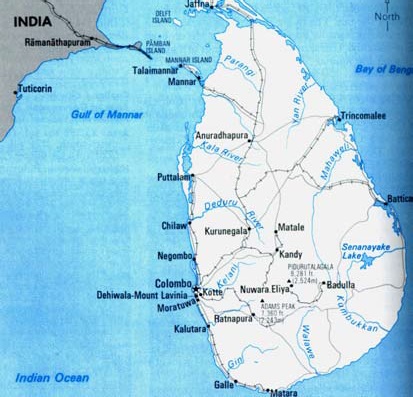
Map of Ceylon which became Sri Lanka in 1972. Glorious land steeped in religion.
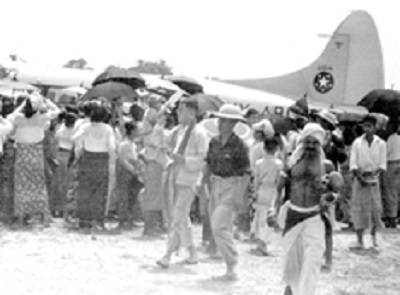
4 March 1950, Mergui Burma. Dove XY-ABQ swamped by devotees welcoming the relic.In early March 1950 a British cruiser left Ceylon carrying the Tooth and its guardians. The night before the 4 March the phone wakened me and I was told my trip on the morrow was to fly the relic to Mergui in lower Burma. The Company had placed its faith, its reputation, and the priceless relic in my hands.
The day dawned, and with my valuable cargo aboard I pointed my Dove at the azure sky. My radio officer Steve Monteiro advised Mingaladon radio that we were leaving the coast at 3,500 feet. Ahead stretched the usually restless Gulf of Martaban, which today it seemed in a benign mood. I held the Gulf of Martaban in some awe as strange things had happened there. Many pilots called it Burma’s Devil’s Triangle.
Then, and only then, did I realise the enormity of my responsibility. To lose such a relic would put the friendship of nations back a hundred years and a foreign non-believer could be blamed!
We landed at Mergui and even before the Dove’s propellers had stopped thousands of devotees swamped the plane. I mused that a spinning prop would behead a Buddhist with the same indifferent lack of discrimination as an Anglican.
Dalada Maligawa, Kandy: where the Sacred Tooth Relic is kept. (Photo: Sunday Times 16 August 1998).
Adam's Peak which Buddhist climb to worship the Buddah's footprint enshrined at its peak. (Photo: Time-World's Great Religions).Following my touch down the DC3s of Air Burma and Cathay Pacific Airways landed. These aircraft carried the backup personnel and a 20-man group of Kandyan Dancers and their Drummers. Each day for the past 2000 year, at 11:00 hours these performers and their forebears had performed a reverential and sacred ceremony.
Their dance ended with offerings of water and flowers. The dancers’ vitality and grace won the applause of the then great ballerina Anna Pavlova. She rated their dancing the most pure form in the world.
That evening I called on a Burman friend, and when I told him of my day’s work he showed great interest. He knew the history of Siddhartha Gautama, the Enlightened One, who trod our earth in the 6th Century BC. The relic was taken from his funeral pyre at Gaya in northern India, and in 483 BC, a Kalinga princess smuggled it from India secreted in her hair. Its custodians moved it around until its enshrinement in its final resting place - the Temple of the Tooth in Kandy. The area around Kandy is rich in religious belief. Not far to the south rises a 7360-foot (2243-metre) mountain - the mysterious Adam’s Peak that links many of our great faiths. We read that Adam and Eve were driven from the Garden, but where did they go? Did they make their second Eden on that mountain? Some believe they did! At its crest is a deep depression that resembles a giant footprint. Did the Lord Buddha step there? My Buddhist friends assure me that he did!
The Hindus venerate it as Shiva’s Peak, Christian’s link it to St. Thomas the Apostle. Why do countless white and yellow butterflies return to its slopes? Is it merely to die? How easy to ask questions – how hard to get worthwhile answers!
6 March 1950 Mergui Burma. Dove XY-ABQ waiting to take the Tooth Relic to Tavoy.
The Reclining Buddah in inaccessible country between Mergui and Tavoy.
I told my friend that I would see the relic on the 6th, but he smiled saying that was unlikely. He assured me that privilege was reserved for Sons of Kings and a few Buddhists with high connections. In my boorish manner I replied that not only would I hold the domed container but be photographed looking at the relic. He merely gave a sympathetic smile.
At the crack of dawn on the 6th I thrust take-off power to my Dove. I must have been a little brutal for the sudden screech woke up my splendid radio officer Hla Pe who gave me a look of reproach. We arrived at Mergui to a deserted airfield. A traffic man guided us to a position behind a wire enclosure and quickly closed the entrance. In a few minutes the crowd that had accompanied the relic to the airport surged against the fence. The police cleared a path for the relic and its guardians to approach the plane. They began to board the Dove. A traffic officer rushed to the plane to get the Chief Guardian to answer an urgent phone call. I approached the second in command guardian and asked to see the relic. He told me the Chief Guardian had told him to show me the relic but not until I asked. As he handed me the golden container he raised its dome. He gave a little snigger as he said that I must not be photographed looking at it. It seemed everybody knew of my plans!
The relic was of burnt ivory, further yellowed by age, about two inches long and an inch in diameter. It seemed more a tusk - the Gautama was not only massive in belief but in build. Yet, what did I really see? The Portuguese claimed they removed the relic when they occupied the country and any authoritative sources agree they did! If this is so did I merely see a counterfeit?
6 March 1950 Tavoy Burma. The devotees receive the Tooth.
R/O Hla Pe befriends a Kandyan dancer.Our flight to Tavoy had a ten-minute excursion when the Chief Guardian enforced the quid pro quo. We repeatedly circled a Reclining Buddha in an
inaccessible spot south of Tavoy. Our arrival at Tavoy proved a repeat of the Mergui fiasco. Again the spinning props behaved themselves avoiding the masses of humanity that pressed on every side.
With the passing days that great honour gradually slipped into the archival part of memory, but such wonders insidiously await recall. About 50 years later I was in Hong Kong to help close down the fabulous Kai Tak Airport.
A phone call, in answer to a fax, brought me to the Kowloon Cricket Club. There I met a splendid fellow named Roger Thiedeman, who is a valued contributor to several newspapers. He interviewed me and in the fullness of time this article appeared in the Sri Lanka Sunday Times.
When he submitted the feature it carried the title THE PIRATE AND THE TOOTH RELIC. His editor thought pirate was somewhat questionable for a religious story. Naturally, the editor won, but, was Roger the more perceptive?
Printed & Published by Wijeva Newspapers Ltd. 16 August 1998
H7.06
What Did the Buddha Look Like?
Bhante Dhammika of Australia
The Tipitaka provides a great deal of information about the Buddha, including about his physical appearance, perhaps more than for any other person from the ancient world. We know that Socrates was quite ugly, with a flat turned-up nose, bulging eyes and a large belly and that his friends joked about his appearance. But nothing has been recorded about the appearance of Lao Tzu or Confucius and in all the four Gospels there is not even a hint about what Jesus liked like. As far as the Buddha’s height was concerned, we are told that he was four finger-breadths taller than his handsome and younger half-brother Nanda, who could be mistaken for him from a distance.
Images of the Buddha whether statues of paintings have always shown him with hair but this is not historically accurate. According to the Buddha’s own comment, before his renunciation he had black hair, probably long, and a beard and after his renunciation, he cut off his hair and beard and ever after regularly shaved his scalp and face, as did other monks. He said of himself: “Dressed in my robe, homeless do I wander and with my head shaved” (Sanghativasi agiho carami nivuttakeso).
All sources agree that the Buddha was particularly good-looking. The brahman Sonadanda described him as “handsome, of fine appearance, pleasant to see, with a good complexion and a beautiful form and countenance.” To Dona he appeared “beautiful, inspiring confidence, calm, composed, with the dignity and presence of a perfectly tamed elephant.” These natural good looks were indicative of his deep inner calm, as another observer noted: “It is wonderful, truly marvelous how serene is the good Gotama’s presence, how clear and radiant his complexion. As a yellow jujube fruit in the autumn is clear and bright, or a palm fruit just plucked from its stalk is clear and bright, so too is the good Gotama’s complexion.”
The ancient Indian notion of a desirable and attractive complexion was that it was “not too dark and not too fair”, and as the Buddha was frequently praised for his fine complexion, presumably his skin tone was like that. He himself said that those who live in the present moment tend to have a beautiful complexion. Saccaka noticed that, during a debate, when the Buddha was verbally attacked, his features seemed to change: “It is wonderful, truly marvelous that when good Gotama is continually berated and subjected to rude, impolite language, his complexion becomes beautiful and his face bright, which is just as one would expect of a worthy one, one who is fully awakened.”
Enhancing the Buddha’s physical attractiveness was the way he spoke. One person who had attended several of his talks described the tone and timbre of his voice, as “clear and distinct, silvery and audible, orotund, sonorous, deep and resonant.”
The Buddha observed that old age brought with it “brokenness of teeth, greyness of hair, wrinkling of skin, decline of vigor and the failing of the sense faculties,” and there is no reason to doubt that he too exhibited some of these characteristics as he aged. Ananda said this of him towards the end of his life: “The Lord’s complexion is no longer pure and bright, his limbs are flabby and wrinkled, his body stooped, and his sense faculties have deteriorated.” In the months before his death, he said of himself: “I am now old, aged, worn out, having traversed life’s path, approaching the end of my life, being about eighty. Just as an old cart can only be kept going by being strapped together, so too, my body can only be kept going by being strapped together.”
Images of the Buddha from the earliest time onwards always show him with elongated and partly slit earlobes, and people sometimes ask what this means. Like depicting the Buddha with hair, this an iconographic convention although it may well have had its origins in an authentic memory of the Buddha’s physical features. Ancient Indian, males and females, commonly wore earplugs (kannalankara) of bone, ivory, clay or shell. Archaeologists have dug up some these objects and they have been found to be either disks or cylinders made of shell, clay, ivory or sometimes gold. Gotama undouble would have worn such earplugs. When he renounced the world to become a wandering ascetic he would have removed these ear plugs, causing the stretched earlobes to hang down.
06 03 2022 - The Island
H7.07
How the Buddha Spoke
Bhante Dhammika of Australia
Much has been written about what the Buddha taught which is only right given its clarity, consistency and the fact that 2500 years later millions still accept and live by its principles. However, beyond what the Buddha said, perhaps almost as important is how we said it, i.e. the aesthetic quality of and ethical components of the Buddha speech. How someone speaks – the tone, loudness and intonation of their voice – tells us much about what their thinking, their state of mind and their personality, and can convey something to the listener quite apart from what their words alone do. Words spoken in anger or with disapproval or sarcasm, can be received quite differently if said in a gentle or calm manner. The exclamation ‘No!’ can affect the person to who it is addressed completely differently if said sharply and emphatically or slowly and gently.
We are fortunate to have a few snippets of information about how the Buddha spoke, i.e. the tone and timbre of his voice. In one passage from the Tipitaka an individual who had attended one of the Buddha’s talks described his delivery as “clear and distinct, pleasant and audible, bindu, concise, deep and resonant.” The word bindu means ‘round’ and in this context it is difficult to know what is meant; perhaps something like ‘well-rounded’ as we might say in English, meaning developed in all ways. Whatever the case, the impression given by this description is of a voice that was pleasing to the ear, elegant and effective in delivered its message.
As for the ethical components of the Buddha’s speech we have two descriptions – one by an admirer and another by the Buddha himself. The brahman Sonadanda who had engaged in dialogues with the Buddha on several occasions, found his speech “welcoming, friendly, courteous, genial, uttana mukho and pubba bhasi. These last two qualities need a bit of explaining. Uttana mukho literally means ‘clear mouthed’ and may have meant articulate or clearly enunciated. Or it might have been a way of indicating that the Buddha said what he meant, that he was ‘a straight-talker.’ The term pubba bhasi is a little more difficult to understand. Pubba means ‘before’ so the term literally means something like ‘speaks before’ and may mean that the Buddha would initiate the conversation with someone who had come to meet him, or that he directed any conversation taking place, stopping it getting bogged down, or keeping it from straying from the subject at hand. The first four of Sondanda’s description of the Buddha’s way of speaking – welcoming and friendly, courteous and genial – definitely have an ethical dimension. All of them combined would let the person who had come to talk with the Buddha know that they were respected, and that he was open to them and wished to have a friendly encounter with them. These qualities could be seen as an expression of the Buddha’s general attitude of good-will and metta. Once someone asked the Buddha if he would ever say anything that would upset or annoy another and he replied that he could. He then added that if he ever did such a thing his words would always be truthful (bhuta), useful (atthasmhitam), said at the appropriate time (kalena) and motivated by compassion or empathy (anukampa). Being a teacher, a spiritual guide to this disciples, and someone whose understanding of reality differed from many others of the time, it is only natural that the Buddha would sometimes have to reprimand or even scold some of the monks and nuns under his tutorage. It also meant that those of other views would not necessarily like hearing ideas that differed from their own. Thus there are cases in the Tipitaka when people did not like hearing things the Buddha had to say even if he said them in a moderate and balanced manner. Clearly he was aware of this, and so when delivering reprimands, or speaking truths he knew would be unwelcome, he would assess whether or not his words would be likely to bring about positive change, he would judge the best time to say them, and he would say them in a moderate non-threatening manner. Interestingly, there are two incidents in the Tipitaka, and only two, where the Buddha held his tongue when asked a question. It would seem that in both cases he decided that the questioner would neither understand or appreciate any answer he might give and so he decided that to keep quiet was the best course.
It is right to say that the Buddha became the most respected and successful teacher of his time and that this was mainly due to the scope, consistency and logic of his philosophy. But it is equally true that how he presented his philosophy – how he communicated it, his speaking style, gave an added appeal to his Dhamma. The Tipitaka contains quite a few descriptions of the effect the Buddha’s speech had on his audience. On several occasions it is said that he “delighted, inspired and uplifted his audience” and another comment recorded in the Tipitaka says that when one of his talks was over the audience rose from their seats and left reluctantly, while keeping their gaze on him.
It seems that public discourse nowadays – whether at political meetings, in parliament, or on television talk programs – has declined badly. It has become more acceptable to shout, interrupt another speaker, wildly gesticulate, use words lased with sarcasm and insults, and resort to exaggerations bordering on lies. Sadly, I have even heard sermons by certain religious personalities delivered in a similar ugly manner. It is almost as if such speakers believe that the louder they shout the truer their claims are. Given the power of speech to motivate people for good or evil, to make them consider carefully or unthinkingly accept whatever they hear, to obscure the truth or illuminate it; it is no surprise that the Buddha included Right Speech (Samma Vaca) as one of the eight essential steps leading to human growth and freedom. But Right Speech is not just what we say but how we say it, and the Buddha have given us an excellent model of the best way to communicate with others.
08 08 2021 - The Island
H7.08
Roots and routes of Buddhist diplomacy
Madapatha Chintaka
Unlike Vesak, which is celebrated on different days at different times and with different festivities in different countries throughout Asia, Poson is specific to Sri Lanka and India. Briefly, it celebrates the coming of Buddhism to the island through an embassy or retinue of five monks, one samanera, and one layman, led by Mahinda Thera, the son of Asoka Maurya from his second wife, Vedisa-Devi. The Dipavamsa and the Mahavamsa are the main literary sources from this country that we have for the details of this embassy, while all other accounts are more or less variations of them.
According to the Chronicles, Tissa, the second son of Mutasiva, was out on a hunt with 40,000 of his courtiers during a water festival, when he caught sight of an elk-stag (or a deer) which he proceeded to give chase to. After signalling his presence to it, he pursued it to the top of Missaka Mountain, or Mihintale as it is known today, where Mahinda Thera preached the Dhamma to him after testing his intelligence. The choice of the discourse by Mahinda Thera – the Cula Hatthipadopama Sutta or the “Lesser Discourse on the Simile of the Elephant’s Footprint”– indicates that the aim of the embassy was to convince the king and the people of the country of the intrinsic purity of the Dhamma. After the conversion of the 40,000, the Chronicles tell us that, through intervention by Tissa (or Devanampiyatissa as he was later to be called), it was established in the island.
Anuradhapura origins
Buddhism was not unheard of or ignored in Sri Lanka before Mahinda Thera’s arrival. Adikaram puts it that even prior to the establishment of links between the Mauryan Empire and the Anuradhapura Kingdom, Buddhist temples existed side-by-side with Jain and Hindu temples, as well as yaksa and tree cults. Pandukabhaya, the de facto founder of the Anuradhapura Kingdom, built a temple for the Yakkha Cittaraja, whom Paranavitana identified as a water spirit, while also fixing a banyan tree near the Western Gate of the kingdom for Vaisravana, along with a Palmyra tee for Vyadha Deva.Patron deities and Jains, the latter including the Nigantas who were to lose patronage during the reign of Vattagamini-Abhaya, as well as Paribbajakas and Ajivikas, had several cults of their own, which if we are to believe the Dipavamsa survived even Gautama Buddha’s three visits to the island. Significantly in the first of those visits, the Sakyamuni, in contrast to his calm demeanour, inspires terror among the yaksas and banishes them; this reading of the visit may have been due to the need of the writers to uphold the primacy of Theravada Buddhism “by seeking authority in the past”, as Sirima Kiribamune put it.
King Devanampiyatissa came to the throne almost 20 years after Asoka Maurya had, yet the trajectory of the doctrine had a lot to do with the friendship between the two monarchs. The ascent of Buddhism in Sri Lanka, in fact, was coterminous with its decline after the death of arguably the single greatest patron of the religion in India. Popular historians attribute the decline to the lack of interest shown in it by Asoka’s successors, but as writers such as Romila Thapar have concluded, those successors didn’t hesitate to sponsor the renovation of temples and dagabas. The truth was that Asoka had, in his intense zeal for Buddhism, in which he found a philosophy which suited the needs of an empire that had reached its zenith, established the closest to a Buddhist State India came to; his decease in that sense signalled the end to such a polity, a polity that was to find its expression later in Sri Lanka.
The groundwork had been laid down by his predecessors. By the time of the Buddha’s passing away the Magadha region had turned into a monarchy, shedding away the janapadas and tribal republics from which the founder of the doctrine had emerged. Under the Haryankas (546-414), the Sisnugas (414-346), and the Nandas (344-322), the kingdom expanded to the territories of Kosala and Vrjis in the north, Kurupancala and Mathura in the west, Avanti, Haihaya, and Asmaka in the centre and the southwest, and Bengal and Kalinga in the east.
Sponsorship for Buddhism
Bimbisara, Ajasattru, Udayin, Munda, and Kalasoka lavishly patronised Buddhism, although other kings, while not privileging it, nevertheless did extend support to its propagation. Interestingly enough, neither Uttarapatha nor Sri Lanka, which Buddhist missionaries were to touch later, figured in as important regions (or polities) in the Magadha Period; Uttarapatha of course was the site of Taxila, the famous ancient university.The teachings of the Buddha flourished particularly in the Middle Ganges. Lack of patronage stunted its potential to expand further, however, and it was soon overshadowed by the rival orders of the Nigantas, Ajivikas, Aviruddhakas, Tendandikas, and other sects. The two Councils, one convened in the year of the Buddha’s decease in 486 BC at Rajagaha and the other 100 years later at Vaisali, tried to stamp out heterodox tendencies from the Order.
The fact that its founder had refused to name or designate a successor did not help reconcile these rival factions. In any case, right after the death of Kalasoka, under whom the capital was shifted from Rajagaha to Pataliputra, and who was arguably the last Magadhan king to publicly patronise Buddhism, a period of 22 years of rule by no fewer than 10 kings was followed by another 22 years of rule by nine kings of the House of Nanda, of which the last, Dhana-Nanda, was killed by Chandragupta Maurya with the help of Kautilya in 320 BC.
The fight was harsh, if not bloody: the Nandas were reported to have a powerful army of 20,000 infantrymen, 20,000 horsemen, 2,000 chariots drawn by four horses EACH, and 3,000 elephants. While they were in Pataliputra, moreover, Alexander the Great had conquered the northwest.
The shift to a new monarchical order, and the statecraft of Kautilya, did much to erode State support for Buddhism. In Kautilya and his Arthashastra the Mauryans had their equivalent of Machiavelli and The Prince. Both laid emphasis on two key imperatives: stability through an authoritarian State, and sustained intervention in all spheres of activity. Chandragupta’s defeat of the Nandas was the defeat of a kshatriya or upper caste clan of a lower caste one, according to mythical lore (the founder of the Nanda dynasty was the son of a Shudra peasant woman), so the emphasis on caste, sidelined if not abhorred by Buddhists, came to the fore during his reign.
The needs of empire were prioritised over the qualms of religious doctrines, and so with “an army of 600,000 men” (according to Plutarch) the founder of the new dynasty “overran and subdued the whole of India.” Chandragupta’s war with Seleucus I – which may have ended in defeat for the latter, but which, more probably, ended in the signing of a treaty of friendship between the two – confirmed the immense, awesome power of the Mauryans over the country and the continent. This is puzzling when you consider that the founder of that immense, awesome empire was eclipsed by his less ambitious grandson.Mauryan expansionism
Asoka’s achievement was his realisation of a Buddhist State against the backdrop of an empire which had reached its zenith. His conquest of Kalinga or Orissa, which had resisted Mauryan expansionism until then, led to the deaths of 100,000 and the deportation of 150,000 others. Popular accounts pin this as the starting point of Asoka’s conversion to Buddhism. The temporal conquest was followed by the spiritual: by 258 BC, two years after the end of the war, he had turned to the new doctrine.Both Chandragupta and his son Bindusara had resisted converting to Buddhism, the former spending his last years as a Jain hermit in the forest, succumbing to hunger brought on by a fast. So the effect of becoming a devout follower of the new doctrine, which emphasised a middle path that favoured neither self-indulgence nor self-denial, was symbolically to transform Chandasoka, or the Evil Asoka, who had reportedly prior to the Kalinga Campaign murdered his brothers and suppressed a revolt in Taxila, to Dharmasoka, who balanced the needs of that faith with a state policy that laid emphasis on peace at home and abroad. He privileged Buddhism, yet he didn’t do so by withdrawing support for other heterodox sects: as one of his Major Rock Edicts (No 12) put it, “one should honour the sect of another, for by doing so one increases the influence of one’s own.”
With that policy Asoka balanced the needs of the State and the needs of the faith while keeping the two distinct and at the same time entangling them in each other. While implementing the norms of the Dhamma in his empire, he was pragmatic enough to understand that there were religious mores and, paraphrasing the Biblical phrase, a law of Caesar that had to be rendered to.
He frequently had to intervene in the affairs of the Sasana, as when forest-dwellers were causing a schism, and raised the concept of ahimsa to the level of state policy by, inter alia, banning animal sacrifices and paring down the cooking of meat (though as we know from his own inscriptions, he allowed for the cooking of “a little venison and peacock meat”, which evidently were his favourites). He deemed sideshows and ceremonies as useless and unworthy, yet he did not object to displays of divine power as long as they created an interest, among village dwellers, in the Dhamma. Asoka was the foremost patron of Buddhism. He also was a pragmatist who had to juggle competing State interests.
Propaganda and propagation has a lot to do with the spread of a faith. So it was with Buddhism after the Third Council, where it was held that missions should be despatched to other parts of the region. Under Moggaliputta, who presided over the Council, these missions gained an evangelical character, though with Asoka’s patronage they became a spiritual expression of a temporal need.
Epigraphical evidence
One of them was even sent to the country of the Yonas, the Greeks, while others were sent to the Himalayas and to Suvarnabhumi, or Indonesia. Mahinda, with the theras Ittiya, Uttiya, Samba, and Bhaddasala, and the samanera Sumana, were selected for the mission to Sri Lanka. The Mahavamsa, as well as other narratives, tell us that after they visited the city of Mahinda’s mother, Vedisagiri or Vidisha, a layman called Bhanduka, a nephew of Mahinda, joined them. From there they miraculously floated through the air and alighted at Missaka or Mihintale, where they encounter Tissa.We have epigraphical evidence for this encounter. In 1935 22 inscriptions were discovered at a cave in Rajagala or Rassahela in Batticaloa. One of these was a record in ancient Brahmi script dating back to around 200 BC, commemorating the arrival of Mahinda’s entourage. The inscription read “Ye ima dipa patamaya idiya agatana Idika-tera-Mahida-teraha tube”, or “This is the stupa of the Elder Idika [Ittiya, one of the monks in the embassy] and the Elder Mahinda, who came to this island by its foremost good fortune.”
Paranavitana contends that the stupa alluded to in the inscription could have been built after Mahinda’s decease. More importantly, he interprets the word Idiya to mean, as it usually does, “prosperity” and “good fortune”, and suggests that by distorting this to “Iddhi”, the Pali word for supernatural power, later chroniclers could have taken it to mean that Mahinda and his embassy came to this island by miraculous means: by flight through air, for instance.
As Buddhism began its descent in Mauryan India, the patronage of Asoka soon gave way to a more lukewarm reception from his successors – his son Kunali, born to his third consort Padmavati, was as sainted as Mahinda, yet either was blinded by his fourth consort, Tisyaraksita, or, as Romila Thapar argues, metaphorically blinded himself by turning away from Buddhism – and later, by the time of a new dynasty, the Shungas, an attitude of indifference and dis-favouration.
Buddhism in India at this juncture survived thanks to two main factors: the sheer largeness of India which allowed for sects to develop and flourish even if they militated against the conventional doctrines, and the enmeshing of Buddhism in folk religion across more rural parts of the country. To these we can add another crucial factor: the spread of Buddhism to other parts of the continent, including Cambodia, Laos, Thailand, China, and Sri Lanka: which brings to light the importance and the relevance of Poson, not just to Sri Lanka, but also to the rest of the Buddhist world.
24 06 2021 - Daily News
H7.09
Kindness without borders
K.K.S. Perera
Samanamayam maharaja - Dhammarajassa savaka
Thaveva anukampaya - Dambudipa idhagata.We are hermits, O Great King, adherents of the Buddha. With apprehension towards you all, have come hither from India.
The Buddha: Dear Kassapa, please advise these bhikkhus and guide them from faltering in their code of conduct. You must please counsel them regularly, now. Preach them the Dhamma too. Or else, I myself will have to do so.
Maha Kassapa Thera: O Lord, these bhikkhus are now highly undisciplined. They are not amenable to correction. They often resort to their own ways. They do not show obedience or patience. They are not willing to abide by the advice given to them for their own welfare and progress; instead, they often misconstrue and misunderstand it.
The Buddha delivered a modified discourse to Kutadanta on morality, generosity and heaven, showing the risk, degradation of sense-desires, and the returns of renunciation. Knowing that Kutadanta’s mind was all set, flexible, free from the impediments, serene and calm, then he delivered a sermon in brief on four noble truths. Like removing all stains from a clean cloth and receives the dye flawlessly, so in Kutadanta, there arose the uncontaminated and immaculate Dhamma-eye and he realised: “anything that has an origin must come to an end.”
Sacred practice
Arahant Mahinda’s visit was followed six months later by his own sister, Sanghamitta Therini, who introduced Bhikkhuni Sasana to the island. She brought with her a Bo sapling, a branch of the Siri Maha Bodhi which was planted in the Sacred soil of the Mahamevuna Uyana, which continues to consecrate the nation. Sri Lankan culture developed into a Buddhist culture; which remained unharmed for over 18 centuries. All rulers of the island as a practice intervened in religious matters and their actions were based on Buddhist ethics. A king whose leisure was hunting became a vegetarian, followed by a large section of the population. The agricultural economy substituted the traditional meat industry.Let us resolve, on this significant occasion, to re-establish inter-ethnic and inter-religious harmony, which we have failed to achieve for over decades. An alcohol-free, anti-tobacco nation and free from animal slaughter for human consumption, while practicing the basics of the Buddha’s teachings. There remains a continual and universal belief that Buddhist societies are non-violent and harmonious.
The Buddha made an open invitation for women to participate in the Sasana by making them eligible to enter the Bhikkhuni Sangha – with ample prospects for public life had greatly improved the status of women. In Islamic and Hindu societies several books have been authored on the changing position of women, but strangely little in Buddhism—apart from IB Horner, Pali scholar who wrote the book titled Women under Primitive Buddhism in 1930. The Buddha’s teachings indisputably have the least biased advances against women. Their significance to society was acknowledged very much enhancing their reputation among men.
Compassion
It was through the realisation that the Buddha revived the true Dhamma!. That he felt disillusioned with this round of rebirth; that he completely understood other being’s suffering; that he himself crossed over the flood to Nibbana; that he became his own last and absolute helper. He gained majestic pride as a worthy Buddha; he remained separated from all being’s craving; his own mind was detached from all experiences.It was through compassion, that he educated it thoroughly to a large number of human beings. That he himself was courageous of all other beings; that he tolerated it long while learning to liberate others; that he embarked on to counter their immense sadness; that he brought other beings across this flood also...!
The Buddha told the first sixty Arahants:
“Go forth, O Bhikkhus, one in each direction, advocate the Dhamma, for the good of many, for the wellbeing and happiness of many, proclaim the holy unblemished life for the good of the world.”
Emperor Asoka sent ambassadors to Sri Lanka, Afganistan, Syria, Persia, Iran, Egypt, Greece, Italy, Turkey, Cambodia, Burma, Thailand and Vietnam to spread the message of Buddhism.
Flesh-Eating
All rulers of the island, as a custom, got involved in religious matters and their actions were based on Buddhist morals. A king whose leisure was hunting became a vegetarian, followed by a large section of the population. The agricultural economy substituted the traditional meat industry.There is a long passage in Lakavatara Sutta ruling out consumption of flesh, killed or dead. The Buddha predicted in the Sutta that later the monks will “hold bogus writing to be authentic Dhamma, and will devise their own suttas and claim that Buddha allowed eating carcasses of dead animals.” A passage shows Buddha speaks out against the consumption of meat, that it is undesirable and karmically disagreeable, and is unequivocally in favour of vegetarianism.
In Dhammapada, Danda Vagga verse 129 goes as following:
Sabbe tasanti dandassa - sabbe bhayanti maccuno
attanam upamam katva - na haneyya na ghataye.The meaning of Verse 129: All are afraid of the stick, all fear death. Putting oneself in another’s place, one should not beat or kill others.
Jivaka Sutta says that meat should not be shared under three situations: when it is seen or heard or suspected that animal has been slaughtered for the eater; when it is not seen or heard or suspected, in which meat can be eaten.
The meat prepared for eaters do not belong to the thricotika parisuddha category. It is a myth formed through erroneous interpretations by those insatiable flesh-eaters: if you eat you contribute to the offence; it’s killed for you!
Let me wrap up with an anecdote, which goes as the fisherfolk in the township invited the Village Headman and his wife for a meal at his residence.
Presenting two dishes of fish of two different varieties to the righteous man and mentioning the name of the assortment, he said: “Sir, this one I caught especially for you.”
The Headman, avaricious though, realizes the folly. If he eats, it becomes clear that it is not thricotica parisudda and as such the dignified man he, would be committing a sin. The witty man responded: “I say, you provide this to my wife, and let me have the one which you slaughtered especially for her.”
Are there loopholes in the Dhamma as exposed and preached by the Blessed One?
The Buddha preached the following:
You should know that all things in the world are impermanent; coming together inevitably means parting. Do not be troubled, for this is the nature of life. Diligently practising the right effort, you must seek liberation immediately. Within the light of wisdom, destroy the darkness of ignorance. Nothing is secure. Everything in this life is precarious. Always wholeheartedly seek the way of liberation. All things in the world, whether moving or non-moving, are characterized by disappearance and instability. Stop now! Do not speak! Time is passing. I am about to cross over. This is my final teaching.
24 06 2021 - Daily News
H7.10
Some reflections on the origins of Buddhism
Madapatha Uditha
UDAKDEV1@GMAIL.COM
By the 6th century BC the centre of Indian civilisation had, according to most accounts, shifted to the Ganges Valley. Social and economic conditions made possible the rise of several religions that posed as alternatives to the rigid orthodoxy of Brahmanism. By the end of the 5th century BC, however, the number of these sects had come down, and among those that survived were Jainism and Buddhism. There were other religious groups as well – the Ajivikas and the Gotamakas, the latter being the breakaway creed espoused by Siddhartha Gautama’s cousin, Devadatta – but the rise of a merchant class and a universal monarch, as later events clearly showed, brought about a religious paradigm shift which favoured an ideology that followed a middle path. Buddhism, wrote the eminent Indian historian Kosambi, thus became "the most important discovery of India for a great majority of Asian people." Yet by the end of the Mauryan Empire, this most important discovery had exited India to other neighbouring lands, including Cambodia, China, and Sri Lanka.
The Gangetic Basin became the centre of the second urbanisation of ancient India, following the Indus Valley phase from 3300 to 1800 BC. This second urbanisation accordingly took place in two stages, the first going back to the 6th to 5th century BC and the second to the last centuries of the first millennium BC. By the 7th century BC, before the rise of cities in the region, 16 small states had sprung up, bordering the Ganges Valley. Alexander Cunningham, founder of the Archaeological Survey of India, retraced the route taken by the Chinese pilgrims Fa-Hsien and Xuanzang to the sites of some of their cities, including Mathura, Ahicchatra, Sankisa, Kanauj, Kausambi, Ayodhya, Sravasti, Kusinagara, Varanasi, Vaisali, Pataliputra, Bodhgaya, Rajagaha, Nalanda, Champa, and Tamralipti. Within 150 years, these small "republics" or "janapadas" would be reduced to four, while within the next two centuries they would be consolidated into one empire, Magadha. Bimbisara and Ajasattu, its most illustrious rulers, were among the most influential patrons of the Buddha, who spent much of his life there; the language he used was, after all, Maghadi Prakrit.
The story of Buddhism and its rise is thus, at one level, the story of the economic and social changes rapidly unravelling throughout India. In the Mauryan Empire Indian civilisation had its first universal monarchy, while Buddhism would be adopted as a state religion many decades later under Asoka, the grandson of its founder. Jean Darian points out correctly that the ascent of Buddhism was tied to the rise of bureaucratic empires that was in turn based on two historical trends: the withering away of tribal republics and the formation of kingdoms, and the rise of a merchant class which was more conducive to the growth of empires than a priestly class/caste. Buddhism, therefore, did not emerge in a vacuum: there were conditions that stimulated its rise over not just those priestly sects but sects which, while sharing some of its key tenets, nevertheless emphasised a more ascetic and extreme lifestyle. Siddhartha Gautama’s first two teachers Alara Kalama and Uddaka Ramaputta were, in fact, followers of these extreme, rigidly ascetic creeds.
How did urbanisation come about, and what influence did it exert on Buddhism, a religion which in Sri Lanka found its truest expression, as anthropologists, historians, and eminent writers like Martin Wickramasinghe and Gunadasa Amarasekara have observed, in the village? The transition from the Indus Valley to the Ganges was accompanied, if not driven, by the emergence of a Vedic culture in the latter. This culture was the product of a semi-nomadic people who called themselves "Arya", which European orientalists and philologists of the 18th and 19th centuries, including William Jones and Max Muller, linked to the civilisations of Europe. We know a lot from literary sources and at the same time so little from actual inscriptions about the nature and the character of these people. The little we do know is that, in their hands, the Ganges Valley, which Brahmanical and Buddhist texts referred to as the "Majjhimadesaya" or the Middle Kingdom, transformed from a flourishing, fertile agricultural enclave to a highly developing civilisation. As a rural outpost, the valley was the site of a stratified society, divided into castes and occupational groups; its transformation into a highly urban civilisation was thus marked by breakdowns in the traditional rural order.
Buddhists texts themselves attest to the commercialisation of life in around the 5th century BC. The Jataka stories tell us of a "flourishing urban society" in North India. This spurt of commercialisation centred on, and revolved around, Rajagaha, the capital of Magadha. A steady rise in the number of people in urban settlements there meant the rise of an urban consciousness, and of the formation of towns, markets, and trade guilds, including those of woodworkers, ironworkers, leatherworkers, and painters. The Magadha period moreover saw developments in mercantile practices and skills, in the trade and transport of items such as silk, jewellery, and armour, and of a special ceramic called the Northern Black Polish Ware; the latter would make its first appearance in 500 BC and spread rapidly beyond the Ganges valley. Kosambi puts all this against the ascent of Buddhism: "The 1,500 years of the full cycle of the rise, spread, and decline of Buddhism saw India change over from semi-pastoral tribal life to the first absolute monarchies and then to feudalism."
Under these absolute monarchies, the faintest outline of a market economy emerged for the first time in India. The rule of these monarchs was linked inextricably, though not without its share of antagonisms and conflicts, to the rise of a merchant class, among which were the famed sresthi, the financiers. The immediate result of this was the undercutting of the caste system. No longer tied to the land like their ancestors, the merchants forwent on their earlier allegiance to the rigid religious texts of the Vedas. Indeed, injunctions against and condemnations of city life run through many of the traditional religious texts from this period: cities are described as places "where the Vedas are not recited", and householders who are completing their studies are warned against "spending too much time in the city", since urban-dwellers "cannot attain salvation, despite their austerities." The rulers, on the other hand, found in merchants a ready means of accumulating capital for large public works, which Marx and Engels noted as the distinguishing mark of Indian (and Asiatic) pre-capitalist civilisation. Capital needed to be freed from control by traditional status groups or the upper castes. At the same time, they required a polity, and a religious doctrine, which would discourage too much accumulation of wealth, especially "in the hands of potentially rival groups."
Buddhism was one among many doctrines that witnessed this spate of urbanisation, but it was also arguably the most adaptable. The religious revolutions of the Gangetic Basin can be traced to the teachings of Ajita Kesakambali, a materialist philosopher who, in stark contrast to the Brahmins and the Vedas, believed that the body turned to dust and nothing else upon death. This evolved into still other creeds and sects, of which the Samkhyians were among the first to propound that the soul was distinguishable from the physical body, whose decomposition the former survived. Alara Kalama was a follower of this creed. The Jains under Mahaviraswami adhered to a rigid ideology which forbade drinking "without straining or filtering" and in-breathing, since they could kill life-forms in water and in the air. Uddaka Ramaputta is considered to have been a Jain. The achievement of Buddhism was its avoidance of both materialism and asceticism. The Middle Way, the "Majjhimapatipadawa", thus suited a civilisation rooted in trade practices liberated from caste constraints on the one hand, and a clergy and a lay following which believed in staying away from accumulating too much wealth on the other. That was, arguably, its single greatest innovation.
Newton Gunasinghe noted in the transformation of Buddhism from an urban theology in India to a rural folk religion in Sri Lanka an ideological paradigm shift which suited the dominant social patterns of each country. Thus, from the emperor and urban-dweller Buddhism came to be patronised, in Sri Lanka, by the king, landlord, and peasant. By the turn of the 19th century, when urbanisation made inroads to the country via changes in the economic landscape forced on locals by colonial officials, Buddhism faced its second major revival: the Theosophist Protestant Buddhist revival. Nevertheless, despite its urban trappings, the movement remained bonded to the wellsprings of Buddhism in the village. As in the Ganges Valley and the Middle Kingdom of India, then, the teachings of the Buddha adapted to their new environment, and with that to entirely new patterns of life.16 05 2020 - The Island
H7.11
Archaeologists Unearth China’s Earliest Bronze Buddha Statues
Raymond Lam
Archaeologists have discovered two of China’s oldest gold-plated, bronze sculptures of Buddhas to date in northwestern Shaanxi Province. Xinhua reported that the antiquities were excavated in Chengren Village, in modern Xianyang City.
Researchers with the Shaanxi Academy of Archaeology believe that the statues date back to the Eastern Han Dynasty (202 BCE–220 CE), and were found in a clan cemetery with six tombs.
These sculptures date back two centuries earlier than previous discoveries of Buddhist sculptures, and experts once thought that they had not appeared until the era of the Sixteen Kingdoms (304–439 CE).
One of the statues is made in the apparent mould of Shakyamuni Buddha, while the other is of five Buddhas.
According to CGTN, the total height of the Shakyamuni statue is 10.5 centimetres, the diameter of the base it sits on is 4.7 centimetres, and the total height of the Five Buddhas is 15.8 centimetres and the width is 6.4 centimetres.
Strikingly, they seem to have been made locally by Chinese artisans in the Gandharan style. Gandhara was a Central Asian region that pioneered one of the earliest styles of Buddhist art under the rule of the Indo-Greeks, Indo-Scythians, Indo-Parthians, and Kushans. According to CGTN, this conclusion of their provenance was based on, “preliminary results of the modelling characteristics, manufacturing process analysis and metal composition detection of the Buddhas.” This means that the statues, already priceless in their heritage, hold critical research value for the introduction and Sinicisation of Buddhist culture.
“The findings show that Buddhism spread to China from South Asia via the ancient Silk Road during the boom time, of this cultural exchange route—that is, the Han Dynasty,” a representative for the Shaanxi Academy of Archaeology told Deutsche Welle.
From June 2020 to November 2021, the Shaanxi Academy of Archaeology has excavated 3,648 tombs and 16,000 sets of artefacts in Xianyang. Its teams are working on the Hongduyuan cemetery site, which is to the north of Xi’an, once known as Chang’an, the capital of the Tang Dynasty (618–907).
The tombs and artefacts discovered at Hongduyuan span a history of 2,200 years, from the Warring States period (475 BC–221 BC) to the Qing Dynasty (1644–1911).
Hongduyuan’s large number of tombs, the high quality of the items found at the site, and the extensive duration of these items’ dynastic provenances are unprecedented in the country. Li Ming, a researcher with the Shaanxi Academy of Archaeology, said: “The owner of the graveyard was possibly a county official or landlord, who had certain family influence and economic might,” Xinhua reported.
According to CGTN, most of those buried in the tombs are found to be royal relatives, senior officials and dignitaries, all recorded in historical books. It is highly likely that these sculptures were part of the owner’s funerary and religious paraphernalia, indicating that he was aware of the Buddhist religion and perhaps its teachings.
The Buddha images formed part of a lay devotee’s collection that, along with his large family tomb, boasted to posterity his wealth and status, fine taste, and spiritual piety.
The excavation continues.
(Buddhist Door)18 12 2021 - Daily News
H7.12
Kuragala - A Sacred Buddhist site with a resplendent history
Lahiru Fernando and Dilshan Tharaka
The ceremony to enshrine Sacred Relics in the ‘Asadisi Shakya Sugatha Maha Seya’ (The Stupa) being built at the Kuragala Sacred Site under the ‘Revival of Kuragala’ programme will be held from January 16 -18.
The 130-feet high ‘Asadisi Shakya Sugatha Maha Seya’ is considered to be the largest such Stupa in the Sabaragamuwa Province which is visible from six districts in four provinces due to its location.
Most Venerable Mahanayake and Anunayake Theras of the Malwathu and Asgiriya Chapters and Ramanna and Amarapura Sectors, Sri Lanka Army Commander General Shavendra Silva, Sri Lanka Army and Civil Security Department personnel who contributed to the constructions and the devotees who dedicated their labour and funds for the Stupa project will participate on this occasion.
Ven. Wathurukumbure Dhammarathana Thera
Parallel to the enshrinement ceremony, a series of religious programmes including an overnight Pirith chanting ceremony and an overnight Bana sermon will be held during this three-day programme.
Associated Newspapers of Ceylon (Lake House) is the print media sponsor of this religious event.
Kuragala is a prehistoric archaeological site with ruins of an ancient Buddhist cave temple complex dating back to the Second Century BC, in Balangoda. The temple complex is located on the Balangoda–Kalthota road approximately 24 Kilometres away from the Balangoda town. The Kuragala Sacred Area is located at the centre of the Kuragala Rock which rises upwards from the Kaltota valley. The Kuragala Ancient Buddhist Monastery is located in the Kuragala Grama Niladhari Division which now belongs to the Kaltota Divisional Secretariat in Balangoda, Ratnapura District of the Sabaragamuwa Province.
This Sacred Site was forcibly occupied by religious extremist groups for the past 50-year period since 1971. Continuous attempts and struggles made under several governments to take it over from them failed due to various reasons during these five decades.
The ‘Revival of Kuragala’ programme is the result of this five-decade-long continuous attempt which finally gave the Buddhist community of this country the entire ownership and the ability to develop it in accordance with the Buddhist culture.
Ven. Wathurukumbure Dhammarathana Thera, who is also known as the Nelligala Hamuduruwo has taken the lead in developing this Sacred Site since March 2021.
A total of 40 constructions including the ‘Asadisi Shakya Sugatha Maha Seya’, a Sermon Hall, which can accommodate nearly 3,000 devotees at a time for Sil campaigns, a monastery, a Sacred Relics House, a Bodhi Pavilion, a huge Buddha statue, a statue of God Saman which is similar to the statue at Nelligala Temple, a staircase of 500-feet high and a lion statue to pay tribute to all those who saved the Kuragala Sacred Area from pagans from 1971 to 2021 and returned it to the Buddhist community and also a reservoir called ‘Kuragala Wewa’ will be constructed in this 100-acre Sacred Area under the programme.
All these constructions are being completed within a period of 13 months from March 2021 to May 2022.
The State Vesak Festival 2022 will also be held at the Kuragala Sacred Site in May following the completion of these projects.
The ‘Revival of Kuragala’ programme is the largest project being implemented to build a Buddhist temple complex in Sri Lanka in the past 1,200 years, Ven. Dhammarathana Thera said.
Among the many historical sites located in the Sabaragamuwa Province, the Kuragala Sacred Area has a special place. This Sacred place which is thousands of years old displays the pride of the Sri Lankans of yore through the magnificent facades dating back to the pre-Buddha era. It was known in ancient times as the ‘Mahathittaka Wel Yaya’ (Mahathittaka Line of Paddy Fields).
The Kuragala Sacred Area is located at an elevation of 515 metres above sea level and is the first mountain to be encountered when coming from the Hambantota area. Known as the ‘Hituwangala Rock’ in ancient times, this great rock was no doubt a vantage point for sailors to identify Serendib back then.
The historical and Buddha Sasana connection of this place can be clearly understood from the inscriptions belonging to the Second Century BC. There are inscriptions in the pre-Brahmin script and there is a pool of drip-lined caves dating back to the time when the great Arahats lived there.
These historical facts attest to the existence of the Sangha in the forest at that time. It is not difficult to understand that it was a place where the great Arahats lived in the caves, as the inscriptions show. In ancient times this temple complex was also known as ‘Dathahasapudahalena’.
The Kuragala Sacred Area is a place of great importance in both religious and archaeological terms. The reason is that a recent excavation at this site revealed the fossilised remains of a human at a depth of about 16 feet. According to archaeological evidence, the Kuragala area had been used by humans in the prehistoric period. From the excavations, archaeologists found stone tools, fossilised bone fragments and remains of a human skeleton which is believed to be aged more than 16,000 years. Investigations further revealed that the humans who lived in Kuragala may have had close links with the coastal areas as excavators found remnants of seashells.
This Sacred place with such a Buddhist Sasana history was later taken over by pagans. Then in 1971, Ven. Wataddara Gnanissara Thera started the struggle to liberate Kuragala and give it back to Buddhists. After Ven. Wataddara Gnanissara Thera, this Sacred Area was handed over to Ven. Deltota Dhammajothi Thera to rebuild it. Both made a positive effort and handed over this Sacred place to the present Chief Incumbent of Kuragala Ancient Buddhist Monastery, Ven. Wimalakirthi Dhammaratana Wataddara Sri Gnanissarabhidhana Nayake Thera on February 4, 2021.
14 01 2022 - Daily News
H7.13
Arrival of the Treasured Tree
That the Bo tree sapling was brought to Sri Lanka from India by Arahant nun Sanghamitta is common knowledge.
Jaya Sri Maha Bodhi, as famously known, is a sacred fig tree in Anuradhapura said to be a sapling from the historical Bodhi tree under which the Buddha achieved enlightenment. The sapling belongs to the southern branch of the original Bodhi tree in Bodh Gaya. Planted in 288 BC, the Bo tree is the most ancient human-planted tree with a traceable date. King Devanampiyatissa planted the sapling in Mahameghavana Park, Anuradhapura, in 249 BC.
The bo tree is planted on 6.5m (21.3ft) high terrace on the ground and is surrounded by railings. Much revered by the Buddhists both Sri Lankan and across the globe, the tree was surrounded by a wall built during King Kirthi Sri Rajasinghe’s period. It was a barrier for wild elephants.
Sanghamitta links two important personalities: Emperor Asoka being her father and Arahant Mahinda being her brother. Emperor Ashoka was hesitant a little at first to send his daughter on this overseas mission, yet finally gave in as the intention was bona fide. Arahant Sanghamitta was accompanied by a number of Buddhist nuns as a result of Sinhala royal ladies requested Buddhist nun order be set up in Sri Lanka.
The arahant died at 59. The celebrations had lasted for a whole week.
Mahawamsa account
When the lord of chariots had appointed to watch over the Bodhi-tree eighteen persons from royal families and eight from families of ministers, and moreover eight persons from brahman families and eight from families of traders and persons from the cowherds likewise, and from the hyena and sparrowhawk-clans, (from each one man), and also from the weavers and potters and from all the handicrafts, from the nagas and the yakkhas; when then the most exalted prince had given them eight vessels of gold and eight of silver, and had brought the great Bodhi-tree to a ship on the Ganges, and likewise the theri Samghamitta with eleven bhikkhunis, and when he had caused those among whom Arittha was first to embark on that same ship, he fared forth from the city, and passing over the Viñjhä-mountains the prince arrived, in just one week, at Tamalitti.The gods also and the nagas and men who were worshipping the great Bodhi-tree with the most splendid offerings, arrived in just one week. The ruler of the earth, who had caused the great Bodhi-tree to be placed on the shore of the great ocean, worshipped it once more by (bestowing upon it) the great kingship.
When the wish-fulfiller had consecrated the great Bodhi tree as a great monarch, he then, on the first day of the bright half of the month Maggasira, commanded that the same noble persons, eight of each (of the families) appointed at the foot of the great säla-tree to escort the great Bodhi-tree, should raise up the great Bodhi tree; and, descending there into the water till it reached his neck, he caused it to be set down in seemly wise on the ship. When he had brought the great theri with the (other) theris on to the ship he spoke these words to the chief minister Maharittha: ‘Three times have I worshipped the great Bodhi-tree by (bestowing) kingship (upon it). Even so shall the king my friend also worship it by (bestowing) kingship (upon it).’
When the great king had spoken thus he stood with folded hands on the shore, and as he gazed after the vanishing great Bodhi-tree he shed tears. ‘Sending forth a net like rays of sunshine the great Bodhi-tree of the (Buddha) gifted with the ten powers departs, alas! from hence!’
Filled with sorrow at parting from the great Bodhi-tree Dhammasoka returned weeping and lamenting to his capital.
The ship, laden with the great Bodhi-tree, fared forth into the sea. A yojana around the waves of the great ocean were stilled. Lotus-flowers of the five colours blossomed all around and manifold instruments of music resounded in the air.
By many devatas many offerings were provided, and the nagas practised their magic to win the great Bodhi-tree. The great theri Samghamitta, who had reached the last goal of supernormal powers, taking the form of a griffin terrified the great snakes. Terrified, the great snakes betook them to the great theri with entreaties, and when they had escorted the great Bodhi-tree from thence to the realm of the serpents and had worshipped it for a week by (bestowing on it) the kingship of the nagas and by manifold offerings they brought it again and set it upon the ship. And on that same day the great Bodhi-tree arrived here at Jambukola.
King Devanampiyatissa, thoughtful for the welfare of the world, having heard before from the samanera Sumana of its arrival, did, from the first day of the month Maggasira onwards, being always full of zeal, cause the whole of the highroad from the north gate even to Jambukola to be made ready, awaiting the arrival of the great Bodhi-tree, and abiding on the sea-shore, in the place where the Samuddapannasälä (afterwards) was, he, by the wondrous power of the theri, saw the great Bodhi-tree coming.
The hall that was built upon that spot to make known this miracle was known here by the name Samuddapannasala.
By the power of the great thera and together with the (other) theras the king came, with his retinue, on that same day to Jambukola.
Then, uttering an exulting cry moved by joyous agitation at the coming of the great Bodhi-tree, he, the splendid (king), descended even neck-deep into the water; and when together with sixteen persons (of noble families) he had taken the great Bodhi-tree upon his head, had lifted it down upon the shore and caused it to be set in a beautiful pavilion, the king of Lanka worshipped it by (bestowing on it) the kingship of Lanka. When he had then entrusted his own government to the sixteen persons and he himself had taken the duties of a doorkeeper, the lord of men forthwith commanded solemn ceremonies of many kinds to be carried out for three days.
On the tenth day he placed the great Bodhi-tree upon a beautiful car and he, the king of men, accompanying this, the king of trees, he who had knowledge of the (right) places caused it to be placed on the spot where the Eastern Monastery (afterwards) was and commanded a morning meal for the people together with the brotherhood. Here the great thera Mahinda related fully to the king the subduing of the nägas which had been achieved by the (Buddha) gifted with the ten powers.
When the monarch heard this from the thera he caused monuments to be raised here and there in such places as had been frequented by the Master by resting there or in other ways. And, moreover, when he had caused the great Bodhi-tree to be set down at the entrance to the village of the brahman Tivakka and in this and that place besides, he, (escorting it) on the road, sprinkled with white sand, bestrewn with various flowers, and adorned with planted pennons and festoons of blossoms, bringing thereto offerings unweariedly, day and night, brought the great Bodhi-tree on the fourteenth day to the neighbourhood of the city of Anurädhapura, and after, at the time when the shadows increase, he had entered the city worthily adorned by the north gate amid offerings, and (when he then), leaving the city again by the south gate, had entered the Mahämeghavanäräma consecrated by four Buddhas, and here had brought (the tree) to the spot worthily prepared by Sumana’s command, to the lovely place where the former Bodhi-trees had stood, he, with those sixteen noble persons, who were wearing royal ornaments, lifted down the great Bodhi-tree and loosed his hold to set it down.
Hardly had he let it leave his hands but it rose up eighty cubits into the air, and floating thus it sent forth glorious rays of six colours. Spreading over the island, reaching to the Brahma-world, these lovely rays lasted till sunset. Ten thousand persons, who were filled with faith by reason of this miracle, gaining the spiritual insight and attaining to arahantship, received here the pabbajja.
When the great Bodhi-tree at sunset was come down from (its place in the air) it stood firm on the earth under the constellation Rohini. Then did the earth quake. The roots growing over the brim of the vase struck down into the earth, closing in the vase. When the great Bodhi-tree had taken its place all the people who had come together from (the country) round, worshipped it with offerings of perfumes, flowers and so forth. A tremendous cloud poured forth rain, and cool and dense mists from the snow-region surrounded the great Bodhi-tree on every side. Seven days did the great Bodhi-tree abide there, awaking faith among the people invisible in the region of the snow. At the end of the week all the clouds vanished and the great Bodhi-tree became visible and the rays of six colours.
The great thera Mahinda and the bhikkhuni Samghamitta went thither with their following and the king also with his following. The nobles of Kajaragama and the nobles of Candanagama and the Brabman Tivakka and the people too who dwelt in the island came thither also by the power of the gods, (with minds) eagerly set upon a festival of the great Bodhi-tree. Amid this great assembly, plunged into amazement by this miracle, there grew out of the east branch, even as they gazed, a faultless fruit.
This having fallen off the thera took it up and gave it to the king to plant. In a golden vase filled with earth mingled with perfumes, placed on the spot where the Mahääsana (afterwards) was, the ruler planted it. And while they all yet gazed, there grew, springing from it, eight shoots; and they stood there, young Bodhi-trees four cubits high.
When the king saw the young Bodhi-trees he, with senses all amazed, worshipped them by the gift of a white parasol and bestowed royal consecration on them.
Of the eight Bodhi-saplings one was planted at the landing place Jambukola on the spot where the great Bodhi-tree had stood, after leaving the ship, one in the village of the Brahman Tivakka, one moreover in the Thüpäräma, one in the Issarasamanäräma, one in the Court of the First thüpa, one in the äräma of the Cetiya-mountain, one in Kajaragäma and one in Candanagäma. But the other thirty-two Bodhi-saplings which sprang from four (later) fruits (were planted) in a circle, at a distance of a yojana, here and there in the vihäras.
When thus, for the salvation of the people dwelling in the island, by the majesty of the Sammäsambuddha, the king of trees, the great Bodhi-tree was planted, Anulä with her following having received the pabbajjä from the therï Samghamittä, attained to arahantship. The prince Arittha also, with a retinue of five hundred men, having received the pabbajjä from the thera, attained to arahantship. The eight (persons from the) merchant-guilds who had brought the great Bodhi-tree hither were named therefrom the ‘Guild of the Bodhi-bearers’.
In the nunnery, which is known as the Upäsikävihära the great theri Samghamitta dwelt with her company (of nuns). She caused twelve buildings to be erected there, of which three buildings were important before others; in one of these great buildings she caused the mast of the ship that had come with the great Bodhi-tree to be set up, in one the rudder, and in one the helm, from these they were named. Also when other sects arose these twelve buildings were always used by the Hatthälhaka-bhikkhunis.
The king’s state-elephant that was used to wander about at will liked to stay on one side of the city in a cool grotto, on the border of a Kadamba-flower-thicket, when he went to feed. Since they knew that this place was pleasing to the elephant they put up a post in the same spot. One day the elephant would not take the fodder (offered to him) and the king questioned the thera who had converted the island as to the reason. ‘The elephant would fain have a thupa built in the Kadamba flower thicket,’ the great thera told the great king. Swiftly did the king, who was ever intent on the welfare of his people, build a thupa, with a relic, in that very place and a house for the thupa.
The great theri Samghamitta, who longed for a quiet dwelling-place, because of the too great crowding of the vihara where she dwelt, she who was mindful for the progress of the doctrine and the good of the bhikkhunis, the wise one who desired another abode for the bhikkhunis went (once) to the fair cetiya-house, pleasant by its remoteness, and there she the skilled (in choice) of dwelling-places, the blameless, stayed the day through.
When the king came to the convent for bhikkhunis to salute the theri, he, hearing that she had gone thither, went also and when he had greeted her there and talked with her and had heard the wish that was the cause of her going thither, then did he, who was skilled in (perceiving) the desires (of others), the wise, the great monarch Devänampiya-tissa, order to be erected a pleasing convent for the bhikkhunis round about the thüpa-house. Since the convent for the bhikkhunis was built near to the elephant-post therefore was it known by the name Hatthälhaka-vihära.
The well-beloved, the great theri Samghamitta of lofty wisdom now took up her abode in this pleasing convent for bhikkhunis.
Bringing about in such wise the good of the dwellers in Lañkä, the progress of the doctrine, the king of trees, the great Bodhi-tree, lasted long time on the island of Lanka, in the pleasant Mahamegha-grove, endowed with many wondrous powers. Here ends the nineteenth chapter, called ‘The Coming of the Bodhi-tree’, in the Mahavamsa, compiled for the serene joy and emotion of the pious. -SM
18 12 2021 - Daily News
H7.14
The Sanghamitta Day
K.K.S. Perera
Unduvap, the last Full moon for the year, in the month where Jesus Christ was born, is obviously the time to reflect upon giving up hatred speech and destructive judgment on other faiths that are contrary to Buddhist, Christian and other teachings. Proper practice of religious principles would definitely help in commencing the diluting of the differences between our approach and those of others; while compassion being cultivated for every living being.
The daughter of Emperor Dharmasoka, Sangamitta theri, bringing with her a sapling of Jaya Sri Maha Bodhi, arrived in the island accompanied by arahat Bhikkhunis, King Dharmasoka’s ministers, Brahmins, and Kshatriya family members. The contingent landed in Dambakolapatuna in Jaffna on an Unduvap fullmoon day during the reign of King Devanampiyatissa.
The sixteen year-old charming Princess Sanghamitta, married Prince Aggribrahama. They were blessed with a son named Sumana. Emperor Asoka’s brother Prince Tissa became a monk and entered the Buddhist order, followed by Aggribrahama and his seven year-old son Sumana. Her brother, uncle, husband and son entering the order left Sanghamitta with no options but enter bikkhuni order under two elderly nuns, namely Ayupali and Dhammapali and attain arantship following the footsteps her brother Mahinda thera. Theri Sanghamitta, was partly responsible in making this island the "Dhammaddveepa" along with her brother Mahinda thera. She passed away at the age of 61, during the rule of King Uttiya. A proud civilization changed the society— Buddhist culture, literature, arts, economy, and crafts developed on Buddhist thoughts.
King Devanampiyaissa was considerate of the necessity to establish the Order of Nuns [Mehenisasna –] in his kingdom. Princess Anula, the wife of king’s viceroy who had already attained Sowan , the first stage or path to Nirvana together with many others were anxious to enter the Order of Nuns. Hence Mahinda Maha Thera requested his father, the emperor Dharmasoka to send Arahant Sanghamitta with a sapling of Sri Maha Bodhi in Buddhagaya. the fact that Sangamitta Theri’s, samanera son was already in Sri Lanka with uncle Mahinda thero, prompted Sangamitta to demand her father, King Asoka: she said “Father, the order of my brother is important and the ladies who are to be ordained in Lankadveepa are many, it is absolutely essential that I visit them”.
The Bo sapling which was in a golden casket was planted with a magnificent ceremony in the Maha Megha Garden where it lasts for over 23 centuries [perhaps the oldest known tree in the world] receiving the adoration of millions of devotees. Arahat Sangamitta theri passed away at the age of 79, while residing in Anuradhapura. Her last rites were performed in close proximity to Jaya Sri Maha Bodhi by King Utthiya.These great occurrences, exchange of contributions of dhamma were possible as a result of Consensual governing structures, healthy foreign relations that existed during monastic rule in the earliest times in the sub-continent.
Discrimination of Women
The Buddha always treated women with kindness and civility and made no distinction on gender in all matters. Women from all walks of life received the blessings in joining the order. Sangamitta theri worked with untiring devotion and fearlessly for the rational, moral, and pious upliftment of the womenfolk. Bhikkhuni order that was established by Sangamitta lasted for over a 10 centuries before it was destroyed during Chola invasion. It was revived on December 8th 1996 at the Mulagandhakuti premises, in Uttar Predesh, India where seven Dasa Sil Mathas from Sri Lanka were ordained as bikkunis. In ancient India, like in many parts of the world, women were treated as being inferior to men; they were measured on the same level as the so-called lowest of the four castes. Their liberty in male dominated societies was extremely restricted under the view that they had to be under the guard of their husbands. The main role of women was considered to be that of housewives, attending to house chores, looking after the children as per the wishes of their husbands.
Buddhism totally disagrees that women as being inferior to men: it consider men and women to be equally useful to the society. The Buddha in many instances have emphasised the productive role the women can occupy and should play. Buddhism persuades both husbands and wives to share equal liability and discharge their obligations with equal commitment. The wife is a companion, a friend, and equal in partnership— wife was expected to acquaint herself with the assets owned by the family, so that she could administer such affairs in husband’s absence. In a Buddhist culture the wife occupied an equal place with the husband.
The liberal approach towards women that exists and has sustained from the distant past in Sri Lanka is due to Buddhist authority. The place of women in many Theravada countries like Myanmar and Thailand has been as favourable as here in Sri Lanka. In ancient India, a widow was not allowed to remarry, but had to commit suicide [sathi puuja] by leaping into dead husband’s funeral pyre. In some primitive African territories, India, and in America wives were treated as the private property of their husbands. Religious freedom was restricted , and they did not have educational choices. So much so the birth of a female baby was considered a bad luck, it happened that when King Pasenadi of Kosala who being informed that his queen had given birth to a daughter, the king came to the Buddha and lamented. The Buddha had to pacify him saying, ‘A female child, O Lord of men, may prove even a better offspring than a male.' –Samyutta Nikaya
Buddha encouraged women to demonstrate themselves and to confirm that they too had the ability like men to attain the highest position in the spiritual way of life by attaining Arahanthood.
Many religious institutions today claim that they give equal rights to women, though, it seems that they are discriminated in various fields, they have no property rights and usually undergo violence in many subtle forms. Even in the so-called advanced societies in the western world, women seeking the right to vote through organized protest had to struggle very hard for their rights. Buddha recognised their capabilities and capacities, and gave them responsible places in the Bhikkhuni Sangha. The Buddhist literature are full of eminent Bhikkhunis, who had been scholarly, like in Khema, Dhammadinna and Uppalavanna to mention a few who excelled in sermonising the Dhamma. Theri-gatha contains so many stanzas that undoubtedly articulate the feelings of happiness experienced by pious bhikkhunis at their skill to realize the Truth. The Buddha himself was born as a woman on many of his previous births in Samsara and even as a woman he developed the noble character and insights in his path gaining enlightenment. Buddhism fashioned a ‘conflict’ against Brahmin doctrine rejecting discrimination in any form. Gender difference has no place in Dhamma, which emphasizes the spiritual equality both male and women.
18 12 2021 - Daily News
H7.15
Significance of Ill Poya: Arahant Sariputta’s last debt
Arahant Sariputta is a famous name in Buddhist literature among a few others: Moggallana, his colleague and Ananda, the Buddha’s chief assistant. Sariputta’s story starts in a village of brahmins, being born to Sari in Upatissa village. The brahmin priests named him after his hometown Upatissa.
Although Sariputta later became a monk followed by his siblings, his mother could never know the Buddha’s teachings.
Bhikkhu Nanamoli describes a full length picture of Arahant Sariputta according to the Pali Canons. Where the arahant converts his mother is named as ‘Last Debt Paid’.
During his journey the Venerable Sariputta spent one night wherever he stopped, and thus for one week he favored many people with a last sight of him. Reaching Nalaka village in the evening, he stopped near a banyan tree at the village gate. It happened that at the time a nephew of the elder, Uparevata by name, had gone outside the village and there he saw the Venerable Sariputta. He approached the elder, saluted him, and remained standing.
The Elder asked him: “Is your grand-aunt at home?”
“Yes, venerable sir,” he replied.
“Then go and announce our coming,” said the Elder. “And if she asks why I have come, tell her that I shall stay in the village for one day, and ask her to prepare my birth chamber and provide lodgings for five hundred bhikkhus.”
Uparevata went to his grand-aunt and said: “Grandaunt, my uncle has come.”
“Where is he now?” she asked.
“At the village gate.”
“Is he alone, or has someone else come with him?”
“He has come with five hundred bhikkhus.”
And when she asked him, “Why has he come?” he gave her the message the elder had entrusted to him. Then she thought: “Why does he ask me to provide lodgings for so many? After becoming a monk in his youth, does he want to be a layman again in his old age?” But she arranged the birth chamber for the Elder and lodgings for the bhikkhus, had torches lit and then sent for the Elder.
The Venerable Sariputta then, accompanied by the bhikkhus, went up to the terrace of the house and entered his birth chamber. After seating himself, he asked the bhikkhus to go to their quarters. They had hardly left, when a grave illness, dysentery, fell upon the Elder, and he felt severe pains. When one pail was brought in, another was carried out. The brahman lady thought: “The news of my son is not good,” and she stood leaning by the door of her own room.
And then it happened, the text tells us, that the Four Great Divine Kings asked themselves: “Where may he now be dwelling, the Marshal of the Law?” And they perceived that he was at Nalaka, in his birth chamber, lying on the bed of his Final Passing Away. “Let us go for a last sight of him,” they said.
When they reached the birth chamber, they saluted the Elder and remained standing.
“Who are you?” asked the Elder.
“We are the Great Divine Kings, venerable sir.”
“Why have you come?”
“We want to attend on you during your illness.”
“Let it be!” said the Venerable Sariputta. “There is an attendant here. You may go.”
When they had left, there came in the same manner Sakka the king of the gods, and after him, Maha Brahma, and all of them the elder dismissed in the same way.
The brahman lady, seeing the coming and going of these deities, asked herself: “Who could they have been, who came and paid homage to my son, and then left?” And she went to the door of the elder’s room and asked the Venerable Cunda for news about the Elder’s condition. Cunda conveyed the inquiry to the Elder, telling him: “The Great Upasika (lay devotee) has come.”
The Venerable Sariputta asked her: “Why have you come at this unusual hour?”
“To see you, dear,” she replied. “Tell me, who were those who came first?”
“The Four Great Divine Kings, upasika.”
“Are you, then, greater than they?” she asked.
“They are like temple attendants,” said the Elder. “Ever since our Master took rebirth they have stood guard over him with swords in hand.”
“After they had left, who was it that came then, dear?”
“It was Sakka the king of the gods.”
“Are you then, greater than the king of gods, dear?”
“He is like a novice who carries a bhikkhu’s belongings,” answered Sariputta. “When our Master returned from the heaven of the Thirty-three (Tavatimsa), Sakka took his bowl and robe and descended to earth together with him.”
“And when Sakka had gone, who was it that came after him, filling the room with his radiance?”
“Upasika, that was your own Lord and Master, the Great Brahma.”
“Then are you greater, my son, even than my Lord, the Great Brahma?”
“Yes, Upasika. On the day when our Master was born, it is said that four Great Brahmas received the Great Being in a golden net.”
Upon hearing this, the brahman lady thought: “If my son’s power is such as this, what must be the majestic power of my son’s Master and Lord?” And while she was thinking this, suddenly the fivefold rapture arose in her, suffusing her entire body.
The Elder thought: “Rapture and joy have arisen in my mother. Now is the time to preach the Dhamma to her.” And he said: “What was it you were thinking about, upasika?”
“I was thinking,” she replied, “if my son has such virtue, what must be the virtue of his Master?”
The Venerable Sariputta answered: “At the moment of my Master’s birth, at his Great Renunciation (of worldly life), on his attaining Enlightenment and at his first turning of the Dhamma Wheel — on all these occasions the ten thousand world-system quaked and shook. None is there who equals him in virtue, in concentration, in wisdom, in deliverance, and in the knowledge and vision of deliverance.” And he then explained to her in detail the words of homage: “Such indeed is that Blessed One...” (Iti pi so Bhagava...). And thus he gave her an exposition of the Dhamma, basing it on the virtues of the Buddha.
Last breath
When the Dhamma talk given by her beloved son had come to an end, the brahman lady was firmly established in the Fruition of stream-entry, and she said: “Oh, my dear Upatissa, why did you act like that? Why, during all these years, did you not bestow on me this ambrosia (the knowledge of the Deathless)?”
The Elder thought: “Now I have given my mother, the brahman lady Rupa-Sari, the nursing-fee for bringing me up. This should suffice.” and he dismissed her with the words: “You may go now, upasika.”
When she was gone, he asked: “What is the time now, Cunda?”
“Venerable sir, it is early dawn.”
And the Elder said: “Let the community of bhikkhus assemble.”
When the bhikkhus had assembled, he said to Cunda: “Lift me up to a sitting position, Cunda.” And Cunda did so.
Then the Elder spoke to the bhikkhus, saying: “For forty-four years I have lived and traveled with you, my brethren. If any deed or word of mine was unpleasant to you, forgive me, brethren.”
And they replied: “Venerable sir, not the least displeasure has ever come from you to us, who followed you inseparably like your shadow. But may you, venerable sir, grant forgiveness to us!”
After that the Elder gathered his large robe around him, covered his face and lay down on his right side. Then, just as the Master was to do at his Maha Parinibbana, he entered into the nine successive attainments of meditation, in forward and reverse order, and beginning again with the first absorption he led his meditation up to the fourth absorption. And at the moment after he had entered it, just as the crest of the rising sun appeared over the horizon, he utterly passed away into the Nibbana-element which is without any remnant of clinging.
And it was the full-moon day of the month Kattika, which by the solar calendar is between October and November.
The brahman lady in her room thought: “How is my son? he does not say anything.” She rose, and going into the Elder’s room she massaged his legs. Then, seeing that he had passed away, she fell at his feet, loudly lamenting; “O my dear son! Before this, we did not know of your virtue. Because of that, we did not gain the good fortune to have seated in this house, and to feed, many a hundred bhikkhus! We did not gain the good fortune to have built many monasteries!” And she lamented thus up to sunrise.
As soon as the sun was up, she sent for goldsmiths and had the treasure room opened and had the pots full of gold weighed on a large scale. Then she gave the gold to the goldsmiths with the order to prepare funeral ornaments. Columns and arches were erected, and in the center of the village the upasika had a pavilion of heart-wood built. In the middle of the pavilion a large, gabled structure was raised, surrounded by a parapet wall of golden arches and columns. Then they began the sacred ceremony, in which men and deities mingled.
After the great assembly of people had celebrated the sacred rites for a full week, they made a pyre with many kinds of fragrant woods. They placed the body of the Venerable Sariputta on the pyre and kindled the wood with bundles of Usira roots. Throughout the night of the cremation the concourse listened to sermons on the Dhamma. After that the flames of the pyre were extinguished by the Elder Anuruddha with scented water. The Elder Cunda gathered together the relics and placed them in a filter cloth.
Yasa’s initiation
Yasa was a man with great wealth inherited from his father. He had all riches around him, such as music and female company. That night he went to sleep listening to music and feeling the female company. He woke up early in the morning and saw the appalling scene of tired women sleeping here and there. Yasa was greatly frustrated.
The Buddha had a lengthy talk with the young man on generosity, morality, futility of sensual pleasures and the benefit of renunciation. Yasa could slowly collect his wits and his mind became stable. He had the rare privilege of being a monk straight away, when the Buddha called him as ‘Come here, monk’. He became a Sotapanna.
He was the sixth to be a monk as well as an Arhath. He is believed to have lived in Uttar Pradesh and Bihar in northern India.
The Buddha and his six arahants visited the home of Yasa the following day. Yasa’s mother and his former wife thus became the first two female lay disciples. Upon hearing of Yasa’s ordination, four of his closest friends, Vimala, Subahu, Punnaji and Gavampati followed him into the sangha and they too became arahants. Within two months, a further fifty of Yasa’s friends had joined the Sangha and attained arahantship, bringing the total number of arahants to sixty.
This Yasa should not be mistaken with the namesake monk who played a pivotal role in the second Buddhist Council, which took place 100 years following the Buddha’s death.
How could Yasa get a chance to become the first Arahant monk after five ascetics? Saddharmaratnavaliya has an interesting account:
“Yasa had done a good deal of merits in a time of a certain Buddha. He and his friends were all born on earth in a time when no Buddha was in existence. Still they did merits such as cremating the poor and needy and those who had no kinsmen."
Yasa’s retinue
Yasa’s family found him to be missing. His father got into the street to locate him, but met only the Buddha. He was impressed by the sermon of the Buddha, and became a disciple; he attained Sotapanna too. The scriptures say Yasa’s father became the Buddha’s first lay disciple. He was more than happy to hear of his son’s spiritual achievement and invited the monk community to his home.
Yasa’s family members, mother and wife, became first female disciples and his closest friends, Vimala, Subahu, Punnaji and Gavampati became monks. This was followed by another batch of fifty friends, who all became Arhaths ultimately. Now the monk community consisted of sixty-one altogether. The Buddha knew it was the right time to propagate the teaching now.
Go forth, O monks, for the welfare of the many, for the happiness of the many, of compassion for the world, for the good, benefit and happiness of gods and men. Two must not take the same path. Teach the Dhamma which is excellent in the beginning, excellent in the middle and excellent in the end, both in spirit and letter. Proclaim the holy life, perfect and pure.
Maithri Buddha
This poya is equally important because of the Buddha’s prophesy about his successor Maithri. www.vipassana.info quotes Pali Proper Names Dictionary entry of Maithri Buddha. The extract goes as follows.
The future Buddha is the fifth of this kappa.
According to the Cakkavatti Sihanada Sutta, he will be born, when human beings will live to an age of eighty thousand years, in the city of Ketumati (present Benares), whose king will be the Cakkavatti Sankha. Sankha will live in the fairy palace where once dwelt King Mahapanada, but later he will give the palace away and will himself become a follower of Metteyya Buddha.
The Anagatavamsa gives further particulars. Metteyya will be born in a very eminent brahmin family and his personal name will be Ajita. Metteyya is evidently the name of his gotta [caste]. For eight thousand years he will live the household life in four palaces. Sirivaddha, Vaddhamana, Siddhattha and Candaka - his chief wife being Candamukhi and his son Brahmavaddhana. Having seen the four signs while on his way to the park, he will be dissatisfied with household life and will spend one week in practicing austerities. Then he will leave home, travelling in his palace and accompanied by a fourfold army, at the head of which will be eighty-four thousand brahmins and eighty four thousand Khattiya maidens. Among his followers will be Isidatta and Prana, two brothers, Jatimitta, Vijaya, Suddhika and Suddhana, Sangha and Sangha, Saddhara, Sudatta, Yasavati and Visakha, each with eighty four thousand companions. Together they will leave the household and arrive on the same day at the Bodhi tree. After the Enlightenment the Buddha will preach in Nagavana and King Sankha will, later, ordain himself under him. Metteyya’s father will be Subrahma, chaplain to King Sankha, and his mother Brahmavati. His chief disciples will be Asoka and Brahmadeva among monks, and Paduma and Sumana among nuns. Siha will be his personal attendant and his chief patrons Sumana, Sangha, Yasavati and Sangha. His Bodhi will be the Naga tree. After the Buddha’s death, his teachings will continue for one hundred and eighty thousand years.
According to the Mahavamsa, Kakavannatissa and Viharamahadevi, father and mother of Dutthagamani, will be Metteyya’s parents, Dutthagamani himself will be his chief disciple and Saddhatissa his second disciple, while Prince Sali will be his son.
At the present time the future Buddha is living in the Tusita deva-world. There is a tradition that Natha is the name of the future Buddha in the deva world.
The worship of the Bodhisatta Metteyya seems to have been popular in ancient Ceylon, and Dhatusena adorned an image of him with all the equipment of a king and ordained a guard for it within the radius of seven yojanas.
Dappula I made a statue in honour of the future Buddha fifteen cubits high. It is believed that Metteyya spends his time in the deva-world, preaching the Dhamma to the assembled gods, and, in emulation of his example, King Kassapa V. used to recite the Abhidhamma in the assemblies of the monks. Parakkamabahu I. had three statues built in honour of Metteyya, while Kittisirirajasiha erected one in the Rajata-vihara and another in the cave above it. It is the wish of all Buddhists that they meet Metteyya Buddha, listen to his preaching and attain to Nibbana under him.
18 12 2021 - Daily News
H7.16
Most Incredible Buddhist Stupas in India
Priya Srivastava
India has been a significant place for Buddhism and it is home to several incredible Stupas of all sizes and varieties. Stupas are hemispherical structures with Sacred Buddhist Relics in them. They mainly used to be places of meditation for the Arahats and other monks. The country has some famous Stupas such as the Dhamek Stupa and Sanchi Stupa, which are among the oldest Stupas in the world.
Let us have a look at some of the must-visit Stupa attractions in India.
Do-Drul Chorten Stupa, Gangtok, SikkimThe Do-Drul Chorten Stupa in Gangtok was built in 1945 by Trulshik Rinpoche, who was the head of the Nyingma Order of Tibetan Buddhism. There is a complete set of holy books and several other religious objects here. Besides, the 108 Mani Lhakor or prayer wheels around the Stupa look amazing.
Sanchi Stupa, Sanchi, Madhya PradeshSituated inside a massive Buddhist complex, the Great Sanchi Stupa is set on a hilltop in the Raisen District of Madhya Pradesh. It is one of the oldest stone structures in the country and was built by the Mauryan Emperor Ashoka (later known as Dharmashoka after he embraced Buddhism) in the third century. Incidentally, Sanchi was also the venue of Emperor Ashoka’s wedding.
Ramabhar Stupa, Kushinagar, Uttar PradeshThis dome-shaped Buddhist monument stands at a height of 49 feet in the Kushinagar District of Uttar Pradesh. It is an important Buddhist pilgrimage site as the Buddha attained Parinirvana (Passing Away)at the spot. That is why the Stupa is also known as the Parinirvana Stupa and is believed to be the cremation site of the Buddha.
Maha Stupa, Visakhapatnam, Andhra PradeshThe Thotlakonda Buddhist Complex is about a 15 km drive from Visakhapatnam. Situated on a hill, 420 feet above the sea, the place is beautiful and overlooks the endless sea. The Telugu name Totlakonda is taken from the presence of a number of rock-cut cisterns here in the hillock. The place is home to the Maha Stupa which is quite popular among pilgrims.
Kesaria Stupa, Champaran, BiharIt is among the most famous Buddhist sites in Bihar known for the striking Kesaria Stupa. Set around 110 km from Patna, the Stupa is in the Champaran District of Bihar. The original construction of the Stupa probably dates back to the third century, the time of Emperor Ashoka.
Dhamek Stupa, Sarnath, Uttar PradeshOne of the oldest Stupas in the world, the Dhamek Stupa is huge. It is in Sarnath, which is only 13 km from Varanasi, from where international flights are available. This Stupa is said to mark the spot where Buddha gave his first sermon (Dhammachakkapavattana Sutta) to His first five disciples after attaining Enlightenment. And that is why this whole place is so important for Buddhists.
The Great Peace Stupa, Dehradun, UttarakhandThe Great Peace Stupa in the Clement Town of Dehradun is known for being one of the largest Stupas in the world measuring 185 feet. Situated in the sprawling Mindrolling Monastery, it is one of the most important places for Buddhist pilgrims from around the world.
Animeshlochan Stupa, Bodh Gaya, BiharMahabodhi Temple, also known as the Great Awakening Temple, is one the most prominent Buddhist temples in India and the world. The place is about 96 km from Patna and attracts Buddhists and travellers from across the globe. The temple complex has a holy Bodhi tree, a monastery and the Animeshlochan (after the Buddha’s homage to the Bodhi Tree under which He attained Enlightenment known as Animisa Lochana Pooja) Stupa. (Times of India)
18 12 2021 - Daily News
H7.17
The celestial allure of Nelligala Temple
Dishan Joseph
Sri Lanka has a rich history of Buddhism. In this backdrop, our island is embellished with ancient Buddhist temples that have inspired generations of ardent devotees. The Central Province and Kandy in particular has some of our important temples, of which the Temple of the Tooth, the Sri Dalada Maligawa, remains the most significant Buddhist sanctum.
Influenced by continuing religious zeal, another temple is steadily becoming popular - the Nelligala Temple. I set off on Monday morning with my Buddhist friend Kumuduni to gain a deeper insight into this peaceful Buddhist abode that is located at the top of a mountain.
We boarded an intercity bus from Pettah at 5 am. Most of the city was still awakening as the bus moved out of the city limits. By 6 am, we were passing the town of Ambepussa. By 8 am, we were in Pilimathalawa. We were advised to get off at a point called Aladeniya, a quaint village. Right next to this bus stop, there is a three-wheeler park and these obliging taxi drivers will take you to the temple. The distance is roughly about five or six kilometres. There are buses that go to the temple, but one has to wait.
On the way, we passed a small town where time seems to standstill. The shops here still displayed the vintage charm of the 1970s. The early morning mist in the village of Muruthalawa still prevailed and enhanced the stunning views along a winding road. We could make out mountains covered with lush foliage. The final kilometre of the road leading to the Nelligala International Buddhist Centre was neatly carpeted. At regular intervals, there were large pots, painted in gold paint standing like sentinels along the way. The temple has been wisely planned and built. There is a large and safe car park.
A friendly police sergeant who was on duty greeted us. There are shops selling fresh flowers and other Buddhist offerings. The unblemished air was so refreshing. One of the impressive first visuals is that of three massive Buddhist flags, flying jubilantly from a rock. A beautiful stone stairway leads to a celestial setting. For senior citizens and people with mobility impairments, there is a separate safe path which provides wheelchair access. This is highly commendable as all people can access this temple and worship.
As we climbed the stairway, on our left, we saw a pond with a statue of the Buddha. On the right-hand side is a modern dhana shalawa (dining hall). Within minutes, we reached the summit and the panoramic view was amazing. This spectacular landscape of hills, green tea estates and lush woodlands set the positive mood to appreciate this wonderful International Buddhist Centre. I must also emphasise that at some temples which I have visited, there is a rush as people move, but at serene Nelligala, there is so much space due to prudent planning, which allows for a true spiritual engagement.
On the left-hand side of the summit is a gold colour Stupa, which brilliantly reflected the sunlight. As I stood and gazed at this imposing structure, I could imagine the effort of its builders. We walked a few feet away and observed a large bell. Suspended by a sturdy red iron frame, the inscription read that it is a donation from Thailand, a gesture of friendship. A paved path leads to the viharage, where the Sacred relics are enshrined. This beautiful building has two golden lions at the entrance. I was just in time to click a photo of the temple’s musicians, three drummers neatly attired. The chambers surrounding the relics were embellished with beautiful paintings. On the right-hand side, there are large statues of Buddha accentuating the temple’s religious serenity. Adjacent to the viharage is the Sacred Bo tree.
From here I noticed another Stupa painted in white. Its border is adorned with a unique fence of large swans, also painted in a golden hue. From this side, you can see the distant hills.
In Buddhism, birds are symbolically used to teach ethics and concepts. When Prince Siddhartha was a child, he went with his cousin Devadatta towards the forest. On seeing a flight of swans, Devadatta, using his bow and arrow pierced the wing of a swan. However, kind Siddhartha ran to the injured bird and gently took out the arrow, nursing the injured swan. His cousin Devadatta insisted that the swan belonged to him. A wise old man told them: “The prized possession of every creature is its life. As such a creature belongs to the one who protects it”. This advice is still relevant today. Another bird symbolic in Buddhism is the peacock as the Buddha and his monks encountered this bird during their monsoon season retreats.
My friend pointed out another beautiful statue of Saman Deviyo. The name Saman means “rising morning sun”. He is the presiding guardian of Sabaragamuwa; this is why his main shrine is found in Ratnapura. The statue at Nelligala is definitely one of the best man-made manifestations of this deity. Maha Sumana Saman Deviyo is displayed seated majestically on a white tusker. Even the crown on his head is efficiently chiselled to detail. The artiste who fashioned this magnificent elephant deserves respect and appreciation. From its commanding tusks to other minute details, the tusker has been creatively brought to life.
He is positioned on a ledge. From this vantage point, depending on the cloud formation and visibility, you can see the Sacred hill of Siri Pada, miles away. Adam’s Peak is a holy pilgrimage site for Buddhist and Hindu devotees. On this morning, the sky was clear and we were blessed with this view. One side of the summit has beautiful flower trees, full of yellow flowers. The temple also has a book shop. You can spend an hour on the summit indulging in religious observances. For those desiring deeper awakening and spiritual connection, they can spend more time as desired.
For the return journey, there are taxi drivers at the temple car park who will take you to Aladeniya town (Rs. 500) or to the Kandy town from where you can take the train or AC bus to Colombo. I convinced my friend to do a walk covering about half a mile, from the temple premises. I did this to further enjoy the stunning natural views. We observed pepper trees and clove trees growing amidst the other trees. Wild roses and bougainvillaea plants were also spotted. Birds flew about chirping. The sky kept changing like a live canvas looking different in every photograph. A visit to the Nelligala International Buddhist Centre is a rewarding experience. I encourage my fellow Sri Lankans to take this beautiful journey, for it is in discovering our religious diversity that we consolidate national unity. As a sage told me once we are all branches of one tree.
09 02 2022 - Daily News
H7.18
Worthy Ones of a Great Assembly
Rupa Banduwardena
Realising that there were now sufficient disciples to start the pioneer movement for the propagation of the Dhamma, the Buddha addressed them "Oh, Bhikkus, you should now wander forth for the welfare of the many out of compassion, for the benefit of gods and men. Do not go together two of you in the same direction. Preach the Dhamma glorious at the beginning (Sila) in the middle (Samadhi) and at the end (Panna)".
Sakyamuni Siddhartha Gautama’s search for the truth leading to enlightenment was the most sacred event unparalleled in human history. Then He set out from Rajagaha the capital of Magadha Kingdom to Benares the capital of Kasi and delivered His first sermon - Dhammachakkapavattana Sutta or the wheel of Law to the five ascetics. The Ven. Kondanna who attained the eye of Dhamma became his first disciple. Subsequently, the Buddha delivered the second sermon Anantalakkhana Sutta. The disciples listened with utmost faith and became Arahants. While at a park He instructed a youth named Yasa and his 54 friends with a sermon called Anupubbikatha a discourse on moral values until all of them became Arahants. The number then was 60.
Realising that there were now sufficient disciples to start the pioneer movement for the propagation of the Dhamma He addressed them “Oh, Bhikkus, you should now wander forth for the welfare of the many out of compassion, for the benefit of gods and men. Do not go together two of you in the same direction. Preach the Dhamma glorious at the beginning (Sila) in the middle (Samadhi) and at the end (Panna). Then the Buddha himself set out for Rajagaha where on his way He preached the doctrine to three Jatila brothers helping them to attain Arahantship. It was Adittapariyaya Sutta meaning ‘all in flames’. Their 1,000 disciples too were to become Arahants. Soon the Sangha grew in numbers.
Chief Disciples
The next important event in the expansion of the Sangha order was the arrival of the two youths - the two faithful and true friends. Kolitha Upatissa came with their retinue numbering 250. They belonged to the leading families of the day well brought up and well disciplined. They all listened to the doctrine and here they got the unique opportunity of entering the order.
Subsequently, the Buddha assembled them to one place and pronounced them, the Chief disciples of the Sasana are Sariputta and Moggallana. He explained the significance of the rare occasion. It was revealed that they received (Niyatha Vivarana) permission from a previous Buddha-Anomadassi who with His divine vision and insight had predicted that they would be the next chief disciples in the sasana. Ever since they had fulfilled Parami Dhamma, leading a life of piety and sanctity devoted to the doctrine. This supreme position was the outcome of extreme pious lives spent throughout samsara, by the two friends and the culmination was on the Navam Full moon day.
The period of two decades after the enlightenment is described in Sasanic history as the first “Bodhi Period”. The code of discipline of the Sangha is said to have been perfect during this period. This was attributed to the proper observance of Kusala Kamma throughout samsara till they finally met the sacred master under whom they attained Nibbana. They listened to the Buddha very earnestly and the outcome was the attainment of margapala immediately. Hence there was no urgency to formulate rules and regulations for the sangha. The discourse Ovada Patimokkha did the needful.
Ovada Patimokkha
This signifies the early period of the establishment of the Sangha commemorating the day when 1,250 Arahants came together to hear the teachings of the Buddha. It was on this day that the Buddha preached the discourse known as “Ovada Patimokkha” which established the tradition of the Sangha coming together before the rules of Vinaya.
This discourse which is referred to as the basis and the foundation of the Buddha’s teachings was delivered on Navam full moon poya day after the enlightenment. It is said to have created a very disciplined and orderly Sangha Samaja to preserve the doctrine. Ovada Patimokkha was the guiding principle in Sangha life covering the entire sphere of conduct and moral progress of them. Hence the Navam poya has a special significance regarding the emergence and the inauguration of the Sangha for the propagation of Dhamma for the sake of humanity.
16 02 2022 - Daily News
H7.19
Gampola Era Temples - Part 1
Embekke Devalaya: Sublime edifice of wood carvings
Dishan Joseph
Sri Lankan craftsmen and artistes have dazzled us for decades. Their skills passed down for generations, are unique in a certain sense as each country has its distinct national and regional designs. Thankfully, our glorious monarchs realised the value of these men and supported their artistic talents, which still impresses thousands of tourists who visit this paradise island.
One of my favourite sites to appreciate wood-related carvings is Embekke Devalaya, in the Kandy region. Kandy is an ancient city embellished with temples and temple-related sculptures and paintings. Embekke Devalaya is one venue where the adroitness of our ancient craftsmen commands our attention. This site has indeed gained global attention. UNESCO duly recognised these remarkable wood carvings at Embekke Devalaya as one of the unique collections to be found anywhere in the world. These magnificent carvings feature an intricate display of ancient Sinhalese art which have lasted for centuries. Embekke Devalaya thus manifests itself as an iconic landmark of opulent Sri Lankan wood carvings.
The dazzling venue can be reached from Pilimathalawa on the main Kandy road. In spite of its global fame, the area presents a serene atmosphere. This is conducive to appreciating the ornate designs that reign supreme. We passed green paddy fields as we headed towards this venue. Except for the Sanctum, the rest of Embekke Devalaya is made almost entirely of wood, a striking contrast to the steel and concrete buildings of today. The temple was built in the Gampola era (1357–1374 AD) and is dedicated to Kataragama Deviyo. The prudent use of wood enriches the soul of this devalaya. The most alluring place in these premises is the Drummer’s Hall (madduwa) due to its architectural features adorned with ornate wood carvings on its sturdy pillars and doorframes. The building is approximately 52 feet long and 25 feet wide. Amazingly, it is raised with the support of 32 wooden pillars. The pillars have stood for centuries. It is also built on a granite base about 35 inches high.
I observed the wooden pillars supporting this building are made utilising two different shapes - square and octagonal. The bases of the pillars are octagonal while their top sections end in the shapes of four leaves stacked in a square created as Pekada. These pillars are made of indigenous Sri Lankan trees such as Gammalu, Ginisapu, Burutha, Halmilla and Na. According to oral tradition, the core of the tree is ripped off and taken away to patiently hand carve these solid pillars. Then they are supposedly dipped in oil and have been finely seasoned. This explains why there is no termite damage after centuries. It also reminds us that our wise forefathers were indeed the pioneers of green and sustainability concepts.
The roof of this hall is also able to captivate the visitors with its unique designs, a notable expression of ancient Sri Lankan architecture. We realised the most visible feature here is the fitted wooden clamp of the main beam on the roof which is called the Modal Kurupawa. This large wooden pin firmly sustains 26 wooden rafters together at one end of the roof of the hall. Another awe-inspiring element is that this entire structure is made of wood. I was told even the nails used to fix the rafters have been produced with wood. This accentuates the precision and dexterity of these gifted carpenters. I was surprised to note some squirrel nests within the roof of this national treasure.
The significant feature of Embekke Devalaya is the carvings on the wooden pillars. There are many ornate images blissfully carved into the sides of these pillars. Each of them is different from one another. When we consider the carvings of the entire devalaya complex, there are about 125 series of decorations, 64 lotus designs, 30 decorative patterns and roof designs. A friend in Colombo asked me to spot an entwined elephant and bull design. It is an amazing example of the artistic expertise of Sri Lankan forefathers.
Among these famous wood carvings, one of the most beautiful is the Hansa Puttuwa, translated as the entwined swans. Others include designs of entwined rope (Lanu Gataya), festoon work (Liyawala) and images of deities (Deva Ruwa). We can see double-headed eagles, Gaja Sinha (the elephant lion), dancing female forms, wrestlers, gallant soldiers on horseback and strange birds manifesting with human figures.
The entrance of Embekke Devalaya is called Vahalkada. It has wooden pillars decorated with intricately detailed carvings. A section called the Antaralaya of this Devalaya complex has a collection of antiquities with great historical significance. There is a pair of tusks supposedly offered by King Wickramabahu. There is a palanquin given to King Rajasinghe II by the Dutch, which he thereafter bestowed on the devalaya. Additionally, there is a paddy store or vee atuwa, within the yard of the devalaya.
The building is raised on a platform on stone pillars. It is 39 feet long and 13 feet wide. The solid structure is used to store and provide the required quantity of paddy for the ritual offerings. The offerings are normally made three times a day. Since the kings’ period, an agile person has to climb the top of the paddy barn and enter via a small wooden door to take the grain.
On the outskirt of the yard of this ancient edifice, there is a building called Sinhasana Mandapaya. It is said that this building was used by the king and his royal entourage as a resting place. And also it was used as an observation place when the annual perahera was in progress. We walked to this location and from here there is a clear view of Embekke Devalaya.
A fascinating oral tradition states the construction of Embekke Devalaya. It involves a drummer from the village of Rangama, who was suffering from a skin disease. According to the tale, he had been cured after visiting Kataragama Devalaya. In deep appreciation, he had promised the Deity of Kataragama (Skanda) that he would visit the devalaya annually. He went and played his drum as promised. As he became old, he was worried that he will not be able to maintain his promise. One day, the Deity of Kataragama appeared in his dream and informed him of a miraculous place. The bewildered humble drummer got to know such a miracle has happened in the garden of Queen Henakanda Biso Bandara, the chief consort of King Wickramabahu. In the garden, there was a Kaduru tree from which blood dripped when a labourer tried to cut it down. After knowing this incident, the drummer informed the king of his supernatural dream and performed his offerings at this tree. Having duly garnered the royal patronage of King Wickramabahu III and the queen, a shrine was built in this place. From here we visited the Lankathilake temple and Gadaladeniya temple, also built in the Gampola era. Embekke Devalaya must be preserved for future generations. Its unique wood carvings are priceless.
(Continued in Pt. 2)
17 02 2022 - Daily News
H7.20
Gampola Era Temples – Part 2:
The Glory of Gadaladeniya & Lankathilaka Temples
Dishan Joseph
Inner sanctum at Gadaladeniya-The Reliquary at Gadaladeniya templeI have written previously about the Embekke Devalaya, which is one of the three prominent temples built during the Gampola era. The kings of Gampola did not control the entire country during their reign; in fact, they were regional regents of the hill country.
Lankathilaka Viharaya
From the Embekke Devalaya, you can travel to Lankathilaka temple. We walked part of this distance which is about two kilometres. On the way, I noticed trees full of nutmeg, known as saddikkai in the rural areas. The lush paddy fields were ready for harvest. The Lankathilaka temple was built on a rock. My Buddhist friend Kumuduni and I climbed about 100 steps, which have been cut from the solid rock. The wind is chilly as you ascend. The three-storied structure dominates the rock. The view from the summit is refreshing. The stone foundation of the temple is very impressive.
Lankathilaka Viharaya is a Buddhist temple situated in Udunuwara of Kandy. It is located in the village of Daulagala. The village name Daulagala has a beautiful meaning. In the period of the kings, the royal messenger was sent to deliver the king’s messages. He played a daula (drum) from the top of a small rock (gala). Hence, the name Daulagala, meaning the rock from which the drum was played. The history of the temple goes back to the 14th century. According to historical reports, this temple was built by King Buwanekabahu IV. He entrusted the construction of this temple to his Chief Minister named Senalankadhikara, who successfully finished the sacred task. The architecture of the temple is said to be designed by a South Indian architect named Sathapati Rayar.
The vihara buildings were built on a natural rock called Panhalgala Rock. Among the buildings, the image house displays outstanding architecture, featuring traditional Sinhalese sculptures.
According to the facts in the Lankathilaka copper plaque, this image house was constructed as a four-storeyed mansion with a height of 80 feet, but today only three storeys can be seen at this serene temple. The pure white building resonates with tranquillity. At each corner of the main temple, you can identify the image of a protruding elephant which is holding a crest, suspended from its trunk. Another unique visual at Lankathilaka is the image of the ‘hansa puttuwa’- here it shows four swans, instead of the traditional two swans.
I experienced a lovely moment near the large Bo tree. A schoolgirl in uniform was offering her prayers before the A/L exam. After she finished, this amiable student turned around and knelt down in front of us, seeking our blessing. This was indeed a surprise. I was delighted to see this child respecting adults, something not seen much in Colombo city. Lankathilaka temple has a separate Stupa. This ancient temple is a golden example which shows the cohabitation of Buddhist- Hindu worship, augmenting the fact that we all are Sri Lankans.
After descending the rock, it was time to visit the third temple of the Gampola era.
Gadaladeniya Viharaya
A short three-wheeler ride brings you to the magnificent Gadaladeniya Viharaya also known as Saddharmatilaka Viharaya. This Buddhist edifice is situated in Pilimathalawa, Kandy. It is located on the Gadaladeniya Road to the west of Kandy.
The solid Gadaladeniya Viharaya is considered one of the largest rock temples in Sri Lanka. The history of this temple can be traced back to the 14th century. According to historical reports, this temple was built in 1344, under the patronage of King Buwanekabahu IV by Ven. Seelavamsa Dharmakirti Thera. At the temple entrance, there is a visitors’ room where a middle-aged man was patiently engaged in drawing designs found within the temple. It was nice to watch him at work, recreating ancient art in this digital era.
We know that King Buwanekabahu IV was the first king of Gampola. He succeeded his father Vijayabahu V of Dambadeniya and became the king of Gampola. King Buwanekabahu IV ascended to the throne after his father shifted the capital from Kurunegala to Gampola, with the support of General Senalankadhikara. He was duly succeeded by his brother Parakramabahu V.
According to oral tradition, the architecture of Gadaladeniya temple was designed to manifest Hindu artistic styles by a South Indian architect named Ganeshvar-aachariyar. On the solid rock outcrop upon which the temple stands, we can observe a carved inscription regarding the temple’s construction. Another two inscriptions are found on the rock near the Bodhiya. In 1934, Archeology Commissioner H.C. Bell had found the stone slab inscription. Five rock inscriptions are found on the south side. It is said this beautiful temple was constructed in the Dravidian architectural style infused with Sinhalese architecture from the Polonnaruwa era. The architecture is similar to the Vijayanagar styles of South India. Celebrated scholarly monks who have resided at this temple include Sangharaja Dharmakirti II and Vimalakirti I. The temple was abandoned until King Vira Parakrama Narendra Sinha (1707–1739) handed over the care of this sacred site to Ven. Weliwita Sri Saranankara Thera, whose students have faithfully looked after the temple for centuries.
The central temple building is unique because it is built entirely of sculptured granite, except for two sikharas which are built of brick, and sit on a large stone slab. It shows the determination of the ancient builders. The sikharas, which are located above the sanctum begin in an octagonal shape but have been bestowed with the features of a dagoba. After the original construction of the temple building, a multi-tiered and tiled roof, resting on brick piers and wooden pillars was added to the temple. At the entrance to the shrine room is an elegantly sculptured Makara Thorana (Dragon Arch).
Inside the shrine room is an eight-feet-tall statue of a seated Buddha, with four standing Buddha statues flanking the main statue. The doors to the main shrine are adorned with beautiful art. The colours remain fresh after 700 years, which is a testament to the artist’s skill. The topmost panels depict the sun on the left wing and the moon on the right wing.
I also noted mythological creatures painted amidst floral designs. The reliquary can be seen on the left. The wooden doors are painted to depict the Buddha’s senior disciples, Ven. Sariputta and Moggallana in pious adoration. Their halos indicate they are arahants (enlightened beings).
Adjacent to the main shrine room, is a devale dedicated to the Hindu God Vishnu. According to oral tradition, the devale was originally dedicated to Varuna when it was built, however, as Vishnu became more popular with devotees the shrine to Varuna was replaced with Vishnu. In the middle of the temple compound is a secondary shrine, the Vijayothpaya or Vijayantha Prasada named after the mythical palace of God Indra. It was built on the turtleback section of the natural rock. This shrine was supposedly constructed after the main shrine by King Parakramabahu V.
The shrine consists of a central Stupa, built on a square platform. The entire Stupa is covered by a four-sided roof supported by four stone pillars. On the four sides of the main Stupa are four mini stupas, extending in cruciform angles out in the four cardinal directions - said to denote spiritual sovereignty over the world. Interestingly, each of these four smaller Stupas is built on stone platforms with their own individual shrine rooms. You can enter each room via a small door, but the inside area is pretty small.
The white Stupas form a contrast to the black rock. The incumbent chief priest has done an excellent job in creating a good atmosphere to educate all devotees. Of the three Gampola era temples, Gadaladeniya Viharaya is the best maintained, with all facilities. A visit to these temples enriches our personal appreciation of our Sri Lankan identity and respect for all religions.
19 02 2022 - Daily News
|
6 ~ End of Aloka History Page 7 ~ 8
“A man traveling across a field encountered a tiger. He fled, the tiger after him. Coming to a precipice, he caught hold of the root of a wild vine and swung himself down over the edge. The tiger sniffed at him from above. Trembling, the man looked down to where, far below, another tiger was waiting to eat him. Only the vine sustained him. Two mice, one white and one black, little by little started to gnaw away the vine. The man saw a luscious strawberry near him. Grasping the vine with one hand, he plucked the strawberry with the other. How sweet it tasted!” Happiness does not depend on what you have or who you are, it solely relies on what you think. ~ Buddha ~ |

| JOURNAL | NEWS | LETTERS | BOOKS | PERSONS | HISTORY | SLIDES |
© Aloka MCMXCIX-MMXXII