 JOURNAL - Page
16
JOURNAL - Page
16| JOURNAL | NEWS | LETTERS | BOOKS | PERSONS | HISTORY | SLIDES |
Vesak 2014
 JOURNAL INDEX :
Page 16 JOURNAL INDEX :
Page 16 |
| J16.01 Sangamitta and the Bhikkhuni Order in Sri Lanka - Bringing with her a sapling of the Jaya Sri Maha Bodhi... |
| J16.02 How Buddhism can be localized in one’s own country - The spread of Buddhism was due to two reasons. |
| J16.03 Buddha’s Universe Cosmologically Compatible - Breakthrough Research by Canadian Scholar |
| J16.04 End of the world the Buddhist perspective - Extreme solar eruptions could disrupt communications, power grids |
| J16.05 The way to possess the great treasure - The Buddha's Dhamma is a great and marvelous thing. |
| J16.06 Duruthu Poya Gauthama Buddha’s first visit to Lanka - Duruthu poya is the first Buddhist event of... |
| J16.07 'He who discerns the Dhamma discerns me' - There are two salient characteristics in any religion which has a long history. |
| J16.08 King Pasenadi's 16 dreams - A dream can be defined as a sequence of scenes and feelings... |
| J16.09 Understanding Bududahama - It is the day the ascetic Siddhartha (Siduhath Thavusa) attained Buddhahood... |
| J16.10 Greatest son born in Indian soil - The three great events in the life of the Prince Siddhartha Gautama Buddha |
| J16.11 Devadatta and Bodhisatva - In 'The Questions of King Milinda' (Milindapanna) one proposition... |
| J16.12 The tragic story of Bhikkhuni Patachara - Patachara was born one hundred thousand aeons (Kalpas) ago... |
| J16.13 Practice of Buddhist Wisdom and loving Kindness - In the Karaniya Metta Sutta, Buddha has indicated... |
| J16.14 Buddhist ethics is the only way to an ideal society - Brilliant senior surgeon of a bygone era... |
| J16.15 Ariya Samatha as Expounded by Buddha - Samatha refers to the serenity of mind... |
| J16.16 Is spirituality a grey matter? - One early morning while waiting for a subway train at the London... |
| J16.17 The quest for meaning - However much the modern world may pride itself... |
| J16.18 Should Buddhists continue to eat meat? - When the First Percept deals in not destroying a life... |
| J16.19 Purification of Mind - An ancient maxim found in the Dhammapada sums up the practice... |
| J16.20 Essential points of the Buddhist teachings - On the occasion of giving a special talk... |
J16.01
Sangamitta and the Bhikkhuni Order in Sri Lanka
Walter Wijenayake

Today, 27
Dec 2012 marks Unduvap Full Moon Poya Day, commemorating the
arrival of Arahant Theri Sangamitta, bringing with her a sapling of the
Jaya Sri Maha Bodhi from Buddha Gaya to be planted in Anuradhapura, and
the introduction of Bhikkhuni Sasana to Sri Lanka 2551 years ago.
The Arahant Maha Theri, daughter of Emperor Dharmasoka of India, as
well as the sister of his son Arahant Mahinda Thera, was accompanied by
eleven Arahant Bhikkhuni- members of Khastriya families, Brahmins,
Ministers and noblemen of the court of the Emperor during the reign of
King Devanampiyatissa here.
The two rulers were mutual friends despite
not having seen each other but through the exchange of precious gifts
regularly. It is also said that King Devanampiyatissa sent envoys to his
counterpart in India with expensive presents. In return, a grateful
Emperor sent a delegation of his chosen ministers together with gifts
and with the following message:
‘I have taken refuge in the
Buddha, His Dhamma and the Sangha. I have declared myself a lay disciple
in the religion of the Sakya son, seek them even thou. O, best of men,
converting thy mind with believing heart, take refuge in the best of
gems.’ The ground was prepared for the mission of Arahant Maha Mahinda
Thera to Sri Lanka.
Arahant Maha Thera arrived in Sri Lanka on
the Full Moon Poya Unduvap, 236 years after theParinibbana of Sakyamuni
Siddhartha Gauthama Buddha, when King Devanampiyatissa was ruling the
country, established the Buddha Sasana and founded the order of Sangha
(Sangha Sasana). The King along with people in large numbers sought
refuge in the Triple Gem- Buddha, Dhamma and Sangha.
When the
Maha Thera had thus planted the faith in this country and constituted
the Bhikkhu Sasana, there came the urge from women-folk to enter the
order of nuns – the Bhikkhuni Sasana. By this time, Queen Anula, the
consort of an Uparaja (Sub King) Mahanga being convinced of this
preachings of the Maha Thera and also observing males entering the
Bhikkhu Sasana desired to enter the Bhikkhuni Sasana and it was brought
to notice of the King who in turn conveyed it to the Maha Thera.
As he was not able to give ordination to women-folk in accordance with
the vinaya rules. He suggested it to the King that His sister Sangamitta
who was then a Bhikkhuni in India be invited to come to Sri Lanka to
bestow ordination on those desirous of it and thus establish the
Bhikkhuni Sasana in Sri Lanka. The King in turn dispatched a deputation
to India headed by one of his ministers, Aritta to Emperor Dharmasoka,
intimating to him the wish of Mahinda Thera and himself.
The
Emperor, as suggested by the Maha Thera, sent his daughter Arahat
Sangamitta Maha Theri to Sri Lanka with a sapling of the Jaya Sri Maha
Bodhi tree under which the Buddha attained Enlightenment. The ship in
which she was travelling landed at the port of Jabukola within seven
days.
King Devanampiyatissa then received the Maha Theri together
with the sapling with great honour and full of devout feelings, brought
her to Anuradhapura and planted the sapling at Mahamevuna Uyana with
magnificent splendour and ceremony. Arahat Maha Theri was responsible
for the introduction of the worship of the sacred Bodhi tree.
After the completion of this historic ceremony, the Arahat Their
conferred Pabbaja Ordination on Queen Anula who was ordained as the
first Sinhala Bhikkhuni in Sri Lanka and 500 young women including noble
ladies of Royal families who expressed their desire to be ordained as
Bhikkhunis.
The Bhikkhuni Sasana grew fast in Sri Lanka. Even a
delegation of eleven Bhikkunis headed by Bhikkhuni Devasara went to
China and established the Bhikkhuni Sasana during the reign of King
Mahanama in Sri Lanka. However, due to the invasion of Cholas and the
capture of Anuradhapura both the Sasana Bhikkhus and Bhikkhunis were no
more. Despite King Vijayabahu I driving away the Cholas from
Anuradhapura and being able to revive the Bhikkhu Order he was unable to
revive Bhikkhunis. The Sinhala women could only observe eight of ten
precepts in addition to the five precepts.
The Maha Theri passed
away at the age of 79 while residing at Haththaloka Upasikaramaya in
Anuradhapura and her last rites were performed by the King Utthiya at a
venue close to the sacred Jaya Sri Maha Bodhi.
Covering a new
chapter in the history of the Buddha Sasana on December 08, 1996 ten
Dasa Sil Mathas from Sri Lanka were ordained at the Mulagandakuti
premises, Saranath in Isipathana in Uttar Pradesh, They were given
residence at a special Upasikaramaya at the Maha Bodhi Centre premises
in Saranath and were taught Hindi, English, Bhikkhuni discipline and
higher knowledge of Dhamma. They were provided a training course of one
year.
27 12 2012 - The Island
How Buddhism can be localized in one’s own country

The spread of Buddhism was due
to two reasons. First was the royal patronage it received from Emperors
Ashoka and Harsha later the Pala kings. The second was the popular
support it received due to its essentially non intrusive nature of its
dictates and practices. The countries that have the largest Buddhist
populations are China, Japan, Thailand, Vietnam, Myanmar, Sri Lanka,
South Korea, Taiwan, Cambodia, and India.
The spread of Buddhism
far and wide also made its traditional teachings and philosophy subject
to an assimilative process that made it indigenous to the host society
and culture. The spread of Buddhism was always through missionaries and
pilgrims who followed established trade routes. While it had to compete
with established religions it was always amenable to the osmotic
absorption of local beliefs and traditions. This paper examines how
Buddhism is localized in Sri Lanka, Japan and India.
Sri
Lanka
Buddhism arrived in Sri Lanka under royal
patronage and became the state religion and a national identity. From
its inception it became the sole religion of the state and the Buddhist
monastic order was so fashioned that the Buddhist monk was royal
advisor, educator and spiritual guide. To a great extent the same socio
political order took root in Myanmar and Thailand. Sri Lanka is regarded
as the cradle of pure Theravada Buddhism. While this school of Buddhism
is soundly based on the Four Noble Truths which eventually leads to
Nibbana and the end of suffering the localized Buddhism that is
popularly practiced has more mundane objectives such as success in
business, social mobility, political recognition etc. These worldly
pursuits are far removed from the austere Buddhists teachings found in
canonical texts.
The Buddhists of Sri Lanka practice a form of
devotional and ritualistic Buddhism that has a marginal relation to the
Buddhist doctrine of suffering and Nibbana.
In day to day
practice of localized Buddhism the ordinary Buddhist life is a series of
rituals, ceremonies and traditions which serve to produce a society that
is homogenous in terms of religious observances and the acceptance of
the authority of the Buddhist clergy.
The rituals performed by
Buddhists of Sri Lanka are in essence intended to gain worldly rewards
and to prevent misfortune. In order to reach these objectives the Buddha
and the monks are invested with supernatural powers.
The purpose
of these practices is to gain as much merit as possible and the act of
giving ‘Dana’ is central to this form of Buddhist living.
Max
Weber when describing Buddhism in Sri Lanka as ‘Monastic Landlordism’
comes close to the localized Buddhism of Sri Lanka where the Temples
held large tracts of land not so much as exploitative feudal land lords
but benevolent custodians of the belief system that held the nation
together.
Japan
Buddhism reached the
shores of Japan as the religion of the elite society. It was established
in the Nara imperial court. Gradually it spread among the general
population simultaneous to its synthesis with Shinto. The adoption of
Buddhism as the official religion of the court was an accident that owes
its occurrence to the ascendancy of the Soga family. During the
Taikareforms, Buddhism became the instrument of power of the emperor
paving way for the creation of a state sponsored and state administered
Buddhism where the monks were recognized officials. Yet Buddhism
remained confined to the aristocracy with ordinary people rarely
involved in the practice of the religion. This court monopoly of
Buddhism in Nara was the cause of the removal of the seat of government
from Nara and the shift to Kyoto.
The shift of the imperial
capital to Kyoto by Emperor Kammu at the close of the 8th century marked
the beginning of the Heian period and the golden years of imperial
patronage of Buddhism. The new emperor removed himself from the Nara
temples and founded a long line of temples in the environs of Kyoto. The
end of the Heian period marked the rise of the warrior class which in
turn had a major impact on Buddhism and its role in Japans political
order. Increasingly people turned to religion with Buddhist priests who
were used to lavish lifestyles were ignored or marginalized with new
sects coming to fill the void and meet the needs of the people.
In this backdrop of political upheaval and religious transformations
three distinct sects of Buddhism, True Pure Land, Nichiren, and Zen,
gained tremendous popularity. While the old established and powerful
monasteries were busy pursuing their economic and political ambitions,
the new orders spread their teaching that helped spread Buddhism
throughout Japan.
For centuries thereafter, Buddhism was more a
political instrument than a belief system. The systems of government
under imperial rule or the Shoguns influenced the practice of Buddhism.
China
Buddhism morphed in to a definite
Chinese mold that was compatible with the Chinese way of life or the
Chinese world view. Thus Buddhism adopted ancestral worship and obscure
texts brought from India on filial piety became core belief systems.
Buddhism spread faster in northern China where social dynamics helped
demolish cultural barriers between the elite ruling families and the
general population; In contrast the southern aristocracy and royal
families retained their monopoly on power. Daoist and Confucian
political ideology helped sustain the political status of elite clans in
the south. Finally Buddhism gained official support during the reign of
Emperor Wu of the Liang Dynasty. However Buddhism spread fast among the
peasantry both in the north and the south.
The immense popularity
of Buddhism during the Tang Dynasty is evident from the many caves and
structures that survive to date.
As the first religion to come in
to China from outside Buddhism has had a major impact on Chinese
culture, politics, literature and philosophy for nearly two millennia
during which Buddhism was totally and irrevocably localized.
Conclusion
Buddhism is a belief system that
evolved in a society that was already under the influence of Hindu
Brahamin teaching. The Buddha in seeking the truth to his satisfaction
was a social reformer who questioned many of the traditions, surmises
and even the dogma that was contemporary to his time. Therefore it was
inevitable that his teachings were founded on strong moral assumptions
that determined whether a specific act under defined conditions was
right [moral], wrong [immoral] or neutral [neither right or wrong and
hence no moral implication].
Thus Buddhism when transplanted in
any society had the advantage of immediately triggering a discussion or
debate on ‘Morality'? This usually happened according to the composition,
structure and genius of that particular society, group or country. It is
this unique character of Buddhism that makes it even today a `Science of
Morality’. This allows Buddhism as practiced in any country to seek the
‘Moral Truth’ in the context within which it is engaged. The French
anthropologist Claude Levi-Strauss of the Sorbonne in Paris wrote on
Buddhism "Between this form of religion and myself, there was no
likelihood of misunderstanding. It was not a question of bowing down in
front of idols or of adoring a supposed supernatural order, but only of
paying homage to the decisive wisdom that a thinker, or the society
which created his legend, had evolved twenty-five centuries before and
to which my civilization could contribute only by confirming it."
This examines Buddhism through an anthropological lens. Hence it
does not follow the familiar path of the textual, historical and
philosophical analysis. It is necessary to see Buddhism in these
different landscapes of Sri Lanka, Japan and China though local
practices and traditions instead of the pure textual scripture. It is of
course easy to dismiss these traditions and rituals as aberrations or
corruptions of the pristine text. However that would be a myopic
construction of a far deeper reality of Buddhism as a living experience
in the countries that are examined in this paper. Most western scholars
associate the practiced Buddhism with notions of political influences
such as power, tribe and ethnicity. The anthropology of Buddhism in
almost every Asian country contains a wide array of local religious
rituals which can only be explained as local compulsions through the
millennia since the first sermon at the Deer park at Isipathana.
Ven. Suduhumpola Wimalasara Thera
The Chief incumbent of Japan
Naritasan Joso Temple,
The Founder, Daham Sevane Singiththo,
The International Development Foundation.
www.dahamsevanesingiththo.lk
29 12 2013 - Sunday Island
J16.03
Buddha’s Universe Cosmologically Compatible
Breakthrough Research by Canadian Scholar Prof. Suwanda Sugunasiri

The Buddha is known as a
Religious Teacher. But a cosmologist? A Darwinist? That is how he comes
through in a Buddhist text known as the Agga¤¤a discourse, one of the
Long Discourses (Digha Nikaya). This is the view one gets from a recent
research by Canadian Prof. Suwanda H.J. Sugunasiri, published in the
latest issue of Canadian Journal of Buddhist Studies (2013). He finds is
a "historically and scientifically accurate characterization of the
cyclical cosmic process of Devolution (saüvañña) and Evolution
(vivañña)."
In Western Science, our universe has its beginnings
in the Big Bang. In contrast to this linear model, with connotations of
a first cause theism, it is, for the Buddha, the Devolutionary phase,
one phase of the cycle.

So how does Evolutionary phase that
precedes it end? When the ‘seven suns’ (as in a different Discourse)
burns out everything – animal life, plant life, tallest of mountains,
and the rivers and oceans dry up. The Big Bang is a big explosion
spewing out heat.
The Big Bang, of 13.5 billion years ago, is
followed by cooling period, after which the earth appears at 4.5 billion
years ago. In the Buddha’s Evolutionary phase, ‘all is water’ and ‘it’s
pitch dark’; no moon and sun, no constellation, no days and night are to
be seen. This is followed by the earth.
While the Buddha is less
specific in terms of years, he says ‘This world evolves’ to capture the
change from Devolution to Evolution, and ‘This world evolves again’ when
the earth appears.
It is in Biology and the Darwinian Theory of
Evolution that we read about the evolution of life in Western Science.
But the Buddha introduces sentient life in relation to the earth. Thus
the Buddha identifies three types of plant life. The last is rice, that
we have in supermarkets today, but an early variation, not forgetting
that ‘all sentient beings are food-based’.
Enjoying the food,
beings begin to be more complex. They come to be of different skin
colour, and the bodies become coarser. In the end are ‘females and
males’ (in that order) engaging in sex! If this marks the emergence of
carnality, or passion, in humans, eating the food types earlier marks
‘craving’. So the Buddha not only introduces the process of sentient
evolution, but also sentient characteristics.
Marking this
relatively shorter period of time, the Buddha says that the sentient
beings continue enjoying each of the food types ‘for a very long stretch
of time’. No ‘evolution’ appears here. He’s clearly capturing the
sub-phases.
"I was able to figure out the intent of the Buddha",
says Prof. Sugunasiri, "only by looking at the Text from the perspective
of Western Science". It was a breakthrough, since the text has been
dismissed by leading Western Buddhist scholars as just ‘satire’ or
‘parody’.
The first Beings that appear during the Devolutionary
phase are called âbhassara Beings in the Discourse. They are said to be
‘mind-based’ and ‘self-luminous’. While there is a traditional meaning
for the term âbhassara, Sugunasiri takes it literally - as
‘hither-come-shining arrow’. What he sees here is a ‘photon’ – a
‘quantum of energy’, in the words of Einstein. Based both in the Canon
and Western Science, what we have is a bold venture in successfully
insighting the Buddha’s insights through the lens of Western Science.
Here, then, is a Chart , self-explanatory, that gives you a visual
picture of the Buddha’s findings vis-à-vis Western Science:
The
87 page article, "Devolution and Evolution in the Aggañña Sutta" may be
accessed
online.
Prof. Sugunasiri
is a US Fulbright Scholar and author of You’re What You Sense: Buddha on
Mindbody, 2001; Dehiwala, Sri Lanka: Buddhist Cultural Centre, a popular
treatment on Abhidhamma. He may be reached at
suwanda.sugunasiri@utoronto.ca
09 03 2014 - Sunday Island
J16.04
End of the world the Buddhist perspective
Dr. Keerthi Jayasekera

A planet collides with Earth
Extreme solar eruptions could
disrupt communications, power grids and other technology on Earth by
2012. These eruptions are expected to increase in frequency and
intensity towards the next solar maximum cycle which peaks in 2012, up
from the current minimum of its 11 year active cycle.
Warning
"Whether it is terrestrial
catastrophes of extreme space-weather incidents, the results can be
devastating to modern societies that depend in a myriad of ways on
advanced technological system," warned Daniel Baker, Director,
Laboratory for Atmospheric and Space Physics, Colorado University in
Boulder.
Such conditions can produce solar storm electromagnetic
fields that induce extreme currents in electric wires, disrupting power
lines, causing wide-spread blackouts and affecting communication cables
that support the Internet. It also produces solar energy particles and
the dislocation of the Earth's radiation belts, which can damage
satellites used for commercial communications, global positioning and
weather forecasting. "Obviously the Sun is Earth's life blood," said
Richard Fisher, Director of the Heliophysics Division at NASA
headquarters in Washington.
Besides emitting a continuous stream of plasma called the Solar Wind, the sun periodically release billions of tons of matter called the Coronal Mass Ejections. These immense clouds of material, when directed towards Earth, can cause large magnetic storms in the magnetosphere and upper atmosphere. Such space weather can affect the performance and reliability of space-born and ground-based technological systems reported a National Academy release.
What Buddha taught
The scientific data thus available to us, does not speak well for the inhabitants of Planet Earth. But this is the reality that mankind is faced with. All what Lord Buddha taught in his 45 years long ministry was for man to train his mind to view reality as it is. In this context a journey back in space and time to the era of the Buddha 2600 years ago is needed to see what the Buddha said about the universe. This exercise would be both interesting and pertinent in order to make up our minds to face this reality. The relevant information and answers are all to be found in Buddhist Cosmology.
Man is not alone
According to Buddhist cosmic perspective man is not alone in the universe. The human world, Earth is not the centre of the universe. Earth is also not the only place for beings to live. According to Buddhism, there are a large number of other beings living in the universe. Buddhism recognizes the vastness of space and the immensity of Time. Both Time and Space is relative. There are millions and millions of worlds in the universe. In the Anguttara Nikaya it is said: "As far as these suns and moons revolve, shedding their light in space, so far it extends the thousandfold world systems. In it are thousands of suns and thousands of moons, thousands of earths, and thousands of heavenly worlds. There is said to be thousandfold minor world systems, Thus Buddhism recognizes world systems. According to Buddhism, all conditioned things are impermanent. Therefore millions of world systems are not everlasting. There are 'Samvatta' (rolling on or forward evolution), and 'Vivatta' (rolling back, or devolution). They are in the process of evolution and devolution. There are no beginnings or endings in a world as they are constantly changing."
Appearance of other suns
Time is not the same everywhere. In one Buddhist discourse, it is mentioned that 50 earthly years is equal to one day in a certain heaven and 1600 earthly years is equal to one day in yet another heaven. Hence the Buddhists use Kappa (aeons) to describe a very long period of time. It is reported in a Sutta that the Ven. Ananda was listening to a discussion between the Buddha and two Brahmin friends, Vasettha and Bharadvaja at the mansion donated by Visaka in Savatti. He did not interrupt the discussion because he wanted the two Brahmins to get their problems resolved. In the evening when the Buddha was alone, Ananda approached him and questioned: "Sir, you explained to Vasettha and Bharadvaja how the evolution of the world and human society could have taken place gradually after a period of dissolution. But, Sir, you did not explain how the world would dissolve. May the Fortunate One explain it for the benefit of the community?"
The Buddha said: "Ananda, there will be a time when there will be no rainfall for years and all form of life, seeds and products and herbs will be burnt up and completely destroyed. Then after a long period of time the second sun appears. When the second sun appears the rivulets and small lakes will dry up. With the appearance of the third sun the great rivers like Ganga, Yamuna, Achirawati, Sarabhu and Mahiwill dry up.
When the forth sun appears the great lakes which are the sources of the great rivers-lakes like Anotatta, Sihapapatna, Rathakara, Kannamunda, Kunala, Chaddanta and Mandakini will dry up completely.
After another long period of time a fifth sun will appear when the waters of the oceans to the depth of miles will evaporate and the oceans will recede. In the end, whatever water there would be in oceans would be like what one can see in the hoof prints of cows after the rains. This then would be followed by the appearance of a sixth sun. With it, this great Earth and the great Mount Sinaru will start emitting smoke. Finally, Ananda with the appearance of the seventh sun the great Earth as well as Mount Sinaru will burn up and not even the ashes will be visible. This Ananda, is the manner in which this world will gradually die. Remember, it happens during an incalculable period of time and the period it takes to re-evolve is similarly in calculable".
"Dust thou art..."
The closest that one could get to visualize what earth would look like when the 6th sun appears as said by the Buddha would be to look at photographs of Hiroshima and Nagasaki in Japan after the atom bomb was dropped over them during the second world war-all what was there, plants, animals, buildings reduced to ash! It reminds one of the Biblical saying: 'Dust thou art, to dust thou shall return'. The victims of these atomic explosions are still suffering with the after effects of the injuries and illnesses sustained at that time.
The signs
Already, the effects of global warning due to environmental pollution caused by man, has caused weather patterns to change. Polar ice caps have begun to melt. What levels in the oceans are on the rise. Tsunamis can occur again. Volcanic eruptions, excessive rain, widespread floods and accompanying health hazards and relatively new diseases like AIDS and viral infections are on the increase. Malfunctioning nuclear reactors in Bhopal, India and Chernobyl in Russia have had its devastating effects on the surrounding populations. What would be the consequences of a nuclear explosion in a nuclear bomb storage area if it were to happen accidentally? The affected area on Earth will look as if the 6th sun has appeared and has had its effects!
In 2012, if solar eruptions
would cause a large mass of solar matter to break off and form a solar
mass with properties of the sun and were to get in to an orbit and begin
to go around planet Earth, then it would have the effects of the first
sun as told by the Buddha. Buddhism recognizes the reality of the
external world. The Buddha has clearly pointed out in a Sutta that the
first beginning of this world is not observable.
J16.05
The way to possess the great treasure
Ven. Nawalapitiye Ariyawansa Thera

The Buddha's Dhamma is a great
and marvelous thing. This Dhamma is so marvelous that even the dead can
be helped to enjoy comfort. There is no any other opportunity out of the
Buddha's Dhamma to help the dead.
According to the Supreme
Buddha, if some alms is offered and transfer the accrued merit to the
dead, the dead will have the ability to make their lives happy.
Try to understand the miraculous nature of this Dhamma. We should think
not of the benefit that can be gained by a dead person from this Dhamma,
but of the benefit that can be obtained during the period he is living
in this world. Actually after the death, the help that we can take from
the Dhamma is limited and very small.
Before death
Not the dead but the living can obtain the abundant and complete
benefit from this Dhamma.
Although we want to help our dead
friends and relatives soon, ability to do so is limited and small. So,
we must think of helping them when they are living or before they die.
They may be our parents, our relatives, our close friends, spouse or
our own kids. We must help them while they are living among us. If we
sympathize with someone, if we are kind to someone, if we really love
someone we must help them before they die.
To educate them how to
make up their mind to be born in a heavenly world after this life is the
most important assistance for them. To be born in a heavenly world after
this life, firstly, he must be a person who could live with a
comfortable and healthy mind.
It is the Buddha's Dhamma that
helps us make this life easy and comfortable. If someone could explain
the Buddha's Dhamma, to make others pleased with the Noble Triple Gem,
he would be a person who could generate a lot of comfort.
If he
is really pleased with the Noble Triple Gem, he will be a person who
rejoices here in this world. One who rejoices here in this world will be
born in heaven after this life with an unlimited comfort as a very
fortunate person.
Noble principles
If we
love someone, kind to someone or compassionate towards someone, we must
help them to generate a comfortable life and to please with the Noble
Triple Gem by educating them on Saddhamma.
So as the followers of
the Blessed One, educate others on Buddha's Dhamma and Sangha and work
so as to please them on the Noble Triple Gems.
Translated by
M.A. Samarasinghe
J16.06
Duruthu Poya Gauthama Buddha’s first visit to Lanka
Gamini Jayasinghe

Duruthu Full Moon Poya day
usually falls on the first month of the calendar year i.e. January and
hence the celebration of Duruthu poya is the first Buddhist event of
each calendar year. It was on a day like today, nine months after the
Enlightenment that Gautama Buddha, the Eminent One, the Exalted One set
foot on our land- Sri Lanka for the first occasion. This took place on
the first Duruthu full moon poya day after His Enlightenment.
First sixty Arahants of Gauthama Buddha Sasana
Gauthama Buddha’s first discourse was Dhammacakka-pavattana sutta which
was delivered on Esala Full Moon poya day. Five Brahmin ascetics Annata
Kondanna and four others, who understood the Four Noble Truths and the
Eight-fold Path, attained Arahantship. After the conversion
Yasakulaputra and his followers they attained Arahantship and by Ill
full moon poya day there were sixty Arahants excluding the Buddha. On
the first Ill full moon poya day after the Enlightenment, the Exalted
One dispatched the first sixty Arahants including the five ascetic
monks -Pasvaga Mahanu- to various directions to propagate the sublime
Dharma and He Himself went to Uruwela Danawwa to be of service to Jatila
brothers and their followers. After subjugating them and putting them on
the correct path the Buddha visited Sri Lanka. Thus before proceeding to
Sri Lanka Gauthama Buddha put in the correct path, the very arrogant and
aggressively asserted or presumptuous Uruvela Kassapa with five hundred
followers, Nadi Kassapa with three hundred followers and Gaya Kassapa
with two hundred followers.
Significant incidents taken
place on Duruthu Full Moon Poya day

Gauthama Buddha’s
first visit to Lanka after putting the very arrogant Kassapa brothers in
the correct path and offering the Hair Relic to god Sumana Saman are
regarded as significant incidents taken place on the Duruthu Full Moon
Poya day. Duruthu Perahera of Kelaniya Raja Maha Viharaya is also
conducted on this day. The visit of Gauthama Buddha to Sri Lanka is the
most important incident in the history of Sri Lanka after the Rama -
Rawana war which is said to have taken place in this country more than
three thousand and one hundred years ago.
Settlement of
the dispute between Yakkhas and Nagas who were in constant confrontation
At the time when the Enlightened One visited Sri Lanka for
the first time the inhabitants of this country were Yakkhas who were
humans and descendants of Rawana and his brother, Vibhishana. Yakkhas
and Nagas were in constant confrontation. There is a belief that god
Sumana Saman had invited the Buddha to put an end to that hostility. It
was on this invitation that the Enlightened One set foot on Mahiyangana
Mahanaga Grove. At that time the Yakkhas had gathered there for a
meeting.
Rays of light from the Buddha’s body more pleasant,
clear, calm and gentle than moon light. The Buddha stood there radiating
rays of light from His body more pleasant, clear, calm and gentle than
the moon light. The aggregate of six colours forming a halo around the
Buddha in separate circles viz. blue, yellow, red, white, crimson and
the colour formed by their combination.
Yakkhas turned
submissive
Yakkhas were not prepared to listen to the
Buddha as they thought that He was an invader on their hereditary land.
Yakkha soldiers were up in arms. It was time for the Buddha to subjugate
the Yakkhas and the Buddha terrified them by setting forth a terrible
drought, rain thunder and a gale. Yakkhas were terrified and realized
that Buddha was a supernatural being and turned submissive. They obeyed
the Buddha and begged for His pardon. The Buddha laid His piece of cloth
-Pathkada- on the ground and after sitting on it He called the Yakkha
and Naga leaders and admonished both parties. According to legends the
Yakkhas who dispersed had gone to Giri Divayina not being able to
understand the words of the Buddha. Mahiyangana Dagaba which is also
known as Miyuguna Seya was built at the site of the Mahanaga grove in
Minipe where the Buddha had subjugated the Yakkhas.
Devas
and Nagas take refuge in the Triple Gem – God Sumana Saman to protect
Sri Lanka
According to legends Devas and Nagas assembled
at Maha Naga grove in large numbers and took refuge in the Triple Gem.
Among them was god Sumana Saman. According to legends God Sumana Saman
is a member of the Deva tribe from the central hills of Sri Lanka. This
god attained “Sowan“ or the first of the four paths or stages leading to
Nirvana. God Saman begged for a relic for worshipping and the Buddha
gave him a lock of His hair relic. God Saman received the hair relic in
a gold casket and enshrined it in Mahiyangana chethiya which he built at
the place where the Exalted One stayed. This is the first dagaba in Sri
Lanka and one of the shrines built during the time of the Buddha.
After forty five years “Greeva Dhathu” the Collar bone relic of the
Buddha was enshrined in this dagaba by Arahant Sarabha. This Dagaba had
been renovated from time to time by various kings such as Dutugemunu,
Dhatusena, Sirisangabo and Agbo.

Buddha’s visit to
Magadha kingdom
During the month of Duruthu the
Omniscient One proceeded to Magadha Kingdom accompanied by Jatila
Arahants. This visit was made in keeping with an invitation extended by
Magadha King Bimbisara to the Buddha before His Enlightenment. Arahant
Uruwela Kassapa, Aarahant Nadi Kassapa, Arahant Gaya Kassapa and their
followers accompanied the Buddha. Having seen the Buddha with Arahant
Kassapa king Bimbisara hesitated to believe that Uruwela Kassapa was a
disciple of the Buddha. Realizing the king’s misconception Arahant
Uruwela Kassapa performed a perahera to indicate that all the Jatila
Arahants including himself were disciples of the Buddha. King Bimbisara
and his people were very happy and devotedly embraced Buddhism. Buddha
preached Dharma and all of them took refuge in the Triple Gem. King
Bimbisara offered Veluwanaramaya to the Buddha. Buddha made a
proclamation allowing Bhikkhus to accept monasteries.
King Bimbisara’s dream
King Bimbisara saw in a dream
that his deceased relatives were suffering having born as goblins.
Buddha preached Dharma to offer merits to those goblins.
On
Duruthu Full moon poya day the Omnificent One visited Lanka for the
first time and made this land a suitable place for Arahant Mahinda Maha
Thera to establish Buddhism. We, the present population of this country
are fortunate to have pure Buddhism in our country.
dailymirror.lk/19.01.11
J16.07
'He who discerns the Dhamma discerns me'
Ven. Prof. Bellanwila Wimalaratana Thera

There are two salient
characteristics in any religion which has a long history. One of them
points to the fact that the fundamental nature of the religion should
continue to exist in its original form.
The other points to the
necessity of transformations of these from country to country into which
the religion spreads in keeping with the contemporary happenings,
changes and modernization of religious rites.
The first group
strictly adheres to the basic teachings and rejects all forms of
modifications.
The other group advocates that, advancing in
tandem with contemporary changes would result in the development and
expansion of the religion.
When we look at the history of any
religion which has an organised form, we can see that various sects,
schools, traditions, divisions and sub-divisions have come into being as
a result of these two-fold characteristics of religion.
These two
traditions can be seen in Buddhism as well. One sect strictly clings on
to the old tradition, while the other is open to modification.
The group which emphatically asserts that the Tripitaka, which includes
the teachings of the Buddha, should be preserved in its original form,
constituted the Theravada tradition and the group which accepts the
ideological developments, subsequently formed Mahayana sect.
The
traditions such as Vajrayana and Tantrayana have stemmed from Mahayana
itself. Although both Theravada and Mahayana accept the basic factors,
such as the Four Noble Truths, Theory on Cause and Effect and Nirvana,
yet they have conflicting analysis on the concepts of the Buddhahood,
Body of the Buddha (Buddhakaya), aspirants to Buddhadood (Bodhisatva)
and Arahantship.
However, it can be mentioned that the new
concepts in Mahayana Buddhism have been shaped and developed from the
original Buddhist teachings.
Some scholars believe that Mahayana
teachings are not entirely new concepts, that they can be clearly seen
in the original teachings of the Buddha.
Some others say that
what the Mahayana version has done is to analyze the ideas in the Pali
texts in a clearer and broader perspective.
But when we look at
the basic Buddhist concepts found in the Mahayana Sutras, we see a
development of ideas basically contrary to the fundamental teaching
rather than a broader definition and interpretation. Original Buddhist
teachings pertaining to the Buddha concept, which is pivotal to Buddhism
and its subsequent development, is a vivid example in this regard.
According to original Buddhism, the Buddha is a human being, both in
outward appearance and also in all respects, who attained supreme wisdom
and became a teacher who expounded the Dhamma to people of all walks of
life, in a spirit of humility (Sattha deva manussanam). Although adorned
by miracles and extraordinary phenomena, the story of the life of the
Buddha has been undoubtedly reported in a way which gives priority to
historic facts. According to Pali texts, the story of his life can be
summarised as follows.
The Buddha who was born as a son of a king
of a small kingdom called Sakya Janapada, left the palace in the prime
of life despite parental opposition and became a wandering ascetic.
After studying under two teachers, and acquiring and later losing five
disciples, in the end, on his own, endeavour he found the truth he was
seeking.
Then, having gathered a nucleus of followers, which he
gradually developed into a monastic Order, he travelled on foot from
place to place in northeastern India preaching, teaching and engaging in
debates.
Finally, at the age of eighty or so, having established
a community of well-trained and well-disciplined disciples, he passed
away in a small township called Kusinagar (Kusinara), after which, as
stated in the texts, devas and men see him no more.
It is
noteworthy that all Buddhist schools accept, that all those major events
connected with the life of the Buddha are undoubtedly historical
occurrences. But the problems, in this context, stem primarily from some
remarks of the Buddha himself, regarding the Buddhahood attained by him
and the nature of the Buddha.
It is clear from the Pali texts
that during the lifetime of the Buddha, problems had arisen as to who
the Buddha was, whether the human form would be discarded through the
attainment of Supramundane state and how the Buddhahood underwent change
in values and differed from all existing religions.
Such problems
were caused mainly by the fact that, on one hand, the Theravada texts
deal with his human characteristics in a very credible form, and on the
other, they simultaneously deal with his super-human characteristics.
However, the Theravada tradition has continuously endeavoured to
establish that the Buddha was born as a human being, attained
Buddhahood, and finally attained ‘Parinirvana’ as a human being. But it
is obvious from the development of Mahayana thinking that subsequently,
words of the Buddha himself found in early texts, were used to adduce
different ideas about the Buddhahood.
A few weeks after
Enlightenment, the Buddha visited the Pancavaggiya Bhikkhus, who
addressed him by his personal name and in a friendly way.
Then
the Buddha advised them that it was inappropriate for the Buddha to be
addressed by his personal name or as an ordinary friend, and that the
Tathagata is an Arahant and a Fully Enlightened One.
On another
occasion when a Brahmin called Dona inquired whether the Enlightened One
was a human being, a demon, a deva or a Brahma, the Enlightened One
replied that he was none of them, but the Buddha.
According to
the Theravada tradition these statements do not alienate the Buddha from
the human state and include him in a divine (deva) state.
But in
Mahayana texts these statements are interpreted to mean that the Buddha
transcends the human, demon, deva and brahma states; that he does not
take any physical form, and that the Buddhahood is Dharma and the Truth
itself.
As such, Mahayana texts do not accept that the Buddha had
a definite physical body. The Buddhahood can be seen only in a supreme
state of the Dharma and not as an individual.
The statement “if
one discerns the Dharma and not as an individual."
The statement
“if one discerns the Dharma he discerns me” made by the Buddha and
included in the Theravada Tripitaka is an example of the complex
meanings given in Mahayana texts in relation to the Body of the Buddha.
This particular statement made by the Buddha to a Bhikkhu called Vakkali
who was looking at the Buddha in great admiration, means that if anyone
realises the Dhamma he would understand who the Buddha is.
The
literal meanings of the Buddha's statement in question is, that it is
advisable to follow the Dhamma, rather than revering and venerating the
Buddha's body.
There is no metaphorical meaning in it. But the
scholars of later schools of thought defined this statement as a
rejection of the belief of a Buddha with a physical body, and as an
assertion that the Dhamma is the real body of the Buddha.
In
order to confirm this concept, epithets adducted to the Tathagata in
Pali texts, e.g. Dhammakaya (body of the Dhamma), Dhamma-bhuta (one who
became the Dhamma) and so on, have been cited.
Hence the concept
of Mahayanists was that the Buddha is the Dharma, the Supreme Truth. If
so, what is meant by the phrase "the advent of the Buddha?" At the early
stages of the development of the Buddhakaya concept, the replay to this
question was, that it is a manifestation, an appearance (Nirmanakaya) of
the Dharma, for the good of the people.
The Noble Truth or the
Dharmakaya is born in human form, attains supreme Enlightenment.
Expounds the Dharman and finally attains Parinirvana. Therefore, the
Buddha, known as Gautama or by any other name, are mere manifestations
and not real human beings.

It is a misconception to see
this manifestation as the Buddha. Hence, in order to see the real
Buddha, the Dhamma should be understood.
It is this very idea
that is advanced by Nagarjuna who is his examination.
"Tathagato
yat svabhavas tat svabhavam idam jagat tathagato nihsvabhavo
nihsvabhavam idam jagat" (Whatever is the self-nature of the Tahtagata
that is also the self-nature of the inverse. The Tathagata is devoid of
self-nature. This universe is also devoid of self-nature.)
This
in other words is an identification of the Buddha with
pratitya-samutpada.
Accordingly, at the beginning of the
Buddhakaya concept of Mahayana Buddhism, the Buddha was considered to
have two bodies viz., the Dharmakaya and Nirmanakaya (Manifestation).
Some scholars say that according to Pali texts, the Buddha
manifested himself on various occasions in physical form, and therefore,
the idea of Nirmanakaya in Mahayana was developed through Theravada
teachings.
After a passage of time another body was added to the
Mahayana concept of Buddhakaya based on the explanation how the
manifestations are possible through the Supreme Truth which does not
have a physical form. This third body is known as "Sambhogakaya" which
denotes the form of aspirants to Buddhahood who are living in divine
abodes. The aspirants to Buddhahood (Bodhisatva) manifest themselves in
Sambhogakaya for the good of the people until they attain Parinirvana.
This Sambhogakaya concept was developed parallel to the Mahayana
concept regarding the aspirants to Buddhahood (Bodhisatva) which differs
from that of Theravada. The aspirants to Buddhahood appear in the world
in the form of this Sambhogakaya. At the same time, all discourses of
the Mahayana were expounded to the aspirants to Buddhahood, means the
personification of the Supreme Truth realised by the aspirants to
Buddhahood.
For the aspirants to Buddhahood it is
Parasambhogakaya (sub-Buddha) and for the Buddha it is Svasambhogakaya
(super-Buddha).
Accordingly, the Trikaya concept was formed. The
salient feature of this Trikaya (Triple Body) concept is that the
Buddhakaya is not limited to one Buddha, but involves an unlimited
number of Buddhas and aspirants to Buddhahood Although previous and
future Buddhas are mentioned in the Theravada teachings, the life and
the Dhamma expounded by Gautama or Sakyamuni Buddha are sufficient for
the culmination of the goal of the Buddhist way of life.
According to Mahayana, past and future Buddhas are unlimited. But these
Buddhas are a manifestation of Universal Truth, Supreme Truth and
Reality, and can be called Adi-Buddha. There is no birth or death as
such. From time to time these Buddhas appear in the world in order to
emancipate the living beings. There are Buddha in all directions. These
spheres are known as Buddha-fields, which are headed by different
Buddhas.
The Adi-Buddha or Supreme Truth consists of five
appearances namely, Vairocana, Akshobhya, Ratnasambhava, Amithabha and
Amoghasiddhi. The respective Buddha sphere are headed by these Buddhas.
What we have already stated explains that according to Theravada,
one who is born as a human being can attain Enlightenment through one's
wisdom. But according to Mahayana Buddhism the Buddhahood has become a
very complex concept. In Theravada, the Buddha is a teacher and a guide.
The Buddha cannot confer Enlightenment on anybody. To attain Nirvana,
one must follow the teachings of the Buddha through one's own effort. On
the contrary, the last stage of the Buddhakaya concept is that one has
to find emancipation through the Buddha himself.
Buddha
Amithabha, who is the head of the Western Paradise (Sukhavati), brings
about the Enlightenment of those who take refuge in him. What is
necessary is to worship him as often as possible.
Those who
worship the Buddha Amithabha will be born in Sukhavati Heaven, where he
dwells and finally attains Nirvana. This idea found in Mahayana
discourses such as Sukhavati Sutra, makes the Buddha a Saviour-God.
This is altogether contrary to the fundamental Buddhist teachings,
which totally reject the concept of a Saviour.
11 05 2014 - Sunday Observer
J16.08
King Pasenadi's 16 dreams
Premasara Epasinghe

A dream can be defined as a
sequence of scenes and feelings occurring in the mind during your sleep.
It is your sub-conscious mind that is reacting. There are ideas and
practices based on the belief that certain events cannot be explained by
human reason or physical laws, irrational fear of what is unknown or
mysterious is known as superstition.
The people who believe in
superstitions sometimes come to the conclusion that dreams they see come
true.
What is a bad dream? It is a situation that is unpleasant.
In Buddhist literature, King Pasenadi Kosala's 16 dreams are well
known. He is the titular head of a kingdom once in East India. He was a
just ruler, respected by his subjects. He was an ardent beneficiary and
supporter of the Buddha.
In fact, he was so close to the Buddha
that he sometimes sought advice on various issues, both personal as well
as matters relating to politics.
One night, Pasenadi Kosala had a
series of dreams.
He woke up in fright, shaken up, as what the
dreams might portend. Some people sometimes do not remember the dreams
they see. But in the case of King Pasenadi Kosala, he remembered the 16
dreams clearly.
As the king was very upset, he immediately
summoned his ministers and asked for advice.
Opportunity
A
crafty minister, realising that its a good opportunity to be in his good
books advised that the dreams would bring three calamities to the
kingdom, and the king himself.
The minister said that the only
way to save the kingdom and the king's life was to sacrifice one
thousand animals to god.
On the following day thousands of
animals, birds and other creatures were brought to the courtyard.
When Queen Mallika saw the unusual sight she asked the king to
consult the Buddha and seek his advice.
Meeting the Buddha, the
king explained the dreams one by one.
“Ven. Sir, in my first
dream, I saw four black bulls entering the royal courtyard with the
intention of fighting. The bulls only made a show, bellowed, went away
and the onlookers were badly disappointed."
"Then I saw tiny trees
and shrubs. There were flowers and fruits. Then, in the next dream, I
saw cows sucking milk from calves herd of oxen was trying to pull carts,
I was carrying a golden bowl filled with 'Kahavanu' and a jackal
urinated into the bowl. Sir, can you believe in the next one, a man was
weaving a rope and a she-jackal was eating it. Very strange, in my next
dream, I saw a big water tank filled to the brim and people pouring
water. Then, there was a pond overgrown with five kind of lotuses."
Frogs
“In my next dream, I saw a pot with rice boiling and in the
other an empty pumpkin sinking in water. Further, I saw large palaces
and houses floating and frogs chasing black snakes."
“In my 15th
dream, I saw a crow with a golden sheer in the company of many black
crows. In my final dream, I saw goats chasing a panther."
"Sir,
will there be any bad effects for my life and my kingdom?"
The
Buddha said, “In the future after many years of your reign, there will
be weak rulers."
“Even the religious leaders will leave the
kingdom. Great king, by animal sacrifices or killing animals and birds,
problems cannot be solved. The kings and ministers should be the ones
who should light up their lives, by systematic planning and with
kindness and compassion ushering in peace and prosperity. People should
be united, always putting country before self. There are absolutely no
bad effects on your life or your kingdom" stated the Buddha. Then the
Buddha recited:
Devo Vassatu Kalena, Sassa Sampatthi Hotucha,
Phito Bhavatu Lococa, Raja Bhavatu Dhammiko.
(May the rain fall
in due season, May there be rich harvest,
May the world prosper, May
the ruler/king be righteous)
11 05 2014 - Sunday Observer
16 Dreams of King Pasenadi (Mahasupina Jataka)
King Pasenadi : "Just before
daybreak, venerable sir, I dreamed sixteen terrifying dreams. My
brahmans have warned me that my dreams foretell calamity. To avert the
evil, they are preparing to sacrifice many animals wherever four roads
meet. Queen Mallika suggested that I ask you to tell me what these
dreams really mean and what will come of them."
"It is true,
sire, that I alone can explain the significance of your dreams and tell
you what will come of them. Tell me your dreams as they appeared to
you."
"I will, Blessed One," answered the king, and he began
relating his dreams.
1
. "In the first dream, I saw four jet-black bulls," the king began. "They came together from the four cardinal directions to the royal courtyard with every intention to fight. A great crowd of people gathered to see the bullfight. The bulls, however, only made a show of fighting, pawing and bellowing. Finally, they went off without fighting at all. This was my first dream. What will come of it?"


"Sire, that dream will have no result in
your lifetime or mine. But in the distant future, when kings are stingy,
when citizens are unrighteous, when the world is perverted, and when
good is waning and evil waxing, in those days of the world's decline, no
rain will fall from the heavens, the monsoons will forget their season,
the crops will wither, and famine will stalk the land. At that time
immense clouds will gather from the four quarters of the heavens as if
for rain. Farmers will rush to bring in the rice they had spread to dry
in the sun. Men will take their spades and hurry to repair the dikes.
The thunder will roar, and the lightning will flash from the clouds.
However, just as the bulls in your dream didn't fight, these clouds will
retreat without giving any rain. This is what shall come of this dream.
But no harm shall come to you from this dream because it applies only to
the remote future. The brahmans only said what they said to get some
profit for themselves. Now tell me your second dream, sire."
2
. "My second dream was about tiny trees and shrubs which burst through the soil. When they were scarcely more than a few inches high, they flowered and bore fruit. This was my second dream. What will come of it?"


"Sire," said the Buddha, "this dream will be
realized in future days when the world has fallen into decay and when
human lives are short. Passions then will be so strong that even very
young girls will cohabitate with men. Despite their immaturity, they
will get pregnant and have children. The flowers and fruit symbolize
their babies. However, you have nothing to fear from this. Tell me your
third dream."
3
. "I saw cows sucking milk from their very own newborn calves. This was my third dream. What can it possibly mean?"


"This dream will come about only when age is no
longer respected. In that future time young people will have no regard
for their parents or parents-in-law. Children will handle the family
estate themselves. If it pleases them, they will give food and clothing
to the old folks, but, if it doesn't suit them, they will withhold their
gifts. Thus the old people, destitute and dependent, will survive only
by the favor and whim of their own children, like big cows suckled by
day-old calves. However, you have nothing to fear from this. Tell me
your fourth dream."
4
. "Men unyoked a team of strong, sturdy oxen, and replaced them with young steers, too weak to draw the load. Those young steers refused to pull. They stood stock-still, so that the wagons didn't move at all. This was my fourth dream. What will come of it?"


"Here again the dream will not come
to pass until the future, in the days of wicked kings. In days to come,
unjust and parsimonious kings will show no honor to wise leaders,
skilled in diplomacy. They will not appoint experienced, learned judges
to the courts. On the contrary, they will honor the very young and
foolish, and will appoint the most inexperienced and unprincipled to the
courts. Naturally, these appointees, because of their ignorance of
statecraft and the law, will not be able to bear the burden of their
responsibilities. Because of their incompetence they will have to throw
off the yoke of public office. When that happens, the aged and wise
lords will remember being passed over, and, even though they are able to
cope with all difficulties, they will refuse to help, saying: 'It is no
business of ours since we have become outsiders.' They will remain
aloof, and the government will fall to ruins. It is just like when the
young steers, not strong enough for the burden, were yoked instead of
the team of sturdy oxen. However, you have nothing to fear from this.
Tell me your fifth dream."
5
. "I saw an incredible horse with a mouth on each side of its head being fed fodder on both sides. That dreadful horse ate voraciously with both its mouths. This was my fifth dream. What will come of it?"


"This dream will
also come true only in the future, in the days of unrighteous and
irresponsible kings, who will appoint covetous men to be judges. These
despicable magistrates, blind to virtue and honesty, will take bribes
from both sides as they sit in the seat of judgment. They will be doubly
corrupt, just like the horse that ate fodder with two mouths at once.
However, you have nothing to fear from this. Tell me your sixth dream."
6. "I saw people holding out a brightly burnished golden bowl which must have been worth a fortune. They were actually begging an old jackal to urinate in it. Then I saw the repulsive beast do just that. This was my sixth dream. What can it mean?"


"This dream too will come to be only in the remote future,
when immoral kings, although from a royal line themselves, will mistrust
the sons of their old nobility, preferring instead the lowest-born of
the country. Because of the kings' blindness, nobles will decline, and
the low-born will rise in rank. Naturally, the great families will give
their daughters to them in marriage. The union of the noble maidens with
the ignoble, nouveau-riche will be like the pissing of the old jackal
into the golden bowl. However, you have nothing to fear from this. Tell
me your seventh dream."
7. "I saw a man braiding rope. As he worked, he dropped the finished rope at his feet. Under his bench, unknown to him, lay a hungry jackal bitch, which kept eating the rope as fast as he braided it. This was my seventh dream. What shall come of it?"


"This dream also will happen only in far
off days. At that time women will crave men, strong drink, extravagant
clothes, jewelry, and entertainment. In their profligacy these women
will get drunk with their lovers and carry on shamelessly. They will
neglect their homes and families. They will pawn household valuables,
selling everything for drink and amusements, even the seed needed for
the next crop. Just as the hungry jackal under the bench ate the rope of
the rope-maker, so these women will squander the savings earned by their
husbands' labor. However, you have nothing to fear from this. Tell me
your eighth dream."
8. "At a palace gate there stood a big pitcher full to the brim. Around it stood many empty pitchers. From all directions there came a steady stream of people carrying pots of water which they poured into the already full pitcher. The water from that full pitcher kept overflowing and wastefully soaking into the sand. Still the people came and poured more and more water into the overflowing vessel. Not a single person even glanced at the empty pitchers. This was my eighth dream. What shall come of it?"


"This
dream too will not come to pass until the future when the world is in
decline. The kingdom will grow weak, and its kings will be poorer and
more demanding. These kings in their poverty and selfishness will make
the whole country work exclusively for them. They will force citizens to
neglect their own work and to labor only for the throne. For the kings'
sake they will plant sugar cane, make sugar-mills, and boil down
molasses. For the kings' sake they will plant flower gardens and
orchards and gather fruits. They will harvest all the crops and fill the
royal storerooms and warehouses to overflowing, but they will be unable
even to glance at their own empty barns at home. It will be like filling
and overfilling the full pitcher, heedless of the needy, empty ones.
However, you have nothing to fear from this. Tell me your ninth dream."
9. "I saw a deep pool with sloping banks overgrown with lotuses. From all directions, a wide variety of animals came to drink water from that pool. Strangely, the deep water in the middle was terribly muddy, but the water at the edges, where all those thirsty creatures had descended into the pool, was unaccountably clear and sparkling. This was my ninth dream. What does it mean?"


"This
dream too will not come to pass until the future, when kings grow
increasingly corrupt. Ruling according to their own whim and pleasure,
they will never make judgments according to what is right. Being greedy,
they will grow fat on lucrative bribes. Never showing mercy or
compassion to their subjects, they will be fierce and cruel. These kings
will amass wealth by crushing their subjects like stalks of sugar cane
in a mill and by taxing them to the last penny. Unable to pay the
oppressive taxes, the citizens will abandon their villages, towns, and
cities, and will flee like refugees to the borders. The heart of the
country will be a wilderness, while the remote areas along the borders
will teem with people. The country will be just like the pool, muddy in
the middle and clear at the edges. However, you have nothing to fear
from this. Tell me your tenth dream."
10. "I saw rice boiling in a pot without getting done. By 'not getting done' I mean that it looked as though the cooking was going on in three distinct stages which were sharply delineated and separate from each other. One part of the rice was sodden, another part was hard and raw, and the third part looked like it was perfectly cooked. This was my tenth dream. What will come of it?"


"This dream too will not be fulfilled
until the future. In days to come kings will become unrighteous; the
nobles will follow the king's example, and so will the brahmans. The
townsmen, the merchants, and at last even the farmers will be corrupted.
Eventually, everyone in the country, the sages and even the gods of the
land, will become immoral. Even the winds that blow over the realm of
such an unrighteous king will grow cruel and lawless. Because even the
skies and the spirits of the skies over that land will be disturbed,
they will cause a drought. Rain will never fall on the whole kingdom at
once. It may rain in the upper districts, but in the lower it will not.
In one place a heavy downpour will damage the crops, while in another
area the crops will wither from drought. The crops sown within a single
kingdom — like the rice in the one pot — shall have no uniform
character. However, you have nothing to fear from this. Tell me your
eleventh dream."
11. "I saw rancid buttermilk being bartered for precious sandalwood worth a fortune in gold. This was my eleventh dream. What shall come of it?"


"This will happen only
in the distant future, when my teaching is waning. In those days, there
will be many greedy, shameless bhikkhus, who for the sake of their
bellies dare to preach the very words in which I have warned against
greed! Because they desert the Truth to gratify their stomachs, and
because they sided with sectarians, their preaching will not lead to
Nibbana. Their only thought as they preach will be to use fine words and
sweet voices to induce lay believers to give them costly robes, delicate
food, and every comfort. Others will seat themselves beside the
highways, at busy street corners, or at the doors of kings' palaces
where they will stoop to preach for money, even for a pittance! Thus
these monks will barter away for food, for robes, or for coins, my
teaching which leads to liberation from suffering! They will be like
those who exchanged precious sandalwood worth a fortune in pure gold for
rancid buttermilk. However, you have nothing to fear from this. Tell me
your twelfth dream."
12. "I saw dried gourds sinking in the water. What shall come of it?"


"This dream also
will not have its fulfillment until the future, in the days of unjust
kings, when the world is perverted. In those days kings will favor the
low-born, not the sons of nobility. The low-born will become great
lords, while the nobles will sink into poverty. In the king's court and
in the courts of justice, the words of the low-born alone will be
recognized, so that they, like the dried gourds, will be firmly
established. In the assemblies of monks it will be the same. Whenever
there are enquiries about proper behavior, rules of conduct, or
discipline, only the counsel of wicked, corrupt monks will be
considered. The advice of modest monks will be ignored. It will be as
when the empty pumpkins sank. However, you have nothing to fear from
this. Tell me your thirteenth dream."
13.
Then the king said, "I saw huge blocks of solid rock, as big as houses,
floating like dried gourds upon the waters. What shall come of it?"


"This dream also will not come to pass until those times of which I
have spoken. At that time unrighteous kings will show honor to the
low-born, who will become great lords, while the true nobles will fade
into obscurity. The nobles will receive no respect, while the ignorant
upstarts will be granted all honors. In the king's court and in the law
courts, the words of the nobles, learned in the law, will drift idly by
like those solid rocks. They will not penetrate deep into the hearts of
men. When the wise speak, the ignorant will merely laugh them to scorn,
saying 'What is it these fellows are saying?' In the assemblies of monks
as well, people will not respect the excellent monks. Their words will
not sink deep, but will drift idly by, the same as the rocks floating on
the water. However, you have nothing to fear from this. Tell me your
fourteenth dream."
14. "I saw tiny frogs, no bigger than miniature flowerets, swiftly pursuing huge black snakes and devouring them. What can this mean?"


"This dream too will not
have its fulfillment until those future days of which I have already
spoken, when the world is declining. At that time men's passions will be
so strong that husbands will be thoroughly infatuated with their
childish wives. Men will lose all judgment and self-respect. Being
completely smitten, they will place their infantile wives in charge of
everything — servants, livestock, granaries, gold and silver, everything
in the house. Should the over-fond husband presume to ask for some
money, or for a favorite robe, he will be told to mind his own business,
and not to be so inquisitive about property in her house. These abusive
young wives will exercise their power over their husbands as if the men
were slaves. It will be like the tiny frogs which gobbled up the big
black snakes. However, you have nothing to fear from this. Tell me your
fifteenth dream."
15. "I saw a village crow, a vile creature with all the ten vices, attended by an entourage of Mandarin ducks, beautiful birds with feathers of golden sheen. What shall come of it?"

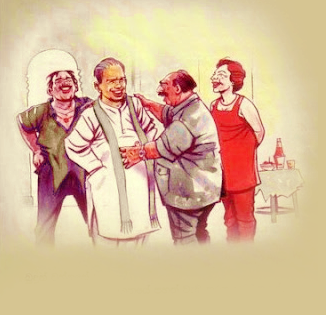
"This dream too will not come to pass until
the far distant future, in the reign of weakling kings. Then there will
be kings who know nothing about ruling. They will be cowards and fools.
Fearing revolt and revolution, they will elevate their footmen,
bath-attendants, and barbers to nobility. These kings will ignore the
real nobility. Cut off from royal favor and unable to support
themselves, bona fide nobles will be reduced to dancing attendance on
the upstarts, as when the crow had regal Mandarin ducks for his retinue.
However, you have nothing to fear from this. Tell me your sixteenth
dream."
16. "I saw goats chasing wolves and eating them. At the sight of goats in the distance, the wolves fled terror-stricken, quaking with fear to hide in thickets. Such was my dream. What will come of it?"


"This dream too will not have its
fulfillment until the reign of immoral kings. The low-born will be
raised to important posts and will become royal favorites. True nobles
will sink into obscurity and distress. Gaining power in the law courts
because of the king's favors, the parvenu will claim the ancestral
estates of the impoverished old nobility, demanding their titles and all
their property. When the real nobles plead their rights in court, the
king's minions will have them beaten and tortured, then taken by the
throat and thrown out with words of scorn. 'That will teach you to know
your place, fools!' they will shout. 'How dare you dispute with us? The
king shall hear of your insolence, and we will have your hands and feet
chopped off!' At this, the terrified nobles will agree that black is
white and that their own estates belong to the lowly upstarts. They will
then hurry home and cower in an agony of fear. Likewise, at that time,
evil monks will harass good, worthy monks until the worthy ones flee
from the monasteries to the jungle. This oppression of true nobles by
the low-born and of good monks by the evil monks will be like the
intimidation of wolves by goats. However, you have nothing to fear from
this. This dream refers to the future only."
When he had thus
reassured the king, the Buddha added: "It was neither truth nor love for
you that prompted the brahmans to prophesy as they did. It was pure
greed and selfishness that led them to prescribe sacrifices."
Thus the Buddha explained the meaning of the sixteen dreams. Then he
said, "Nor are you the first to have had these dreams. They were dreamed
by kings of bygone days as well. Then, as now, brahmans found in them a
pretext for sacrifices."
sampunaliew.blogspot.com
J16.09
Understanding Bududahama
Nalin de Silva

It is Vesak again. It is the
day the ascetic Siddhartha (Siduhath Thavusa) attained Buddhahood or
became Samma Sambuddha. I have found that understanding Bududahama is
much more difficult than fathoming Relativity, Quantum Physics, western
Mathematics or western Philosophy or any other system of knowledge that
I have some acquaintance, and it is amazing that this Dhamma has
survived for more than two thousand five hundred years not only as a
Dahama but as a way of life or religion or whatever one calls it. In
Bududahama what is important is the "knowledge" gained by the Nobles
(Aryan or Arhants) and we prthagjanas are encouraged to "acquire" this
particular "knowledge" and attain Nibbana. I write certain words in
parentheses as I am not quite sure of what they mean with respect to the
Nobles. I do not want to pretend that I "know" Bududahama on this Vesak
day, as had I "known" Bududahama I have a feeling that I would have
attained Nibbana and would not have written this article at least in
this form.
I try to be non sarcastic on this Vesak day as much as
possible, but if I exceed my limits then it is because I am a prthagjana
who does not understand Bududahama. How many of us understand the
following quoted from Kaccayanagotta Sutta as translated by Ven.
Thanissaro Bhikku. "'Everything exists': That is one extreme.
'Everything doesn't exist': That is a second extreme. Avoiding these two
extremes, the Tathagata teaches the Dhamma via the middle: From
ignorance as a requisite condition come fabrications...". It is
not difficult to repeat this ad nauseam without understanding it. How
many times this Sutta has been repeated by learned Bhikkus and laymen
during the last two thousand years? What is meant by avoiding the two
extremes mentioned in the Sutta? Does the world exist or not? Is it a
wrong question? How many of us understand the "dasa avyakatha prashna"?
How many Ph.D. theses have been written on these problems without
offering a convincing answer?
Budunvahanse or Tathagatha (I do
not want to ask the meaning of Tathagatha as it would create more
problems) often avoids dualities with respect to the knowledge of
(created by) the Prthagjanas, and teaches Dhamma via the middle as the
Ven. Thanissaro Bhikku has said. What is said is that A paccaya B. It
may be translated as if A exists then B exists. Also the "nirodha" is
valid. That is if not A then not B. If not for the "nirodha" we would
not be able to attain Nibbana. The prthagjana experience is limited to a
world where two valued two fold Aristotelian logic is valid. I suppose
it is not quite true and what I should have said is that the prthagjana
(if one wants human) experience is such that it leads to the creation of
Aristotelian logic. Thus the world either exists or does not exist. If A
is true then not A is false and vice versa. However, Kaccayanagotta
Sutta states it is wrong to say that the world exists or does not exist.
It goes against our experience, and who said that Bududahama is
empirical in the western sense? This new kind of experience (whose
experience?) leads to catuskotika logic according to which the world
could neither exist nor does not exist. In Catuskoti both A and not A
could be true or both A and not A could be false (refer na ca so na ca
anno in Milinda Prashnaya). In western knowledge the closet that comes
to mind is Quantum Physics where a particle could go through two slits
at the same time. In other words the particle is at A as well as not at
A. No wonder that Richard Feynman said that nobody understood Quantum
Physics!

Imagining a God, Brahman or even a Nirgun
Brahman as in Advaitha Vedantha is not difficult compared with imagining
a world that neither exists or does not exist. Try to imagine Nibbana as
Sunya and that would drive some Theravadins to declare that Sunya is a
Mahayana concept that is not valid! This is in spite of Budunvahanse
having mentioned Anicca, Dukkha, Anaththa and Sunya at least on a few
occasions.
It should not be thought that Budunvahanse always
avoided "dualities", especially when they did not belong to the same
system. After all twofold logic is included in Catuskoti or fourfold
logic, and if A is true then not A is false is not discarded in certain
cases. Consider the case of Atma (soul). Budunvahanse has not stated
that there is neither Atma nor Anatma. Some scholars in their eagerness
to avoid dualities would not talk of Anatma or Anatta as they think it
is one extreme or by stating Anatta one assumes Atta or Athma. If that
is the case then one cannot state Anicca as it is also an extreme and
one cannot state Anicca without assuming Nicca or Nithya. These
contradictions by scholars arise as they want to impress the westerners
that Bududahama is empirical. Anithya may be empirical as everything
changes over time (it is the other way around as time is a concept that
has been formulated , in fact a pannatti as stated in Attasalini by Ven.
Buddhaghosha Thero, after observing change) but Anathma is a different
kettle of fish, where Athma appears to be empirical.
Ven.
Nagarjunapada has tried to avoid dualities by referring to them as
relative concepts as in the case of light relative to dark but it
appears that the Thero has made the terrible mistake of considering
Samsara relative to Nibbana. The trouble with words such as Anicca,
Anatta and Nibbana is that the prthagjanas use them as if they are
concepts and they should not be considered as extremes or ends of
dualities (dvikotika) as in the case of light and dark. While Nitya,
Athma and Samsara are concepts that belong to the system of knowledge
that the prthagjanas have created due to Avidya, Anicca, Anatta and
Nibbana seem to belong to "knowledge" of the Nobles or Arhants. The
former is in the sphere of prthagjanas while the latter is "understood"
by the Arhants. The duality between the prathagjanas and the Arhants has
not been discarded by Budunvahanse and Dvayatanupassana Sutta
exemplifies it very well.
The following is from the Selected
Texts from the Sutta Nipata by John D. Ireland. They are some "gathas"
from the Dvayatanupassana Sutta and I reproduce what has been given by
Ireland. "See how the world together with the devas has self-conceit for
what is not-self. Enclosed by mind-and-body it imagines, 'This is real.'
Whatever they imagine it to be, it is quite different from that. It is
unreal, of a false nature and perishable. Nibbana, not false in nature,
that the Noble Ones know as true. Indeed, by the penetration of the
true, they are completely stilled and realize final deliverance."
"Forms, sounds, tastes, scents, bodily contacts and ideas which are
agreeable, pleasant and charming, all these, while they last, are deemed
to be happiness by the world with its devas. But when they cease that is
agreed by all to be unsatisfactory. By the Noble Ones, the cessation of
the existing body is seen as happiness. This is the reverse of the
outlook of the whole world."
"What others call happiness, that the
Noble Ones declare to be suffering. What others call suffering, that the
Noble Ones have found to be happiness. See how difficult it is to
understand the Dhamma! Herein those without insight have completely gone
astray. For those under the veil (of ignorance) it is obscured, for
those who cannot see it is utter darkness. But for the good and the wise
it is as obvious as the light for those who can see. Even though close
to it, the witless who do not know the Dhamma, do not comprehend it."
"By those overcome by attachment to existence, those who drift with
the stream of existence, those in the realm of Mara, this Dhamma is not
properly understood. Who other than the Noble Ones, are fit to fully
understand that state, by perfect knowledge of which they realize final
deliverance, free from defilements?"
This Sutta may be one of the
few Suttas that admit duality or dvyaitha. (I must admit that I have not
read all the Suttas, and I may be wrong here). Budunvahanse has not
stated that there are neither prthagjanas nor Arhants. In any event, it
shows that the knowledge of prthagjanas is different from the
"knowledge" of Arhants. What the prthagjanas call happiness the Arhants
"call" suffering. We may use words such as Anicca, Dukkha, Anatta and
Nibbana but they remain mere words to us until we understand Bududahama
and attain Nibbana. In a sense one attains Nibbana by eradicating one's
knowledge. May even the scholars who are Buddhists attain Nibbana!
14 05 2014 - The Island
J16.10
Greatest son born in Indian soil
Premasara Epasinghe

The three great events in the
life of the Prince Siddhartha Gautama Buddha - Birth, Enlightenment and
the Passing Away, took place on Vesak Full Moon Poya Day. Therefore, it
is known as this holiest of all holy day for the entire Buddhist
community in the world.
On this day, it is
interesting to understand the vision and knowledge and follow Buddhas
Great Philosophy that leads to calm insight and Enlightenment. It moulds
your character in an inner transformation with an indepth study of
Middle Path. This great philosophy is woven round the "Eight Fold Path",
which consists of Right Understanding, Right Thought, Right Speech,
Right Action, Right Livelihood, Right Effort, Right Mindfulness and
Right concentration.
These factors can be categorized into three
stages of Training, Morality, Mental, Culture and Wisdom.
The
greatest son born in the Indian soil was undoubtedly Siddhartha Gautama
Buddha. Today he is been honoured, respected and followed, by six
billion people all over the world. The majority of them are in Asian
Religion.
Born on Vesak Full Moon Poya Day in 623 BC. in the city
of Kapilavasthu, on the foothills of beautiful, panoramic enchanting
Himalayan Range in Modern Uttara Pradesh, He attained Enlightenment,
achieved Vimukthi, from the state of Dukkha on 588 BC. and became a Fully
Awakened One - Sammasambuddha. His noble ministry, preaching of Dhamma
lasted for 45 years.
The Blessed One - Buddha, showed the
Blessings of Universal Compassion to all Beings. Violence, in any form
under any pretext whatsoever is absolutely against the Noble Teachings
of the Buddha.
Out of all Religious Leaders in the world, the
Blessed one has made an enormous contribution to human civilization.
Buddhism is a Thinking Religion and a Philosophy. It's a way of life.
Buddha taught us an Universal Truth. He once uttered -
Sabbapapassa Akaranam - Kusalassa Upasampada
Sacittapariyodapanam - Etam
Buddhana Sasanam
(To refrain from doing Evil, To indulge
in doing good;
To cleanse mind - This is the Teaching of all
Buddhas)
In a nutshell - the Entire Buddhist Philosophy is
embodied in these four lines.
Buddhism is always a question of
knowing and seeing and not that of believing. The teaching of the Buddha
is qualified as Ehi Passika - inviting to come and see, but, not to
come and believe.
Buddhism is undoubtedly a Religion of Wisdom.
In this world of storm and strife, hatred and violence, the Message of
Buddha shines like a Radiant Sun. the immortal message of Buddhism help
us, immensely to fashion our Thoughts and actions according to the
Buddhist way of life. Today, the need of the hour is to follow the Noble
Message of the Triple Gem.
Buddha is a Free Thinker. In the
Kalama Sutta - Anguttara Nikaya, the Blessed One stated not to believe
anything just because you have heard. His eternal message thrilled the
humanity. Humans are their own masters. There is no external higher
Being of Power that sits in judgement. Even, advanced science and
technology, have proved the Truth expounded the Gautama Buddha.
Buddha was the Greatest Democrat as well as the Greatest Communicator. A
Sakyan named Mahanama once approached Buddha and questioned Him, on
becoming a Virtuous Lay Person.
The Buddha replied thus:
"Mahanama, a lay follower who abstain from destruction of life, from
taking what is not given, not involved in sexual misconduct, avoid false
speech, and retrain from consuming intoxicant drinks remains virtuous.
This is the basic principle - 'Panchaseela' - Five precepts in Buddhism.
These principles, the virtuous precepts mould any individuals character.
Its an Universal Truth."
Buddha is a human being. He attributes
all his achievements, attainments to his human endeavour as well as his
intelligence. He claimed no inspiration from any God or any other super
power. Although, some of the Religions in the world believe in God,
Buddhism does not believe in any unseen external power. In Buddhism,
"Man" is his own Master. The Buddha called upon men and women to build
their own new world on the basis of Love and Kindness. Undoubtedly,
Siddhartha Gauthama Buddha was a fountain of compassion. He treated his
own son Rahula and vicious cousin Devadatta (who conspired to kill Him)
in the same wave length of loving kindness.
Buddha was the first
Religious Universalist. He advised the disciples to spread the Dhamma
far and wide. He said "Go forth for the good of many for the happiness
of many. Out of compassion to the world, for the welfare, for the good
and happiness of Gods and Men. Let no two of you go in the same
direction."
Buddha, influenced the entire society by the Power of
His word. He was the greatest social reformer the world has ever seen.
Buddha once uttered a man becomes a Brahmana or Vasala, not by birth,
but by his deed and action. The status of the women in pre-Buddhist
Indian society was pathetic. They were relegated to a status tower and
inferior to that of men. Gautama Buddha was a Great Religious Leader and
Philosopher, who recognized them as lay devotees. Under the able
guidance of His own step mother, Mahaprajapathi Gotami, the Bhikkuni
Sasanaya (Order of Nuns) was established.
Buddhism is the
religion of man, and of humanity as a whole. Some religious, to spread
their message, they adopted an element of persecution. Buddhism never
converted anyone by force or through persecution. Buddhist missionaries
have never competed for converts in the market place. Buddha was the
embodiment of all the virtues he preached. In his eventful ministry of
45 years he translated all his words into action; and in no place did he
give vent to any human frailty or any base passion. The Siddhartha
Gautama Buddha's moral code of conduct was most perfect.
The
Buddha is like a Physician. A doctor diagnosis of different kind of
illness, their causes, the antidotes and remedies and must be able to
apply them, so also the Buddha has taught the Four Truths which indicate
the range of suffering, its origin, its cessation and the way which
leads to its cessation.
Buddha is the property of whole mankind.
Buddhism is common to everybody. Every religion, which came into
existence after the Buddha, has borrowed many good ideas from the
Buddha. Buddhism is realistic, for its takes a realistic view of life
and of the world.
I end this with a quote from Prof Rhys Davids.
"Buddhist or no Buddhist, I have examined every one of the great
religious systems of the world. In none of them have I found anything to
surpass in beauty and comprehensiveness, the Noble Eightfold Path and
Four Noble Truths of the Buddha. I am content to shape my life according
to that Path."
- Prof Rhys Davids
14 05 2014 - Daily News
J16.11
Devadatta and Bodhisatva
Dr. Senarath Tennakoon

In 'The Questions of King
Milinda' (Milinda-panna) one proposition of king Milinda was that good
and evil bear equal fruit. As evidence for proving this proposition the
king projected several instances from the previous lives of Devadatta
and Bodhisatva. Although Devdatta has been identified and noted, as an
evil one he has been superior or equal in life status when compared with
Bodisat who has been identified as a good, virtuous and compassionate
character.
In many birth stories Devdatta has been leading happy
and comfortable life style while Bodisat has been subject to suffering.
King Milinda also asked Venerable Nagasena why the Buddha admitted
Devadatta to the Order very well knowing that he would raise up a
schism, and having done so would suffer torment in purgatory for a
Kalpa. Venerable Nagasena's response was that if Devadatta had not
entered the Order he would have laid up much karma as a layman leading
to states of woe, and so passing for hundreds of thousands of Kalpas
from torment to misery, and form one state of perdition to another, he
would have suffered constant pain. It was through mercy that the Blessed
One admitted Devadatta to the Order. Venerable Nagasena used the
stylistic device, analogy for making inferences.
He declared that
a king through his powerful influence could make light the grievous
penalty imposed upon a friend or a relative. Another analogy was that a
clever physician or surgeon could make a serious sickness, light by
using a powerful medicinal drug. Thus the Buddha Admitted Devadatta to
the Order and made his previous pain light by the aid of the Dhamma by
the power of mercy. Although Devadatta would suffer in a woeful state
for his heinous crimes, yet as a result of the Holy life he led during
the early part of his career, it has been stated that he would become a
Pacceka Buddha named Attissara in the distant future.
Erroneous attitudes
Devadatta was the cousin
of Gautama the Buddha and his most persistent enemy. He was the son of
King Suprabuddha and Queen Amita. His sister was Yasodara who became the
wife of Prince Siddhartha. All of them were worried about the evil
character of Devadatta since childhood. As a prince once Devadatta
arrowed down a swan while Siddhartha nursed it lovingly and saved it
from death. There was a dispute over the ownership of this injured swan
between Devadatta and Siddhartha. His mother Queen Amita loved Devadatta
as he was her son and often tried to correct his erroneous attitudes.
It has been said that Upali, a barber's son who was a friend of
Devadatta often used to point out the evil actions of Devidatta and
tried to correct him. Even Yasodhara was critical of Devdatta's
misdeeds. King Suprabuddha has been informed by the astrologers, that
evil planets were influencing Devadatta's life style. Devadatta was
against the Buddha, as after marrying his sister Prince Siddhartha left
her and made her live alone like a widow with a son. Even King
Suprabuddha was against the Buddha for the same reason. But it was
surprising why Devadatta entered the Order in the early part of the
Buddha's ministry together with Ananda and other Sakyan princes.
Devadatta could not attain any of the stages of Sainthood, but was
distinguished for worldly psychic powers (pothujjanika-iddhi). During
the early part of his career he led an exemplary life that even
Venerable Sariputta extolled him. But later Devadatta overcome by
worldly gain and honour became jealous of the Buddha and radically
changed in character thus becoming the greatest personal enemy of the
Buddha. According to the Pali Canon he twice tried to kill the Buddha,
as well as attempting to cause schisms in the Sangha.
He
attempted three attempted murders in order to take control of the Sangha
from the Buddha. But all these nasty attempts to overthrow the Buddha
failed. The enmity between the two was not confined to one lifetime, but
has been continuing right throughout their Samsaric existence in varying
forms. There were over 64 jataka tales where Devadatta and Bodisat have
appeared together in their samsaric existence. Speculation over the
noxious behavior of Devadatta could be based on the karmic phenomenon in
Buddhism. Inequality that exists among human beings is not accidental or
due to blind chance. Heredity along cannot account for these
differences. Subha, an intelligent youth asked the Buddha about the
cause of inequality and the Buddha responded thus "All beings have
actions (Kamma) as their own, their inheritance, their congenital cause,
their kinsman, their refuge. It is kamma that differentiates beings into
low and high states in accordance with the law of cause and effect".
Bodhisatva in Sanskrit and Bodisatta in Pali means 'a seeker after
enlightenment' or 'a Buddha to be'. In original Pali Buddhism, the term
Bodhosatta is used exclusively to designate Gautama Buddha prior to his
enlightenment. The concept of Bodhisattva has been in vogue in India
even before the appearance of Gautama Buddha. In the Buddhavamsa of the
Khudikka Nikaya, there are life stories of twenty-five Buddhas and that
of Gautama Buddha is the last. Buddhas as well as bodhisattvas must have
been innumerable.
Intellectual Bodhisattas
The Buddha has been described in Jataka accounts of his previous
lives as the Bodhisatta. In Apannaka Jataka the Buddha had been a
merchant as well as Devadatta. In Guttila Jataka both have been
musicians. In Serivanija Jataka the Buddha was named Kachchaputa a kind
merchant while Devadatta was Serivanija also a merchant but very shrewd
and arched enemy of Kacchaputa. In Vanarinda Jataka the Buddha has been
a monkey king while Devadatta has been a crocodile. In Virochana Jataka
the Buddha had been a lion while Devadatta had been a cunning fox. In
Chulla Paduma Jataka the Buddha was King Paduma while Devadatta was the
Cripple.
According to Buddhism there are three types of
Bodhisattas-intellectual Bodhisattas (Pannadhikas), Deotional
Bodhisattas (Saddhadikas) and Energetic Bodhisattas (Viriyadikas)
respectively. The intellectual Bodhisattas concentrate on meditation and
develop wisdom leaving aside rituals and blind faith. They attain
Buddhahood within a short period. The Devotional Bodisattas rely on
trustful confidence (saddha) and various forms of homage and the image
of the Buddha is a great source of inspiration in their endeavour. They
attain Buddha hood in a longer time than the intellectual Bodisattas.
The energetic Bodisattas are dedicated to the service of others.
They are happy active social workers like King Sangabodhi... But they
take still a longer time for attaining Buddhahood than the other two
types.Every Bodisattva has to practice the ten transcendental virtues
called perfections (Paramita) to attain Supreme Enlightenment
(Samma-Sambuddha-hood). Out of these transcendental virtues,
compassion/loving kindness is the noblest virtue. The ten are,
Generosity (Dana), Morality (Sila), Renuncxiation (Nekkhamma), Wisdom
(Panna), Energy (Viriya), Patience (Kanthi), Truthfulnes (Sacca),
Determination (Aditthana), Loving Kindness (Metta) and Equanimity
(Upekkha) respectively The life history of Gautama Buddha exemplifies
the genesis, evolution and realization of the Bodhisattva was born as a
Brahmin child named Sumedha.
Later in life he led a homeless life
as a hermit who gained Jhanas and supernatural powers. Once he noticed
the residents of city Ramma filling the muddy places and decorating the
road thus clearing the way for Buddha Deepankara with a large number of
Bhikkus who were going round for alms. Sumedha too joined the folks and
began to fill a plot of muddy road with sand. But he could not complete
his task when the Buddha arrived there.
He united his hair and
spread the hair and the deerskin he had, over the mud and lay on it for
the Buddha to walk on. While lying he thought "May I be able to attain
Full Enlightenment like this Buddha and be of service to mankind".
Deepankara Buddha knew his wish, and informed the Bhikkus that Sumedha
would become the future Gautama Buddha. This was the first affirmation
(Niyata Vivarana) Gotama Bodisatta was born as Wessantara, in the last
human existence.
By that time has completed fulfilling all the
thirty perfections (Paramita). Then he was born in the Tusita Devaloka
where he lived for 576 million human years when all the Devas and
Brahmas appealed to him to be born in the human world for becoming a
Buddha. The Bodhisatta accepted this request and was born as Prince
Siddhartha-son of King Suddodena and Queen Mahamaya. It was this Prince
Siddhartha who renunciated became an ascetic and finally attained
Buddhahood.
14 05 2014 - Daily News
J16.12
The tragic story of Bhikkhuni Patachara
Premasara Epasinghe

Patachara was born one hundred
thousand aeons (Kalpas) ago, during the time of Padumuttara Buddha in
the city of Hansawati. With her parents, she used to listen to the
sermons of the Buddha. One day she saw Buddha Padumuttara, conferring
and elevating an Bhikkhuni to the position of the foremost disciplined
Bhikkhuni. She regularly used to offer alms to the Buddha and Bhikkhunis
and wished to be the foremost Bhikkhuni of discipline, under a future
Buddha.
In her next birth, during Kassapa Buddha she was born as
the daughter of King Kiki in the Kigndom of Kasi.
To fulfil her
wish, she was born as a daughter of a wealthy, rich family during the
dispensation of Sidhartha Gautama Buddha.
Love at first sight
The parents looked after her
like their own eyes. She lived in a big mansion and special maids were
there to look after her. She lived in luxury in the seventh flour of the
mansion. One day, she saw a handsome youth, chopping firewood. She fell
in love with him at the first sight. When she left the mansion to enjoy
a stroll she met her lover. Her parents found a nobleman to be her
partner. She informed her lover about it. She decided to elope with the
lover who was a wood-cutter of the mansion. They left the mansion and
crossed the river Achiravati. They put up a small hut and lived
according to their means happily.
As the delivery date of the
first child was close, she appealed to the husband to take her back to
her mansion. But the labourer was frightened to meet her parents. So, he
kept the matter on hold. As it was the normal practice of girls to go to
her parents’ place on such vacations, she left for her parents’ place
without informing her husband.
The journey was tiring. On her way
to her parents, she delivered a baby boy. Therefore, she returned to her
husband. Again they lived happily according to their means.
After
about one and half years, she was pregnant again. This time too she
decided to go to her parents’ place. As the husband was not in favour,
she took her son and left to see the parents. When the husband came
home, he realised that the wife had left. He quickly went in search of
her and found his wife and the child.
Torrential rains
The skies were darkened and
threatening. Before the rains fell, the husband went in search of
cutting, leafy branches to put up a hut. In the meantime, she delivered
the second baby. Torrential rains poured. The husband never returned.
In the morning she found her husband's dead body stung by a snake
near an ant hill. She lamented. The elder child cried. Carrying the
little baby, and holding the hand of the other child, she wondered what
to do. The heavy rain made the waters of Acirawati River rise. She asked
the elder boy to wait on the river bank and swam with the little new
born baby and kept him, on the other side of the bank.
Then, she
came crossing mid-way of the river to take the elder child. She saw, a
big, eagle swooping down on the new born baby's direction. She shouted
to chase the bird. The elder son thought his mother was calling him and
jumped into the river. He was carried away by the swift current, and
disappeared in the water. The massive eagle carried away the little
baby.
How can any one bear such a calamity? Within a matter of
few hours, she lost her husband and two children. She felt unconscious.
When she recovered she ran hither and thither naked like a mad woman.
The people not knowing her pathetic condition, called her Patachara
‘a woman who has no shame about her nakedness'. Some people gave her
some clothes to cover herself. She did not know what she was doing.
She entered the city and ran towards the monastery where the Buddha
was residing. People tried to stop her. The compassionate One, allowed
her to reach Him. Patachara, related her entire story to the Buddha.
The Enlightened One delivered a sermon on impermanence.
“Daughter, in your Samsaric journey many a time you have shed tears, for
your loved ones. Even the four oceans will overflow with your tears.
Death overwhelms you. No one can help you, except the Dhamma of the
Blessed One." The wise person, who realises the truth, paves the way
getting rid of all sufferings. As a great communicator, the Buddha
delivered the sermon to suit her trend of thoughts, like a psychologist.

Patacara realised the truth, and attained the stage of stream
entrant - Sovan.
She fell near the Buddha and
worshipped the Blessed One and seek permission to enter the order.
The Buddha directed her to the Bhikkhuni's and she was Ordained. She
was committed. She meditated and attained the stages – Once-returner,
(Sakurudagami) and non-returner (Anagami).
It was water – rain
water, which caused the deaths of the husband and the two children.
Thinking about water she used to wash her feet downwards that helped her
to attain Nibbana.
In Theri Gatha – there are stanzas relating to
Patacara, depicting the truth of Buddhist philosophy.
I washed my
feet with water
It flowed downwards
I observed the flow of water
I realised the transient nature of life.
Patachara, realised the
absolute truth – All desires extinguished – Rebirth ceased. Patachara
too destroyed her desires and attained the Bless of Nirvana and achieved
Arahanthood.
Later the Buddha elevated Patacara to the rank of
the foremost Bhikkuni in discipline. Later, she became a towering
strength for the sorrowing women who lost their loved ones.
sundayobserver.lk/2012/12/23
Practice of Buddhist Wisdom and loving Kindness

In the Karaniya Metta Sutta,
Buddha has indicated many ways of leading a happy and contented life
here on earth and also hereafter which ultimately leads to the
eradication of all suffering.
To achieve this happiness one has
to be...
1) Clever, efficient, able - “sakko”
2) Upright
in Conduct, Safeguarding the Precepts by abstaining for example from
Killing, Stealing, Sexual Misconduct, Lying, Partaking of Intoxicants,
etc. - “uju"
3) Extremely Honest - “suju”
4) Willing to
listen to the Good and the Noble - “suvaca”
5) Very mild and
flexible - “mudu”
6) Humble and not be proud and conceited and
self-opinionated - “anatimani”
7) Happy and satisfied with
whatever one has - “santussa”
8) Easy to manage, with only a few
wants and undemanding - “subhara”
9) Not over loaded with work,
have some leisure - “appa kicca”
10) Relaxed and not over taxed
having an enjoyable profession - “sallahuka-vutti”
11) Able to
restrain the Senses of Eye, Ear, Nose, Tongue, Touch and Mind and also
the Sensory Stimuli of sights, sounds, smells, tastes and bodily touch.
These sensations should not bring up emotions of anger or attachment.
When the outside world brings pleasant sensations, one must be
restrained and not get carried away by greed and attachment. Likewise,
when unpleasant sensations arise one has to be restrained and not become
angry and resentful. - “santindriya”

Through Mindfulness and Wisdom, one must learn to control one’s emotions. - “nipaka”
Mindfulness of being in the Present needs training in Vipassana
Meditation, where one learns the art of “Letting Go’. Stop proliferating
thoughts and memories of the past or hopes for the future, which arc
just imaginary processes, without any prejudice, fear or favour. Being
ever mindful of the present moment brings Wisdom as follows:
(1)
Knowing the changing nature of the mind, body and environment –
Impermanence “anicca”
(2) Understanding the Pain and
Suffering of the mind and body. “dukkha”
(3) Knowing the Causal
conditions that are necessary for the maintenance of the Body and mind
and understanding the utter lack of ownership in terms of “Me”, “I” and
“Mine” - Non Self “anatta”
These three factors when seen again
and again, develops true wisdom and helps in the restraining of the
Senses. In this way the greed for pleasant sensations and anger towards
unpleasant sensations can be controlled and restrained.
Seeing the
actions and reactions Karma and Vipaka also helps to restrain the
senses. To control the senses, one has to:
1) Be refined in
behaviour, not coarse and vulgar - “appa gabbho”
2) Be without
any notions of family, clan, caste etc.- “kulesu ananu giddho”
3)
Be heedful to the advice of good and noble ones and try to redeem one’s
bad behaviour accordingly by listening to the Dhamma and following
religious ethics - “vinnu pare upavadeyyum”
4) Wish that all
beings be well and happy and that they may forgive others and forgive
themselves - “sukhinova khemino”
5) Spread Loving Kindness to all
beings without any exception - “sabbe satta bhavantu sukhi tatta”
6) Whatever living beings there may be - "Ye keci pana bhu tatti"
7) Wish that all living beings in the universe, all those who live
in fear, and the fearless, ones with long bodies or short, the huge
ones, the middle sized or the minute ones, those that can be seen and
the unseen, those living far and near, those born and unborn be well and
happy. – “tasa va thavara va anava sesa dighava ye mahanta va majjhima
rassa kanuka thula dittha va ye ca addittha yeca dure vasanti avidure
bhuta va sambhave siva”
8) Wish that all beings may never deceive
one another – “na paro param nikubbetha”
9) Wish that they never
speak highly of themselves and disparage others – “nati mannetha
kaththaci nam kanci”
10) Not show signs of anger by facial
expressions or bodily gestures – “bhayarosana patigha sanna”
11)
Never give pain and suffering to one another – “nanna mannassa dukkha
miccheyya”
12) Just as a mother with an only child would protect
it at the risk of her own life, so must we protect the lives of all
living beings – “mata yathaniyam puttam ayusa eka putta manu rakkhe”
13) Even so towards all beings - “evampi sabba bhutesu"
14) Let
him cultivate boundless mind - “Mansam bhavaye aparimanam”
15) Give
loving kindness to all living beings – “mettanea sabba lokasmin”
16) Above, below and around, may all living beings be free from pain and
suffering, from anger and hatred and enmity – “uddham adho ca tiriyanca
assambhadam averam asapatam” (mediatation)
17) Wish that all
living beings be well and happy – “Sabbe satta bhavantu sukhitatta”
18) Standing, sitting, walking, lying down and even until falling
asleep, may all beings practice this meditation on loving kindness with
determination – “tittham, caram, nisinnova sayanova yavatassa vigata
middho”
19) He should develop this mindfulness - “Etam satin
adhiteyya”
20) This indeed is the practice of the Great Brahma –
“brahma metam viharam”
21) Free from wrong view, virtuous,
keeping precepts, practicing Vipassana Meditation, seeing impermanence
pain and non self, giving up sensual pleasure such a being would never
sleep in a mother’s womb again since he would be an enlightened one –
“ditthinca anupa gamma silava dassanena sampanno kamesu vineyya gedham
nahi jatu gabba seyyam punarettiti”
From the speech
delivered by Bhikkhuni Kusuma at the Elijah Interfaith Conference of
Religious Leaders of the World held from May 5 to 8 2014 in Munich in
Germany.
12 06 2014 - Daily Mirror
J16.14
Buddhist ethics is the only way to an ideal society
Dr. Keerthi Jayasekara

Brilliant senior surgeon of a
bygone era now 93 years, whose surgical assistant I was for many years
with whom I still maintain an affectionate teacher - student
relationship, having read my article on Vesak Day asked me why I chose
to write about the Buddha’s advice on family life and not on
impermanence, the four noble truths or Nirvana as most Buddhist writers
do ?
I told him that the priority was Buddhist social philosophy
-- the way the Buddha introduced ethics to transform society and usher
in happiness to mankind.
I reminded him of Ven. Balangoda Ananda
Maithriya Thera, one of the most respected and venerated Buddhist
scholars both in Theravada and Mahayana Buddhism in recognition of which
he was appointed the first Professor of Mahayana Buddhism to Vidyodaya
University. A master of nearly ten languages who at the tender age of 96
acquired a computer and became computer literate and began working on
the computer thereafter. He had his training in meditation from the
yogis in the foot hills of the Himalayas. He was endowed with physic
powers and also had the ability of out of body experience to the Astral
body. When he was 100 years old at a religions ceremony to mark the
event he said he did not wish to attain nirvana but wished to be born in
Sri Lanka over and over again to serve the people of this country.
To the Buddhist who is in a hurry to cut short his journey in
sansara this statement will be most confusing.
However if we view
it in the light of what the Buddha said to the first batch of Buddhist
missionaries of 60 Arahaths including Arhath Yasa, it will make sense
and very meaningful indeed. It is well to remember that Buddhism is the
first missionary religion in the world.
The Buddha addressing the
first batch said, “Go now and wander for the welfare and happiness of
many, out of compassion for the world for the benefit and welfare and
happiness of gods and man. Teach the Dhamma that is good in the
beginning, good in the middle, and good in the end with meaning and the
letter, explain a holy life that is utterly perfect and pure. There are
those with little dust in their eyes who will be lost through not
hearing the Dhamma some will understand the Dhamma.”
The Buddha
discovered that human suffering in society was due to lust, hate and
delusion. He expounded an elaborate ethical system for the removal of
misery. The Buddha explained the universality of suffering with these
words, ”Birth is misery, old age, decay, sickness, death, sorrow, grief,
woe, lamentation and despair, having said this the Buddha expounded an
elaborate ethical system for the removal of misery."
The Buddha
preached not only the existence of misery but also brought hope of
redemption. The Buddha assured that suffering can be avoided and should
be avoided by properly following the ethical discipline of self control.
The Buddha said that misery has a causal chain and that it can be
stopped and also a way to check it.
The Buddha did not accept the
view that misery was an inevitable part of life. The third noble truth
concerns the means of checking misery.

In the Hinayana tradition
the ethical teachings of the Buddha is summarised in the following
Triple Jewels:
1. Conduct
2. Meditation
3.
Contemplation
The conduct includes the observance of the
following vow:
1. Non violence
2. Non stealing
3. Truth
4.
Celibacy
5. Abstinence from intoxicants.
These five rows are
meant for all. The mendicants are advised in addition to observe abstinence
from:
6. Evening meals
7. Garlands
8. Valuable
beds
9. Music
10. Gold and silver
Meditation in
Buddhism has been given a special status.
Contemplation
1.
Study
2. Rational thinking
3. Affirmed knowledge acquired by
meditation
These Three stages of contemplation are strikingly
similar to SRAVANA MANANA and MDIDHYASANA of Vedanta system. The
Ethical Principle of Buddhism can be described from another view point
as well. It is the Noble Eight-fold Path. Which when perfected leads to
liberation. They are...
1.] Right attitude - Nothing can
arise alone without the support of other things on which its existence
depends.
2.] Right determination - It is the intention of
renunciation. The intention of non ill-will, non-cruelty.
3.]
Right speech - Abstention from lying, slander, abuse and gossip.
4.] Right action - Abstention from killing living beings, stealing,
misconduct in sensual desires.
5.] Right livelihood - Refrain
from trading in weapons living beings, meat, liquor and poison.
6.] Right effort
- Non arising of un-arisen evil causes unwholesome
states. Abandoning of arisen causes evil unwholesome states.
7.]
Right mindfulness - To be fully present, not lost in daydreams,
anticipation, indulgences, or worry.
8.] Right concentration - One
pointedness of mind. It is the ability to focus steadily one’s mind on any
one object and one only, to the exclusion of all others.
What the Buddha preached in his 45 years ministry was this ethic to bring about a complete psychological transformation of society to establish a righteous society. Professor Radha Krishnan says “Buddhism is a way of living and not a way of talking.” It is a way of living based on moral values based on ethics, which perfected will lead to the conquest of ultimate happiness.
12 06 2014 - Daily Mirror
J16.15
Ariya Samatha as Expounded by Buddha
Lalith Dhammika Mendis

Samatha refers to the serenity
of mind. It has a much deeper meaning in the Buddhist tradition as
opposed to what is popularly referred to as Samatha today. First it is
important to understand what causes mental turbulence or agitation which
results in loss of serenity.
There are two traditions that
demonstrate how Samatha is achieved. The Pre-Buddhist traditions involve
Jainist, Vedic and Yogi Teachings and the other being what is expounded
as Samatha in the Buddhist tradition. Unless the divergence between
these two traditions is properly differentiated, it would eventually
leave the follower aimlessly adrift in the infinite ocean of Samsara.
Hence it is vital that those who are on the quest to seek ultimate truth
or Nibbana clearly understand Samatha taught in the pure Buddhist
tradition.
Ariya Samatha discoursed by Buddha is not achieved by
focusing on a pre-determined object or concentrating on some selected
process of thoughts as a form of meditation in undisturbed tranquility.
Pre-Buddhist tradition postulated that, mental turbulence is
caused by twin factors of “Raga” and “Dosa”, whilst Buddhist tradition
clearly identifies “Raga”, “Dosa” and “Moha” as three causes responsible
for the loss of serenity of mind. The old traditionalists who did not
comprehend “Moha” developed transient calmness of mind through
methodologies dictated by their own traditions. To avoid external
stimuli which give rise to Raga and Dosa, being the causal factors of
mental turbulence, retreating to monastic living was adopted, as
tranquil surroundings offered an environment conducive for secluded
existence, far detached from potential sources of distraction. This
enabled sustainability of tranquility of mind. Widely used techniques in
this endeavour included Apo Kasina, Thejo Kasina, etc. whereby the mind
was trained to keep steady with a continued focus on objects such as
water or flame of a lamp. The resultant state of calmness enabled
gradual development of Vitakka, Vichara, Pithi, Sukha and Ekaggatha to
elevate the mind to four stages of absorption or Jhanas where one is
able to experience tranquility, full concentration and oneness of mind.
Equanimity, composure and self-possession of mind thus achieved
leads to “Anariya Samatha”, which is entirely different from the “Ariya
Samatha” taught by Buddhist tradition. “Anariya Samatha” is of fragile
and transient nature as there is high tendency on the part of those who
even attain “Abhinna” or supernormal knowledges through Anariya Samatha
to simply lose such elevated states of mind upon mere encounter of
mundane stimuli or distractions arousing Raga, Dosa and Moha.
Buddhist tradition by contrast proclaims “Moha” too as one of the three
sources of defilements as “Ragha” and “Dosa” cannot arise without
“Moha”.
Ariya Samatha discoursed by
Buddha is not achieved by focusing on a pre-determined object or
concentrating on some selected process of thoughts as a form of
meditation in undisturbed tranquility. It involves critical examining
and dissecting of every thought that occurs based on the principles of
Paticca Samuppada comprehending worldly phenomena through the three
Characteristics of Raga, Dosa and Moha, thereby eliminating and
uprooting all defilement that binds oneself to Sansara whilst absorbing
and nurturing the Dhamma, which would enable the calming down of
Nivaranas or hindrances that create obstacles to achieving Nibbana.
Samatha achieved through Buddhist tradition leads to “CethoVimutti”
which forms the basis of elevating to Panna Vimutti leading to
accomplishment of the ultimate goal of Nibbana. With the achievement of
Ceto Vimutti, Bojjhanga’s or Seven Factors of Enlightenment would be
developed consummating all 37 Bodhipakkhiya-Dhamma’s leading to the
supreme bliss of Nibbana.
Ariya Samatha expounded by
Buddhist tradition is achieved in an entirely different process through
four different unique approaches as described below.
1. Dhamma
Uddachcha Viggahitha Maanasan
This refers to an extremely rare state
of elevated mental capacity characterized by possession of superlative
faculty of wisdom or “Panna Indriya”, which enables instantaneous
realization of truth and achievement of Arahanthood through complete
eradication of all defilements. Arahant Dharucheeriya and Santhathi
found in Buddhist tradition are two perfect examples of this extremely
rare state of elevated mind.
2. Samatha Pubbangama Vidassana
Refers to achievement of Vipassana by those who are born with Samatha
already developed through pre-birth endeavours during Sansarik journey.
3. Vidassana Pubbangama Samatha
Vidassana refers to the
capability to comprehend true nature of all phenomena and worldly things
through incisive analysis of such phenomena based on Buddhist teaching.
Through such endeavour one is able to achieve serenity of mind by
calming down Raga, Dosa and Moha. Hence Vidassana forms the essence of
Buddha’s teaching.
4. Euganaddha
This is a process of mental
evolution where Samatha and Vidassana develop simultaneously.
Accordingly Samatha could be said to be of twofold, namely Ariya Samatha
and Anariya Samatha. According to Buddhist tradition Samatha and
Vidassana are inseparable and considering Samatha and Vidassana as two
distinct states is contrary to Buddha’s teaching.
Commentaries
written by many authors other than Pali Cannon cannot be regarded as
Buddha’s teaching. Hence various interpretations given by writers on
Pali Cannon are of no relevance as they are often found to be at
variance with the pristine Dhamma preached by Buddha. Pali Cannon
contains Buddha’s own words of peerless wisdom and teaching. Under the
circumstances, commentaries written by Bhadanthacharya Buddha-Gosha
cannot be accepted as pristine pure Pali Cannon comprising of Buddha’s
own words, but as his own writings only.
Buddha’s teaching
expounds the accomplishment of Nibbana as the ultimate goal of Buddhist
aspirations. Hence what is important is to achieve the Noble Elevated
states beginning from Sothapanna to reach the final goal of Arahanthood
which leads to Nibbana. Such accomplishment is irreversible, although
various Jhana’s and super human powers developed through Anariya Samatha
popularly practiced today are transient in nature.
12 06 2014 - Daily Mirror
J16.16
Is spirituality a grey matter?
Dr. H.D. Goonetilleke

One early morning while waiting
for a subway train at the London underground, Dr. James Austin, a
Neurologist and a long practitioner of Buddhist meditation sensed
something he had never experienced before in his life. In a
contemplative mood he was gazing over the gloomy surrounding of the
dimly-lit station, when all of a sudden and quite unexpectedly he felt
that he lost his sense of self-identity. He realized that he was in
total unison with everything else around him and that there was nothing
separating him from the surrounding physical world. Rid of every last
connection to an I-Me-Mine, or his own ego-self, he experienced a
paradox of ‘extraordinary viewing’ with no real viewer to observe. As he
recounted later, he saw things "as they really were, with a sense of
eternity, where time stood perfectly still". He stated that in the
absence of a subjective ‘self’ making a biased view of the world, what
he experienced conveyed the impression of an ‘objective’ reality.
Rather than recognizing this specific encounter as a realization of
absolute reality beyond comprehension by any of his senses or as a form
of enlightening spiritual experience, Dr. Austin decided to explore the
neurological foundations of his unique experience. He saw a likeness of
his experience to what is encountered by monks in meditation, or by
priests and nuns in prayer, and was interested in finding out whether it
was a total manifestation of the ‘grey matter’ inside the brain. He has,
since then, published many scholarly books and articles including the
‘Zen and the Brain’ based on his work on how the brain works when it
endures some form of spiritual and mystical experiences.
Not
surprisingly though, he is not alone in this challenging task of
unearthing the neurological basis of human spirituality. Today a
countless number of psychologists and neuroscientists are trying to
uncover the neurological underpinnings of spiritual and mystical
experiences, or discover what happens in our brains when we sense that
we have encountered a reality different from - and, in some sense, more
blissful than - the reality of everyday experience. Working on related
fields as diverse as contemplative neuroscience, meditative
consciousness and neurotheology, scientists are eager to seek an answer
to this age-old question: what makes us spiritual?
Using
sophisticated neuro-imaging techniques, such as multiphoton microscopy
and PET scans that produce 3-dimensional colour depictions of the
functional processes within the brain, neuroscientists are now able to
see what parts of the brain are working, or not working under different
circumstances. This has enabled them to detect the influence of
meditative and transcendental states of mind on the functioning of the
brain’s nerve cells, known as ‘neurons’. For example in the brain scans
of those engaged in meditation and prayer, scientists have observed a
significant increase in neuronal activity in a region of the brain known
as ‘prefrontal cortex’ which regulates emotions and feelings. At the
same time, a significant reduction in neuronal activity has been
detected in a specific region of the brain known as ‘parietal lobe’, or
otherwise referred to as the ‘orientation association area’ which is
responsible for orienting oneself in time and space. This particular
region of the brain also conveys the sense of where the body ends and
the rest of the world begins. If no sensory inputs are sent to this
region of the brain as when in deep concentration, or meditation, the
brain cannot find any boundary between the self and the world. As a
result, it will have no choice but to perceive the self as endless and
intimately interwoven with everyone and everything else.
"When
this happens, you lose your sense of self," says Dr. Andrew Newberg,
Director of Research in Integrative Medicine at Thomas Jefferson
University who is a neuroscientist probing the biology of thought and
belief. According to him, under these conditions one will have the
notion of grand unification of things in a manner where self evaporates
into nothingness, or dissolves into God, or the universe. Such
experiences may not therefore indicate the presence of God or some
higher realm of existence, but our ability to change the perception of
realty by manipulating what takes place in the complex web of neurons
inside the brain.
Irrespective of what benefits such experiences
could have on the individual through the effects of mind over matter, a
number of inferences can be made with these findings. The fact that
transcendent states of consciousness could be the result of biologically
based events in the brain explains why people sense such inspiring
moments as equally real as anything else they experience in real life.
Additionally, the consistency and regularity in which spiritual
experiences are reported across different faiths and traditions reflect
the similarity and uniformity in the fundamental structure of the human
brain which, in all respect, remains one of the world’s greatest
unsolved mysteries.
Then, how can we explain the power of
religious rituals and festivals that can arouse and inspire believers,
or even non-believers, alike? The intense sensory stimulation caused by
rhythmic dancing, drumming and slow chanting, besides the presence of
strong aroma and the grandeur of the event, induces powerful emotional
responses that put the prefrontal lobes of the brain into a hyperactive
state, while depriving the orientation area of normal sensory inputs. As
in meditation and prayer, the orientation area loses its ability to
maintain its sense of self, leading to what neuroscientists refer to as
a ‘softening of the boundaries of the self’. The ultimate result would
be the same; a feeling of cosmic unity, clarity and harmony in the mind.
For many, spiritual and religious experiences can be extremely
mesmerizing and profoundly compelling, though they appear to be mere
products of the brain. This, along with the fact that it is the human
brain, with all its complexity that evolved over thousands of years
which is responsible for what he is today, helps us understand why
spirituality is one of the defining features of the human species.
There is much unraveling to be desired on human consciousness -
essentially a ‘grey area’ for scientists - which could explain the
origin of spirituality. Science may still be far away from knowing even
a fraction of what takes place inside the mind of a human. But one thing
is very clear; whatever we do and feel consciously, or unconsciously,
are the result of the firing up of nearly 100 billion neurons in a
tangled web of nerve cells inside the brain, with each neuron connected
to and talking to around 10,000 other neurons. Spirituality appears to
be an extraordinary manifestation of this complex neuronal activity
inside the vital ‘grey matter’ of our brain.
16 07 2014 - The Island
J16.17
The quest for meaning
Bhikkhu Bodhi

However much the modern world
may pride itself on its triumphs over the follies and foibles of the
past, it appears that the progress we credit ourselves with has been
bought at a price so steep as to throw into question the worth of our
achievements. This price has been nothing less than the shared
conviction that our lives are endowed with ultimate meaning. Though in
earlier ages men and women lived in a space populated largely by
figments of the collective imagination, they could still claim a
precious asset that we sorely lack: a firm and buoyant belief that their
everyday lives were encompassed by a penumbra of enduring significance
stemming from their relation to a transcendent goal.
Present-day
attitudes, however, molded by scientific reductionism and technocratic
audacity, have combined forces to sweep away from our minds even the
faint suspicion that our lives may possess any deeper meaning than
material prosperity and technological innovation. For an increasing
number of people today the consequence of this militancy has been a
pervasive sense of meaninglessness. Cut loose from our moorings in a
living spiritual tradition, we find ourselves adrift on a sea of
confusion where all values seem arbitrary and relative. We float
aimlessly along the waves of caprice, without any supreme purpose to
serve as the polestar for our ideals, as the wellspring for inspired
thought and action.
But just as little as nature can
tolerate a vacuum, so humankind can little tolerate a complete loss of
meaning. Thence, to escape the plunge into the abyss of meaninglessness,
we grasp after flotsam, attempting to immerse ourselves in distractions.
We pursue pleasure and power, seek to augment our wealth and status,
surround ourselves with contraptions, invest our hopes in personal
relationships that only conceal our own inner poverty. At the same time,
however, that our absorption in distractions helps us to cope with the
psychological void, it also stifles in us a deeper and still more
insistent need — the longing for a peace and freedom that does not
depend upon external contingencies.
One of the great blessings of
the Buddha’s teaching is the remedy it can offer for the problem of
meaninglessness so widespread in human life today. The Dhamma can serve
as a source of meaning primarily because it provides us with the two
requisites of a meaningful life: an ultimate goal for which to live, and
a clearcut but flexible set of instructions by which we can advance
towards that goal from whatever station in life we start from.
In
the Buddha’s teaching the quest for ultimate meaning does not begin, as
in the theistic religions, with propositions about a supernatural scheme
of salvation to be assented to in faith. It begins, rather, by focusing
upon an experiential problem right at the crux of human existence. The
problem, of course, is the problem of suffering, the boundaries of which
are shown to extend beyond our immediate subjection to pain, misery and
sorrow, and to encompass all that is conditioned precisely because of
its impermanence, its vulnerability, its lack of abiding substance.
The goal of the teaching, the unconditioned element which is
Nibbana, then comes to have a decisive bearing upon our vital concerns
because it is apprehended as the cessation of suffering. Though in its
own nature it defies all the limiting categories of conceptual thought,
as the cessation of suffering Nibbana provides the final answer to our
innermost yearnings for an imperishable peace, for complete freedom from
sorrow, anxiety and distress. The way that the quest for this goal
intersects with the course of our everyday life is made plain by the
Buddha’s analysis of the cause of suffering. The cause of suffering, the
Buddha holds, lies within ourself, in our selfish craving conjoined with
blinding ignorance, in the three evil roots that taint our normal
engagement with the world: greed, hate and delusion. Thence the freedom
from suffering that we seek lies in the eradication of these three
roots.
To orient our life towards the goal of deliverance from
suffering requires that we tread the path that leads to and merges with
the goal. This path is the Noble Eightfold Path, which brings an end to
suffering and bondage by enabling us to extricate the causes of
suffering embedded in our hearts. We begin the path exactly where we
are, in the midst of error and defilement, and by clarifying our views,
transforming our attitudes, and purifying our minds, we advance by
stages towards the direct realization of the ultimate good.
If
the goal towards which the path points lies beyond the pale of
conditioned existence, to walk the eightfold path is to discover within
the confines of conditioned existence dimensions of meaning previously
unknown. This richness of meaning stems from a twofold source. One is
the recognition that the following of the path brings a diminishment of
suffering for ourselves as well as others, and at the same time an
enhancement of joy, mental equipoise and peace. The other source of
meaning is the conviction that the values we are pursuing are not merely
subjective and arbitrary, but are grounded in an absolutely objective
order, in the very nature of things.
As we embark on the way to
the end of suffering, the final goal no longer appears merely as a
distant shore but becomes refracted in our experience as the challenge
of overcoming the unwholesome roots, and of assisting our fellow beings
to do the same. This challenge, the task of actualizing our own good and
the good of others, becomes at the same time life’s inner core of
meaning: to transmute greed into generosity and relinquishment, to
replace hate with love and compassion, and to dispel delusion with the
light of liberative wisdom.
08 10 2014 - The Island
J16.18
Should Buddhists continue to eat meat?
K.K.S. Perera

When the First Percept deals in not destroying a life
“If a person does not harm any living being and
does not kill or cause others to kill- that person is a true spiritual
practitioner.” - The Dhammapada
The Katina or Cheevara month is
approaching. The most meritorious act (kusalakamma), Buddhists believe
is the offering of Katina cheevara (robe) to monks who practise this
age-old tradition of rain retreat or Vassana, though it has little
relevance today considering the highly unpredictable weather patterns.
It is the usual practice to offer non-vegetarian meals to the Sangha,
during and at the end of Vassana on Katina pooja, as usually done at any
alms giving, unless specifically requested by the Sangha for vegetarian
food. Dishes prepared from the meat of innocent animals slaughtered for
human consumption, only result in more destruction of life.
The
Buddha unconditionally discouraged consumption of flesh, when he said,
“The eating of meat suffocates the seed of sympathy and feeling for
others.” - The Mahaparinirvana Sutta.
Can one practise
mettabhavana, meditation on kindness for all living beings, while
consuming the flesh of animals that are brutally and violently killed?
Be mindful of this contradiction. In Jivaka Sutta, the Enlightened One
spoke against the habit of eating the flesh of an animal that was “seen,
heard or suspected” of having been killed (Majjhima Nikaya 55) for
satisfy the taste buds of monks. This statement was subsequently
misinterpreted to say, ‘seen, heard or suspected’ of being killed
especially for the particular individual; for you or me, and therefore
consuming what was killed in general for all meat eaters does not fall
into this category. Doesn’t it sound silly and childish? The First
Precept cautions us to refrain from intentionally harming or causing the
destruction of a living creature. Even while we offer alms at our temple
or at home and follow up with metta meditation wishing “may all beings
be well and happy”, at some nearby place,encouraged by our action,
animals are being slaughtered by butchers for our consumption.
A
lay upasaka or a monk practising ‘maithree bhavana’, (meditation on
compassion) after partaking food that included flesh of animals killed
for consumption, is in severe contradiction. The meat eaters (including
those who claim, ‘I only eat fish, not meat’ thinking that the so-called
‘marine resources’ are only vegetables). They are responsible for the
trade of fishing, hunting and butchering; where the killers are only
serving the demand created by flesh eaters who contribute to the heinous
crime of causing violent deaths to harmless animals.
It is
shocking and disgusting to witness Buddhists offering The Buddha, the
great compassionate leader a meal on a dish ‘decorated’ with the flesh
of animals killed for consumption. We grab from religions only what
makes us happy, and reject the rest as impractical. The founders of all
religions; Jesus Christ, Prophet Mohammad, and Mahavira, were all
vegetarians. Followers of Seventh Day Adventists, a Christian sect, are
vegetarians; they know that hurting or disrespecting life of any of
God’s creations, will keep the Almighty away from them.
The Mahayanists
The Lankavatara sutta in
Mahayana texts strongly advocates vegetarianism. It clearly sees the
link between meat-eating and the agony and misery of animals. The sutta
says, “Those who practise loving-kindness must give up eating flesh;
they should consider all sensitive beings as their own kith and kin. It
is untrue that consuming meat is permissible when the animal was not
slaughtered by himself, when he did not order anybody to kill it and
when it is not particularly meant for his consumption.” The Buddha in
fact went to the extent of predicting the future through the Dhamma when
he declared, “…there may be interpreters, who under the influence of the
greed for meat, will string together numerous arguments justifying the
eating of meat through subtle and illogical presentations. But, eating
flesh in any manner, in any form and in any place is absolutely
prohibited.”
The Brahmajala Sutta too forbids meat-eating. Chinese
Bikkhus refrain from eating meat based food as told in the Brahmajala
Sutta. The Brahmaviharas of loving-kindness and compassion to all
sentient beings is discussed in the Jivaka Sutta. There is an
overwhelming wealth of urgings to be ashamed of this irregularity when
considering Buddhist texts that prescribe the value of compassion and
kindness to all living creatures. A basic tenet of Buddhist philosophy
is the banning of the destruction of life that creates a strong argument
in support of vegetarianism.

Udana:
As spoken by
the Buddha, “I am yet to meet with anything that was dearer than his own
self. To teach one for himself, and others that the self is dear, let
him who desires his own advantage not harm another.”
Great vegetarians in history
World renowned scientists,
mathematicians, writers and philosophers like Socrates, Plato,
Aristotle, Pythagoras, Isaac Newton, Albert Einstein, Charles Darwin,
Mahatma Gandhi, Shakespeare, Tagore, Bernard Shaw, Leo Tolstoy and
Bertrand Russel to mention a few were all vegetarians. 2600 years ago
the mathematician and philosopher, Pythagoras denounced the eating of
carcasses of animals believing in what he termed, the ‘trans-migration
of souls between living creatures’. He said it was immoral for humans to
destroy or aid and abet the act of killing living beings. The concept of
vegetarianism was not known until the mid-19th century. However, this
great concept lost favour with newer generations; in fact non-meat
eaters in Europe were labelled as those who were unable to afford to buy
meat.
As Tristram Stuart said, ‘vegetarianism took hold of the
West after European travellers discovered that high-caste Indians lived
long and healthy lives on vegetable diets….’ (The Bloodless
Revolution: Lond. 2006- Pp416.) He also quoted Thomas Tyron, the
seventeenth century dissenter, who hailed the Hindu concept for life and
said, ‘Brahmins represent the purest remnants of paradisiac tradition
that remains on Earth’.
Nutritional requirements
The myth that animal proteins
are essential for humans to repair worn out tissues and for making
enzymes has been effectively disproved. All 12 essential amino acids are
available in plenty in grams, soya, lentils, seed products, milk,
potatoes, peanuts, beans, green gram, and spinach. If one wants more
high quality proteins than those found in meats and eggs, he can consume
cashew nuts and tofu. Soya is a comparatively cheap source of all
nutrients. A person with a body weight of 60 kg needs 60 gms of proteins
a day. With an average vegetarian meal of rice, bread and dhal he can
easily obtain 80 mgs of proteins. A non-vegetarian would usually consume
excessive quantities of proteins, as much as 130-145 gm per day
affecting joints, causing high blood pressure, increased levels of
cholesterol, kidney dysfunction, obesity, osteoporosis, album in urine
etc.
Buddha’s last meal of ‘sukara-maddava’ –a delicacy made of
pork– is a faulty interpretation contributing to a grave misconception
that the Enlightened One attained parinibbana after eating putrid pork.
'Sukara-maddava' erroneously described as a ‘pork’ dish was actually made
from a type of mushroom.
May all beings be happy!
08 10 2014 - Daily Mirror
J16.19
Purification of Mind
Bhikkhu Bodhi

An ancient maxim found in the
Dhammapada sums up the practice of the Buddha's teaching in three simple
guidelines to training: to abstain from all evil, to cultivate good, and
to purify one's mind. These three principles form a graded sequence of
steps progressing from the outward and preparatory to the inward and
essential. Each step leads naturally into the one that follows it, and
the culmination of the three in purification of mind makes it plain that
the heart of Buddhist practice is to be found here. Purification of mind
as understood in the Buddha's teaching is the sustained endeavor to
cleanse the mind of defilements, those dark unwholesome mental forces
which run beneath the surface stream of consciousness vitiating our
thinking, values, attitudes, and actions. The chief among the
defilements are the three that the Buddha has termed the "roots of evil"
-greed, hatred, and delusion- from which emerge their numerous
offshoots and variants: anger and cruelty, avarice and envy, conceit and
arrogance, hypocrisy and vanity, the multitude of erroneous views.
Contemporary attitudes do not look favorably upon such notions as
defilement and purity, and on first encounter they may strike us as
throwbacks to an outdated moralism, valid perhaps in an era when prudery
and taboo were dominant, but having no claims upon us emancipated
torchbearers of modernity. Admittedly, we do not all wallow in the mire
of gross materialism and many among us seek our enlightenments and
spiritual highs, but we want them on our own terms, and as heirs of the
new freedom we believe they are to be won through an unbridled quest for
experience without any special need for introspection, personal change,
or self-control.
However, in the
Buddha's teaching the criterion of genuine enlightenment lies precisely
in purity of mind. The purpose of all insight and enlightened
understanding is to liberate the mind from the defilements, and Nibbana
itself, the goal of the teaching, is defined quite clearly as freedom
from greed, hatred, and delusion. From the perspective of the Dhamma
defilement and purity are not mere postulates of a rigid authoritarian
moralism but real and solid facts essential to a correct understanding
of the human situation in the world.
As facts of lived
experience, defilement and purity pose a vital distinction having a
crucial significance for those who seek deliverance from suffering. They
represent the two points between which the path to liberation unfolds -the former its problematic and starting point, the latter its resolution
and end. The defilements, the Buddha declares, lie at the bottom of all
human suffering. Burning within as lust and craving, as rage and
resentment, they lay to waste hearts, lives, hopes, and civilizations,
and drive us blind and thirsty through the round of birth and death. The
Buddha describes the defilements as bonds, fetters, hindrances, and
knots; thence the path to unbonding, release, and liberation, to untying
the knots, is at the same time a discipline aimed at inward cleansing.
The work of purification must be undertaken in the same place where
the defilements arise, in the mind itself, and the main method the
Dhamma offers for purifying the mind is meditation. Meditation, in the
Buddhist training, is neither a quest for self-effusive ecstasies nor a
technique of home-applied psychotherapy, but a carefully devised method
of mental development -theoretically precise and practically efficient- for attaining inner purity and spiritual freedom. The principal tools
of Buddhist meditation are the core wholesome mental factors of energy,
mindfulness, concentration, and understanding. But in the systematic
practice of meditation, these are strengthened and yoked together in a
program of self-purification which aims at extirpating the defilements
root and branch so that not even the subtlest unwholesome stirrings
remain.
Since all defiled states of consciousness are born from
ignorance the most deeply embedded defilement, the final and ultimate
purification of mind is to be accomplished through the instrumentality
of wisdom, the knowledge and vision of things as they really are.
Wisdom, however, does not arise through chance or random good
intentions, but only in a purified mind. Thus in order for wisdom to
come forth and accomplish the ultimate purification through the
eradication of defilements, we first have to create a space for it by
developing a provisional purification of mind - a purification which,
though temporary and vulnerable, is still indispensable as a foundation
for the emergence of all liberative insight.
The achievement of
this preparatory purification of mind begins with the challenge of
self-understanding. To eliminate defilements we must first learn to know
them, to detect them at work infiltrating and dominating our everyday
thoughts and lives. For countless eons we have acted on the spur of
greed, hatred, and delusion, and thus the work of self-purification
cannot be executed hastily, in obedience to our demand for quick
results. The task requires patience, care, and persistence - and the
Buddha's crystal clear instructions. For every defilement the Buddha in
his compassion has given us the antidote, the method to emerge from it
and vanquish it. By learning these principles and applying them
properly, we can gradually wear away the most stubborn inner stains and
reach the end of suffering, the "taintless liberation of the mind."
(Courtesy: Buddhist Publication Society)
03 02 2015 - The Island
J16.20
Essential points of the Buddhist teachings
Ajahn Buddhadasa

On the occasion of giving a
special talk, I feel I should deal with those important subjects that
most adequately sum up the principles of Dhamma (Ultimate Truth; the
truth of nature; the duty of all that lives; the teachings of the
Buddha.) So I have resolved to speak on "The Essential Points of the
Buddhist Teachings" in a hope that a grasp of them will greatly
facilitate a wide-ranging advance on your studies. If these points are
not grasped, it will be confusing. You will feel that there are a great
number of things to be known and that they keep increasing until there
are too many to understand and practice. This is the root cause of
failure, for it results in discouragement and an interest that becomes
more and more unfocused and imprecise. In the end, it's as if one is
carrying around a great load of knowledge without being capable of
studying or practicing so as to make use of it.
So
please set your mind on some revision, on order to grasp the essential
points of the Buddhist Teachings, so as to realize the knowledge that is
the foundation for a correct understanding of Dhamma. I emphasize that
it is the foundation, because there is knowledge that is not a
foundation, just as there is incorrect understanding, understanding of
the sort that deviates little by little until it is no longer Buddhist
teaching. Or if it is still Buddhist teaching, it is an offshoot of it
that is continually branching away from the trunk.
To call
something the foundation of the Buddhist Teachings is only correct if
firstly, it is a principle which aims at the extinction of Dukkha (the
suffering, unsatisfactoriness or imperfection of every experience or
state clung to as being "I" or "mine") and, secondly, it has a logic
that one can see for oneself without having to believe others. These are
the most important constituents of a foundation.
The Buddha
refused to have any dealings with those things which don't lead to the
extinction of Dukkha. Take the question of whether or not there is
rebirth. What is reborn? How is it reborn? What is its kammic
inheritance? (kamma-is volitional action by means of body, speech or
mind.) These questions are not aimed at the extinction of Dukkha. That
being so, they are not Buddhist teaching and they are not connected with
it. They do not lie in the sphere of Buddhism. Also, one who asks about
such matters has no choice but to indiscriminately believe the answer he
is given, because the one who answers is not going to be able to produce
any proofs, he's just going to speak according to his memory and
feeling. The listener can't see for himself and so has to blindly
believe the other's words. Little by little the matter strays from
Dhamma until its something else altogether, unconnected with the
extinction of Dukkha.
Now, if one doesn't raise those sort of
problems, one can ask instead, "Is there Dukkha?" and "How can Dukkha be
extinguished?" To these questions the Buddha agreed to answer, and the
listener can see the truth of every word of his answer without having to
blindly believe them, see more and more clearly until he understands.
And if one understands to the extent of being able to extinguish Dukkha,
then that is the ultimate understanding. One knows that, even at this
moment, there is no person living; one sees without a doubt that there
is no self or anything belonging to a self. There is just a feeling of
"I" and "mine" arising due to the foolishness whereby one is deluded by
the beguiling nature of sense-experience. Therefore, there being no one
born here, there is no one who dies and is reborn. So, the whole
question of rebirth is utterly foolish and nothing to do with Buddhism
at all.
The Buddhist teachings aim to inform us that there is no
self and nothing belonging to a self, there is only the false
understanding of the ignorant mind. There is merely body and mind, which
are nothing but natural processes. They function like a mechanism that
can process and transform data. If they do so by the wrong method, it
gives rise to foolishness and delusion, so that one feels that there is
a self and things which belong to a self. If they do so by the correct
method, those feelings do not arise; there is the primal
truth-discerning awareness (satipanna), the fundamental true knowing and
clear seeing that there is no self and nothing belonging to a self.
The matter of "I" and "mine" is the single essential point of the
Buddhist teachings. It is the one thing which must be completely purged.
It follows that here lies the knowing, understanding, and practice of
all the Buddhist teachings without exception. So please pay full
attention.
In regards to the foundations or root principles of
Dhamma, there aren't a great deal. The Buddha said that there was a
single handful. A sutta in the Samyutta Nikaya makes this clear. While
walking through the forest, the Buddha picked up a handful of fallen
leaves and asked the monks who were present, which was the greater
amount - the leaves in his hand or all the leave in the forest. They all
said that the leaves in the forest were much more, so much that it was
beyond comparison. Even now, try to imagine the scene and see the truth
of this, how much more they are, The Buddha then said that, similarly,
those things which he had realized and which he knew were a great
amount, equal to all the leaves in the forest - but that which was
necessary to know, those things which should be taught and practiced,
were equal to the number of leaves in his hand.
So from this it
can be taken that, compared to all the myriad things that are to be
found in the world, the root principles to be practiced to completely
extinguish Dukkha amount to a single handful. We should appreciate that
this "single handful" is not a huge amount, it's not something beyond
our capabilities to reach and understand. This is the first important
point that we must grasp if we want to lay the foundations for a correct
understanding of the Buddhist teachings.
Here we reach the
phrase, "the Buddhist Teachings". Please understand the phrase
correctly. These days, that which is labeled as the "Buddhist Teachings"
is a very nebulous thing - that is to say it is extensive without much
definition. In the Buddha's time, a different word was used, the word
"dhamma"; it referred specifically to the dhamma which extinguishes
Dukkha. The dhamma of the Buddha was called Samana Gotama's dhamma. If
it was the dhamma of another sect - say that of Nigantha Nataputta
(contemporary of the Buddha and founder of the Jain religion) - it would
be called Nigantha Nataputta's dhamma. One who liked a particular dhamma
would try to study it until he understood it and then practiced
accordingly. It was called dhamma and that is what it was, real pure
dhamma without any of the numerous things which have come to be
associated with it in later times. Now we call those appendages
"Buddhist Teachings". Due to our carelessness the "Buddhist Teachings"
have become so nebulous that they include within them many things
foreign to them.
The real Buddhist Teachings alone are already
abundant - as many as all the leaves in the forest - but that which has
to be studied and practiced is merely a handful, and that's already
plenty. But nowadays we go and include those things which are associated
with the teachings, such as the history of the religion and an expanded
psychology. Take Abhidhamma (the third of the three "baskets" of the
Buddhist scriptures. Compiled after the Buddha's death, they are a
complete analysis of mind and matter into their constituent parts), some
parts of it have become psychology, some parts philosophy, it's
continually expanding to fulfill the requirement of those disciplines.
And there are many more offshoots, so that things which are associated
with the Teachings have become exceedingly numerous. They have all been
swept in together under one term, so that there have become to be a
large number of "Buddhist Teachings".
If we don't know how to
take hold of the essential points, then it will seem that there's a
great amount and we won't be able to choose between them. It will be
like going into a shop selling a great variety of goods, and being
completely at a loss what to take. So we will just follow our common
sense -a bit of this, a bit of that, as we see fit. And mostly we will
take those things which agree with defilements (kilesa) rather than let
ourselves be guided by truth-discerning awareness. Spiritual life
becomes a matter of rites and rituals, of making merit by rote or to
ensure against some fear or other. There is no contact with the real
Buddhist Teachings.
Let us know how to separate the Buddhist
Teachings from those things which have merely come to be associated with
them and included under the same name. Even in the Teachings themselves,
we must still know how to distinguish the root principles, the essential
points, and it is of these things that I have resolved to talk.
The spiritual disease of our time is the disease whose germ lies in the
feeling of "we" and "ours", "I" and "mine" that is regularly present in
the mind. The germ that is already in the mind develops first into the
feeling of "I" and "mine" and them, acting through the influence of
self-centeredness, becomes greed, hate and delusion, causing upset for
both oneself and others. These are the symptoms of the spiritual disease
that lies within us. To remember it easily, it may be called the disease
of "I" and "mine."
Every one of us has the disease of "I' and
"mine", and we absorb more germs every time we see a form, smell an
odor, touch a tangible object, tastes a flavor, or think in the manner
of an ignorant person. In other words, there is a reception of the germ,
those things surrounding us that are infected and cause the disease,
every time there is sense contact.
We must recognize that the
germ is clinging (upadana) and that it is of two kinds: clinging to an
"I" and clinging to "mine". Clinging to "I" and feeling that "I" is an
entity, that I am like this or like that, that I am the equal of any
man. Anything of this sort is called "I". "Mine" is taking that as
belonging to me, that which I love, that which I like. Even that which
we hate, we consider to be "my" enemy. This is called "mine."
In
Pali, "I" is atta and mine is attaniya: or, if one uses the terms in the
general use of Indian philosophy, ahamkara meaning to have the feeling
of "I" (stemming from the word aham, "I"), and mamamakara, meaning to
have the feeling of "mine" (stemming from the word mam, which means
"mine.")
The feelings of ahamkara and mamamkara are so very
dangerous that they are called the spiritual disease, and every branch
of philosophy or dhamma in the Buddha's time wanted to wipe them out.
Even though they were followers of other teachings, they all had the
same aim of wiping out ahamkara and mamamkara. The difference lay in
that when they eradicated those feelings, they called what remained the
True Self, the Pure Atman, the Desired. As for our Buddhist Teaching, it
refused to use those names because it did not want to give rise to any
new clinging to a self or things belonging to a self. It was just left a
perfect emptiness, which was called Nibbana, as in the phrase, "Nibbanam
paramam sunnam" - "Nibbana is supreme emptiness" - that is to say,
absolutely empty of "I" and empty of "mine" in every respect, without
remainder. That is Nibbana, the end of spiritual disease.
This
matter of "I" and "mine" is very hard to see. If you don't really
concentrate, you won't be able to understand that it is the force behind
Dukkha, the force behind spiritual disease.
"That which is called
"atta" or "self" corresponds to the latin word "ego". If the feeling of
self-consciousness arises, we call it egoism because once the feeling of
"I" arises it naturally and inevitably gives rise to the feeling "mine".
Therefore, the feeling of self and the feeling of things belonging to
self, taken together is egoism. Ego can be said to be natural to living
beings and, moreover, to be their center. If the word "ego" is
translated into English, it must be rendered as soul, a word
corresponding to the Greek "kentricon" which in English means center.
Ego and kentricon being the same thing, the soul (atta) can be regarded
as the center of living beings, as their necessary nucleus, and
therefore is something that the ordinary person cannot rid themselves of
or refrain from.
So it follows that all unenlightened people must
experience this feeling of egoism arising continually. Although it's
true that it doesn't express itself all the time, it manifests whenever
one sees a form, hears a sound, smells an odor, touches a tactile object
or has a thought arise in the mind. On every occasion that the feeling
of "I" and "mine" arises, we can take it to be the disease fully
developed, regardless of whether it's dependent upon seeing a form,
hearing a sound, smelling an odor, or whatever. When at the moment of
contact, the feeling "I" and "mine" arises, it is the disease fully
developed. The feeling of selfishness has strongly arisen.
At
this point we no longer call it egoism but selfishness, because it is an
agitated egoism that leads one into low, false ways, into a state of
thinking only of oneself without consideration for others, so that
everything one does is selfish. One is completely ruled by greed, hatred
and delusion. The disease expresses itself as selfishness and then harms
both oneself and others. It is the greatest danger to the world. That
the world is currently so troubled and in such turmoil is due to nothing
other than the selfishness of each person, of each of the factions
forming into competing groups. That they are fighting each other without
desire to fight, but through compulsion, is because they can't control
this thing; they can't withstand it's force, and so the disease takes
root. That the world has taken in this "germ" which has then caused the
disease, is because no one is aware of that which can resist the
disease, namely, the heart of the Buddhist Teachings.
I would
like you to understand this phrase, "the heart of the Buddhist
Teachings". Whenever we ask what the heart of the Buddhist teachings is,
there are so many contending replies that it's like a sea of mouths -
everyone's got an answer! But whether they are correct or not is another
matter, for people just answer according to what they have remembered or
what they have worked out for themselves. Please, look and see for
yourselves how it is these days. Who truly knows the heart of the
Buddhist teachings? Who has truly reached it?

Whenever we ask
what the heart of the Buddhist Teachings is, someone will probably say
the Four Noble Truths (Dukkha, its cause, its extinction, and the path
leading to its extinction) others will say aniccam-dukkham-anatta
(impermanence, unsatisfactoriness and selflessness), other may recite
the verse:
"Sabba papassa akaranam,
Kusalassupasampada,
Sacitta pariyodapanam, Etam Buddhasasanam".
or,
"Refraining from doing evil, doing only good,
and purifying
the mind, that is the heart of the Buddhist Teachings."
That's
correct, but only very slightly so because it is still something
repeated by rote; it's not something that has truly been seen for
oneself.
As to what is the heart of Buddhist Teachings, I would
like to suggest the short saying, "Nothing whatsoever should be clung
to". There is a section in the Majjhima Nikaya where someone approached
the Buddha and asked him whether he could summarize his teachings in one
phrase and, if he could, what it would be. The Buddha replied that he
could: "Sabba dhamma nalam abhinivesaya". "Sabbe dhamm" means "all
things", "nalam" means "should not be", "abhinivesaya" means "to be
clung to". Nothing whatsoever should be clung to. Then the Buddha
emphasized this point by saying that whoever had heard this core-phrase
had heard all the Teachings, who ever put it into practice had practiced
all the Teachings, and whoever had received the fruits of practicing
this point had received all of the fruits of the Buddhist Teachings.
Now, if anyone realizes the truth of this point that there is not a
single thing to be clung to, it means that there is no "germ" to cause
the disease of greed, hatred and delusion, or of wrong actions of any
kind, whether of body, speech or mind. So, whatever forms, sounds,
odors, flavors, tangible objects and mental phenomena crowd in, the
antibody "Nothing whatsoever should be clung to" will resist the
disease. The "germ" will not enter, or, if it is allowed to do so, it
will be only in order to be completely destroyed. The "germ" will not
spread and cause the disease because of the antibody continually
destroying it. There will be absolute and perpetual immunity. This then
is the heart of the Buddhist Teachings, of all Dhamma. Nothing
whatsoever should be clung to - 'Sabbe dhamma nalam abhinivesaya.'
A person who realizes this truth is like someone who has an antibody
that can resist and destroy disease. It is impossible for him or her to
suffer from the spiritual disease. But, for the ordinary person who
doesn't know the heart of the Buddhist teachings, it's just the
opposite, like someone who hasn't the slightest immunity.
You
probably understand by now the meaning of the "spiritual disease" and
who the doctor is that heals it. But it's only when we see that we
ourselves have the disease that we become really serious about healing
ourselves, and in the right way, too. Before we know, we just enjoy
ourselves as we please. It's like someone unaware that they have some
serious illness, such as cancer or TB, just indulging in
pleasure-seeking without bothering to seek treatment until it's too
late, and then dying of their disease.
We won't be that foolish.
We will follow the Buddha's instruction, "Don't be heedless. Be
well-filled with heedfulness." Being heedful people, we should take a
look at the way in which we are suffering from the spiritual disease and
examine the "germ" that is its cause. If you do this correctly and
unremittingly, you will certainly receive in this life the best thing a
human being can receive."
We must look more closely into the
point that clinging is the "germ", as well as the way that it spreads
and develops into the disease. If you've observed even to a small
degree, you will have seen that it's this clinging to "I" or "mine" that
is the chief of all the defilements.
We can divide the
defilements up into lobha, dosa and moha (or raga, kodha and moha) or
group them into sixteen or as many catagories as we want -in the end
they are all greed, hatred and delusion. But these three, too, can be
collected into one-the feeling of "I" and "mine". The feeling of "I" and
"mine" is the inner nucleus which gives birth to greed, hatred and
delusion. When it emerges as greed, as desire and craving, it attracts
the sense-object that has come into contact. If at another moment it
repels the object, then it's hate or dosa. On those occasions when it's
stupefied and doesn't know what it wants, hovering around the object,
unsure whether to attract or repel, that is moha.
Defilement
behaves in one of these ways towards sense-objects, i.e. forms, sounds,
odors, flavors, tangible objects, mental phenomena, depending on what
form the objects takes - whether it is clearly apprehendable or hidden,
and whether it encourages attraction, repulsion, or confusion. But,
though they differ, all three are defilements because they have their
roots in the inner feeling of "I" and "mine". Therefore, it can be said
that the feeling of "I" and "mine" is the chief of all defilements and
the root cause of all Dukkha, of all disease.
Having not fully
appreciated the Buddha's teaching regarding Dukkha, we have
misunderstood it. We have taken it to mean that birth, old age, and so
on are themselves Dukkha, but in fact those are just its characteristic
vehicles. The Buddha summarized his teachings as, "Sankhittena
panucupadana-kkhandadukkha" which translates as, "In short, Dukkha is the
five clung to "khandas" (the five 'groups' or 'aggregates' of existence:
form, feeling, perception, mental formations, and consciousness). This
means that anything which clings or is clung to as "I" or "mine" is
Dukkha. Anything which has no clinging to "I" and "mine" has no Dukkha.
Therefore, birth, old age, sickness, death or whatever, if they are not
clung to as "I" or "mine" has no Dukkha. Therefore, birth, old age,
sickness, death and whatever, if they are not clung to as "I" or "mine"
cannot be Dukkha. Only when they are clung to as "I" or "mine" are they
Dukkha. The body and mind are the same. Its not that Dukkha is inherent
in body and mind. It is only when there is clinging to "I" and "mine"
that they are Dukkha. With the pure and undefiled mind, that of the
arahant (one freed from all greed, aversion and delusion), there is no
Dukkha at all.
We must see that this "I" and "mine" is the root
cause of all forms of Dukkha. Whenever there is clinging, then there is
the darkness of ignorance. There is no clarity because the mind is not
empty; it is shaken up, frothing and foaming with the feeling of "I" and
"mine". In direct contrast, the mind that is free of clinging to "I" and
"mine" is serene, filled full of truth-discerning awareness.
So,
we must firmly grasp the fact that there are two kinds of feeling: that
of "I" and "mine", and that of truth discerning-awareness, and that they
are totally antagonistic. If one enters the mind, the other springs out.
Only one can be present at a time. If the mind is brimful of "I" and
"mine", truth-discerning awareness cannot enter: if there is
truth-discerning awareness, the "I" and "mine" disappears, freedom from
"I" and "mine" is truth discerning awareness.
Thus if one speaks
intelligently -which is to say, concisely, although it is somewhat
frightening, one says along with Huang Po, along with the Zen sect, that
Emptiness is the Dhamma, Emptiness is the Buddha and Emptiness is the
Primal Mind. Confusion, the absence of Emptiness, is not the Buddha, is
not the Dhamma, and not the Primal Mind. There are these two opposing
feelings that arise. Once we have understood them, we will understand
all Dhamma easily.
Right now, you who are sitting here listening
are empty, you are not confecting the feeling "I" and "mine". You are
listening, and you have truth-discerning awareness; the feeling "I" and
"mine" cannot enter. But if on another occasion something impinges and
gives rise to the feeling of "I" and "mine", the emptiness or
truth-discerning awareness you feel here will disappear.
If we
are empty of egoism, there is no consciousness of "I" and "mine". We
have truth-discerning awareness that can extinguish Dukkha and is the
cure for the spiritual disease. At that moment the disease cannot be
born, and the disease that has already arisen will disappear as if
picked up and thrown away. At that moment, the mind will be completely
filled with Dhamma. This accords with the remark that emptiness is the
Buddha, because in that moment of being empty of "I" and "mine", there
will be present every desirable virtue of the whole Tripitaka (Buddhist
scriptures).
To put it simply, there will be perfect
satisampajanna (mindfulness and self-awareness); perfect hiri
(sense of
shame); perfect ottappa (fear of evil); perfect khanti (patience and
endurance); and perfect soracca (gentleness). There will be perfect
katannukatavedi (gratitude) and perfect honesty right up to
yathabhuta-nanadassa (the knowledge and vision according to reality) that
is the cause for the attainment of Nibbana.
I've come down to the
basics, saying that there must be satisampajanna, hiri, ottappa, khanti,
soracca, and katannukata vedi, because these things are also Dhamma,
they too can be a refuge for the world. Even hiri and otappa alone, the
aversion and shame towards doing evil and the fear of doing evil, with
just these the world would be tranquil with lasting peace.
Every
one of the many methods for wiping out the disease of "I" and "mine"
works. It depends on how you wish to practice. One of the many ways is
to constantly contemplate "I" and "mine" as maya, an illusion or
hallucination. This will enable you to see the feeling of self, a
seemingly solid entity that we are familiar with as "I" and "mine", is
in fact a mere illusion. This is achieved by contemplating self in terms
of Paticca-samuppada (the process of dependent origination).
To
explain the Paticcasamuppada theoretically or technically takes a long
time. It could take one or two months for just this single matter,
because in the field of theory it's been expounded more and more as a
subject of psychology and philosophy, until it's reached a state of
excessive complexity. But in the field of practice, the Paticcasamuppada
is, as the Buddha said, just a handful. When there is contact with
forms, sounds, odors, flavors, or whatever at one of the sense doors,
that contact is called in Pali phassa. This phassa develops into vedana
(feeling). Vedana develops into tanha (craving). Tanha develops into
upadana (clinging). Upadana develops into bhava (becoming). Bhava
develops into jati, which is "birth", and following on from birth there
is the suffering of old age, sickness and death, which are Dukkha.
Please see that as soon as there is contact with a sense object
there is phassa, and that the subsequent development of phassa into
vedana, tanha and so on is called Paticca-samuppada i.e. the process by
which various things, existing in dependence on one thing, condition the
arising of another thing, which in turn conditions the development of a
further thing, and so on. This process or state is called
Paticcasamuppada. It is dependent arising with no self or "me" found,
merely dependence followed by arising.
(Phassa, contact, sense
experience: the meeting and working together of inner sense media +
outer sense media + sense-consciousness. e.g. eye + form + eye
consciousness. There are six kinds of phassa corresponding to the six
senses.)
(Vedana, feeling, sensation: the mental reaction to or
coloring of sense experiences (phassa). There are three kinds of vedana:
pleasant, nice, agreeable feeling; unpleasant, disagreeable, painful
feeling; and neither painful or pleasant, indeterminate feeling. Vedana
is not 'emotion". If vedana arises through ignorance or lack or
truth-discerning awareness in the moment it will condition craving as it
then next arises.)
The way of making use of it is not to allow the
dependent arising to take place; cutting it off right at the moment of
sense-contact, not allowing the development of vedana, not allowing
feelings of satisfaction or dissatisfaction to arise. When there is no
production of vedana, then there is no birth of the craving and clinging
that is the "I" and "mine". The "I" and "mine" lie right there at the
birth of the craving and clinging; illusion lies right there. If at the
moment of sense-contact when there is nothing but phassa, it is stopped
just there, there is no way for "I" and "mine" to arise in
truth-discerning awareness.

Another method: For the
average person, it is extremely difficult to prevent phassa from
developing into vedana. As soon as there is sense-contact, the feelings
of satisfaction or dissatisfaction always follow immediately. It doesn't
stop at phassa because there as never been any training in Dhamma. But,
when vedana has already developed, when there are already feelings of
satisfaction and dissatisfaction, stop it right there. Let feeling
remain as merely feeling and let it pass away. Don't allow the reaction
to go on and become tanha, wanting this and that in response to the
satisfaction or dissatisfaction. Because, if there is satisfaction, then
there will be desire, craving, indulgence, possessiveness, envy etc. in
consequence. Once there is dissatisfaction, then there is the desire to
beat to death, to devastate, and kill. If there are these sorts of
desires on the mind, it means that vedana has already developed into
tanha. If so, then you must suffer the spiritual disease of Dukkha and
nobody can help. All the gods together cannot help. The Buddha said that
even he could not help. He has no power over the laws of nature, he is
merely one who reveals them so that others can practice in accordance
with them. If one practices wrongly one must have Dukkha. If one
practices correctly, one has no Dukkha. Thus it is said that if vedana
has developed into tanha then nobody can help. As soon as any form of
craving has arisen then nobody can help and there will inevitably be
Dukkha.
In that turbulent wanting that arises in the mind, see
how to distinguish the feeling of the desirer "I", of the self that
wants this or wants that, wants to do it like this or like that, or who
has acted in this way or that way, or has received the results of those
actions. That one who desires is "I"; wanting things, it grasps them as
"mine" in one way or another -as "my" status, my property, "my" victory,
"my" ideas and opinions - and in all of those feelings the "I" is
present.
The feeling of "I" and "mine" is called upadana, and
arises from tanha, tanha develops into upadana. If the Paticca-samuppada
has progressed as far as tanha and upadana, the germ that enters through
the ear, eye, nose, tongue or body has matured to the extent that it can
express itself as the symptoms of the disease, because upadana is
followed by bhava. Bhava means "having and being". The having and being
of what? The having and being of "I" and "mine". Kammabhava is the
action that conditions the arising of "I" and "mine". If it is simply
"bhava", it means the condition of "I" and "mine" full-blown, the
disease full-blown.
In our practice we must stop it right at the
point of preventing phassa from developing into vedana, or if we fail
there, by preventing vedana from developing into tanha. After that, it's
hopeless. We try to have Dhamma right there at the meeting of eye and
forms, ear and sounds, of tongue and flavors, etc. by continually
training in the point that nothing whatsoever should be clung to. With
ordinary people, once phassa takes place, then vedana arise followed by
tanha, upadana, bhava and jati. This is a path that is so well worn that
it is extremely easy to follow. But we don't take that path. As soon as
there is sense-contact, we turn around and take the form of
truth-discerning awareness. We don't take the path of "I" and "mine" or,
even if we do follow it as far as vedana, we will turn back there to the
path of truth-discerning awareness. We don't just float along with the
stream of "I" and "mine". In this way, there is never any dukkha. If we
can do it well, and follow the correct method, perfectly, we can realize
Arahantship.
If we wish to go by the Buddha's words, there is an
easy principle that the Buddha taught to a disciple called Bahiya.
"O Bahiya, whenever you see a form, let there be just the seeing;
whenever you hear a sound, let there be just the hearing; when you smell
an odor, let there be just the smelling, when you taste a flavor, let
there be just the tasting; when you experience a physical sensation, let
it merely be sensation; and when a thought arises, let it be just a
natural phenomenon (feeling) arising in the mind. When it's like this
there will be no self, no "I". When there is no self, there will be no
moving about here and there, and no stopping anywhere. And that is the
end of Dukkha. That is Nibbana."
Whenever it's like that, then it is Nibbana. If it is lasting, then it is lasting Nibbana; if it is temporary, then it's temporary Nibbana. In other words, it is just one principle.
08 08 2013 - Daily News

| JOURNAL | NEWS | LETTERS | BOOKS | PERSONS | HISTORY | SLIDES |
© Aloka MCMXCIX-MMXXI

