 JOURNAL - Page
17
JOURNAL - Page
17| JOURNAL | NEWS | LETTERS | BOOKS | PERSONS | HISTORY | SLIDES |
VESAK 2016
JOURNAL INDEX : Page 17
J17.01 Buddha's Wisdom and a Universal Law - A world lost in abysmal darkness for countless aeons... J16.02 A life spent in meditation - Clad in deep brown robes the monastic Bhikkhus walk... J17.03 Beyond mere tolerance - The Buddhist viewpoint on other religions... J17.04 Thoughts for Vesak - He who reveres those worthy of reverence, the Buddhas and their disciples... J17.05 Is it correct to call the Buddha’s Teaching a religion? - Having just ushered in a traditional... J17.06 A 2500-year-old message of compassion and love - The Nepalese frontier of Kapilavasthu was J17.07 Buddha’s wisdom and a universal law - Around 26 centuries ago on a day as today... J17.08 Discovering the law of cause and effect under the Bo tree - The Buddha Sakyamuni, proclaimed... J17.09 An introduction to Buddhism and Gothama Buddha - The founder of the great religious philosophy... J17.10 Message for a globalized World - Over the past three decades the world has been dramatically... J17.11 Self-transformation - It is perhaps symptomatic of the "fallen" nature of the ordinary human condition... J17.12 Truth-seeking and path-following: Moral conundrum for the ardent Buddhist J17.13 A discipline of sobriety - Several months ago I went for a two-week retreat to a hermitage... J17.14 Definition of Faith in Buddhism - Buddhistic faith or ‘Saddha’... J17.15 Are we becoming ‘Nominal Buddhists’? - The greatest revolutionary... J17.16 Gautama Buddha visits His Relatives in Kapilawasthupura - Significance of Medin Full Moon Poya day J17.17 Free from bonds; the Dhamma; Buddhism and relatives; visit to Kapilawastu J17.18 Scientific basis of mindfulness meditation - Excerpts of a guest lecture delivered J17.19 Some Reflections on ‘Mindfulness Meditation’ - I was pleased to read another great piece by... J17.20 Scientific proof of mindfulness meditation - A great disservice had been done by making the Buddha a... J17.21 The question arises whether the "Mindfulness Meditation" - Is what Buddha practiced to attain Nirvana...
J17.01
Buddha's Wisdom and a Universal Law
Mervyn Samarakoon
Around twenty six centuries ago on a day as today a most remarkable event in the history of the world took place when wisdom dawned on earth with the Great Enlightenment of Gautama Buddha. A world lost in abysmal darkness for countless aeons was swathed in the benign glow of an astounding discovery made by the Great Sage. The abstruse mentality - materiality nexus of life and the solitary path to the extinction of existential desire, lay bare. Hitherto mysterious phenomenon known as "karma" appeared to Him in all its clarity and formed a cornerstone of the marvellous doctrine He presented before the world. The great repository Tripitaka stands lucid testimony.
Kamma as pronounced by the Enlightened One briefly denotes wholesome and unwholesome volitions (cetana) that arise in one’s mind and accompanying mental factors that shape his destiny. Wholesome actions of mind, speech and body He said, beget benevolent results and unwholesome actions unwholesome results. This law is timeless, insurmountable, applies in equal measure to all, a Samma Sambuddha included. The text says there is no place in the sky or in the bowel of the earth or at the bottom of the sea that one can escape it. Even the Greatest Being on earth is not exempt from the juggernaut.
Yet, disbelievers abound and one who did in ancient India was Makkalighsla the propounder of the theory that it is totally inconsequential if a man walks the banks of river Gangis maiming and killing one and all he confronts on the way. The human mind knows no bounds in its depths of aberration.
Profound Abidhamma preached to devas and thereafter to Ven. Sariputta by Buddha explained that even an unpleasant sight (such as of a tortured or murdered man) is the consequential result of one’s unfortunate kamma (acts) of the past, and if one is saddened or angered by it, he acquires further harmful kamma of an ominous nature that adversely bears upon him in the future. An adept and trained mind however, is capable of harnessing that sight into a topic of insight meditation on anicca, dukkha, anatta leading to the final understanding of oneself, of the cosmos and all things beyond. The said rationale behoves a pleasant consciousness gained such as the vision of benign Buddha or the sound of sublime dhamma preached generates equally beneficial after-results. The principle applies to beings even lesser than humans, eg. the nocturnal bird who gained happiness from the sight of the Noble One early every morning-commentary on Mangala Sutta.
The enormity of a Buddha’s samsaric merit (good karma) prevents Him from witnessing anything abhorrent such as the agonizing last moments of the evil monks Devadatta and Kklika. Law of nature holds supreme over all things corporeal and incorporeal until the principle is theoretically comprehended and practically overcome through the insightful eightfold path.
The present essay concerns Buddha’s sermon titled Pubbakamma-pilthikpadna, a sensational, most humbling preachment delivered by the Noble One to his disciples while resting on an outcrop near lake Anothaththa in the vicinity of the magnificent Himalayas. It begins dramatically, "O monks, listen to my past karma. Karma-result spares not even a Buddha". During the dispensation of Kashyapa Buddha, He was a brahmin of high cast by the name of Jothipala and he ridiculed Kassapa Buddha as a bald-headed empty recluse. Later he entered the order under He Himself where He made the definitive prediction that he would be a future Buddha called Gautama. However, that unpardonable at of his made Him undergo untold suffering in countless lives and pursued him unto his very last life on earth. As punishment for the vile utterance, he was made to starve for six long years during his search for the ultimate truth by following a wrong path of inflicting rigors on himself and abstaining from taking food. His physical appearance took the form of a living skeleton, a peta. He dropped unconscious on countless occasion until he realized penance was not the path of emancipation. Thus did the Noble One pay for a crime long lost from memory.
Incidentally, the one who introduced Jothipala to Kassapa Buddha then was Ghateekara the low-caste humble potter of Vehalinga, faithful friend of Kassapa Buddha, attainer of Angmihood, leading a chaste life and caring for his blind parents, receiving the bare necessaries of life with barter of his pottery produce since he refrains from handling money. The unending effort of Ghateekar to persuade his close and proud friend to meet Kassapa Buddha as traced in the sutta is simply spellbinding, to say the least. How one day kalpas later, Ghateekara reborn as a deva in AvihaBrahmwsa, soon after midnight descends on Jetawanrmaya lighting up the entire sky and begins a "nostalgic" conversation with his old friend Jothipala now Gautama Buddha, recounting their friendship at Vehalinga is equally fascinating. The Kassapa Buddha-Jothipala-Ghateekara encounter verily requires a separate presentation.
Of the twelve kamma-effect instances mentioned by Buddha, the second concerns vilification He had to face at the hands of a ravishingly beautiful woman named Chinchi. Spurred on by her religious teachers the heretics whose popularity was on the wane because of the Noble One, she pretends she leaves Jetawanrmaya in the morning about the same time devotees come in to pay homage. It is none of your business says she when questioned by the devotees where she spent the night. As time passes she is bold enough to say she spends the night with Buddha. The mundane ones believe it, not attainees of sowanhood. On a particular day when Buddha is preaching to an audience with the king in attendance, she arrives covered in a red cloth to hide her simulated pregnancy and blurts out "Great preacher, you deliver sermons here but do not inquire whether I who carries your child need a crumb of food (lunumiris). Buddha declares calmly, "Sister, only two persons, you and I know whether it is truth or not". Those words of a Samma Sambuddha are too profound to go unacknowledged. Through intervention of gods Chinchi’s simulated pregnancy disappears and she is chased out of the preaching hall by the gathering. As she exits Buddha’s view, the earth unable to remain still, opens up for rising flames from Avichi hell to envelop her. Not even the Noble One could help it.
Buddha declared His past karma- "In the long past as a man of low birth by the name of Munli given to many a vice, I insulted a Pacceka Buddha named Surabhi possessed of immense irdi powers as an immoral sinner. In consequence, I spent several tens of thousands of years in Avichi, the residue being the insinuation of Chinchchi".
It being so, misguided heretics never abandoned hope. In a desperate situation of succour, they relied on another follower of theirs, a young woman called Sundari who in her foolhardiness agrees to come to their rescue. The plot was identical as Chinchi’s, where she is seen moving in the temple in the wrong direction at the right time. To whomever she meets her demure reply he is that it is a rendezvous with Buddha. Her masters do not fail to join her in chorus. Again skeptics begin to believe them.
However, heretics soon realize their scheme does not yield the desired results with the Noble One becoming ever popular and admired like "the full moon on a clear sky". The heretics decide on their final move. They hire some criminals to murder Sundari and the body to be hidden in the refuse pit near Jetawanrmaya. Having it done, the king is informed of the murder and Buddha is slandered across the city. Finally however, the murderers are found out by the king’s spies and the conspirators along with the murderers are ordered by the king to be executed together and buried in the same pit. The commentary presents a vivid account of the episode.
The Noble One was a brahmin once who abandoned the lay life to become a pious hermit in the Himalayas living a rigid life with his students. While so living he came across a virtuous ascetic named Bheema possessed of supernormal powers. Being mundane and overcome with jealousy, he derided the ascetic as an immoral knave. His pupils did the same. Vagaries of the human mind however developed, are unpredictable. The temporary but intense humiliation Buddha and His disciples faced through Sundari was its sequel.
Again Bodhisatta born into a prosperous family aeons ago, after the demise of his father quarrelled with His younger brother over father’s wealth. He dispossessed his brother of his share and finally killed him. A countless number of years spent in netherworld did not dissipate the crime, and in His birth as Seriwanija he was to meet his future tormentor who would follow Him unto the end. He was Devadatta, His brother-in-law, nature’s own conduit of reprisals. He caused a bleeding injury on Buddha’s foot in an attempt to do the impossible, to kill Him. As explained by Buddha, it was the consequence of an evil act of His in the extreme past where as a boy playing on the street He injured an alms-seeking Pacceka Buddha with a stone. Time did not obliterate the misdeed.
The incident concerning the drunken tusker Nlgiri charging towards the Noble One in all its fury as plotted by Devadatta is known to all. The boundless compassion Buddha displayed towards His son Rahula, His tormentor Devadatta and towards every living being was directed at Nlgiri this time in equal measure. The mighty beast struck by the avalanche of kindness fell at His feet like a docile pet, whereupon Buddha placed His palm on its forehead. The commentary states, petrified onlookers in hiding rushed out to throw their jewelry at Nlgiri in exultation. The origin of this episode was traced by the Buddha to a time when He was a mahout who prodded His animal to advance menacingly at an alms-seeking Pacceka Bodhi-attainer. The monstrous act followed Him up to His last birth of none less than Buddahood itself.
Buddha recounts in vivid detail remainder of the twelve instances when nature accosted Him with unpleasant repercussion of His previous unwholesome deeds despite the fact that He was the undisputed Master of the three worlds.
As an extremely sadistic provincial king of yore, he went about hacking people with a sword for no reason whatever, on account of which he spent an unfathomable length of time in purgatorial and animal worlds, left over of which Devadatta accounted for by inflicting a bleeding injury on Him.
Buddha suffered from a recurring headache, the cause of which was, as a boy born in a fishing village rejoicing at the sight of a catch of fish on throes of death after being taken out of water. The fishermen due to some good karma of theirs were all born as Shakyan princes, but annihilated en-masse by Vidhudaba in the infamous Shakya-Koliya war. A crime in collaboration it is said, reaps the fruits in collaboration.
Again, Buddha and a group of monks while at Verangja had to survive entirely on gruel offered by some horse traders for three whole months. During the time of Pussa Buddha ninety two kalpas ago, being a man of low birth derided a disciple of Pussa Buddha partaking of a good meal that the shaven-headed vagabond should be made to eat horse-feed instead.
Yet another physical ailment Buddha frequently suffered from was a backache. At times in the middle of a sermon He requests Ven. Sriputta to continue with the preaching till He rests a while to overcome the pain. In a previous birth Buddha was born a deaf midget with enormous strength. In a wrestling bout with a man who was in the habit of challenging everyone to wrestle with him, the Bodhisatta threw him hard on the ground which dislocated his spine. He was picked up, the spine set right and threatened never to challenge anyone again. In consequence the backache followed him birth after birth.
The twelfth and final misdeed which pursued him unto Buddhahood relates to a time when he was a clever physician. Being negligent in the treatment of a patient entrusted to his care who ought to have been given a particular course of treatment knowingly administered a wrong drug instead which made the patient vomit blood. When Buddha’s life-span was about to end, time was also ripe for the aeons-old misdeed to come alive. The Great Being was afflicted with the disease known as "lhithapakkndika"- vomiting of blood. The strength of millions of elephants simply vanished, said the commentary of Arahats. Kamma did not spare even the Deity of Deities. Thus ended the rarest life on earth.
"Being are owners of their actions, heirs to their actions, they originate from their actions, are bound to their actions, have their actions as refuge. It is actions that distinguish beings as inferior or superior. They are the cause and condition for people to be short-lived and long-lived, sickly and healthy, ugly and beautiful, uninfluential and influential, poor and wealthy, low-born and high-born, stupid and wise" said the Buddha in reply to a question of Subha, a brahmin’s son-Chlakammavibhanga Sutta, Majjima Nikaya.
Buddha in His wisdom did not beseech people to relegate all things to kamma in complacence. Kamma is a facet of the doctrine, not its terminus. He invoked one and all to penetrate the veil of delusion and seek the dhamma in earnest like a "man desperately attempting to extinguish a fire that has overwhelmed him".
"Constantly engulfed in flames, what laughter, what merriment?" said He. "Immersed in darkness, why isn’t the light being sought?"- Jar Wagga, Kuddhaka Nikaya.
Karmic theory and Nirvana are beyond the reach of scientific research since they are not subjects of empirical study, but objects of super mundane "vision".
03 05 2015 - Sunday Island
J17.02
A life spent in meditation
Conversation with a monastic Bhikkhu at
Bodhinagala forest hermitage
Story and pictures by Mahil Wijesinghe
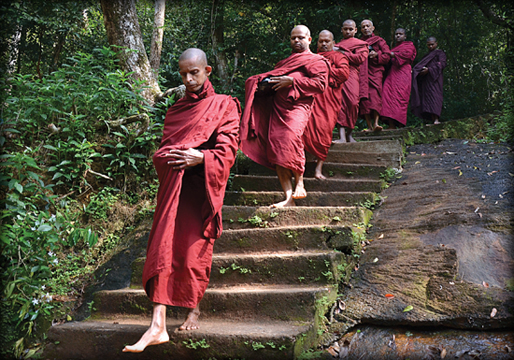
Ven. Thibbotugoda Rahula, in front, walking along with other Bhikkhus of Pindapatha under the forest canopy for midday meal to the alms hall in Bodhinagala hermitage.
Clad in deep brown robes the
monastic Bhikkhus walk in single file, composed, silent, and sedate.
There is beauty in this simple task, a kind of tranquility and harmony
that is in sync with the forest surroundings. With alms bowl in hand,
the monks make their way towards the ‘Dana Salawa’ (alms hall) where the
devotees wait in postures of piety, head bowed, hands clasped.
The scene is near surreal. Some of the male devotees wash the feet of the Bhikkhus while the others serve the ‘dana’ all the while chanting “Sadu, Sadu.”
In silent procession, the Bhikkhus retire to another alms hall a little distance away, sit down and prepare to partake of the food they just received. A sole brown robed figure stays behind in the ‘Dana Salawa’ to confer merit on the devotees who served alms.
Daily routine
This is a
moment in the daily routine of the Bhikkhus of the Bodhinagala forest
hermitage.
Nestling on the bank of the Kalu Ganga, near the Dobagaskanda hill in the outskirts of Ingiriya, the Bodhinagala hermitage lies beneath the leafy canopy of a rain forest reservation extending over 347 hectares. The natural rain forest shields the hermitage from the outside world, providing picture perfect serenity for the meditating Bhikkhus.
When I was a school boy in Botalegama, an adjoining village of Dombagaskanda, I used to hear the reverberation of Hevissi sound from the Bodhinagala forest hermitage in the early hours of the morning and evening. In those days, I had a fixed lens small camera and used to visit the hermitage to shoot the daily life in the hermitage. Each time I visited the hermitage I used to see one Bhikkhu, slender in build and fair in complexion, always walking in front of the group of Bhikkhus when they moved towards the alms hall. That was in the 1980s. However, during my recent visit to the hermitage, I decided to talk to this lone Bhikkhu and find out more about his life.
Up a stone pathway is his kuti (hut), furnished with a narrow bed, table and a low stool. The walls are adorned with pictures of the Buddha. The Kuti is surrounded by huge trees, which provide both ample shade and a sense of absolute calm. The silence of this serene scene is occasionally broken by the sound of a hornbill or monkey.
The Bhikkhu, 67-year-old Ven. Thibbotugoda Rahula, who has been living in the Bodhinagala forest hermitage since 1966, is the most senior resident of the hermitage. Welcoming me to his humble abode, he recounts the extraordinary story of journey to the hermitage and a life spent in meditation.

Ven. Thibbotugoda Rahula washes his bowl after the midday meal (Dana)
History
The history of the Bodhinagala forest hermitage goes back to the early 1950s. Ven. Olaboduwe Sri Revatha Dammakirthi Thera, a pious Buddhist monk and the principal of the Dharmadeepa Vippassana Piriwena in Kaluwamodara in Aluthgama was the founder of the hermitage. He came to Ingiriya to observe Vas on the invitation of devotees in the Raigam Korale. After the Vas season was over, the Bhikkhu prepared to go back, but the devotees persuaded him to stay permanently. The Bhikkhu with the help of a few villagers visited the thick forest of Dombagaskanda and at first sight, realized it was ideal for a forest hermitage.
The villagers and devotees in the Raigam Korale constructed the Kutis and other buildings in the Dobagaskanda forest and on June 4, 1955, the complete hermitage of Bodhinagala was offered to the Sanga. Initially, five Bhikkhus lived in the small Kuti (hut) in five acres of forest and later, it was expanded to 50 acres. Today, this hermitage has numerous constructions including Kutis, meditative walkways and medical halls, linked together and developed as a reputed forest hermitage in the country with around 15 resident Bhikkhus.
Born to a Buddhist farming
family in Thibbotugoda in Horana in 1948, Somawardena Kaluarachchi, as
he was then known, had his primary education at the Welikala Primary
School in Pokunuwita. From there he joined Sri Palee Collage, Horana,
and continued till ordinary level education. When Somawardena
Kaluarachchi was a small boy, he used to frequently visit his
grandmother’s house next door, because of the plethora of books
available there. Among the books he most liked to read were Buddhist
Jathaka stories.
Being the only son in a family eight, his father
gave everything for him. They had large acres of paddy lands, so they
were fairly well to do. He went to school by bullock-cart owned by his
father.
He studied up to the ordinary level, and dropped out, opting to study the Buddhist doctrine and enter the Bhikkhuhood. He had always associated with the village temple where he had learnt a lot about Buddhism.
“Soon I began to read more Buddhist books and I found myself being interested in the forest hermitage in Ingiriya. One day, I visited the hermitage with my father and met the Chief Monk. I told him I would like to enter the Bhikkhuhood. My parent gave permission for me to be a Bhikkhu,” once called Somawardena recalls while sitting on a stone slab in front of his humble Kuti.
His dreams were realized in 1966, when at the age of 19 he was ordained as Thibbotugoda Rahula under the guidance of Ven. Olaboduwe Dammakirthi Thera, the Chief Incumbent of the Bodhinagala hermitage. He lived in the hermitage as a samanera for several years, studying meditation practices with five Bhikkhus, before he attained Upasampadha in 1971 at the Asgiriya Temple in Kandy.
“Soon I became a Bhikkhu of the hermitage. I was provided everything I wanted as a Bhikkhu. Devotees gifted robes. My family members and relatives come to see me time to time. Even today, my sisters who are old now, visit me regularly,” he says.
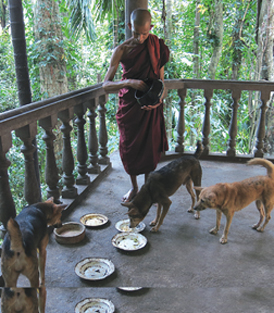
Ven. Thibbotugoda Rahula feeds dogs at the hermitage.
Organized timetable
Since becoming a monastic
Bhikkhu, Ven. Rahula has an organized timetable for daily routine in for
meditation, study and worship, which usually lasts until 10.00p.m. insight
meditation, usually sitting still last for one and a half to two hours,
twice a day. The daily program also includes a few domestic duties, with
priority being given to personal cleanliness. So the hermitage timetable
includes a daily bath, which is a must unless otherwise indisposed.
In the past forty years, Ven. Rahula has spent his monastic life practicing insight meditation, which is one of the most widely use Anapanasathi, the concentration on rhythmic inhalation and exhalation of breath.

Ven. Thibbotugoda Rahula in a pensive mood at his Kuti.
How to get there
To reach the Bodhinagala forest hermitage, one has to travel on the Panadura-Ratnapura (A-8) highway, turn left at the Aduragala junction and travel a further 2 kilometers along the minor road, which leads to the Kalu Ganga. Before coming to the river, the road branches off to the left and continues for another 1.5 kilometers and comes to an area where it reaches the foot of Dombagaskanda. Although the road up to the hill is motorable, it’s better to get off one’s vehicle at this point and walk through the forest.
“My day starts at 4.00a.m. At 6.00a.m. I walk (Pindapatha) for breakfast and around 9.30a.m. have a bath and get ready for the midday meal Pindapatha, which is at 10.00a.m at the alms hall. All the Bhikkhus in the hermitage gather in the upper alms hall from where we go pindapatha to the lower alms hall, which is a little distance away, where devotees offer alms to our begging bowls. We return to the upper alms hall and partake in our midday meal with all the Bhikkhus. After Dana, we rest for a little while and read the Dhamma books, which are gifts of the devotees,” he says, elaborating on the daily schedule, which rarely varies.
Ven. Rahula has been in charge of the Dhamma Chetiya in the hermitage for several years and he is responsible for holding the daily Buddha Puja. “At around 7.00p.m. the devotees, who come to offer alms the following day, take part in this special Buddha Puja called ‘Buddha Watha’, which takes about one hour. After finishing the day’s work I go to sleep at around 10.00p.m.,” he explains.
So do the monastic monks ever venture into the outside world? Being Vipassanadhura monks, Ven. Rahula says he and his fellow Bhikkhus are mainly in contemplation, and that with Vippassana Bhavana, insight meditation, being the dominant and central theme, they live mostly in secluded forest hermitage complexes call Aranya.
They do not take part to any religious activities in outside of the hermitage but if someone invites them to preach a sermon they will accept it.
03 05 2015 - Sunday Observer
J17.03
Beyond mere tolerance
Lionel Wijesiri

From its inception, the Buddhist attitude to other religions has been one of critical tolerance. But significance is that not a drop of blood has been shed throughout the ages in the propagation and dissemination of Buddhism in the many lands to which it spread. Religious wars either between the schools of Buddhism or against other religions have been unheard of.
Buddhism
has also shown a remarkable degree of tolerance and adaptability in the
course of its historical expansion. It may be useful to recall the
famous words of Lord Acton who said, “I may not agree with what you say,
but I will defend to the death, your right to say it”. What this means
is that mere tolerance is not enough. What is needed for our society
today is for everyone to believe what he or she wants to believe without
any hindrances from any quarter. This goes far beyond mere tolerances.
It involves a deep respect for the beliefs of others.
Acceptance
The followers of the Buddha were advised not to believe anything without considering it properly.
In the Kalama Sutta, the Buddha gave the following guidelines to a group of young people: ‘Do not accept anything based upon mere reports, traditions or hearsay; Nor upon the authority of religious texts; Nor upon mere reasons and arguments; Nor upon one’s own inference; Nor upon anything which appears to be true; Nor upon one’s own speculative opinion; Nor upon another’s seeming ability; Nor upon the consideration: ‘This is our Teacher.’ ‘But, when you know for yourselves the certain things are unwholesome and bad: tending to harm yourself of others, reject them; And when you know for yourselves that certain things are wholesome and good: conducive to the spiritual welfare of yourself as well as others, accept and follow them.’
Buddhists are advised to accept religious practices only after careful observation and analysis, and only after being certain that the method agrees with reason and is conducive to the good of one and all.
A layman faces a problem now. How can he select the right religion for him? Perhaps the Sandaka Sutta of the Majjhima Nikaya seems to supply the answer to this question.
Ananda, staying at the Ghositrama in Kosamb?, visits the Pilakkhaguha, where the Paribbajaka Sandaka is staying with some five hundred followers. Ananda is asked to give a discourse on the Buddha’s teachings, and he speaks of describes four wrong ways (views) of religious life.
(1) When the teacher holds the
view that it does not matter whether actions are good or bad;
(2)
When the teacher who holds the view that no evil is done by him who acts
himself or causes others to act;
(3) When the teacher holding the
view that there is no cause for either depravity or purity; and, lastly,
(4)
The teacher who holds, among other things, the view that men make an
end of ill only when they have completed their course of
transmigrations, like a ball of twine which continues rolling as long as
there is string to unwind.
This is evidently with reference to the teachings of Purana Kassapa, Makkhali Gosala and others.
Ananda then continues with the wrong views of leader of a religion. (1) When the teacher who claims to be all knowing and all seeing; (2) When the teacher whose doctrine is traditional and scriptural; (3) When the teacher is a rationalist of pure reason and criticism teaching a doctrine of his own reasoning; and, lastly, (4) When the teacher is stupid and deficient.
Ananda then describes the Buddha’s own teaching, leading up to the four Jhanas. Sandaka and his followers accept the Buddha as their teacher.
Religious labels
It should be clear from the above that the Buddhist attitude to other religions cannot be classified as one of dominance. The attitude would depend on the nature of the religion dealt with. Of course, if we discuss metaphysics and theology, there are differences among all religions. There is no way to get around the differences. It is more beneficial to look at the things that are in common. All the accepted world religions are seeking to improve the situation of humanity and to make life better by teaching people to follow ethical behaviour.
They all teach people not to become totally caught up in the material side of life, but at least to strike a balance between seeking material progress and spiritual progress.
From the Buddhist point of view, religious labels are not the most important aspects for people to be considered religious, but any person leading a respectable and harmless way of life can be regarded as religious. The methods used to introduce the teachings of the Buddha are rational and reasonable. The Buddha made his appeal through reason and experience. The teachings were presented with clear and impressive simplicity and yet kept free from religious and national narrowness and fanaticism.
They have produced clear and sober-minded people. This method of presentation cleared doubts and removed superstitious beliefs. Thus the teachings of the Buddha enlightened the hearts and minds. The Buddhist attitude of tolerance and understanding convinced many great thinkers, philosophers, rationalists, freethinkers and even agnostics to appreciate Buddhism as a peaceful way of life devoid of fear and superstition.
Example:
Often the
interaction among religions is at the highest level, where the people
are open and do not have prejudices. It is at lower levels that people
become insecure and develop a football team mentality: “This is my
football team and the other religions are opposing football teams!” With
such an attitude, we compete and fight.
Nowadays, there is a growing dialogue, based on mutual respect, between Buddhist masters and leaders of other religions. It is a good sign. On one occasion the Buddha was approached by an extremely wealthy person called Upali. This man was the follower of another religion and he wanted to join the Buddha but was unsure of how to treat his former teachers. The Buddha clearly stated that he was to treat them with the same respect as before and to continue to support them even if he no longer followed them. Throughout his life the Buddha urged people to respect all religious people in spite of the differences of opinion between them.
03 05 2015 - Sunday Observer
J17.04
Thoughts for Vesak
Pramod de silva

He who reveres those worthy of reverence, the Buddhas and their disciples, who have transcended all obstacles and passed beyond the reach of sorrow and lamentation - he who reveres such peaceful and fearless ones, his merit none can compute by any measure. (Buddhavagga, Dhammapada)
Vesak, which celebrates the Birth, Enlightenment and the Passing Away of the Buddha has now become a global event, but it is only in Sri Lanka that Vesak is celebrated on such a large scale. There are spiritual and material poojas to the Buddha all over the country, where Vesak is celebrated as a national festival, not just a festival limited to Buddhists.
Vesak has always been, and always will be, a time for unity. It is not only Buddhists who take part in Vesak activities. It is truly a national event where the whole country comes together as one. Many Vesak dansalas, pandals and decorations are put up by organisations headed by non-Buddhists. Singers from all communities join hands to sing devotional songs for Vesak.
In fact, some of the most well-known Buddhist songs, played repeatedly on radio stations during Vesak, have been performed by non-Buddhists. Non-Buddhists help their Buddhist neighbours with their Vesak decorations. Such religious and communal unity is vital to the development of our country and Vesak is an occasion which reinforces these bonds. This is in accordance with the teachings of the Enlightened One, who advised His followers to respect other religions and their views.
Vesak, the Holiest Day for Buddhists, gives them another opportunity to begin life anew by adhering firmly to the Dhamma. “He who practices the Dhamma abides in happiness with mind pacified; the wise man ever delights in the Dhamma.” (Pandithavagga, The Dhammapada). The Dhamma has shown us how to lead fulfilled, pious lives without contaminating our minds with evil thoughts. Our Nation too is making a new start after three decades of bloodshed, under a new administration that is committed to uphold Buddhist values of compassion and peace.
Appropriate
Thus Vesak this year is most appropriate for spreading the message of peace and reconciliation, the need of the hour. Today, the Nation is at a crossroads, having opted for unity and peace instead of discord and rancour. We have the Herculean task of rebuilding the Nation ahead of us. And the Buddha Dhamma offers ample guidance for such a process of healing and rebuilding of trust among all our peoples.
The Buddha during one of his visits to our island settled a dispute between two factions, stressing the importance of peace. His message of peace resonates to this day, for His words are immortal and timeless. The Buddha advocated compassion for all beings, human and animal and enunciated that hatred does not cease by hatred, but by love.
Indeed, these are moral values that our society has lost sight of in the relentless pursuit of material wealth. This is not surprising in a highly commercialised world, where money is generally regarded as ‘everything’. In fact, the Vesak festival itself is commercialised to such an extent that many have forgotten its very purpose and foundation. We see the glitter and glamour in the illuminations, the pandals but fail to turn the light inwards to our inner selves with a view to purifying our thoughts, words and deeds. We should see beyond the decorations and strive to understand the Buddha Dhamma and how it relates to our day-to-day lives.
Suffering
The Buddha exhorted that affinity towards material things leads to constant suffering through Samsara. The Four Noble Truths and the Eight Fold Path espoused by the Buddha point the way towards a permanent end to this suffering - Nirvana, the State of Supreme Bliss. According to the Dhammapada: “Do not follow a life of evil; do not live heedlessly; do not have false views; do not value worldly things. In this way one can get rid of suffering.” (Lokavagga, The Dhammapada)
While this is the ultimate goal of every Buddhist, it would be wrong to assume that Buddhism is a very complicated philosophy that offers nothing for our lay lives. The Buddha had plenty of advice to offer for lay persons who want to lead to pious lives in their Samsaric journey. He made it clear that inner peace or cleansing the mind was the first step in this endeavour. “The mind is hard to check. It is swift and wanders at will. To control it is good. A controlled mind is conducive to happiness.” (Chitta Vagga, The Dhammapada). Thus thoughts of peace and compassion should emanate from the mind at all times and a Nation that collectively engages in this exercise will see peace and unity.
In this exercise, it is essential to revive the link between the village and the temple (and other places of worship). Many of us have distanced ourselves from places of worship. This Vesak should see a revival of this age-old link. It is also vital to inculcate moral values in the younger generation who have embraced the material world and even the virtual world via the Internet. They are exposed to a high level of violence through movies and video games from an early age.
Tolerance
Indeed, practising tolerance and compassion as taught by the great religious leaders will help reduce violence and crime in our society. Crimes almost always happen due to hatred of some sort and the Buddha’s immortal words (“Hatred does not cease by hatred, hatred ceases by love alone”) can heal wounds of the mind and make us better human beings. We need plenty of love and compassion in our society, not only towards humans but also towards animals who live in our midst. A love of nature was one of Buddha’s major traits (He paid a tribute to the very tree that gave him shelter to attain Enlightenment) and we too should have the same respect for nature.
“Of all the paths the Eightfold Path is the best; of all the truths the Four Noble Truths are the best; of all things passionlessness is the best: of men the Seeing One (the Buddha) is the best.” (Maggavagga, Dhammapada)
03 05 2015 - Sunday Observer
J17.05
Is it correct to call the Buddha’s Teaching a religion?
Dr. Primrose Jayasinghe

Although there are places of Buddhist ‘worship’ that one could visit in order to contemplate His Teaching (The Dharma or The Doctrine), there is no compulsion to attend these temples
Having just ushered in a traditional new year, swiftly to be followed by the most important Buddhist celebrations, it seems an opportune moment to take stock of what one has learned during the past year, especially any ‘new revelations’. My thoughts were mixed as I had done only a few important things, but the one thing that kept recurring was the thought that Buddhism is not really a religion after all! Let’s consider if this might be valid:
To my mind, Buddhism is a doctrine that surpasses the narrow confines of a ‘religion’. These are my own inferences, having read some of the salient features of Buddhist Teaching.
Buddhism is very well
established throughout the world, more particularly in the East, and
still continues to offer solace, without distinction, to the millions
who have followed Buddha’s Teaching for over 2,600 years. Although
there’s no convention for an institutionalisation of Buddhism as a
‘religion’, as found in the various other popular religions of the
world, the Buddha’s Teaching swept far and wide merely by word-of-mouth,
encompassing the Middle East, ancient Greece and parts of Europe
(including Russia), on its way to becoming a world ‘religion’.
Presently, however, while it persists in the East, Buddhism has dwindled
elsewhere, as newer religions have become established. ‘The Teaching of
the Buddha’ or Buddhism, in commonly parlance, is generally practised as
a ‘religion’, with all the trimmings associated with that word. I cannot
help but wonder whether this is truly the right thing to do. It is
possible that some readers concur with my line of thinking, but let me
present my case anyway, about why I think ‘religion’ is a misnomer here.
The Oxford English Dictionary defines ‘religion’ as a “belief in, and worship of, a superhuman controlling power – a God or Gods”. Thus, it is obvious that Buddhism cannot be defined as a ‘religion’ in these conventional terms. The very first fact we accept is that Buddha is not a God; hence there is no compulsion to ‘worship’ him. There is no acknowledgement of a super-being in heaven, with an omnipotent presence and power over beings on Earth. The Buddha is human, with no ‘controlling power’. Therefore, the use of the word ‘religion’ is already questionable. Buddha is not derived from a ‘powerful spiritual being’, so He is not a ‘messenger’ from heaven; neither has He described Himself as a ‘God’. Though there is no coercion to worship Him, all Buddhists will invariably show Him respect as acknowledgement of His status – as a Buddha or “Enlightened One” – by bringing their palms together. This is not only a mark of reverence but also an expression of gratitude for the incomparable Teaching He has placed before us. According to the Mangala Sutta, to ‘venerate’ those who deserve to be venerated, is a ‘blessing’. So to Buddhists, the Buddha is a ‘special human being’ suitable to be revered and venerated.
Although there are places of Buddhist ‘worship’ that one could visit in order to contemplate His Teaching (The Dharma or The Doctrine), there is no compulsion to attend these temples. The word ‘worship’ is used here in the broadest sense (such as when it is used in the act of showing respect to one’s parents, teachers or elders); it is not equivalent to ‘praying’. Buddhism recognises the individual freedom in the choice of one’s ‘religion’, but if the need is for ‘prayer’, then Buddhism is not the right choice – there is indeed no-one to pray to! Buddha is not a god. He does not answer prayers. He is not in ‘heaven’. Unless the word ‘prayer’ is used casually, the chanting associated with Buddhism is merely recitation of the Buddha’s word, written down by disciples many years after His passing. Buddhism is one doctrine that existed for three centuries in the oral tradition, with no written scriptures or ‘prayers’.
The sole aspiration of each disciple was to break away from repeated births: in other words, to attain Nirvana. To achieve this, it was necessary to develop an advanced culture of Morality (Seela), Mental Discipline (Samadhi) and Wisdom (Pragna) – under a proficient teacher in the absence of The Buddha Himself. There was no need for the written word then. This discipline is unique to the practice of Buddhism. To follow it, one merely needs to be convinced of The Dharma. Accordingly, can Buddhism be a ‘religion’?
There are a few principles of Buddhism that make His doctrine stand out from other ‘religions’. One is the identification and acknowledgement of the everyday-problem of ‘Dukkha’ or, for the lack of a better word, ‘Suffering’. The Pali word, dukkha, is not easy to define: it is a state of ‘un-satisfactoriness’ that exists in every aspect of our lives. The happiness we enjoy is short-lived or could end up in sorrow. Think about it or observe it objectively and you’ll see that this is what life offers us. This is the reality, but we tend to ignore it as we are enthralled with the few moments of enjoyment or pleasure we perceive. The fact that life is fraught with ‘un-satisfactoriness’ is not recognised in other religions. Although difficult to comprehend, those who are open-minded are likely to understand what is meant by ‘suffering’.
The ‘reality’ of dukkha was propounded by the Buddha in His first sermon after Enlightenment, the Dhamma-chakka-pavattana Sutta, before His five fellow ‘truth-seeker’ ascetics. Dukkha was the first of The Four Noble Truths, one of The Founding Principles of Buddhism, explaining the reality of this existence. One is responsible for one’s own state; no god can be blamed for it. Therefore the Buddha’s Teaching is to define ‘Reality’. Bringing it closer to home, think of the changes that accompany ageing: degeneration and decay. These are not changes we like; they cause dukkha – distress and pain – but that is the certain reality: nothing remains the same in the present or forever. Nothing is eternal. Everything is Impermanent (Anichchaā) causing pain and disgust. It’s impossible to deny ‘suffering’ or ‘un-satisfactoriness’, but most unfortunately nothing can be done, no ‘medicine’ be taken, to stop this onslaught. The only way out is through a fervent effort to break away from this dreary state of woe and cut short the cycle of rebirth.
Rebirth, did I say? One cannot, so far, prove or disprove rebirth, but there is enough circumstantial evidence that that’s the most likely outcome following our death. Research around rebirth has been conducted and books have also been written, for instance by the likes of Professor Ian Stevenson and his team from the University of Virginia.
If one has an enquiring mind and is convinced that there is dukkha in everything around us, then one can decide to eradicate it by following the Noble Eight-fold Path. As outlined in the above sermon, the Buddha encourages us to look at everything objectively; in so doing, you’ll realise that you’re the only one who can help yourself to change this status quo, and that is by eradicating dukkha. There is no place for faith here; no amount of praying will help. The eradication of dukkha takes place only through your own efforts to attain Nirvana. Buddhism teaches us to focus on ‘reality’ or ‘things as they really are’. Scientifically-speaking, we know what we’re made of – the elements of the universe! Various combinations of these elements form everything in this world, including our body, which is functional through chemical and electrical reactions that have developed according to specific cellular programming over millennia. Nothing remains static; everything is in a state of flux across this universe. Therefore everything can be broken down to the finest particle, but also rebuilt when conditions are satisfied for the process. Broadly speaking, there is nothing more than that. Science cannot deny dukkha or impermanence as part of ‘reality’, and no other ‘religion’ professes these two realities are worth overcoming.

There is no concept of a ‘creator’ in Buddhism. Instead, the Buddha strongly confirms that we undergo repeated cycles of birth and death, depending on our own actions. He calls it Karma – actions we all do, good or bad, through mind, word and deed. Just as science confirms that every action has an equal and opposite reaction, so would karma become instrumental in conditioning another existence relevant to the accumulated worth of the karma. This process will continue until one breaks away from the cycles of rebirth on attaining the final stage of sainthood (arahanth), on the verge of Nirvana. This is His Teaching of the existence of the ‘Cause and Effect’ phenomenon, known as ‘Patichcha Samuppada’ or ‘Dependent Origination’. In other words, the arising of everything is dependent on a cause. There is no place for an intermediary; it’s all a part of the ‘reality’ of the existence of things.
Just as the phrase ‘things as they really are’ means that we’re made of the same stuff as the rest of the universe, to my mind, the Buddha’s Teaching offers the prospect of extrapolating the process of evolution. We, as human beings have ended up in the most desirable of existences, being at the top of the animal kingdom. The Buddha stated that this Earth (mangala loka in Pali) is the most salubrious place to be born, and to be born a human is indeed the highest blessing! What the Buddha elaborated is what is most needed by us to end these cycles of rebirth and therefore, dukkha.
Nirvana is not ‘heaven’. It is supra-mundane alright, but quite unlike ‘heaven’. The use of the prefix ‘Ni’, meaning “without”, describes it in the negative, as that “state which is ‘free of’ craving”; thereby denoting the ending of the continuity of the ‘being’ through his/her cycles of existence when the flames of craving that establishes rebirth are totally extinguished.
Given the above, albeit in gist, I am of the firm opinion that Buddhism is certainly not a religion. Can we call it a science? We could. However, as this doctrine was propounded over 2,500 years ago, none of it is in the scientific terms we use today, although there is undoubtedly a great deal of science and reasoning to comprehend within it. One needs patience and commitment to delve into its depths, if one is serious enough to want to study it.
Is it a philosophy? To my mind this is quite unlikely, too. It is not a belief system or a set of theories or hypotheses that can be broken down or superseded in the expanse of time. Buddhist Teaching has endured and remained true to the original writing, even going into this third millennium. There are no addenda, revisions or alterations. The doctrine has been described as ‘timeless’ and equally valid at any given time. When one ‘looks back’ on the Teaching, it is ‘true’ today, as it was yesterday, and it will remain true in the future, as it deals with ‘things as they really are’.
Becoming a Buddha is an extraordinary feat for a human to achieve. Being called The Enlightened One means that He has actively achieved infinite knowledge, wisdom, science, vision and light, and through this expertise He has guided countless other human beings to break away from sansara (cycles of birth and death) and attain Nirvana, after which rebirth is extinguished.
My own conclusion is that the Buddha Dharma is the Teaching of the existing ‘reality’. Therefore, I would like to call the Buddha’s Doctrine, ‘Realism’ rather than a ‘religion’ or a ‘philosophy’, since it teaches us what is real and factual, and encourages us to view things ‘as they really are. What about you? Why not take the opportunity to read the Teachings of the Buddha yourself and see if they fit in with your line of thinking? No compulsion!
J17.06
A 2500-year-old message of compassion and love
Udumbara Udugama

The Nepalese frontier of
Kapilavasthu was where Buddha lived until he gave up his worldly life in
search of truth and Enlightenment
As the country prepared to
celebrate Vesak, we received the shattering news that Nepal, the
Buddha’s country has been devastated by a massive earthquake which
caused the loss of over 5,000 lives. Homes and historic sites in the
land of the Buddha have also been destroyed.

A man cries as he walks past a damaged statue of Lord Buddha surrounded by debris from a collapsed temple in the UNESCO World Heritage Site of Bhaktapur on April 26, in Bhaktapur, Nepal. Such World Heritage Sites are a major part of Nepal’s tourism industry, which will take a major hit as a result of the earthquake (Reuters).
This year, the full-moon Poya falls today, May 3 and Buddhists the world over will celebrate the Thrice Blessed Day of Vesak, the Birth, Enlightenment and Parinibbhana of the Sakyamuni Gautama Buddha.
Kapilawasthu or Kapilavatthu on the Nepalese border, the capital of the kingdom of the Sakyans was where the young Prince Siddhartha Gautama lived until he gave up his worldly life in search of truth and Enlightenment.
Kshatriya King Suddhodana was the ruler of Kapilawasthu. His Queen Mahamaya, a princess of the Koliyas, on her way to her parental home stepped into the Lumbini Sal Grove where the sweet scented Sal flowers were in bloom. It was under the shade of a Sal tree that the Queen gave birth. The King’s happiness knew no bounds. Named Siddhartha Gautama, the prince lived in the lap of luxury. At his birth, it was predicted by the wise men, seven Brahmins, that if he remained to rule he would become a universal monarch, a cakravarti but if he renounced the world, he would become a Supremely Enlightened One. But Kondanna, the youngest and the wisest, said that he would definitely go in search of truth and become a Supremely Enlightened Buddha. The King was not happy to learn of this prediction, as he wished his son to inherit his kingdom and rule as a cakravarti. At the young age of sixteen, the Prince was married to his beautiful cousin Princess Yasodhara.
The worried King Suddhodana built three palaces for the prince to spend the three seasons in India. Living in the lap of luxury with music, song and dance, food and laughter, the Prince did not know of any sorrow; an illusion that was created to keep the Prince tied to the material world. But the father’s endeavours to keep his son attached to worldly pleasures was futile.
The turning point for the deep thinking, contemplative Prince was the four visions he encountered during his visits to the city. On the first occasion, when he was on his way to the royal gardens he saw a man very old and feeble. Next, he saw a sick man with sores on his body. On the third occasion he saw some men carrying a dead body on a plank. He looked at Channa his charioteer in surprise who explained to the Prince that everyone born to this life ages, will be subject to disease and finally die. On the fourth occasion, the Prince saw a calm and serene figure of a recluse. The Prince was impressed and was in deep thought. On his way home, he received a message that his wife Yasodhara had given birth to a son. He uttered the words “it is a fetter, I have a bond.” He believed that this attachment would deter his search for the Truth.

A painting at Isipathanaramaya in Colombo depicting the birth of Prince Siddhartha
At the age of 29, he renounced his worldly life to lead the life of an ascetic, a mendicant. He struggled for six long years without any results. Realising that self-mortification did not help him in his search, he gave up fasting and took normal meals and believed in the Middle Path. His search was directed inwards to his own mind. Regaining strength in body and mind, he sat in solitude under a Bo tree on the bank of Neranjara the river which flowed through Gaya (Buddhagaya) to meditate and resolved, “even though only my skin, sinews and bones remain and my blood and flesh dry up, I will not rise from this seat until I have attained full enlightenment.”
He concentrated on his ‘in and out breathing’ to gain mindfulness (anapana sati). His mind was cleared of impurities and at the age of 35, again on a full moon day in May, attained Supreme Enlightenment, to be the Buddha. For 45 long years he fulfilled his mission of teaching the dhamma and at the age of 80 passed away, the final parinibbhana, ending the life circle of birth and death, once again on a full moon poya day in May, in Kusinara, the kingdom of the Mallas.
With the spread of Buddhism, society changed. Buddha categorised the people as Bhikkshu, Bhikshuni, Upasaka, Upasika and not according to caste or creed. Due to the spread of Buddhism, the culture, architecture and rituals influenced the life-style of the people in countries around the world.
Today Buddhism is alive as it was over 2,500 years ago. We should venerate the Buddha on Vesak day by remembering His message of compassion and universal love to all beings and not only by way of material worship. In their hour of need, as a meritorious deed, we should think of sending all that we would spend on Vesak ‘dansalas’ to the people of Nepal who are suffering today with the loss of their loved ones and homes.
J17.07
Buddha’s wisdom and a universal law
Mervyn Samarakoon

‘Kamma’ as pronounced by Gautama Buddha denotes wholesome actions of mind, speech and body that beget benevolent results and unwholesome actions unwholesome results. This law is timeless, insurmountable and applies in equal measure to all.
Around 26 centuries ago on a
day as today a most remarkable event in the history of the world took
place when wisdom dawned on earth with the Great Enlightenment of
Gautama Buddha. A world lost in abysmal darkness for countless aeons was
swathed in the benign glow of an astounding discovery made by the Great
Sage. The abstruse mentality-materiality nexus of life and the solitary
path to the extinction of existential desire, lay bare. Hitherto
mysterious phenomenon known as “karma” appeared to Him in all its
clarity and formed a cornerstone of the marvellous doctrine He presented
before the world. The great repository Tripitaka stands lucid testimony.
Kamma as pronounced by the Enlightened One briefly denotes wholesome and unwholesome volitions (cetana) that arise in one’s mind and accompanying mental factors that shape one’s destiny. Wholesome actions of mind, speech and body, He said, beget benevolent results and unwholesome actions unwholesome results. This law is timeless, insurmountable, applies in equal measure to all, a Samma Sambuddha included. The text says there is no place in the sky or in the bowel of the earth or at the bottom of the sea that one can escape it. Even the Greatest Being on earth is not exempt from the juggernaut.
Yet, disbelievers abound and one who did in ancient India was Makkalighsla the propounder of the theory that it is totally inconsequential if a man walks the banks of river Ganges maiming and killing those he confronts on the way. The human mind knows no bounds in its depths of aberration.
Profound Abidhamma preached to devas and thereafter to Ven. Sariputta by Buddha explained that even an unpleasant sight (such as of a tortured or murdered man) is the consequential result of one’s unfortunate kamma (acts) of the past, and if one is saddened or angered by it, he acquires further harmful kamma of an ominous nature that adversely bears upon him in the future. An adept and trained mind however, is capable of harnessing that sight into a topic of insight meditation on anicca, dukkha, anatta leading to the final understanding of oneself, of the cosmos and all things beyond. The said rationale behoves a pleasant consciousness gained such as the vision of benign Buddha or the sound of sublime dhamma preached generates equally beneficial after-results. The principle applies to beings even lesser than humans, eg. the nocturnal bird who gained happiness from the sight of the Noble One early every morning-commentary on MangalaSutta.
The enormity of a Buddha’s samsaric merit (good karma) prevents Him from witnessing anything abhorrent such as the agonising last moments of the evil monks Devadatta and Kklika. The law of nature holds supreme over all things corporeal and incorporeal until the principle is theoretically comprehended and practically overcome through the insightful Eightfold Path.
The present essay concerns Buddha’s sermon titled Pubbakammapil thik pad na, delivered by the Noble One to his disciples while resting on an outcrop near lake Anothaththa in the vicinity of the magnificent Himalayas. It begins dramatically, “O monks, listen to my past karma. Karma-result spares not even a Buddha”. During the dispensation of Kashyapa Buddha, he was a brahmin of high caste by the name of Jothipala and he ridiculed Kassapa Buddha as a bald-headed empty recluse. Later he entered the order and made the definitive prediction that he would be a future Buddha called Gautama. However, that unpardonable act made him undergo untold suffering in countless lives and pursued him unto his very last life on earth. As punishment he was made to starve for six long years during his search for the ultimate truth by following a wrong path of inflicting rigours on himself and abstaining from taking food. His physical appearance took the form of a living skeleton, a peta. He dropped unconscious on countless occasions until he realised penance was not the path of emancipation. Thus did the Noble One pay for a crime long lost from memory.

Incidentally, the one who introduced Jothipala to Kassapa Buddha then was Ghateekara, the low-caste humble potter of Vehalinga, faithful friend of Kassapa Buddha, attainer of Angmihood, leading a chaste life and caring for his blind parents, receiving the bare necessaries of life with barter of his pottery produce since he refrained from handling money. The unending effort of Ghateekar to persuade his friend to meet Kassapa Buddha as traced in the sutta is simply spellbinding, to say the least. How one day kalpas later, Ghateekara reborn as a deva in AvihaBrahmwsa, soon after midnight descends on Jetawanrmaya lighting up the entire sky and begins a “nostalgic” conversation with his old friend Jothipala now Gautama Buddha, recounting their friendship at Vehalinga is equally fascinating. The Kassapa Buddha-Jothipala-Ghateekara encounter verily requires a separate presentation.
Of the 12 kamma-effect instances mentioned by Buddha, the second concerns vilification He had to face at the hands of a ravishingly beautiful woman named Chinchi. Spurred on by her religious teachers the heretics whose popularity was on the wane because of the Noble One, she pretends she leaves Jetawanaramaya in the morning about the same time devotees come in to pay homage. It is none of your business, says she, when questioned by the devotees where she spent the night. As time passes she is bold enough to say she spends the night with Buddha. The mundane ones believe it, not attainees of sowanhood.
On a particular day when Buddha is preaching to an audience with the king in attendance, she arrives covered in a red cloth to hide her simulated pregnancy and blurts out “Great preacher, you deliver sermons here but do not inquire whether I who carries your child need a crumb of food (lunumiris)." Buddha declares calmly, “Sister, only two persons, you and I know whether it is truth or not”.
Those words of a Samma Sambuddha are too profound to go unacknowledged. Through intervention of gods Chinchi’s simulated pregnancy disappears and she is chased out of the preaching hall by the gathering. As she exits Buddha’s view, the earth unable to remain still, opens up for rising flames from Avichi hell to envelop her. Not even the Noble One could help it.
Buddha declared His past karma- “In the long past as a man of low birth by the name of Munli given to many a vice, I insulted a Pacceka Buddha named Surabhi possessed of immense irdi powers as an immoral sinner. In consequence, I spent several tens of thousands of years in Avichi, the residue being the insinuation of Chinchchi.”
It being so, misguided heretics never abandoned hope. In a desperate situation of succour, they relied on another follower of theirs, a young woman called Sundari. The plot was identical to Chinchi’s, where she is seen moving in the temple in the wrong direction at the right time. To whomever she meets her demure reply is that it is a rendezvous with Buddha. Her masters do not fail to join her in chorus. Again sceptics begin to believe them.
However, heretics soon realise their scheme does not yield the desired results. They hire some criminals to murder Sundari and the body to be hidden in the refuse pit near Jetawanaramaya. The king is informed of the murder and Buddha is slandered across the city. Finally however, the murderers are found out by the king’s spies and the conspirators along with the murderers are ordered by the king to be executed together and buried in the same pit. The commentary presents a vivid account of the episode.
The Noble One was a Brahmin once who abandoned the lay life to become a pious hermit in the Himalayas living a rigid life with his students. While so living he came across a virtuous ascetic named Bheema possessed of supernormal powers. Being overcome with jealousy, he derided the ascetic as an immoral knave. His pupils did the same. Vagaries of the human mind however developed, are unpredictable. The temporary but intense humiliation Buddha and His disciples faced through Sundari was its sequel.
Again Bodhisatta born into a prosperous family aeons ago, after the demise of his father quarrelled with his younger brother over the father’s wealth. He dispossessed his brother of his share and finally killed him. A countless number of years spent in the netherworld did not dissipate the crime, and in his birth as Seriwanija he was to meet his future tormentor who would follow him unto the end. He was Devadatta, his brother-in-law, nature’s own conduit of reprisals. He caused a bleeding injury on Buddha’s foot in an attempt to do the impossible, to kill him. As explained by Buddha, it was the consequence of an evil act of his in the extreme past where as a boy playing on the street he injured an alms-seeking Pacceka Buddha with a stone. Time did not obliterate the misdeed.

The incident concerning the drunken tusker Nalagiri charging towards the Noble One in all its fury as plotted by Devadatta is known to all. The boundless compassion Buddha displayed towards His son Rahula, His tormentor Devadatta and towards every living being was directed at Nalagiri this time in equal measure. The mighty beast struck by the avalanche of kindness fell at His feet like a docile pet, whereupon Buddha placed His palm on its forehead. The commentary states, petrified onlookers in hiding rushed out to throw their jewellery at Nalagiri in exultation. The origin of this episode was traced by the Buddha to a time when he was a mahout who prodded his animal to advance menacingly at an alms-seeking Pacceka Bodhi-attainer. The monstrous act followed Him upto His last birth of none less than Buddahood itself.
Buddha recounts in vivid detail, the rest of the 12 instances when nature accosted Him with unpleasant repercussion of His previous unwholesome deeds despite the fact that He was the undisputed Master of the three worlds.
The twelfth and final misdeed which pursued Him unto Buddahood relates to a time when he was a clever physician. Being negligent in the treatment of a patient entrusted to his care who ought to have been given a particular course of treatment knowingly administered a wrong drug instead which made the patient vomit blood. When Buddha’s life-span was about to end, time was also ripe for the aeons-old misdeed to come alive. The Great Being was afflicted with the disease known as “lahithapakkandika”- vomiting of blood. The strength of millions of elephants simply vanished, said the commentary of Arahats. Kamma did not spare even the Diety of Deities. Thus ended the rarest life on earth.
“Beings are owners of their actions, heirs to their actions, they originate from their actions, are bound to their actions, have their actions as refuge. It is actions that distinguish beings as inferior or superior.
They are the cause and condition for people to be short-lived and long-lived, sickly and healthy, ugly and beautiful, uninfluential and influential, poor and wealthy, low-born and high-born, stupid and wise” said the Buddha in reply to a question of Subha, a brahmin’s son Chlaka-mmavibhanga-Sutta, MajjimaNikaya.
Buddha in His wisdom did not beseech people to relegate all things to kamma in complacence. Kamma is a facet of the doctrine, not its terminus. He invoked one and all to penetrate the veil of delusion and seek the Dhamma in earnest like a “man desperately attempting to extinguish a fire that has overwhelmed him”.
“Constantly engulfed in flames, what laughter, what merriment?” said He. “Immersed in darkness, why isn’t the light being sought?”- Jar Wagga, Kuddhaka Nikaya.
Karmic theory and Nirvana are beyond the reach of scientific research since they are not subjects of empirical study, but objects of supermundane “vision”.
J17.08
Discovering the law of cause and effect under the Bo tree
Anagarika Dharmapala

The Blessed One, the Buddha Sakyamuni, proclaimed the Doctrine of Nirvana for the happiness and welfare of human and divine beings, who had the qualifications to comprehend the lofty doctrine, which had been similarly proclaimed by the Buddhas of the past.
To comprehend the principles of the Nirvana Doctrine one has to walk in the Noble Eightfold Path, destroy the ten ‘samyojana’ fetters, get rid of the five ‘nivaranas’ which are obstacles for the attainment of mystic illumination which is called Dhyana or Jhana. Pragna and Dhyana are inter-related, as is declared in the Dhammapada gatha.
‘Natti Jhanam apannassa natthi ajhyato’, which means that Dhyana is not for the man deficient in the higher wisdom, and to him who has not the attainment of Jhana there can be no super-wisdom. When the two are combined in the devotee he stands on the threshold of Nirvana.
The path of mortification of the body is traversed by ascetics to gain emancipation from ‘sanasara’. In ancient India asceticism was a form of religion practised until death. The Prince Siddhartha after he made the Great Renunciation in his 29th year practised the most oppressive form of bodily mortification in order to gain deliverance from samsaric sorrow. Ancient Indian sages knew of the torments of samsara, and they made asceticism a vehicle in order to get out of the circle of samsara. The Prince Siddhartha followed the ancient method and continued the ascetic method for six years in the most virulent form as detailed in the ‘Bhaya berana sutta’ in the Majjima Nikaya. When he had realised that even the extremist form of asceticism did not give an insight into the comprehension of truth he abandoned the tortuous path and discovered the Middle Path which avoids the extremes of asceticism and sensuous pleasures.
To get an insight into the history of the evolution of the doctrine of Nirvana, the earnest student has to get a clear view of the life of the Blessed One. This means that he has to study the Pali texts as they contain authentic accounts of the life of the Blessed One. The first book that one should read is the Mahavagga of the Vinaya Pitaka to get an idea of the foundation of the Nirvana doctrine.
There you read the Prince ascetic sitting at the foot of the Bodhi Tree on the bank of the river Neranjara was enjoying the bliss of deliverance (‘vimurisuka pati samvedi’) and in that state He had discovered the law of inter-related causes and effects beginning with Ignorance as the immediate cause of all sorrows and sufferings in the world of cosmic phenomenon. Why should man as such suffer, was the question he wished to solve. The cause of sorrow, misery, suffering, disappointment, despair, lamentation, anguish in the life of man was due to ‘avidya’ (ignorance). Ignorance produces sankharic ideations in the mind, which giveth rising to ‘Trishna’, and the two elemental causes keep men and gods tied to the wheel of samsara, and they continue to whirl round until the two causes are destroyed. In the Anamatagga Samyutta, Samyutta Nikaya, the Blessed One declares: Beginning-less is the circle of samsara, whose ultimate point is beyond knowledge. Under the glamour of ignorance, and fettered by unsatisfying sensuous desire the individual being (‘satta’) continues to run round the circle.
It is said that the Bodhisatva before He gained supreme enlightenment of a perfect Buddha gained the divine right to look back into the past and to the future. He saw by his divine knowledge that man was not a created being but had existed from the beginning-less past and that after death he was reborn according to karma he had done, that the karma of the past had brought him into the present existence, and that the karmic energy generated here in this life make him to be reborn in the next. He saw an infinite past, and an infinite future, and the law of cosmic change working in the universe, with numberless solar systems, world systems in their nebulous states, other habitable worlds also numberless. Birth, death and decay are the constituents of the endless samsara, and in this net He found men and Gods struggling and dying. Under the Bodhi tree he discovered the panacea of Immortality, which brings relief to the suffering wayfarer. He arrived at the condition of supreme wisdom which gave Him power to keep the mind disentangled from sansaric reproductions. and cosmic desires. No more birth, no more death. He had won the state of Nirvana.
Nirvana is a state of; positive realization free from ignorance, ignoble desires, hatred, ill-will, pride, covetousness, false beliefs, and full of faith, energy, vigilance, peace and wisdom. Love universal and supreme wisdom find their consummation in Nirvana. The path to reach the goal is the Noble Eightfold Path: Right Insight, Right Yearnings, Right Speech, Right Deeds, Right Livelihood, Right Exertion, Right Analysis and Right Illumination. To elaborate, Right Insight is to be freed from metaphysical aberrations, superstitions, heathen beliefs, dependence on ignoble rituals; Right Yearnings generating thoughts of love, compassion, pity, harmlessness, and renunciation from ignoble sensuous pleasures; Right Deeds freed from destruction, dishonesty, lustfulness and intemperance; Right Livelihood wherein one gains from one’s livelihood freed from cruelty, selling nothing that will cause suffering or pain to another; Right Exertion where he makes a strenuous effort to avoid evil and do good in the word, deed and thought; Right Analysis whereby he purifies his mind from the impurities of the body, feelings, thoughts and acquires the right mind to follow the principles of enlightenment avoiding the obstacles which prevent his progress in the path of Nirvana. With these weapons in hand he prepares himself to enter the right Samadhi which requires the wayfarer to practise the four Jhanas, whose realization brings him into the threshold of Vimuktic emancipation. All Ignorance is annihilated, ignoble desires are forever abandoned, and he lives realizing Nirvana in perfect consciousness.
From Mahabodhi Journal Vol.31, July 1923. Paper read at the first Buddhist Convention held in connection with the Sarnath University.
J17.09
An introduction to Buddhism and Gothama Buddha
Ven. Piyadassi Thera

The Buddha, the founder of the
great religious philosophy of Buddhism, lived in North India over two
thousand and five hundred years ago and was known as
Siddhattha (Siddhartha = one whose purpose has been achieved).
Gotama (Sanskrit = Gautama) was his family name. His father, King
Suddhodana, ruled over the land of the Sakyans at Kapilavatthu on the
Nepalese frontier. His queen was Mahamaya, a princess of the Koliyas.
On a full-moon day of May, when the trees were laden with leaf,
flower and fruit, and man, bird and beast were in joyous mood, Queen
Mahamaya was travelling in state from Kapilavatthu to Devadaha, her
parental home, according to the custom of the times, to give birth to
her child. But that was not to be, for halfway between the two cities,
in the Lumbini grove, under the shade of a flowering Sal tree, she
brought forth a son.
Lumbini or Rummindei, the name by which it
is now known, is 100 miles north of Variinasi and within sight of the
snowcapped Himalayas. At this memorable spot where Prince Siddhattha,
the future Buddha, was born, Emperor Asoka, 316 years after the event,
erected a mighty stone pillar to mark the holy spot. The inscription
engraved on the pillar in five lines consists of ninety-three Asokan
(brahmi) characters, amongst which occurs the following:
‘Hida
Budhe jate Sakyamuni’, ‘Here was born the Buddha, the sage of the
Sakyans’. The mighty column is still to be seen. The pillar, ‘as crisp
as the day it was cut’, had been struck by lightning even when Hiuen
Tsiang, the Chinese pilgrim, saw it towards the middle of the seventh
century after Christ. The discovery and identification of the Lumbini
park in I896 is attributed to the renowned archaeologist, General
Cunningham.
Queen Mahamaya, the mother, passed away on the
seventh day after the birth of her child, and the baby was nursed by his
mother’s sister, Pajapati Gotami. Though the child was nurtured till
manhood in refinement amid an abundance of material luxury, the father
did not fail to give his son the education that a prince ought to
receive. He became skilled in many a branch of knowledge, and in the
arts of war easily excelled all other. Nevertheless, from his childhood
the prince was given to serious contemplation. When the prince grew up
the father’s fervent wish was that his son should marry, bring up a
family and be his worthy successor; but he feared that the prince would
one day give up home for the homeless life of an ascetic.
According to the custom of the time, at the early age of sixteen the prince
was married to his cousin Yasodhara, the only daughter of King Suppabuddha
and Queen Pamita of the Koliyas. The princess was of the same age as the
prince. Lacking nothing of the earthly joys of life, he lived knowing
nothing of sorrow. Yet all the efforts of the father to hold his son a
prisoner to the senses and make him worldly-minded were of no avail. King
Suddhodana’s endeavors to keep life’s miseries from his son’s inquiring eyes
only heightened Prince Siddhattha’s curiosity and his resolute search for
Truth and Enlightenment.

With the
advance of age and maturity the prince began to glimpse the woes of the
world. As the books say, he saw four visions: the first was a man
weakened with age, utterly helpless; the second was the sight of a man
mere skin and bones, supremely unhappy and forlorn, smitten with some
pest; the third was the sight of a band of lamenting kinsmen bearing on
their shoulders the corpse of one beloved for cremation. These woeful
signs deeply moved him. The fourth vision, however, made a lasting
impression. He saw a recluse, calm and serene, aloof and independent,
and learnt that he was one who had abandoned his home to live a life of
purity, to seek Truth and solve the riddle of life. Thoughts of
renunciation flashed through the prince’s mind and in deep contemplation
he turned homeward. The heartthrob of an agonized and ailing humanity
found a responsive echo in his own heart. The more he came in contact
with the world outside his palace walls, the more convinced he became
that the world was lacking in true happiness. In the silence of that
moonlit night (it was the full moon of July) such thoughts as these
arose in him:
‘Youth, the prime of life, ends in old age and
man’s senses fail him when they are most needed. The hale and hearty
lose their vigour and health when disease suddenly creeps in. Finally
death comes, sudden perhaps and unexpected, and puts an end to this
brief span of life. Surely there must be an escape from this
unsatisfactoriness, from aging and death.’
Thus the great
intoxication of youth, of health, and of life left him. Having seen the
vanity and the danger of the three intoxications, he was overcome by a
powerful urge to seek and win the Deathless, to strive for deliverance
from old age, illness, misery and death, to seek it for himself and for
all beings that suffer. It was his deep compassion that led him to the
quest ending in Enlightenment, in Buddhahood. It was compassion that now
moved his heart towards the Great Renunciation and opened for him the
doors of the golden cage of his home life. It was compassion that made
his determination unshakable even by the last parting glance at his
beloved wife asleep with their babe in her arms.
Now at the age
of twenty-nine, in the flower of youthful manhood, on the day his
beautiful Yasodhara, giving birth to his only son, Rahula, made the
parting more sorrowful and heart-rending, he tore himself away - the
prince with a superhuman effort of will renounced wife, child, father
and a crown that held the promise of power and glory, and in the guise
of an indigent ascetic retreated into forest solitude to seek the
eternal verities of life. ‘In quest of the supreme security from
bondage-Nibbana.’
This was the great renunciation. Dedicating
himself to the noble task of discovering a remedy for life’s universal
ill, he sought guidance from two famous sages, Nara Kimma and Uddaka
Ramaputta, hoping that they, being masters of meditation, would show him
the way to deliverance. He practiced concentration and reached the
highest meditative attainments possible thereby, but was not satisfied
with anything short of supreme enlightenment. Their range of knowledge,
their ambit of mystical experience, however, was insufficient to grant
him what he earnestly sought. He left them in turn in search of the
still unknown.
In his wanderings he finally reached Uruvela, by
the river Neranjara at Gaya. He was attracted by its quiet and dense
groves and the clear waters of the river. Finding that this was a
suitable place to continue his quest for enlightenment, he decided to
stay.
Five other ascetics who admired his determined effort
waited on him. They were Kondanna, Bhaddiya, Vappa, Mahanama and Assaji.
There was, and still is, a belief in India among many of her ascetics
that purification and final deliverance from ill can be achieved by
rigorous self-mortification, and the ascetic Gotama decided to test the
truth of it. And so there at Uruvela he began a determined struggle to
subdue his body, in the hope that his mind, set free from the shackles
of the body, might be able to soar to the heights of liberation. Most
zealous was he in these practices.
He lived on leaves and roots,
on a steadily reduced pittance of food, he wore rags from dust-heaps; he
slept among corpses or on beds of thorns. The utter paucity of
nourishment left him a physical wreck.
‘Rigorous have I been in
my ascetic discipline. Rigorous have I been beyond all others. Like
wasted, withered reeds ‘became all my limbs...’ In such words as
these, in later years, having attained to full enlightenment, did the
Buddha give his disciples an awe-inspiring description of his early
penances. Struggling thus, for six long years, he came to death’s very
door, but he found himself no nearer to his goal. The utter futility of
self-mortification became abundantly clear to him by his own experience;
his experiment for enlightenment had failed. But undiscouraged, his
still active mind searched for new paths to the aspired-for goal. Then
it happened that he remembered the peace of his meditation in childhood
under a rose-apple tree, and confidently felt: ‘This is the path to
enlightenment’. He knew, however, that, with a body so utterly weakened
as his, he could not follow that path with any chance of success. Thus
he abandoned self-mortification and extreme fasting and took normal
food. His emaciated body recovered its former health and his exhausted
vigour soon returned. Now his five companions left him in their
disappointment; for they thought that he had given up the effort to live
a life of abundance.
Nevertheless with firm determination and
complete faith in his own purity and strength, unaided by any teacher,
accompanied by none, the Bodhisatta (as he is known before he attained
enlightenment) resolved to make his final search in complete solitude.
Cross-legged he sat under a tree, which later became known as the Bodhi
tree, the ‘Tree of Enlightenment’ or ‘Tree of Wisdom’, on the Bank of
the river Neraiijara, at Gayii (now known as BuddhaGaya)’ a pleasant
spot soothing to the senses and stimulating to the mind making the final
effort with the inflexible resolution: ‘Though only my skin, sinews and
bones remain, and my blood and flesh dry up and wither away, yet will I
never stir from this seat until I have attained full enlightenment
(samma-sam-hodhi).’ So indefatigable in effort, so unflagging in his
devotion was he, and so resolute to realize Truth and attain full
enlightenment.
Applying himself to the ‘Mindfulness on in-and-out
Breathing’ (ana + pana sati), the meditation he had developed in his
childhood, the Bodhisatta entered upon and dwelt in the first meditative
absorption. By gradual stages he entered upon and dwelt in the second,
third and the fourth jhanas. Thus cleansing his mind of impurities; with
the mind thus composed, he directed it to the knowledge of recollecting
past births. This was the first knowledge attained by him in the first
watch of the night (6 p.m. to 10 p.m.).
Then the Bodhisatta
directed his mind to the knowledge of the disappearing and reappearing
of beings of varied forms, in good states of existence, and in states of
woe, each faring according to his deeds (cuti + upapata). This was the
second knowledge attained by him in the middle watch of the night (10p.m. to 2a.m.). Next he directed his mind to the knowledge of the
destruction of the taints. He understood as it really is: This is
suffering (dukkha), this is the arising of suffering, this is the
cessation of suffering, this is the path leading to the cessation of
suffering.’ He understood as it really is: These are the taints, this is
the arising of the taints, this is the cessation of the taints, this is
the path leading to the cessation of the taints.

Knowing thus,
seeing thus, his mind was liberated from the taints: of sense-pleasures,
of becoming and of ignorance (avijjiisava). When his mind was thus
liberated, there came the knowledge: ‘liberated’ and he understood:
Destroyed is birth, the noble life (brahma cariyam) has been lived,
done is what was to be done, there is no more of this to come (meaning,
there is no more continuity of the mind and body, that is, no more
becoming, rebirth). This was the third knowledge attained by him in the
last watch of the night (2a.m. to 6a.m.).’ Thereon he spoke these
words of victory:
‘Being myself subject to birth, ageing,
disease, death, sorrow and defilement; seeing danger in what is subject
to these things; seeking the unborn, unageing, diseaseless, deathless,
sorrowless, undefiled, supreme security from bondage-Nibbana, I attained
it (literally I experienced it). Knowledge and vision arose in me;
unshakable is my deliverance of mind. This is the last birth, now there
is no more becoming, no more rebirth. Thus did the Bodhisatta Gotama on
another full moon of May, at the age of thirty-five, attain Supreme
Enlightenment, by comprehending in all their fullness the Four Noble
Truths, the Eternal Verities, and become
04 05 2015 - The Island
J17.10
Message for a globalized World
Bhikkhu Bodhi

Over the past three decades the
world has been dramatically transformed in ways that none but a handful
of prophets and visionaries could have foreseen even a hundred years
ago. From a multitude of loosely connected nation-states it has quickly
evolved into a tightly knit global community linked together by rapid
means of transportation and instantaneous media of communication. Old
barriers of space and time have dropped away, confronting us with new
vistas of self-understanding and forcing us to recognize the hard truth
that we all face a common human destiny. The claims to special privilege
of a particular people, nation, race, or religion now sound hollow. As
occupants of the same planet — a bright blue jewel suspended in the
frigid blackness of infinite space — we either flourish together or
perish together. In the long run between these two alternatives no
middle ground is feasible.
But while our proud technology has
enabled us to split the atom and unscramble genetic codes, the daily
newspapers remind us that our mastery over the external world has not
ushered in the utopia that we had so confidently anticipated. To the
contrary, the shrinking of global boundaries has given rise to fresh
problems of enormous scope — social, political, and psychological
problems so grave that they throw into question the continued survival
of our planet and our race. The problems that challenge the global
community today are legion. They include the depletion of the earth’s
natural resources and the despoliation of the environment; regional
tensions of ethnic and religious character; the continuing spread of
nuclear weapons; disregard for human rights; the widening gap between
the rich and the poor. While such problems have been extensively
discussed from social, political, and economic points of view, they also
cry out for critical examination from a religious viewpoint as well.
A spiritually sensitive mind would not look upon these problems as
isolated phenomena to be treated by piecemeal solutions, but would
insist on probing into unexplored areas for hidden roots and subtle
interconnections. From such a perspective, what is most striking when we
reflect upon our global ailments as a whole is their essentially
symptomatic character. Beneath their outward diversity they appear to be
so many manifestations of a common root, of a deep and hidden spiritual
malignancy infecting our social organism. This common root might be
briefly characterized as a stubborn insistence on placing short-term,
narrowly considered self-interests (including the interests of the
limited social or ethnic groups to which we happen to belong) above the
long-range, vital good of the broader human community. The multitude of
social ills that assail us cannot be adequately accounted for without
bringing into view the powerful human drives that lie behind them. And
what is distinctive about these drives is that they derive from a
pernicious distortion in the functioning of the human mind which sends
us blindly in pursuit of factional, divisive, circumscribed ends even
when such pursuits threaten to be ultimately self-destructive.
The most valuable contribution that the Buddha’s teaching can make to
helping us resolve the great dilemmas facing us today is twofold: first,
its uncompromisingly realistic analysis of the psychological springs of
human suffering, and second, the ethically ennobling discipline it
proposes as the solution. The Buddha explains that the hidden springs of
human suffering, in both the personal and social dimensions of our
lives, consist of three mental factors called the unwholesome roots.
These three roots — which may be regarded as the three prongs of the
ego-consciousness — are greed, hatred, and delusion. The aim of the
Buddhist spiritual path is to gradually subdue these three evil roots by
cultivating the mental factors that are directly opposed to them. These
are the three wholesome roots, namely: non-greed, which is expressed as
generosity, detachment, and contentment; non-hatred, which becomes
manifested as loving-kindness, compassion, patience, and forgiveness;
and non-delusion, which arises as wisdom, insight, and understanding.

If we contemplate, in the light of the Buddhist analysis, the
dangers that hang over us in our globalized world order, it will become
clear that they have assumed such precarious proportions due to the
unrestrained proliferation of greed, hatred, and delusion as the basis
of human conduct. It is not that these dark forces of the mind were
first awakened with the Industrial Revolution; they have indeed been the
deep springs of so much suffering and destructiveness since time
immemorial. But the one-sided development of humankind — the development
of outward control over nature, coupled with the almost complete neglect
of any attempts to achieve self-understanding — has today given the
unwholesome roots an awesome, unprecedented power that veers ever closer
to the catastrophic.
Through the prevalence of greed the world
has become transformed into a global marketplace where human beings are
reduced to the status of consumers, even commodities, and where
materialistic desires are provoked at volatile intensities. Through the
prevalence of hatred, which is often kindled by competing interests
governed by greed, national and ethnic differences become the breeding
ground of suspicion and enmity, exploding in violence and destruction,
in cruelty and brutality, in endless cycles of revenge. Delusion
sustains the other two unwholesome roots by giving rise to false
beliefs, dogmatic views, and philosophical ideologies devised in order
to promote and justify patterns of conduct motivated by greed and
hatred.
In the new era marked by the triumph of the free-market
economy the most pernicious delusion that hangs over us is the belief
that the path to human fulfillment lies in the satisfaction of
artificially induced desires. Such a project can only provoke more and
more greed leading to more and more reckless degrees of selfishness, and
from the clash of self-seeking factions, the result will necessarily be
strife and violence. If there is any validity in the Buddhist diagnosis
of the human situation, the task incumbent on humankind today is clear.
The entire drive of contemporary civilization has been towards the
conquest and mastery of the external world. Science probes ever more
deeply into the hidden secrets of matter and life, while technology and
industry join hands to harness the discoveries of science for their
practical applications. No doubt science and technology have made
appreciable contributions towards alleviating human misery and have
vastly improved the quality of our lives. Yet because the human mind,
the ultimate agent behind all the monumental achievements of science,
has pitifully neglected itself, our patterns of perception, motivations,
and drives still move in the same dark channels in which they moved in
earlier centuries — the channels of greed, hatred, and delusion — only
now equipped with more powerful instruments of destruction.
As
long as we continue to shirk the task of turning our attention within,
towards the understanding and mastery of our own minds, our impressive
accomplishments in the external sphere will fail to yield their proper
fruits. While at one level they may make life safer and more
comfortable, at another they will spawn baneful consequences of
increasing severity and peril, even despite our best intentions. For the
human race to flourish in the global age, and to live together happily
and peacefully on this shrinking planet, the inescapable challenge
facing us is that of coming to understand and transform ourselves.
It is here that the Buddha’s Teaching becomes especially timely,
even for those who are not prepared to embrace the full range of
Buddhist religious faith and philosophical doctrine. In its diagnosis of
greed, hatred, and delusion as the underlying causes of human suffering,
the Buddha-Dhamma enables us to see the hidden roots of our private and
collective predicaments. By defining a practical path of training which
helps us to remove what is harmful and to foster the growth of what is
beneficial, the Teaching offers us an effective remedy for tackling the
problems of the globe in the one place where they are directly
accessible to us: in our own minds. Because it places the burden of
responsibility for our redemption on ourselves, calling for personal
effort and energetic application to the taming of the mind, the Buddha’s
Teaching will inevitably have a bitter edge. But by providing an acute
diagnosis of our illness and a precise path to deliverance, it also
offers us in this global era an elevating message of hope.
(Courtesy: Buddhist Publication Society)
J17.11
Self-transformation
Bhikkhu Bodhi

It is perhaps symptomatic of
the "fallen" nature of the ordinary human condition that few of us pass
the full extent of our lives comfortably reconciled to our natural
selves. Even in the midst of prosperity and success, grinding notes of
discontent trouble our days and disturbing dreams come to haunt our
sleep. As long as our eyes remain coated with dust we incline to locate
the cause of our discontent outside ourselves -in spouse, neighbor or
job, in implacable fate or fluky chance. But when the dust drops off and
our eyes open, we soon find that the real cause lies within.
When
we discover how deeply the cause of our unhappiness is lodged in the
mind, the realization dawns that cosmetic changes will not be anywhere
near enough, that a fundamental internal transformation is required.
This desire for a transformed personality, for the emergence of a new
man from the ashes of the old, is one of the perennial lures of the
human heart. From ancient times it has been a potent wellspring of the
spiritual quest, and even in the secular, life-affirming culture of our
own cosmopolitan age this longing has not totally disappeared.
While such concepts as redemption, salvation and deliverance may no
longer characterize the transformation that is sought, the urge for a
radical reshaping of the personality persists as strong as ever,
appearing in guises that are compatible with the secular worldview.
Where previously this urge sought fulfillment in the temple, ashram and
monastery, it now resorts to new venues: the office of the
psychoanalyst, the weekend workshop, the panoply of newly spawned
therapies and cults. However, despite the change of scene and conceptual
framework, the basic pattern remains the same. Disgruntled with the ruts
of our ingrained habits, we long to exchange all that is dense and
constrictive in our personalities for a new, lighter, freer mode of
being.
Self-transformation is also a fundamental goal of the
Buddha's teaching, an essential part of his program for liberation from
suffering. The Dhamma was never intended for those who are already
perfect saints. It is addressed to fallible human beings beset with all
the shortcomings typical of unpolished human nature: conduct that is
fickle and impulsive, minds that are tainted by greed, anger and
selfishness, views that are distorted and habits that lead to harm for
oneself and others. The purpose of the teaching is to transform such
people -ourselves- into "accomplished ones": into those whose every
action is pure, whose minds are calm and composed, whose wisdom has
fathomed the deepest truths and whose conduct is always marked by a
compassionate concern for others and for the welfare of the world.
Between these two poles of the teaching -the flawed and knotted
personality that we bring with us as raw material into the training, and
the fully liberated personality that emerges in the end- there lies a
gradual process of self-transformation governed by highly specific
guidelines. This transformation is effected by the twin aspects of the
path: abandoning (pahana), the removal from the mind of all that is
harmful and unwholesome, and development (bhavana), the cultivation of
qualities that are wholesome, pure and purifying.
What
distinguishes the Buddha's program for self-transformation from the
multitude of other systems proposing a similar end is the contribution
made by another principle with which it is invariably conjoined. This is
the principle of self-transcendence, the endeavor to relinquish all
attempts to establish a sense of solid personal identity. In the
Buddhist training the aim of transforming the personality must be
complemented by a parallel effort to overcome all identification with
the elements that constitute our phenomenal being. The teaching of
anatta or not-self is not so much a philosophical thesis calling for
intellectual assent as a prescription for self-transcendence. It
maintains that our ongoing attempt to establish a sense of identity by
taking our personalities to be "I" and "mine" is in actuality a project
born out of clinging, a project that at the same time lies at the root
of our suffering. If, therefore, we seek to be free from suffering, we
cannot stop with the transformation of the personality into some sublime
and elevated mode as the final goal. What is needed, rather, is a
transformation that brings about the removal of clinging, and with it,
the removal of all tendencies to self-affirmation.

It is
important to stress this transcendent aspect of the Dhamma because, in
our own time when "immanent" secular values are ascendent, the
temptation is great to let this aspect drop out of sight. If we assume
that the worth of a practice consists solely in its ability to yield
concrete this-worldly results, we may incline to view the Dhamma simply
as a means of refining and healing the divided personality, leading in
the end to a renewed affirmation of our mundane selves and our situation
in the world. Such an approach, however, would ignore the Buddha's
insistence that all the elements of our personal existence are
impermanent, unsatisfactory and not self, and his counsel that we should
learn to distance ourselves from such things and ultimately to discard
them.
In the proper practice of the Dhamma both principles, that
of self-transformation and that of self-transcendence, are equally
crucial. The principle of self-transformation alone is blind, leading at
best to an ennobled personality but not to a liberated one. The
principle of self-transcendence alone is barren, leading to a cold
ascetic withdrawal devoid of the potential for enlightenment. It is only
when these two complementary principles work in harmony, blended and
balanced in the course of training, that they can bridge the gap between
the actual and ideal and bring to a fruitful conclusion the quest for
the end of suffering.
Of the two principles, that of
self-transcendence claims primacy both at the beginning of the path and
at the end. For it is this principle that gives direction to the process
of self-transformation, revealing the goal towards which a
transformation of the personality should lead and the nature of the
changes required to bring the goal within our reach. However, the
Buddhist path is not a perpendicular ascent to be scaled with picks,
ropes and studded boots, but a step-by-step training which unfolds in a
natural progression. Thus the abrupt challenge of self-transcendence -the relinquishing of all points of attachment- is met and mastered by
the gradual process of self-transformation. By moral discipline, mental
purification and the development of insight, we advance by stages from
our original condition of bondage to the domain of untrammeled freedom.
(Courtesy: Buddhist Publication Society)
02 06 2015 - The Island
Truth-seeking and path-following: Moral conundrum for the ardent Buddhist
R. Chandrasoma

The Tathāgata was a seeker of
the Truth before his enlightenment - and his career as the Great
Expositor was preceded by a dialectical interaction with the leading
saintly intellects of the day. The Jaina teachings provided the initial
stimulus for his path-breaking spiritual innovations and the Brhaminic
wisdom of the day was an ever-present background against which he set
his revolutionary teachings on Anatta and Anicca.
The point to
stress is that he was a quester of the truth before he turned discoverer
of the path. The earnest Buddhist Pilgrim or Devotee of today is faced
with a puzzling choice – must he, like the Great Teacher, seek the truth
before adopting a creed or Follow the Path that the Enlightened One had
discovered and luminously set forth for the good of all? Seemingly all
established religions set forth a path that must be traversed before the
attainment of that spiritual and moral excellence that is the necessary
prerequisite for a fulfilled life. Must it not be conceded, however,
that a huge gulf separates the Seeker from the mere Follower? As that
Modern Sage Krishnamurti puts it ‘Truth cannot be brought down, rather
the individual must make the effort to ascend to it. You cannot bring
the mountain-top to the valley. If you would attain to the mountain-top
you must pass through the valley, climb the steeps, unafraid of the
dangerous precipices’.
We say all this because the Buddhists of
Sri Lanka are fast becoming Path Followers and that questing
metaphysical spirit –the desire to know the truth through personal
endevour– has all but gone. Earnest seekers of the Truth must tussle
with the enemy of ignorance by reviewing all pretenders to this truth -
including those beliefs and systems of thought that seem greatly at
variance with the enthroned beliefs of their own religion. In this day
and age Science is religion’s chief adversary - and for a sincere
Buddhist to set aside or overlook this high achievement in secular
matters is not merely odd but perilous. In our country contrariness is
equated with the heretical and to hew to a well-known path of lofty
indifference to anything outside the professed orthodoxy seems to be the
accepted wisdom – the wisdom of only looking backwards. Orthodox Monks
of the Sinhala Tradition speak glibly of Heavens and Hells - glorious
Abodes for the Worthy and Punishment Centres of extraordinary cruelty
for the Wicked.
This phantasmagoric vision of ethical
re-balancing in distant worlds is a childish dream but it persists in
the kind of debased folk-Buddhism that the masses are made to believe.
In the latter, karmic merit is treated as a transferable commodity and
placatory ‘poojas’ for the gods play a foremost role in the pious
endevours of the lackadaisical Buddhist masses of our country.
Above all, an Ecclesiastical Brotherhood of Renuncients -the Monks-
now play the role of the Exclusive Interpreters of the Doctrine
(Sacerdotalism). Religious Services – not the pursuit of the Sacred
Truth - is at the heart of the new orthodoxy. That this is a truly
lamentable metamorphosis of a great religion that has illumined the
lives of countless millions will be conceded by all who treasure the
truth as against the trumpery of a show-piece public religion for the
masses. A concluding word on Buddhism –it is an awakening to
transcendence– the aquistion of a spiritual vision that makes the
worldly and mundane a distraction in the great task of being one with
the Absolute, (Nirvana).
21 10 2015 - The Island
J17.13
A discipline of sobriety
Bhikkhu Bodhi

Several months ago I went for a
two-week retreat to a hermitage in the low country highly respected for
the austere, meditative life of its monks. Each day a different group of
dayakas (donors) comes to the monastery bringing almsfood, often from
remote towns and villages. They arrive the previous evening, prepare an
early breakfast which is sent up to the refectory, and then, in the
forenoon, offer alms directly to the monks when they come down on alms
round. After the other monks have collected their food and gone back up,
one elder stays behind to give the Refuges and Precepts, preach a short
sermon, and conduct the dedication of merit.
One day during my
retreat I noticed some of the male dayakas behaving rather oddly near
the abbot's quarters. I asked my friend, a German monk, about their
strange behavior, and the explanation he gave me jolted my mind. "They
were drunk," he told me. But that wasn't all. He continued: "The only
thing unusual about yesterday's incident was that the men had gotten
drunk early in the day. Usually they put on their best behavior until
the formalities are done, then they break out the bottles."
This
stark revelation aroused in me both indignation and sorrow. Indignation,
at the idea that people who consider themselves Buddhists should flaunt
the most basic precepts even in the sacred precincts of a monastery -
indeed one of the few in Sri Lanka where the flame of arduous striving
still burns. Sorrow, because this was only the latest evidence I had
seen of how deeply the disease of alcoholism has eaten into the entrails
of this nation, whose Buddhist heritage goes back over two thousand
years. But Sri Lanka is far from being the only Buddhist country to be
engulfed by the spreading wave of alcohol consumption. The wave has
already swept over far too much of the shrinking Buddhist world, with
Thailand and Japan ranking especially high on the fatality list.
The reasons for this ominous trend vary widely. One is rising affluence,
which for the rich makes of liquor (hi-grade imported) a visible symbol
of newly acquired wealth and power. Another is a burgeoning middle
class, which blindly imitates the social conventions of the West. Still
another is poverty, which turns the bottle into an easy escape route
from the grim face of everyday reality. But whatever the reason, it is
more than our woes and worries that alcohol is dissolving. It is gnawing
away at the delicate fabric of Buddhist values on every level -
personal, family, and social.
For his lay followers the Buddha
has prescribed five precepts as the minimal moral observance: abstinence
from killing, stealing, sexual misconduct, false speech, and the use of
intoxicants. He did not lay down these precepts arbitrarily or out of
compliance with ancient customs, but because he understood, with his
omniscient knowledge, which lines of conduct lead to our welfare and
happiness and which lead to harm and suffering. The fifth precept, it
should be stressed, is not a pledge merely to abstain from intoxication
or from excessive consumption of liquor. It calls for nothing short of
total abstinence. By this rule the Buddha shows that he has understood
well the subtle, pernicious nature of addiction. Alcoholism rarely
claims its victims in a sudden swoop. Usually it sets in gradually,
beginning perhaps with the social icebreaker, the drink among friends,
or the cocktail after a hard day's work. But it does not stop there:
slowly it sinks its talons into its victims' hearts until they are
reduced to its helpless prey.
To dispel any doubt about his
reasons for prescribing this precept, the Buddha has written the explanation
into the rule itself: one is to refrain from the use of intoxicating drinks
and drugs because they are the cause of heedlessness (pamada). Heedlessness
means moral recklessness, disregard for the bounds between right and wrong.
It is the loss of heedfulness (appamada), moral scrupulousness based on a
keen perception of the dangers in unwholesome states. Heedfulness is the
keynote of the Buddhist path, "the way to the Deathless," running through
all three stages of the path: morality, concentration, and wisdom. To
indulge in intoxicating drinks is to risk falling away from each stage. The
use of alcohol blunts the sense of shame and moral dread and thus leads
almost inevitably to a breach of the other precepts. One addicted to liquor
will have little hesitation to lie or steal, will lose all sense of sexual
decency, and may easily be provoked even to murder. Hard statistics clearly
confirm the close connection between the use of alcohol and violent crime,
not to speak of traffic accidents, occupational hazards, and disharmony
within the home. Alcoholism is indeed a most costly burden on the whole
society.

When the
use of intoxicants eats away at even the most basic moral scruples,
little need be said about its corrosive influence on the two higher
stages of the path. A mind besotted by drink will lack the alertness
required for meditative training and certainly won't be able to make the
fine distinctions between good and bad mental qualities needed to
develop wisdom. The Buddhist path in its entirety is a discipline of
sobriety, a discipline which demands the courage and honesty to take a
long, hard, utterly sober look at the sobering truths about existence.
Such courage and honesty will hardly be possible for one who must escape
from truth into the glittering but fragile fantasyland opened up by
drink and drugs.
It may well be that a mature, reasonably
well-adjusted person can enjoy a few drinks with friends without turning
into a drunkard or a murderous fiend. But there is another factor to
consider: namely, that this life is not the only life we lead. Our
stream of consciousness does not terminate with death but continues on
in other forms, and the form it takes is determined by our habits,
propensities, and actions in this present life. The possibilities of
rebirth are boundless, yet the road to the lower realms is wide and
smooth, the road upwards steep and narrow. If we were ordered to walk
along a narrow ledge overlooking a sharp precipice, we certainly would
not want to put ourselves at risk by first enjoying a few drinks. We
would be too keenly aware that nothing less than our life is at stake.
If we only had eyes to see, we would realize that this is a perfect
metaphor for the human condition, as the Buddha himself, the One with
Vision, confirms (see SN 56:42). As human beings we walk along a narrow
ledge, and if our moral sense is dulled we can easily topple over the
edge, down to the plane of misery, from which it is extremely difficult
to re-emerge.
But it is not for our own sakes alone, nor even for
the wider benefit of our family and friends, that we should heed the
Buddha's injunction to abstain from intoxicants. To do so is also part
of our personal responsibility for preserving the Buddha's Sasana. The
Teaching can survive only as long as its followers uphold it, and in the
present day one of the most insidious corruptions eating away at the
entrails of Buddhism is the extensive spread of the drinking habit among
those same followers. If we truly want the Dhamma to endure long, to
keep the path to deliverance open for all the world, then we must remain
heedful. If the current trend continues and more and more Buddhists
succumb to the lure of intoxicating drinks, we can be sure that the
Teaching will perish in all but name. At this very moment of history
when its message has become most urgent, the sacred Dhamma of the Buddha
will be irreparably lost, drowned out by the clinking of glasses and our
rounds of merry toasts.
(Courtesy: Buddhist Publication Society)
27 10 2015 - The Island
J17.14
Definition of Faith in Buddhism
Mervyn Samarakoon

Buddhistic faith or ‘Saddha’ is
iconic, wholly rational. Defined ‘Akarawathi Saddha’, the concept is not
speculative ideology but experiential functionality founded upon
absolute conviction following dialectic enquiry. Oft quoted Kalama Sutta
too is indicative of its substance to some extent. For the same reason
hearsay and divine dicta have no application here. Faith in its
unshakable, most intense form (achala) is achieved at acquisition of
first stage of liberation, sowanhood, until which it remains
questionable, shaky and suspect. In combination with wisdom, ‘Saddha’
transforms itself into the mightiest force on earth. Surambatta,
faithful follower of Buddha affords a touching example.
Having
returned home from Jetawanaramaya where he attained sowanhood, he was
shocked to find Buddha at his doorstep a while later. In bewilderment he
rushed up to his great benefactor when the latter made the stunning
pronouncement that he made a mistake at Jetawanaramaya when he said all
things are ‘anicca’, ‘dukkha’ and ‘anatta’, whereas there are things in
the world that are not. Steeped in unassailable faith where fake is
easily identifiable, Surambatta ordered the supremely malevolent
imposter Mara, celestial personification of evil to disappear forthwith,
which he did ‘as if struck with an axe’, declared the marvelous
commentary.
The present essay concerns the sensational life of
the good king of Taxilla, Pukkusathi, a living example of faith in
Buddha’s time. He was one of the five bhikkhus who perished on the
mountain top in their desperate bid to seek samsaric liberation before
the disappearance of Kassapa Buddha’s dispensation towards the end of
its rapid decline many aeons ago. An outstanding symbol of faith in
Gautama Buddha’s dispensation as well, Pukkusathi’s life story is a
classic instance of evolutionary biography where varied states of mental
development and innate human traits pass from life to life in unending
succession. He ranked among the most benevolent kings of ancient India.
It is said he was both mother and father to his subjects and ensured
their happiness as a parent would the child in his lap.
Through
interstate traders Great King Bimbisara of Rajagaha came to know of the
merciful provincial king of Taxilla. He was elated when he heard the
details- was of the same age as his and righteous too, so he requested
the traders to make him friends with Pukkusathi- eternal phenomenon of
like-minded coming together. Pukkusathi in time sent King Bimbisara a
gift of eight shawls of extreme value, four of which were offered to
Buddha by the king and four retained by him. For a gift in
acknowledgement, Rajagaha abounded in valuable treasures, but he was in
a quandary. Ever since he became a stream winner (Sowan), no treasure on
earth other than the Triple Gem could evoke happiness in him. Hence, he
was looking for the right treasure, the unparalleled one for his friend.
He asked later visitors from Taxilla whether the Triple Gem Buddha,
Dhamma and Sangha is seen in their kingdom. Not even heard of, let alone
seen they said. The king pondered, there was no way Buddha, Sariputta or
Mugalan could be sent to Taxilla, but their word as good as their image,
could.
Having observed the eight-fold precepts early one morning,
he climbed the top most floor of the palace, closed the door and began
writing an immortal message in meticulous letters on a plate of gold.
A Buddha has appeared on earth from the Thusitha world. He was known
by this name while in the mother’s womb and by this, as a layman.
Attained Supreme Enlightenment from the unconquerable seat under the
bo-tree. He is possessed of nine incomparable virtues. There isn’t a
like treasure in the human or the heavenly words. May the power of this
truth bestow blessings upon you. Thanks were heaped on the Dhamma. The
profound doctrine is to be discerned intelligibly, individually,
separately. Anantariya Samadhi, the subtle, extremely refined state of
concentration reached consequent to the attainment of supermundane
consciousness of each fruit of the path was explained briefly. No other
concentration comes anywhere near, wrote the sowan-attainer. Finally he
laid praise upon the astute clansmen who having listened to the Blessed
One have abandoned their homes, their kingdoms and their generaliships
to enter the order of discipline and solitude leading up to the non
-lingering, totally woeless state. Very importantly, he gave a concise
description of anapanasathi meditation and prophetically declared
Pukkusathi should leave his kingdom and don the yellow robe, if
possible. It may not have been a samsaric accident that king Bimbisara
thought of citing anapanasathi. The gold sheaf was encased in eleven
caskets one after another made of gold, silver and priceless gems. After
accompanying it to the border of his kingdom in a spectacular procession
and worshiping the casket falling on his knees, he instructed the royal
emissaries to request King Pukkusathi to open it in seclusion, not in
the presence of women in the harem.
Pukkusathi accepted the
sacred gift in a ceremony conducted with equal solemnity and followed
his friend’s instructions to the letter. When he commenced reading the
virtues of the Blessed One, all ninety nine thousand hairs stood on end,
was not aware whether he was seated or standing. Unprecedented joy
pervaded his whole body, sat down awhile and next commenced reading on
Dhamma and Sangha. Swiftly he reached the fourth and fifth jhana on the
given meditation and full fifteen days he abided in its absorption.
There was no inspection of the army, rejoicing with dancing women or
arbitration of disputes, but just one question remained - kingdom or
Buddha? Numberless were the times of managing kingdoms and holding
ministerships; I shall bear the noble doctrine. He cut off his hair with
the sword, clad himself in a saffron robe obtained from the marketplace
through a minor employee and entered the street with a clay bowl in
hand, heading towards Buddha and his royal friend in Rajagaha in the
company of a group of caravanners, leaving behind a weeping nation.
He wouldn’t get on to a pair of single strap sandals or carry an
umbrella to walk the 192 yojuns (720 miles) lest he shames his Master
who never ever boarded an animal-drawn carriage in the entirety of His
majestic forty five year Buddha- hood. When Pukkusathi reached Rajagaha
at nightfall, he discovered he had passed Jetawanaramaya where Buddha
was residing then, by forty five yojuns. He was directed by townsfolk to
Bhaggawa the potter, whose workshop served as the resting place for late
- arriving ascetics in the city. Pukkusathi obtained his permission to
spend one night in it until he begins his journey back to Jetawanaramaya
at break of day.

That morning the Great Being perceived in
His vision the clansman Pukkusathi having read only a letter of his
friend, abandoning his 375 mile wide kingdom, taking to robes and
walking over 700 miles in His honour and dying a feeble death after
living a night in a humble shed. If He goes Pukkusathi will receive the
third reward of noble disciplehood. That morning, surrounded by bhikkhus
He went on His morning alms-round in the city of Savaththi, rested
awhile after the meal and left for Rajagaha in the guise of a wandering
ascetic suppressing the visual splendour like a dark cloud obliterating
the glow of the full moon. Two chief disciples themselves were not wise
to it. The Great Being did not travel astrally, neither did he constrict
the earth, but walked the entire 170 miles from Savaththi to Rajagaha to
reciprocate Pukkusathi’s grateful deed. He reached Bhaggava’s workshop
soon after Pukkusathi. There was no bold announcement that that he was
Buddha, but sought Bhaggava’s permission to spend a night there. The
potter agreed if the homeless one already in it consented. Buddha went
upto Pukkusathi, said if it is not inconvenient to the bhikkhu he would
remain one night there. Why would he crave for another’s shed when the
kingdom he left was over 300 miles wide. Empty men ordained in this
immaculate discipline unable to conquer their vicious greed continue to
keep bickering shamelessly over temple premises and their lodgings.
"The potter’s workshop is large enough friend, let the venerable one
stay as long as he likes" replied Pukkusathi. Having forgone the
perfumed chamber at Savaththi, the extremely delicate Buddha laid the
folded pansakulika robe on a spread of grass at one end of the unkempt
floor littered with ash, broken jars and chicken droppings to sit in
perfect cross-legged composure as in heavenly abode.
The Great
Being arose from unfractured royal lineage. The clansman too grew up in
a royal womb. Buddha had enormous merit. So did the clansman. Buddha
abandoned royalty for reclusion. So did the clansman. They both had a
radiant complexion. Both were princely hermits. Both had acquired mental
absorptions. The lowly workshop dazzled with their presence. Not a
thought occurred they ought to take a moments rest. The Great being
instantly entered nirodha sampaththi (attainment of state of
extinction), the clansman the fourth jhana. Did not Buddha travel the
enormous distance in order to preach Dhamma? Clansman in a state of
exhaustion would not absorb it. In the third watch of the night Buddha
exited from nirodha sampaththi and opened his jewel- like eyes to see
the absolutely motionless clansman seated like a golden statue,
inspiring confidence. A unique exchange of words, of mystique then takes
place.
Buddha- "Under whom have you gone forth, bhikkhu ? Who is
your teacher?"
"Friend, there is the recluse Gotama who went
forth from the Sakyan clan. A good report of the Blessed Gotama is that
he is accomplished, fully enlightened, perfect in knowledge and conduct,
sublime, knower of the worlds, incomparable tamer of persons, teacher of
men and gods, enlightened and blessed."
"Bhikku, have you seen
that Blessed One before? Could you recognize him?"
"No friend, I
have not seen him before, neither would I recognize him."
The
Blessed One addressed venerable Pukkusathi- "Bhikkhu, I will teach you
the Dhamma, listen closely to what I shall say". Why would he not, when
he didn’t meet one person in his entire journey from Taxilla to Rajagaha
who could tell him a word of the sweet Dhamma, the sole purpose of his
mission. "Yes friend," venerable Pukkusathi replied.

The
Samma Sambuddha in the potter’s shed then delivered the fascinating,
awe- inspiring sermon ‘Dhatuvibhanga Sutta’ an analysis of the ultimate
constituents of the entity called ‘person’ in worldly parlance, a
subject entirely in the domain of a Samma Sambuddha. He did not touch
upon the requisite seven-fold antecedent regime of blameless conduct,
control of the senses, moderate food intake, ability to break rest and
establishment of the four jhanas since Venerable Pukkusathi had already
mastered them. He delved directly into the profound theory of voidness
liberation (sunnata vimokkha) hallmark of the doctrine, substratum of
Nibbana. The Supremely Enlightened One began, "Bhikkhu, this person
consists of six elements, six bases of contact, eighteen types of mental
exploration and four foundations. Tides of conceiving do not sweep over
one who stands upon these foundations, and when tides of conceiving no
longer sweep over him he is called a sage at peace. One should not
neglect wisdom, should uphold truth, should cultivate relinquishment and
train himself in the elimination of defilements. This is the summary of
the exposition of the elements.
"Bhikkhu, why was it said that
the person consists of six elements? There is the earth element, the
water element, fire element, air element, space element and the
consciousness element". At times, Buddha expounds the real through
imagery at others imagery through the real. Here he chose the latter
-there is no person here, only a concept.
"Bhikkhu, it was said
that this person consists of six bases of contact. There are the base of
eye contact, the base of ear contact, the base of nose contact, the base
of tongue contact, the base of body contact and the base of mind
contact".
"Bhikkhu, this person consists of eighteen kinds of
mental exploration. So it was said. And with reference to what was this
said? On seeing a form with the eye he explores a form productive of
joy, or of grief or of equanimity. On hearing a sound with the ear, he
explores…, On smelling an odour with the nose, he explores… On tasting
a flavour with the tongue, he explores… On touching a tangible object
with the body, he explores… On cognizing a mind object with the mind, he
explores… So it was said that, ‘Bhikkhu, this person consists of
eighteen forms of mental exploration’".
"Bhikkhu, this person
has four foundations, it was said, It was said with reference to
foundation of wisdom, foundation of truth, foundation of relinquishment
and foundation of peace. So it was with reference to this that it was
said, ‘Bhikkhu, this person has four foundations’. "One should not
neglect wisdom, should preserve truth, should cultivate relinquishment
and should train for peace, so it was said."
The Fully
Enlightened One then proceeded on a lucid elaboration of each of these
topics elucidating the intricate mode of treating each of them in their
proper perspective of non-entity, of non-self, leading up to total
disenchantment where only equanimity remains, purified, bright,
malleable, wieldy and radiant. Buddha initially praised the fine
material sphere (rupavachara loka) of the fourth jhana so the clansman
wouldn’t be suddenly thrown into a state of confusion that the immensely
pacifying attainment he had already gained was after all meaningless and
totally in vain; or could the preacher be making a mistake? Buddha then
gradually leads him to the higher jhanas of the immaterial planes
embracing infinite space, infinite consciousness, nothingness and the
sphere of neither perception nor non- perception entailing enormous,
almost incomprehensible lifespans of 20,000, 40,000, 60,000 and 84,000
aeons. The preachment of the Enlightened One was an unending cascade
flowing from the sky, as was said. The clansman at times fumbled in
digesting it.
Even though the lifespan there is 20,000 aeons,
that too in conditioned, fashioned, built-up. It is thus impermanent,
unstable, not lasting, transient, subject to perishing, breaking up and
dissolution. It is not a shelter, a place of safety, a refuge. Having
passed away from there as a worldling, he can still be born in the four
states of deprivation. Finally Buddha masterfully directs the clansman
to the total destruction of craving for eternal existence and belief in
annihilation (bhava thanha, vibhava thanha) culminating in the
attainment of sublime arahantship.
He does not cling to anything
in the world. When he does not cling, he is not agitated. When he is not
agitated he attains Nibbana. It is called the pacification of lust, hate
and delusion. The sage at peace is not born, does not age, does not die;
he is not shaken and does not yearn. Not being born, how could he age?
Not aging, how could he die? Not dying, how could he be shaken? Not
being shaken, why should be yearn? He understands, on the dissolution of
the body, with the ending of life, all that is felt, not being delighted
in, will disappear right there, never to arise again.
"So it was
with reference to this that it was said the tides of conceiving do not
sweep over one who stands upon these foundations, and when tides of
conceiving no longer sweep over him, he is called a sage at peace,"
‘muni santo’, ‘Bhikkhu, bear in mind this brief exposition of the six
elements". The Great Sage delivered the sermon from the loftiest
pedestal of arahantship, Buddhahood. The clansman grasped it in
consonance with his accumulated merit and reached the third stage of
deliverance in the manner of a ‘vipachithanghu’, one who comprehends
upon elaboration. Whatever doubts that existed vanished, prostrated
himself at the Blessed One’s feet and sought forgiveness for the
transgression of addressing Him as ‘friend’, ‘like a confused,
blundering fool’. The Blessed One said "since you see your transgression
as such and make amends in accordance with Dhamma, we forgive you, for
it is growth in the Noble One’s discipline when one makes amends in
accordance with Dhamma and undertakes restraint in the future".
The clansman pleaded full admission under the Blessed One.
"But
are your bowl and robes complete, Bhikkhu?" said the Buddha.
"Venerable Sir, my bowl and robes are not complete"
"Bhikkhu,
Thathagathas do not give full admission when one’s bowl and robes are
not complete."
Bowl and robes did not materialize by divine means
on this occasion. Has he not donated them to another before? He has. But
they appear for those who live their last lives ‘paschima bhavika’.
The clansman was not. Could not then the Noble Being provide them
Himself and give full admission? There was no possibility. The
clansman’s life had come to an end. It was as though the Anagami Maha
Brahma from the pure abode had descended upon the potter’s workshop.
The clansman paid homage to the Blessed One and keeping Him on his
right side, departed in search of robes. Appearance of first streaks of
the morning sun, ending of the sermon and arising of the six coloured
resplendent rays of the Blessed One all took place at once.
The
entire workshop was aglow in splendorous radiance. Golden flares of the
Blessed One ran in all directions forming circles. He determined that
townspeople shall see him. They converged on the workshop in numbers and
hurried to inform King Bimbisara who rushed there to worship Him.

"Lord, when did you arrive here?"
"Great King, yesterday
at sunset"
"Lord, for what reason?"
"Your friend King
Pukkusathi, having read your letter, ordained himself. Coming in search
of me, he passed Savaththi by forty five yojuns, arrived at this
workshop. Reciprocating his difficult task, I came here and
preached Dhamma to him. He realized the third fruit of the path."
"Lord, where is he now?"
"Since his robes were incomplete for
higher ordination, he went in search of them."
King Bimbisara
left in the direction his friend went. Buddha came through the sky and
appeared in the magnificent chamber at Jetawanaramaya.
Clansman
looking for bowl and robes did not go to his royal friend of Rajagaha,
neither to the tradesmen from Taxilla. A thought occurred, I should not
be going from place to place like a fowl in the great city, surely I
ought to find them on a charnel ground, a river bank or in a rubbish
heap somewhere. While rummaging through a rubbish heap the cow that
killed three of his accomplices for murdering a woman of easy virtue
many births before, gored him, taking him completely by surprise.
The frightened, angry woman who died with a curse on her lips had
turned demon in the form of a cow. The clansman flew up, fell dead face
downwards. Was like a golden statue on the mound of rubbish. No sooner
he died he was born in Aviha Brahmawasa and attained arahanthood
immediately like the five others Upaka, Palagandiya, Bhaddiya, Kundadeva
and Pingiya. When King Bimbisara’s men found him, the king went there
and wept for his noble friend who died a lonely death, who could not be
given a befitting regal reception. In a final act of endearment he
dressed him in white clothes decorated with royal insignia, kept him on
a golden bier and had him cremated on a pyre made of fragrant firewood.
He also built a stupa enshrining his relics. King Pukkusathi
epitomized the disciple of ultimate faith known to Buddhism.
Reference:
* Middle Length Discourses of the Buddha by Bhikkhu
N?namoli and Bhikkuhu Bodhi.
* Majjima Nikaya Atthakatha
translation by Ven Balapitiye Siri Seevali
27 12 2015 - Sunday Island
J17.15
Are we becoming ‘Nominal Buddhists’?
Dr. Upul Wijayawardhana

The greatest revolutionary to
grace this world of ours, the Buddha, continues to influence us but,
unfortunately, the designated ‘successor’, "The Dhamma", seems to be
losing out gradually, at least in Sri Lanka, to the religion that is
built around Him. I can well understand why many Buddhists, and even
non-Buddhists, may question this statement on many counts but let me
explain what exactly I mean, before proceeding further. Revolutionary
may be a tainted word to some, as it is often associated, incorrectly
with a narrow definition, with politics. According to O E D, a
revolutionary is someone who brings about dramatic change or innovation.
In human history, the person who brought about the most dramatic change
in thought, attitude and behaviour is the Buddha; changing the
dependence on an external force, by whatever name, to one of
self-determination. He was the ‘Father of Science’ encouraging
questioning before acceptance. His greatest innovation ‘Mindfulness’, in
many guises, is spreading fast around the world (which I plan to discuss
in a future article). When the Buddha was asked, shortly before his
‘Parinibbana’, who his successor would be, He is said to have stated
that it will be the Dhamma; translated as the truth which is universal.
Instead of blind reverence, the Buddha wanted us to tread the path He
showed. Religion, the institution that was built, over the years, around
the Buddha’s teachings, with borrowed rituals and embellished with
tales, some unbelievable, seems to be more important to many.
Having the great luxury of time at disposal, thanks to retirement, is a
gift in an era where means are readily available to spend that time
fruitfully exercising the brain. Watching YouTube, we suddenly came
across a ‘Bana’ preaching by a Buddhist priest whose name included the
title ‘Arahant’. Not being aware of the existence of any Arahantsin our
time, naturally, curiosity was aroused and we decided to watch the
programme. To say the least, it was a great disappointment which led me
to ask the question "Are we becoming ‘Nominal Buddhists’?"
The
venerable Monk, dressed in a shiny robe and seated on a highly decorated
‘throne’, rather than expounding the Dhamma, continued with an onslaught
of attacks on many including institutions and fellow Monks interspersed,
every four or five minutes, with an enthralling statement to his
audience ‘You understand what I am stating’, reciprocated with grateful
nods from the audience. We simply could not understand what he meant
other than unwarranted abuse, unbecoming of any Buddhist Priest leave
alone an Arahant. Having not been able to stomach it any longer, I left
to do something else after about half an hour but my wife continued to
watch it till the end, for interest’s sake. When I inquired later how it
was, she said "It was more of the same, nothing gained" but added that
there was an interesting episode during questions; one young lady has
said something to the effect that her three year old child behaves just
like the ‘Sadhu’. I burst out laughing at the devoted but misguided
comment made without realizing the implications, all due to blind faith
in a self-proclaimed Arahant.
I wondered whether Arahant’s
declared their attainment and suddenly remembered ‘Thera Ghatha’ and
‘Theri Ghatha’. A search in ‘buddhnet.net’ confirmed that it is in
‘Khuddaka Nikaya’ and described as follows:
"These two treatises
form a compilation of delightful verses uttered by some two hundred and
sixty-four theras and seventy-three theras through sheer exultation and
joy that arise out of their religious devotion and inspiration These
inspiring verses gush forth from the hearts of bhikkhus and bhikkhunis
after their attainment of Arahatship as an announcement of their
achievement and also as statement of their effort which has led to their
final enlightenment."
However, it is not meant to be
self-aggrandizement and the concluding paragraph sums up Arahanthood:
"The bhikkhu has now his ‘abode’ of the five khand has well
protected by ‘the roofing and walls’ of sense restraints and panna. He
lives thus comfortably, well shielded from the rain and storm of lust,
craving and attachments. Undisturbed by the pouring rain, and whirling
wind of conceit, ignorance, hatred, he remains calm and composed,
unpolluted. Although he lives thus in security and comfort of liberation
and calm, he keeps alert and mindful, ever ready to cope with any
emergency that may arise through lack of mindfulness."
It seems
incomprehensible that an Arahant could be so critical but may be that
Arhants of modern day are different from the Arahants of Buddha’s time!
We pride ourselves for having produced the first woman Prime
Minister in the world but when interested ladies wished to establish a
‘Meheni Sasana’ in Sri Lanka, our noble Prelates hindered rather than
supported in spite of the Buddha having shown the way. When I wrote
about ‘Buddha, Confucius and Socrates’ (The Island, 29 August 2015), one
aspect I did not elaborate on was the treatment of women. In Socrates’
Athens democracy was only for men and in Confucius’ China too, women had
no place. Of the ‘Geniuses of the Ancient World’ it was only the Buddha
that recognised the equal status of women and Buddhism had been a
liberating influence for many women. Two very significant examples come
to mind:
In 7th century, Empress Wu of the Tang dynasty used
Buddhism to overcome the Confucian prejudice against women to rule (It
is as unnatural as having a hen crow like a rooster at daybreak) and is
considered one of the great rulers of that dynasty. The great Buddha
statue, she built, purported to be that of Maitriya Buddha with a
feminine face, supposed to depict her own, is among 100,000 Buddhist
statues in Luoyang caves in Hunan province of China.

The Tale
of Genji, written in Japanese in the 11th century, is considered the
first great novel in world literature or the first novel still
considered to be a classic. The author, Murasaki Shibuku, was a
noblewoman and lady-in-waiting who later became a Buddhist nun and it is
believed that Murasaki is an assumed name, the name of the second wife
of Genji who was the son of a Japanese Emperor and a concubine. It is
interesting that in the novel, Murasaki finds solace in Buddhism, when
her husband marries again, by becoming a Bhikkuni.
While Buddhism
has been a liberating influence on women throughout the world and
throughout history, reluctance on the part of our Prelates to support
the establishment of ‘Meheni Sassna’ has nothing to do with Dhamma but
simply is yet another example of a protective religious practice.
Whereas the Buddha empowered us to seek our own liberation, most
Buddhists, especially politicians, go behind gods to seek salvation. It
was recently reported that the Opposition politicians went round
breaking thousands and thousands of coconuts in Temples to oust the
Government! What primitive thinking!! During the Polonnaruwa era, our
Ancient Kings, out of consideration, allowed ‘Devales’ to be built in
Buddhist Temples to accommodate the religious needs of some of their
wives who were Hindus. Now the Kovils are the money spinners in the
temple and the place to go for ‘Seth-Kavi’ or ‘Vas-Kavi’.
I saw
first-hand what happens at a famous Devale as the Festival Medical
Officer in 1965 and I have never visited those places since. I will, no
doubt, upset a lot of my friends and relations who continue to make
regular pilgrimages to redeem vows for their successes but I take
personal credit for my achievements for, as a Buddhist, I have empowered
myself and do not pray for favours. However, whenever I do a meritorious
deed, I convey merits to all other beings including gods, if there are
any, but not expecting anything in return.
The latest fashion
seems to be the lavish ‘Dana’ ceremonies held to celebrate birthdays of
Buddhist priests which flies against the ideals of Buddhism. Is this
simple living? Is this the moderation expected? Why cannot the Venerable
Monks persuade their rich but misguided ‘Dayakayas’ to give them a
modest meal and spend the balance to help the needy? Perhaps, it is not
in their interest to point out that giving is to get rid of greed but
not to be richer in the next birth!
Buddha was a revolutionary in
yet another important aspect. In caste-ridden Hindu society of India, he
was bold enough to preach equality of all and state that it is actions,
not birth, that makes one a Brahmin or an untouchable. When caste
barriers are coming down even in marriages, politicians try to continue
for votes and priests for the ‘Nikayas’. Is this not a sign of
continuing ‘Nominal Buddhism’?
May I offer my humble apologies,
if I caused offence, to many Sri Lankan Buddhists who follow the path
laid down by the Buddha properly; my words are meant to stimulate
thinking and, hopefully, swell your ranks!
05 03 2016 - The Island
J17.16
Gautama Buddha visits His Relatives in Kapilawasthupura
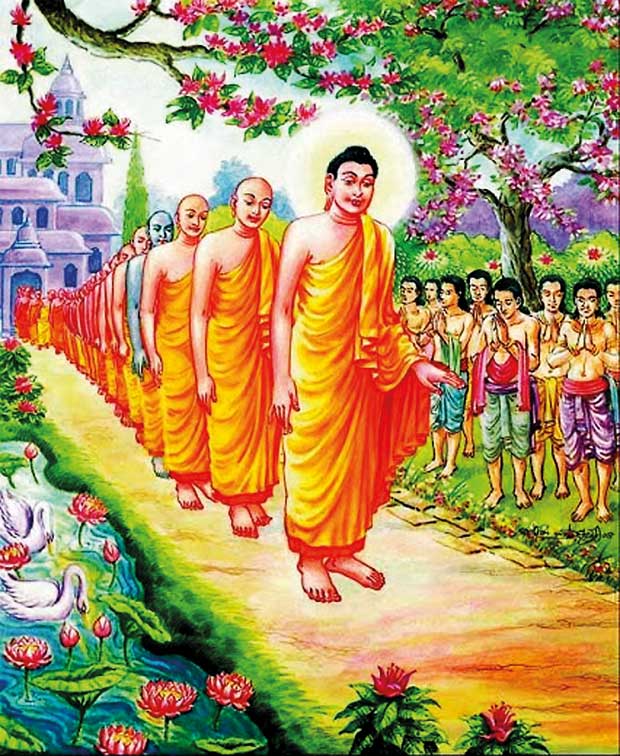
On the first Medin Full Moon
Poya day after the Enlightenment and seven years after the
“Abhiniskramanaya” or leaving the royal palace seeking Emancipation
Gautama Buddha visited His relatives in Kapilawastupura, the capital of
the Sakyan kingdom. The city of Kapilawasthu was also known as
Kimbulwathpura.
Endeavour in search of the Truth
From the time of Abhiniskramanaya or the day when prince Siddhartha left the royal palace and went in search of the truth, Mokshaya, total liberation or the freedom from transmigration the state of Nirvana, His father, King Suddhodhana kept himself informed of the developments of his son.
During a period of six long years he received various items of news and
some of them were heartbreaking. On a number of occasions news was
brought to him that prince Siddhartha had died. According to legends
some parties had brought human bones to substantiate their
statements. However, the king rejected their news on the contention that
Sakyans did not die before their maximum span of life.
"Contrary
to the king’s expectations all the nine envoys joined the Order with
their followers and attained Arahantship."
News for the
consolation of the king
After six long years, the happy news that his son had attained Buddhahood was brought to the king for his consolation. King Suddhodhana rejoiced at the news that his son had attained Enlightenment and was preaching His doctrine at Rajagaha Nuwara Veluwanaramaya. The king who was longing to hear about his son was overcome with joy and happiness. Enraptured by the latest news about his son, the king immediately sent one of his ministers to invite the Enlightened One to Kimbulwathpura.
The envoy was accompanied by more than one thousand followers. Relatives too were anxious to see the Buddha. The king got his men to construct Nigrodharamaya for the Buddha and His disciples. However, to the disappointment of the king and the relatives the envoy did not come back. He and his followers had entered the priesthood having heard the Dharma from the Buddha and had not conveyed the message. On nine successive occasions the king sent envoys to invite the Buddha to Kimbulwathpura. Contrary to the king’s expectations all the nine envoys joined the Order with their followers and attained Arahantship. Since Arahants were indifferent to worldly affairs they did not convey the king’s message to the Buddha. The disappointed king ultimately sent Kaludai, who was a playmate of prince Siddhartha as an envoy. Kaludai agreed to go on condition that he would be allowed to enter the Order.
Kaludai too entered the Oder in
the like manner and attained Arahantship but unlike the previous envoys
he told the Enlightened One that the rainy season was over and the time
was quite good to visit Kimbulwathpura. The Blessed One accepted the
invitation and attended by a large retinue of disciples journeyed the
whole distance preaching Dharma on the way and arrived at Kimbulwathpura
in two months.
Absence of Princess Yasodhara
When the Exalted One preached Anumeveni Bana all but princess Yasodhara came to pay their reverence to the Enlightened One. Princes Yasodhara remained in her apartment assuming that Buddha would pay her a visit if she was sincere and virtuous enough.
Buddha handed over His bowl to
the king and accompanied by His two chief disciples entered the
apartment of princess Yasodhara and sat on the seat prepared for Him.
“Let the king’s daughter pay reverence as she likes” the Blessed One
said and she came swiftly, clasped His ankles and placing her head on
His feet worshipped Him.
King Suddhodhana’s commendations
King Suddhodhana commended her
saying that she had given up garlands, comfortable seats and beddings
and wore yellow robes hearing that Buddha was doing so. He also said
that she resorted to one meal a day and rejected the offers made by her
relatives to maintain her.
Prince Rahula and Prince Nanda
A large number of Sakyan princes and princesses entered the Order notably Prince Rahula, son of prince Siddhartha and princes Yasodhara, His step Brother, Prince Nanda, Prince Ananda, His cousin, who ministered to all the needs of the Buddha until His parinibbana, and Sakkya Nobles, Anuruddha, Bhaddiya, Bhagu, Kimbila and Devadatta.
22 03 2016 - The Daily Mirror
J17.17
Free from bonds; the Dhamma; Buddhism and relatives; visit to Kapilawastu
K.K.S. Perera

The message that the Buddha had arrived spread in a few minutes all over in Kapilawattu like a whirl-wind, creating an environment in and around King Suddodana’s palace to assume a pleasing atmosphere as to welcome the Buddha.
Kaludai, Buddha’s lay-life friend was successful in convincing the Buddha to set out from Rajagahanuwara to Kapilavasthupura with a large retinue of Bhikkhus, which led to four most significant events that happened on Medin Full moon day. Buddha had to perform ‘Yama Maha Pelahera’, the twin miracle to counter the pride of senior relatives who were reluctant to pay respect.
It was on this occasion that -the father of the Buddha- King Suddhodana worshipped the Buddha for the
third time, followed by all the Sakyans. The following morning the
Buddha went on an alms round from house-to-house. When the king
protested saying it was an insult to the Sakya clan Buddha said, “Yours
is Sakya clan. Mine is the Buddha clan.” The Buddha along with Arhant
Sariyuth and Mugalan went to see his former wife Princess Yasodhara at
her chambers as she refused to oblige to a message sent by King
Suddodana to come and meet her former husband- she fell prostrate by his
feet and wept bitterly, for Buddha to warn others not to disrupt her
emotional gesture. The Buddha responded by explaining to her, how she
assisted him through eons in the Sansara until he became the Buddha.
Buddha the Psychotherapist Meets Yasodharavo, Rahula and Nanda
On the third day at Kapilawasthu, Rahula, who asked for his
inheritance from the Buddha was accompanied to the temple where the
little one [Prince Rahula] expressed his interest to enter the sasana.
The next day the Buddha handed over his bowl to Prince Nanda the step-
brother as he was returning to the temple; Nanda, who was to marry
Janpada-kalyani the next day was ordained too. King Suddhodana and
Queen Maha Prajapathi Gothami attained Sothapanna during Buddha’s stay,
while Princess Yasodhara took refuge in the Buddha, Dhamma and Sangha.
Freed himself of all bonds, the enlightened one sees the father, step
mother, wife, son and cousin as just another being with no special
attachment. The above incidents confirm the western psycho-analyst’s
view as Buddha the most rational psychotherapist ever lived.
Freedom from Bonds
How to free ourselves from bonds of life? We
have to investigate ourselves – not someone explaining while we listen,
agreeing or disagreeing, but taking a journey of discovery into the most
deep corners of our minds. And to take such a journey we cannot be
burdened with prejudices, opinions, and conclusions - all that we have
collected for thousands of years and more. Give up all you have ever
thought about yourself; start as if you knew nothing, and begin to
understand ourselves for the first time.
How can we be free to
look and learn when from the moment we are born to the moment we die,
our minds are shaped by a particular culture in the narrow pattern of
the ‘I’ `me’ and ‘mine’? We have been conditioned for centuries by
nationality, religion, caste, language, class, custom, tradition,
education, literature, art, convention and propaganda of all kinds, the
pressures, the climate we live in, the food we eat, our friends, our
family, our experiences -and therefore our reactions and responses to
every problem are conditioned. You will never be free of it, and if you
think, `I must be free of it’, you will fall into another form of
conditioning. Even when you look at a tree and say, `That is a jak
tree’, or `that is a mango tree’, the naming of the tree, which is
general knowledge, it has so conditioned you that the word comes between
you and actually observing the tree.
So it is for us to decide whether or not we wish for complete freedom. If we say we do, then we have to understand the character and structure of freedom. Is it freedom when you are free from pain, free from anxiety? Or is freedom itself something completely different? You can be free from envy, resentment say, but isn’t that freedom a response and therefore not freedom at all? You can be free from doctrine very easily, by scrutinizing it, but the purpose for that freedom from dogma has its individual reaction since the desire to be free from a doctrine may be that it is no longer fashionable or opportune.

Silly Nationalistic Belief
You can be free from patriotism because you believe in
internationalism or because you sense it is no longer reasonably
necessary to adhere to this silly nationalistic belief. You can
effortlessly put that away. Or you may counter against some religious or
political leader who has guaranteed you freedom as a result of restraint
or revolt. But has such rationalism, such commonsense conclusion
anything to do with liberty? If you say you are free from something, it
is a rejoinder which will then become another reaction which will bring
about another conventionality, another form of authority. In this way
you can have a chain of responses and accept each reaction as
independence. But it is not freedom; it is merely a link of a modified
history which the mind adheres to. All youth, are in revolt against the
world, and that is a good thing in itself, but revolt is not freedom
because when you revolt it is a reaction and that response sets up its
own pattern and you get trapped in that pattern. You think it is
something novel, but it is the old in a different mould. Any societal or
political rebellion will inevitably slip back to the good old bourgeois
frame of mind.
There are no guides, no teachers. There is only
your relationship with the world - nothing else. When you understand
this, what you feel, what you think, how you work, all self-pity goes.
We will not thrive on blaming others, which is a type of self-pity.
What is imperative is not a philosophy but to observe what is in fact taking place in our daily existence, inwardly and outwardly. If you examine very closely what is taking place and observe it, you will see that it stands on a rational conception. And when we look at what is happening in the world we commence to understand that there is no external and internal process; there is only one unitary process, it is a whole movement. To be able to stare at this seems to me all that is required, because if we make out how to look, then the whole thing turns out to be very clear, and to look desires no viewpoint, no teacher. Nobody need tell you how you should look. You just look.
22 03 2016 - The Daily Mirror
Scientific basis of mindfulness meditation

Excerpts of a guest lecture
delivered on 15th February 2017, by Dr. Upul Wijayawardhana
at the 39th
Annual Academic Sessions of the Kandy Society of Medicine.
I
consider it a great privilege and my special thanks go to Dr. Udaya
Ralapanawa, Joint-secretary of your association, who was the last Sri
Lankan Post-graduate trainee I had in Grantham Hospital, before my
retirement over five years ago. I am tasked with the great
responsibility of sharpening your minds so that you would imbibe with
great enthusiasm and mindfulness all the words of wisdom to follow over
the next two days, but before doing so that let me take a few minutes to
explain why I owe so much to Kandy.
Let me begin with an
unbelievable story. They say truth is stranger than fiction; yes, it is.
It was a Sunday morning in February or March 1967; I had just got off a
bus at the Kirulapone junction and was walking along High Level Road to
my future wife, Primrose’s house when a car stopped suddenly in front of
me and a tall fair gentlemen got out. Nowadays one probably would have
run away but those were peaceful days!
As he came towards me I
recognised it was Prof. Ajwad Macan Marker, the first Professor of
Medicine in Kandy. He asked me "Are you Wijayawardhana?" When I said
"Yes, sir" he said "I am very sorry you failed MD. You just missed and
we all were very sorry to fail you. In fact, Prof Cooray, Professor of
Pathology commented, ‘This is a fellow who will go far because with the
little he knows he can show a lot’ May be this will be your conclusion
too at the end this thirty minutes! Prof Cooray, I am sure was referring
to the three hour essay I wrote on ‘Care of the aged’ in an examination
I was totally unprepared to sit but did so simply because of the
cockiness of youth. What Prof. Macan Marker then said stunned me: "I am
advertising the post of Registrar in Medicine and would you like to
consider applying for it". You can guess what my reply was. Yes, I could
have hugged him but I didn’t.
I joined his department that June
and as fortune would have it, I was tasked to work under another
wonderful person, Prof. T. Varagunam, who was the Senior Lecturer then.
They taught, inspired and shaped my post-graduate career for which I am
eternally indebted. I sat the MD examination again that December but
thinking I would fail did not even care go to Colombo for the results.
Depressed, I was waiting, in the house in Lewella, where I lived, when I
heard suddenly the loud sounding of a car horn. When I looked out I
found Prof. Varagunam shouting "Hey, you have passed". What better
service can one get?
The moment Dr. J.B. Pieris and I passed MD,
the Department in its callousness decided to take us back though 18
months of our secondment were still left. Annoyed, Prof. Macan Marker
advertised two posts of Lecturer but when we went for the interview the
panel decided to appoint two Senior Lecturers instead; both were working
in the UK and one had the Prime Minister as his referee, the other the
previous PM. So, Ladies and Gentlemen, ‘pulling’ in Sri Lanka is nothing
new. After I obtained my MRCP in 1971, I was selected Senior Lecturer,
as the pair with pulls had already deserted the country, but the cussed
Prof of Medicine in Colombo who became DHS in addition, whose name I
prefer to forget, refused to release me for no good reason in spite of
Prof. Varagunam making repeated requests and keeping the post open for
two years. That is how I ended up doing Cardiology.
Whenever
possible, I have attempted to show my gratitude to Kandy in whatever
small way. While I was in the Cardiology unit in Colombo, I trained
Rohini Tennakoon and am frightened to learn that she has just retired.
When your trainees start retiring, it is time up for you! In Grantham,
in addition to Udaya I was fortunate to be able to train Kumudini
Jayasinghe as well, two of the finest. You are lucky to have them
because unlike me, they know a lot but do not show it.
When I
retired I directed my attention to an organ more obscure than the heart;
the brain. I was fascinated by the mind and consciousness and started
learning Abhidhamma, metaphysics of Buddhism when I realized that no
scientist, be it a Psychologist, a Psychiatrist or a Neurologist, has
described the mind, thoughts and thought processes in such great detail
and so elegantly as the Buddha whom I consider to be a scientist and a
philosopher. A great disservice had been done by making him a religious
leader thus limiting his discoveries only to his followers but,
fortunately, it is changing though slowly, as I will demonstrate later.
One of the tenets, indeed the most important one of Buddhism is
meditation and though born a Buddhist but being a scientist by training
and a sceptic by nature, I started questioning whether there is a
scientific basis for meditation and I am obliged to KSM for giving me
the opportunity to share with you, what I found over the last five
years.
Meditation is a practice to train the mind or induce a
level of consciousness for some benefit or for the mind simply to
acknowledge content. It originated in ancient India, over three thousand
years ago, and the first mention is in the Vedas, in the ‘Gayatri’
Mantra of Rig-Veda.
There are many types of meditation which,
broadly, fall into two groups; Samatha or one pointedness meditation
which embraces many types and Vipassana or Mindfulness meditation.
Vipassana meditation was introduced by the Buddha and according to
Buddhist teaching, though with Samatha you can achieve many high levels
of consciousness, it is only with Viassana that you can achieve total
detachment. It can be described as ‘non-judgemental attention to present
moment experiences’, very simple indeed in the concept but extremely
difficult to achieve as our mind is the greatest wanderer, refusing to
stay still even for a moment.
Meditation is claimed to impart
many benefits including more focussed attention, relaxation, positive
shifts in mood, enhanced self-awareness and improved health &
well-being. Two meta-analyses, one published in the Psychology Bulletin
in 2012 and the other published in JAMA in 2015 have shown benefits with
Mindfulness Meditation.
Mindfulness meditation has evolved from
the traditional Vipassana to many guises most identified by the prefix
Mindfulness- Based. The first was the Mindfulness Based Stress Reduction
programme that was introduced in 1979 by Jon Kabat-Zinn in Massachusetts
General Hospital. Though based initially on Vipassana, he later changed
it to a secular form and combined with ‘Hatha’ Yoga. It has become very
popular and he is the author of many best-selling books.
Mark
Williams, Professor of Clinical Psychology and until recently the
Director of the Oxford Mindfulness Centre at Oxford University, UK,
co-developed with John Teasdale of Cambridge University in UK and Zindel
Segal of the University of Toronto, Canada, a new technique for the
treatment of depression; Mindfulness-Based Cognitive Therapy (MBCT)
which he readily admits is based on the technique introduced by the
Buddha. Multiple trials have confirmed the efficacy and there is data to
show that it is superior to currently available drugs in preventing
relapses of depression.
I have just read about Cognitive-Based
Compassion Therapy to help burnout in health care givers and am sure
many more will follow based on the same fundamental message of ‘living
the moment’.
Though the purists may argue that these variants
negate the original aims but I am sure Gautama Buddha would not have
minded his technique being used, even with modifications, for the good
of many. After all, it was the Buddha who said "What matters is the
intention". Unfortunately, Mindfulness has become a rage, a fashion in
the West and some are using it to make money. I suppose it is a part of
the capitalist system we venerate today.
The person responsible
for the spread of Mindfulness Meditation across the world is the great
meditation master Satya Narayan Goenka, who died in September 2013 at
the age of 89. His is a fascinating story. He was born in Burma to a
rich Indian family and was a pillar of the Hindu community but things
changed when he started getting intractable migraine for which he needed
regular Morphine injections. His friends recommended meditation as an
alternate treatment and suggested he sees U Ba Khin, the first
Accountant General of newly independent Burma. U Ba Khin threw him out
saying that he does not treat migraine but after many pleas, agreed to
let him in do a ten day course of Vipassana Meditation. As the course
progressed migraine subsided and Goenka became an ardent convert. He
handed over his business empire to his children and returned to India
with the hope of reintroducing to India, the technique of the greatest
Indian ever. He met the spiritual leader Vinoba Bhave, who wanted proof.
As he could not get permission to do this in a prison, he chose a school
notorious for bad behaviour and demonstrated that these children’s
behaviour could be changed. He was then able to do a programme in Jaipur
jail but the biggest experiment was in Tihar jail.
Based on the
success of these programmes, which I will come to later, Goenka started
setting up Vipassana Meditation centres. There are 170 permanent
centres, including the one in Kandy, in 94 countries including Iran,
Turkey and Oman where the Sultan himself donated a property to establish
the centre. The ten-day courses are held in 302 locations around the
world and in recognition of his work Goenka was invited to address the
Millennium World Peace Summit of Religious and Spiritual Leaders on 29
August 2000 at the General Assembly Hall of the United Nations in New
York. It is one of the most inspirational speeches, which I consider to
be on-par with Martin Luther King’s ‘I have a dream’ speech and well
worth watching on YouTube.
J17.19
Some Reflections on ‘Mindfulness Meditation’
Laksiri Fernando

I was pleased to read another
great piece by Dr. Upul Wijayawardhana on the subject of meditation,
titled "Scientific basis of mindfulness meditation" on The
Island, 4 March 2017. I am using neutral language as much as possible
by purpose without glowing him in praise. It is also my personal
experience that ‘meditation to the mind is like physical exercises to
the body.’ I am particularly referring to the mindfulness meditation or
Vipassana, as he has explained.
I became attracted to Buddhism at
the age of ten when my Mahappa (father’s elder brother) became a
Buddhist in 1955. I was inquisitive what he was doing in his room,
sitting on a mat in a strange posture; and sitting there for long hours,
keeping his eyes closed.
It was in 1958 and thereafter, I
came across many of E.W. Adikaram’s articles in the Silumina newspaper,
one of which was "Jathivadiya Manasika Pisseki" (Communalist is a Mental
Patient). He also published a series of short booklets thereafter called
"Sithuvili" (Thoughts) where he explained some simple methods of
meditation. I also had the opportunity to listen to him at Moratuwa town
hall and on radio. He came for a series of lectures. Everything became
forgotten later, engrossed in studies, ‘student politics’ and in a busy
professional life thereafter. However, when I look back, even ‘student
politics’ (!) could have been enriched, if there was a touch of
‘mindfulness.’
In Australian schools today, mindfulness training
is extensively used and there will be a "Mindfulness Teacher Training
Certificate Course" in Sydney in a week’s time on 15-16 March. As Dr.
Wijayawardhana says "Though the purists may argue that these variants
negate the original aims but I am sure Gautama Buddha would not have
minded his technique being used, even with modifications, for the good
of many." The important point to ask here is whether and how far the Sri
Lankan schools use these methods of ‘Mindfulness’ in a scientific manner
for the benefit of the students and the society. Three objectives that
Australian schools attempting to achieve are: (1) Relieve anxiety and
stress of students (2) Let go of anger and frustration and (3) Overcome
worrying and negative thinking.
Wijayawardhana has given a useful
exposition to the benefit of many medical personnel at the 39th Annual
Academic Session of the Kandy Society of Medicine (15 February) about
the various ways the medical science/s today using the methods of
meditation, beginning with the initiatives by Professor Jon Kabat-Zinn
in 1979 in USA. When I encountered the first symptoms of acute angina in
early 1997, after what they called an angioplasty, I was put on a heart
rehabilitation program at the Concord Hospital in Sydney. After several
weeks of physical exercises, I was surprised when the instructor
introduced what he called the ‘Breathing Meditation.’ It was similar to
Anapanasati and when he was talking, he looked at me and said,
‘Fernando, you must be familiar with this,’ to which I just nodded.
It was mainly sitting relaxingly, and inhaling and exhaling for ten
minutes, closing your eyes. There was a cassette available at a
reasonable price to take home. The important thing was to be conscious
about the process, and the instructor during the training, and also in
the cassette, was asking us to concentrate on the nostrils, and how the
air goes into the lungs and coming out when you exhale. During this
exercise, your mind really becomes focussed. After the process, you feel
much calmer and relaxed. This was mainly for stress control, as he said.
Only after sometime that I realized, the name of the hospital, Concord,
was well suited for this meditation lesson. During that time, we were
also living in Concord.
On a more social or ‘spiritual’
application, Dr. Wijayawardhana has highlighted the recent contributions
made by U Ba Khin (the Burmese) and more particularly, Satya Narayan
Goenka, to popularize meditation and mindfulness in society. He also
mentions its relevance to peace and harmony in the world, referring to
Goenka’s speech at the UN Summit of Religious and Spiritual Leaders for
World Peace in August 2000. This is immensely relevant for Sri Lanka
today.
Goenka started
his speech by saying that "Religion is religion only when it unites.
Religion is no more religion when it divides." He ended his speech by
quoting Emperor Dharma Asoka’s Edict XII, which begins with declaring
"One should not honour only one’s own religion and condemn the religions
of others, but one should honour other’s religions for this or that
reason." He did quote the whole Edict, which further explains ‘this or
that reason’ why other religions should be respected.
What is
more important is what he said as the main thrust of his speech relating
to Vipassana Meditation. He related ‘the peace in the world to the peace
in the mind.’ This is also in the motto of UNESCO taking from the Buddha
directly which says "We must construct the defences of peace in the
minds of women and men." He further said, "If there is no peace in the
minds of the individual, I cannot understand how can there be real peace
in the world."
Within a short span of time, given to him at the
summit, Goenkatried to illustrate the problem by explaining the common
or normal nature of the human mind which is agitated with often-times
with ‘anger, envy, hatred and animosity.’ This is how he tried to
emphasise the importance of meditation and mindfulness which are
necessary for peace within and in the world. He categorically said, "If
I have anger, I am the first victim of my anger" which is absolutely
true.
Therefore, we should thank Dr. Wijayawardhana for bringing
Goenka’s speech and other matters to our attention. He says, "When I
retired I directed my attention to an organ more obscure than the heart;
the brain. I was fascinated by the mind and consciousness and started
learning Abhidhamma…" In my case, my knowledge of Abhidhamma is almost
nil. But when he says he considers the ‘Buddha to be a scientist and a
philosopher’ it resonates with my understanding as well. One of my
recent journal articles was "Origins of research methodology, Buddhism
and the Four Noble Truths" (Sri Lanka Journal of Social Sciences
39 (2), December 2016).
He has also said "A great disservice had been done by making him
[the Buddha] a religious leader thus limiting his discoveries only to
his followers but, fortunately, it is changing though slowly…" I am not
going to deduct simplistic conclusions from that statement for the
current debates on ‘foremost place for Buddhism’ in the present or a new
constitution. But it might give some food for thought for the Buddhists
to think about, while I have no objection for that ‘foremost place’ or
hesitation to appreciate Buddhism as a great religion. It is my
observation that Buddhism has given many (or most) people some civility,
discipline and a particular serene culture. Listening to Bana (sermons),
observation of Sil (precepts) and worship of Bodhi (Bo tree) are good
ethnical practices which would be meaningless to those who consider
Buddhism only as a philosophy and/or science.
Be as it may, more
pertinent is Dr. Wijayawardhana’s emphasis on ‘mindfulness’ and
‘meditation,’ now for some time in these pages. It appears to me that
the mind is a jumble of thought processes for whatever the reason/s. I
am not sure whether there is a physiological/medical explanation for its
erratic nature. When you try to focus on it, it is almost uncontrollable
at least at the beginning. That can be one reason why many people
(including myself!) are usually grievance ridden, aggressive, agitated
and intolerant. That cannot however be the only reason. There are some
other objective or external reasons why your agitations are generated.
For example, if a person is deprived of possessions or unnecessarily
harassed by someone, then the agitation is almost natural.
Thoughts in the mind come and go quickly, unless you are engaged
thoroughly in a particular task (i.e. talking, writing, driving) and
they usually come and go as images or in words. Your thinking is
audio-visual! What comes to mind, when you first observe, usually are
grievances or offenses. That your spouse, brother, neighbour or
colleague has done such and such a thing to you. Most hearting
(particularly among the middle classes) is what happens to your dignity
or pride. Most intriguing is the grievances and antagonisms coming in
enlarged forms. Some of them can be pure misunderstandings.
Of
course, there are thoughts that come to your mind because of sensual or
sexual impulses. However, they are (presumably) less if you try to
meditate. If you can observe your thought processes through simple
meditation and analyse them for rational reasoning, that renders much
peace to your mind than anything else. You also might be able to
identify some root causes for your disturbances. Continuous doing so
definitely calms you down and your productivity in whatever you do would
be increased. Your thoughts become more cohesive and logical and also
objective without (much) prejudice. You feel more harmony in life and
less conflicts and animosities. You may achieve some ‘detachment.’
Therefore, what Dr. Wijayawardhana has been saying in his numerous
articles in The Island newspaper should be taken seriously. Three major
conclusions that can be drawn could be (1) the introduction of
mindfulness training in school curricula with an interfaith or secular
emphasis, (2) the setting up of mindfulness/meditation training centres
in universities for the benefit of students and academics, and (3) the
incorporation of a purposeful ‘Peace of Mind Program’ (i.e. UNESCO motto)
in the national reconciliation and peace building work. It should be
emphasised that meditation and mindfulness are common to all religious
traditions, and more particularly to Hinduism and Buddhism.
08 03 2017 - The Island
J17.20
Scientific proof of mindfulness meditation
Dr. Upul Wijayawardhana

The interesting piece by
Laksiri Fernando, former Senior Professor of Political Science and
Public Policy of Colombo University, ‘Some reflections on Mindfulness
Meditation’ (The Island, March 8), expanding on my article ‘Scientific
basis of Mindfulness Meditation’ (The Island, March 4) has given me an
impetus to do further study on the subject. I am indeed very grateful
for his compliments and support. His excellent review article in the Sri
Lanka Journal of Social Sciences titled "Origins of research
methodology, Buddhism and the Four Noble Truths", should be read by
anyone interested in the scientific method and we should thank Laksiri
for pointing out how the ‘West’ has disregarded Buddha’s philosophy and
scientific method, a fact I, too, have alluded to in the past.
Prof. Fernando states in his article:
‘He has also said "A great
disservice had been done by making him [the Buddha] a religious leader
thus limiting his discoveries only to his followers but, fortunately, it
is changing though slowly…" I am not going to deduct simplistic
conclusions from that statement for the current debates on ‘foremost
place for Buddhism’ in the present or a new constitution. But it might
give some food for thought for the Buddhists to think about, while I
have no objection for that ‘foremost place’ or hesitation to appreciate
Buddhism as a great religion.’
I can reassure it was not a
political statement but a fact which I established later in my lecture
to the Kandy Society of Medicine but, unfortunately, due to constraints
of space the Editor could print only excerpts of my lecture. My
endeavours have not been for political recognition of Buddhism but
explaining the aspects of the Dhamma that is applicable to all, in
addition to challenging some widely held misconceptions. It was the
Dalai Lama who, very wisely, said ‘The science and philosophy of
Buddhism is for all but the religion of Buddhism is for us, Buddhists’.
Those who argue for the political recognition of Buddhism may, quite
justifiably, point out some discrepancies in the arguments. For
instance, Malaysia is referred to as a Muslim country and the
constitution declares Islam the state religion with only 61% being
followers whereas in Sri Lanka 70% are Buddhists. Though some injustices
may have been heaped on minorities, Sri Lanka did not even consider
discriminatory policies like ‘the Bhumiputra policy’. Further, there
have been many instances of the ‘majority’ been discriminated but all
these need to be forgotten if we wish to strive for true reconciliation.
In the scientific method, the first step is to show that something
works. As far as Mindfulness Meditation is concerned, it was Satya
Narayan Goenka who convincingly demonstrated the efficacy, first in
unruly school children and then in prisoners.
"Doing Time, Doing
Vipassana" is a
wonderful film that chronicles the changes Vipassana Meditation brought
about in Tihar prison in Delhi, one of the largest and the worst prisons
in India which houses 10,000 prisoners of which 9000 are awaiting trial.
In May 1993, when controversial but enthusiastic and young lady police
officer, Kiran Bedi, was appointed Inspector General, no one imagined
the changes she would introduce. She was of the firm view that the
prison system was failing and was looking for new ways for change. She
took the suggestion of an Assistant Superintendent, Rajinder Kumar who
had personal experience, to introduce Vipassana Meditation. She invited
Goenka who conducted a number of ten-day sessions; the results were
immediate and dramatic. Many prisoners were deeply affected by the
experience, and their attitude changed drastically. The success led to
one of the most extraordinary events to take place in a prison anywhere:
in April 1994, at a special facility inside Tihar, one thousand prison
inmates participated in an 11-day Vipassana course - the largest ever
held in modern times. Subsequently, a permanent meditation centre was
opened in the prison.
Sceptics will counter the Indian experience
as biased, but that is dispelled by "Dhamma Brothers", a documentary
that explores in detail, the lives of four convicted murderers who are
in a group that undergo an intensive ten-day Vipassana Meditation
programme devised by Goenka and conducted by Jenny Phillips, a
psychotherapist, in a rural prison in Alabama, USA.
The programme is so
successful that the Christian Chaplain gets it stopped, through the
Commissioner of Prisons, as he fears he will have no flock to tender as
the prisoners would all become Buddhists! Prisoners had to meditate in
secrecy till the programme was reinstituted, once saner counsel
prevailed.
Two meta-analyses of trials of efficacy of Mindfulness
meditation have shown positive results. The first, published in the
Psychological Bulletin in 2012 showed reduced negative emotions and
neuroticism. The second, published in the Journal of American Medical
Association in 2015 showed a moderate decrease of anxiety, depression
and pain.
The experience of Jill Bolte Taylor, a Neuro- Anatomist
who had a bleed into her brain, perhaps, gives a clue as to how
Mindfulness Meditation works. Her TED lecture titled "Jill Bolte
Taylor’s stroke of insight", watched by over four
million, reveals a fascinating story. She woke up on December 10th, 1996
with a throbbing headache but disregarded it and got on the exercise
bicycle. She suddenly realised altered perception; she was looking at
her body from outside. She had alternating signals from the two sides of
the brain.
Neurophysiologists believe that the right hemisphere
collects data from sensory organs to form an instant picture of the
moment and is connected to the whole. It acts like a parallel processor
of a computer. The left hemisphere, on the other hand, thinks linearly,
methodically and having gathered all the information from the past
projects to the future. It produces the concept of self; ‘me’ and works
like a serial processor. The two hemispheres are connected by about 300
million nerve fibres.
She felt lighter in the body with no
emotional baggage when the right hemisphere dominated but then suddenly
the left hemisphere comes alive to tell her that she is in trouble and
needs to get help. However, she realizes that she cannot identify
letters or numbers and gets her business card to ring for help. It takes
45 minutes to match the shape of numbers on the card with that on the
key-pad but when her colleague answers she could not understand nor
could she speak coherently. Fortunately, her colleague realised there
was a problem and arranged for an ambulance. She heard loud sounds, felt
enormous, felt free and spirit flowed freely. She felt she was in
Nirvana and wanted everyone else also to be there. Blood clot was
removed from the left side of the brain, two weeks later and it took
eight years for her to recover fully. She concludes the blood clot on
the left side impaired the function of the ‘me’ lobe and the right
dominated giving her the feeling of what she calls ‘Nirvana’.
What is felt at high levels of meditation is well described and the
descriptions tally, to a great extent, with the experiences of some who have
had ‘out-of-body experiences’ (OBEs); calm, oneness, time standing still
etc. Dr. Bruce Greyson, who succeeded Ian Stevenson as Professor of
Psychiatry in Virginia University, has studied over 1000 patients and he
raises some very interesting points though not all are related to
meditation. These OBEs occur mostly in patients who have had resuscitated
cardiac arrests but have also been described in patients who were gravely
ill. Few instances of patients having these experiences while under
anaesthesia for surgery have also been described. We know some drugs can
cause hallucinatory experiences. Very rarely, some get these experiences
without any of these factors, while they are wide awake.
It is likely
that all these experiences occur when the right hemisphere dominates and
it is quite possible that by meditation we either make the right
hemisphere dominant or supress the left or do both; the difference is
that in all other instances it is transient and not reproducible.
Experienced meditators, on the other hand, can repeatedly achieve this.
There may be other explanations too.
Brain imaging with MRI and
Functional MRI has shown increase of grey matter in areas dealing with
empathy, emotional regulation, meta-awareness etc. A meta-analysis
published in 2014 of 21 studies examining 300 practitioners showed
consistent changes in eight regions of the brain but the work of Sara
Lazar from Harvard University is the most interesting. First, their
group compared brain images of meditators against non-meditators which
showed significant changes. She has commented that a 50-year-old
meditators brain looks like that of a 25-year old non-meditator. The
second study included a group that did Mindfulness Meditation, once a
week in the hospital with advice to do so at home for just eight weeks,
compared with a matched group who did not do meditation. Four areas;
posterior cingulate, Left hippocampus, Temporal-Parietal junction and
Pons showed thickening whereas Amygdala, concerned with reacting to
stress, got smaller showing that they could cope with stress better. It
is surprising such structural differences could be seen in such a short
time and the reduction in size of the part of the brain controlling
response to stress is in keeping with what is observed clinically.
The most fascinating studies are those done by the group led by
Elizabeth Blackburn. She co-discovered telomeres and telomerase.
Telomeres are the caps at the ends of chromosomes which seem to protect
them. As chromosome division continues telomeres get progressively short
and when they get very small cell division stops. Telomerase is an
enzyme that increases the activity of telomeres. These two play a
crucial role in aging of cells. For these discoveries she and her
colleagues were awarded the Nobel Prize in Physiology or Medicine in
2009. She was approached by Elissa Epel, a Psychologist with an interest
in Mindfulness Meditation. This unlikely combination of disciplines has
produced very interesting results though some scientists question the
validity of such a combination. Preliminary data show that regular
meditation increases the level of telomerase and delays the shortening
of telomeres too. Studies are continuing and it looks as if Mindfulness
Meditation retards aging of cells which will surely translate as health
benefits.
Though meditative practices of different types are
found in most religions, it was the Buddha who introduced Mindfulness
Meditation which scientist are gradually proving to be effective and the
practice of Mindfulness is spreading far and wide. Prof. Fernando has
described what is happening in Australia.
In UK, an all-party
parliamentary group produced, in October 2015, a report titled ‘Mindful
Nation UK’ and ‘The Mindfulness Initiative’, a policy institute that
works with parliamentarians, media and policy makers to develop
recommendations on the role of mindfulness in public life, has been
formed. In their website they state:
‘Scientific research is
generating substantial evidence of the benefits of mindfulness to
well-being. There is great public interest in the field, but access to
quality training is patchy. Despite recommendations by the National
Institute of Clinical Excellence (NICE) for the use of Mindfulness-based
Cognitive Therapy (MBCT) to prevent relapse in depression, NHS
implementation rates are low, and there is little understanding of how
mindfulness could help in other areas of policy.'
'In an era
dominated by statistics, case studies can really bring to life the
potential that mindfulness can have for a diverse range of individuals.
From schoolchildren, to NHS staff, policemen, and members of parliament,
mindfulness courses have offered significantly improved wellbeing by
reducing stress, fostering compassionate care and providing greater
clarity in prioritising the demands of life.’
In the report there
is only a passing reference to the Buddha but, I am sure, the Buddha
would not have minded it as what matters is that the concept he
introduced is benefitting many, irrespective of their religious beliefs.
Is it not time our politicians woke up from their slumber and start
programmes that reduce crime, improve productivity and, more than
anything else, enhance the education of our children?
25 03 2017 - The Island
Scientific proof of mindfulness meditation -2
N.A. de S. Amaratunga

With reference to Dr. Upul
Wijayawardhana’s excellent article under the above title published in
the Sat Mag of The Island on 25.03.2017, it must be said that readers
would be grateful for literature on the subject he has surveyed and
quoted in his article. However, the question arises whether the
"Mindfulness Meditation" he refers to is what Buddha practiced to attain
Nirvana. In a previous letter published in these columns, I mentioned
that "Mindfulness Meditation" or yoga as it was then known had been a
well-established means of seeking "vimukthi" in the Vedic tradition well
before the advent of Buddhism. In fact, Alara Kalama and Uddaka
Rasaputha were two of the leading yogis of the Vedic tradition from whom
Buddha learnt meditation at the very beginning of his journey in search
of freedom.
Dr. Wijayawardhana has not said what the methods
employed in the studies were; he has quoted excerpts to say it was
mindfulness meditation. It has been recorded that "Anapana Sathi", or
focus on breathing for long periods, could bring about the physiological
and psychological benefits that Dr. Wijayawardhana mentions. It is
probable that in most of those studies the method of meditation was
"Anapana Sathi" or something very much similar. In most of the
meditation centers in the West, and also elsewhere, this is the method
employed. It is an inexactitude to say that this is Buddhist meditation
because it was in practice in India before the arrival of Buddhism, and
Alara Kalama taught Buddha the same method. Hence Dr. Wijayawardhana’s
view that Buddha was the first to develop the method of meditation that
is practiced in the West and which is gaining in popularity may not be
correct.
Scientific studies have shown that "Anapana Sathi"
meditation can be useful in controlling stress, depression, pain, blood
pressure etc. But this method cannot lead a person to Nirvana. Buddha
realized this inadequacy, and that is why he left Alara Kalama and
Rasaputta and developed his own method which is known as "Arya Astangika
Marga". Any other method of meditation that teaches to focus and
concentrate cannot be called Buddhist, because those methods had been in
use before the time of Buddha and they have other goals and not Nirvana.
In the "Arya Astangika Marga" there are three essential stages "seela,
samadi, prangna" or virtue, concentration and wisdom, which have to be
attained in a gradual process. There cannot be concentration without
virtue preceding it, and wisdom without the other two prerequisite
stages. There are no short cuts.
There is another very critical
difference between Buddhist meditation and the type practiced in the
West, which stems from the basic difference between Buddhist philosophy
and the Vedic/Hindu philosophy. The Veda, which is the predecessor of
Hinduism, saw the phenomenon of life as "Nithya, Sukha, and Athma" or
that it was permanent, joyful and had a self. Buddha could not agree
with this, as it did not accurately define the life he saw around him.
He saw that life and everything around it was impermanent and therefore
was sorrowful, and he defined life as "Anithya, Dukha, and Anathma" or
that it is impermanent, sorrowful and did not have a self. It could be
seen that Buddha’s view was the exact opposite of the Vedic/Hindu view.
The Vedic/Hindu method of meditation was aimed at realizing that life
was permanent, joyful and had an Athma, which finally will unite with
Brahma the final goal. There is no need to get rid of greed, hatred or
ignorance. Buddhist meditation attempts to realize the impermanence, the
sorrowfulness and the selflessness of life, and strives to get rid of
greed, hatred and ignorance. It must be said with emphasis that the
meditation practiced in the West and elsewhere is not Buddhist, simply
because it is not aimed at getting rid of greed which is the cause of
human suffering according to Buddhism. In fact, these methods may
indirectly encourage greed for it appeases the mind that is under stress
caused by the effort made to satisfy the insatiable greed. Hence, it is
not surprising that sponsorship for these meditation centers come from
the rich; the Gurus who conduct them are also rich and those who
patronises these centers are also rich.
The scientific proof of
meditation that Dr. Wijayawardhana mentions is in relation to the type
of meditation that appeases the mind and not insight meditation that
Buddha developed. I wonder whether Buddha’s method could be practiced
while leading a rich luxurious life. "Seela" which is a prerequisite for
the next stage "Samadhi" cannot be practiced in an affluent background,
and without "Seela" there cannot be "Samadhi" that Buddha preached. It
may be true that Buddha has given the freedom to examine the Dhamma
before one accepts it, but not the freedom to modify it to suit one’s
life style. Further, it may not be correct to call any meditation
Buddhist, if it does not conform to the method given in the "Arya
Astangika Marga". That does not mean Buddhists should not practice
meditation that has the benefits mentioned above, but they must not do
it with the mistaken belief that they are practicing Buddhist
meditation. They must always remember that suffering could be eliminated
only by eliminating greed as Buddha preached.
28 03 2017 – The Island
  One of his students asked Buddha, "Are you the messiah?" "No", answered Buddha. "Then are you a healer?" "No", Buddha replied. "Then are you a teacher?" the student persisted. "No, I am not a teacher." "Then what are you?" asked the student, exasperated. "I am awake", Buddha replied. |
| JOURNAL | NEWS | LETTERS | BOOKS | PERSONS | HISTORY | SLIDES |
© Aloka MCMXCIX-MMXXI


