 NEWS - Page
5
INDEX
NEWS - Page
5
INDEX| JOURNAL | NEWS | LETTERS | BOOKS | PERSONS | HISTORY | SLIDES |
N5.01
India allows Colombo-Bhopal flights
S. Venkat Narayan
NEW DELHI: India has granted permission to Sri Lanka to introduce direct flights from Colombo to Bhopal in Madhya Pradesh to provide Buddhist pilgrims easy access to Sanchi.
This was disclosed by visiting Sri Lankan Foreign Minister Dinesh Gunawardena to The Island here yesterday.
"We hope to get SriLankan Airlines to launch the flights in the next three months," he told this correspondent in an interview.
Sanchi Stupa is a Buddhist complex, famous for its Great Stupa, on a hilltop at Sanchi Town in Raisen district in Madhya Pradesh. It is located 46 kilometres (29 miles) north-east of Bhopal, capital of Madhya Pradesh.
Sanchi is a popular place of worshipa for Buddhist pilgrims from Sri Lanka and other countries.
The Great Stupa at Sanchi is one of the oldest stone structures in India, and an important monument of Indian architecture.
It was originally commissioned by Maurya Emperor Ashoka in the third century BCE. Its nucleus was a simple hemispherical brick structure built over the relics of the Buddha. It was crowned by the chhatri, a parasol-like structure symbolising high rank, which was intended to honour and shelter the relics.
The original construction work of this stupa was overseen by Ashoka, whose wife Devi was the daughter of a merchant of nearby Vidisha. Sanchi was also her birthplace as well as the venue of her and Ashoka's wedding. In the 1st century BCE, four elaborately carved toranas (ornamental gateways) and a balustrade encircling the entire structure were added. The Sanchi Stupa built during Mauryan period was made of bricks. The composite flourished until the 11th century.
11 01 2020 - The Island
N5.02
Plant power! A case for vegetarianism
Samangie Wettimuny
Vegetarianism is a growing trend across the globe – especially in the West - with many consumers turning to plant based diets, abstaining from animal products. Vegetarian and Vegan alternative products are gaining momentum in every category, from non-dairy milks and cheeses, to plant-based meat substitutes. UK’s supermarket giant Waitrose recently added a dedicated vegan section in 134 of its stores nationwide, having taken into consideration the rising demand for vegan food among vegan consumers. The number of vegetarians in many top meat consuming countries including the USA and Australia has been steadily increasing, according to latest reports.
One may choose to be a vegetarian for a variety of reasons ranging from health concerns/ religious reasons to animal rights advocacy. Of late we have witnessed many international animal rights organisations such as PETA taking to the streets to protest against appalling animal welfare violations and barbaric methods of animal slaughter either for food or extremist religious purposes.
As recently revealed by Dr. Walter Willett, Professor of Epidemiology and Nutrition at Harvard Medical School at least one-third of early deaths could be prevented if everyone moved to a vegetarian diet. At least 200,000 lives in the UK could be saved each year if people cut meat from their diets, the study revealed.
“We have just been doing some calculations looking at the question of how much could we reduce mortality shifting towards a healthy, more plant based diet, not necessarily totally vegan, and our estimates are about one third of deaths could be prevented,” The Telegraph.UK quotes him as saying. “But the benefits of a plant-based diet had been vastly underestimated.”
Dr. Neal Barnard, President of the Committee for Responsible Medicine, a non-profit research and advocacy organisation based in Washington, D.C, also highlights the need to wake up to the health benefits of vegetarianism and veganism.
“I think we’re underestimating the effect,” he opined at the 2018 Unite to Cure Fourth International Vatican Conference in Vatican City. “I think people imagine that a healthy diet has only a modest effect and a vegetarian diet might help you lose a little bit of weight. But when these diets are properly constructed I think they are enormously powerful. A low-fat vegan diet is better than any other diet I have ever seen for improving diabetes.” The Telegraph quotes him saying.
Sri Lankan situation
Speaking at the Second Annual Asian Buddhist Animal Rights Conference at the Buddhist Cultural Center in Colombo late last year Speaker Karu Jayasuriya expressed his concern that meat consumption in Sri Lanka was on the increase though many western countries were turning to vegetarianism.
The Speaker Jayasuriya has opted for vegetarianism as a tribute to his late daughter who was a vegan.
“She always wanted me to be a vegetarian. I used to eat prawns and chicken in the past. But one of the requests of my late daughter was for me to be a vegetarian. She was a vegan. So after her sickness [death, I switched to vegetarianism.” he told the Daily News during a recent interview.
As well- known nutritionist and researcher Dr. Damayanthi Perera noted even though for many decades western medical and nutrition authorities have been promoting foods of animal origin such as meat and milk as healthy food, now many informed western consumers are turning to vegetarianism, “Many informed consumers such as UK, USA, Germany, in general consumers from all the industrially developed nations are turning to vegetarianism.”
Dr. Perera cited an interesting personal experience to elaborate her point. “The research topic of one of my British PhD colleagues was on vegetarianism. I was surprised and I asked her why she chose such a well-researched subject because the majority of Indians are vegetarian and the benefits of the vegetarian diet were known by then! She then explained to me that she was researching why many British consumers were becoming vegetarian. That was around 1990–more than two and a half decades ago. I am not citing from her thesis, but to my knowledge, the three key reasons for British consumers to adopt vegetarianism were due to health, ethical and environmental reasons. With regard to ethical reasons there were concerns regarding battery farming practices etc. at that time,” she said.
Veganism
“Currently, many children and young adults from industrially developed countries are becoming vegetarian or vegan. Vegans shun all animal products including milk. Veganism is developing as a silent protest against the unimaginable cruelty meted out to farm animals and dairy cows, in industrial farms. A couple of decades ago, the majority of Western consumers were unaware of what was happening in industrial farms. Animal rights activists, undercover reporters /journalists and food researchers have investigated what was happening in the Animal Agriculture Industry and exposed the wrong doings. Therefore, currently consumers are making informed choices about meat and milk consumption,” she explained.
Milk Mustache and Milk Myths
As Dr. Perera further noted there is an over production of milk in Western countries and the consumers are now aware that the nutritional benefits of milk have been hyped up by the Western milk industry simply to boost sales. “The Tag Line ‘Got Milk’ and the ‘Milk Mustache Campaign’ of the US is an example. Milk was promoted as an essential food for adults!”
“Currently many Western medical doctors, naturopathic doctors and consumers are questioning about the physiological need for cow / animal milk consumption by humans. Logically thinking, we are the only species that drink milk from another species! This is highly un-physiological. There are many facets to the milk issue such as allergies, and other illnesses associated with milk consumption,” Dr. Perera noted.
“Due to health, environmental and ethical reasons Western consumers are rejecting foods of animal origin. There is a silent Tsunami growing against meat and milk. As researchers we observe the under-currents long before the Tsunami hits the shore!” she emphasized.
Go Green
With so many great vegan options, eating green has never been more delicious. Whether you go vegan for the environment, for your health, or for animals, you have the power to change the world, simply by changing what’s on your plate, notes Jason Baker, Vice-President of International Campaigns, People for the Ethical Treatment of Animals (PETA) Asia.
He too agrees that a vegan diet is as good for humans’ health as it is for animal welfare.
“There is no nutritional need for humans to eat any animal product; all our dietary needs, even as infants and children, are best supplied by a meatless diet. The American Dietetic Association notes that a vegetarian diet reduces the risk of many chronic degenerative diseases and conditions, including heart disease, cancer, obesity, hypertension, and diabetes,” he added.
Baker noted that in addition to causing heart disease and cancer, animal products contain harmful contaminants—including bacteria, arsenic, dioxins, and mercury—that can affect our health both in the short and long terms.
“The overuse of antibiotics on factory farms has caused many of the bacteria found on animal flesh to become antibiotic-resistant,” he said.
Pain gone through by animals
As Baker explained animals are much more intelligent and complex than most people realize, and scientists are providing more and more evidence of this all the time. They are sensitive to what they encounter; a horrific death in front of other helpless animals.
“Most animals raised for food today spend their lives in factory farms. These animals, who feel pain and fear just as the dogs and cats who share our homes do, are separated from their families and crammed by the thousands into filthy warehouses. They are mutilated without the use of painkillers and deprived of everything that is natural and important to them—they won’t be permitted to see the sun or breathe fresh air until the day when they are forced onto trucks bound for the slaughterhouse. On the killing floor, many animals are completely conscious and struggling to escape while their throats are cut—and some are still conscious while their bodies are hacked apart or when they are dunked into tanks of scalding-hot water,” Baker revealed the sad and horrific truth behind meat and dairy industry.
“The amount of pain suffered by animals before being killed could be reduced if alternative food practices are adhered to,” Baker emphasized.
Buddhist view
Venerable Sathindriya Thera of Dhamma Voice for Animals (DVA) who jointly organised last year’s Asian Buddhist Animal Rights Conference said that the Buddha’s view on meat consumption is clearly stated in Jeevaka Sutta in the Middle Length Discourses of the Buddha.
“In Jeevaka Sutta the Buddha says, “I say there are three occasions in which meat should not be eaten; when it is seen, heard or suspected that the living being has been killed for sake of a bhikkhu. I say: Meat should not be eaten on these three occasions.”
However the common argument raised by those who are in favour of meat consumption is that “the Buddha did not prohibit meat consumption, he only imposed three conditions.”
The Thera explained why it is high time we dispelled such myths. “Can anyone eat meat by passing all these conditions? If someone passes these conditions the food chosen defiantly would not include meat. But Buddhist way is not arguing with the unwise. Buddhism is for the wise people to practise and benefit from. Unwise people argue to prove that they are correct. Therefore, we have to think wisely. The Buddha did not force anyone to do anything, even monks. But he has clearly mentioned what is a virtue and what is not,” he noted.
The Thera promotes vegetarianism because as Buddhist Monks they have to promote virtuousness, not malevolence.
“The Buddha asked monks to go on in all directions and spread the wisdom and compassionate life style to overcome human ignorance. That is the duty of monks. So I don’t just promote vegetarianism! I promote non-violent Buddhist life style. Someone can see my non-violent activism as Vegetarian promotion. But if someone eats animal flesh they indirectly promote Killing of another being. You don’t have to be Buddhist to understand the malevolence in that action. Also we don’t need the Buddha to explain such a simple thing; this is common sense. Buddhism is for advanced thinkers,” the Thera added.
DVA’s role
DVA Sri Lanka Project’s Director Keshinie Bandaranaike said that the sole mission of the DVA Sri Lanka Chapter is to enlighten the masses on suffering faced by the animals due to the meat and dairy industry in the world and appeal to the people to turn to a vegetarian diet with the noble intention of putting an end to animal suffering.
“It is our stand that the consumption of meat directly results in immense suffering and pain for animals when they are being killed for our consumption. If you accept that animals have rights, raising and killing animals for food is morally wrong. An animal raised for food is being used by others rather than being respected for itself. It is being treated as a means to human ends and not as an end in itself and this is a clear violation of the animal’s rights,” she said.No matter how humanely an animal is treated in the process, DVA believes that raising and killing it for food remains morally wrong.
“There is clear evidence of the link between heavy consumption of meat and adverse environmental and health impacts. Worldwide, livestock and meat production have also been identified as major contributors to intensive water use, high phosphorus use, land degradation and threats to food yields and loss of biodiversity.”Just as PETA, the DVA too intends to show that there are adequate nutrients that can be derived from a vegetarian diet. “A nutritious and tasty meal can be made with pure vegetarian ingredients. Due to much awareness in the world of the benefits of vegetarianism, there are enough restaurants serving varied vegetarian dishes, specialty vegetarian restaurants and various food items made available in the market,” Bandaranaike added.
Plant food vs. Animal food
Is there enough scientific evidence to prove that plant based food products are healthier than animal based food? The Daily News asked Dr. Damayanthi Perera.
“Chronic, degenerative diseases/ Non Communicable Diseases (NCDs) have become a major health problem in the world. The latest and emerging scientific information demonstrate the benefits of plant based foods i.e. fruits, vegetables, pulses, nuts and seeds etc. for preventing chronic diseases such as: overweight and obesity, diabetes, heart disease, high blood pressure, stroke, cataracts, immune system disorders etc. A plant based diet will also prevent hormone -dependent cancers such as: breast, ovary, prostrate and colon cancer,” Dr. Perera said.
On the contrary, the latest scientific evidence demonstrates that in addition to the processed meat products, red meat and chicken are also strongly associated with certain types of cancer.
“Abstinence or reduced meat consumption will prevent cancer and many chronic disease and also environmental pollution caused by industrial animal farms. In industrialized nations a large portion of cereals are fed to farm animals which is a very wasteful process. As such, there are plenty of benefits to man and the eco-system,” she added.
Growth, Health, NCDs and Premature Death
According to Dr. Perera, as per conventional knowledge, it is believed that animal proteins are superior to plant proteins, but it is important to understand that the early research was based only on the impact of animal foods on growth.
“New, robust, large scale scientific research data on health demonstrates that meat and milk are strongly associated with cancer and other chronic, degenerative diseases. Therefore, there is a burning question. Is it ethical to promote foods that are causing such terrible illnesses as healthy food? This is something the professionals ought to consider seriously. Knowledge brings an obligation to change,” she added.
As the world is going through a NCD epidemic and consumers are dying prematurely, the relevant professionals and policymakers have a professional obligation to update their knowledge and provide the latest information to the consumers, the well- experienced researcher emphasized.
“It is then up to the consumers to make an informed choice about consumption of foods of animal origin. This will help parents to safeguard the health of their children. To ignore or withhold truthful information is unprofessional and unethical,” she noted.
Healthy diet
A question that many people would ask is whether a vegetarian diet is healthy. The scientific consensus is that a carefully planned vegetarian diet is healthy.
“A vegetarian diet that combines cereals and pulses can meet the protein requirement. This method is called ‘mutual supplementation or complementation,” she said.
However Dr. Perera emphasized that a ‘carefully planned vegetarian diet’ excludes the poverty based vegetarian diets followed by poor people due to economic reasons. “Obviously such a diet would be deficient in many nutrients,” she noted.
“For generations Indian vegetarians have known how to thrive on a vegetarian diet. They never consumed any special dietary supplements or complementary proteins. However, in addition to the mutual supplementation process, they also used beneficial processes such as fermentation and germination of food that enhanced vitamin B1 2 and Vitamin C etc. We have to look at the epidemiological data and the total picture. What better scientific proof is needed to prove that a vegetarian diet is healthy? A vegetarian diet is healthy, sustainable, ethical and eco-friendly,” she concluded.
Can people survive entirely on a vegetarian diet?
Human requirement for protein is about 10% of energy intake.
Pulses average over 25%
Cereals, nuts and seeds over 12%
Therefore, even on a vegetarian diet, it is not difficult to obtain an adequate amount of protein if energy requirements are fulfilled. A child over one year is supposed to eat from the family pot. In other words they share the same food cooked for the family. A growing child needs more protein per kg body weight compared to an adult but as noted afore, the most crucial matter is to ensure that first and foremost the child’s energy requirements are met. If the energy requirements are not met, it is a futile exercise to worry about protein because the protein will be burnt to provide energy! Children can be given cashew nuts, peanuts, sesame seed sweets (Thala Guli), Green gram sweet (Moong Guli) etc. as snacks in place of biscuits, cakes and other unhealthy short-eats. The above foods are high in protein and liked by children.
60 + Diet
One may recall that in a normal family set up, though children may receive some milk as an extra food, other family members were never fed according to their age group. i.e. as a young person or as an over 60 person! Ironically, this is a wrong message inculcated via the mass media by dietary supplement marketers. Our parents and grandparents never consumed a special diet or any special dietary supplements based on their age.
In place of non-vegetarian food, vegetarians can include dhal / lentils (pulses), millets, nuts, seeds, mushrooms etc. Vegetarians may also consume milk and milk products. What the latest data demonstrates is that whether an individual is a vegetarian or not it is important to consume plenty of fruits and vegetables for a number of health reasons. In addition to vitamins, minerals and fibre, fruits and vegetables also provide thousands of beneficial phytochemicals (plant chemicals). It is also beneficial to consume part of the vegetables in the raw form as salads or snacks to obtain the benefits of heat labile enzymes and Vitamin C.31 08 2018 - Daily News
N5.03
UN hosts virtual Vesak
The United Nations in Sri Lanka along with the Ministry of Foreign Affairs and other Member States represented in Colombo hosted a virtual commemoration of the International Day of Vesak this week.
UN Resident Coordinator in Sri Lanka, Hanaa Singer Hamdy addressing virtual commemorations said Vesak was brought to international attention thanks to the late Foreign Minister Lakshman Kadirgamar.
UN Resident Coordinator in Sri Lanka, Hanaa Singer Hamdy addressing virtual Vesak commemorations“Thanks to Mr. Kadirgamar, a resolution was tabled at the United Nations General Assembly, along with other member states, to include Vesak in the list of official UN international days,” Ms. Hamdy said.
Reading the UN Secretary General António Guterres’s message, Ms. Hamdy said: “As we face the lasting impact of the Covid-19 pandemic, it is clearer than ever that humility and deep empathy are essential to our well-being and that of our planet. On this day of Vesak, let’s resolve to build lives of peace and dignity for all on a healthy planet.”
Foreign Affairs Minister Dinesh Gunewardena said that this Vesak marks the 21st anniversary of the international recognition of the Day of Vesak by the United Nations.
“It is heartening to see the most sacred day for a fifth of the world population being celebrated and appreciated by the UN global community. In this light, I pay tribute to the late Hon Lakshman Kadirgamar who in his capacity as the Minister of Foreign Affairs, Sri Lanka took the initiative in 1999 and proposed at the 54th General Assembly that the UN honour the Buddha by observing the day of Vesak as a special day,” he said.
High Commissioner of India to Sri Lanka Gopal Baglay, addressing the event, said for both India and Sri Lanka, the spiritual twins who share the umbilical cord of Buddhism, its importance is unparalleled.
“Both countries share a rich Buddhist cultural and spiritual heritage. India and Sri Lanka work with each other and the United Nations and UNESCO to conserve and promote this priceless heritage. The governments of India and Sri Lanka are working closely to promote our Buddhism ties and exchanges. Prime Minister Modi announced a fund of US$15 million last year for this purpose,” he said.
“On this sacred day I pray to the Buddha to alleviate the suffering of the world, and bestow his blessings for peace and well-being for all,” the Indian High Commissioner said.
30 05 2021 – Sunday Times
N5.04
Buddhism is thriving in Mongolia
Gonchig Ganbold
A Statue of Prince Siddhartha in Mongoliya
Vesak (Pali: Vesakha, Sanskrit: Vaisakha), known as Buddha Jayanti or Buddha Purnima and Buddha Day is observed by Buddhist communities in and beyond India as the day of the Birth, Enlightenment and Parinirvana of Gautama Buddha.
Mongolians also plan to celebrate Buddha Day today (26) which has been declared a public holiday.
A Buddha statue in Ulaanbaatar
In the seventh century Xuanzang, a Chinese traveller, who was a Buddhist monk and a scholar recorded that while traversing the Gobi Desert on the way to reach the Silk Road, he saw Buddhist temples in the territory of Mongols, where monks were doing puja and studying, as well as chanting in an Indian language.
Also, there is a record that states that in the sixth and seventh centuries an Indian, Pandita Narendra-yashas, and a teacher at a school in Magadha, Baragawara Midara, came to the land of the Mongols.
Historical sources corroborate that Mongolia was indeed the earliest to receive the Bauddha Dharma among the three Dharmic lands after India.
There is archeological evidence to prove the second spread of Buddhism in Mongolia. For instance, a Buddha statue found in the tomb of a Uyghur nobleman is directly related to the time of the Uyghur empire (ninth to tenth century) in Tsagaan–Ovoo soum of Dornod province.
Ancient Indian culture and arts reached Mongolia through its Dharma. Based on these and other records, we can say that our ancestors adopted the Bauddha Dharma from India through Sogdian and Uyghur panditas in ancient past.
Kavyadarsha by Dandini (a Mirror of Poetry) is an ancient systematic methodology of poetry in Sanskrit, which was composed in the seventh century in India. Kavyadarsha plays an important role in oriental literature. This text on Indian theories of poetry was translated into Mongolian languages. Learned lama Gelegjaltsan had translated this text on theories from Tibetan into Mongolian in the 17th century and other lamas wrote commentaries in Sanskrit.
Even nowadays, the young generation of scholars like D. Shirendev, who studied at the Central Institute of Higher Tibetan Studies in Varanasi, translated 13 volumes of the Pali Tripitaka into Mongolian. Eight volumes of the 13 have already been published. “The Tsogt Khurden” an editorial group is also doing translation and comparative studies of these ancient sutras from the Pali and Sanskrit languages.
Since the 13th century Mongolian emperors invited the spiritual masters and assigned them the tile of “Imperial guru” for enlightening the commoners with Bauddha Dharma. Chinggis Khan exempted Buddhist monasteries from taxes. His successor, Ugedei Khan established a Buddhist monastery in the capital of then Mongolian empire, Khar Korin.
Guyug Khan, Godun Khan, Mongke Khan and Kublai Khan and their descendants disseminated the Bauddha Dharma during their respective times. During the time of Khaisan Khuleg Khan and Buyan Khan, Buddhist sutras such as Pancha Ragsha Sutra, Saddharmapundarika Sutra, Arya Manju Shiri Nama Samgiri and Bodhicaryavartara were translated into the Mongolian languages and Kanjur was casted in gold.
Thus, from Chinggis to Togoontumur all the great Khans were relying on Dharma and Damma Gurus. The monasteries, statues and stupas built during the Yuan dynasty are countless. The manuscripts Shebya Rabsel composed by Phagva Lama at the request of Chingim, a son of Kublai Khan was block-printed. This Sutra, written in the Square script the then formal script of the Yuan dynasty, obviously attracts interests of scholars because Mongolians used all the Buddhist terms and notions that were used in the old Mongol script when they translated Buddhist Sutras.
Prof. B. Rinchen made a catalogue of the texts translated into Mongolian which was partly published during his lifetime. Now Dr. Shashibala of Bharatiya Vidya Bhavan is editing the remaining part and contemplates publishing them in four volumes.
The Grand White Stupa built in the capital city of the Yuan dynasty by the decree of Kublai Khan is a historical property that provides valuable information of the Yuan dynasty.
The 13th century’s famous annals The Sacred History of Mongols (Chapter 261 to 264) referred to India as Hindu or Hindustan and the river of Indus as Sindhi or a ‘Shine gol’ (new river). This manuscript was first translated into the English language in 1959 at Aligarh Muslim University by noted historian Mohammad Habib.
At the time of Ligden Khan, Mongolian scholars completed translating the entire Kanjur and Tanjur consisting of over 5000 Sutras. By the end of 15th century, Mongolian noblemen extensively contributed to the spread of the Bauddha Dharma. Amongst them, Altan Khan of Tumed invited His Holiness Sonam Gyatso to Mongolia and became his spiritual disciple and bestowed the famous title of ‘Dalai Lama’ (Lama with knowledge as vast as ocean) to His Holiness.
In the 16th century, there were three great Buddhist figures spreading Dharma. At the grace of Neij toin from Inner Mongolia, Venerable Zanabazar (Gyani Vajaru) from Khalkha and Jaya Pandit Namkhaijamtso from Oirad, the Gelugpa tradition flourished in its full zenith. At this time, all Mahayana manuscripts were entirely translated into the Mongolian language. Many if not all of them, are preserved in the Gandantegchilin monastery and Public Library of Mongolia.
Indian Prime Minister Narendra Modi during his official visit to Mongolia in 2015 presented saplings of a Banyan tree and pledged to help in building a statue of the Buddha and his two disciples as well as digitalizing these ancient and rare Buddhist manuscripts. His offer was deeply appreciated as a vivid indication of our bonds of Dharma and common civilizational affinities.
Two years back, the Government of India built and gifted statues of Buddha and his two main disciples, beautifully crafted by well-known sculptors Ram and Anil Sutar, to the Gandantegchilin Monastery in Ulaanbaatar. And 108 volumes of Mongol Kanjur, a compilation of the Buddha’s teachings, have also been republished by the National Mission for Manuscripts, Indira Gandhi National Centre for the Arts, Ministry of Culture, Government of India, along with the International Academy of Indian Culture to present to Mongolia on the upcoming Buddha Day.
Teachings of Buddha and Buddhism have become an inseparable part of the Mongolian way of life. The Middle Path or Noble Eightfold Path, consisting of perfect view, perfect thought, perfect speech, perfect action, perfect mode of living, perfect endeavour, perfect mindfulness and perfect consciousness helped to form our thoughts and turned into a philosophy that has huge impact on our state policy. Henceforth, Mongolians attach the highest value to gyan (knowledge), dharma (realization) and karma (action). Though, sitting on the northern and southern fringes of Buddhist Asia, Mongolia and India have been intertwined with such spiritual legacies which has grown into a solid basis of our state-to-state relations. Recently, we jointly marked the 65th anniversary of the establishment of diplomatic relations.
Since Buddhism adopted in my country came from India, many of our learned scholars studied at the ancient centres of Buddhist studies such as Nalanda. Returning to Mongolia after the attainment of high religious order, they significantly contributed to the promotion of humane values in their native land. Mongolian Buddhist scholars wrote a large number of sacred texts on the tradition of the Dharma. With enormous suffering and great sacrifices Mongolians have preserved their national culture and Buddhist heritage.
I wish to note that the majority of Mongolians practise Buddhism, not only as religion, but also as a philosophy of empowerment and contentment. Even nowadays a large number of novitiates are cloistering in monasteries in India. Thus, Bharat is regarded as a sacred land of Dharma and a source of wisdom and knowledge. These spiritual ties constitute another pillar of our close cultural and educational exchanges.
On this auspicious occasion, I pay heartfelt tributes to those Buddhist masters who cultivated the Dharma and brought our two nations as closer as strategic partners.
Both of us, peace-loving nations, free from any military alliances, are constructively collaborating within the framework of the Asian Buddhist for Peace Conference for over 50 years and International Buddhist Confederation to avoid conflicts and facilitate understanding and amity. Undoubtedly, the contemporary world needs more spiritual and moral empowerment for sustainable development. It is worth underlining here that the Teachings of the Gautama Buddha are more relevant today. They not only inspire the people for cultivation of wisdom but also for peaceful co-existence, mutual respect and togetherness.
Our collaborations are exponentially growing in multiple areas including information and communication technology, agriculture and mining industry. Collaboration between Mongolia and India have ample room for growth and will play a substantive role in their economies.
Mongolia exports primarily commodities such as minerals and agricultural products. These account for about 80 percent of our exports. However, the Government pursues policies supporting investors who export not just raw material, such as ores and concentrates, but bring in deep processing and produce value-added products. There is immense potential still available to increase non-mineral exports, especially of agriculture-based Mongolian brand products. Today, 80 million heads of animals have been counted which constitute untapped resources of ecologically clean hides, dairy, cashmere and wool.
To bolster sustainable growth, Mongolia has undertaken a comprehensive set of initiatives over the past years in such areas as taxation, visa regime and trade policy that provide for a stable investment and legal environment and clear guidelines for the role of Government in major projects.
Mongolia currently offers a range of tax concessions for export-oriented industries and priority sectors of the economy. Foreign investment is encouraged in tourism. Indian tourism companies that used to work in the area of studying the market and legal environment are now showing interest to ramp up their presence and increase their operations in Mongolia.
Given the promising initiative of the Hunnu Air, a Mongolian company, to launch scheduled flights connecting Ulaanbaatar and New Delhi and the new international airport in Khoshigt valley, in the outskirts of Ulaanbaatar coming into operation, I am optimistic that India’s involvement in the field of tourism and hospitality industry would be enhanced.
Considering that 590,000 eligible citizens of Mongolia have been fully vaccinated, Mongolia reopened for international air travellers on May 10, 2021, and resumed scheduled flights with countries that recognize its immunization certificate for COVID-19, named ‘International Travel Health Certificate’ (ITHC). I believe that Mongolia would be another favourable destination for brothers and sisters in the Dharma. (WION)
26 05 2021 – Daily News
N5.05
Celebrating the serenity of Vesak amidst the pandemic
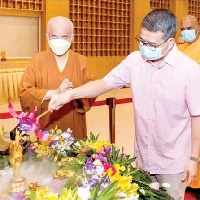
Singapore Minister for Culture, Community and Youth Edwin Tong performing the ritual of bathing Prince Siddhartha during a visit to the Singapore Buddhist Federation on Sunday. With him is the Venerable Kwang Phing, President of the Federation.This marks the second year that Buddhists around the world will celebrate Vesak, a holiday commemorating the Buddha’s birth, enlightenment, and final passing into parinirvana, under the confines of pandemic life. Similar to Vesak 2020, many countries and Buddhist temples have opted for scaled-down or online versions of the traditional events, which include prayer, chanting, the lighting of candles and paper lanterns, and the offering of gifts.
In Thailand, where the Buddha’s birthday, or ‘Visakha Bucha Day’, falls today, religious activities will follow strict Covid-19 preventative measures, according to the Bangkok Post. Thailand’s Minister of Culture, Ittipol Khunplome, has encouraged Buddhists to celebrate Visakha Bucha Day via online ceremonies hosted by the Department of Religious Affairs and a network of Buddhist leaders from May 20 to 26.
Culture Minister Ittipol Khunplome has revealed that the resurgence of Covid-19 has again put a limit on Visakha Bucha Day religious activities, hosted annually by the Department of Religious Affairs (DRA) in cooperation with the clergy and other public and private businesses.
To help flatten the curve of the contagion, this year’s activities today (26) will now strictly follow preventive measures from the Ministry of Public Health. Buddhists are thereby encouraged to participate in Visakha Bucha Day 2021 ‘new normally’ via online platforms.
The Minister also addressed the ongoing cooperation between the DRA and a network of clergy to host online activities from May 20 to 26 to promote understanding of the essence of Buddhism. Religious practices, such as making offerings to the Buddha, will be broadcast live on the NBT channel from Wat Phra Chetuphon Vimolmangklararm today (26) from 8.30 pm to 9.00 pm, along with the chanting of Buddhist mantras and traditional candle-lit temple walks.
Organisers have put together an online exhibition of the Buddha’s life. Thus Buddhists at home can still join Visakha Bucha Day celebrations through the Stay Home, Make Merit app. Essential doctrines, insights and sermons from several monks of repute are also featured on the platform. Visitors can write down their resolutions to perform good deeds using the Buddha’s teachings as guidance. Candle-lit temple walks can be safely joined online. To support the continued promotion of Buddhism, a Visakha Bucha Day E-Booklet is available at no cost on the Stay Home, Make Merit app, DRA’s Facebook page, and www.dra.co.th.
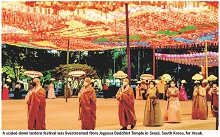
South Korea’s Buddhist community adhered to Covid-19 precautions when it celebrated the Buddha’s birthday on May 19, Yonhap News Agency reported. President Moon Jae-in expressed his gratitude to the Buddhist community for deciding to cancel the annual lotus lantern festival, Yeon Deung Hoe, a decision made more difficult due to the festival’s recent listing as a UNESCO event of Intangible Cultural Heritage. “It’s natural wanting to celebrate the feat, but the Buddhist community decided to cancel this year’s lantern festival and hold an online event instead,” President Moon said in a message shared on social media.
Although South Korean Buddhists could not gather in Seoul for the festival, they will be able to visit a rare Buddha for the first time. A giant scroll painting of Rocana Buddha travelled from its permanent home at the Sinwon Temple in South Chungcheong to be displayed at the National Museum of Korea in central Seoul, just in time for the Buddha’s birthday. According to Korea JoongAng Daily, the gigantic 17th-century painting (32.8 feet high and 21 feet wide) – and Korea’s National Treasure No. 299 – will be on display until September 26.
In a white paper titled “Tibet Since 1951: Liberation, Development and Prosperity,” released on Friday, the Chinese government said it must approve any successor to the Dalai Lama – and that Tibet has been a part of China for centuries, India’s Economic Times reports. When the current Dalai Lama, the 14th generation of a lineage that dates back to 1642, dies, regents – typically the Dalai Lama’s disciples – will begin searching for his reincarnation, following the guidance of oracles and omens from religious leaders. As the Dalai Lama ages (he is currently 85 years old), the subject of his successor has become particularly pressing.
The Tergar Meditation Community, founded by the respected Dharma teacher and master of the Karma Kagyu and Nyingma lineages of Tibetan Buddhism Yongey Mingyur Rinpoche, has announced a special online Saga Dawa community celebration to be led by Rinpoche on May 29.
Saga Dawa (Skt: Vaishakha), the fourth month in the Tibetan lunar calendar, is the most important Buddhist religious and cultural event of the year. The name is derived from the clan name of Shakyamuni Buddha. The occasion is also known in Tibetan as Bumgyur Dawa, “the 100,000-multiplying month,” as karma from all skillful and unskillful actions is believed to be multiplied 100,000 times. This year, Saga Dawa runs from May12 to June 10, with Saga Dawa Duchen, the single most important day of the year for Tibetan Buddhists, commemorating the birth, enlightenment, and final passing into parinirvana of Shakyamuni Buddha, falling on May 26, the full moon day. The occasion is also known around the world as Buddha Purnima and Vesak in other Buddhist traditions and following different calendars. The event is open to all, with translations offered in Chinese, French, German, Portuguese, Russian and Spanish.
In Fukui, Japan, a priest has revived attendance at his small temple by giving his services a modern twist: techno music and light shows. Though he was passionate about DJing in his youth, Gyosen Asakura eventually followed in his family’s footsteps and became a 17th-generation priest. Now, he’s found a way to combine his love for music with his religious life. “The main teaching of Buddhism is nothing will remain. Everything will change. So, I thought the traditional way of teaching must change as well,” Asakura told the Indianapolis-based TV station WTHR. “Traditionally, the temple would try to recreate the world of light with gold decorations. So, the traditional music can change. Suiting the music to the modern generation.”
Prayers and support for India
On Wednesday, India reported 4,529 deaths from Covid-19 in 24 hours – a new global high as the country’s second wave continues to rage. However, as the New York Times has reported, this number doesn’t even represent the real toll because so many cases and fatalities don’t get reported. In response to the surge, neighboring Bhutan has pledged Buddhist prayers and liquid oxygen to India. On May 12, the Zhung Dratshang, Bhutan’s central Buddhist monastic body, offered 1,000 butter lamps and prayers to Covid victims, specifically those in India.
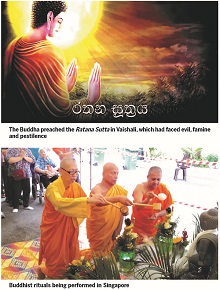
On May 15, King Jigme Khesar Namgyel Wangchuck visited the oxygen plant that will supply 40 metric tons of liquid oxygen per day to Assam. Meanwhile, the Sri Lanka Broadcasting Corporation started airing the Ratana Sutta, known as the ‘Jewel Discourse’, to bless India’s Covid victims last week. Though the Sutta has been airing since October 2020, SLBC Director General Chandrapala Liyanage said last week that they have entered a second phase of the programme in partnership with the Indian High Commission in Colombo. “We have extremely strong ties with India, and Buddhism came to Sri Lanka from India. That is specifically the reason why we decided to air the chantings for India,” Liyanage said.
With the ongoing Covid-19 pandemic, activities for Vesak Day, which falls today (26), will again have to be scaled down and moved online.
Prior to the pandemic, the day of celebration for Buddhists would see many flock to temples, engaging in a day of prayers and offerings.
Last year, Singapore was in its circuit breaker period on Vesak Day, which became a muted affair.
In the light of safe distancing measures again this year, the Singapore Buddhist Federation has put together a livestream for devotees so they can view the prayers and activities remotely today.
Minister for Culture, Community and Youth Edwin Tong visited the Federation at its premises in Geylang on Sunday.
In a Facebook post, he said he had visited to explain the current situation to the Federation and to thank them for their understanding and leadership.
“A regular Vesak Day would usually see thousands of Buddhists visit the temples, engaged in a day of prayers and offerings, performing Three Step One Bow procession, Light Transference ceremony, and the bathing of Prince Siddhartha. This year, however, these activities will again have to be scaled down and also moved online,” he said.
“I know many people seek solace in religion, and I hope that we will be able to overcome this recent spate of infections, and resume some degree of community events again. Venerable Seck Kwang Phing, President of the Singapore Buddhist Federation, showed me their livestream set-up, which was put together by their millennial generation. Devotees can now view livestreams of the prayers and activities, or watch and pray with the recorded prayers services at their convenience,” he said.
Those who wish to view the streams may register via the Federation’s page on Facebook or through its website.
The Embassy of India in Phnom Penh, in collaboration with Preah Sihanouk Raja Buddhist University (SBU), hosted a webinar discussion on Sunday, about Buddhism in Cambodia and Southeast Asia to celebrate Vesak Day and the 130th anniversary of the birth of Dr. B.R. Ambedkar, considered the chief architect of the Constitution of India. During the webinar, Ambassador of India to Cambodia Dr. Devyani Khobragade stressed the importance of Vesak Day for the Buddhist community all over the world.
“The United Nations at the 54th session of UN General Assembly in 1999 had recognised Vesak as an International Day of Observance. The teachings of Buddha have brought people together across social, generational, cultural and national divides especially in these challenging times of the Covid-19 pandemic,” she said.
She highlighted the ancient connections between India and Cambodia and India’s efforts to take its relationship with Southeast Asian countries, including Cambodia, to new heights through Buddhist linkages.
“As heirs to these ancient civilisations and religion, our countries have a lot to offer to the rest of the world in the form of culture and learning,” she added.
Dr. Khobragade also outlined some of the initiatives that the Indian government has been undertaking, such as working on the Buddhist circuit, organising international Buddhist conferences, offering scholarships to Cambodian students and monks in Nalanda University on Buddhist Studies as well as organising online ITEC courses on Buddhism and Vipassana and more. She highlighted India’s resolve to continue fostering strong Buddhist linkages between India and Buddhist countries through various bilateral, multilateral and public and private initiatives. (Tricycle, Agencies)
26 05 2021 – Daily News
N5.06
Buddhism’s Five Remembrances are wake-up calls for us all
Koun Franz
Often, someone will ask me, What's Buddhism about?” I usually go straight to what are known as Buddhism’s “three seals” — the concepts of dissatisfaction, impermanence, and non-self. I will tell the person, “These are the structural underpinnings of Buddhism.” But that’s a lot to take in. If I were being more skillful, I would probably have business cards printed up with the “Five Remembrances” of foundational Buddhism on them. And when someone asked, “What is Buddhism?” I would say, “Here. It’s this.”
· I am of the nature to grow old. There is no way to escape growing old.
· I am of the nature to have ill health. There is no way to escape having ill health.
· I am of the nature to die. There is no way to escape death.
· All that is dear to me and everyone I love are of the nature to change. There is no way to escape being separated from them.
· My actions are my only true belongings. I cannot escape the consequences of my actions. My actions are the ground upon which I stand.
A Bhikku venerating the BuddhaThese Five Remembrances, first found in the Upajjhatthana Sutta (“Subjects for Contemplation”), are intended to be recited. They are intended to be memorized. They are things we can say every day. Maybe they are the first thing you say when you wake up, or the first thought you have before you go to bed; maybe they are taped next to your bathroom mirror or on your kitchen counter. And as they become internalized, they become a kind of touchstone, a constant reminder to yourself that you are of the nature to grow old, that there’s no way around aging, that there is no way around sickness. There is no way around death.
These first three, of course, are basically what drove the Buddha to become the Buddha. These were the central wake-up calls of his life before he “woke up”: sickness, old age, death. It’s so commonsensical.
If you have all five memorized, there’s no need for a further teaching. I’m going to ramble about these for a while, but it’s all right there already. It’s complete. It’s Buddhism at its very, very best. It’s perfectly clear. It’s perfectly compassionate. It’s perfectly concise. And you can’t argue with it. It must matter.
So we have sickness, old age, death, and then we have these last two. “All that is dear to me and everyone I love are of the nature to change.” This is impermanence. “There is no way to escape being separated from” — and there we have a little bit of the spice of dukkha, or unsatisfactoriness. Everything is going to change; nothing is ever going to be as I want it to be, as I need it to be, as I think it should be. I can’t keep the perfect thing. I can’t keep anything.
We say these in the first person, but we can say them in the second person. Maybe not out loud, but as you are looking at your aging parents, as you are looking at your friend who is suffering from a debilitating disease, as you are looking at your children going through all the joys and the difficulties of growing up, you can pause and think to yourself:
You are of the nature to grow old.
You are of the nature to die.
You are going to suffer separation and loss.
A meditating monkWe shouldn’t pretend otherwise. And of course, we can also say it as “we”: we are all this. We are all going to lose what we have, if we ever had it. We are all of this nature. Some of my most grounded and simple moments in relationship to this practice have taken place in settings like subway stations, moments of being crowded in by hundreds or thousands of people and looking out at so many faces, more than you can process, and then thinking, “Oh, we’re ALL this. Everything that is true to me about this practice is true to them.” It changes the room. It changes the air. Not because something good happened, but because that’s my one brief honest look at where I am.
Remembrance #5 is maybe the most interesting. “My actions are my only true belongings. I cannot escape the consequences of my actions. My actions are the ground upon which I stand.” This is about karma. I’ve heard it said, and maybe you have as well, this phrase, that we own our actions “but not the fruits of our actions.” We experience the consequences, but we don’t get to have the rewards. Within my tradition, Zen, we can understand this to a certain degree as practice–verification, Dogen’s central teaching that the meaning of what we do is expressed, complete, in what we do. What we do is the thing.
My life is being expressed 100 percent right now. This is what my life looks like right now. There’s no back story. There’s no other thing that you don’t see. And it’s equally true for you wherever you are, whichever part of the world you are in. However you are sitting, however you are breathing, that’s you — not just a version of you but the complete you, the culmination of your life.
Prince Siddhartha sees sickness, death, old age and a sageWhat you choose to do in this moment matters. There will be consequences. And while you get to choose which actions you take, you don’t get to choose what those consequences will be. It’s like aiming a bow and arrow while you’re running: you know what you want to hit. Maybe you’ll get it. Maybe you won’t. You just do your best, but you have to accept the consequences for what happens because what other option is there? So Remembrance #5 is saying that what you do matters — so live like it does.
These Five Remembrances are powerful. They are enough. They are more than enough. But I want to add another piece, which is that in another sutra, in the Devaduta Sutta (“The Deva Messengers”), there’s discussion about the Remembrances, but from a different angle: “The Five Divine Messengers.” When we encounter these five divine messengers, they are reminders of the Five Remembrances.
I love the first one. It makes me trust the whole list: newborn babies. When we encounter a newborn baby, even if we don’t have any particular philosophy about the nature of reality, we are struck with something powerful. There’s something earth-shattering about a newborn child. In that little face, we see all of it; we see something so perfect. And at the same time, we know that it can’t remain. We would never wish for that baby not to grow up, to not get older. And at the same time, when that child gets a little older, we may not be able to see its perfection as clearly. So there’s a sense of loss. There’s an understanding that this is temporary — and at the same time, so complete.
Devotees engage in religious observancesThe second divine messenger is “a bent over, broken-tooth, old person.” Every time you see someone who has reached old age — and in this case, a kind of extreme example, someone who has really felt the ravages of age — that’s a divine messenger. It’s a kind of angel appearing to remind you, in case you forgot in this moment or for today that you, too, are of the nature to grow old, that you cannot escape.
Don’t look away. Say thank you.
The third messenger is someone who is suffering from an illness. Part of what I love about this teaching is that I’ve heard people say, many times, that when you see someone else who is suffering, you should count your blessings that you’re not suffering in the same way. This teaching is saying the opposite: “That person is suffering. Don’t kid yourself — that person is showing you the nature of your life. You may not feel it acutely in this moment, but this is what it is to be human.”
Again, don’t look away. Realize what you are seeing.
The next is someone who has died. In this culture, that’s usually been a rare event; in other cultures and other times, seeing a corpse was not uncommon at all. But these teachings came about in times when there was, for example, no photography. We have a different opportunity. Every time you see a picture of someone from the past, every time you see a photograph of someone who is no longer with us, you can pause and consider the fact that that person died and that you will too, that there is no escape. It isn’t a punishment; it isn’t unfair. It’s just who we are.
And then there’s the last divine messenger. This one, we need to examine a little bit; it comes from a different place. The last messenger is “a punished criminal.” This image, of course, is intended to remind us of karma, but it points to a narrow definition of karma, something closer to “justice.” Perhaps people had more faith in the criminal justice system 2,500 years ago, but if someone points out a “punished criminal” to me today, I don’t simply assume the person got what they deserved. How can I know that?
If a divine messenger isn’t sending the intended message, you can disregard it. Find something new. In this case, we’re looking for something to remind us of karma — luckily, literally everything does. Every time you can’t find your keys, it’s because you put your keys somewhere else. That too is karma — it doesn’t have to look like justice. It doesn’t have to be a balancing of the scales; that’s a simplistic and dangerous view. It’s simply that we do things, and something comes of those choices.
When you breathe out, your body needs to breathe in again. Just like that, multiple times a minute, you have a reminder that what you do matters, that what you do now is leading to something else. We always bear the weight of that, but we can also choose that weight in the way we sit and stand and walk and speak, because again, what other option is there?
We can get so caught up in the idea that this tradition and this practice are about somehow perfecting ourselves or about purifying our view. Even if we are in a tradition that tells us not to see it that way, that particular door feels so wide, so open, so seductive. But if we choose that path, if we try to walk through that door, then we walk past this, the thing that is truly on offer.
Maybe, in the future, there is a better you, a wiser you, a more compassionate you. But in this moment, you don’t need to focus on that at all. Just don’t lie to yourself about the nature of your life. That’s what these five are saying. Remember every day. Let them be the air you breathe. Metabolize them. And then, whatever you choose to do with your life, the actions you choose to take will come from that place of total honesty, of total transparency.
That’s what these five are about. Not something out there. Not something to come.
If you are looking for a project, go grab a 5×7 card and write the Remembrances down, and stick it next to your mirror. Tape it on your kitchen counter. Put it on your desk. Let these five truths soak into your skin. You’ve always known them, because they’ve always been true. But best to remind yourself anyway. (Lion’s Roar)
26 04 2021 – Daily News
N5.07
‘Servants of the Buddha’ celebrates its Centenary
The meeting at the Maitriya Hall adjacent to the Mettaramaya Temple on Lauries Road, Bambalapitiya, on April 23, 2021, was a landmark for the group of Buddhists who have formed a collective and call themselves ‘Servants of the Buddha’. It is also a notable event for Buddhism in Sri Lanka and for the country itself. The centenary meeting on April 23 commemorated 100 years of continuous meetings on Saturday afternoons of Buddhists within their organization – ‘Servants of the Buddha’, uninterrupted by WW II, our civil war and JVP uprisings. Unfortunately Covid 19 stymied weekly meetings; but they continue as virtual meetings via Zoom called ‘Dhamma Chats with the Servants of the Buddha’.
Who are the Servants of the Buddha? “A group of individuals who strive to learn, practice and preserve the Buddha’s teachings in its pristine purity.” Their Vision is the pursuit of enlightenment while Mission is “the study, practice and dissemination of the teachings, taking great care not to stray from the authentic word of the Supreme Buddha.” A clarification of the term ‘servants’ is offered since the Buddha did not tolerate subservience. Here ‘servants’ denotes those committed to free thinking, questioning and investigation (ehipassiko) of the Buddha Dhamma. Servant connotes service to the Buddha and his Dhamma. This is a life’s practice; consolidation and shared commitment and investigation are accommodated during Saturday afternoon meetings which are conducted in English, when an erudite bhikkhu or bhikkuni, or a learned lay person addresses those gathered at the Maitriya Hall. Many a young monk has gained experience speaking in English at these meetings and some have gone overseas to spread the Buddha’s Word.
The expression that comes to mind when considering this group of dedicated Buddhists is ‘small is beautiful’ with the added term ‘sustained and durable’. It is a small society in numbers, funding itself and meeting weekly, but extensive in its integrity and dedication to its Vision and Mission. We congratulate it on its hundredth year and know it will continue for very long – another 100 years and more!
BeginningsThe Society was founded in 1921 by Dr. Cassius Pereira who later ordained as Ven. Kassapa in Vajiraramaya. Other founders were Messrs W.J. Soysa, W,A. Silva, Hema Basnayake – the first Sinhalese Chief Justice. The inaugural public meeting was on April 23, 1921. Thus the centenary celebration this year.
On a personal note I say I have regularly attended Saturday meetings from the time Alec Robertson was President and then Rajah Kuruppu and now Anoja Wijeyesekera. The benefits are you sit in pin drop silence on comfortable pew benches, part of a dedicated group of truth seekers and feel welcome and completely at ease; you give ear and mind to an always valuable Buddhist talk in English which is appreciated by older persons whose first language is English. Metta is spread to all; and one comes away calm and serene.
Those who donated their time and commitment selflessly were all the patrons and office bearers, more especially those who held the office of President starting with Dr Casssius Pereira and consequent to his ordination, his son Ananda Pereira (Crown Counsel). Alec Robertson was president for 30 years and Rajah Kuruppu for 10. Drs. Gamini Jayakuru, Kosala De Silva and Ranjini Ratnapala followed by Anoja Wijeyesekera, the present President. I need to say more about Anoja. She was associated with the Society for long and served as Hony Secretary. After her return from UN service in Afghanistan and Bhutan she took on the responsibility of being President and then again after an assignment in Malaysia. She is dedicated and dynamic, with excellent organizational and interpersonal skills.
Patrons of the Society have usually been head monks from Vajiraramaya Temple. Ven Kassapa was followed by Ven Narada and Piyadassi Theras and the present Patron is Ven Siri Vajiraramaye Nanasiha Thera (formerly Deshabandu Olcott Gunasekera of the Ceylon Civil Service)
A deep friendship that benefited generationsLike most historical facts a touching story buttresses the Servants of the Buddha. Allan Bennett was an Englishmen born in 1872; this being the time when the West was awakening to Buddhism. Britain had its colonized Empire stretching over much of Asia; Edwin Arnold in India had composed his epic poem – The Light of Asia; and Charles Darwin’s Theory of Evolution debunked the creation of the world and man by an almighty god. Scientist Allan Bennett, curious about the world’s second oldest major religion, decided to come East. He learnt Pali in a temple in Kamburugamuwa and ordained as a monk in Burma. Returning to Colombo as Ven Ananda Maitriya, he so impressed Ellenson Pereira and others with his sermons, they inaugurated The Buddhist Aid Association, bought a piece of land adjoining the Mettaramaya Temple and in 1903 built a hall for delivering bana and named it Maitriya Dhamma Sala. Thus also the strong friendship of the English monk with medical doctor Cassius Pereira, son of Ellenson Pereira. The Servants of the Buddha evolved from the Buddhist Aid Association, and is unique. So is the Maitriya Hall in its resembling a church inside and out in English Gothic Revival architectural style. As Anoja pointed out, we who attended the centenary ceremony sat on the pews that furnished the original Salawa; more than a hundred years old.
The Centenary commemorative meetingThe meeting under strict Covid restrictions was held in the Maitriya Hall on 23 April starting at 4.00 pm. The Chief Guest was Most Venerable Uda-Eriyagama Dhammajiva Thera, Chief Meditation Master of Meetirigala Forest Monastery. Guest of Honour was Prof Kapila Gunawardene, Secretary, Buddha Sasana Ministry. They were both at a meeting with President Rajapaksa. The venerable monk arrived just in time to make his keynote address, but not Prof Gunawardena. A paper sent by him was read. To benefit those unable to attend, proceedings were live-streamed online, unfortunately interrupted by short power outages.
The entire proceedings were well managed and kept sharp to time. This, Anoja said, was due to the willingly cooperative effort of all the office bearers of the Society. A plaque at the entrance to the hall was unveiled after which many distinguished monks and Servants of the Buddha Board of Management and office bearers entered in procession. Preliminary remarks were made by Vice President Prof Kolitha Sellahewa after which Pansil was administered by Ven Olande Ananda. The traditional oil lamp was lit.
President Anoja Wijeyesekera delivered a long though succinct and very interesting “Looking back over one hundred years.” A 140 paged, large sized volume – ‘100 years 1921-2021 Dhamma Gems’ was presented to the monks and other distinguished invitees which included important persons of the other three religions.
Next on the agenda was the address by the Patron of Servants of the Buddha – Ven. Siri Vajiraramaye Nanasiha Thera who had, with Prof. Manouri Senanayake, edited ‘Dhamma Gems’ on which he commented, including historical facts about the Society.
Most Ven. Uda-Eriyagama Dhammajiva Maha Thera spoke about how he became a monk from being a university student who broke all five precepts. He chose living as a forest bhikkhu. We know he is in demand overseas and assists Ven. Bhikkhu Bodhi in New Jersey in his meditation retreats. He now stresses very much on Sathi – Mindfulness, and directs retreats of one day or more for students of Grades 5 and 6. Kids of all religions participate. Mindfulness is introduced as secular and therapeutic, and could lead to religiousness. He has proposed to the country’s President to include Sathi in school curriculums. He stressed on the excellence of the book on mindfulness by Ven. Nynaponika.
An official from the Buddha Sasana ministry read out the script sent by Prof. Kapila Gunawardena in which were listed 20 identified deviations (malpractices) carried out by a few radicals who call themselves Buddhist monks and also conversions to Christianity, and what the Buddha Sasana Ministry hopes to do to combat these.
Prof Manouri Senanayake spoke on ‘Venturing into the next century’ and Secretary Samudra de Zoysa presented the vote of thanks. Pirit chanting brought the ceremony to a close.
Gilanpasa was offered the monks present; fellowship and refreshments followed. A copy of Dhamma Gems was given to each one present.
02 05 2021 – The Island
N5.08
The great significances of the Vesak Poya
Nanda Pethiyagoda
Undoubtedly, the greatest significance of the Vesak Poya in May is that the three most important events of Siddartha Gautama’s life occurred on this day six centuries ago in Nepal and India. He was born, attained enlightenment, and his life and almost 50 years of preaching the dhamma he had reasoned out for himself and decided to share with others, ended this full moon day. The details of these events are truly marvelous, most unusual and mixed with sorrow and hardship, finally triumph. Consider his birth: out in a park under a tree when his mother travelling to her father’s palace for her first confinement felt labour pains as she alighted from her carriage to take a respite. The sorrow was that she died seven days later but the joy of the birth of a son to Suddhodana was restored when Mahamaya’s younger sister, Prajapathi Gotami, became Siddhartha’s foster mother.
Attaining Buddhahood was after a most traumatic leaving of his wife and newborn son and venturing forth as a homeless, poor ascetic. The suffering of seven years of starving the body and the least of comforts brought him close to death. He decided to follow a middle path in his search and then gloriously found the truth seated under a bo tree in Gaya after partaking of a good meal provide by Sujatha. His death at 80 was not a sudden one. He suffered dysentery after consuming either mushrooms or pork served him by a pious devotee and walked in thirst and fatigue with his faithful Bhikkhu Ananda until he reached Kusinara – his destined place of death. Lying down on a hastily prepared bed between two sal trees, having been visited by a person who wanted questions to his answer and giving his final advice to the Sangha present, he breathed his last.
I gleaned more great significances from reading the article by Ven Mirisse Gunasiri Mahathera in the centenary publication of the Servants of the Buddha – Dhamma Gems.
We had these in mind, but the article induced more effect and influence giving thoughts to ponder over this season of Vesak and lockdown.The Mahathera speaks of Social equality which the Buddha introduced to class and caste wracked India of the time. Oft repeated is the Dhammapada verse: “Not by birth but by deed does one become a Brahmin or an out-caste. Not by colour bar or caste bar or by wealth or poverty must a person be judged.” Many are still impressed by wealth and power – both ephemeral and even injurious if mishandled. The wealthy and powerful often get inebriated over these and end up disastrously if not in this life, in a later life. To put it simply, sycophants are led up the garden path!
Free thinking: The Mahathera next advocates as the Buddha was the greatest and probably first Free Thinker. I quote from the article: “Free thinking, not in its modern significance but in its primary meaning, was one of the Buddha’s high principles. He shunned all traditional systems… and finally adopted an independent outlook based on rational understanding.” This in other words is freedom of thought and understanding, which is often shunned by other religions. The Mahathera quotes the Buddha’s words: “Oh monks, do not accept even my own words without scrutinizing them out of respect towards me. The purity of gold is discerned by melting it or cutting it or by means of a touch stone.” Certainly apt when lies are omnipresent and rumour and fake news are often taken to be true.
Personally I relish the Buddha’s advice that he is the advisor, the show-er of the Path that we should investigate and if found good, we follow. He gives us the responsibility of paving the way for our future of samsaric lives to come; whether to be reborn or strive to end the samsaric cycle.
This brings on the Buddha’s exhortation that he was a mere man who strove and reached Buddhahood. Of course he had superior powers and every other excellent quality. But he was no god to be venerated nor worshipped. This thought is very necessary in Sri Lanka of today when building or going to temple is the highest merit and merely listening to bana. Within temple premises are altars for gods of the Hindu Pantheon. Not right.
The Buddha is supposed to have said: “Visit the four places of significance to me.” Hence we pilgrimage to India to visit Lumbini, Buddha Gaya, Saranath and Sravasti, and Kusinara. Ven Brahms gave a different interpretation. The four places mentioned by the Buddha are the four janas one achieves when meditating which lead to Nibbana.
Greatly appreciated is the fact to be kept in mind that death is the one sure happening in life, and can happen any time. And the comforting thought that if one follows at least the five precepts diligently, one need not fear death.
23 05 2021 – The Island
N5.09
Pakistan PM welcomes delegation of Buddhist monks from Sri Lanka
M.A. Kaleel
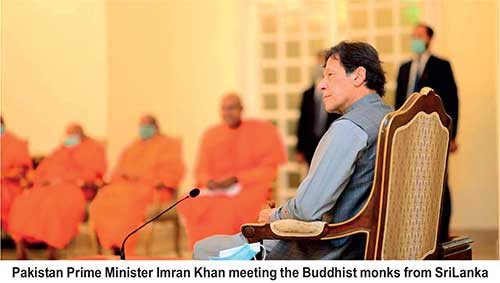
Pakistan Prime Minister Imran Khan received an 11-member delegation of prominent Buddhist Monks from Sri Lanka who visited Pakistan on the invitation of the government there.
Imran Khan underscored the importance of enhancing people to people contacts and strengthening interfaith harmony.
While highlighting the glorious Gandara heritage of his country, the PM said Pakistan was a proud custodian of some of the most sacred Buddhist sites in the world, and informed the delegation that his government was currently working on creating a Holy Buddhist Trail which would include the most revered Buddhist heritage sites in Pakistan.
The delegation appreciated Pakistan’s initiatives to develop Holy Buddhist Trail as well as the renovation work being done on various archaeological and religious sites. Sri Lankan High Commissioner to Pakistan, Vice Admiral (Retd.) Mohan Wijewickrema organised the visit of the delegation and looked after their interests.
24 04 2021 - The Island
Buddhist delegation praises Pakistan for its commitment to preserving Buddhist heritage
Maj. Gen. (R) Saad Khattak meets the delegation on its arrival in Colombo (pic courtesy Pakistan HC)
The Chief incumbent of the Gangaramaya Temple Ven. Dr. Assaji Thera said that Pakistani authorities were keen on the views expressed by a delegation of Buddhist monks during a recent visit to Pakistan. The Ven Thera said so on his return to Colombo on Monday (26).
The following is the text of a statement issued by the Pakistan High Commission yesterday:
The Most Venerable Buddhist Monks delegation on a goodwill visit to Pakistan from 19-26th April, 2021 returned to Colombo on Monday 26th April and were received by the High Commissioner of Pakistan Major General (R) Muhammad Saad Khattak along with other senior officers of its High Commission in Colombo at the Bandaranaike International Airport.
While welcoming the Most Venerable Monks on their return, the High Commissioner Maj. Gen. (R) Saad Khattak said that the highly successful tour was organized by the High Commission of Pakistan in Colombo and was the culmination of ongoing efforts for enhancing people-to-people contacts and Buddhist religious tourism between Pakistan and Sri Lanka.
The High Commissioner expressed his gratitude to the Most Venerable Monks for undertaking the tour and the Government of Sri Lanka for facilitating the same. He also appreciated the role and efforts of the security forces, the National Heritage & Culture Division and the Ministry of Foreign Affairs, Islamabad for conducting the visit in the most befitting manner. He underscored that the meetings of the Monks with the President and Prime Minister of Pakistan reflected the strong bilateral relations and deep commitment of the leadership and people of Pakistan towards Sri Lanka.
On behalf of the delegation, the Venerable Dr. Assaji Thera, Chief incumbent of the Gangaramaya Temple, expressed gratitude to the Prime Minister of Pakistan and for the personal involvement of the High Commissioner of Pakistan in extending immense support in arranging the tour, which provided an invaluable opportunity to visit and experience the glorious Buddhist heritage and relics in Pakistan. He highlighted that the Pakistani authorities and officials gave top priority to their comfort and safety during their stay and were also keen on their views and recommendations on improving facilities for Buddhist pilgrims in the country.
The accompanying coordinating official from the Sri Lankan side, Dr. Asela Wickrmasinghe, highlighted Pakistan Government’s vision to develop Buddhist tourism between Pakistan and Sri Lanka, to which end the visit of a group of 11 senior Buddhist monks was organized by the High Commission of Pakistan in Colombo in order to explore the Buddhist heritage in Pakistan. He expressed his gratitude to the Government of Pakistan and the High Commission for this initiative and for the wonderful and enthusiastic hospitality of the Pakistani people towards Sri Lankans during their visit. He further highlighted that they were able to witness first-hand the respect that Pakistani citizens have for other religions and their keenness to preserve Buddhist heritage in the country. He also highlighted that as a result of the linkages built with various stakeholders during the visit, arrangements were in process for a Buddhist pilgrimage visit of Sri Lankans to Pakistan in the near future.
28 04 2021 - The Island
N5.10
Esala Poya a day significant to Sri Lankan Buddhists
Nira Diaz

The Buddha’s first sermon at Saranath
The Esala Poya is in the month of Esala according to the Sinhala calendar and the Gregorian calendar in which it is called July.
Several important incidents took place on the Esala Poya or Esala Full Moon Day.* The conception of Prince Siddhartha (Bodhisattva) in Queen Mahamaya’s womb occurred on this day.
* Prince Siddhartha and Princess Yashodhara’s son, Prince Rahula was born on an Esala Poya Day.
* On the same day, Prince Siddhartha gave up his lay life, donned the robes of an ascetic and went in search of Enlightenment or Buddhahood as he became disillusioned with lay life after encountering an old man, a sick man and a corpse. He realised everyone including himself, a prince, must go through old age, sickness and death. His final encounter was with a sage. Then, he thought becoming an ascetic or a sage and finding the truth was the way out of Samsara (life).
Prince Siddhartha’s giving up of lay life is known as the Great Renunciation. In preparation to leave the palace, he quietly went and looked at his son Prince Rahula, who was born on that day and Princess Yasodhara, his wife, both of whom were fast asleep. Then he mounted his horse Kantaka and with his trusted Minister Channa left the Palace and his life as a Prince forever. When they came to the bank of the river Neranjana, Prince Siddhartha dismounted. He cut off his hair with his sword, took off his royal garments and donned the yellow robes of an ascetic. He gave his clothes to weeping Channa and bade him go back to the Palace and break the news of his Renunciation. The horse Kantaka watched his beloved master walk away and died of a broken heart.
* After achieving Buddhahood, the Buddha preached his first sermon, the Dammachakkapavattana Sutta to five ascetics on an Esala Poya Day at the Deer Park in Isipatana (present Saranath) in India. They were with him for some time during his search for the truth. Their names were Kondanna, Bhaddiya, Vappa, Mahanama and Assaji. At the end of the sermon, the ascetics embraced Buddhism and became the first Theras in the Sasana. The ascetic Kondanna attained the state of Sotapatti. Many Devas and Brahmas also listened to this first sermon.
* It was on Esala Poya that the Buddha visited the Tauvthisa Dev Lova, (Tauvtisa abode of the Gods) and for the first time preached the Abidhamma to the Maathru Divya Rajaya (who was Mahamaya Devi in her previous birth) and the other Gods there.
* The Buddha performed Yamaka Maha Prathiharya or the Twin Miracles on an Esala Poya Day to prove that he was the Buddha to the proud, older Sakya clansmen. He rose into the air and walked over and made flames come out of the upper part of his body and water from the lower part. Then he reversed the process. Then, the Buddha made fire come out of the right side of his body and water from the left side of his body. He also emitted six resplendent rays of light from his body.
For Sri Lankan Buddhists, Esala Poya is very important as several important events took place in the country on the Esala Poya Day.
* The first ordination of a Sri Lankan took place on an Esala Poya Day in Anuradhapura. Prince Ariththa, nephew of King Devanampiyatissa was ordained as a Bhikku by Arahath Mahinda.
* It was on an Esala Poya Day that the laying of the foundation for the Ruwanweliseya took place and the relics were enshrined by King Dutugemunu.
* Esala Poya also marks the start of the Vas Kalaya (rainy season retreat) for Bhikkus. Vas commences on the day after the Esala Poya. Bhikkus who were not able to start Vas on this day will be allowed to start late Vas on the next Poya day which is Nikini Poya, the Poya day in the month of August.
* It was on an Esala Poya Day that the Sacred Tooth Relic was brought to Sri Lanka by Princess Hemamala and Prince Dantha. Dante Pura, (City of the Tooth) in the state of Kalinga, on the Eastern coastal belt of India (present Orissa) was the home of the Sacred Tooth Relic originally.
The then King of Kalinga, Guhasiva was a devout Buddhist. He greatly feared that the Hindu kings would try to destroy the Sacred Tooth Relic. Therefore, he instructed his daughter, Princess Hemamala and her husband Prince Dantha to take the Sacred Tooth Relic to Sri Lanka where it would be safe with the King of Sri Lanka who too was a devout Buddhist.
Princess Hemamala disguised herself as an ordinary woman and hid the Sacred Tooth Relic in her hair. They left the Port Tamalitti, Kalinga and sailed to Sri Lanka and landed at Lankapattana. From there, they walked to Anuradhapura and handed over the Sacred Tooth Relic to King Kithsirimevan (AD 303-331).
The King, who was also known as Kirthi Sri Meghavarna was very happy to receive the Sacred Tooth Relic and kept it for a few days in a monastery called Meghagiri, the present Isurumuni Viharaya. Subsequently, the Sacred Tooth Relic was deposited in a building called Dhamma Cakka Geha built by King Devanampiyatissa.
The Sacred Tooth Relic was taken annually to Abhayagiri Viharaya in a grand procession and kept there for three months.
It is thought that this procession could be the origin of today’s annual Esala Dalada Perahera held in Kandy and associated with the Dalada Maligawa. The Perahera is held in August.
04 07 2020 – Daily News
N5.11
Vesak sans carnival atmosphere
Vesak has dawned while the world is under a pall of uncertainty, caused by the Covid-19 pandemic. The prevailing national health emergency, and the attendant restrictions on mass gatherings, in this country, will make the Vesak festival somewhat less colourful, but, on the positive side, these preventive measures will allow Buddhists to embrace spirituality in a more profound manner. The rising incidence of Covid-19, and the resultant staggering death toll, remind us of the fragility of life, which the Buddha likened to a dewdrop on the tip of a blade of grass.
Sri Lankans, who usually throng the streets during Vesak, especially after nightfall, have been confined to their homes for weeks, and the main attractions of the festival, such as thorana, or pandals, are conspicuous by their absence. People may not consider Vesak complete without thorana. But, not many of those who flock near these beautifully lit structures, in their thousands, are interested in Jathaka stories and moral lessons. Instead, they watch myriads of lights; they miss the message for the lights.
Street decorations are sparse due to lockdowns and curfew. However, people won’t miss much, other than some entertainment, if it is the true meaning of Vesak that they actually seek. They may not be able to attend religious functions, at temples, but they can observe sil at home and there will be many live telecasts of Dhamma programmes, today.
This year’s Vesak is devoid of cultural and commercial accretions and, most of all, the usual carnival atmosphere, as there are no puppet shows and other such forms of entertainment. In some parts of the country, musical events are also usually held during Vesak. The most popular among these Vesak shows, as it were, is apaya, or hell, where scenes of torment are enacted inside dark tents, purportedly to instil fear into sinners, but what really happens, in most cases, is that the ‘tormentors of hell’ suffer heavy blows at the hands of some drunken youth.
Dansel, where food and beverages are given away, have been banned on account of the highly contagious virus, lurking in every nook and cranny. They would have facilitated the spread of the virus. Anyway, there wouldn’t have been many dansel around even if no ban had been imposed thereon, for most people are struggling to keep the wolf from the door.
Meanwhile, Vesak has come at a time when complaints abound that lockdowns have led to mental health issues, such as depression among stir-crazy people cooped up indoors. The frustration of some of them has found expression in domestic violence and other such aggressive behaviour, we are told. Some men try to drown their lockdown blues in alcoholic brews, and they make a beeline to liquor outlets, the moment curfew is relaxed, in a bid to keep their spirits up.
The best way to remain calm and happy, in depressing situations, is to engage in religious activities. After all, the religiosity of Sri Lankans knows no bounds. Their vehicles are veritable mobile shrines. Buddhists, troubled by lockdown blues, can always find solace in the Buddha’s teachings, and others in the tenets of their religions. Mindfulness mediation is known to have a calming effect on racing thoughts and agitated minds. It helps get rid of the gnawing sense negativity, which results in depression. Let the Buddhists, troubled by mental problems in these depressing times, be urged to practise meditation.
We wish our readers a happy and peaceful Vesak!07 05 2020 - The Island Editorial
N5.12
Buddhists head online to pay homage to Buddha

As Buddhists around the world prepare to mark Vesak and commemorate the birth, enlightenment, and death of the Buddha. Millions of Buddhists, many living under lockdown or subject to strict social-distancing rules due to the COVID-19 pandemic, will be marking the sacred day at home or connecting with their communites digtally, by joining online observances of Buddhism’s most auspicious holiday.
In many countries and regions, Buddhist practitioners have been urged to focus and reflect on the internal aspects of the celebration rather than attending traditional public festivities as the world struggles to battle the growing coronavirus pandemic that has wrought havoc on billions of lives, destroyed livelihoods, and stalled national economies.
Vesak, also known as Buddha Purnima (or more informally Buddha’s Birthday), commemorates three key events in the life of the historical Buddha, Shakyamuni, that represent the birth of Buddhism: his birth, enlightenment (Skt: sopadhishesa-nirvana), and passing from this world (Skt: mahaparinirvana). The occasion is a public holiday in many countries in Asia and is celebrated by millions of Buddhists across the world. Although the date of the holiday can vary from country to country, it is traditionally observed on or around the date of the full moon in the month of May.
In a public message to the Buddhist world, UN Secretary-General António Guterres’, who in March issued an urgent call for a ceasefire on all armed conflicts around the world in light of the pandemic,* offered the following message for the international Buddhist community for the Day of Vesak on 7 May, calling on all nations to celebrate the Buddha’s teaching by acting with compassion and solidarity, and by renewing our commitment to build a peaceful world:
I send warm wishes to all celebrating the Day of Vesak, a sacred occasion to millions of Buddhists around the world.
As we honour the birth, enlightenment and passing of Lord Buddha, we can all be inspired by his teachings.And as the human family suffers the impacts of the COVID-19 pandemic, we are reminded of the sutra: “Because all living beings are subject to illness, I am ill as well.” This timeless message of unity and service to others is more important than ever. It is only together that we will stop the spread of the coronavirus and recover.
On the Day of Vesak, let us celebrate Lord Buddha’s wisdom by taking action for others with compassion and solidarity, and by renewing our commitment to build a peaceful world.
The UN General Assembly first officially recognized Vesak as an international observance in 1999 and the first celebration was held at the UN headquarters in 2000.
In light of the rapidly evolving COVID-19 pandemic situation, the International Council for the Day of Vesak (ICDV) decided in early March to cancel the upcoming 17th United Nations Day of Vesak event, which was scheduled to be held in Thailand.
Many Buddhist families in Sri Lanka will be staying home to celebrate with immediate family members on 7–8 May. Buddhist monks have been urged to avoid holding public gatherings, and in turn have been advising followers to make traditional lanterns in their homes using sustainable materials. Sri Lankan Christians were also reported to be decorating their churches and homes with Buddhist lanterns and flags in a show of interfaith solidarity.
Buddhists in Bangladesh received similar advice to avoid mass gatherings as President Abdul Hamid and Prime Minister Sheikh Hasina issued messages of greeting to the nation’s Buddhist community for Vesak. “I urge all of the Buddhist community to celebrate their festival while staying at their respective homes,” President Hamid’s message said. (Dhaka Tribune)
The Malaysian Buddhist Association (MBA) has prepared a series of online programs to help Buddhists celebrate Vesak in their homes, following the cancellation of traditional celebrations. The MBA’s honorary secretary, Rev. Ji Zun, said a ceremonial bathing of a Buddha image and chanting would be live-streamed on the MBA’s Facebook page, with an assortment of live interviews to be shared online over the course of the celebrations.
“Although the public is not able to go to temples to bathe the Buddha statue, they can still participate online in these auspicious activities at home through the YouTube video,” she said.
“We hope that through the program, devotees will enrich their innermost being to understand and nurture reverence to Buddha, Dharma, and Sangha during the movement control order (MCO).” (The Star)
In Vietnam, the Vietnam News Agency announced that Vesak celebrations—to be hosted at the headquarters of the Vietnam Buddhist Sangha (VBS)’s Central Committee—would be broadcast live on Youtube, Facebook, Butta and Phatsuonline, and An Vien TV. Monasteries and other Buddhist institutions have been advised not to hold rituals, parades, or other public events for more than 20 people.
Likewise, Buddhist monks in Thailand will still perform traditional Vesak rituals at their temples, but they will have to follow physical distancing rules while doing so.
Lay Buddhists have been recommended to stay home and show their gratitude to the Buddha by observing the five precepts, practicing meditation, chanting, and listening to online sermons.
07 05 2020 – Daily News
N5.13
Five Buddhist teachings to help with Coronavirus anxiety
Brooke Schedneck
Buddhist meditation centers and temples in coronavirus-hit countries around the world have been closed to the public in order to comply with social distancing measures. But Buddhist teachers are offering their teachings from a distance in order to remind their communities about key elements of the practice.
In Asia, Buddhist monks have been chanting sutras to provide spiritual relief. In Sri Lanka, Buddhist monastic chanting was broadcast over television and radio. In India, monks chanted at the seat of the Buddha’s enlightenment, the Mahabodhi Temple in the eastern state of Bihar. Buddhist leaders argue that their teachings can help confront the uncertainty, fear and anxiety that has accompanied the spread of COVID-19. This is not the first time Buddhists have offered their teachings to provide relief during a crisis. As a scholar of Buddhism, I have studied the ways in which Buddhist teachings are interpreted to address social problems.
Engaged Buddhism
The Zen master Thich Nhat Hanh first coined the concept of “engaged Buddhism.” During the Vietnam War, faced with the choice between practicing in isolated monasteries or engaging with the suffering Vietnamese people, he decided to do both. He later ordained a group of friends and students into this way of practice. In recent years many Buddhists have been actively involved in political and social issues throughout much of Asia as well as parts of the western world.
The following five teachings can help people in current times of fear, anxiety and isolation.
1. Acknowledge the fear:
Buddhist teachings state that suffering, illness and death are to be expected, understood and acknowledged. The nature of reality is affirmed in a short chant: “I am subject to aging … subject to illness … subject to death.” This chant serves to remind people that fear and uncertainty are natural to ordinary life. Part of making peace with our reality, no matter what, is expecting impermanence, lack of control and unpredictability. Thinking that things should be otherwise, from a Buddhist perspective, adds unnecessary suffering. Instead of reacting with fear, Buddhist teachers advise working with fear. As Theravada Buddhist monk Ajahn Brahm explains, when “we fight the world, we have what is called suffering,” but “the more we accept the world, the more we can actually enjoy the world.”
2. Practice mindfulness and meditation:
Mindfulness and meditation are key Buddhist teachings. Mindfulness practices aim to curb impulsive behaviors with awareness of the body. For example, most people react impulsively to scratch an itch. With the practice of mindfulness, individuals can train their minds to watch the arising and passing away of the itch without any physical intervention. With the practice of mindfulness, one could become more aware and avoid touching the face and washing hands. Meditation, as compared to mindfulness, is a longer, more inward practice than the moment-to-moment mindful awareness practice. For Buddhists, time alone with one’s mind are normally part of a meditation retreat. Isolation and quarantine can mirror the conditions necessary for a meditation retreat.
Yongey Mingyur Rinpoche, a Tibetan Buddhist monk, advises watching the sensations of anxiety in the body and seeing them as clouds coming and going. Regular meditation can allow one to acknowledge fear, anger and uncertainty. Such acknowledgment can make it easier to recognize these feelings as simply passing reactions to an impermanent situation.
3. Cultivating compassion:
Buddhist teachings emphasize the “four immeasurables”: loving-kindness, compassion, joy and equanimity. Buddhist teachers believe these four attitudes can replace anxious and fearful states of mind. When emotions around fear or anxiety become too strong, Buddhist teachers say one should recall examples of compassion, kindness and empathy. The pattern of fearful and despairing thoughts can be stopped by bringing oneself back to the feeling of caring for others. Compassion is important even as we maintain distance. Brother Phap Linh, another Buddhist teacher, advises that this could be a time for all to take care of their relationships. This could be done through conversations with our loved ones but also through meditation practice. As meditators breathe in, they should acknowledge the suffering and anxiety everyone feels, and while breathing out, wish everyone peace and well-being.
4. Understanding our interconnections:
Buddhist doctrines recognize an interconnection between everything. The pandemic is a moment to see this more clearly. With every action someone takes for self-care, such as washing one’s hands, they are also helping to protect others. The dualistic thinking of separateness between self and other, self and society, breaks down when viewed from the perspective of interconnection. Our survival depends on one another, and when we feel a sense of responsibility toward everyone, we understand the concept of interconnection as a wise truth.
5. Use this time to reflect:
Times of uncertainty, Buddhist teachers argue, can be good opportunities for putting these teachings into practice. Individuals can transform disappointment with the current moment into motivation to change one’s life and perspective on the world. If one reframes obstacles as part of the spiritual path, one can use difficult times to make a commitment to living a more spiritual life. Isolation in the home is an opportunity to reflect, enjoy the small things and just be. (The Conversation)
The writer is Assistant Professor of Religious Studies at Rhodes College.
N5.14
Vesak Day celebrations around the world
Every spring, thousands of monks gather at the ancient Borobudur Temple in Java, Indonesia, on the most important day on the Buddhist calendar: Buddha Day. Also known as Waisak Day or Vesak Day, the holiday marks the birth of Gautama Buddha -- the father of Buddhism, who is responsible for the religion's core teachings. Robe-clad monks circle the 9th-century temple -- the world's largest Buddhist temple and a UNESCO heritage site -- to meditate, chant sutras and release an ocean of glowing lanterns into the night sky. It's just one of many celebrations taking place across Asia this month as worshippers ring in the holiday at the region's most beautiful temples, from lantern festivals at Seoul's Jogyesa Temple to rituals at Yangon's golden Shwedagon Pagoda.
Born in Nepal in 567 BC, Gautama Buddha -- or Prince Siddhartha Gautama at birth -- was the son of a tribal leader. As an adult, he founded a sect of wandering ascetics and the community eventually evolved into a religion after his death at 80 years old. Today, over 488 million people -- or roughly 9% of the world's population -- practice Buddhism, nearly 99% of which are located in the Asia-Pacific region. Each year, on the full moon of the month of Vesakha (usually falling in May or June in the western calendar), millions of Buddhists around the world take part in Vesak Day celebrations.
Not only does the date of Vesak Day change year after year, but it can also be different among cultures, depending which calendar they subscribe to.
In China and Hong Kong, for example, which follow the Chinese lunar calendar, worshippers observe Buddha Day on the eighth day of the fourth month (usually in early May). The holiday goes by dozens of names -- but many countries unofficially refer to it as Buddha's Birthday or Buddha Day.
It celebrates three important events of Buddha's life: birth, enlightenment, and death -- said to have occurred on the same calendar day, albeit many years apart. From Thailand to South Korea, Myanmar, China and Malaysia -- every country has its own traditions, each symbolizing various aspects of Buddha's life or teachings. Home to 255 million Buddhists -- the world's largest Buddhist population -- China sees one of the most widespread celebrations.
Most of the action revolves around Buddhist temples, where people light incense and leave offerings. In South Korea, the holiday comes to life in a Lotus Lantern festival, best viewed at Seoul's Jogyesa Temple. Temples are draped in thousands of colorful paper lanterns. It's also common for temples to offer bibimbap and tea to those who visit on the holiday. Meanwhile, in Sri Lanka, people decorate their homes with paper lanterns. Colombo's Gangaramaya Buddhist Temple hosts a colorful Vesak Day festival.
In Ipoh, Malaysia, Buddhist devotees practice the ritual of "Sunning Buddha." At Ipoh's Enlightened Heart Tibetan Buddhist temple, monks place a sacred Tibetan Buddhist painting -- called a "Thangka" -- in the sun to absorb its powers. The energy is believed to promote peace, health, and harmony for the rest of the year.
And in Nepal, where Buddha was born thousands of Buddhists flock to Lumbini, his birthplace, where they donate supplies to disadvantaged communities and pay tribute to monasteries.
(CNN)
N5.15
Vesak celebrations in Malaysia

Devotees of Gautam Buddha celebrate Wesak worldwide to commemorate his birthday. Also known as Vesak, Buddha Purnima, Buddha Day and Buddha Jayanti, the date of Wesak Day changes year after year depending on which calendar is followed. It is believed that Buddha was born in Lumbini, Nepal, in 567 BC. After his birth, an astrologer predicted that he would grow up to denounce all his wealth and luxuries to become a holy man. At the age of 29, he denounced his royal life and decided to follow the path of spirituality.
Though the day is celebrated to mark his birth, it is also known as the day he attained Nirvana or salvation under the Mahabodhi tree at Bodh Gaya, now in the Mahabodhi Temple Complex in India. Devotees discuss and preach the life and teachings of Lord Buddha, decorate his statues with flowers, chant from the scriptures, eat simple vegetarian food, and donate clothes, money, and food to the needy. Countries celebrating Wesak Day have their own traditions that symbolise numerous aspects of Buddha's life and teachings.
In Malaysia, hundreds of devotees gather on Vesak Day (though not this year) at the temples of Ipoh, to seek Buddha's blessings. They practise the ritual of "Sunning Buddha" and gather at Ipoh's Enlightened Heart Tibetan Buddhist temple where monks place a sacred Tibetan Buddhist painting called a "Thangka" in the sun to absorb its powers. It is believed that the energy promotes peace, health, and harmony for the rest of the year. Lighting oil lamps on Wesak Day is an important ritual. Last year, Jonas Wong Wai Leong, 30, came with his new bride to pray for a baby and for wealth. As an offering, he carried a Buddha statue and placed it on the altar of Ipoh's "Enlightened Tibetan Buddhist" temple. Like many other devotees, he also lit candles as a sign of respect. "I am so happy today. The temple gave us rice and sugar. I am going to consume them for strength and good health," he added. In Malaysia, Buddhism is the religion with the second most adherents after Islam. Out of a population of 30 million, approximately 5.4 million Malaysians are Buddhists, most of whom are ethnic Chinese.
(TRT World)
N5.16
Vesak: A festival like no other
Shaelyn McHugh

What do feeding monks, fighting a crowd to reach the front row of a rock concert, and celebrating the first day of summer have in common? They can all take place at a festival. Whether it’s a religious ceremony or an event in the name of art or music, festivals have a certain allure that brings together diverse crowds of people to share a cultural experience.
The anticipation of a major festival instills a certain type of feeling. There’s a welling of excitement in one’s chest, knowing that it is a “special day.” I have always been attracted to the type of energy that festivals generate. Being raised Catholic, the Christmas experience was filled with sensory delights signalling that it was an important time of year. Christmas music played over the radio, peppermint candies were sold, and an evergreen conifer tree appeared in the living room. A thrill came on Christmas morning from not knowing what to expect after a magical being’s personal visit to our home.
The out-of-time-and-place experience that came with the holiday festivities extend beyond the commercial side of the celebration. There was also the way the church was upgraded to honor the birth of Jesus with wreaths and the heavy scent of hundreds of flickering candles. But as maturity transpired, the level of excitement associated with Christmas began to fade.
Even those in the United States who are not religious still tend to observe Christmas as a special time to spend with family or friends. Buddhists are familiar with religious holidays when they similarly celebrate important dates in the Buddhist calendar. The largest Buddhist celebration is known as Vesak, Visakha Puja, or Buddha Day. During Vesak, Buddhists across the globe celebrate the birth, enlightenment, and death of the Buddha.
Last year I attended a Buddha Day festival hosted at a Buddhist temple here in California. I went to the event alone, without knowing a single person there. It was my first opportunity to engage with the Buddhist community in Santa Barbara and I had no idea what to expect, aside from the fact that Buddhists know how to host a great celebration.
The first thing I noticed about the gathering was the beautifully wide variety of people that came to attend. There were many races and ages, and I immediately felt welcomed as a female college student. The day began with a traditional Theravada Visakha Puja ceremony, during which donations and food were offered to the monastic attendees. There was also chanting in Pali, Tibetan, and English. After a long lunch break, everyone gathered under the beautiful orange and yellow canopy that gave everything a relaxing glow, complimenting the colors of Thai, Tibetan, and Zen monks’ robes.
The second part of the celebration began with a recitation of the Buddha’s first teaching in Pali and in English. The visiting monks were then introduced, representing an impressive variety of monastic backgrounds. A substantial community discussion followed between those in the audience and the visiting monks on the relevance of the Buddha’s teachings in modern society.
In this way, Buddha Day served as a connecting force for a religion that began far away and has since made its way around the world. Americans who have no deep geographical connection to Buddhism had the opportunity to connect with monastics from the Asian regions where Buddhism originated. It proves how Buddhism is a religion that appeals to all, and has the potential to transcend cultural borders. Religious festivals show the importance of certain events in the religious year with certain rituals and festivals, reinforcing beliefs in them.
From Buddha Day, to Christmas, Yom Kippur, Diwali, and Ramadan, these festivities are relevant throughout the world.
When I traveled to Nepal, I quickly learned that there were more festivals celebrated than there are days in the year due to the diversity of religions, either of Hindu, Buddhist, or indigenous origins. In any diverse society, whether it be a variety of religious groups, immigrants, or a rank-based societal structure, festivals are able to take diversity and transform it into a common and transcendent identity. The magic also lies in that special feeling of not knowing what to expect, like a child on Christmas morning. This sense of the unexpected helped fuel the community discussion on Buddha Day on how things can be different than they are. It provided a significant opportunity for lay people and monastics alike to imagine how the binding values that brought them together could be imagined in our world today. It takes ancient religious beliefs to the future.
When I arrived at the airport in Ladakh, northern India, about a year ago, I was immediately greeted with a khata around my neck by Ladakhis in traditional dress and a schedule for the Ladakh Festival. I had not expected my visit to coincide with this annual celebration of Ladakhi culture, but as a foreign tourist I could not have asked for better timing. Throughout the week there were several traditional events, including dancing, singing, archery, polo, and cham dance. Many societies around the world have started to employ cultural festivals to attract tourists and boost their economies. In the process of image enhancement, these types of festivals also allow for cultural regeneration by reviving nearly-lost traditions and preserving local heritage. Beyond its capacity to inform tourists about the culture they are visiting, elders are able to share stories and experiences to unite generations to come.
Humans are social by nature, so festivals and events become an opportunity to temporarily forget our fleeting, everyday concerns. They are unique experiences that allow for a deeper realm of connection by coming together over a shared common interest. Time and time again I feel something deep within me light up while at a festival. It’s that sensation that every human being craves—to feel united with one another.
The Summer Solstice Celebration is a festival that I helped to plan and hold last year—a large community arts event on the weekend of the first day of summer in an ocean-side community. Across all ages, religions, and political backgrounds, nearly 100,000 people gathered for a large parade and festival to honor the beginning of the best season of the year when you live near the ocean in Santa Barbara.
What I witnessed, from the months of preparation to the execution, was unlike anything else. I saw massive crowds of people dance for hours on end, make new friends or deepen previous bonds, and try something new. I played with children while dressed as a giant bird puppet. I felt my heart open and my mind expand to the power of letting go to come together.
Something about these experiences is enlightening. I believe it is because they provide a special chance to come together with people from different cultures to celebrate a collective purpose in unison. The sense of belonging for religious, social, or geographical groups allows for a shared belief to develop in imagining what can be achieved when we work together. During festivals, we can enjoy being playful by breaking away from our day-to-day routines even as adults.
Celebrating culture and pride can also help keep our spirits up in times of crisis. Festivals can provide a counter-narrative to an unsatisfactory status quo. Sometimes these events are not for celebration, but for meditation or reflection.
Growing up in California, I found myself at the center of many major festivals, such as the internationally-known music festival Coachella. As an avid festival-goer of all types myself, I started wondering about the cross-cultural relationships between festivals. What really sparked my interest was when I attended my first “transformational” or alternative gathering. These festivals feature music, alternative healing tutorials, talks about social justice issues, and group meditation sessions. At events like these, festival-goers who have never thought about a meditation practice in their life are encouraged to give it a try. By offering different activities in a festival setting, participants are more likely to step out of their comfort zone and try something new.
Festivals serve societal unity. The atmosphere of a festival serves the creation, preservation, and foundation of social solidarity. Festivals are unique because they aid unity in the midst of diversity. The diversity and unity element of reversal found in festivals that can transform people and take them from one place to another.
A festival—whether a special event or an annual holiday—has the capacity to open the human heart to creative experience and play. You are sure to walk away a different person and experience a shift from one place to another after attending any type of festival.
07 05 2020 – Daily News
N5.17
Buddhist art: More timely than you think

What was the Buddha’s great wisdom, and how do the artworks of the Buddhist tradition convey it to us today?
Buddhist art has been created over two millennia across India, China, Japan and throughout Asia, and takes some distinctive forms in various regions, but generally speaking it was created to guide followers of the Buddha, known as “the Awakened One,” in their religious practice.
Whether they depict the Buddha himself, episodes from his life, or boddhisattvas (those who have taken a vow to seek enlightenment), this art was meant to inspire the Buddha’s devotees and remind them of his teachings, whose core message is about compassion and the path to relieving suffering.
One thing Jeff Durham, associate curator of Himalayan art at the Asian Art Museum, San Francisco, stresses is that the very role of Buddhist art is fundamentally different from that of art in the Western world.
“Buddhist art isn’t just a picture of anything,” he said over the phone. “It’s active art designed to reflect and project a certain mental state. These works are meant to change the mind from a state of obsession to one of friendliness.”
Despite the broad geographic reach of Buddhism and its centuries-long history, the teachings are consistent. Our actions, or karma, define our destiny. The Buddha, who was born as the Prince Siddhartha into a royal family in Lumbini, close to the border with India in what is now Nepal, taught that the cycle of death and rebirth, called samsara, is caused by our mental attachment to earthly concerns, and that a mind disciplined by meditation can release us from this endless cycle of suffering.
Durham’s museum recently mounted the exhibition “Awaken: A Tibetan Buddhist Journey Toward Enlightenment,” whose works point to key aspects of Buddhist philosophy.
One classic representation of the Buddha, depicting a key moment in his life, is the museum’s “The Buddha triumphing over Mara,” a ninth-century Indian stone sculpture. In it, the Buddha is seated in meditation at the very moment of his awakening, or enlightenment, when he realized the causes of suffering in human life, and understood that meditation could release humankind from such suffering. The Buddha went into Vipassana meditation, a technique practiced throughout the world today, Durham explained, after making the resolution that, “My bones may break, my blood may dry up, but I will not move from this position until I have solved the mystery of the universe.”
He would not rise, he determined, until he had divined a means to banish suffering.
There is a way to read what these sculptures are saying, Durham explained. Here, the clue that the sculpture shows the moment of Buddha’s awakening is the gesture he is making with his right hand. When the demon Mara -- who in Buddhist cosmology is associated with desire -- tried to challenge the Buddha by demanding a witness to his awakening, the Buddha touched the Earth itself, calling upon it to testify to his enlightenment. When the Earth testified, “I am your witness,” it drove the demon away.
Another exceptionally fine representation is the brass “Buddha Shakyamuni” from the twelfth or thirteenth century in central Tibet, explained John Guy, curator of South and Southeast Asian Art at New York’s Metropolitan Museum of Art. This particular sculpture is rare since it avoided destruction in a historical purge: “It’s one of the rare survivors of Tibetan art to have come down to us from this very early period,” he said over the phone. It’s not only gestures that clue viewers in to the fact that a sculpture represents the Buddha and conveys his teachings, but also distinctive physical attributes. One common feature of the Buddha among Tibetan renditions, Guy explained, is the fire atop his head, seen in this work. “Kings and rulers are understood to have distinguishing body marks, of which this is one,” he said.
Another telltale mark is the profile of the Buddha’s cranium. That’s not a headdress you see creating a conical shape on top of the Buddha’s skull -- it’s actually a bodily attribute called the ushnisha (cranial protuberance), which signifies great wisdom.
Other identifying marks of the Buddha are long earlobes (a relic of his earlier, wealthier life, when he wore earrings), flat soles of the feet, and fingers all the same length. (“That continues to this day,” Guy added. “The Dalai Lama, too, was chosen because of the body marks on the infant.”)
The Met’s seventh-century Indian bronze sculpture “Buddha Offering Protection,” meanwhile, shows how some of the earliest artists to depict the Buddha combined attributes that were unique to Buddhist teachings, with those associated with regal figures in other art historical traditions, such as the raised right hand, palm outward, which extends protection to his followers. They also used umbrellas, fans, and thrones, which were meant to help followers of other traditions shift their loyalties to the Awakened One, said Guy.
“The Buddha triumphing over Mara” provides a great example of an artwork that doesn’t just remind you of an episode from the Buddha’s life, but also includes the Awakened One’s teachings too,” Durham said. The writing around the Buddha’s head reads, “Everything has a cause.” The Buddha realized at his moment of enlightenment that nothing in the world is disconnected from anything else; samsara, remember, is caused by our own minds.
“You can actually read off the sculpture that it’s the enlightenment experience,” Durham said. “And you can understand what the Buddha actually understood that woke him up.”
If you’re not quite ready to accept that your own mind causes the endless cycle of death, rebirth and suffering, there’s still plenty to be gleaned from this ancient tradition and its artworks.
“The Buddha’s teachings can be read on many levels,” Guy said. “But at a fundamental level, all the storytelling was a way of conveying ethical values. One of them is the peaceful coexistence of all life forms, which is very germane today. We’ve wandered dangerously far from that principle in the era of climate change.”
Referring to the seated Buddha sculpture in San Francisco, which is inscribed with the message that all things are connected by causality (in contrast with the deterministic belief that our fate is out of our hands), Durham, too, brings matters from the time of the Awakened One to today.
“What he saw when he woke up is that things don’t happen by chance, that everything is connected by causality,” he said. “And if nothing else, Covid-19 is waking us up to the fact that we are all connected.”
(CNN)
N5.18
In Passing...The themagula and thilaksana
Malinda Seneviratne
Vesak in Sri Lanka. Vesak in Sri Lanka in a Covid-19 frame of being. Thinking of Vesak I am reminded of the Buddha Vacanaya, in particular the thilaksana, i.e. anicca, dukkha and anatma (impermanence, suffering and the untenable nature of the concept ‘self’). We don’t have to dwell on all of that, just anicca alone would make for much commentary.
Vesak is a religious holiday, celebrating the themagula or three significant moments in the life of the Buddha — birth, enlightenment and the parinirvaana, the ascendence to the ultimate blissful state of nirvana. Now one might say that consequently celebration ought to be about reflection on The Word. Perhaps.
On the other hand, Vesak is also cultural. It is about affirming that element of a community’s religious identity. Such affirmation evolves interacting with changed social, cultural and economic circumstances and of course perceptions of the dhamma. And so Vesak today is not what Vesak used to be and is unlikely to resemble Vesaks yet to come. True of Vesak as it is true of any religious holiday or celebration.
Now we have come to associate Vesak with a lot of festivity which, to be fair, does not detract or distract from less worldly religious practices. There’s a time to make vesak koodu and decorate ‘home’ with them, a time to organize or partake of dansal and rejoicing in the amazing cultural moment where almost the entire island is turned into one massive carnival of giving, a time to walk city streets to revel among the more elaborate Vesak decorations, and there’s a time for sober reflection — observing sil, the lighting of a lamp, offering flowers and the chanting of gathas affirming the decision to seek refuge in the Noble Triple Gem.
This year, we are distanced socially. Such distancing, obviously physical, does not forbid other kinds of proximity. For example, Covid-19 made for a subdued aluth avurudda, but this did not rob anything from the wholesomeness. Indeed, it might have made people more acutely appreciative of the most significant cultural meanings of avurudu.
It is the same with Vesak or rather it is likely to be no different. Nothing grand is possible and this is not necessarily a bad thing. There won’t be massive thoran, but there will be koodu, far more humble, far less pretentious and yielding simple joys to the young and old. There won’t be dansal but there will be giving. No one will suggest vesak balanna yamu (let’s go ‘see’ Vesak), but journeys are not rendered impossible; one could reflect on the themagula and obtain insights hitherto missed. The devout will not flock to the island’s temples but then again in each household where belief in the logic, relief and possibility of emancipation embedded in the Noble Triple a lamp will be lit, some flowers gathered, rinsed and offered and hands come together in worship that is at once meditation.
Perhaps, Covid-19 has persuaded people to realize the true dimensions of all things, given the vision to see beyond frill and created space for a return to The Word simply because the cacophony of festival is absent.
And so, we can reflect on the thilaksana. And so we could resolve to affirm in word and deed the sathara brahma viharana (compassion, loving kindness, the capacity to rejoice in another’s joy and treat with equanimity the vicissitudes of life).
Socially distanced, self-isolated, sequestered and subject to all manner of restraint we may be, but the mind is free — free to lose itself in wild indulgence in sound, fury and all that glitters or to find for itself the most profitable deployment, that of deep reflection and the true discovery of the ways of things and processes. Yes, the anicca, dukkha and anathma clearly evident and yet unseen in everything around us including customs acquired and practices confused with doctrine.
If focus helps, we can light a lamp and reflect on the wavering flame. We could offer flower and meditate on the inevitability of perishing, the withering of petals and fading of fragrance. And since Vesak is about the themagula, perhaps there’s no better way to ‘celebrate’ than to reflect on the incomparable qualities of the Buddha and through such reflection resolve to shape a sense of being that is free of evil and affirming of the good and wholesome.
Araham (having eradicated all defilements), Samma Sambuddho (having discovered alone and understood fully the Four Noble Truths), Vijja Carana Sampanno (endowed with knowledge and conduct, theory and practice), Sugato (adept at choosing the right word at the right time and always to the benefit of the listener), Lokavidu (having understood absolutely the nature of the world), Anuttaro Purisa Dhamma Sarathi (a teacher incomparable), Satta Deva Manussanam (a leader unto one and all, people and the gods), Buddho (awakened from delusion and ignorance) and Bhagava (endowed with special powers on account of merit acquired).
This Vesak, a lamp can be lit. Two, in fact. One made of clay, with oil and a wick, and the other a resolution to abide by the dhamma. That would a celebration of the themugala that is at once a resolution to reflect deep on the thilaksana. It cannot be anything but wholesome.
malindasenevi@gmail.com. www.malindawords.blogspot.com.
07 05 2020 – Daily News
N5.19
The glory of Vesak in Colombo
Tissa Devendra
Sinhala Buddhists have, for centuries, associated certain towns with specific Buddhist festivals. Chief among them is the ancient holy city of Anuradhapura where white clad millions throng on Poson Poya in June to celebrate the introduction of the Buddha Dhamma to Sri Lanka over two thousand three hundred years ago. The month of Esala (August) draws many thousands of devotees to Kandy, our last Royal Capital, to pay homage to the Sacred Dalada (Tooth Relic), the palladium of Sinhala royalty, and witness the magnificent parade of the Perahera (procession) in its honour.
Case of Colombo
Strangely enough, cosmopolitan Colombo, long devoid of Buddhist celebrations has, over the last century, become a magnet for multitudes of Buddhists during the week of Vesak – although the city has neither any hallowed, nor ancient, Buddhist precinct. Though no urban sociologist, I will attempt to explore the origins of this peculiar phenomenon, based on oral tradition and personal observation.
Although it is recorded that the Dalada was honoured with a Perahera in the last kingdom of Kotte, Sinhala independence and the Dalada, fled to the mountain fastnesses of Udarata when the Portuguese invaders of 1505, overran Kotte and established their capital in Colombo with the puppet Catholic king Don Juan Dharmapala. Thus, during the almost five centuries of rule by the Portuguese, Dutch and British, Colombo remained ‘terra incognita’ as far as the millions of Sinhala Buddhists in the country were concerned, apart from a few viharas ministering to the local Dayakas (patrons) in their neighbourhood.
This state of affairs began to change in the early decades of the 20th Century thanks to the vigorous campaign of Anagarika Dharmapala to restore national pride among Sinhala Buddhists. There now took place a quiet revolution with Buddhists beginning to take pride in their traditions. Buddhist homes and businesses now began to boldly fly the colourful new ‘Bauddha Kodiya’ (Buddhist flag) and light oil lamps in their homes and shops to celebrate Vesak.
Bastian the pioneer
Some decades ago, in the course of conversation between Buddhist scholar Professor Malalasekera and my archaeologist father D.T. Devendra, the Professor stated his firm conviction that today’s colourful Vesak in Colombo can be dated to the enterprise, and imagination, of the pioneer Sinhala Buddhist entrepreneur from Pettah, W.E. Bastian. From humble beginnings Bastian had risen to become Ceylon’s premier trader in paper, stationery and books. Much of his trading was with Japan. When he observed the wondrous paper lanterns decorating Buddhist temples in Japan it dawned on him that these decorations would add colour to our rather simple decorations of ‘Gok-kola’ and ‘Pol-Thel Pahan’. With his uncanny business sense Bastian detected a potential consumer market and began the wholesale import of Japanese lanterns. Lit by flickering candles these lanterns soon transformed Vesak in Colombo. Local craftsmen quietly began to emulate the Japanese models. Meanwhile, an unknown genius seems to have crafted the oh-so-simple, and once ubiquitous, ‘bucket lantern’ which colourfully decorated humble gardens for many years, but are rarely seen today. I am not sure as to how and when there evolved ‘Ata-pattam Koodu’ of bamboo frame and tissue paper. This too may have been an adaptation of a Japanese or Chinese model, though no longer seen in those countries, for I saw a few such in Manila as Christmas decorations. These Koodu (lanterns) now proliferate in many guises, with satellites (Paetiyas), revolving, or of mammoth size sheltered in their own cadjan marquees. Their early panels of plain tissue paper later came to be elaborately decorated with lacy patterns and/or religious pictures.
A grand nexus of Buddhist revivalism, Bastian’s colourful lanterns and the electrification of Colombo were the key elements in the development of Vesak Thoranas (pandols), that unique manifestation of urban Buddhist piety. A committed student may be able to trawl Sinhala newspapers of yore to pinpoint the first references to Vesak Thoranas. My hunch, however, is that their genesis dates back to just after the end of World War I in 1918 when wartime black-outs ended and electricity rapidly phased out Colombo’s flickering gas lamps.
Building Thoranas
Here gain one is faced with a ‘black hole’ of information as to the untutored geniuses who developed these fantastic structures. The elite would have, probably, considered these as crude manifestations of rustic art not worthy of record in the English newspapers of yet Colonial Ceylon. (I may, of course, be wrong as I write without archival research). These amazing structures came into existence with the coming together of four, basically traditional, elements. Thoranas of areca palms, decorated with bunches of coconuts and Gok-kola, had been a feature of temple, and other, festivals. There was also a corps of traditional temple artists available to embellish the Thoranas with paintings of the Buddha’s life and Jataka tales on a heroic scale, never before seen within viharas. Most important, was the bedrock of the Buddha Charita (life of the Buddha) and Jataka tales embedded in the psyche of all Buddhists, thus a ready source for artistic interpretation. Last, but not least was the enthusiastic and generous patronage of the newly emergent class of Sinhala traders and small businessmen whose establishments were centered round the Pettah and such, largely Sinhala, bazaars as Borella, Dematagoda and Maradana. They gladly met the costs of these structures as a gesture of Buddhist piety.
The Vesak Thorana was no longer restricted in design to a two dimensional framework. The new model Thorana’s structure and theme (for example, which Jataka or episode of the Buddha Charita to portray) was decided by a group of carpenters,‘light baases’ (electricians), painters, donor businessman and advised by the Chief Incumbent of the neighbouring Vihara. The Police were also taken on board as they had a role to play in anticipated crowd and traffic control. These new Thoranas were singularly individualistic in design, so as to provide the most appropriate backdrop for the stories depicted. Preparations began many weeks before Vesak with a customary Buddhist ritual preceding the raising of the framework.
The painters were responsible for the onlookers’ first impression of the thorana. Their artistry was on display, day and night, for the whole Vesak week. A giant image of the Buddha, in Samadhi or Parinibbana, crowned the edifice. While there was an overall theme in the main painting, various panels gave artists the liberty of depicting interesting variations on well-known stories. These paintings were in vivid colours and figures depicted almost life-size, unlike those on temple walls. They made no attempt at realism but were, almost always, in a stylized mix of the Sigiriya fresco style and that of the legendary temple painter, Sarlis Master. These artists gave full play to their imagination. Grand kings, queens and nobles were in resplendent robes and swathed in jewellery, their furniture was ornate, carriages splendid and palaces gloriously baroque. Queens and their buxom handmaidens were a feast for the eyes of the spectator.
Electrical wizardry
However, what made these thoranas stand out was their display of intricate and moving electric lights in a bewildering palette of colours. Wondrous revolving many splendoured haloes crowned the Buddha’s head, and intricate waves of colour swept across the painted scenes. This artistic phenomenon has been the Vesak Thorana’s unique contribution to Sinhala Buddhist art of modern times. I hope an art historian will record it.
Many years ago I had the privilege of being invited ‘backstage’ of an enormous Thorana to observe the complicated machinery that powered the lighting system. All I can remember were huge wooden drums bristling with strange knobs whirling wildly, powered by a generator. The ‘light baases’ behind this enterprise were clearly men of great mechanical knowledge as well as the fine artistic sense to understand the timing and enhancement of the various episodes of the visual narrative. I remain wonderstruck at the inventiveness, mechanical skill, and imagination of these unlettered geniuses who invented a totally new form of artistic expression. I hope that Moratuwa University will study this machinery before they lose the battle to computer displays.
The surrounding crowd of spectators was regaled by loud speakers playing Sinhala songs with Buddhist themes. ‘Canned’ music alternated with ‘bhakti gee’ (devotional songs) sung by young girls in ‘lama saris’ (half sarees). At suitable intervals a dramatic narrator related the stories depicted in the Thorana.
Social divides
The first impressive Thoranas were located in locales noted for ‘muscular Buddhists’, Thotalanga, below Victoria Bridge, Arunadisi Hotel in Darley Road, Borella bazaar and the Pettah Fish Market. As time went on, major players entered the scene with a not-so-subtle whiff of advertising, prominent among them were the South Western Bus Co. Terminus Thorana at Mount Lavinia and the Navaloka Thorana at Kiribathgoda, both on the city’s outskirts and not too far for sightseers. It did not take very long for other towns, beginning along the road to Galle, to follow Colombo’s example but they are not the subject of this story.
What makes Colombo’s Vesak week unique and memorable is the multitude of spectators, and their vehicles, that crowd its streets to overflowing. It may all have started with people from the suburbs and neighbouring towns coming to see the wonderful Thoranas. Gradually more Thoranas and elaborately decorated shopfronts proliferated, thus providing even more colourful decorations for them to admire. Cars, vans, open lorries and, in an earlier era, open bullock carts chock-a-block with cheery, noisy passengers crawled along crowded streets driving policemen crazy. City-dwellers from humble neighbourhoods roamed about all night in cheerful bands. An imaginative CTB ran a ‘Thoran Sevaya’ of double-decker buses for those too lazy, old or burdened with kids to have a leisurely tour of Thoranas. Driving across the city, some years ago provided us with a practical lesson in urban sociology. The great Thoranas and colourfully lit shopfronts of Thotalanga, Pettah, Maradana and Borella and the colourful garden lanterns of these neighbourhoods were firmly Sinhala Buddhist areas, the posh shopping locality of Fort was never decorated, the non-Buddhist Tamils, Muslims and Catholics of Kotahena never celebrated Vesak, and the mansions of Cinnamon Gardens rarely displayed a lantern.
Commercialism
Change is inevitable, and the earlier pattern of Vesak decorations has undergone a sea change. It all began with a Head of State who had a great fondness for exhibitions, ‘discipline’ and commercialism. He came up with the bright idea of sprinkling Colombo with ‘Vesak Kalapas’ (Vesak Zones), whose streets were lined with boxy little stalls where mini-thorana makers could display their mechanical and artistic ingenuity and earn financial rewards. Thus, a host of clever young men, instead of decorating their homes and neighbourhoods, have now left them to stew in the dark, to vie for cash prizes in cramped little urban stalls.
Dansalas
The wonderful Sinhala Buddhist institution of the ‘dansala’ to feed pilgrims, now got a new lease of life to serve Colombo’s Vesak crowds. Local neighbourhoods put up long open sheds furnished with trestle tables and benches to seat the tired walkers and feed them steaming portions of rice and curry freshly prepared in huge cauldrons by housewives just by the ‘dining hall’. Volunteer youths cheerfully waited on the unending multitude.
It is hard to believe that, in less than a century, long cosmopolitan Colombo has come to host one of the greatest gatherings of Sinhala Buddhists in Sri Lanka. For one glorious week the Thoranas of the city transform it into a wondrous spectacle of light and sound, to adapt the ‘Mahavansa’, for the joy and admiration of the multitude.07 05 2020 – The Island
N5.20
Theravada Buddhism in Nepal; Darkness and Light
Bhante Dhammika of Australia
When the British took over Ceylon and Burma they used at first robust but gradually more subtle means to weaken the traditional religions; Hinduism but more so Buddhism, believing that the Anglicisation of the subject peoples would make them more amiable to British rule. While it is only right that there was resentment about this at that time and subsequently too, knowing something about the suppression of Buddhism in other countries can help give a better perspective of this chapter of history. Strong countries have been bullying weaker ones since there have been countries, this did not begin with what is now called ‘the colonial period’ and it has by no means stopped even now.
In the early 18th century Nepal had not yet come into being, the country we now know by that name was a cluster of small kingdoms and principalities. As the century proceeded the king of the small state of Gurkha, Prithvri Narayan Shah (1779-1875), embarked on a series of ferociously fought campaigns which resulted in the conquest of all the territory now making up modern Nepal. The richest jewel that fell into his hands was what was called the Kathmandu Mandala, the three small confederated kingdoms in the Kathmandu valley – Kathmandu, Lalitpur and Patan.
The people who lived there were Newaris who had their own distinctive language and culture, and they were Hindu and Buddhist by religion. Unfortunately for the Newaris, Prithvri Narayan Shah’s occupiers were orthodox Hindus and from the beginning of their rule they supressed Buddhism and the Newari language, mainly because most Buddhist literature was in that language. At the beginning this persecution was just irksome but as Gurkha rule tightened its grip it became harsher.
In 1846 the Rana family took over the government which marked the beginning of an era of darkness for Buddhists and their religion, and which was to last up until 1951. Temples were confiscated or had Hindu gods forcibly installed in them, some Buddhist festivals were banned and it became illegal even to have books in Newari language. The campaign to eliminate Newari intensified in 1906 when documents in that language were no longer admissible in court and anyone found with Buddhist books could be whipped and/or imprisoned. One could even be fined if heard speaking Newari in the street.
In 1909 a Buddhist named Nisthananda Bajracharya secretly published a Buddhist sutra in Kathmandu, the first book ever to be printed in Nepal using movable type, and five years later he published the Lalitavistara, an ancient work on the life of the Buddha. In 1925 he moved to India and came into contact with Theravada Buddhism for the first time; he was deeply impressed by it. Traditional Buddhism in the Kathmandu Valley was, at least to an outsider, hardly distinguishable from Hinduism; it was sharply divided along caste lines, the monks had centuries before given up celibacy and were married, and much of the religion was little more than the performance of rituals that the priests were paid to perform.
In Calcutta Nisthananda Bajracharya founded the magazine ‘Buddhism and the Nepalese’ (Buddha Dharma was Nepal Bhasa) in which he first used the name Nepal Bhasa which later became the official name for Newari. Copies of the magazine were read by Nepalese visiting India and smuggled into Nepal by them. This started a surge of interest in a different type of Buddhism
A new stage in the persecution began in the early 20th century when Theravada Buddhism was finally introduced into Nepal. In 1920 Jagatman Vaidya went to India, studied Theravada Buddhism at the Mahabodhi Society in Sarnath, after which he became a monk and returned quietly to Nepal. He began teaching Buddhism in private homes and quickly attracted supporters and converts. As a result of this five young men went to India and also ordained in Sarnath and after their studies returned to Nepal where they attracted even more attention from local Buddhists, but when they went for pindapata in Kathmandu’s streets they were immediately arrested. One of the monks, Bhikkhu Mahapragya, had converted to Buddhism from Hinduism, something that particularly angered the authorities, and he was imprisoned and tortured.
After several years of harassment which did not seem to stop the spread of Theravada, the five monks were all expelled from the country. Some went to Burma, Tibet or Darjeeling in India. But a thirst for the Dhamma meant that more men were going to India to ordain and then live secretly in Kathmandu or in the small villages nearby. What helped them survive was that the persecution was uneven – sometimes severe sometimes not, they laid low during the hard times and re-emerged when the heat was off.
One of the heroes of this period was the poet and social reformer Yogbir Singh Kansakar (1885-1942). After a stint in prison for speaking out against caste he left for India where he was influenced by the so-called Bengal Revival. On his return to Nepal he began writing poetry, including some with Buddhist themes, and soon poets and writers were having regular gatherings at his shop (his family were cloth merchants). In 1929 he and a group of like-minded Newaris plucked up the courage to petition the PM for permission to establish a small library of books in Newari. Kansakar and all the others were arrested, fined, all the books they had collected for their library were confiscated and they were carefully watched for the next few months. Two years later he and 11 others were arrested again but this time he was also flogged and imprisoned for "spreading unorthodox religion", i.e. Theravada. His poetry was only published and freely circulated in Nepal in 1951, an event he never lived to see.
Another heroes of this period was Chittadar Hridaya (1906-1982). As a young man he had written several collections of poetry but they were all published in Calcutta and only a few copies were successfully smuggled into Nepal. In 1941 he was arrested and sentenced to six years in prison and while there, under the most difficult circumstances, he wrote what is now considered the greatest literary work of modern Nepal, ‘Sugata Saurabha,’ a life of the Buddha in 19 cantos. Aesthetically pleasing and doctrinally sound the book has introduced many Nepalese to the early form of Buddhism. Imprisoned with Hridaya was the artist Chandra Man Singh Maskey who, when Sugata Saurabha was published in Calcutta in 1949, did a series of beautiful paintings to illustrate it.
In 1944 the only eight monks in the whole country were rounded up and brought before the fearsome Prime Minister Juddha Shamsher Rana who demanded they sign a pledge that they would stop their activities. When they refused, he ordered them out of the country. Meanwhile, news of these problems filtered into Ceylon through the Mahabodhi Society in India and came to the notice of Venerable Narada of Vajirarama in Bambalapitiya. As a result, he undertook the long difficult journey (there were no roads in Nepal at that time) to Kathmandu where he managed to get an audience with the PM.
He told the PM that the Buddha, whose religion was practiced as far away as Japan, was born in Nepal and that he should be proud of that, and that the monks were in no way endangering his administration. Apparently Ven. Nara was eloquent enough that he convinced the PM to lift the ban on the expelled monks so that they were allowed to return to their country.
With the overthrow of the Rana regime in 1951 an era of freedom for both Theravada and Newari began until King Mahendra who abolished parliament in 1960 and problems started again. Newari could no longer be broadcast on the radio and bookshops which sold literature in the language were harassed. In fact, low level harassment, or perhaps better, ‘disadvantaging’, of Theravada continued right up to the 1980s. Despite the years of sometimes severe persecution Theravada Buddhism initially grew because of a coterie of brave and dedicated monks and lay devotees who were prepared to risk much for the Dhamma. Their story is a little-known but an inspiring one. Theravada continues to grow in Nepal but so far it has little presence outside the Kathmandu Valley. Today there are around 60 Theravada temples and other institutions in the Valley. Newari (officially Nepal Bhasa) is spoken by 3.20% of Nepalese and is one of 129 recognised languages in the country.31 05 2020 - Sunday Island
N5.21
A New Beginning
Siri Vajiraramaye Nanasīha
The coming of Arahant Mahinda from ancient Jambudeepa with a retinue of five monks and a layman to Sri Lanka on a full moon day popularised later as Poson bringing the noble teaching of compassion and peace was a turning point in the history of this thrice blessed country. Under normal circumstances literally thousands would have flocked to Missaka Pabbata or Mihintale where Arhat Mahinda encountered King Devanampiya Tissa, the Lord of the land. 'Devanampiya' or 'devanapiya' (in inscriptions) was a title used by King Tissa after his second coronation at the request of his friend, unseen Emperor Dharmasoka, who also used the same title, as seen in the Asokan edicts.
The first encounter as recorded in the Mahavamsa has many insights and hence, very significant. The King, who was on a chase with 40,000 men in the forests near Missaka Pabbata was called by his first name Tissa in a loud and clear voice by Arahant Mahinda from the top of a mound now identified as Aradhanagala, when the King was sighted. The first reaction naturally would be to ask the person who was calling him by his name to identify himself. Arhant Mahinda's reply is worth repeating. "Samanas are we, O great king, disciples of the King of Truth (Dhammaraja). From compassion towards thee are we come hither from Jambudeepa" (Mv.XIV v. 08 – Geiger's translation).
The whole episode from the entry to the city, the offering and acceptance of the Mahavihra to the establishment of boundaries for the uposatha vinaya karma and other ecclesiastical acts as recorded in the Chronicles indicates the very dignified, healthy relationship that was established between the Mahāsangha and royalty right from the beginning. The King's words were "I will abide under the Buddha's command, thou giver of light! Therefore establish the boundaries with all speed taking in the city." The reply given by Arahant Mahinda was "If it be so, then do thou thyself, lord of the earth, mark out the course of the boundary; we will establish it"(Mv.XV. vv182, 183). There is mutual cooperation right from the word 'go'.
A person studying the history of this country will soon realise that when there was mutual understanding and cooperation between the Mahasangha and the rulers there has been always prosperity. It was a cherished desire of a ruler and his consort to construct in their names at least a vihara and/or stupa indicating their devotion and dedication to the Buddha, Dhamma and Sangha. Their munificent actions were recorded both at their places of residence or maligavas and the viharas and later formed the source material for the great chronicles such as the Mahavamsa, Dipavamsa, Bodhivamsa, Dhatuvamsa etc. That time has gone when these chronicles were downgraded as mendacious fiction and the State acknowledging the value of these chronicles has undertaken the task of updating the Mahavamsa with the assistance of lay and monastic scholars. There is no country in the world with an unbroken written historical tradition of over 2500 years. With such a long history the whole island is studded with ancient sites that need to be identified with the assistance of literary records. The recent initiative to appoint a Task Force to preserve for posterity the ancient sites in the Eastern Province is commendable and needs to be extended to the Northern Province and then to the entire Island.
'Vinayonāmasāsanassayu', is a term that is frequently quoted, a loose translation of which would be, 'Discipline (of the Sangha) is the heart-throb of the dispensation of the Buddha'. History records instances where the ancient kings in their role as the protector of the Sasana purged the Sangha of recalcitrant monks under the guidance of very senior, disciplined and erudite elders. The relationship was not that one could describe as laissez faire where the rulers allowed the Sangha to carry on without interference until a request was made. Even when a monk has committed a Parajikā, after which he ceases automatically to be a member of the sangha community, the Sangha cannot defrock such a person. Such a monk is tabooed from participating in the recitation of the patimokkha with the other monks, which means that he is expelled from being a member of that community of monks. In such an instance, what usually happens now is for that recalcitrant monk either to create his own sect or to join another sect after leaving the sect from which he was expelled. He may defrock by himself if he decides to do so. The task of defrocking was undertaken by the Ruler i.e. the State.
The first recorded defrocking of recalcitrant monks was by Emperor Dharmasoka. The question was put to a monk: What creed do you follow? If the reply was 'Vibhajjavada' (Theravada) he was allowed to continue as a monk. If he replied otherwise that monk was immediately defrocked and given a white piece of cloth to wear. For seven years the uposathakamma was not held by Arhat Moggaliputta Tissa Mahā Thera and when asked by Emperor Asoka for the reason, he made mention of the recalcitrant monks and non-believers among the Mahasangha. The king was responsible for the purification of the Sangha by defrocking. This was followed by the Third Council after which Missionaries were sent to nine countries, including Sri Lanka. It is incorrect to conceive that these are Sasana matters and let not the state intervene.
The first schism of the Mahā Sangha in Sri Lanka was during the reign of King Valagamba in the first century BC. The strict vinaya tradition was to offer anything to the mahasangha coming from all directions and not to an individual monk. In gratitude for the support given to King Valagamba when he fled to the interior because of an invasion from South India, he offered the Abhayagiri Viharaya to Thera Kupikkala Tissa. Although the Mahavihara was considered the seat of authority for the Sangha, Abhayagiri and Jetavana developed to become two rival sects. That rivalry hindered the progress of the Sasana. During the reign of Vijayabāhu I, higher ordained monks had to be invited from Pagan, Myanmar to resuscitate the upasampadāvinaya karma.
King Parakramabahu I, also known as Parakramabahu the Great, restored the Sasana under the guidance of DimbulāGala Kassapa Mahaā Thera. The three sects were united and a code of conduct for the monks and the vihara officials were promulgated and inscribed in stone. It is well known as the Galvihara Katikavata. It is presumptuous to believe that these changes were done with the consensus or full agreement of all the bhikkhus at the time. The State as equal partners to protect the Buddhasāsasana has to intervene not on its own steam but with the guidance of an erudite monk or monks to make the necessary reforms for the protection of Buddhasāsasana.
In recent times, there has been a cry from all quarters for a need of a Katikāvata, which has been rendered into English as an 'Ecclesiastical Convention' (better as Sangha Concordant)to deal with the current indiscipline seen in some quarters and the harm done by wrong use of the YouTube, for example, to propagate non-dhamma in the guise of the Dhamma. Unfortunately, the Ministry of BuddhasāSasana failed to get enacted a single piece of legislation since the dawn of the new millennium. It has become more of a regulatory body.
There is a new beginning after Covid-19, which has become a blessing in disguise both nationally and internationally. On matters relating to the BuddhasāSasana the monthly meeting H.E. the President representing the State has with the Mahāsangha, representing the BuddhasāSasana is another good beginning. It should not become another Advisory Body. Instead, it should be named a Consultative Body with the two parties having equal stakes for the prosperity and welfare of the entire citizenry.
I wish to recall a meeting that I had the fortune to witness between the late King of Thailand H.E. Bhumibol Adulyadej and the Sangharaja of Thailand at Chitralada Palace, the official residence of the King. They were both seated facing each other, the Sangharaja with his senior monks in order of upasampadaā seniority on one side and the King with his officials according to rank on the other. The sight was very much like what we see when missions go abroad and sit to discuss; the difference being that there was no table placed in between separating them. Some matters were discussed and some papers were exchanged. Everything happened with much decorum. According to Thai tradition, one's head or should be kept below that of the person respected. When the officers, including the Prime Minister of the country, went to hand over something to the King they were on all fours. Towards the end of the meeting the King had to hand over a document to the Sangharaja. From his seat, which was at one extremity facing the Sangharaja he went kneeling to where the Sangharaja was seated and handed the document with great respect. It was not servility but traditions maintained with mutual respect.
I think that some of the traditions seen in Thailand had their origins in Sri Lanka when Sri Lankan monks had much influence there like during the Sukhothai period. Whilst some of these traditions continue in other Buddhist countries that had close ties with Sri Lanka, after 1815, when Sri Lanka lost her independence, she was totally immersed in an alien culture, which dominated our people and our land. The Poson full moon day is very opportune for us to reflect whether some of the lost traditions should be resurrected. The Sangha has to be elevated as equal partners in the relationship between the State and the Sangha. In the mutual relationship both the Sangha and the State have equal responsibility to maintain discipline and the purity of the Theravada tradition that was brought to Sri Lanka by Arahat Mahinda.05 06 2020 - The Island
N5.22
Calming the mind amidst the pandemic
Nishantha Dahanayake
The coronavirus pandemic is challenging our health, work, family, food and fun. It’s also disturbing our peace of mind and forcing us to question our own existence.
We are each asking our own existential questions: Why is this happening to me? Why can’t I go on with my usual life? Who created the problem and why?
While scientists are working hard to find medical solutions, concepts from Buddhism can provide us with some solace for our overburdened minds. The Buddha’s answer would be to focus solely on the existential facts, aiming first for understanding and then to adopt a pragmatic meditation practice.
Consider the case of Malunkyaputta, a disciple who kept troubling the Buddha some 2,500 years ago in ancient India. Malunkyaputta prompted him to answer a series of complex questions.
One particular day, he walked up to the Buddha and insisted he needed to be given the answers.
The Buddha responded with an anecdote of a man wounded with a poisonous arrow coming to see a physician for medication. The man insisted that he would not let the arrow be taken out until he knew who shot him and how. The Buddha said by the time all the answers had been given the man would be dead.
The Buddha defined this teaching as eschewing answers to philosophical questions and dealing only with the existential facts: “there is birth, ageing, dying, grief, sorrow, suffering, lamentation, and despair” and their “suppression here and now”.
What this means for us is that although it is natural to have such questions, worrying about the answers may only bring more suffering. We would be wiser to work to reduce our own suffering and that of others.
What remains in this core Buddhism is the pure existentialism of dispassionate detachment from the space-time world that results in nirvana. This state is defined simply as the absence of greed, hatred, and delusion.
Buddhism teaches us the coronavirus is causing us to experience some heightened forms of the three marks of our existence (tilakkhana). They are the impermanence (anicca), the un-satisfactoriness or suffering (dukkha) and the non-self (anatta).
The pandemic’s sudden encroachment on our society, causing death and misery, reminds us of that impermanence. It shows us the inevitable nature of our own death and the associated suffering, leading us to do some soul-searching.
Buddhism teaches meditation practices with deep introspection. These are designed to make us mindful of nature and help relieve us from sufferings, as described in several Buddhist suttas – the records that hold the Buddha’s original utterings.
The process involves loosening our grasp – those things we cling to that are governed by our desires – on both tangible and intangible things in life by realising their true nature – relating them back to three tilakkha?a. Meditation invites us to be happy with the simplest and most basic things in life.
The meditation steps taught in the suttas can guide our mind, calm our body and help our senses find peace and delight. It is hoped that meditation brings about our inherent yet dormant happiness without relying on our body or our dispositions, which are impermanent.
While these deliberations, because of their psychological effect, can bring in peace, happiness and even health benefits to the individual, there are other benefits.
Firstly, such mindful practice can help us get on with our day-to-day life in a more disciplined and safer manner, which as we can see is extremely valuable in a crisis situation such as today.
Meditation might help us not to panic, to be conscious of our own behaviour so that we will be careful even with what we touch, or not touch. It would help us to be conscious of cleaning our hands regularly and mindful of others around us so that we are careful about any chances of passing on germs.
Many believe meditation can help the rest of the world as well, because of the thoughtfulness it creates. Our meditation practices can help us evaluate the impermanence, decay and inevitable death of our existence, against any privileges we may have. Meditation can direct us to consider the possibility of living a happy life by meeting basic needs alone. For some, this can make us reevaluate what we see as our misfortunes.
The Buddha can also be seen as simply an insightful thinker and teacher. He proposed a natural outlook, providing solutions that do not appeal to any supernatural force.
Coupled with the psychological solutions and health benefits meditation can bring, we may find it is possible to adopt Buddhist concepts into a framework for contemplation – one geared for salvation from our current crisis.
The writer is a Phd Candidate, Philosophy, University of New England. From The Conversation.
07 05 2020 - Daily News
N5.23
Must not change history with birthplace claims
Dinitha Rathnayake

Religion is powerfully motivating, but belligerent humans fight over it and change its substance. This is simply because they refuse to admit that someone else might have a valid reason to believe in his or her own religion. Some try to prove that Buddha was born in Sri Lanka, ignoring the mountain of evidence available to prove that the real birthplace was in Nepal, which was then a part of ancient India. This is an unnecessary conflict.
There is a belief among certain sections of society that Gautama Buddha was born in Sri Lanka, and this idea has gained renewed life as of late, promoted by Buddhist groups through various media. However, the evidence to support this claim to Buddha’s place of birth are weaker than the evidence which supports the claim made by Nepal.
In August last year, the Nepalese Government formally objected to Indian External Affairs Minister S. Jaishankar’s statement at a webinar that Buddha was one of the greatest “Indians”. Nepal responded that it was a “well-established and undeniable fact proven by historical and archaeological evidence that Gautam Buddha was born in Lumbini, Nepal”. India was quick to nip the nascent controversy in the bud by asserting that there is “no doubt” that Buddha was born in Nepal.
Amidst the growing vigour in the claims that Buddha was born in Sri Lanka, The Morning spoke to University of Colombo (UoC) Department of Buddhist Studies lecturer Dr. Wimal Hewamanage about this claim, the different schools of Buddhism, and the trajectory of Buddhism in Sri Lanka.
Below are excerpts of the interview.
Q: It has been long-established that the Buddha was born in Lumbini, Nepal where the site has even been named a UNESCO World Heritage Site. What is your view on the idea that the Buddha was born in Sri Lanka?
Buddhist scholar urges focus on Buddhist teachings
A: I don’t think we have a fair right to say that. Pali sources clearly state that Buddha was not born in Sri Lanka. According to me, this situation is troubling in several ways. This creates a complex situation among the followers. Some try to prove that Buddha was born in Sri Lanka, ignoring the mountain of evidence available to prove that the real birthplace was in Nepal, which was then a part of ancient India.
Q: This is an unnecessary conflict. We don’t have to make such claims that would make us face unnecessary economic, political, and social issues as a country. Sri Lanka is an island only about 40 miles off the coast of southeast India in the Indian Ocean, or more specifically, the Bay of Bengal. Scholars actually believe that Sri Lanka and India were once connected by a land bridge thousands of years ago, which has since been washed into the ocean. This is a fact, whether we like it or not. Why are we trying to change history?
A: A comparative analysis of the histories of India and Sri Lanka reveal that there is more to be gained by recognising specific historical developments in Sri Lanka, rather than by regarding it as a country in which the Buddha was born. I understand the emotion behind us wanting to believe that some famous personalities are from our country. But the reality is different. People once believed that the world was flat, but now we know that it is round. What is important is not to debate about where the Buddha was born, but to discuss and understand the Buddhist philosophy since Buddhism and the Buddhist philosophy now have a global following.
Q: What do you think about the work Buddhist monks do as activists, representing different groups in society?
A: Despite the popular belief that monks in Sri Lanka are expected to remain detached from politics, there is a long history of monastic political engagement in the country. This activism has continued during the present transition period where monks have justified their involvement in issues that are beyond the scope of issues that are directly related to the sāsana through various methods of engagement. First is by invoking the duty of a monk to defend the sāsana or Buddhism, second is through other less confrontational ways, third is through image-building and fame, and fourth is through the propagation of the Buddha’s teachings and way of life.
Theravada and Mahayana Buddhism each have their own unique identity. Theravada Buddhism came first. It focuses on the teachings of the Buddha through strict meditation and the Buddha’s Eightfold Path to Enlightenment. Theravada Buddhists seek to become arhat or fully awakened beings. Becoming an arhat requires great dedication. In fact, it’s usually only attempted by monks.
On the other hand, the Mahayana tradition aimed at incorporating newer teachings into Buddhism. It also gave lay people the chance to reach enlightenment. With less emphasis on the original Pāli canon and a focus on encouraging everyone towards enlightenment, the Mahayana branch of Buddhism was established.
The two major branches of Buddhism have their own interpretations of the Buddha’s teachings. But it’s important to remember that while Theravada and Mahayana Buddhism are different, they are still based on the same beliefs. In Sri Lanka, Mahayana rituals were not heavily followed until the last couple of decades, and now we see an increased emphasis on the use of these Mahayana rituals. I feel people want to commercialise Buddhism, which is not pure, and some things are mere publicity stunts.
Q: What do you think about the conflict between religions?
A: Everyone has the right to freedom of thought, conscience, and religion. This right includes freedom to change one’s religion or belief and freedom, either alone or in community with others and in public or private, and to manifest that religion or belief in worship, teaching practice, and observance. But we don’t see that freedom in Sri Lanka.
Religion is powerfully motivating, but belligerent humans fight over it and change its substance. This is simply because they refuse to admit that someone else might have a valid reason to believe in his or her own religion. People might fight because they feel that their rights, their identities, their religions, or their countries are under threat. But often people fight because they want something: More money, more land, more power. They want change. They want to control what other people do and what other people believe.
For some, a religion’s theological beliefs and rituals of worship are central to their lives, but it should not be a burden to anyone. Religion can play an important role in peace-making, and conflict prevention and resolution. People should not take guns in the name of religion.
Q: How do you see Theravada vs. Mahayana Buddhism?
A: The two major schools of Buddhism, Theravada and the Mahayana, are to be understood as different expressions of the same teaching of the historical Buddha. Theravada (Pali: “Way of the Elders”) is the major form of Buddhism prevalent in Sri Lanka, Myanmar, Thailand, Cambodia, and Laos. Theravada, like all other Buddhist schools, claims to adhere most closely to the original doctrines and practices taught by the Buddha.
In the course of its history, Mahāyāna Buddhism spread throughout South Asia, Central Asia, East Asia, and Southeast Asia. It remains influential today in China, Taiwan, Mongolia, Korea, Japan, Vietnam, Nepal, Malaysia, and Bhutan.
However, I don’t see a reason to argue about which is better – Theravada or Mahayana Buddhism. We have accepted great traditions and subtraditions. Theravada, Mahayana, and Vajrayana are also subtraditions. There are three major boughs – or vehicles (yanas) – of Buddhism: Theravada, Mahayana, and Vajrayana.
Just so you know where you are on that tree, Tibetan Buddhism is the third vehicle, which is Vajrayana. Each of the vehicles is styled for the different karma, needs, capacities, and proclivities of different beings. We need to follow what appeals to our sensibilities and tastes. If you find that you respond best to one or another path, or come to recognise your teacher from a particular path, that path is probably yours.
Sometimes we blame one another without seeing the value of them. For example, the Mahayana schools generally recommend a vegetarian diet because Gautama Buddha set forth in some of the sutras that his followers must not eat the flesh of any sentient being. This is a good practice which we have to appreciate. Everything is mixed now. We don’t have to draw lines between one and another.
Q: Will Buddhism disappear if we carry on down this path?
A: According to the Buddha, this will happen one day. Only thing is we don’t have a schedule to know when and how this will happen. The Buddha said that his teaching will start to disappear. Buddhists grew very rapidly and the various schools of Buddhism are now established in all major western countries, making up a small minority in the US, Europe, Australia, and New Zealand, which we have to be happy about.
20 01 2021 - The Morning
N5.24
Buddhist teachings that can help you deal with coronavirus anxiety

Buddhist meditation centers and temples in coronavirus-hit countries around the world have been closed to the public in order to comply with social distancing measures.
But Buddhist teachers are offering their teachings from a distance in order to remind their communities about key elements of the practice.
In Asia, Buddhist monks have been chanting sutras to provide spiritual relief. In Sri Lanka, Buddhist monastic chanting was broadcast over television and radio. In India, monks chanted at the seat of the Buddha’s enlightenment, the Mahabodhi Temple in the eastern state of Bihar.
Buddhist leaders argue that their teachings can help confront the uncertainty, fear and anxiety that has accompanied the spread of COVID-19.
This is not the first time Buddhists have offered their teachings to provide relief during a crisis. As a scholar of Buddhism, I have studied the ways in which Buddhist teachings are interpreted to address social problems.
The Zen master Thich Nhat Hanh first coined the concept of “engaged Buddhism.” During the Vietnam War, faced with the choice between practicing in isolated monasteries or engaging with the suffering Vietnamese people, he decided to do both.
1. Acknowledge the fear
Buddhist teachings state that suffering, illness and death are to be expected, understood and acknowledged. The nature of reality is affirmed in a short chant: “I am subject to aging … subject to illness … subject to death.”
This chant serves to remind people that fear and uncertainty are natural to ordinary life. Part of making peace with our reality, no matter what, is expecting impermanence, lack of control and unpredictability.
Thinking that things should be otherwise, from a Buddhist perspective, adds unnecessary suffering.
Instead of reacting with fear, Buddhist teachers advise working with fear. As Theravada Buddhist monk Ajahn Brahm explains, when “we fight the world, we have what is called suffering,” but “the more we accept the world, the more we can actually enjoy the world.”2. Practice mindfulness and meditation
Mindfulness and meditation are key Buddhist teachings. Mindfulness practices aim to curb impulsive behaviors with awareness of the body.
For example, most people react impulsively to scratch an itch. With the practice of mindfulness, individuals can train their minds to watch the arising and passing away of the itch without any physical intervention.
With the practice of mindfulness, one could become more aware and avoid touching the face and washing hands.
Meditation, as compared to mindfulness, is a longer, more inward practice than the moment-to-moment mindful awareness practice. For Buddhists, time alone with one’s mind are normally part of a meditation retreat. Isolation and quarantine can mirror the conditions necessary for a meditation retreat.
Yongey Mingyur Rinpoche, a Tibetan Buddhist monk, advises watching the sensations of anxiety in the body and seeing them as clouds coming and going.
Regular meditation can allow one to acknowledge fear, anger and uncertainty. Such acknowledgment can make it easier to recognize these feelings as simply passing reactions to an impermanent situation.3. Cultivating compassion
Buddhist teachings emphasize the “four immeasurables”: loving-kindness, compassion, joy and equanimity. Buddhist teachers believe these four attitudes can replace anxious and fearful states of mind. When emotions around fear or anxiety become too strong, Buddhist teachers say one should recall examples of compassion, kindness and empathy. The pattern of fearful and despairing thoughts can be stopped by bringing oneself back to the feeling of caring for others.
Compassion is important even as we maintain distance. Brother Phap Linh, another Buddhist teacher, advises that this could be a time for all to take care of their relationships.
This could be done through conversations with our loved ones but also through meditation practice. As meditators breathe in, they should acknowledge the suffering and anxiety everyone feels, and while breathing out, wish everyone peace and well-being.4. Understanding our interconnections
Buddhist doctrines recognize an interconnection between everything. The pandemic is a moment to see this more clearly. With every action someone takes for self-care, such as washing one’s hands, they are also helping to protect others.
The dualistic thinking of separateness between self and other, self and society, breaks down when viewed from the perspective of interconnection.
Our survival depends on one another, and when we feel a sense of responsibility toward everyone, we understand the concept of interconnection as a wise truth.5. Use this time to reflect
Times of uncertainty, Buddhist teachers argue, can be good opportunities for putting these teachings into practice.
Individuals can transform disappointment with the current moment into motivation to change one’s life and perspective on the world. If one reframes obstacles as part of the spiritual path, one can use difficult times to make a commitment to living a more spiritual life.
Isolation in the home is an opportunity to reflect, enjoy the small things and just be.25 06 2021 - Daily News
N5.25
Brave new world of veganism

When Britain’s largest bakery, Greggs, brought, a vegan sausage roll into the market, it was attacked by a senior reporter as “Stalinist”, and the idea of having a vegan roll as “nauseating”. In India, we never have this problem, because almost everyone at the top of society/media/government/sport/films is vegetarian. But all over the world hundreds of vegans/vegetarians can tell you horror stories about the reactions of “conservatives”. One study found that more than half of vegetarians had experienced discrimination, and nearly 10% of vegetarians said that family had severed contact with them because they didn’t eat meat. About the same percentage say they were not hired for jobs because of their diet.
Why are carnivores threatened by the rise of veganism? I would have thought that being a gentler approach to society and all its beings, a movement towards better environment and better health, would have appealed to all. But apparently not. Those that stuff dead bodies into their faces every day are genuinely resentful that this change has come.
In 2019, protesters against veganism turned up at a vegan market and started eating raw dead squirrels, in order to “shame” those that didn’t eat meat. To eat or not to eat meat: this has become a vitriolic debate, a battleground between conservative meat-eaters and those that venture into a brave new world of peace and good health for all. From robbing pigs from shelters and throwing deer legs into the houses of vegans, to vicious articles on “Is veganism good for you?”
Veganophobes call vegans smug, hypocritical (plants have life too), psychopaths. As one vegan put it “Being vegan is like being the main character in a horror movie who keeps trying to warn the others that there is a monster in the room who will destroy them – but no one will listen and keeps calling you crazy”.
People love to moan that vegans are annoying: research has shown that only drug addicts inspire the same degree of loathing. Now, psychologists are starting to understand why – and it’s clear that the reasons aren’t rational.
According to psychologists the presence of vegetarians makes some carnivores feel that their meat consumption is unethical. They lash out against vegetarians in order to preserve their positive self-image. Many people, who are politically conservative, see this as straying from the status quo – which is clearly eating and using animal products. In many nations, holiday meals and barbeques centre around family and friends cooking and eating meat, like turkey, steak, or hamburgers. Vegetarians are seen as countering important social traditions and thus worthy of backlash.
But much more importantly, studies show that conservatives are more likely to have a “social dominance orientation,” meaning that they believe in economic and political superiority for certain groups. This includes the belief that human animals have supremacy over other animals, and that animals are only relevant in as much as they provide food, entertainment and articles of use. People who lean to the right are more likely to hunt and support testing on animals and circuses with animal acts. They are likely to have dogs (not rescued, but bought) that sit at their feet and complete their self-image as masters of the household and realm.
Vegetarians are seen as rebels that ideologically counter these beliefs and hold animals to be on par with humans and as worthy of consideration. Vegetarians, and now vegans, get the same treatment from conservatives that blacks and women have been getting till now – after all they too are seen as a lower species. People who are bigoted toward other humans are likely to be bigoted toward animals as well. It is the same conservatives who are critical of environmentalists (climate change is a myth), NGOs (all are anti national and in it for the money), social welfare for the poor (they should work harder).
Social psychologists call this the moral schizophrenia of meat-eaters. “If you bring your cod and chips home to eat in front of your beloved goldfish, or tuck into a rabbit stew mere moments after cooing over various #rabbitsofinstagram, you’re likely to encounter “cognitive dissonance”, which occurs when a person holds two incompatible views, and acts on one of them. In this case, your affection for animal clashes with the idea that it’s OK to eat them.”
In the Western world there is more and more evidence about how eating meat is bad. To continue to eat meat requires some serious mental gymnastics. Luckily, our brains are extremely good at protecting us from realities we don’t want to face – and there are a number of psychological tricks at our disposal. So, the first thing that meat-eaters do is not think of meat eating as an ideology. Then they pretend that meat has no link to animals, then they pretend they are eating less and less, or they are only eating animals that are “humanely farmed and happy farm animals”.
Unfortunately, most of these excuses and evasions are derailed by the presence of vegans. Suddenly meat-eaters are confronted by an ideology which makes them have to choose sides as “meat-eaters” and stop making excuses. By their mere existence, vegans force people to confront their schizophrenia. And this makes people angry.
So, they look for rational sounding explanations for why eating animals is the correct decision. And one of these is that vegans are bad.
In a study done by psychologists from the University of Pennsylvania and Stanford University, meateating participants were surveyed about their attitudes towards vegans, and then asked to think of three words that they associated with them. Most came up with these words: “weird”, “arrogant”, “preachy”, “militant”, “uptight”, “stupid”, and – mysteriously – “sadistic”.
How strange that these people would reject and attempt to demean groups that had made laudable choices. As the psychologists dug deeper into this group they found a common fear of their being judged by vegetarians, and that fear far outstripped any respect they might have had for any superior moral integrity. Those who had thought about being judged by vegetarians first, tended to associate vegetarians more strongly with negative words. The finding also explains why ethical vegetarians are more irritating to omnivores than those who choose the lifestyle for health reasons.
The end of an era and a way of life always frightens people. And the new age, where veganism is glamorous, will bring these reactions from those who feel inadequate.

(To join the animal welfare movement contact gandhim@nic.in, www.peopleforanimalsindia.org)
12 06 2021 - The Island
N5.26
What Westerners found attractive in Buddhism
An oration at the Servants of the Buddha
Prof. Manouri Senanayake
President Servants of the Buddha
The Servants of the Buddha look forward to welcoming Dr. Elizabeth J Harris who will deliver her first ever public oration. The orator is an academic attached to the Dept of Theology and Religion in University of Birmingham UK and a Senior Research Fellow in the Edward Cadbury Centre for Public Understanding of Religion. She is the President of the UK Association for Buddhist Studies and Former President of the European Network on Buddhist-Christian studies; and has for many years been committed to Inter-religious understanding. Holding a PhD from University of Kelaniya on Buddhist Studies, she is no stranger to Sri Lanka.
An academic, a researcher and an author, to name but a few of her books I will begin with those most popular, which are Buddhism for a Violent World and Religion, Space and Conflict in Sri Lanka where she points out that eradicating roots of violence by Buddhist Teachings is possible today as it was in the time of the Buddha. Another is a collection of essays titled Journey from Christianity to Buddhism which was featured on BBC Radio broadcasts. Dr. Harris’s voice is not infrequently heard over BBC Radio 3, reciting poems, quotations and excerpts on Buddhist thinking.
Particular mention is necessary of the book Ananda Metteyya the First British Emissary of Buddhism; a publication of the Buddhist Publication Society Kandy. (1998); which describes the life and work of Allan Bennet one of the first Englishmen to have been ordained as a Bhikkhu. This writing is relevant to the upcoming Oration. It was Ven. Ananda Metteyya who inspired a group of English-speaking Ceylonese Buddhists to initiate the Dissemination of the Buddha’s Teachings in English, while he emphasized the need to teach monks to communicate in English.
In keeping with the times, the new Hall they erected for this task resembled a church. Its opening ceremony in1903 saw Bhikkhu Ananda Metteyya (a.k.a. Ananda Maitriya) deliver a stirring inaugural speech. Subsequently the Hall was named after him. The venue of this oration is this historic Maitriya Hall.
The Oration is organised by Servants of the Buddha, a lay Buddhist Organisation which is in its 103rd year. The Society’s objectives are the study, practice and dissemination of the authentic Teachings of the Buddha. As such they engage in Discussing the Dhamma on a weekly basis, in English, every Saturday. The long, unbroken record of weekly Dhamma Talks in English continued uninterrupted during the ‘Covid Lockdown’ by changing on to the virtual platform. This brought wholesome results of attracting an enthusiastic International audience and broadening the scope of the Society. The Dhamma talks by erudite Bhikkhus and learned Lay-persons are accessible on the society’s YouTube channel.
Past Presidents over ‘a-century-long’ history include Dr. Cassius Pereira (later Ven. Kassapa of Vajiraramaya), the country’s first Sri Lankan Chief Justice Hema Basnayake, Alec Robertson, Rajah Kuruppu and Anoja Wijeyesekera among others. Past Patrons are Venerables Kassapa, Narada and Piyadassi of Vajiraramaya. Links with Vajiraramaya in Bambalapitiya continue to date, The current Patron and Co-Patron are Ven. Vajiraramaye Nanasiha Thero and Ven. Olande Ananda Maha Thero.
The Oration will be held on Saturday 10th February 2024 from 4.30 pm- 6.00 pm, in the Maitriya Hall Mettarama, Lauries Road Colombo 4.
Topic is : What did early western converts find attractive in Buddhism?A Case Study on Allan Bennet / Ven. Ananda Metteyya
Servants of the Buddha are delighted Dr. Elizabeth Harris accepted their invitation. Arriving at her own cost she will share her insights on the period of history when the Society was founded; and the stupendous amount of work done by the far-seeing Bhikkhu Ananda Metteyya.
Attendance at this event is by invitation. If interested please email Maitriyahall01@gmail.comThe doors of Maitriya Hall are open to the public. Life Membership is granted to locals and the diaspora who are Buddhists, on recommendation by an existing member.
04 02 2024 - The Island
N5.27
Connecting the Brain’s Missing Links
My Talk with Iain McGilchrist
Nilantha Ilangamuwa
Buddhism is an ideal practice and potent tool for balancing the left and right hemispheres of the human brain - Iain McGilchrist
In this interview with Dr. Iain McGilchrist, a distinguished authority in neuroscience, we explore the nuances of contemporary society, education, and the profound implications of technological advancement, particularly artificial intelligence (AI). Dr. McGilchrist, renowned for his extensive scholarship on hemispheric specialization within the human brain, provides insights into the imbalance between mechanistic thinking and holistic understanding, advocating a critical reassessment of educational paradigms.
The interview begins with Dr. McGilchrist elucidating the dominance of left hemisphere thinking in modern Western society, drawing from his seminal work, “The Master and His Emissary.” He metaphorically portrays the right hemisphere as the true master, embodying intuitive wisdom and holistic perception, while the left hemisphere assumes the persona of an arrogant emissary, overestimating its capabilities and disregarding broader contextual understanding.
Renowned for his diverse expertise and insights, Dr. McGilchrist is a distinguished former Fellow of All Souls College, Oxford, and an associate Fellow of Green Templeton College, Oxford. With a background spanning the fields of psychiatry, neuroscience, and literature, his scholarly contributions have left an indelible mark on our understanding of the human mind and its intricate relationship within broader cultural and societal contexts. His extensive clinical experience, coupled with his scholarly pursuits, has culminated in groundbreaking research on neuroimaging, schizophrenia, and the mind-body relationship.
The Master and His Emissary has won widespread acclaim for its exploration of the divided brain and its implications for Western civilization. His latest publication, “The Matter with Things,” serves as a critique of reductive materialism, inviting readers to contemplate existential questions concerning the nature of humanity, consciousness and the divine. As a prolific author, lecturer, and consultant, he continues to inspire audiences worldwide, igniting conversations that bridge the gap between science, philosophy, and the humanities.
Excerpts;
Question: Did specific childhood events or influences spark your interest in understanding the brain and its functions, shaping your interest towards becoming a neuroscientist and a writer later on?
Answer: Indeed. My family background, with doctors for both father and grandfather, sparked my curiosity in medicine early on. My maternal grandfather, a scientist, introduced me to the complexities of the brain when I was young, igniting my fascination. Philosophical inquiries in my teenage years also shaped my interest, alongside the nurturing environment of natural landscapes and Christian traditions at school. While initially drawn to philosophy or priesthood, I gravitated towards medicine to explore the mind-body problem empirically. With the guidance of educators who recognized my potential, I pursued neuroscience, ultimately influenced more by teachers and philosophical inquiry than familial ties.Q: Why is it important to study the complexities of the brain, and what are the compelling reasons for individuals to explore its mysteries? What potential benefits do you foresee from understanding its workings?
A:Understanding the brain offers insights into how we perceive the world and process information, rather than just grasping mechanical details. While hemisphere differences are significant for understanding mental conflicts, previous misconceptions about them have been debunked. Both hemispheres play unique roles, challenging the notion of one being rational and the other creative. Instead, they contribute differently to our experiences, akin to two individuals reacting to the same stimuli.For instance, hemisphere differences illuminate the diverse ways in which we attend to and interpret the world around us. Rather than viewing the brain as a mere processing unit, understanding these differences can shed light on the richness and complexity of human experience. Previous misconceptions about hemisphere functions have been challenged, revealing that both hemispheres play unique and nuanced roles in shaping our perceptions and behaviour.
Contrary to past beliefs, the left hemisphere is not solely rational and dependable, nor is the right hemisphere solely responsible for creativity and emotion. Instead, both hemispheres are intricately involved in all aspects of cognition and behaviour, albeit in different ways. For example, while the left hemisphere may be less dependable in certain contexts and susceptible to emotions like anger, it does not encompass the entirety of rationality or emotionality.
By recognizing the distinct contributions of each hemisphere, we gain a deeper understanding of how our brains construct subjective experiences. This understanding goes beyond simplistic dichotomies and reveals the multifaceted nature of human cognition. Ultimately, such insights not only advance scientific knowledge but also have practical implications for fields ranging from education to mental health.
In essence, studying the brain offers a pathway to unravelling the mysteries of human consciousness and behaviour, with far-reaching implications for enhancing our understanding of ourselves and the world we inhabit.
Q: Is it accurate to claim that the brain is the most misunderstood organ in human civilisation?
A: Without a doubt, yes. The brain remains remarkably enigmatic, despite ongoing advancements in neuroscience. While our understanding of it has expanded considerably, there is still much to unravel about its complexities and functions.Q: Can you provide an abstract on the missing links in our understanding of the brain?
A:Certainly. One significant area of inquiry revolves around the relationship between the brain and consciousness. Despite being intricately involved in our conscious experience, the brain’s role as the originator of consciousness remains contentious. Explaining how subjective experience emerges from the physical brain challenges conventional notions of matter and consciousness.Moreover, the sheer complexity of the brain’s neuronal connections, often cited as the basis for consciousness, does not fully account for the emergence of consciousness. The disproportionate distribution of neurons between the cerebrum and the cerebellum raises further questions about the neural basis of consciousness, especially considering the cerebellum’s vast interconnectedness.
Furthermore, our understanding of neurochemistry in the brain is still in its infancy. While empirical evidence demonstrates the impact of neurotransmitters on mood and behaviour, the underlying mechanisms remain elusive. Describing the brain’s wiring and neural activity is one thing, but comprehending the processes that underpin consciousness and neurochemical interactions poses a formidable challenge.
Additionally, the brain’s remarkable ability to compensate for damage and adapt to changing circumstances raises intriguing questions about its self-awareness and functional reorganization. Understanding how the brain maintains essential functions in the face of damage underscores the complexity of neural networks and cognitive processes.
In essence, unraveling these missing links requires a multidisciplinary approach that integrates neuroscience, philosophy, and consciousness studies. Addressing these questions not only deepens our understanding of the brain but also sheds light on the nature of consciousness and human cognition.
Q: What sparked your interest in the differences between the left and right hemispheres of the brain, as discussed in your book “The Master and His Emissary”? What inspired you to delve deep into this topic?
A: My fascination with hemisphere differences stemmed from philosophical inquiries into the nature of interpretation and the reductionist tendencies in academic literary studies. I was struck by how dissecting literary works in seminars often stripped them of their unique power and emotional resonance, reducing them to mere paraphrases devoid of their original essence. This realization prompted me to explore how intellectual analysis can overlook implicit meaning and embodied experiences, leading me to question the role of the brain in shaping our understanding of the world.My interest in hemisphere differences was further piqued during my medical training at the Maudsley Hospital in London, where I encountered a colleague’s lecture on the right hemisphere. Despite minimal emphasis on the right hemisphere in medical education, his insights into the distinct functions of each hemisphere, gleaned from studying patients with brain injuries, captivated me. His observations about the left hemisphere’s tendency to categorize and prioritize explicit over implicit meaning resonated with my philosophical musings about the limitations of intellectual analysis. This encounter sparked a profound curiosity about the neural underpinnings of consciousness and cognition, inspiring me to embark on a journey of interdisciplinary research into hemisphere differences.
Despite scepticism from some senior colleagues and the dismissal of hemisphere differences as pop psychology, I remained steadfast in my pursuit of understanding the brain’s complexities. Over the years, I have endeavoured to challenge misconceptions and offer nuanced insights into hemisphere functions, despite encountering resistance from those unwilling to reconsider their preconceived notions. While frustration arose from encountering scepticism, the growing interest in my work has affirmed the importance of continued exploration and dialogue in unravelling the mysteries of the human brain.
Q: Were you ever disappointed while explaining hemisphere differences and their workings in the brain?
A: Yes, there were moments of frustration. Some individuals dismissed my ideas without engaging with them, which could be disheartening. However, I’ve learned to accept that not everyone will be open to new perspectives. While encountering scepticism, I’ve remained encouraged by the increasing interest in my work, which outweighs any disappointment.Q: Your work often touches on hemisphere imbalances and their impact on modern society. How do you perceive this imbalance manifesting in various aspects of our culture and daily life?
A:The imbalance between the left and right hemispheres is reflected in our cultural and societal norms, with the left hemisphere often dominating in modern contexts. The left hemisphere’s inclination to fragment information and seek certainty leads to a reductionist approach, where complex issues are oversimplified into black-and-white perspectives. This desire for definitive answers disregards the nuanced understanding offered by the right hemisphere, which embraces complexity and uncertainty.In contemporary society, we witness a proliferation of proceduralization and bureaucratization, favouring mechanistic thinking over holistic perspectives. This mechanistic mindset, characteristic of the left hemisphere, prioritizes control and efficiency at the expense of intuition, imagination, and holistic understanding. As a result, we risk losing touch with the rich tapestry of human experience and ethical values, succumbing to a narrow focus on productivity and material gain.
To counteract this trend, it is essential to re-engage with practices that nourish the holistic functioning of the brain, such as spiritual contemplation, connecting with nature, and embracing silence. By fostering a balance between the left and right hemispheres, we can cultivate a deeper understanding of ourselves and the world around us, transcending mechanistic thinking to embrace the profound complexities of human existence.
Q: How do you envision your research extending beyond neuroscience into various fields such as philosophy, psychology, and education, and what contributions do you hope it will make?
A: My hope is that my research will serve as a catalyst for interdisciplinary dialogue and insight across diverse fields. While I can offer insights, ultimately, it’s up to individuals in those fields to engage with the research and apply it as they see fit. I’ve been pleasantly surprised by the reception of my work among politicians, economists, legal professionals, philosophers, psychologists, and neuroscientists, who have found relevance and value in its implications for their respective areas. Through ongoing dialogue and collaboration, I aim to foster a deeper understanding and application of the insights gleaned from neuroscience in various domains.Q: How do you reconcile scientific understanding of the brain with personal experiences of consciousness, and what insights does your work offer?
A: My latest book, “The Matter with Things,” endeavours to progress from neuroscience through philosophy towards a comprehensive understanding of existence. It’s essential to recognize that no human mind can comprehend everything, yet we must discern what we consider to be more truthful than others. While the brain’s complexity is intriguing, it should never lead to the reduction of human beings merely to their brains.We are far more than our neurological functions. Fundamental questions about human existence and purpose remain paramount, and my work aims to shed light on these issues, urging individuals to contemplate beyond mechanistic views. Additionally, I advocate a balanced educational approach that values both analytical thinking and holistic understanding. While analytical rigour is crucial, it must coexist with an appreciation for the profound and unexplainable aspects of human experience. Encouraging philosophical inquiry and teaching empathetic listening skills can foster a more respectful and intellectually vibrant society, enriching our collective understanding of existence and consciousness.
Q: In your exploration of the divided brain and its implications for society, you have stressed the significance of mindfulness, which has deep roots in the Buddhist tradition. How do you envision the teachings and practices of Buddhism aiding in our comprehension and cultivation of mindfulness in today’s society? Additionally, how might the integration of ancient wisdom from Buddhism and insights from modern neuroscience inform our approaches to education, mental health, and societal well-being?
A: One aspect that brings me great satisfaction is the convergence I’ve observed between the insights gleaned from neuroscience and the wisdom traditions of the East, such as Buddhism. I’ve found that the discoveries of modern science, including those in biology, physics, and philosophy, align harmoniously with ancient teachings. Despite differences in emphasis, core principles like patience, compassion, and presence are shared across traditions, fostering understanding and unity among diverse beliefs.While I don’t claim expertise in Buddhism, I’ve been heartened by its practitioners’ recognition of parallels between my work and their tradition. This intersection between ancient wisdom and contemporary science offers invaluable insights into human consciousness and well-being. Mindfulness, deeply rooted in Buddhist practice, serves as a potent tool for rebalancing the dominance of the left hemisphere in our minds. By fostering a more equitable distribution of brain activity, mindfulness practices hold promise for enhancing mental health and promoting holistic well-being in modern society.
Q: With advancements in artificial intelligence (AI) and machine learning, there’s a growing interest in exploring how these technologies interact with and mimic human cognition. Considering our understanding of the brain’s hemisphere specializations, how do you anticipate AI impacting our comprehension of human intelligence and consciousness?
A: AI’s impact on our understanding of human intelligence and consciousness is likely to be detrimental. While machines can mimic left hemisphere thinking, replicating sequential and linear processes, they struggle with the uncertainties that characterize right hemisphere cognition, which is non-computable and grounded in human experience. The increasing dominance of mechanistic thinking amplified by AI poses significant risks, as it perpetuates biases and limitations inherent in its programming, without the moral compass and depth of understanding found in human consciousness.
Moreover, the self-referential nature of left hemisphere thinking, coupled with AI’s reliance on machine-generated content, creates a closed loop of information that lacks the critical perspective and insight derived from human experience. This trend raises concerns about the erosion of truth, manipulation of public opinion, and the loss of genuine human creativity and wisdom in a world increasingly shaped by mechanical thinking. As AI continues to evolve, it is crucial to recognize its limitations and safeguard against the potential consequences for future generations’ well-being and autonomy.
Q: If this trend of creation continues, there may come a moment where we forget the essence of humanity, prompting humans to question their own identity. Do you agree?
A: Yes, AI will be programmed to provide insights into human nature, although not all of it may be inaccurate. However, true understanding of humanity comes from living life rather than fixating on screens, allowing for a broader perspective of the world. While the left hemisphere facilitates acquiring material possessions, the right hemisphere comprehends the bigger picture, including awareness of surroundings and relationships. Unfortunately, contemporary society often prioritizes material gain and control, neglecting the appreciation for nuances beyond human control. This imbalance, favouring left hemisphere dominance, leads to a lack of humility and awareness of our limitations, contributing to societal arrogance and misunderstandings. Moreover, the Dunning-Kruger effect illustrates how overconfidence correlates with limited knowledge, highlighting the importance of recognizing the extent of our understanding and the dangers of assuming omniscience.Q: Your concept of the emissary underscores the prevailing dominance of the left hemisphere in contemporary Western society. How do you suggest we reinstate a more harmonious equilibrium between the two hemispheres, both at the individual and collective levels?
A: In “The Master and His Emissary,” the metaphorical representation suggests that the right hemisphere embodies wisdom as the true master, while the left hemisphere acts as an arrogant emissary, overly reliant on its limited understanding. Restoring balance between these cognitive domains requires acknowledging this imbalance, akin to a patient realizing the need for personal transformation in therapy. The first step is raising awareness of this disparity, as insight often precedes meaningful change. Individuals must recognize the dominance of left-hemisphere thinking in contemporary society and its detrimental effects on collective well-being.Moreover, addressing this issue extends beyond individual awareness to systemic reform, particularly within education. The current education system, marked by its mechanistic approach and emphasis on STEM (Science, Technology, Education, Mathematics) subjects, neglects the humanities essential for cultivating empathy, critical thinking, and a deeper understanding of human experience. Restoring balance entails reintegrating humanities into the curriculum, inspiring students to engage with literature, history, philosophy, and the arts. Such reforms aim not to diminish rigour but to foster a holistic approach to learning that nurtures curiosity and intellectual growth.
Furthermore, restoring balance requires re-evaluating professional structures, such as the medical field, where bureaucratic control undermines the autonomy and expertise of practitioners. Doctors, for instance, should reclaim their role as trusted healers rather than being dictated by profit-driven agendas. This broader societal shift involves recognizing the intrinsic value of professions beyond mere economic utility, acknowledging the importance of wisdom, compassion, and ethical integrity in guiding human endeavours. By embracing a more holistic perspective that transcends mechanistic paradigms, society can cultivate a deeper appreciation for the complexities of human existence and the pursuit of genuine well-being.
24 03 2023 - The Island
|
4 ~ End of Aloka News Page 5
The Practice:
|

| JOURNAL | NEWS | LETTERS | BOOKS | PERSONS | HISTORY | SLIDES |
© Aloka MCMXCIX-MMXXIV